Adjective Worksheet: Circle and Fill in the Blanks!
Working from a picture and a sentence together, children ages 4-6 practice choosing an adjective that accurately describes what they see and then writing it into the sentence - a skill that strengthens both vocabulary and the understanding that descriptive words add detail and meaning to a sentence. This bridges picture comprehension with written language, an important step as children move from purely oral vocabulary to using descriptive words in their own writing.
Part of the pack
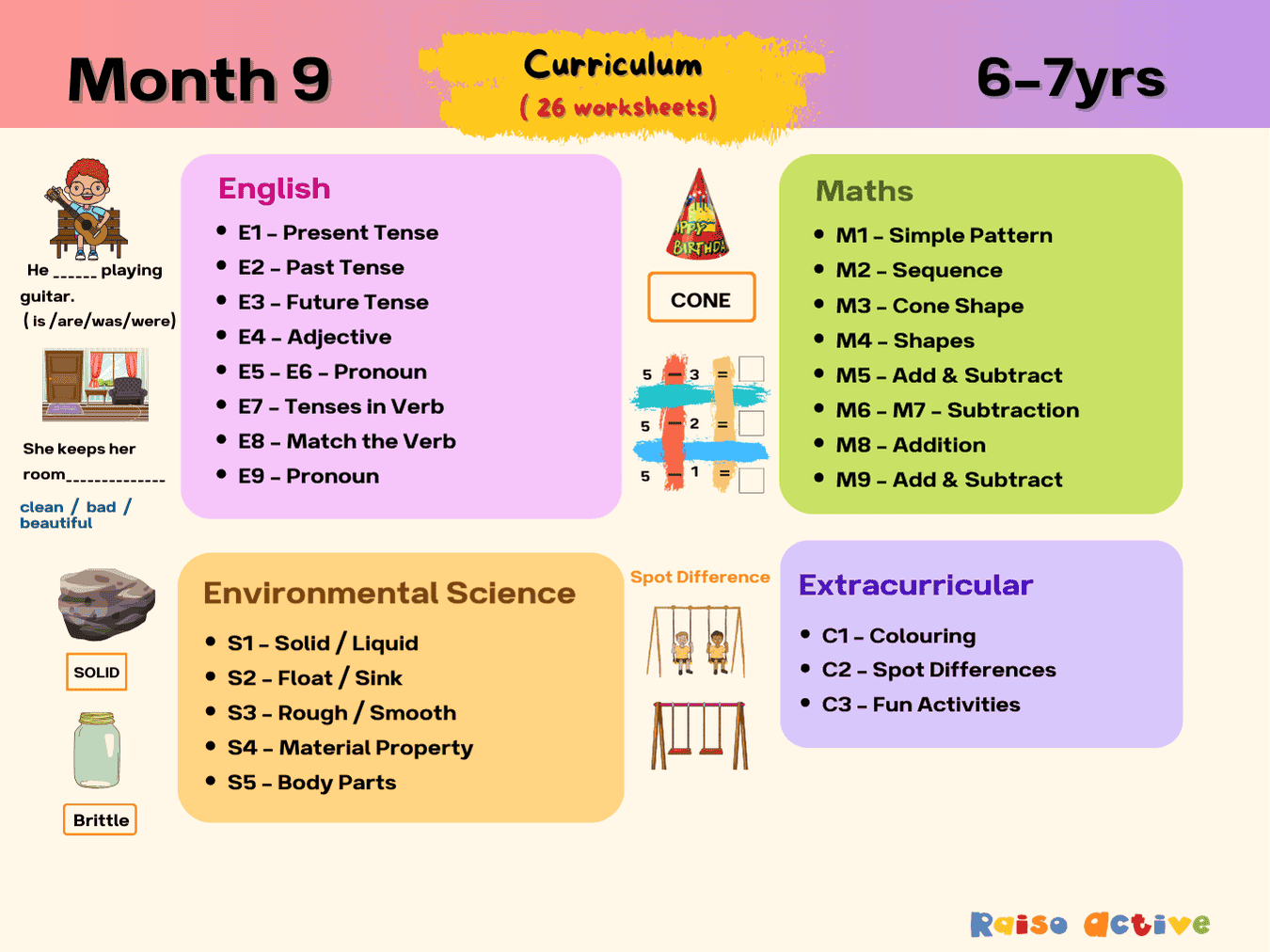
Month 9: Multi-Subject Early Learning | Ages 6-7
This is page 7 of the pack. Ages 6-7 · Grade 1Ages 6-7 · Year 2Ages 6-7 · Class 1Ages 6-7
Made for your child
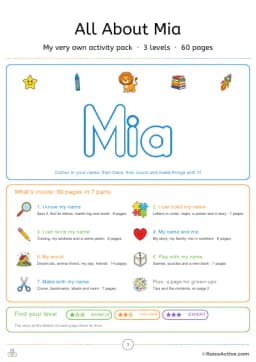
A whole activity pack made with their name
60 pages to spot, build, trace and write their own name, plus pages about their favourites, feelings and family. See a free preview with their name.
Make an All About Me packFree preview · free for members
Or start free: a name tracing sheet with their nameCurriculum
- Grammar > Adjectives
How to use this worksheet
Look at the picture together first and ask your child to describe what they notice about it in their own words. Read the sentence with the blank aloud, then read the adjective options provided and ask your child which one best matches the picture. Have them circle the correct adjective, then copy it into the blank space in the sentence. Repeat for each picture-sentence pair, reading the finished sentence aloud together to confirm it makes sense.
Materials needed
- Pencil
- Eraser
Extension activities
- 1Play a describing game where you hold up an object and your child has to think of three adjectives for it.
- 2Take turns describing family members or pets using at least two adjectives each, like 'fluffy' and 'friendly.'
- 3Cut out pictures from a magazine and write one adjective under each that best describes it.
- 4Read a favorite storybook and pause to highlight any adjectives the author uses to describe characters or scenes.
- 5Create an 'adjective jar' with words on slips of paper and have your child pick one out and use it in a sentence about anything they choose.

Written by
Hemsweta Jain · Teacher Cheena
MBA and Early Childhood Educator, teaching since 2014 · Founder of RaisoActive, Mumbai
Every RaisoActive worksheet is designed and checked by the founder before publishing.
Published · Last reviewed
More from Month 9: Multi-Subject Early Learning | Ages 6-7

Cone Shape Worksheet for Preschoolers: Circle & Match!
Ages 3-5 · Preschool–Pre-KAges 3-5 · Nursery–ReceptionAges 3-5 · Nursery–LKGAges 3-5
This worksheet gives children ages 3-5 focused practice identifying the cone as a distinct 3D shape among a set of pictured objects, building the visual discrimination skills needed to tell shapes apart by their form rather than by color or size. Matching the shape to its printed word 'CONE' also introduces early print awareness, connecting a familiar geometric form to its written name.

Spot the Differences! Fun Picture Puzzle Worksheet for Kids
Ages 3-5 · Preschool–Pre-KAges 3-5 · Nursery–ReceptionAges 3-5 · Nursery–LKGAges 3-5
This spot-the-differences puzzle sharpens visual discrimination in children ages 3-5 by requiring them to compare two nearly identical pictures and notice small changes in detail, color, or position. Scanning systematically for differences also builds sustained visual attention and patience, both important pre-academic skills that support later tasks like proofreading and careful reading.
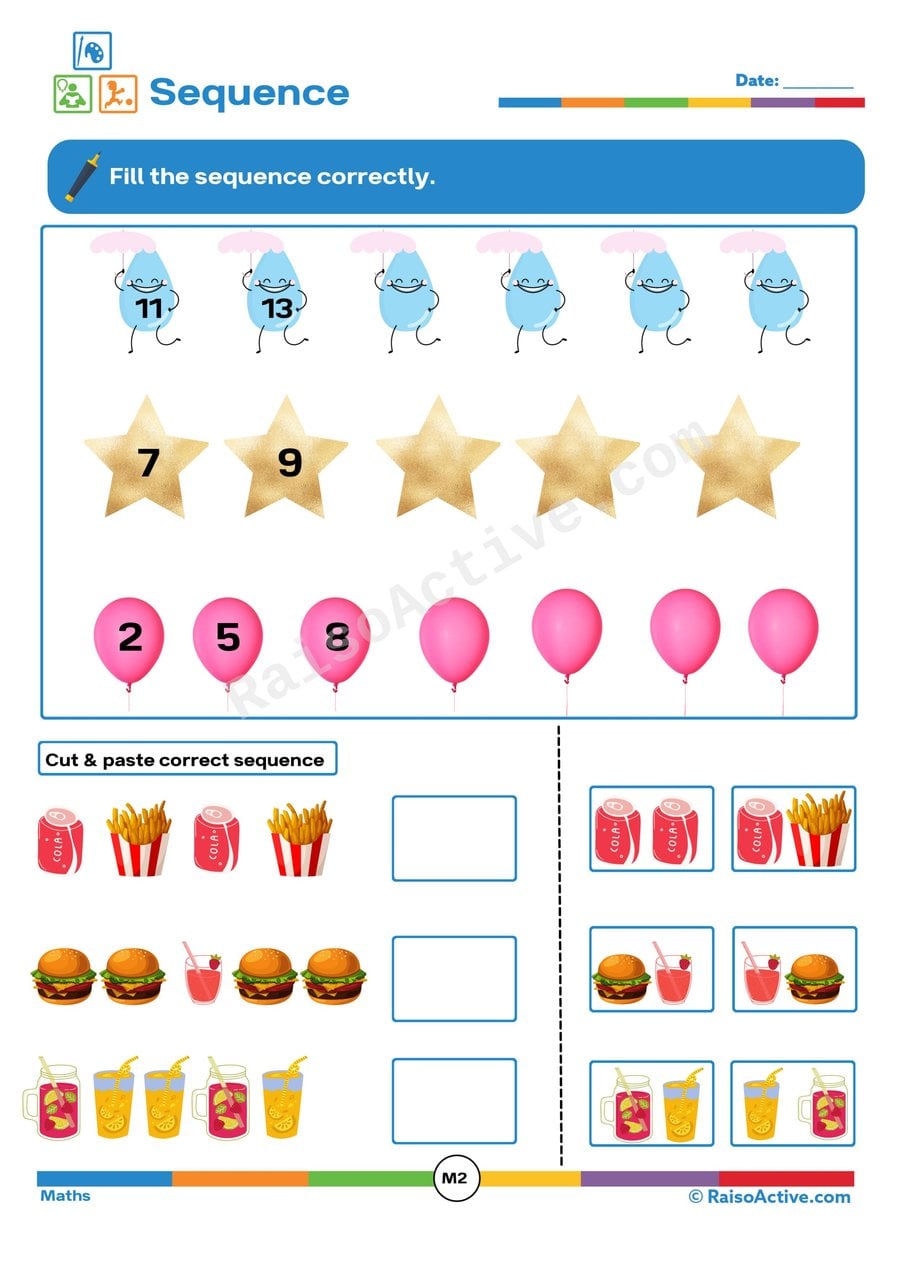
Fill the Sequence Worksheet for Preschoolers
Ages 3-5 · Preschool–Pre-KAges 3-5 · Nursery–ReceptionAges 3-5 · Nursery–LKGAges 3-5
This two-part worksheet has children ages 3-5 first fill in missing numbers within a counting sequence and then cut out and paste the correct completed sequence, combining number-order recognition with fine motor cutting and pasting practice. Understanding that numbers follow a fixed, unchanging order is a critical foundation for counting accurately and, later, for addition and subtraction.

Subtraction Worksheet: Find the Row with Matching Answers!
Ages 4-6 · Pre-K–KindergartenAges 4-6 · Reception–Year 1Ages 4-6 · LKG–UKGAges 4-6
This worksheet pushes subtraction practice a step further for children ages 4-6 by having them solve several subtraction problems and then compare the answers across different rows to find matches, adding a layer of number-sense reasoning on top of basic calculation. Recognizing that two different subtraction problems can produce the same answer helps children understand that numbers can be reached in more than one way, which is an important early step toward flexible mathematical thinking. This kind of comparison task also builds attention to detail, since a child has to solve every problem accurately before the matching rows can be found.

Possessive Pronouns Worksheet for Kids: Fill in the Blanks!
Ages 4-6 · Pre-K–KindergartenAges 4-6 · Reception–Year 1Ages 4-6 · LKG–UKGAges 4-6
Possessive pronouns like 'his,' 'her,' and 'their' are used constantly in everyday speech, but choosing the right one requires children ages 4-6 to track who is speaking and who owns the object being discussed — a genuinely tricky grammar concept at this age. This fill-in-the-blank worksheet gives focused, sentence-level practice choosing the correct possessive pronoun from a set of options, reinforcing the connection between a pronoun and the person or thing it refers to. Mastering this concept supports clearer, more grammatically accurate speech and writing as children move into more complex sentence construction.
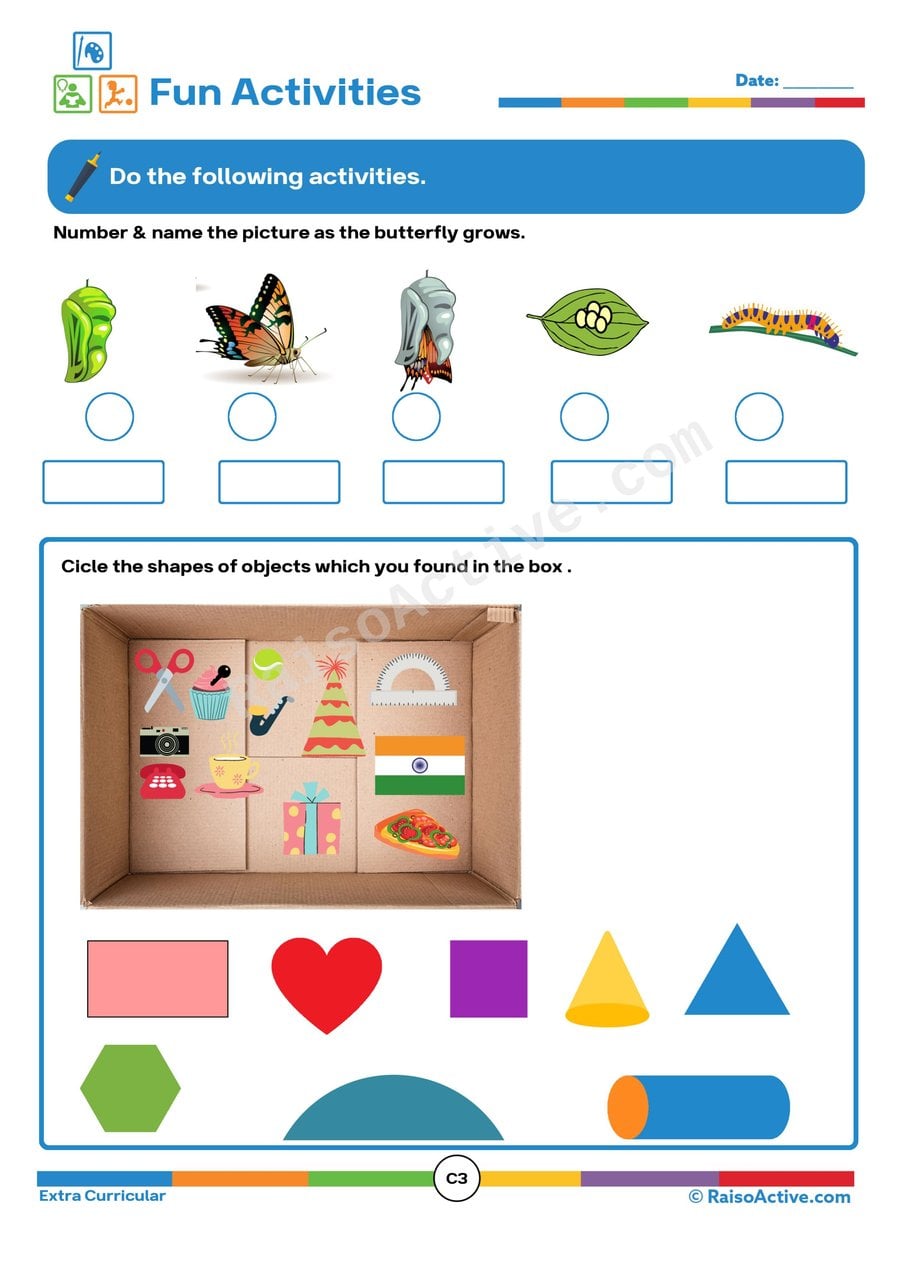
Butterfly Life Cycle Worksheet for Kids
Ages 3-5 · Preschool–Pre-KAges 3-5 · Nursery–ReceptionAges 3-5 · Nursery–LKGAges 3-5
This worksheet introduces children ages 3-5 to the four stages of a butterfly's life cycle — egg, caterpillar, chrysalis, and butterfly — by having them number the pictures in the correct sequence. Understanding a life cycle as an ordered sequence of changes is an early but genuine science skill, building the sequencing and cause-and-effect thinking children need for later scientific reasoning.

Pronoun Power: Complete the Sentences Worksheet for Kids
Ages 4-6 · Pre-K–KindergartenAges 4-6 · Reception–Year 1Ages 4-6 · LKG–UKGAges 4-6
This worksheet gives children ages 4-6 practice choosing the correct pronoun — like 'he', 'she', 'it', or 'they' — to complete simple sentences, reinforcing an early grammar skill that makes spoken and written language flow more naturally. Learning to replace a repeated noun with the right pronoun is a subtle but important step toward writing sentences that sound natural rather than repetitive.
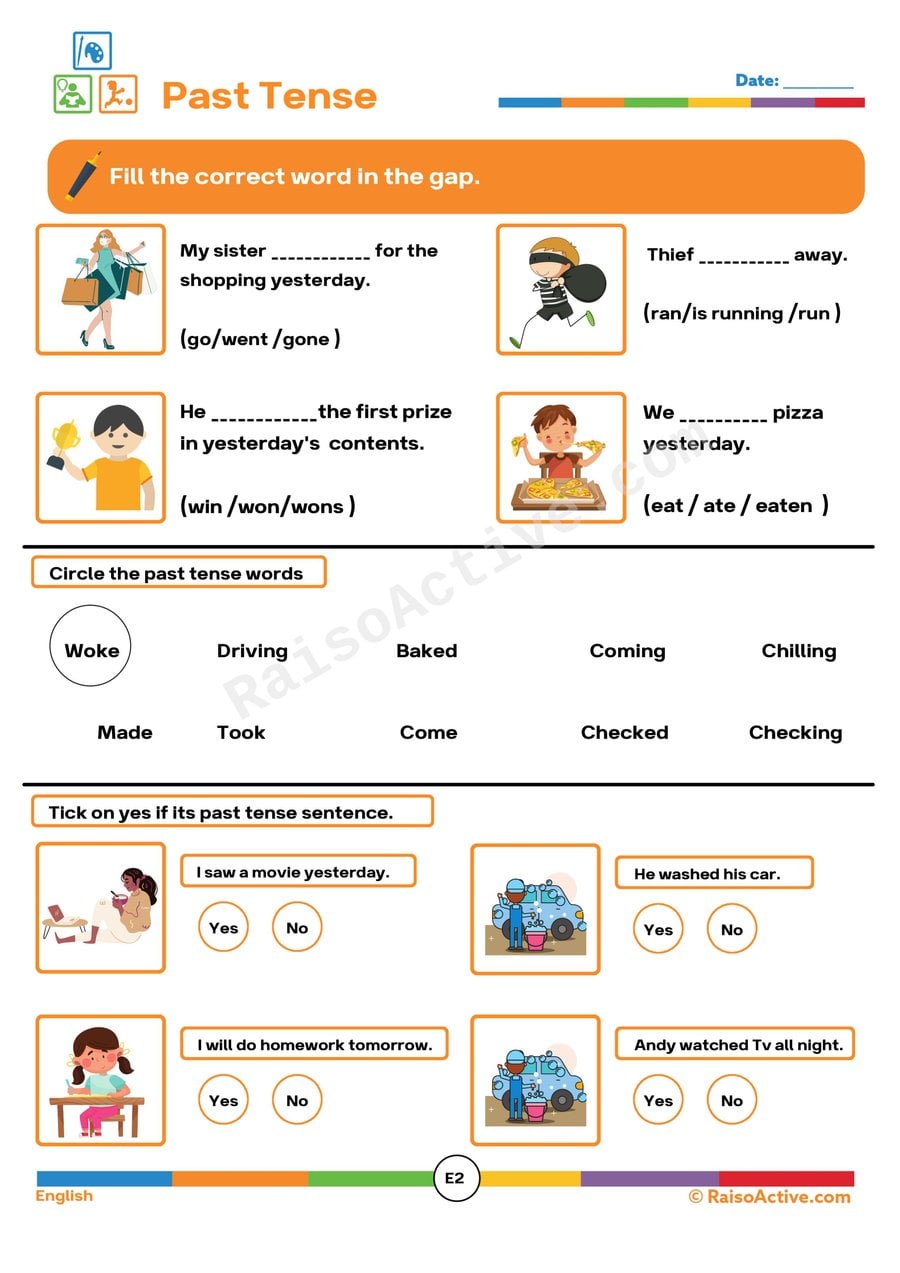
Past Tense Verbs Worksheet for Kids
Ages 4-6 · Pre-K–KindergartenAges 4-6 · Reception–Year 1Ages 4-6 · LKG–UKGAges 4-6
Understanding that verbs change form to show when an action happened is an important grammar concept for children ages 4-6, and this worksheet gives them focused practice recognizing and using past tense verbs in context. Filling in blanks with the correct past tense form, circling past tense words, and judging whether a sentence is already in the past tense all approach the same grammar skill from different angles, which helps solidify the pattern. This kind of grammar awareness supports both clearer spoken language and more accurate writing as children begin composing their own sentences.
Related worksheets

Adjective Adventure: Coloring and Sentence Fun Worksheet for Kids
Ages 3-5 · Preschool–Pre-KAges 3-5 · Nursery–ReceptionAges 3-5 · Nursery–LKGAges 3-5
Coloring only the adjectives in a set of words teaches children ages 3-5 to recognize descriptive words as their own grammatical category, distinct from naming words or action words, a foundational step toward understanding how sentences are built. Writing a sentence using a chosen adjective afterward pushes the recognition skill into active use, requiring children to apply what they identified rather than just spot it.

Adjective Adventure: Circle the Adjectives Worksheet for Kids
Ages 4-6 · Pre-K–KindergartenAges 4-6 · Reception–Year 1Ages 4-6 · LKG–UKGAges 4-6
This worksheet introduces the concept of adjectives as descriptive words that tell us more about a noun, asking children to identify and circle words that describe pictured objects. For ages 4-6, recognizing adjectives builds richer, more expressive vocabulary and lays groundwork for more descriptive writing and speaking later on.

Adjective Adventure: Circle the Correct Words Worksheet
Ages 4-6 · Pre-K–KindergartenAges 4-6 · Reception–Year 1Ages 4-6 · LKG–UKGAges 4-6
Children ages 4-6 practice identifying adjectives, the describing words that tell more about a noun, by reading sentences and circling the word that adds detail or description. Learning to spot adjectives is a foundational grammar skill that also helps children add more vivid, specific description to their own writing and speech.

Adjective Adventure: Cut and Paste Worksheet for Early Readers
Ages 4-6 · Pre-K–KindergartenAges 4-6 · Reception–Year 1Ages 4-6 · LKG–UKGAges 4-6
This cut-and-paste worksheet has 4-6 year olds fill in the blanks of a short story using adjectives, then reread the finished story to see how those descriptive words change and enrich the meaning — a more advanced application of adjective knowledge than isolated sentence work, since it shows how word choice affects a whole narrative. Choosing which cut-out adjective fits best in context also builds reading comprehension alongside vocabulary.

Adjective Adventure: Matching Sentences Worksheet for Kids
Ages 4-6 · Pre-K–KindergartenAges 4-6 · Reception–Year 1Ages 4-6 · LKG–UKGAges 4-6
This worksheet teaches 4-6 year olds that adjectives are the words that describe nouns, asking them to fill in a missing adjective in a sentence and then physically mark the noun and adjective separately by underlining and circling. That separation step — telling apart which word names a thing and which word describes it — is a genuinely useful grammar distinction that most children haven't consciously noticed before, even though they use adjectives constantly in speech.

Trace the Numbers 1-9 Worksheet for Preschoolers
Ages 3-5 · Preschool–Pre-KAges 3-5 · Nursery–ReceptionAges 3-5 · Nursery–LKGAges 3-5
Tracing the numerals 1 through 9 gives children ages 3-5 repeated, guided practice with the specific pencil strokes each number requires, building the fine motor control and muscle memory needed for independent number writing. Because tracing follows a fixed, correct path, it also reinforces accurate numeral recognition, helping children tell visually similar digits apart.

Spooky Vocabulary Worksheet: Fill in the Missing Letters!
Ages 4-6 · Pre-K–KindergartenAges 4-6 · Reception–Year 1Ages 4-6 · LKG–UKGAges 4-6
This worksheet has children ages 4-6 look at a Halloween picture and fill in the missing letters of its matching word, building phonics skills and reinforcing correct spelling patterns for seasonal vocabulary. Because only some letters are missing rather than the whole word, children practice using partial information and sound-based reasoning to complete each word correctly.
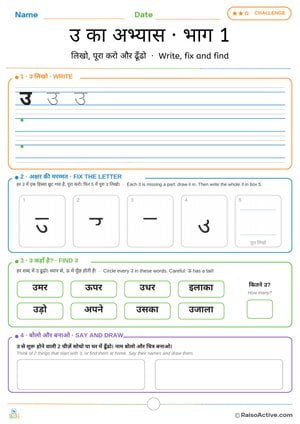
Hindi Letter उ Practice Part 1: Write, Fix and Find | उ का अभ्यास · भाग 1
Ages 3-7 · Preschool–Grade 1Ages 3-7 · Nursery–Year 2Ages 3-7 · Nursery–Class 1Ages 3-7
Children write उ on guide lines, complete four partly drawn letters, circle उ in eight words (while avoiding its look-alike ऊ), count how many they found, then think of two more words at home that start with उ and draw them.
Guides for this topic

Documenting Learning Without Drowning in Data: A Practical Guide for Parents and Teachers
Learn practical ways to document your child's learning without overwhelm. Simple portfolios, observation tips, and printable trackers for ages 1-8.

How to Help Your Child with Letter Reversals: A Complete Guide for Parents and Teachers
Letter reversals are normal until age 7-8. Learn the best multisensory strategies, anchor letter tricks, and activities to help children write b, d, p, and q correctly.

Activities That Help with Pencil Grip Development: A Complete Guide for Parents and Teachers
Discover fun, research-backed activities to develop pencil grip in young children. Age-wise exercises, play ideas, and expert tips for parents and teachers.
Reviews
Every worksheet for ages 4–6, no watermark
Members download the full library of 1,000+ worksheets and every activity pack without watermarks or daily limits. One year costs ₹999 in India or $20 elsewhere.
See membership plansOr download any worksheet free with a watermark (5 a day).