
Adjective Adventure: Coloring and Sentence Fun Worksheet for Kids
Coloring only the adjectives in a set of words teaches children ages 3-5 to recognize descriptive words as their own grammatical category, distinct from naming words or action words, a foundational step toward understanding how sentences are built. Writing a sentence using a chosen adjective afterward pushes the recognition skill into active use, requiring children to apply what they identified rather than just spot it.
Curriculum
How to use this worksheet
Read through the list of words on the page together, discussing which ones describe what something is like, such as its size, color, or feeling. Have your child color only the words that are adjectives, leaving the other words uncolored. Once the adjectives are identified, ask your child to pick one or more of them and think of something those words could describe. Guide them to write a simple sentence using the chosen adjective, then read the finished sentence aloud together.
Materials needed
- Pencil
- Crayons
Extension activities
- •Look through a favorite book together and find one or two adjectives used to describe a character or setting.
- •Play a describing game, taking turns picking an object in the room and listing adjectives for it.
- •Ask your child to describe themselves using three adjectives and write them down together.
- •Sort a small pile of adjective and non-adjective word cards into two separate piles.
- •Create a silly sentence together using as many adjectives as possible to describe one simple object.
Tips for parents and teachers
If your child struggles to tell adjectives apart from other words, ask 'does this word tell us what something is like?' as a simple test question. Model writing a sentence with an adjective yourself first if your child feels stuck, then invite them to try one on their own. Praise creative or funny sentences just as much as simple, correct ones, since willingness to experiment with descriptive language matters at this age.

Written by
Hemsweta Jain · Teacher Cheena
MBA and Early Childhood Educator, teaching since 2014 · Founder of RaisoActive, Mumbai
Every RaisoActive worksheet is designed and checked by the founder before publishing.
Published · Last reviewed
Related worksheets

Adjective Adventure: Circle the Correct Words Worksheet
Children ages 4-6 practice identifying adjectives, the describing words that tell more about a noun, by reading sentences and circling the word that adds detail or description. Learning to spot adjectives is a foundational grammar skill that also helps children add more vivid, specific description to their own writing and speech.

Adjective Adventure: Cut and Paste Worksheet for Early Readers
This cut-and-paste worksheet has 4-6 year olds fill in the blanks of a short story using adjectives, then reread the finished story to see how those descriptive words change and enrich the meaning — a more advanced application of adjective knowledge than isolated sentence work, since it shows how word choice affects a whole narrative. Choosing which cut-out adjective fits best in context also builds reading comprehension alongside vocabulary.

Adjective Adventure: Matching Sentences Worksheet for Kids
This worksheet teaches 4-6 year olds that adjectives are the words that describe nouns, asking them to fill in a missing adjective in a sentence and then physically mark the noun and adjective separately by underlining and circling. That separation step — telling apart which word names a thing and which word describes it — is a genuinely useful grammar distinction that most children haven't consciously noticed before, even though they use adjectives constantly in speech.

Adjective Worksheet: Circle and Fill in the Blanks!
Working from a picture and a sentence together, children ages 4-6 practice choosing an adjective that accurately describes what they see and then writing it into the sentence - a skill that strengthens both vocabulary and the understanding that descriptive words add detail and meaning to a sentence. This bridges picture comprehension with written language, an important step as children move from purely oral vocabulary to using descriptive words in their own writing.

Coloring Worksheet: Identify and Color the Symbols!
This worksheet introduces children ages 3-5 to national symbols by having them color each one and then match or write its name from a list of options. Beyond fine motor coloring practice, naming each symbol builds early cultural knowledge and category-matching skills, since children must connect a picture to the correct word rather than color at random.
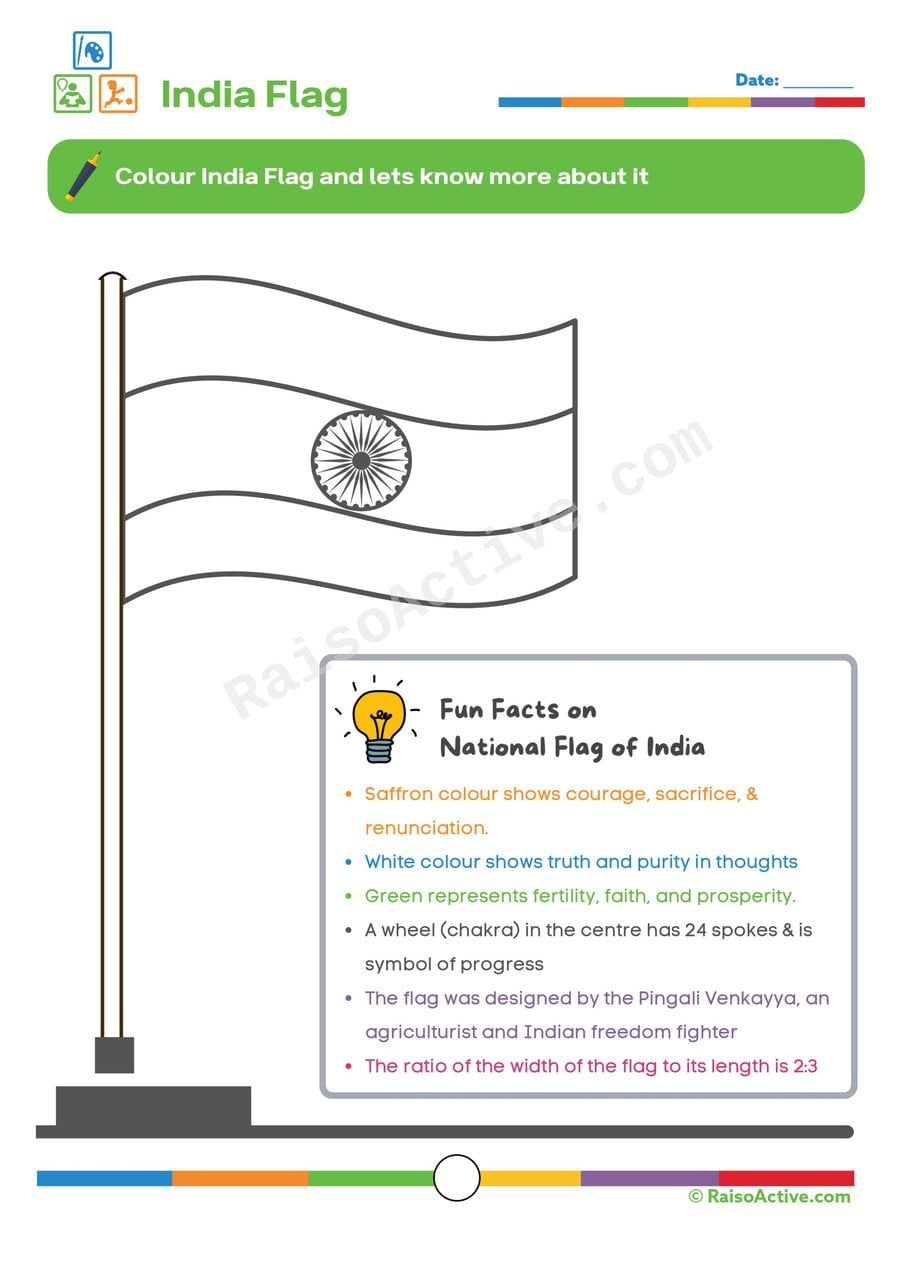
Color the India Flag Worksheet for Preschoolers
This worksheet teaches children ages 3-5 the three colors and layout of the Indian national flag, saffron, white, and green with the navy wheel, while practicing careful, section-by-section coloring. Reading a few simple facts about the flag alongside the coloring also introduces the idea that national symbols carry meaning, an early building block for civic and cultural awareness.

Merry Christmas Coloring Worksheet for Preschoolers
Filling in Christmas-themed pictures with crayons or colored pencils helps children ages 3-5 refine their pencil grip and hand control while practicing the concept of staying within a defined boundary. Because the pictures include multiple familiar holiday objects, this worksheet also gives children a chance to build vocabulary by naming each item as they color it. Repeated coloring practice at this age steadily improves the wrist and finger strength needed for later writing tasks.

Color the Reindeer! Christmas Coloring Worksheet for Kids
Coloring the reindeer and gift bag illustrations gives children ages 3-5 focused practice with crayon control and color selection, helping them build the hand strength and precision needed for later handwriting tasks. Choosing colors for a familiar character like a reindeer also encourages imaginative decision-making, since there's no single 'correct' color for a fictional animal's coat or a wrapped gift. The festive subject matter keeps a repetitive fine motor task feeling like a treat rather than a chore.
Guides for this topic
Best Worksheets for 3-Year-Olds: What Works and What to Avoid
What works on worksheets for 3-year-olds: short sessions, crayons, tracing lines, matching, cutting, a free weekly plan, and signs one is too advanced.
Fostering Creativity in Structured Learning: The Perfect Balance for Young Minds
Learn how to blend creativity with structured learning for children ages 1-8. Practical strategies, activities, and printable worksheets for parents and teachers.
Christmas and Winter Activities That Combine Fun and Learning: Creating Magical Educational Experiences
Discover Christmas and winter activities that combine festive fun with real learning. Crafts, counting, literacy, and printable worksheets for ages 2 to 8 — perfect for home and school.
Reviews
Every worksheet for ages 3–5, no watermark
Members download the full library of 1,000+ worksheets and every activity pack without watermarks or daily limits. One year costs ₹1,000 in India or $20 elsewhere.
See membership plansOr download any worksheet free with a watermark (5 a day).