Natural Resources Matching Worksheet for Kids
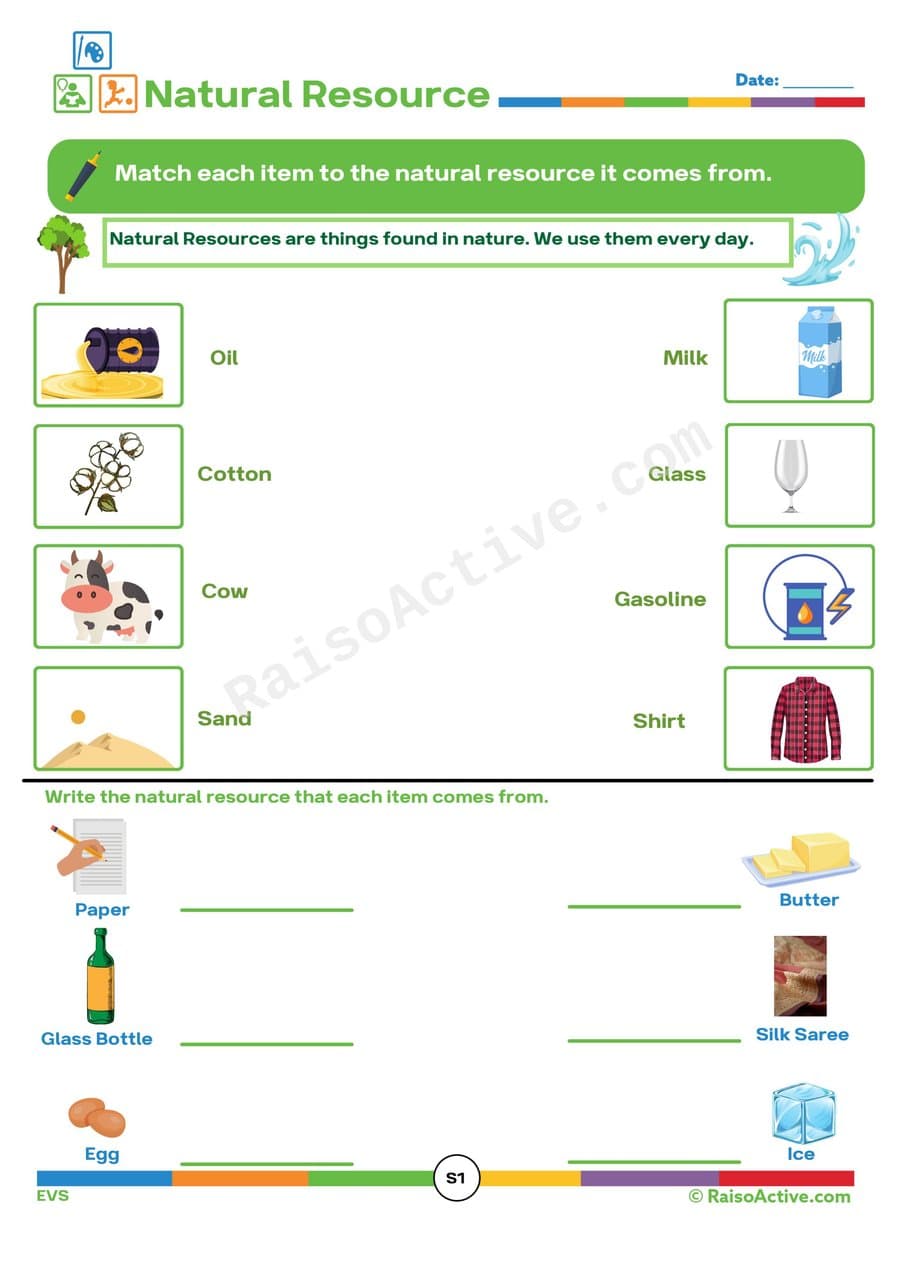
This worksheet deepens understanding of natural resources by asking children to match everyday items, like paper or bread, to the natural resource they originally come from, such as trees or wheat. For ages 3-5, tracing a familiar object back to its natural source builds early cause-and-effect thinking alongside science vocabulary.
Curriculum
How to use this worksheet
Look at the items pictured on the left side of the page and name each one together, then look at the natural resources listed on the right. Ask your child to think about where each item originally comes from before drawing a line connecting it to the matching resource. Continue matching each item to its resource one at a time, talking through the connection out loud as you go, such as 'paper comes from trees.' Finish with the section at the bottom, where your child writes the natural resource for a few additional items without a line to draw.
Materials needed
- Pencil
- Crayons
Extension activities
- •Draw pictures of other everyday items and the natural resources they come from, expanding beyond what's shown on the worksheet.
- •Take a nature walk and identify natural resources like water, soil, or trees that you see along the way.
- •Set up a simple sorting activity at home, grouping household items by the natural resource they originated from.
- •Talk about one item at home, like a wooden chair or a cotton shirt, and trace its origin back to nature together.
- •Read a picture book about how a specific everyday item, like paper or bread, is made from natural resources.
Tips for parents and teachers
If your child struggles to see the connection between an item and its resource, use a simple story format, like 'first there was a tree, then people cut it down and made paper,' to make the chain of events concrete. This worksheet is a natural opening to talk about why protecting natural resources matters, since children respond well to the idea that resources take time to grow or form. Keep the matching light and conversational rather than quiz-like, so the science concept stays enjoyable.

Written by
Hemsweta Jain · Teacher Cheena
MBA and Early Childhood Educator, teaching since 2014 · Founder of RaisoActive, Mumbai
Every RaisoActive worksheet is designed and checked by the founder before publishing.
Published · Last reviewed
Related worksheets

Clothing Pattern Match Worksheet for Preschoolers
This worksheet has children ages 3-5 study repeating patterns on clothing items — stripes, polka dots, or checks — and match each item to its identical twin, building visual discrimination and early pattern-sequencing skills. Distinguishing between similar-looking patterns also sharpens attention to detail, a skill that later supports letter and word recognition.

Taste Bud Sorting Worksheet: Identify and Sort Foods by Taste!
This worksheet introduces children ages 4-6 to four basic taste categories — salty, sour, bitter, and sweet — by having them sort pictured foods into the correct group. Beyond taste vocabulary, sorting foods by an invisible property like flavor (rather than an obvious one like color or shape) pushes children to draw on memory and prior experience, building more advanced classification skills.
Coding Kites Worksheet: Match the Bows!
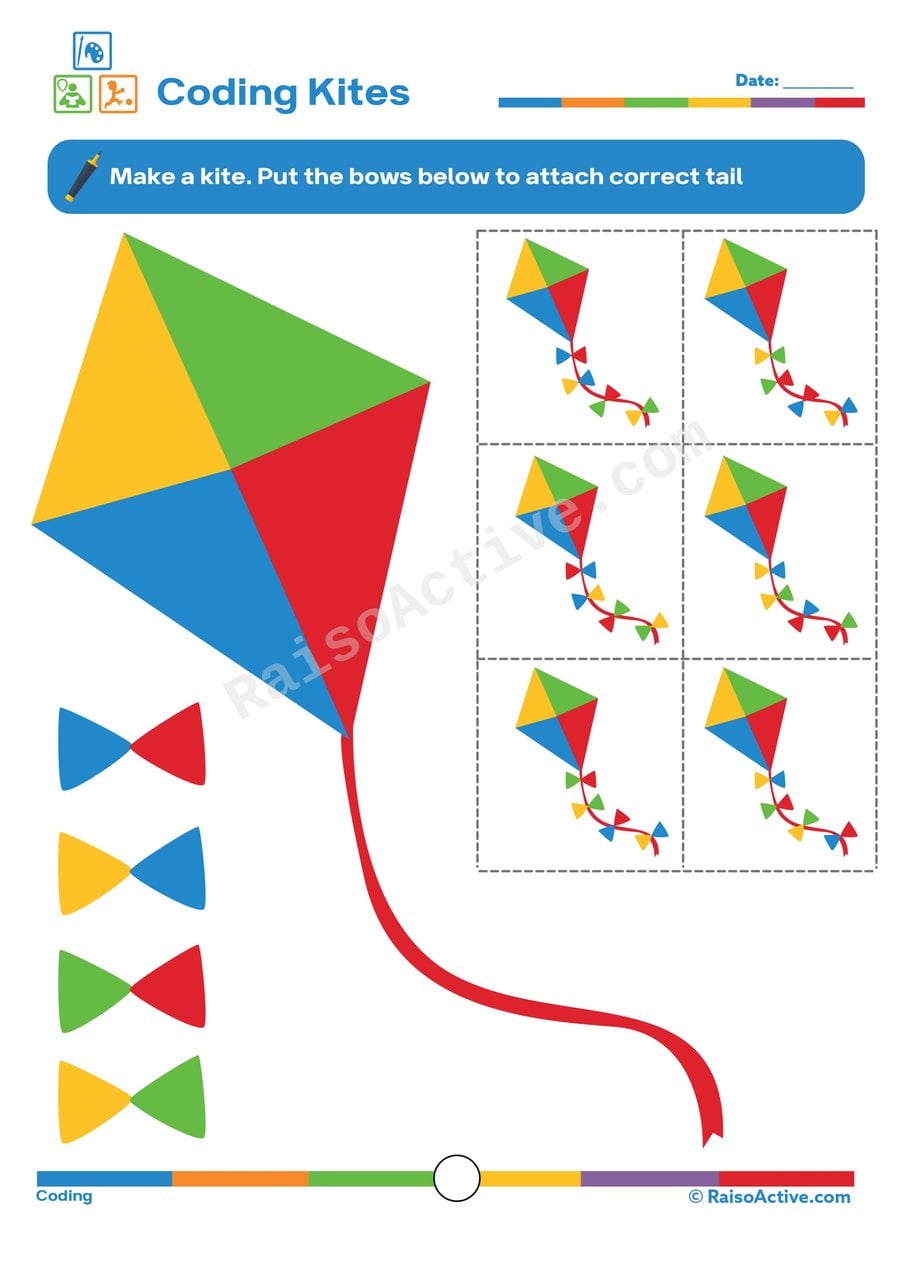
This activity sharpens visual observation in children ages 3-5 as they compare color sequences on each kite to a set of loose bows and find the exact match. Careful, systematic comparison — checking each color in order rather than glancing quickly — builds an attention-to-detail habit that transfers directly to early reading and number work.

Stick Man Emotions Worksheet: Happy, Sad, Angry, and Surprised!
Children ages 4-6 practice reading facial expressions on this worksheet, matching stick-figure faces to their correct emotion labels by noticing details like mouth shape and eyebrow position. This strengthens emotional literacy — the ability to name and recognize feelings in others — which supports empathy and smoother social interactions as children move into more group play and classroom settings.

Lock and Key Matching Worksheet for Preschoolers
Matching each key to the lock sharing the same letter helps children ages 3-5 practice letter recognition in a playful, puzzle-like context rather than rote drilling. Because each key must be checked against several similar-looking locks before finding the right match, this worksheet also builds visual scanning and careful comparison skills that support problem-solving.

Plant Parts Worksheet: Identify and Label the Parts of a Plant!
This worksheet teaches children ages 4-6 to identify and independently label the flower, stem, leaf, and roots of a plant, moving a step beyond simple matching toward recalling vocabulary from memory. Optionally adding pulses or grains to the diagram introduces a tactile, sensory layer that helps reinforce which part is which through touch as well as sight.

Soap & Pepper Science Experiment Worksheet for Preschoolers
This simple experiment introduces children ages 3-5 to the basic science of surface tension and how soap breaks it, using pepper flakes sprinkled on water as a visual demonstration. Watching the pepper scatter away the instant soap touches the water gives children a concrete, memorable example of cause and effect, an early building block for scientific thinking.

Balloon Pattern Matching Worksheet for Preschoolers
Children ages 3-5 build early pattern-recognition skills on this worksheet by studying a sequence of colored balloons and finding the matching set to complete it. Recognizing and continuing a repeating sequence is a foundational pre-math skill that later supports understanding of number patterns, skip counting, and simple algebraic thinking.
Guides for this topic
Best Worksheets for 3-Year-Olds: What Works and What to Avoid
What works on worksheets for 3-year-olds: short sessions, crayons, tracing lines, matching, cutting, a free weekly plan, and signs one is too advanced.
Growing Green Hearts: A Comprehensive Guide to Teaching Environmental Awareness to Preschoolers
Practical guide to teaching preschoolers ages 2-6 about nature, recycling, water conservation, and Earth Day with Indian context and simple home activities.
Discovering Wonder: Nature-Based Learning Activities That Captivate Young Children
Explore nature-based learning activities for children ages 2–7 — leaf rubbings, bug hunts, nature journals, and seasonal Indian outdoor ideas that spark wonder.
Reviews
Every worksheet for ages 3–5, no watermark
Members download the full library of 1,000+ worksheets and every activity pack without watermarks or daily limits. One year costs ₹1,000 in India or $20 elsewhere.
See membership plansOr download any worksheet free with a watermark (5 a day).