Number Matching Worksheet: 0-18
This activity strengthens numeral recognition for children ages 3-5 by having them find and pair matching numbers from 0 to 18 printed on separate strips. Because the numbers are scattered rather than in order, children must recognize each digit shape on its own rather than relying on counting sequence, which builds true number recognition instead of rote list-reciting.
Part of the pack
Hands-On Early Learning Activity Book: Math, Science, Literacy & Emotions for Ages 3-6
This is page 12 of the pack. Ages 3-6 · Preschool–KindergartenAges 3-6 · Nursery–Year 1Ages 3-6 · Nursery–UKGAges 3-6

Made for your child
Counting to 10, made for your child
A maths pack with your child's name in it: pictures that explain, practice at three levels, puzzles and story sums about them. Print a new set whenever they finish.
Make a maths packFree preview · free for members
Curriculum
- Number Sense > Counting 1-20
How to use this worksheet
Cut out all the number strips along the dotted lines and spread them out on a table or flat surface. Have your child pick one strip from the left-hand set and say the number aloud, then search among the right-hand strips for its exact match. Once a pair is found, apply a small amount of glue and stick the two matching strips together. Continue until every number from 0 to 18 has been matched, saying each number aloud as it's paired.
Materials needed
- Scissors
- Glue
Extension activities
- 1Line up the matched pairs in order from 0 to 18 to build a simple number line.
- 2Hide the number strips around the room and have your child find and call out each number as they collect it.
- 3Count a group of household objects and hold up the matching number strip.
- 4Play a quick game comparing two matched pairs and deciding which number is bigger.

Written by
Hemsweta Jain · Teacher Cheena
MBA and Early Childhood Educator, teaching since 2014 · Founder of RaisoActive, Mumbai
Every RaisoActive worksheet is designed and checked by the founder before publishing.
Published · Last reviewed
More from Hands-On Early Learning Activity Book: Math, Science, Literacy & Emotions for Ages 3-6

Parts of a Leaf Worksheet for Preschoolers: Learn and Play!
Ages 3-5 · Preschool–Pre-KAges 3-5 · Nursery–ReceptionAges 3-5 · Nursery–LKGAges 3-5
This hands-on activity teaches children ages 3-5 the parts of a leaf — tip, blade, veins, midrib, petiole, and stem — by having them shape a leaf from playdough while comparing it to a real leaf. Building a physical model alongside a real specimen helps children connect abstract vocabulary to tangible features they can see and touch, which is especially effective for this age group.

States of Matter Worksheet: Exploring Solids, Liquids, and Gases!
Ages 4-6 · Pre-K–KindergartenAges 4-6 · Reception–Year 1Ages 4-6 · LKG–UKGAges 4-6
This worksheet introduces children ages 4-6 to the three states of matter — solid, liquid, and gas — by having them examine images and sort each one into its correct category. Learning to classify familiar objects (like ice, water, and steam) by their physical state builds early scientific reasoning, since children must look past an object's identity and focus on its underlying properties.

Soap & Pepper Science Experiment Worksheet for Preschoolers
Ages 3-5 · Preschool–Pre-KAges 3-5 · Nursery–ReceptionAges 3-5 · Nursery–LKGAges 3-5
This hands-on demonstration shows children ages 3-5 how soap disrupts water's surface tension, using floating pepper as a simple, visible indicator of the change. Because the reaction happens instantly and dramatically, it gives young children a strong, memorable first experience with predicting an outcome and then observing whether their prediction was right.
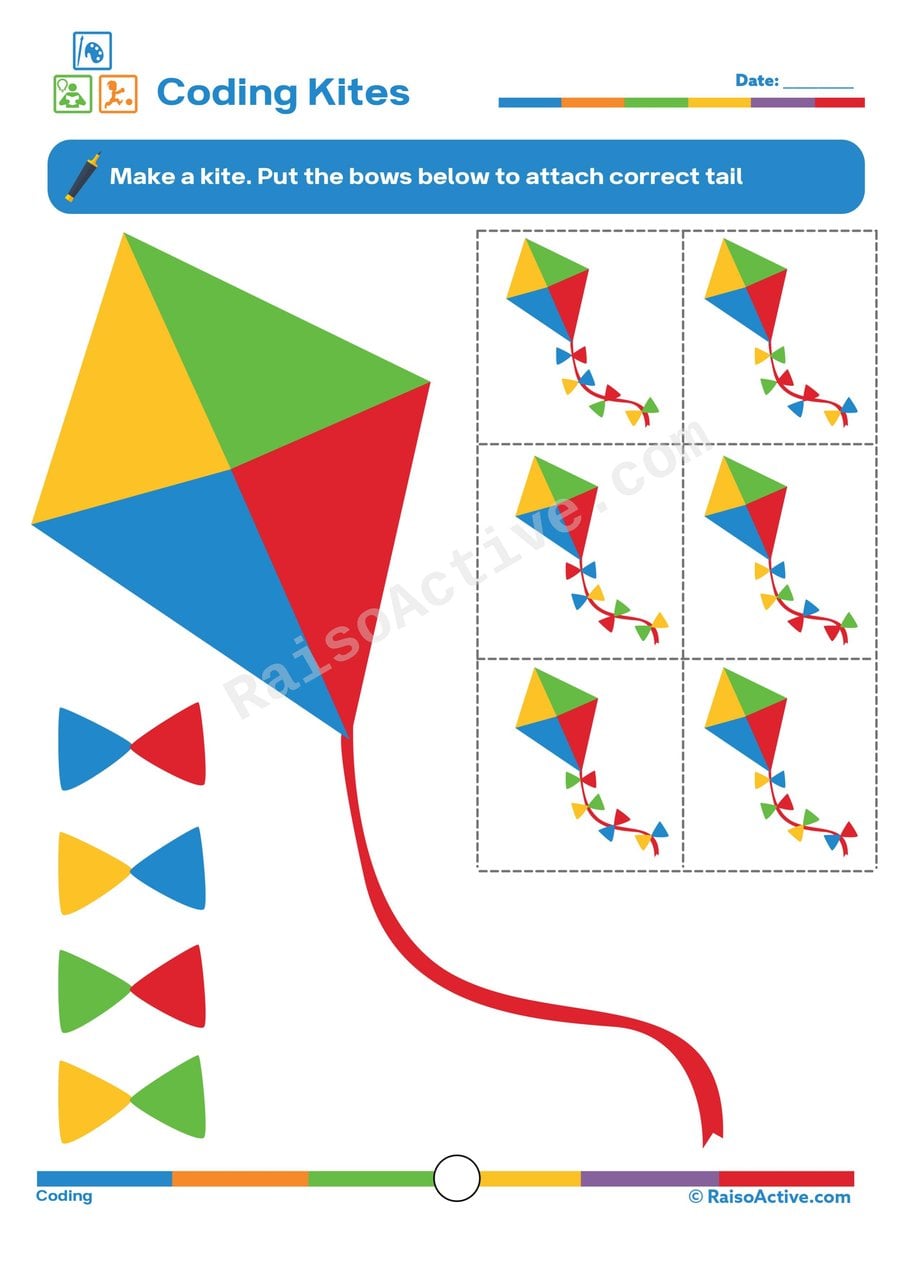
Coding Kites Worksheet: Match the Bows!
Ages 3-5 · Preschool–Pre-KAges 3-5 · Nursery–ReceptionAges 3-5 · Nursery–LKGAges 3-5
By matching each colorful bow to the kite sharing its color pattern, children ages 3-5 practice visual pattern recognition — an early form of the same logical sequencing used in beginner coding concepts. Cutting, matching, and gluing the correct bow also reinforces color-word vocabulary and precise hand-eye coordination.
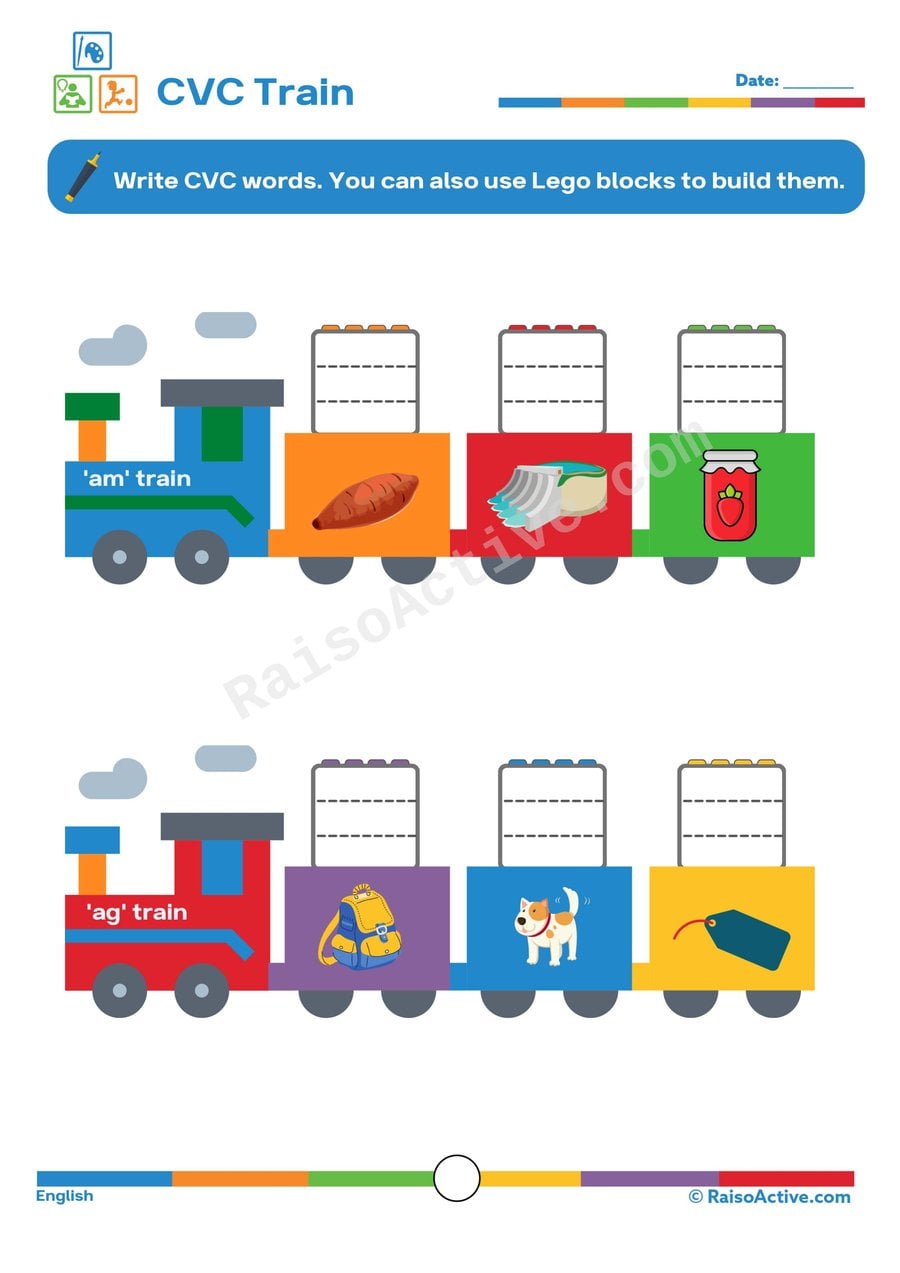
CVC Train Worksheet: Write CVC Words!
Ages 4-6 · Pre-K–KindergartenAges 4-6 · Reception–Year 1Ages 4-6 · LKG–UKGAges 4-6
Writing consonant-vowel-consonant words like 'cat,' 'sun,' or 'pig' under matching pictures gives children ages 4-6 direct practice with letter-sound blending, a core phonics skill that underpins independent reading. Because each train car pairs a picture clue with a blank space, children also practice translating a spoken word they can sound out into its correctly spelled written form.
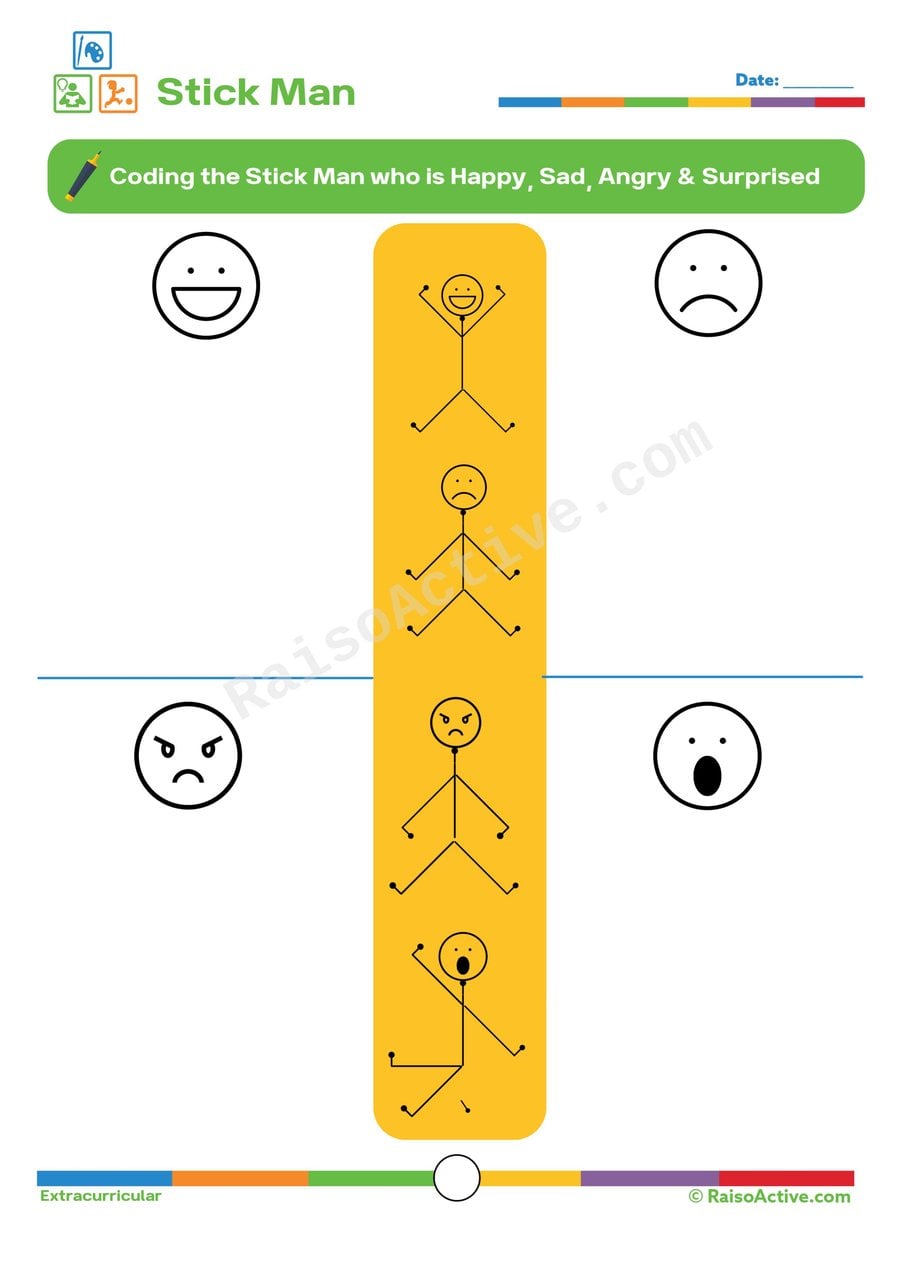
Stick Man Emotions Worksheet: Happy, Sad, Angry & Surprised!
Ages 3-5 · Preschool–Pre-KAges 3-5 · Nursery–ReceptionAges 3-5 · Nursery–LKGAges 3-5
Matching simple stick-figure faces to emotion words helps children ages 3-5 build an early emotional vocabulary, connecting facial cues like a curved mouth or raised eyebrows to specific feeling words. This kind of emotion recognition is a foundational social-emotional skill, helping children name what they and others are feeling instead of just reacting.
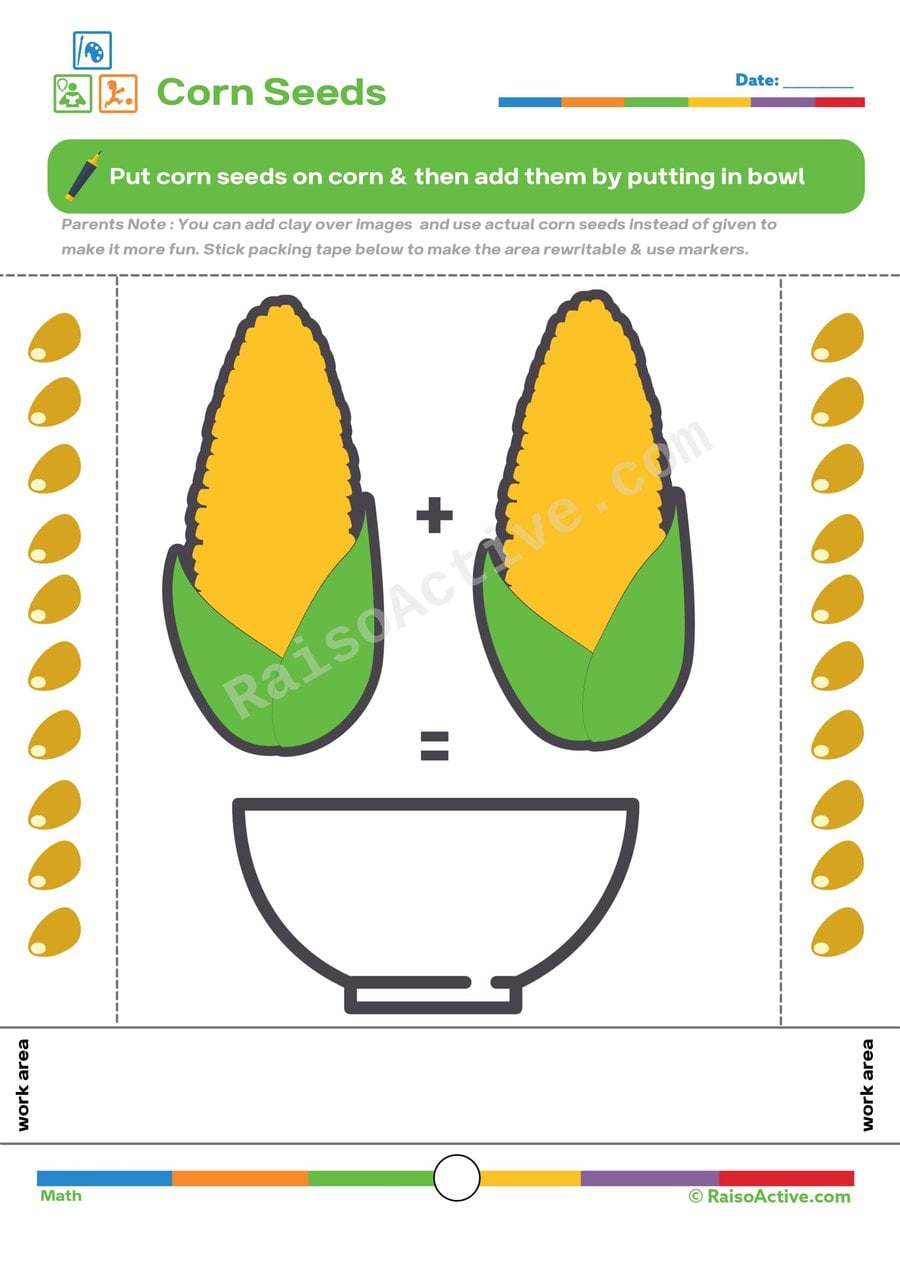
Corn Seed Addition Worksheet for Preschoolers
Ages 3-5 · Preschool–Pre-KAges 3-5 · Nursery–ReceptionAges 3-5 · Nursery–LKGAges 3-5
Counting corn seeds on two ears of corn and combining them into one total teaches children ages 3-5 the core concept of addition as joining groups together, using a concrete, countable image rather than abstract numerals alone. This worksheet also builds one-to-one correspondence, since accurate addition depends on touching or pointing to each seed exactly once while counting.

Balloon Pattern Matching Worksheet for Preschoolers
Ages 3-5 · Preschool–Pre-KAges 3-5 · Nursery–ReceptionAges 3-5 · Nursery–LKGAges 3-5
This worksheet strengthens pattern recognition in children ages 3-5 by having them study a repeating sequence of colored balloons and locate the matching arrangement elsewhere on the page. Recognizing and reproducing a pattern is an early pre-algebra skill, laying groundwork for later number patterns and logical sequencing.
Related worksheets

Sheep's Barnyard Adventure: A Fun Counting and Movement Worksheet
Ages 4-6 · Pre-K–KindergartenAges 4-6 · Reception–Year 1Ages 4-6 · LKG–UKGAges 4-6
This board-game-style worksheet helps children ages 4-6 practice counting and number recognition by rolling a die and moving a sheep piece along a numbered path, following simple instructions at each stop. Turning counting practice into a game with chance and movement keeps children engaged far longer than a static worksheet, while still reinforcing accurate counting and number sequence recognition along the path.

Count the Sea Animals! A Fun Counting Worksheet for Kids
Ages 3-5 · Preschool–Pre-KAges 3-5 · Nursery–ReceptionAges 3-5 · Nursery–LKGAges 3-5
This worksheet has children ages 3-5 count different sea animals grouped in boxes and then identify the matching numeral for each group, strengthening one-to-one correspondence alongside early ocean and marine-life vocabulary. Because each box features a different sea creature, such as fish, crabs, or starfish, children also practice sorting attention between groups rather than counting one long continuous row. This variety keeps the counting task from becoming rote repetition.

I Spy Summer Fun Worksheet: Counting and Identifying Objects!
Ages 3-5 · Preschool–Pre-KAges 3-5 · Nursery–ReceptionAges 3-5 · Nursery–LKGAges 3-5
This 'I Spy Summer Fun' worksheet helps young learners (ages 3-5) master one-to-one correspondence, a crucial foundational math skill, by counting specific summer-themed objects within a busy scene. Children will practice associating a number name with each item they touch or point to, building early number sense and visual discrimination. This activity strengthens their ability to accurately count quantities up to 20, preparing them for more complex mathematical concepts.
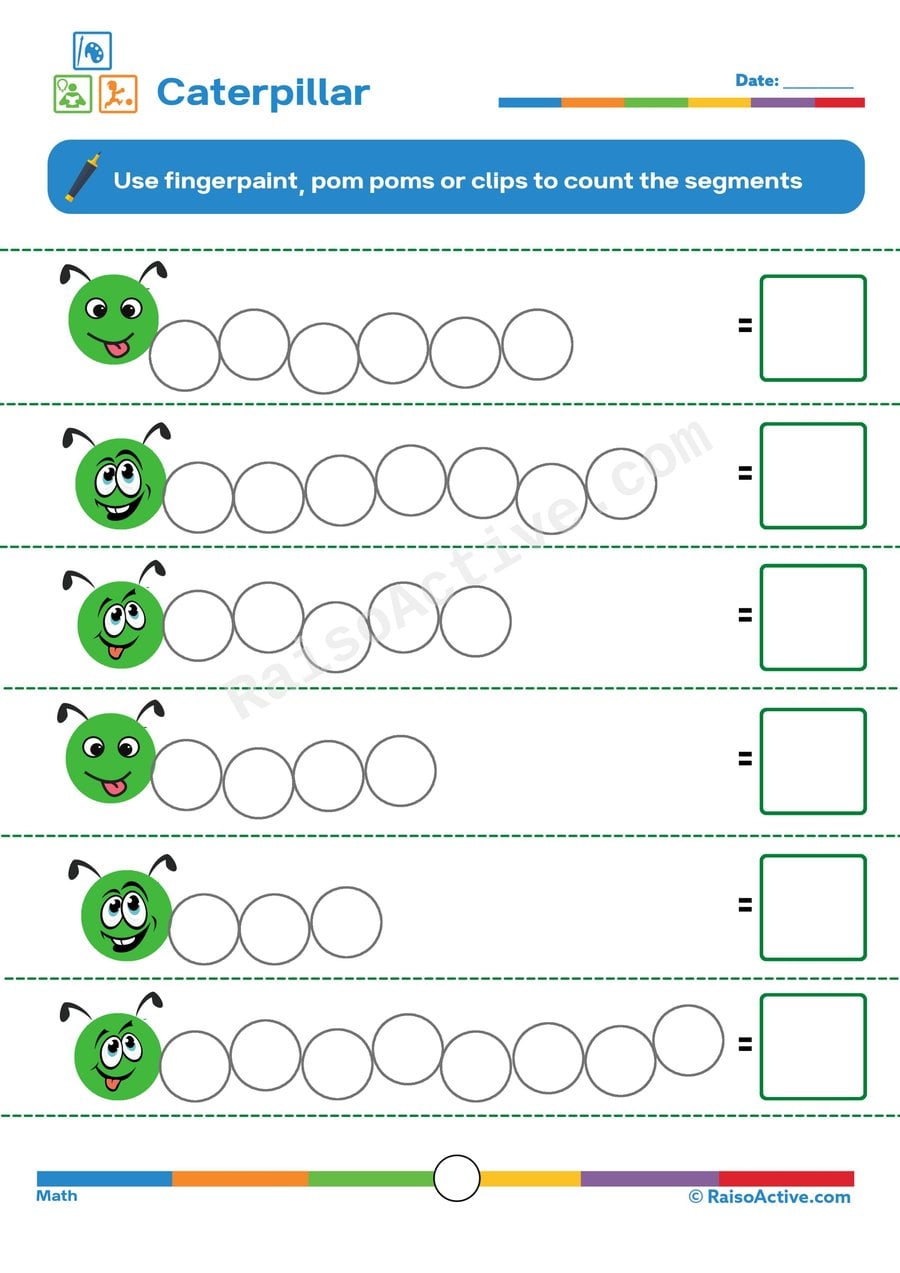
Caterpillar Counting Worksheet for Preschoolers
Ages 3-5 · Preschool–Pre-KAges 3-5 · Nursery–ReceptionAges 3-5 · Nursery–LKGAges 3-5
Counting the segments of each caterpillar teaches children ages 3-5 one-to-one correspondence — touching or marking each segment exactly once while saying a number — which is the core skill underlying accurate counting. Writing the final total in a box also connects the physical act of counting to its written numeral, reinforcing early number-writing practice.

Trace the Numbers 1-9 Worksheet for Preschoolers
Ages 3-5 · Preschool–Pre-KAges 3-5 · Nursery–ReceptionAges 3-5 · Nursery–LKGAges 3-5
Tracing the numerals 1 through 9 gives children ages 3-5 repeated, guided practice with the specific pencil strokes each number requires, building the fine motor control and muscle memory needed for independent number writing. Because tracing follows a fixed, correct path, it also reinforces accurate numeral recognition, helping children tell visually similar digits apart.
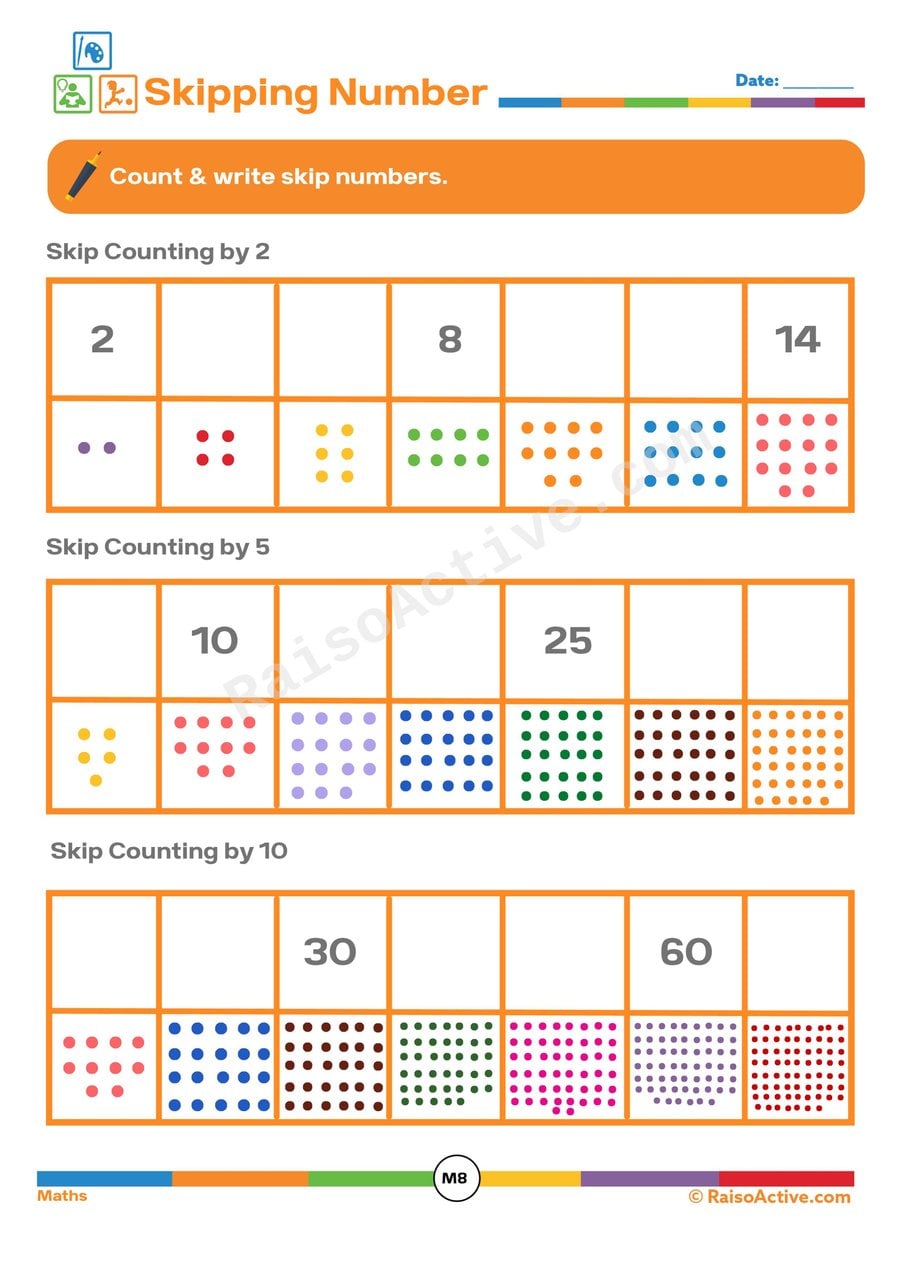
Skip Counting Adventure: Counting by 2, 5, and 10!
Ages 4-6 · Pre-K–KindergartenAges 4-6 · Reception–Year 1Ages 4-6 · LKG–UKGAges 4-6
Children ages 4-6 practice skip counting by 2s, 5s, and 10s, recognizing the repeating number patterns that let them count large groups faster than counting one by one. Skip counting is an early stepping stone toward multiplication and a genuinely useful shortcut children can apply well beyond this worksheet.

Summer Counting Worksheet: Count and Color Summer Objects!
Ages 3-5 · Preschool–Pre-KAges 3-5 · Nursery–ReceptionAges 3-5 · Nursery–LKGAges 3-5
This summer-themed counting page has children ages 3-5 count groups of sun, beach, and vacation-related objects and write the matching numeral in a box, directly practicing one-to-one correspondence, the skill of counting each item exactly once. Because the objects are grouped by theme rather than lined up in neat rows, children also practice visually organizing a scattered set before counting it, a slightly harder skill than counting objects in a straight line. Writing the total afterward connects the physical act of counting to the abstract symbol that represents it.

Summer Counting Worksheet: Count and Color Summer Objects!
Ages 3-5 · Preschool–Pre-KAges 3-5 · Nursery–ReceptionAges 3-5 · Nursery–LKGAges 3-5
This worksheet has children ages 3-5 count summer objects arranged in separate boxes and write the matching number below each group, giving repeated practice at connecting a counted quantity to its written numeral across several small sets. Working through multiple separate boxes, rather than one long row, keeps each counting task short and manageable while still building the stamina to repeat the process several times in a row. This structure also helps children generalize the skill of counting and labeling rather than memorizing a single group's answer.
Guides for this topic

Number Formation Rhymes 0–9 and How to Fix Reversals
Original number formation rhymes for 0–9, the correct stroke order for each digit, why 3, 5 and 7 get reversed most often, and multisensory fixes that work.

Best Worksheets for 3-Year-Olds: What Works and What to Avoid
What works on worksheets for 3-year-olds: short sessions, crayons, tracing lines, matching, cutting, a free weekly plan, and signs one is too advanced.
What's the Best Alternative to ABCmouse? A Complete Parent's Guide to Free and Affordable Educational Apps
ABCmouse runs ~Rs 4,000-5,000/year with US spellings and curriculum. Compare free & affordable Indian-friendly apps like Khan Academy Kids and DIKSHA.
Reviews
Every worksheet for ages 3–5, no watermark
Members download the full library of 1,000+ worksheets and every activity pack without watermarks or daily limits. One year costs ₹999 in India or $20 elsewhere.
See membership plansOr download any worksheet free with a watermark (5 a day).