Measurement Worksheet: Longest to Shortest!
This worksheet builds comparative measurement skills by having children visually assess and rank three objects from longest to shortest and again from shortest to longest, reinforcing that length can be ordered, not just measured in isolation. For ages 4-6, this kind of ordinal comparison is an important stepping stone before children begin measuring with actual units like inches or centimeters.
Part of the pack
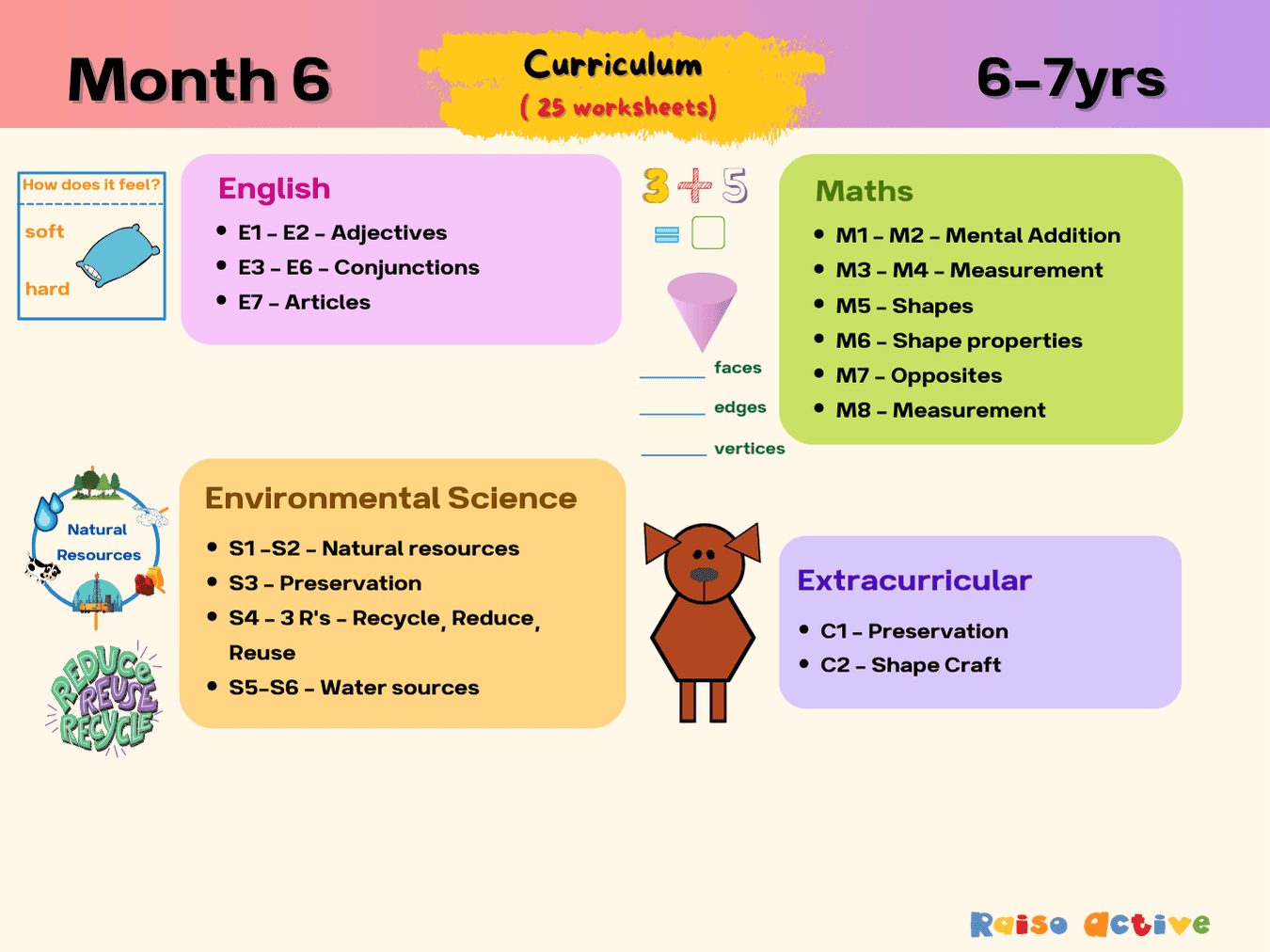
Month 6: Grammar, Math, Environmental Science | Ages 6-7
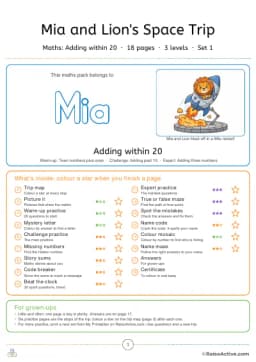
This is page 18 of the pack. Ages 6-7 · Grade 1Ages 6-7 · Year 2Ages 6-7 · Class 1Ages 6-7
Made for your child
Numbers to 20, made for your child
A maths pack with your child's name in it: pictures that explain, practice at three levels, puzzles and story sums about them. Print a new set whenever they finish.
Make a maths packFree preview · free for members
Curriculum
- Measurement - Length > Measurement Basics
How to use this worksheet
Look at the three objects pictured together and ask your child to point to the one they think is longest and the one they think is shortest, encouraging visual comparison before writing anything. Have your child write '1' in the box under the longest object, '2' under the middle-length object, and '3' under the shortest, to show the descending order. Then repeat the exercise for the ascending order, this time starting numbering from the shortest object to the longest. Review both orderings together, double-checking that the numbers correctly match the object lengths.
Materials needed
- Pencil
- Eraser
Extension activities
- 1Line up household objects like spoons, pencils, or shoes and order them from longest to shortest.
- 2Measure a few toys using non-standard units like blocks, then use those measurements to double-check the visual ordering.
- 3Create a 'tallest to shortest' version using family members standing in a line.
- 4Play a sorting game with paper strips of different lengths, ordering them quickly against the clock.
- 5Draw three lines of clearly different lengths and have your child practice ordering them longest to shortest.

Written by
Hemsweta Jain · Teacher Cheena
MBA and Early Childhood Educator, teaching since 2014 · Founder of RaisoActive, Mumbai
Every RaisoActive worksheet is designed and checked by the founder before publishing.
Published · Last reviewed
More from Month 6: Grammar, Math, Environmental Science | Ages 6-7

Parent's Guide: Fun Activities for Adjectives, Conjunctions, and More!
Ages 3-5 · Preschool–Pre-KAges 3-5 · Nursery–ReceptionAges 3-5 · Nursery–LKGAges 3-5
This parent's guide bundles hands-on activities around adjectives, conjunctions, measurement, and recycling, giving children ages 3-5 exposure to both language concepts and early science-adjacent skills within everyday, low-prep activities. Combining grammar practice with physical tasks like measuring height or building a planter helps abstract concepts, like what a conjunction is, become grounded in something concrete and memorable.

Conjunctions Worksheet: Expanding Sentences (Ages 4-6)
Ages 4-6 · Pre-K–KindergartenAges 4-6 · Reception–Year 1Ages 4-6 · LKG–UKGAges 4-6
This worksheet moves beyond simple conjunction identification to active sentence expansion, asking children to use conjunctions like 'but,' 'when,' 'until,' 'because,' and 'if' to add new information and build longer, more sophisticated sentences. For ages 4-6, this kind of guided sentence-combining is a key step toward more complex, connected storytelling in both spoken and written language.
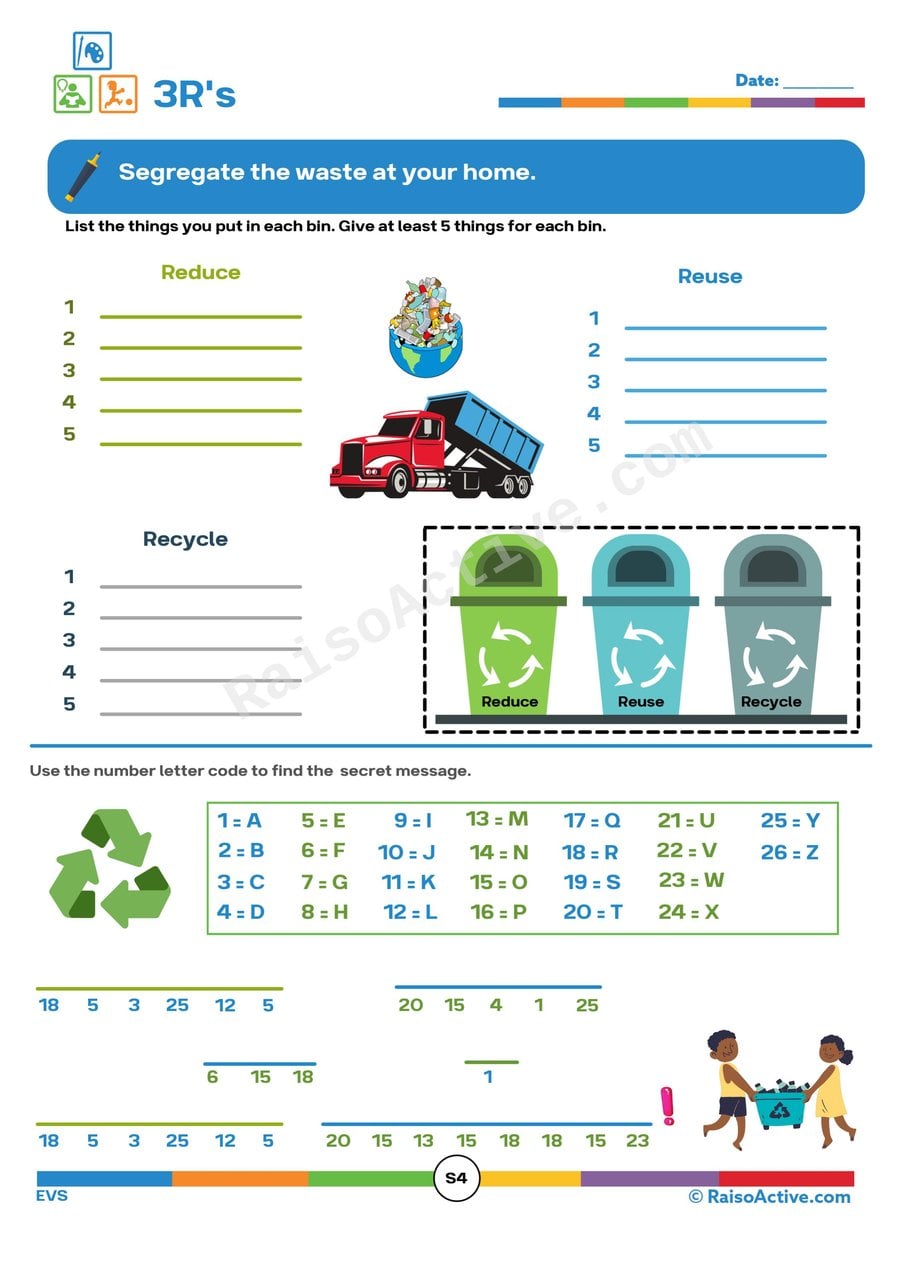
3 R's Worksheet: Reduce, Reuse, Recycle!
Ages 4-6 · Pre-K–KindergartenAges 4-6 · Reception–Year 1Ages 4-6 · LKG–UKGAges 4-6
This worksheet introduces the three R's, reduce, reuse, and recycle, as concrete categories for sorting everyday actions, helping children ages 4-6 build environmental vocabulary and classification skills. Decoding a secret message using a number code adds a layer of early math and logic practice, linking numeral recognition to problem-solving.

Mental Addition Worksheet for Kids: Practice Adding Numbers!
Ages 4-6 · Pre-K–KindergartenAges 4-6 · Reception–Year 1Ages 4-6 · LKG–UKGAges 4-6
This worksheet builds mental math fluency by asking children to solve simple addition problems in their heads rather than relying on counters or drawings, strengthening the internal number sense that supports faster, more confident arithmetic. For ages 4-6, moving from concrete counting toward mental calculation is a significant milestone that sets the foundation for later multi-digit addition.

Mental Addition Worksheet: Add Dots and Find the Total!
Ages 4-6 · Pre-K–KindergartenAges 4-6 · Reception–Year 1Ages 4-6 · LKG–UKGAges 4-6
This worksheet bridges concrete counting and mental addition by having children count visible dots, add them to a given number, and then draw missing dots to complete equations, reinforcing that addition means combining quantities together. For ages 4-6, physically drawing the missing dots makes the abstract equation tangible, helping cement the connection between a math symbol and what it actually represents.
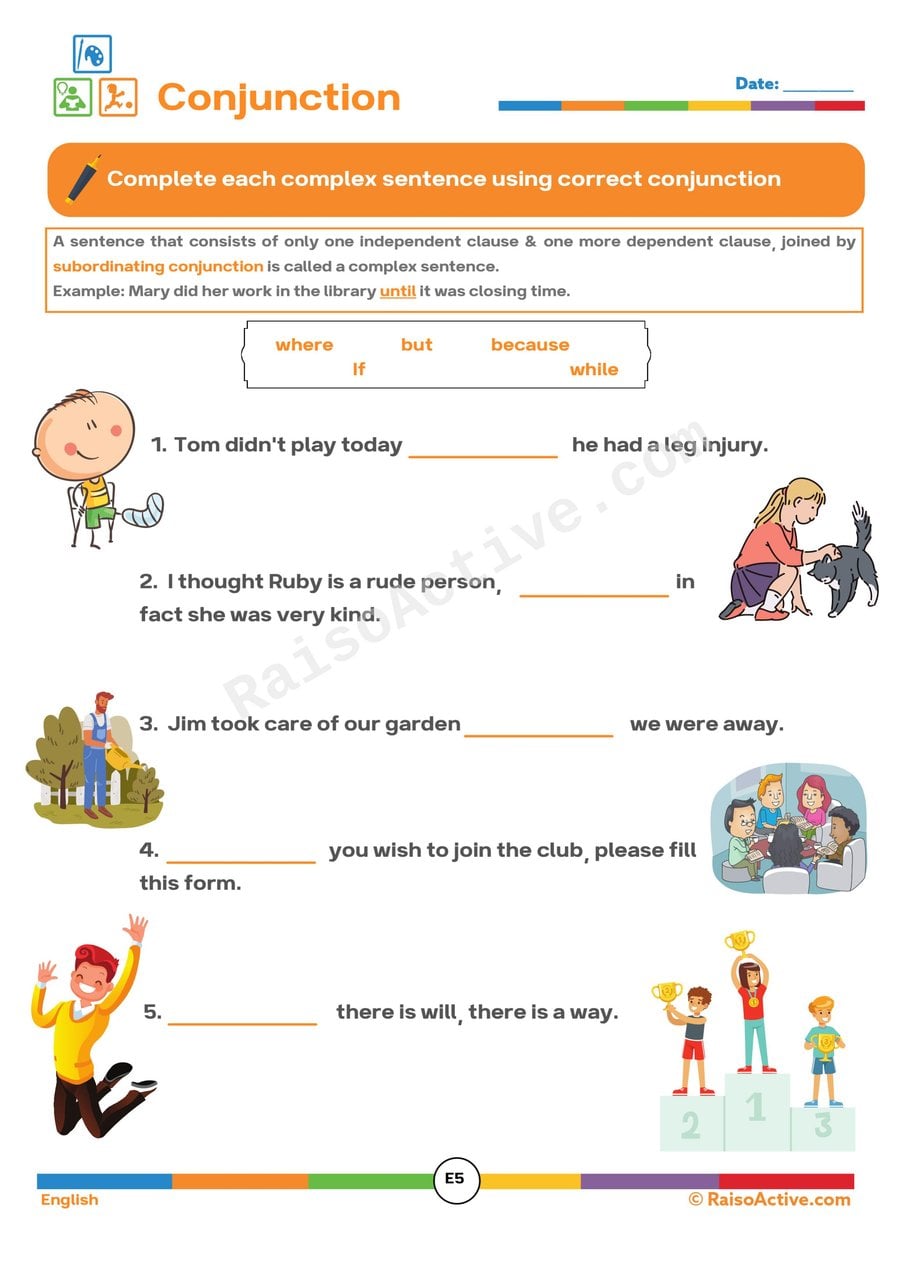
Conjunctions Worksheet: Complete the Sentences!
Ages 4-6 · Pre-K–KindergartenAges 4-6 · Reception–Year 1Ages 4-6 · LKG–UKGAges 4-6
Building on basic conjunction recognition, this worksheet asks children to select the correct conjunction from a word bank and use it to complete a sentence, practicing both comprehension and application rather than just identification. This step toward independent sentence construction helps 4-6 year-olds start forming more complex, connected ideas in both speaking and early writing.
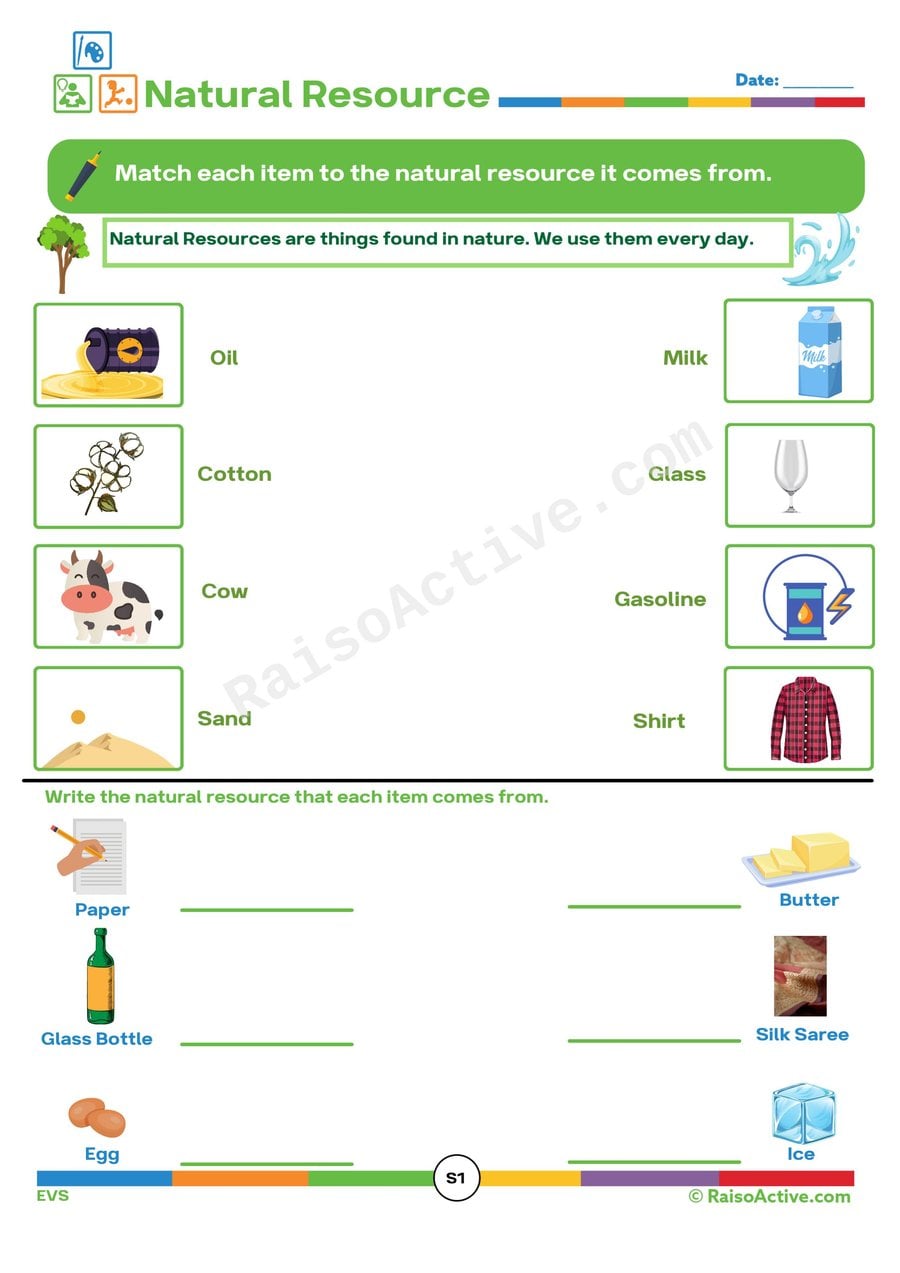
Natural Resources Matching Worksheet for Kids
Ages 3-5 · Preschool–Pre-KAges 3-5 · Nursery–ReceptionAges 3-5 · Nursery–LKGAges 3-5
This worksheet deepens understanding of natural resources by asking children to match everyday items, like paper or bread, to the natural resource they originally come from, such as trees or wheat. For ages 3-5, tracing a familiar object back to its natural source builds early cause-and-effect thinking alongside science vocabulary.

Conjunctions Worksheet: Practice with 'and', 'but', 'so', and 'yet'
Ages 4-6 · Pre-K–KindergartenAges 4-6 · Reception–Year 1Ages 4-6 · LKG–UKGAges 4-6
This worksheet introduces four common coordinating conjunctions, teaching children to notice how 'and,' 'but,' 'so,' and 'yet' each connect ideas differently, whether adding information, showing contrast, or indicating a result. For ages 4-6, this is an early step toward writing compound sentences and understanding that word choice changes the meaning and flow of a sentence.
Related worksheets
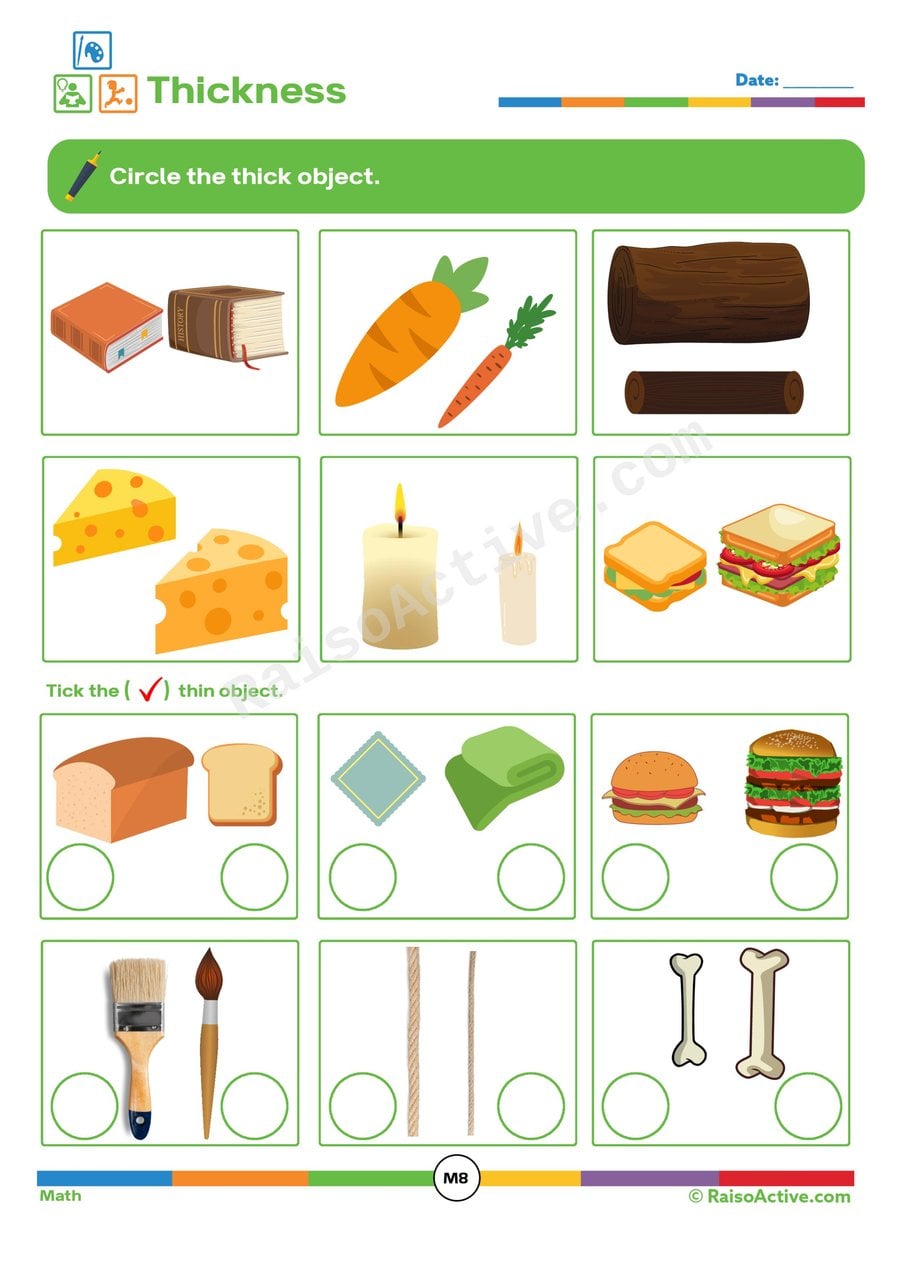
Thickness Worksheet: Circle the Thick Objects!
Ages 3-5 · Preschool–Pre-KAges 3-5 · Nursery–ReceptionAges 3-5 · Nursery–LKGAges 3-5
This sorting worksheet introduces children ages 3-5 to the comparative concept of thickness, asking them to distinguish thick objects from thin ones within paired pictures. Comparing physical properties like thickness, rather than just size or color, sharpens observational vocabulary and prepares children for later measurement concepts involving width and volume. Requiring two different responses — circling the thick object and ticking the thin one — also reinforces that opposite concepts can appear side by side in the very same picture.

Tall and Short Objects Worksheet for Preschoolers
Ages 3-5 · Preschool–Pre-KAges 3-5 · Nursery–ReceptionAges 3-5 · Nursery–LKGAges 3-5
Children ages 3-5 build early measurement vocabulary by comparing pairs of objects and identifying which one is taller and which is shorter, practicing both circling and ticking as response formats. Comparing height between two objects at a time, rather than sorting a whole group, keeps the comparison task simple and direct, which is developmentally appropriate before children move on to comparing three or more items at once.

Measuring Objects with Paper Clips Worksheet for Preschoolers
Ages 4-5 · Pre-KAges 4-5 · ReceptionAges 4-5 · LKGAges 4-5
This worksheet introduces children ages 4-5 to non-standard measurement by having them line up paper clips end-to-end to find the length of different objects, building an early understanding that length can be measured and compared using a repeated unit. This hands-on approach lays the groundwork for using rulers and standard units later on.
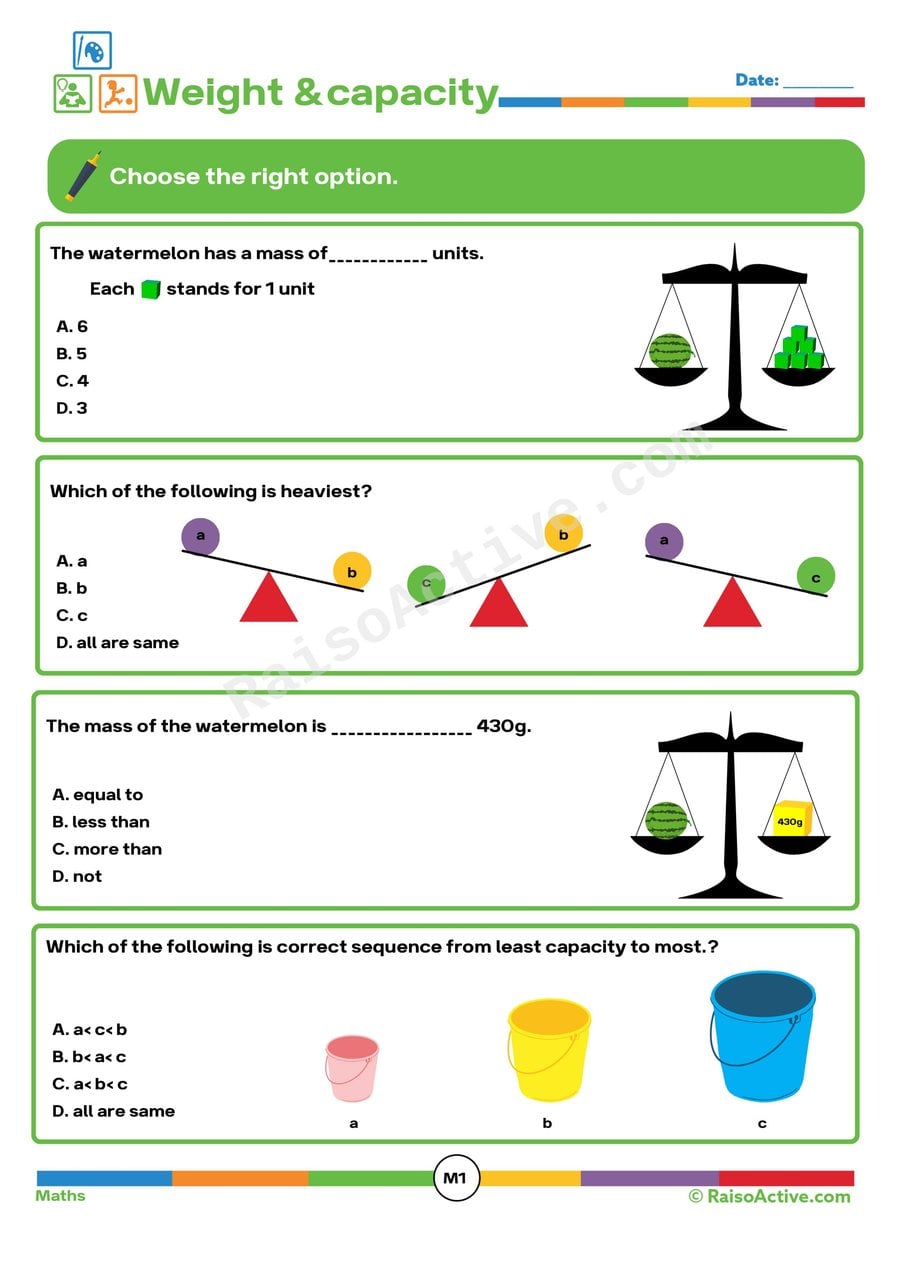
Weight and Capacity Worksheet for Preschoolers
Ages 4-6 · Pre-K–KindergartenAges 4-6 · Reception–Year 1Ages 4-6 · LKG–UKGAges 4-6
Comparing objects visually to judge which is heavier or holds more introduces children ages 4-6 to early measurement concepts, building the comparative reasoning that underlies later formal measurement with scales and measuring cups.
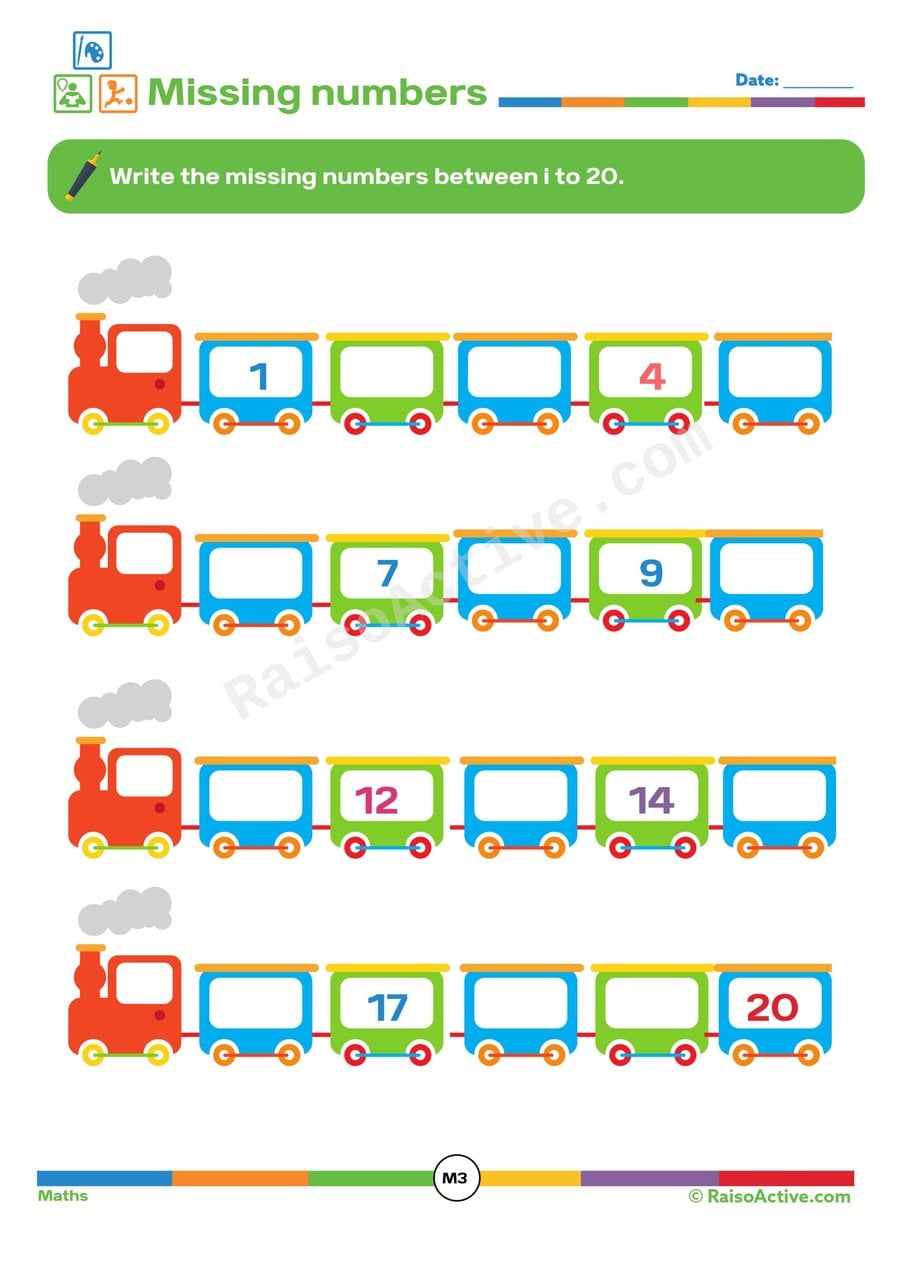
Missing Numbers Train Worksheet: Numbers 1-20
Ages 4-6 · Pre-K–KindergartenAges 4-6 · Reception–Year 1Ages 4-6 · LKG–UKGAges 4-6
This worksheet helps children ages 4-6 practice number recognition and sequencing by filling in missing numbers on a train of cars that counts from 1 to 20, reinforcing that numbers follow a fixed, predictable order. Working with a range this large also builds the stamina and sustained counting skill needed before children move on to skip-counting and simple addition.
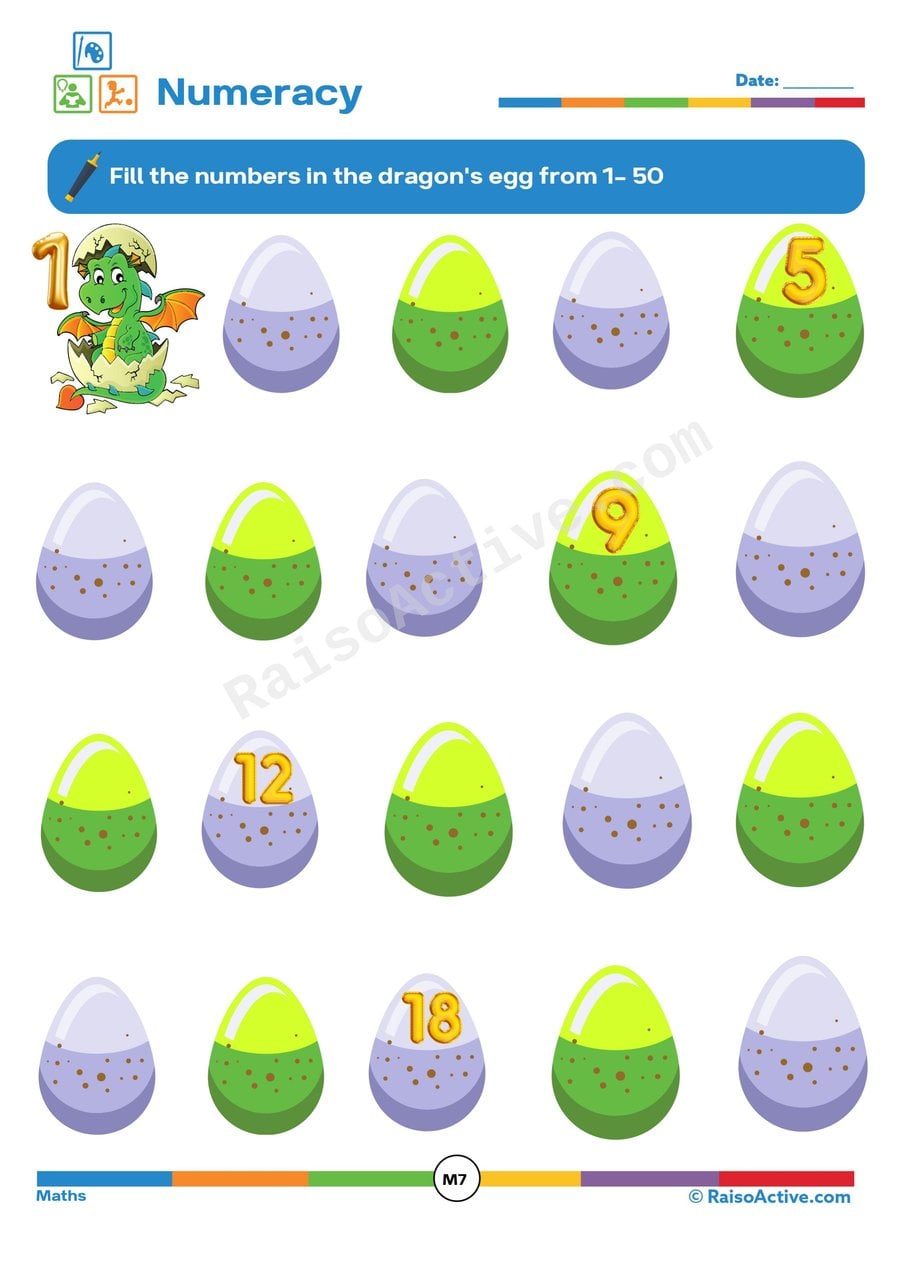
Dragon Egg Numbers: Counting to 50 Worksheet
Ages 4-6 · Pre-K–KindergartenAges 4-6 · Reception–Year 1Ages 4-6 · LKG–UKGAges 4-6
Filling in the missing numbers across a run of dragon eggs stretches a 4-6 year old's counting range well past the more common 1-20 practice, into territory where number patterns — like how every decade starts a new '_1, _2, _3' pattern — start to become visible. It's a strong bridge activity between rote counting and genuinely understanding how the number system is built.
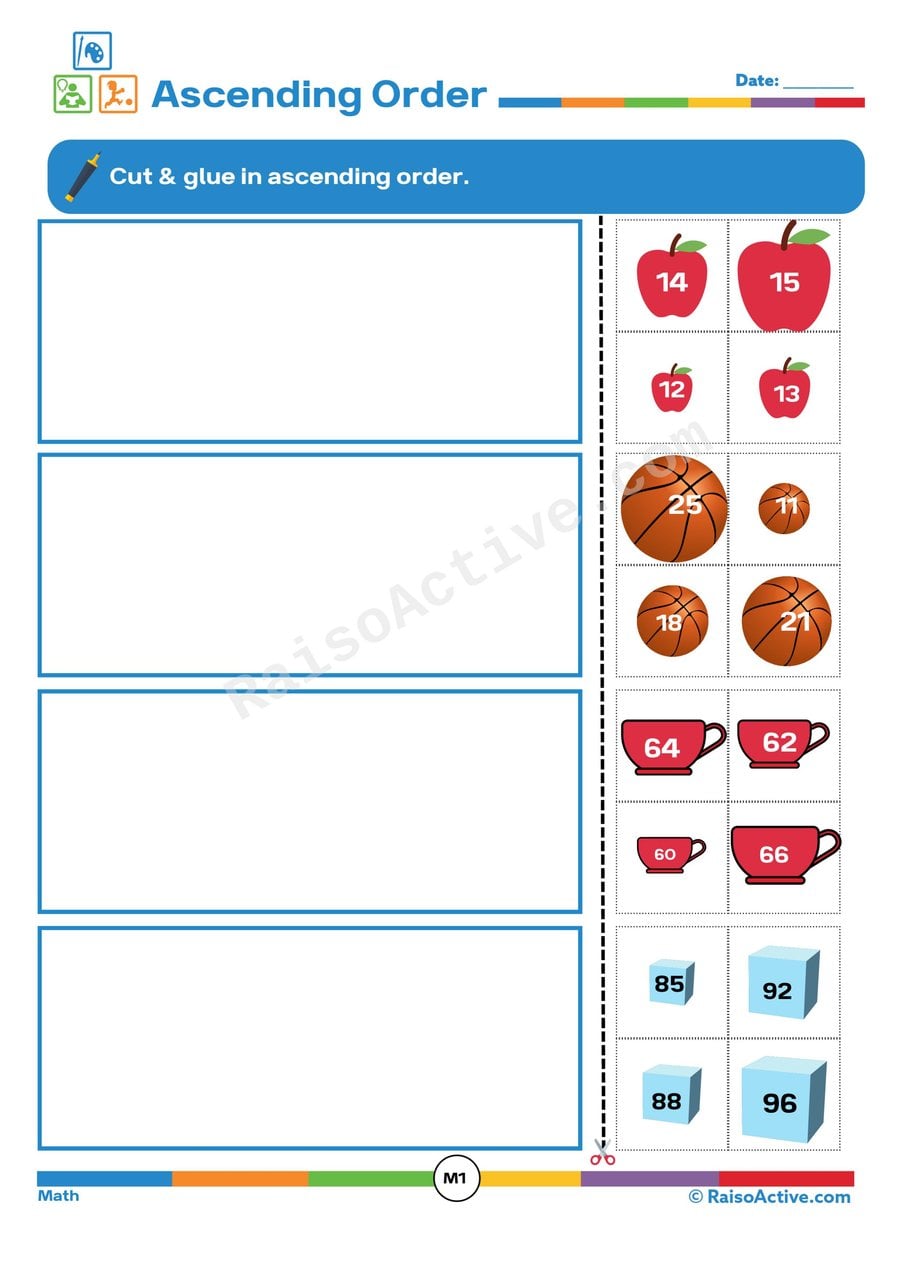
Ascending Order Worksheet: Cut and Paste Numbers!
Ages 4-6 · Pre-K–KindergartenAges 4-6 · Reception–Year 1Ages 4-6 · LKG–UKGAges 4-6
This worksheet has children ages 4-6 physically manipulate number cutouts to arrange them from least to greatest, building both number sequencing and the underlying concept that numbers represent increasing quantity. Because the numbers must be cut, sorted, and glued rather than simply read in order, this activity combines fine motor practice with active number reasoning, requiring children to compare each new number against those already placed.
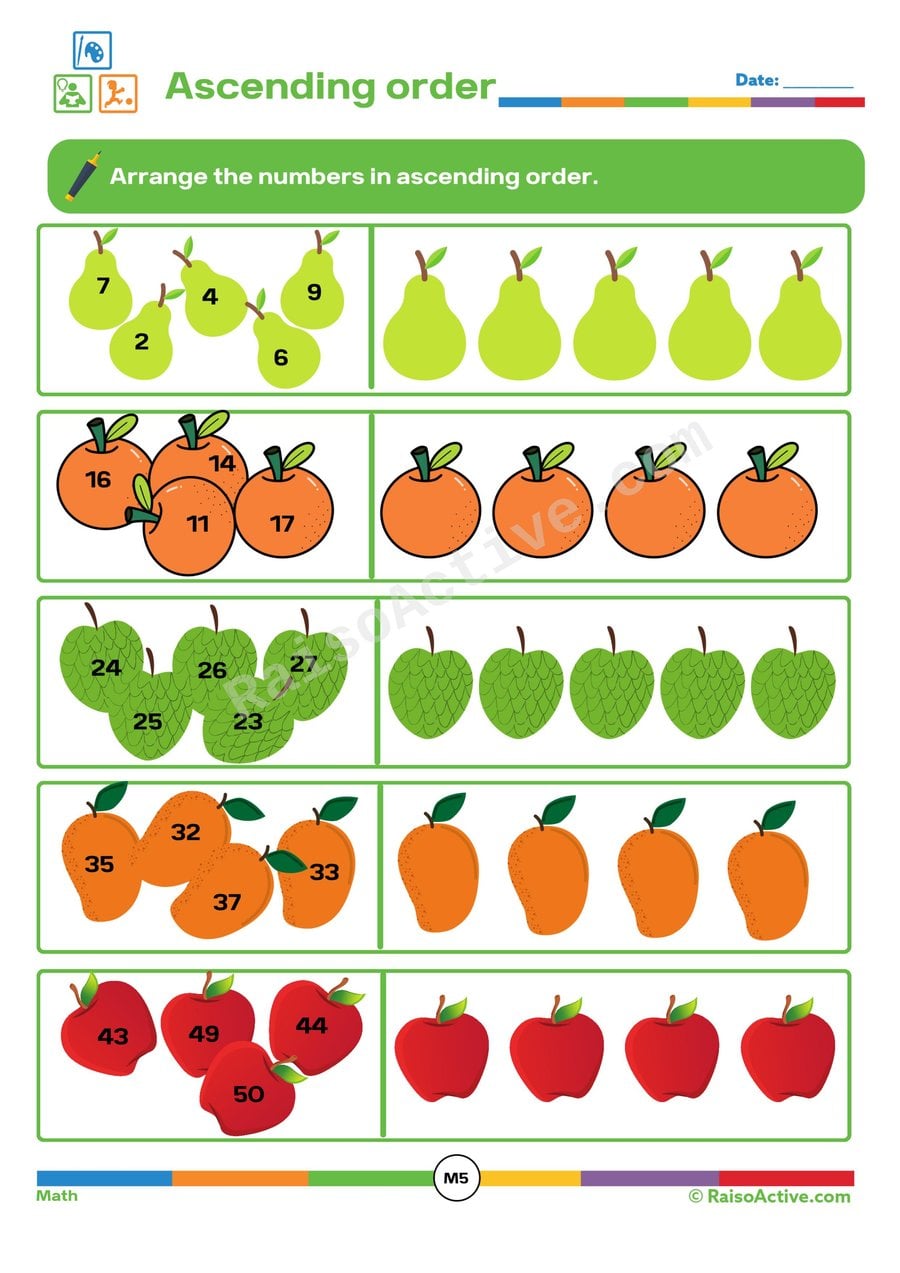
Ascending Order Worksheet: Fruit Fun!
Ages 4-6 · Pre-K–KindergartenAges 4-6 · Reception–Year 1Ages 4-6 · LKG–UKGAges 4-6
Arranging numbers on groups of fruit from smallest to largest teaches children ages 4-6 to compare quantities and understand ascending order, a core numeracy skill that supports later work with number lines and place value.
Reviews
Every worksheet for ages 4–6, no watermark
Members download the full library of 1,000+ worksheets and every activity pack without watermarks or daily limits. One year costs ₹999 in India or $20 elsewhere.
See membership plansOr download any worksheet free with a watermark (5 a day).