
Conjunctions Worksheet: Expanding Sentences (Ages 4-6)
This worksheet moves beyond simple conjunction identification to active sentence expansion, asking children to use conjunctions like 'but,' 'when,' 'until,' 'because,' and 'if' to add new information and build longer, more sophisticated sentences. For ages 4-6, this kind of guided sentence-combining is a key step toward more complex, connected storytelling in both spoken and written language.
Curriculum
How to use this worksheet
Read the first simple sentence aloud together, then look at the conjunction given in brackets and talk about what kind of extra information it might introduce, like a reason, a time, or a condition. Encourage your child to think of an idea that logically follows the conjunction before writing anything down. Have your child write the full expanded sentence on the line provided, combining the original sentence with their new idea using the given conjunction. Move through each sentence the same way, reading the finished version aloud to check that it flows and makes sense.
Materials needed
- Pencil
- Eraser
Extension activities
- •Have your child pick one conjunction and create three different expanded sentences using it with new ideas each time.
- •Read a short story together and find sentences that use conjunctions like 'because' or 'until,' discussing what information they add.
- •Play an oral game where you say a simple sentence and your child expands it on the spot using a conjunction of their choice.
- •Turn one expanded sentence into a short illustrated comic strip showing the cause-and-effect or time relationship.
- •Practice using 'if' sentences by asking your child playful hypothetical questions, like 'what would happen if it rained candy?'
Tips for parents and teachers
This is genuinely more challenging than basic conjunction fill-in-the-blank work, so expect some sentences to need a few tries before they sound natural, and that's a normal part of the learning process. Reading the completed sentence aloud together is the best way to catch awkward phrasing, since children often can hear an error before they can explain it grammatically. Encourage your child to explain their expanded idea in their own words first, then help them translate it into written form if spelling is still developing.

Written by
Hemsweta Jain · Teacher Cheena
MBA and Early Childhood Educator, teaching since 2014 · Founder of RaisoActive, Mumbai
Every RaisoActive worksheet is designed and checked by the founder before publishing.
Published · Last reviewed
Related worksheets

Subject and Predicate Sorting Worksheet for Preschoolers
This worksheet introduces children ages 4-5 to a basic building block of sentence grammar, teaching them that every sentence has a subject — who or what it's about — and a predicate — what that subject does or is. Sorting sentence fragments into these two categories helps children start to notice sentence structure, which supports both reading comprehension and their own sentence writing later on. This early grammar awareness lays groundwork for more formal sentence study in kindergarten and beyond.

Capitalization Worksheet: Practice Writing Sentences Correctly!
This worksheet teaches children ages 4-6 the rule that sentences begin with a capital letter, along with an introduction to capitalizing proper nouns like names and places. Rewriting sentences correctly, rather than just circling errors, gives children active practice applying the capitalization rule themselves, which builds the habit more effectively than passive correction exercises.

Punctuation Practice Worksheet for Early Learners
Children ages 4-6 learn to distinguish between statements and questions by deciding whether each sentence needs a period or a question mark, an early step in understanding how punctuation changes meaning and tone. Recognizing the difference between a question and a statement also supports reading fluency, since readers naturally use rising or falling intonation depending on the punctuation at the end of a sentence.

Sentence Building Fun: Using Words to Create Sentences Worksheet
This worksheet helps children ages 4-6 practice constructing complete, grammatically sound sentences by using a set of provided words alongside a picture prompt. Building sentences from a word bank forces children to think about word order and sentence structure directly, rather than just filling in a single blank, which is a meaningful step up in independent writing skill.

Frame a Sentence Worksheet: Building Sentences with Cows!
Arranging a set of given words into a complete, correctly ordered sentence teaches children ages 4-6 basic sentence structure, helping them understand that word order changes meaning and that sentences follow predictable patterns like subject before action. Remembering to start with a capital letter and end with a period also reinforces early writing conventions alongside the sentence-building itself. This combination of grammar and mechanics gives children practice with the full process of forming a proper written sentence, not just choosing words.

Punctuation Fun: Practice Using Punctuation Marks!
Choosing the correct punctuation mark to complete a sentence teaches children ages 4-6 that periods, question marks, and other marks change how a sentence should be read and understood, not just how it looks on paper. Matching sentences to their correct punctuation marks reinforces this by requiring children to recognize the tone or purpose of a sentence, whether it's a statement, a question, or an exclamation. This early grammar practice builds the foundation for reading with expression and writing complete, correctly punctuated sentences later on.
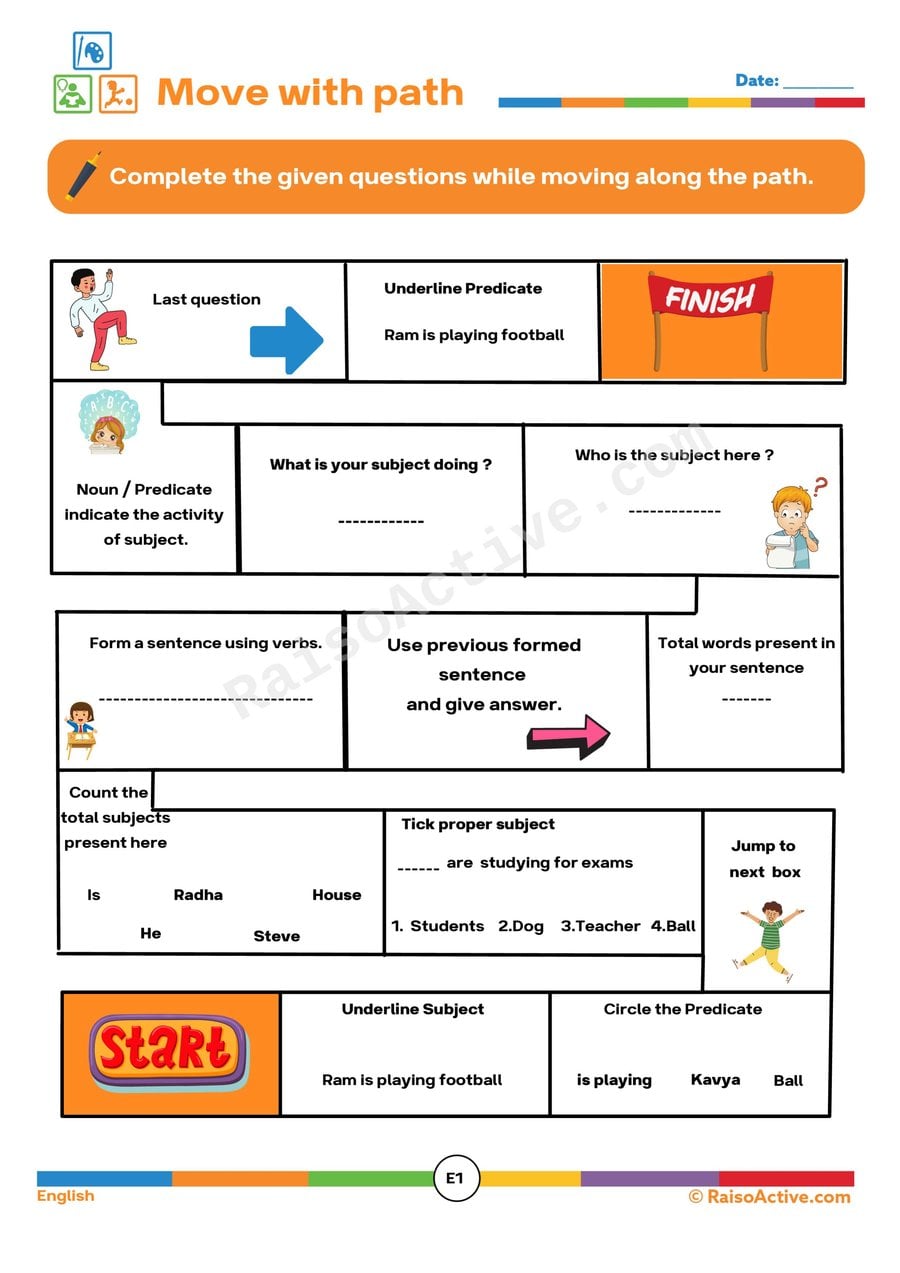
Move with Path Worksheet: Sentence Structure Fun!
This path-based activity teaches children ages 4-6 the basic building blocks of a sentence — subject and predicate — by having them move through a series of boxes, underlining predicates and identifying subjects along the way. Framing grammar as a physical path to follow makes an abstract concept more concrete for early learners. By the end, children practice not just identifying sentence parts but also constructing new sentences of their own, moving from recognition to active use.
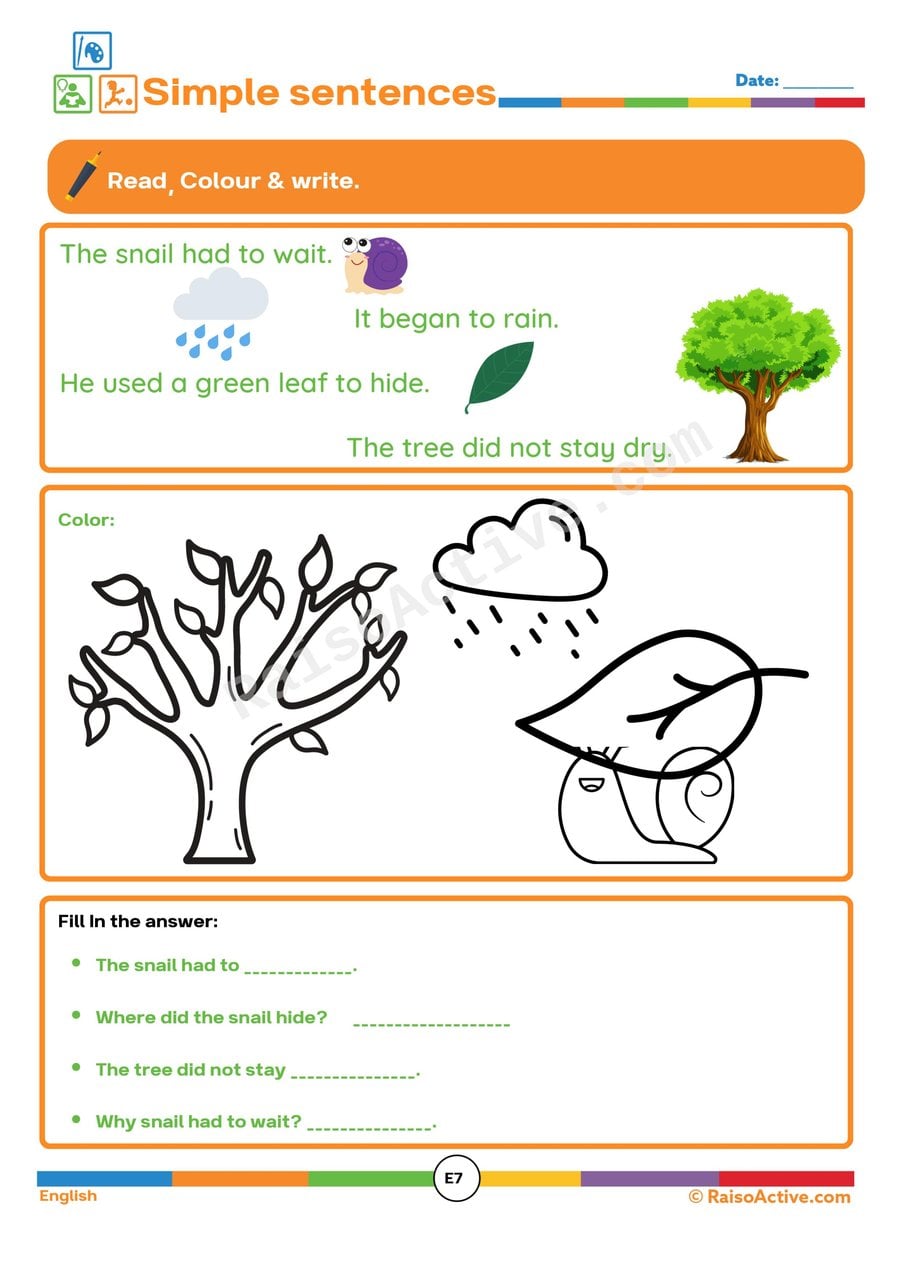
Simple Sentences Worksheet: Read, Color, and Write!
This worksheet combines three literacy skills for children ages 3-5 in one activity: reading short sentences, coloring the pictures that go with them, and filling in a missing word to complete each sentence. Connecting reading, coloring, and writing in a single task reinforces that words carry meaning tied directly to pictures, an important early step toward genuine reading comprehension.
Reviews
Every worksheet for ages 4–6, no watermark
Members download the full library of 1,000+ worksheets and every activity pack without watermarks or daily limits. One year costs ₹1,000 in India or $20 elsewhere.
See membership plansOr download any worksheet free with a watermark (5 a day).