Candy Art: Create Sweet Art with Fruit Candies!
Arranging fruit candies into the outline of a car and an airplane gives children ages 3-5 a playful, sensory way to practice fine motor precision and pattern-following, since each candy must be placed carefully to build the recognizable shape. This open-ended art activity also builds early spatial reasoning, as children figure out how small individual pieces combine to form a larger, specific picture. Because the medium is candy rather than paper, it adds a multisensory, highly motivating twist that keeps younger children engaged longer than a typical craft.
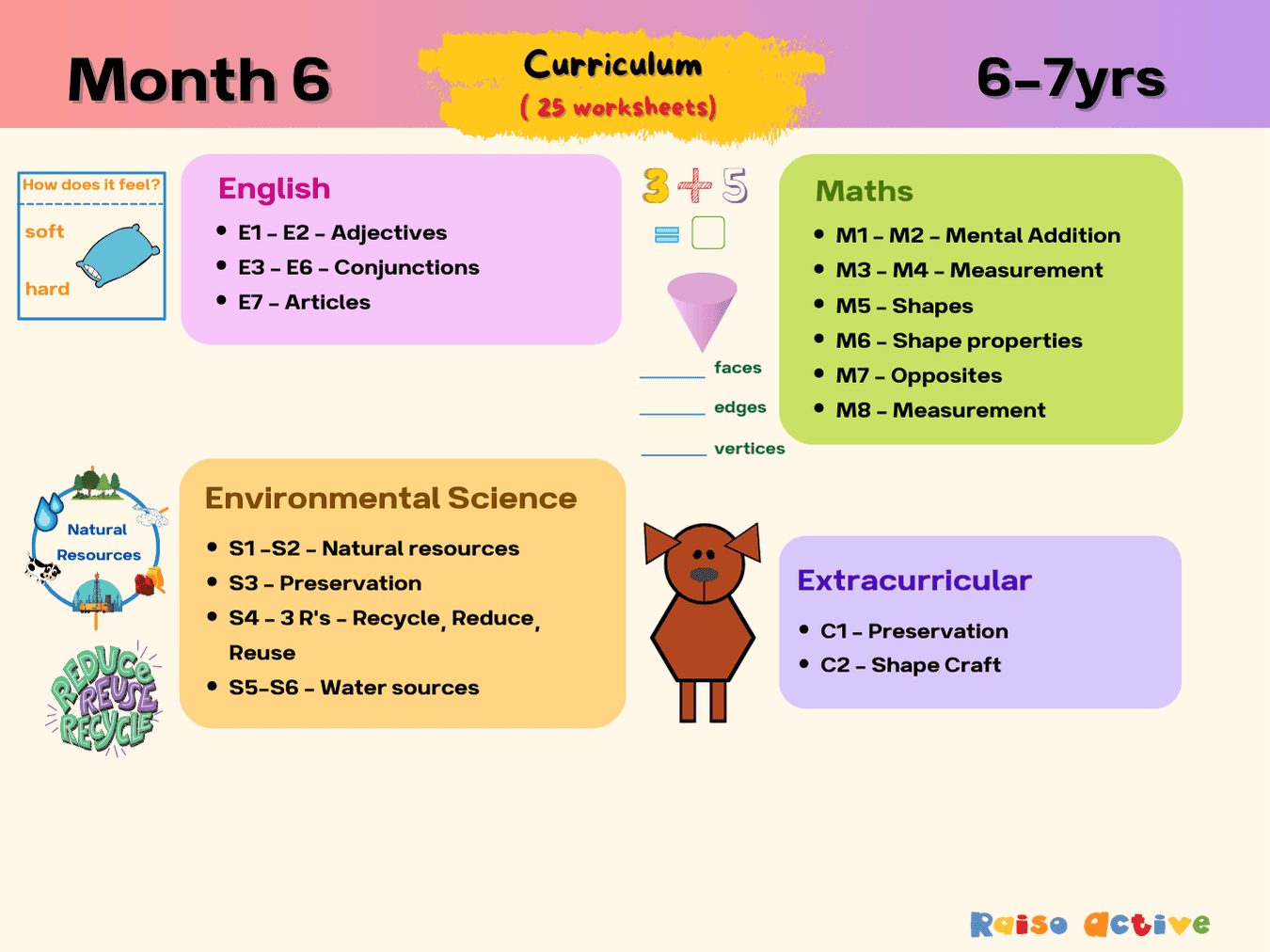
Part of the pack
Month 6: Grammar, Math, Environmental Science | Ages 6-7
This is page 27 of the pack. Ages 6-7 · Grade 1Ages 6-7 · Year 2Ages 6-7 · Class 1Ages 6-7
Curriculum
- Art & Craft > Arts & Crafts
How to use this worksheet
Show your child the example pictures of the car and airplane made from candies so they know what shape to aim for. Give them a handful of fruit candies and a sheet of paper, and have them arrange the candies to outline the shape of the car first, following the example as a guide. Once satisfied with the placement, move on to building the airplane shape the same way. Take a photo of the finished candy art before anyone starts snacking on the materials.
Materials needed
- Fruit Candies
- Paper
Extension activities
- 1Try building a different shape or object from candies, like a house, a flower, or a simple face.
- 2Sort the candies by color or flavor before starting to build, adding an extra classification step.
- 3Use other small snacks, like cereal pieces or crackers, to build shapes on days without candy on hand.
- 4Count how many candies were used to build each shape once finished.
- 5Glue the arranged candies onto paper (once dry, non-edible ones only) to preserve the artwork as a keepsake.

Written by
Hemsweta Jain · Teacher Cheena
MBA and Early Childhood Educator, teaching since 2014 · Founder of RaisoActive, Mumbai
Every RaisoActive worksheet is designed and checked by the founder before publishing.
Published · Last reviewed
More from Month 6: Grammar, Math, Environmental Science | Ages 6-7

Preservation Worksheet: Complete the Sentences for a Greener Earth!
Ages 3-5 · Preschool–Pre-KAges 3-5 · Nursery–ReceptionAges 3-5 · Nursery–LKGAges 3-5
This worksheet helps children connect specific actions, like turning off a tap or planting a tree, to the bigger idea of protecting the environment, building early environmental vocabulary and cause-and-effect thinking. For ages 3-5, completing sentences with picture clues also supports beginning reading and writing skills in a meaningful, real-world context.

Water Sources Flashcards: Learn About Natural Water Bodies!
Ages 4-6 · Pre-K–KindergartenAges 4-6 · Reception–Year 1Ages 4-6 · LKG–UKGAges 4-6
Sorting natural water into distinct types — a river that flows, a lake that's still and enclosed, an ocean that's salty and vast — introduces a 4-6 year old to early classification skills in earth science, well before they'd encounter these terms formally in school. Writing a short description on the back of each card also gives early writers a low-pressure reason to put a few words on paper about something they've just learned.

Mental Addition Worksheet for Kids: Practice Adding Numbers!
Ages 4-6 · Pre-K–KindergartenAges 4-6 · Reception–Year 1Ages 4-6 · LKG–UKGAges 4-6
This worksheet builds mental math fluency by asking children to solve simple addition problems in their heads rather than relying on counters or drawings, strengthening the internal number sense that supports faster, more confident arithmetic. For ages 4-6, moving from concrete counting toward mental calculation is a significant milestone that sets the foundation for later multi-digit addition.

Conjunctions Worksheet: Expanding Sentences (Ages 4-6)
Ages 4-6 · Pre-K–KindergartenAges 4-6 · Reception–Year 1Ages 4-6 · LKG–UKGAges 4-6
This worksheet moves beyond simple conjunction identification to active sentence expansion, asking children to use conjunctions like 'but,' 'when,' 'until,' 'because,' and 'if' to add new information and build longer, more sophisticated sentences. For ages 4-6, this kind of guided sentence-combining is a key step toward more complex, connected storytelling in both spoken and written language.
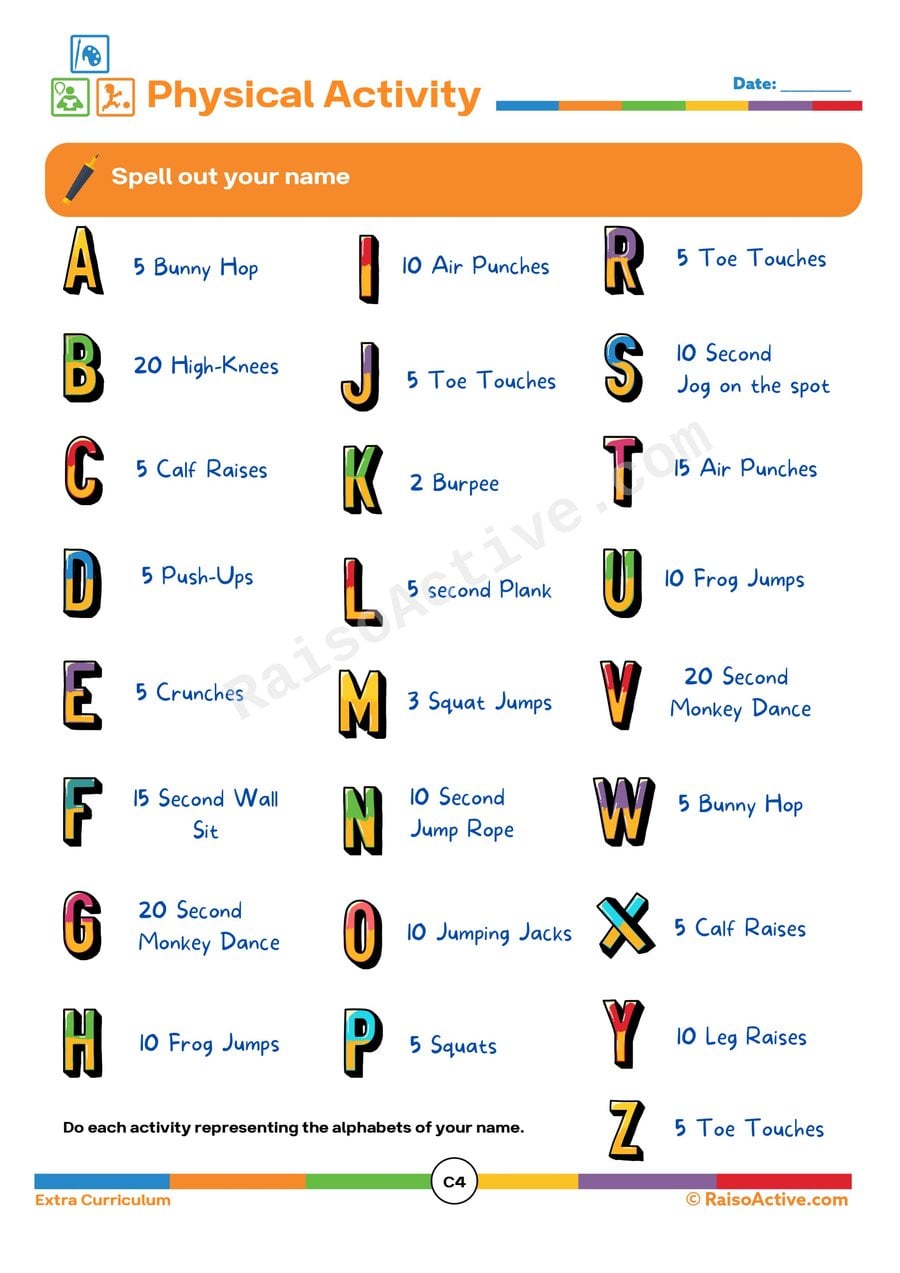
Physical Activity Worksheet: Spell Your Name!
Ages 3-5 · Preschool–Pre-KAges 3-5 · Nursery–ReceptionAges 3-5 · Nursery–LKGAges 3-5
This worksheet turns spelling practice into a physical activity by pairing each letter of the alphabet with a specific exercise, so children spell their name while getting active movement in between. For ages 3-5, connecting letter recognition to gross motor movement supports both early literacy and physical development at once, appealing especially to kinesthetic learners.

Adjective Adventure: Coloring and Sentence Fun Worksheet for Kids
Ages 3-5 · Preschool–Pre-KAges 3-5 · Nursery–ReceptionAges 3-5 · Nursery–LKGAges 3-5
Coloring only the adjectives in a set of words teaches children ages 3-5 to recognize descriptive words as their own grammatical category, distinct from naming words or action words, a foundational step toward understanding how sentences are built. Writing a sentence using a chosen adjective afterward pushes the recognition skill into active use, requiring children to apply what they identified rather than just spot it.

Adjective Adventure: Circle the Adjectives Worksheet for Kids
Ages 4-6 · Pre-K–KindergartenAges 4-6 · Reception–Year 1Ages 4-6 · LKG–UKGAges 4-6
This worksheet introduces the concept of adjectives as descriptive words that tell us more about a noun, asking children to identify and circle words that describe pictured objects. For ages 4-6, recognizing adjectives builds richer, more expressive vocabulary and lays groundwork for more descriptive writing and speaking later on.
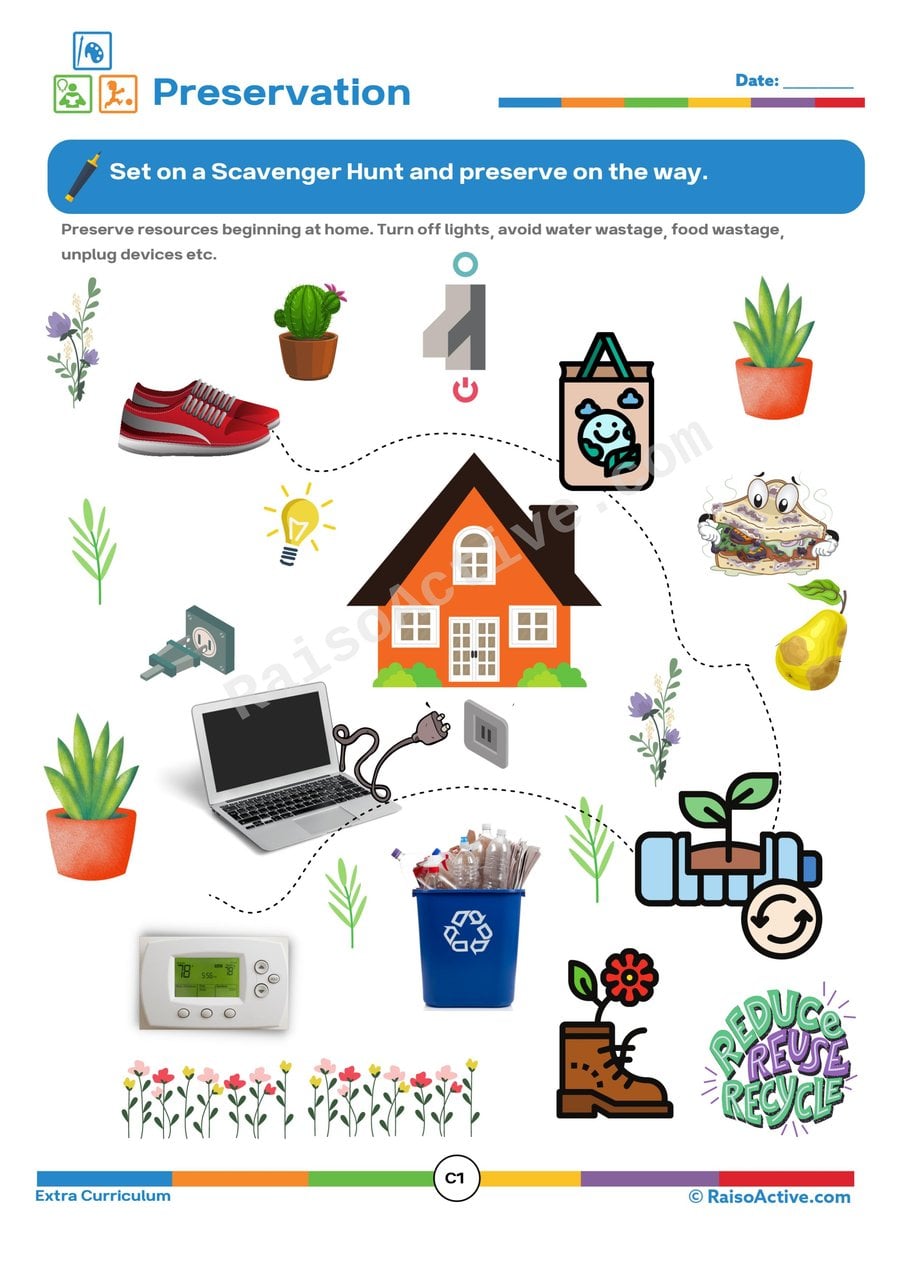
Preservation Scavenger Hunt Worksheet for Kids
Ages 3-5 · Preschool–Pre-KAges 3-5 · Nursery–ReceptionAges 3-5 · Nursery–LKGAges 3-5
This worksheet teaches children to connect specific pictured items to preservation actions, like recycling or saving water, by tracing dotted lines between related images. For ages 3-5, a scavenger-hunt style format makes the abstract idea of conservation feel like an engaging visual puzzle rather than a lecture, while still building genuine environmental vocabulary.
Related worksheets

Spider Web Connect-the-Dots Worksheet for Preschoolers
Ages 3-5 · Preschool–Pre-KAges 3-5 · Nursery–ReceptionAges 3-5 · Nursery–LKGAges 3-5
This connect-the-dots worksheet has children ages 3-5 count in sequence from one number to the next while drawing curved lines, building both number-order recognition and the pencil control needed for pre-writing curves and loops. Revealing a spider web at the end gives the counting practice a satisfying, visual payoff that keeps young children motivated through the whole sequence.

Spooky Fun Coloring Worksheet for Preschoolers
Ages 3-5 · Preschool–Pre-KAges 3-5 · Nursery–ReceptionAges 3-5 · Nursery–LKGAges 3-5
This Halloween-themed coloring page gives children ages 3-5 practice with crayon grip, color choice, and staying within outlines as they bring a collection of spooky objects to life. Naming each object as they color, like a ghost, a pumpkin, or a bat, also builds seasonal vocabulary tied directly to what they're seeing and creating.

Color the Snowman! A Fun Coloring Worksheet for Kids
Ages 3-5 · Preschool–Pre-KAges 3-5 · Nursery–ReceptionAges 3-5 · Nursery–LKGAges 3-5
This worksheet helps children ages 3-5 practice fine motor control and creative choice while coloring a winter snowman scene. Because the image invites open-ended color decisions rather than following a strict code, it also builds confidence in making independent artistic choices.
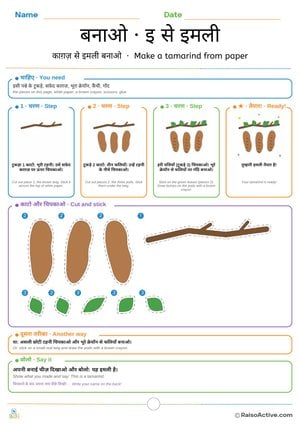
Make a Paper Tamarind: Hindi Letter इ Craft | बनाओ · इ से इमली
Ages 3-7 · Preschool–Grade 1Ages 3-7 · Nursery–Year 2Ages 3-7 · Nursery–Class 1Ages 3-7
Children cut out the pieces, put them together following three step pictures and make a paper tamarind. Saying the word इमली as they make it links the sound इ to something they built themselves.

Reindeer Craft: Follow Instructions and Create a Festive Decoration!
Ages 3-5 · Preschool–Pre-KAges 3-5 · Nursery–ReceptionAges 3-5 · Nursery–LKGAges 3-5
This multi-step reindeer craft has children ages 3-5 follow a sequence of folding and assembly instructions to build a three-dimensional decoration, strengthening both listening comprehension and the fine motor skills needed to position and attach small pieces accurately. Because each step depends on the one before it, children also practice patience and sequencing, skills that carry over into following any multi-step task.
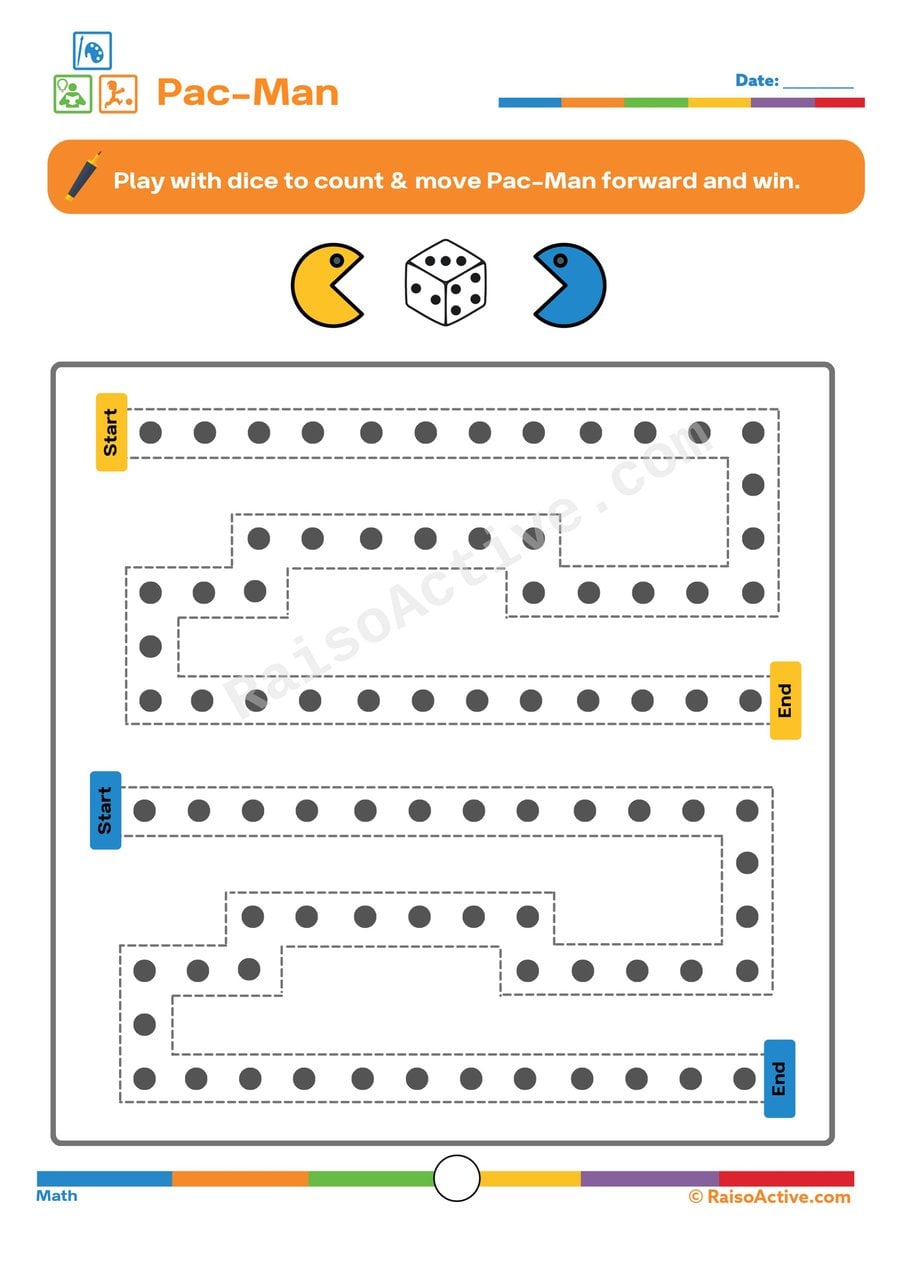
Pac-Man Maze Worksheet: Count and Move!
Ages 3-5 · Preschool–Pre-KAges 3-5 · Nursery–ReceptionAges 3-5 · Nursery–LKGAges 3-5
This dice-counting maze gives children ages 3-5 repeated practice matching a rolled number to the correct number of moves, reinforcing accurate counting under a bit of playful pressure. Tracking Pac-Man's current position after each roll also builds short-term spatial memory, since children must remember where they left off before moving again.

Ordinal Numbers Coloring Worksheet for Preschoolers
Ages 3-5 · Preschool–Pre-KAges 3-5 · Nursery–ReceptionAges 3-5 · Nursery–LKGAges 3-5
This coloring worksheet introduces children ages 3-5 to ordinal numbers — 1st, 2nd, 3rd, 4th, 5th — by having them identify and color the picture in a row that matches a given ordinal position. Ordinal numbers describe order and rank rather than quantity, which is a meaningfully different concept from the cardinal counting children usually practice first. This distinction is an important step toward understanding sequences, rankings, and everyday language like 'first place' or 'third in line.'
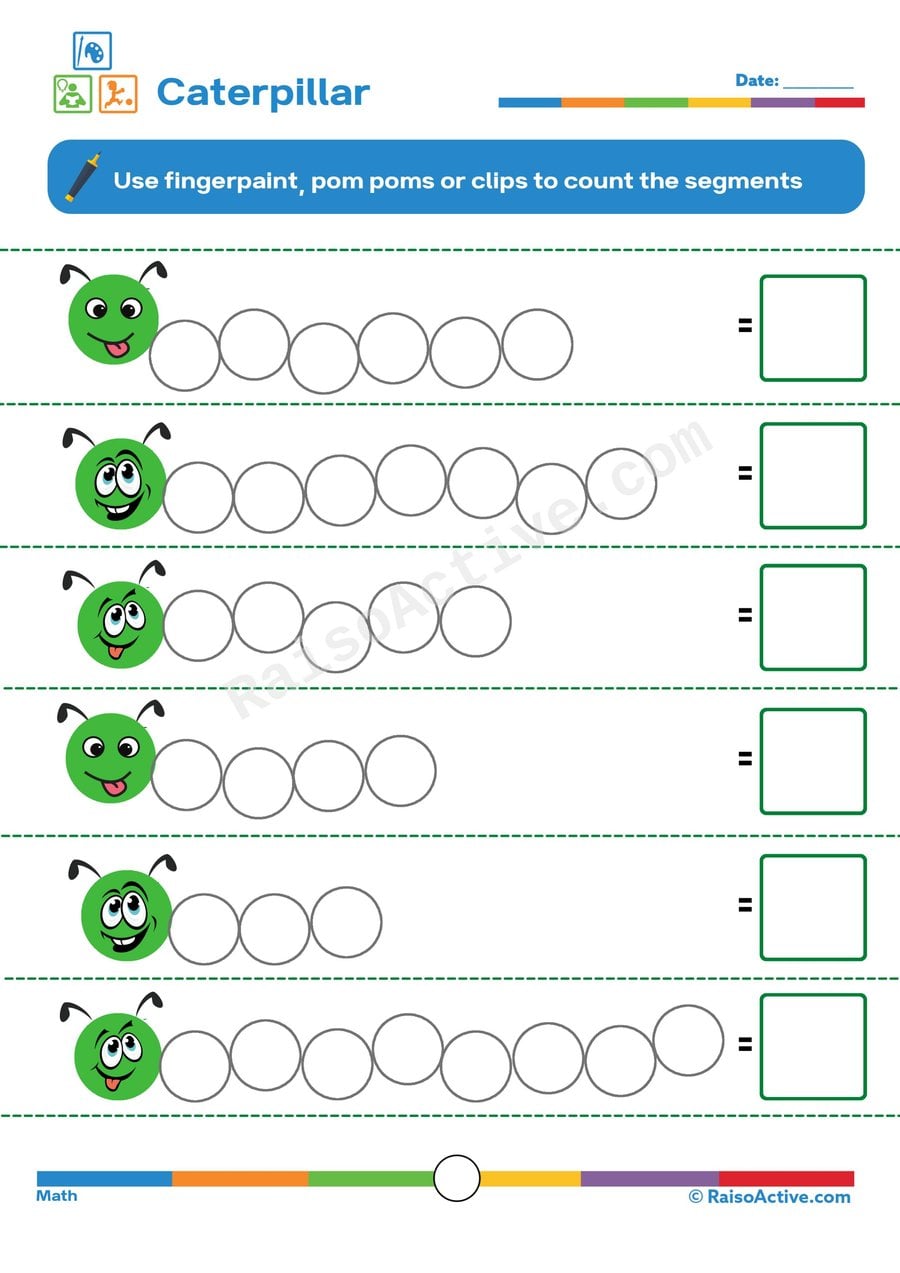
Caterpillar Counting Worksheet for Preschoolers
Ages 3-5 · Preschool–Pre-KAges 3-5 · Nursery–ReceptionAges 3-5 · Nursery–LKGAges 3-5
Counting the segments of each caterpillar teaches children ages 3-5 one-to-one correspondence — touching or marking each segment exactly once while saying a number — which is the core skill underlying accurate counting. Writing the final total in a box also connects the physical act of counting to its written numeral, reinforcing early number-writing practice.
Guides for this topic

Portfolio Assessment with Young Children: A Comprehensive Guide to Meaningful Documentation
Learn how portfolio assessment captures your child's growth through meaningful documentation. Practical tips, templates, and age-appropriate strategies for ages 1-8.
Fostering Creativity in Structured Learning: The Perfect Balance for Young Minds
Learn how to blend creativity with structured learning for children ages 1-8. Practical strategies, activities, and printable worksheets for parents and teachers.
Preparing Your Child for a Rapidly Changing World: Essential Skills for Future Success
Discover the essential 21st century skills your child needs for future success. Practical tips on creativity, critical thinking, digital literacy & emotional intelligence for ages 1-8.
Reviews
Every worksheet for ages 3–5, no watermark
Members download the full library of 1,000+ worksheets and every activity pack without watermarks or daily limits. One year costs ₹999 in India or $20 elsewhere.
See membership plansOr download any worksheet free with a watermark (5 a day).