Physical Activity Worksheet: Spell Your Name!
This worksheet turns spelling practice into a physical activity by pairing each letter of the alphabet with a specific exercise, so children spell their name while getting active movement in between. For ages 3-5, connecting letter recognition to gross motor movement supports both early literacy and physical development at once, appealing especially to kinesthetic learners.
Part of the pack
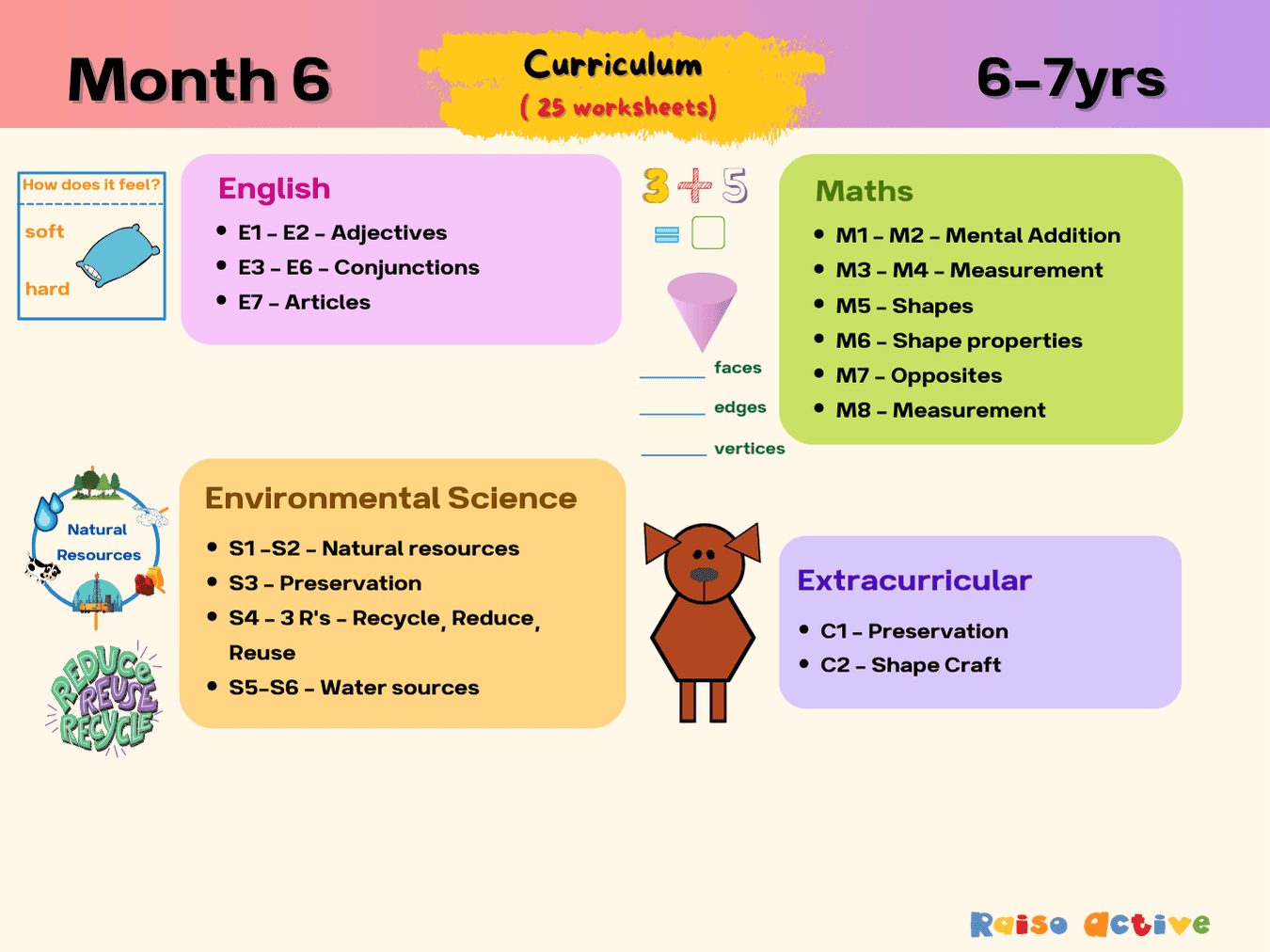
Month 6: Grammar, Math, Environmental Science | Ages 6-7
This is page 28 of the pack. Ages 6-7 · Grade 1Ages 6-7 · Year 2Ages 6-7 · Class 1Ages 6-7
Made for your child
Spelling practice, made for your child
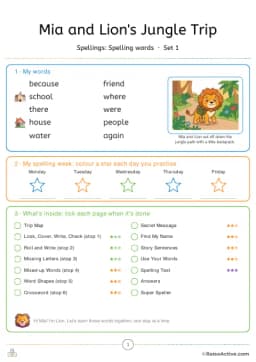
Their own spelling words turned into a pack: trace or look-cover-write-check, roll and write, a secret picture code, a word search, a crossword and a test, with their name in it.
Make a spelling packFree preview · free for members
Or start free: a word search with sight wordsCurriculum
- Physical Education > Physical Activity
How to use this worksheet
Look at the alphabet chart together and talk through the exercise paired with each letter, like jumping jacks for J or squats for S. Have your child spell out their own name letter by letter, either by looking at a name card or from memory if they're able. For each letter in their name, guide them to find the matching exercise on the chart and perform it before moving to the next letter. Continue through every letter of their name, celebrating together once they've completed the full spelled-out workout.
Materials needed
- Pencil
Extension activities
- 1Try spelling a family member's name and performing that set of exercises together as a group activity.
- 2Time how long the whole name-spelling workout takes and try to beat that time on a later day.
- 3Create a brand-new exercise for a letter of the alphabet that doesn't already have one and add it to the chart.
- 4Spell out a favorite short word, like a pet's name or a favorite animal, and do the matching workout.
- 5Turn it into a relay race with siblings or friends, each taking a turn to spell a letter and do its exercise.

Written by
Hemsweta Jain · Teacher Cheena
MBA and Early Childhood Educator, teaching since 2014 · Founder of RaisoActive, Mumbai
Every RaisoActive worksheet is designed and checked by the founder before publishing.
Published · Last reviewed
More from Month 6: Grammar, Math, Environmental Science | Ages 6-7
Measurement Worksheet: Longest to Shortest!
Ages 4-6 · Pre-K–KindergartenAges 4-6 · Reception–Year 1Ages 4-6 · LKG–UKGAges 4-6
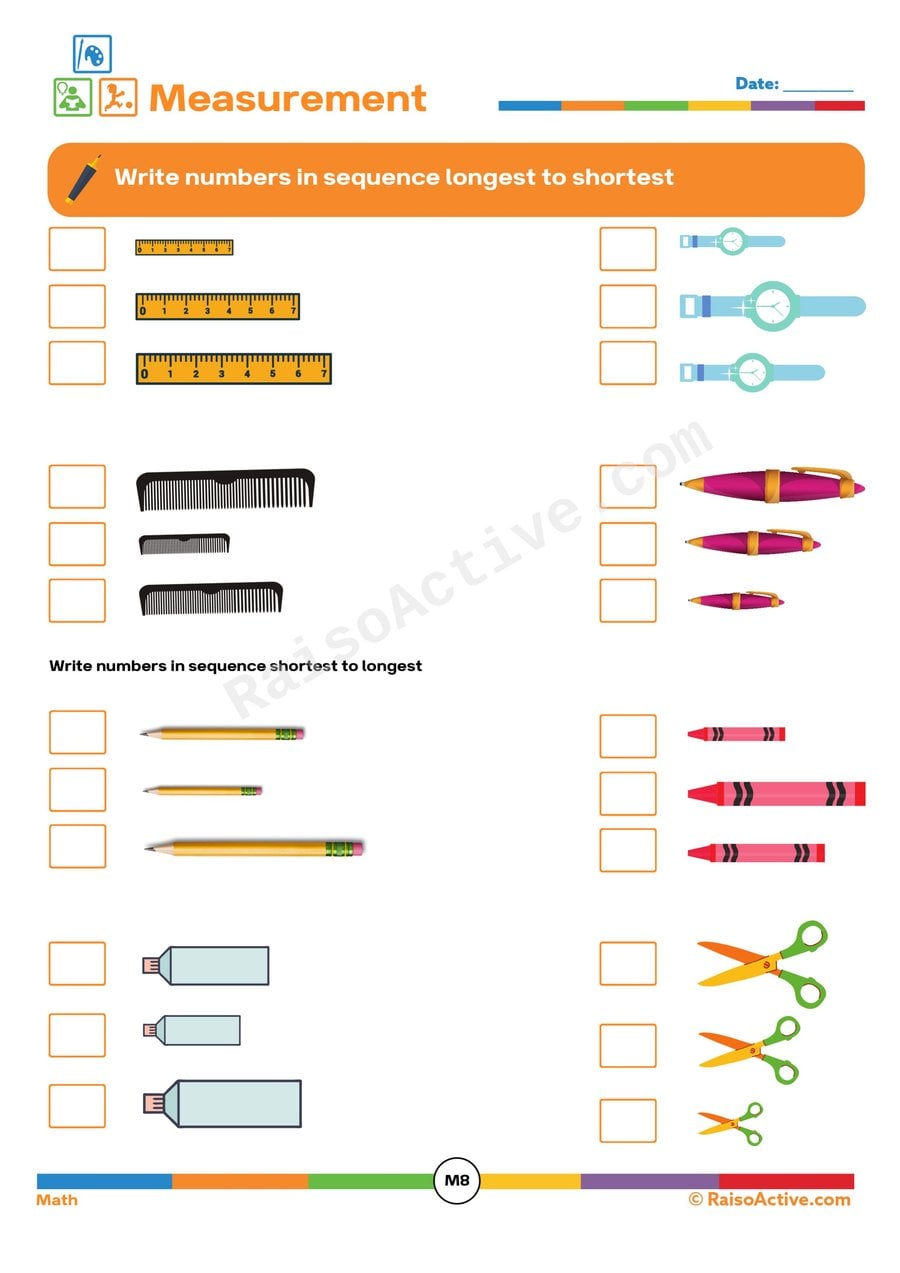
This worksheet builds comparative measurement skills by having children visually assess and rank three objects from longest to shortest and again from shortest to longest, reinforcing that length can be ordered, not just measured in isolation. For ages 4-6, this kind of ordinal comparison is an important stepping stone before children begin measuring with actual units like inches or centimeters.
Natural Resources Matching Worksheet for Kids
Ages 3-5 · Preschool–Pre-KAges 3-5 · Nursery–ReceptionAges 3-5 · Nursery–LKGAges 3-5
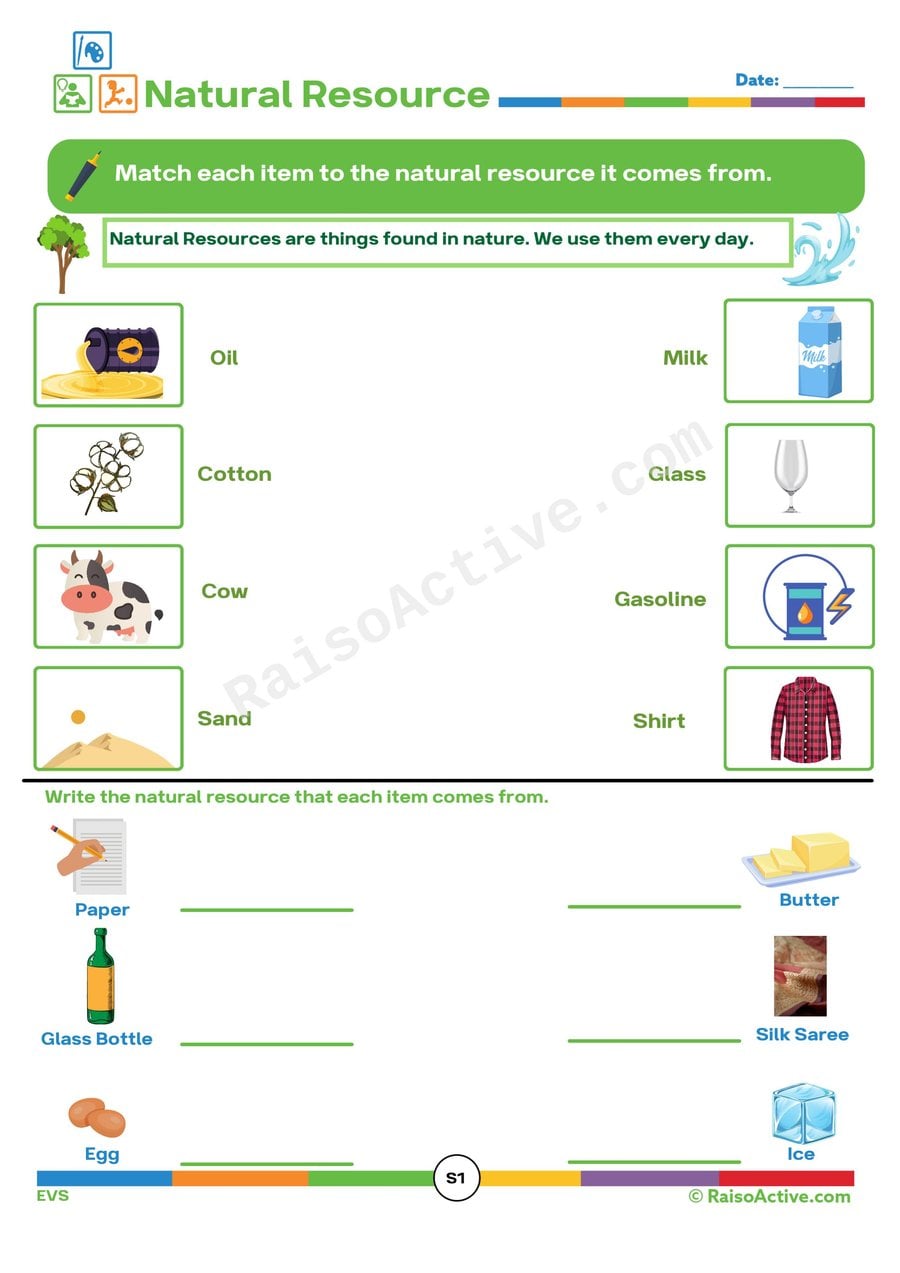
This worksheet deepens understanding of natural resources by asking children to match everyday items, like paper or bread, to the natural resource they originally come from, such as trees or wheat. For ages 3-5, tracing a familiar object back to its natural source builds early cause-and-effect thinking alongside science vocabulary.
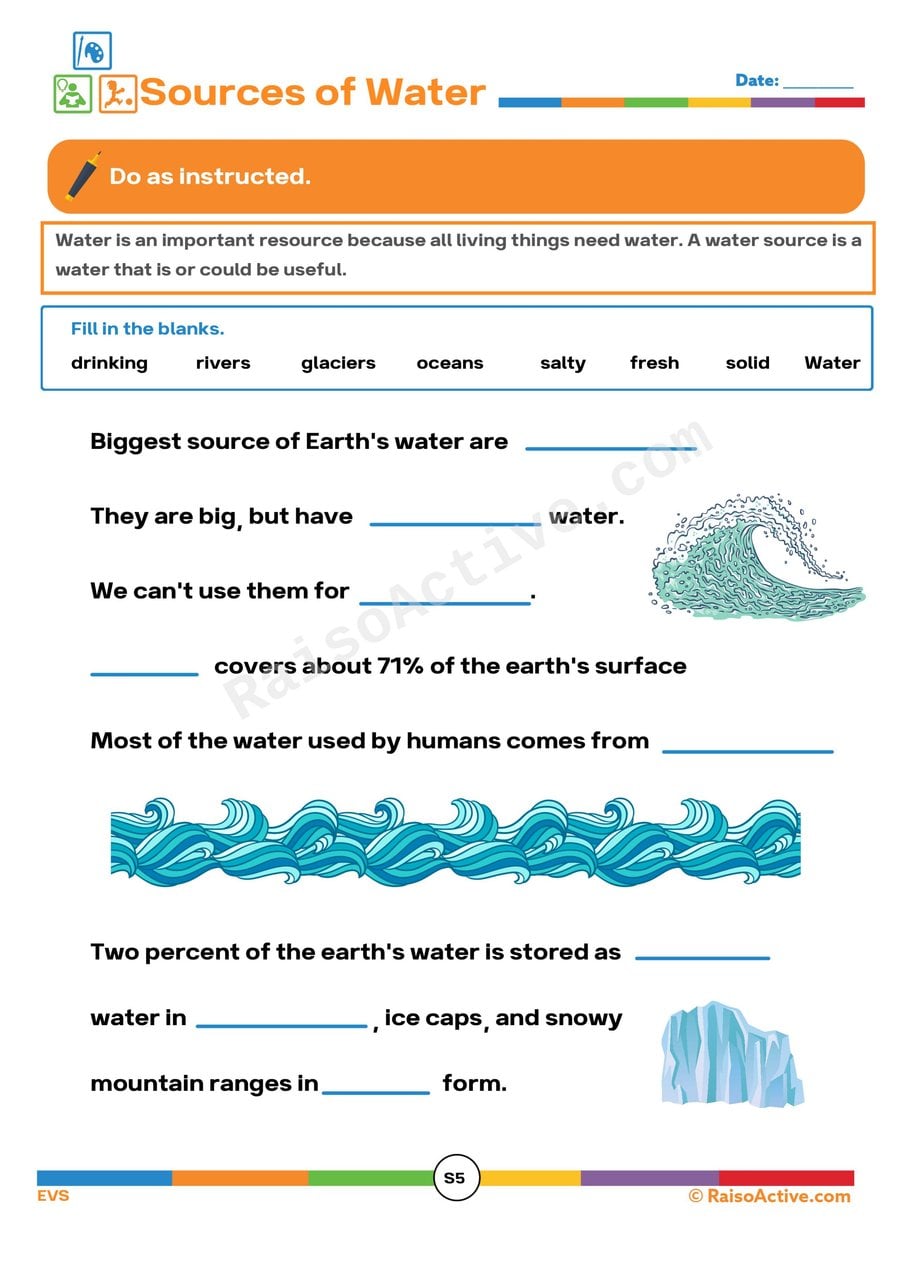
Sources of Water Worksheet for Kids
Ages 3-5 · Preschool–Pre-KAges 3-5 · Nursery–ReceptionAges 3-5 · Nursery–LKGAges 3-5
Learning about different sources of water — like rivers, rain, lakes, and wells — introduces children ages 3-5 to an early environmental science concept: that the water people use every day comes from specific natural places, not just from a tap. Filling in a word bank also reinforces vocabulary and reading skills, requiring children to match a written word to its correct meaning within context.
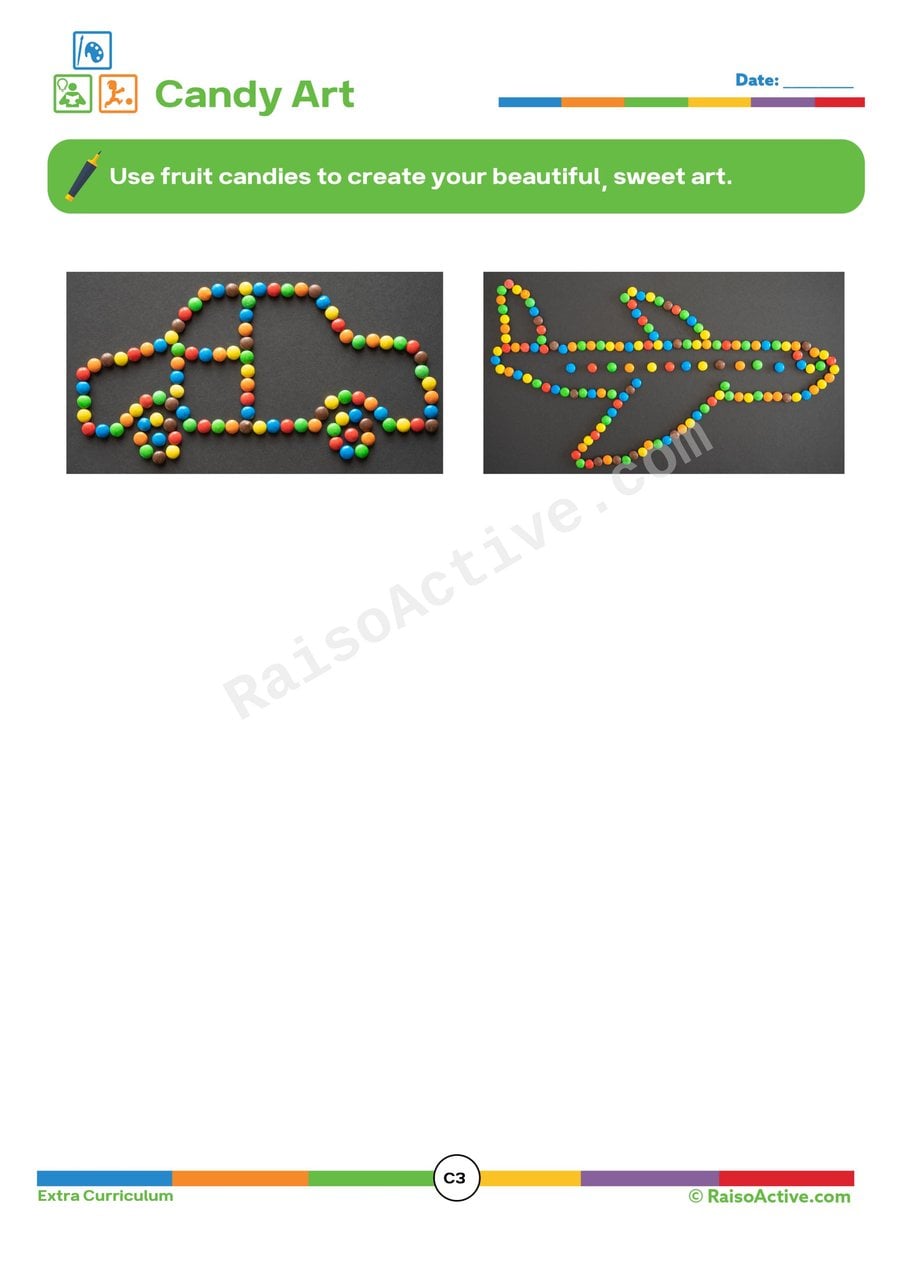
Candy Art: Create Sweet Art with Fruit Candies!
Ages 3-5 · Preschool–Pre-KAges 3-5 · Nursery–ReceptionAges 3-5 · Nursery–LKGAges 3-5
Arranging fruit candies into the outline of a car and an airplane gives children ages 3-5 a playful, sensory way to practice fine motor precision and pattern-following, since each candy must be placed carefully to build the recognizable shape. This open-ended art activity also builds early spatial reasoning, as children figure out how small individual pieces combine to form a larger, specific picture. Because the medium is candy rather than paper, it adds a multisensory, highly motivating twist that keeps younger children engaged longer than a typical craft.

Conjunctions Worksheet: Practice with 'and', 'but', 'so', and 'yet'
Ages 4-6 · Pre-K–KindergartenAges 4-6 · Reception–Year 1Ages 4-6 · LKG–UKGAges 4-6
This worksheet introduces four common coordinating conjunctions, teaching children to notice how 'and,' 'but,' 'so,' and 'yet' each connect ideas differently, whether adding information, showing contrast, or indicating a result. For ages 4-6, this is an early step toward writing compound sentences and understanding that word choice changes the meaning and flow of a sentence.

Mental Addition Worksheet: Add Dots and Find the Total!
Ages 4-6 · Pre-K–KindergartenAges 4-6 · Reception–Year 1Ages 4-6 · LKG–UKGAges 4-6
This worksheet bridges concrete counting and mental addition by having children count visible dots, add them to a given number, and then draw missing dots to complete equations, reinforcing that addition means combining quantities together. For ages 4-6, physically drawing the missing dots makes the abstract equation tangible, helping cement the connection between a math symbol and what it actually represents.
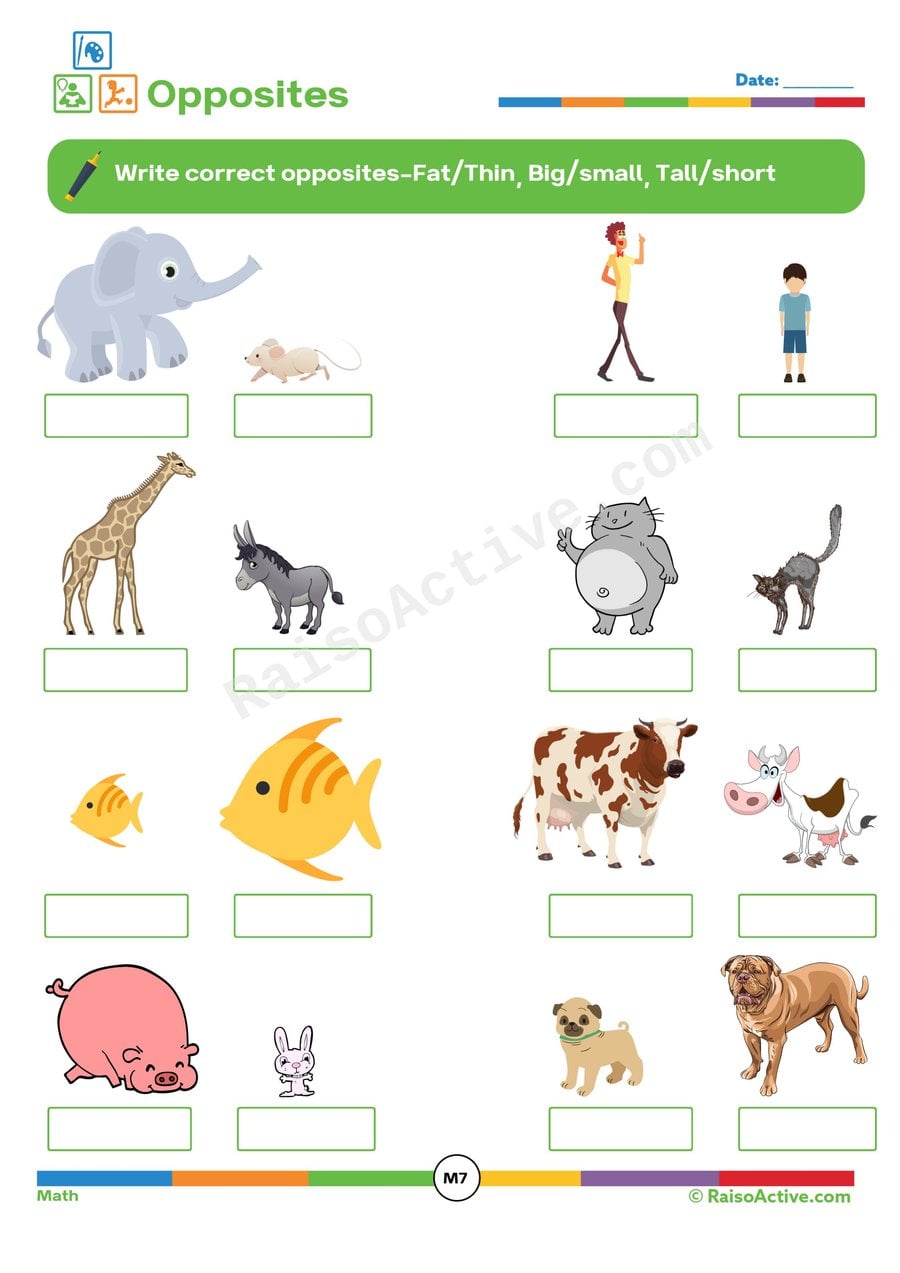
Opposites Worksheet: Fat/Thin, Big/Small, Tall/Short
Ages 3-5 · Preschool–Pre-KAges 3-5 · Nursery–ReceptionAges 3-5 · Nursery–LKGAges 3-5
Identifying opposite pairs like fat and thin, big and small, and tall and short teaches children ages 3-5 to think comparatively, recognizing that these descriptive words only make sense in relation to something else. This early vocabulary work also builds the reasoning skills needed to compare and contrast, a thinking pattern that shows up across science, math, and language throughout their schooling.

Natural Resources Worksheet for Kids: Fill in the Blanks!
Ages 3-5 · Preschool–Pre-KAges 3-5 · Nursery–ReceptionAges 3-5 · Nursery–LKGAges 3-5
This worksheet introduces young children to the idea that everyday materials like water, wood, and air come from the natural world, building early science vocabulary around natural resources. For ages 3-5, matching a picture to its correct word also reinforces beginning reading skills and the idea that objects around them have specific names tied to where they come from.
Related worksheets
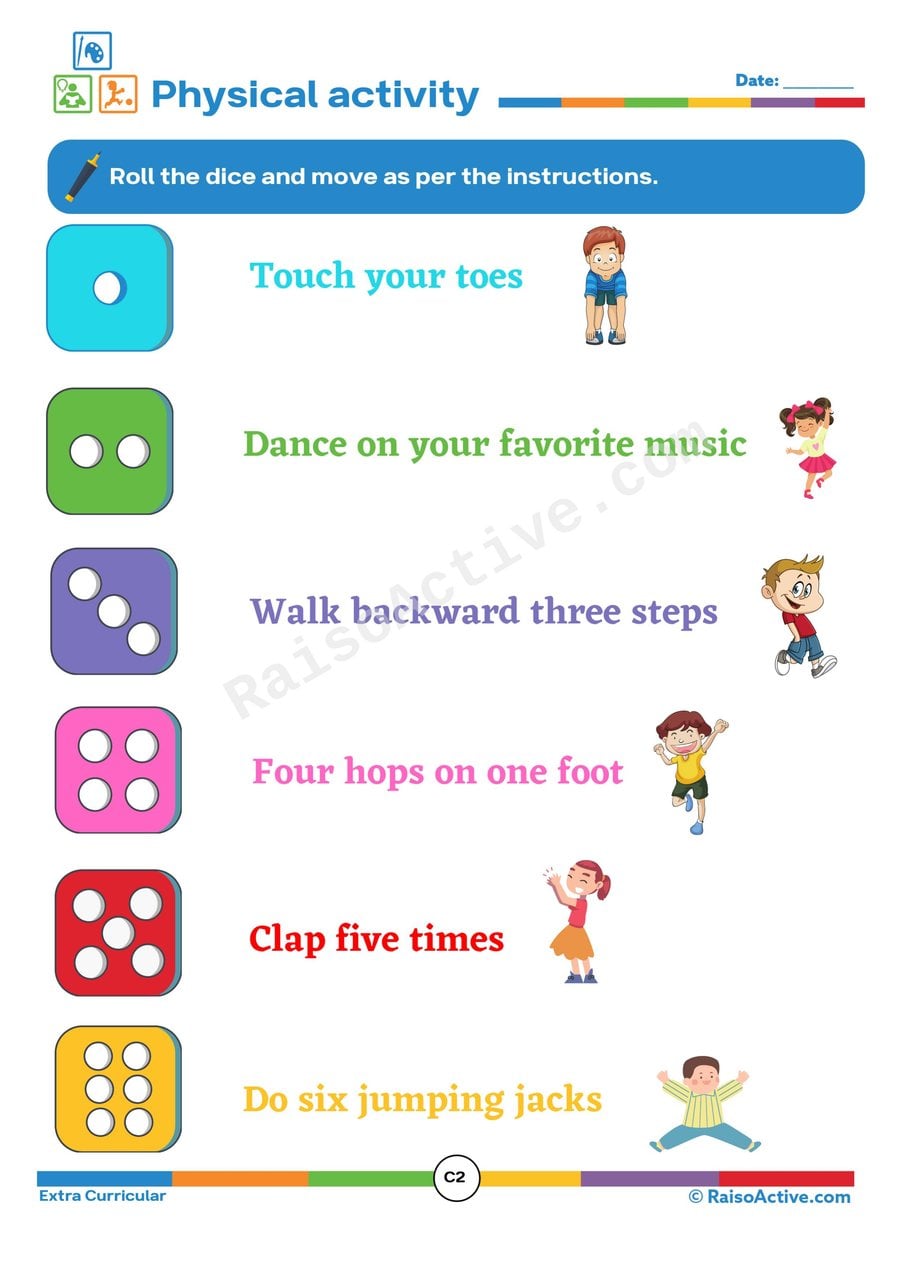
Physical Activity Dice Game Worksheet for Kids
Ages 3-5 · Preschool–Pre-KAges 3-5 · Nursery–ReceptionAges 3-5 · Nursery–LKGAges 3-5
Rolling a die and performing the matching action builds gross motor skills and number recognition together for children ages 3-5, since they must first read the number rolled before they can act on it. Following the sequence of steps also strengthens listening comprehension and the ability to carry out multi-step instructions.

Roll & Move Activity: Fun Physical Activity Cube for Kids!
Ages 3-5 · Preschool–Pre-KAges 3-5 · Nursery–ReceptionAges 3-5 · Nursery–LKGAges 3-5
This cut-and-fold craft combines fine motor skills with gross motor movement, as children build a paper cube featuring different physical actions and then roll it to determine which activity to perform. For ages 3-5, following multi-step folding and gluing instructions builds spatial reasoning and sequencing, while the resulting game encourages active movement and following simple rules.

Simon Says: Follow the Instructions and Get Moving!
Ages 3-5 · Preschool–Pre-KAges 3-5 · Nursery–ReceptionAges 3-5 · Nursery–LKGAges 3-5
This worksheet turns the classic listening game into a written record, having children track which Simon Says instructions they followed correctly. For three- to five-year-olds, the game builds gross motor skills like jumping, spinning, and balancing, while also strengthening auditory attention — the ability to listen carefully and act only when the right cue ('Simon says') is given.
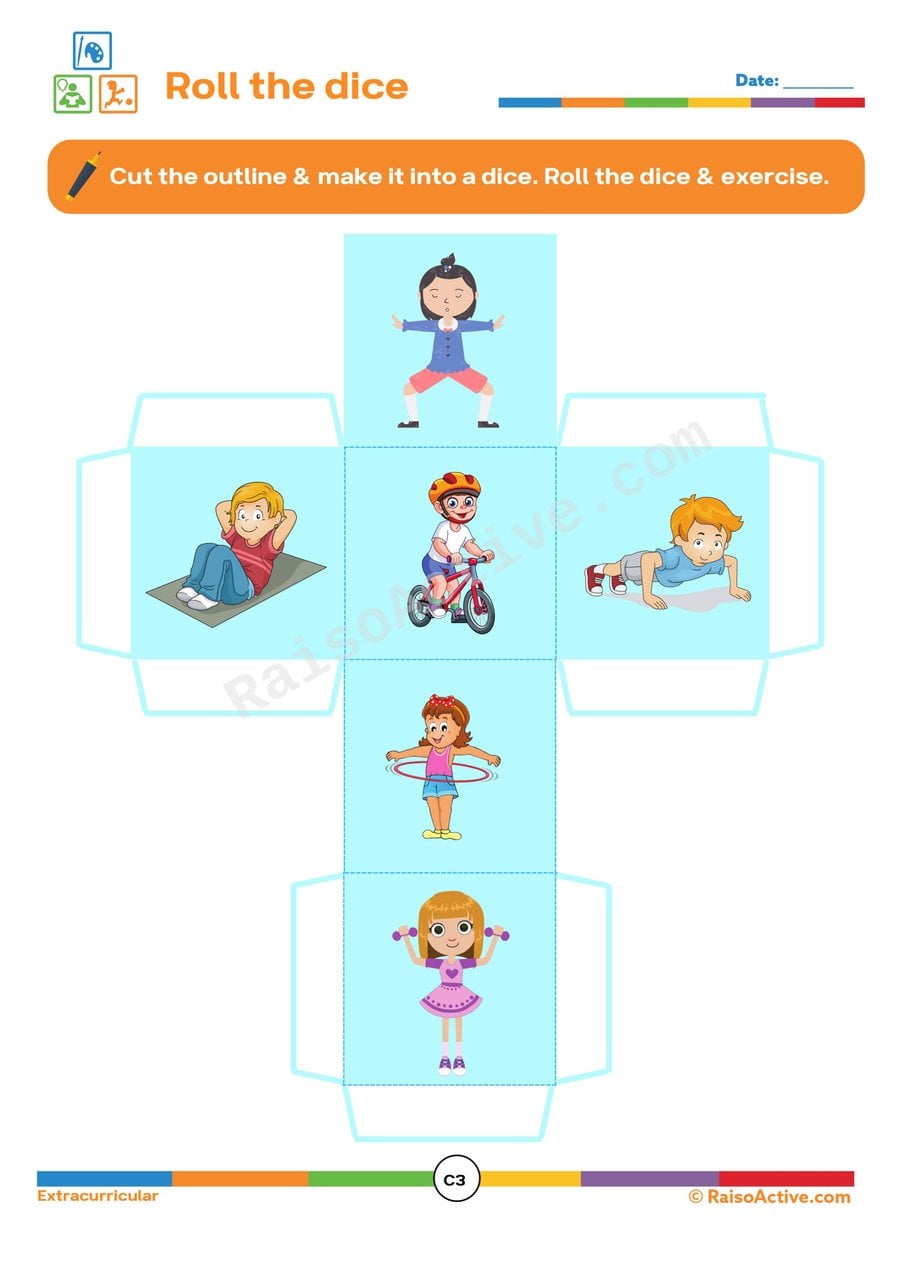
Roll the Dice Exercise Worksheet for Kids
Ages 3-5 · Preschool–Pre-KAges 3-5 · Nursery–ReceptionAges 3-5 · Nursery–LKGAges 3-5
This worksheet gets children ages 3-5 moving as they assemble a paper dice, roll it, and perform whichever physical exercise lands face-up, combining gross motor development with basic probability and turn-taking. Following a picture-based instruction and translating it into a physical action also builds the same instruction-following skill children need for classroom directions.

Physical Activity Worksheet for Kids: Identify and Tick!
Ages 4-6 · Pre-K–KindergartenAges 4-6 · Reception–Year 1Ages 4-6 · LKG–UKGAges 4-6
This identify-and-tick worksheet asks children ages 4-6 to sort a row of pictures into 'physical activity' and 'everyday chore' categories, building the classification skills that underlie early scientific thinking. Ticking the correct boxes also reinforces visual discrimination, since children must notice differences in body position and action between, say, jumping and sweeping. At this age, connecting movement with fun helps children start to associate exercise with enjoyment rather than obligation.

Caterpillar Activity Worksheet: Follow Instructions and Move!
Ages 3-5 · Preschool–Pre-KAges 3-5 · Nursery–ReceptionAges 3-5 · Nursery–LKGAges 3-5
This worksheet helps children ages 3-5 practice following multi-step instructions while getting active, as they move along a caterpillar's body and perform a different physical action in each circle, such as jumping or spinning. Combining movement with sequential instructions builds gross motor skills, listening comprehension, and the ability to hold a sequence of directions in mind.
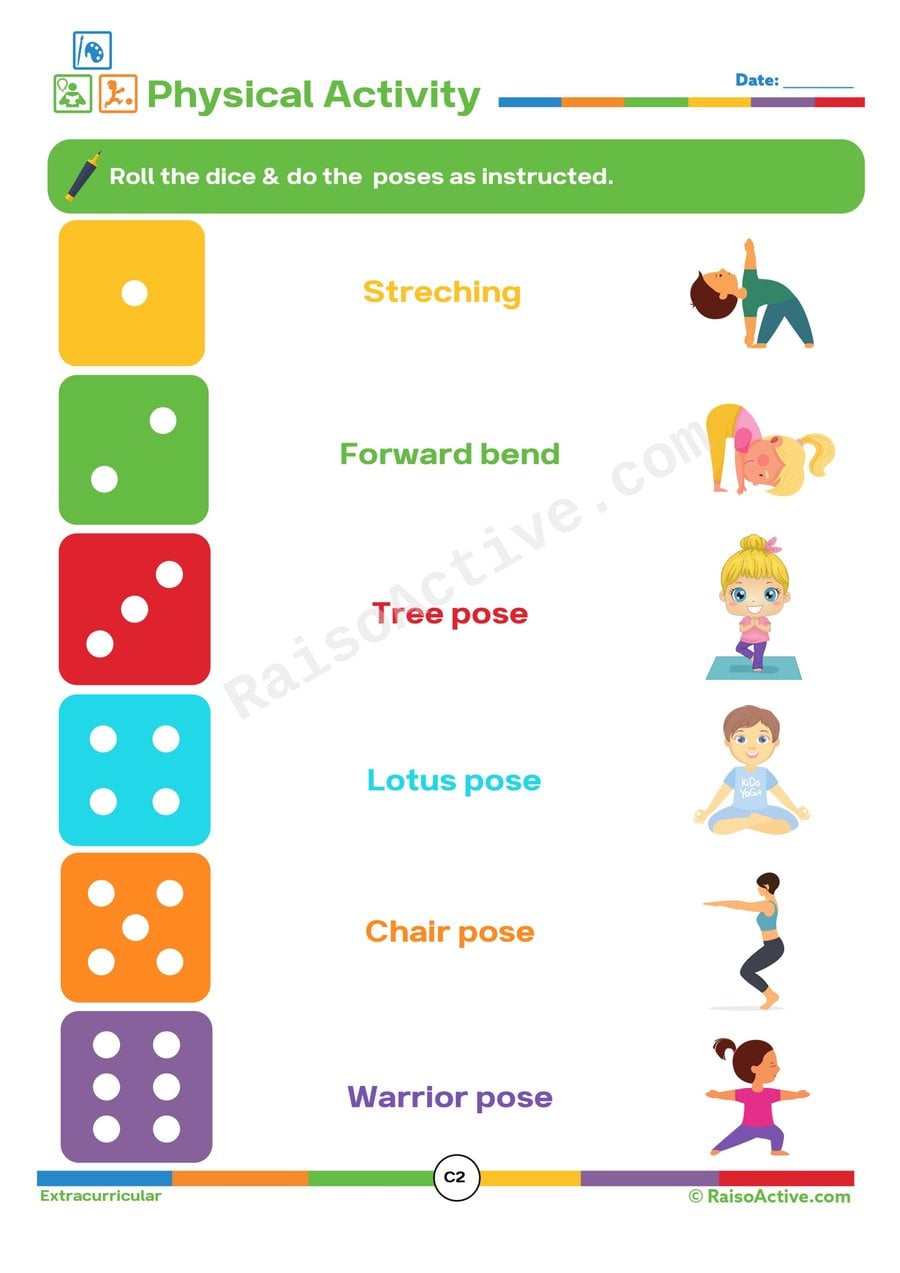
Physical Activity Dice Game: Yoga Poses for Kids!
Ages 3-5 · Preschool–Pre-KAges 3-5 · Nursery–ReceptionAges 3-5 · Nursery–LKGAges 3-5
Rolling a dice and matching the number to a yoga pose introduces children ages 3-5 to basic gross motor movement and body control in a playful, game-based format, while also reinforcing number recognition through the dice roll itself. Practicing simple yoga poses like this builds balance, body awareness, and an early habit of calm, mindful movement.

Complete the Words: A Fun Worksheet for Early Readers!
Ages 3-5 · Preschool–Pre-KAges 3-5 · Nursery–ReceptionAges 3-5 · Nursery–LKGAges 3-5
This worksheet helps children ages 3-5 practice early letter recognition and phonics as they look at a picture and fill in the missing letters to complete an animal-themed word. Saying the finished word aloud after writing it connects the written letters to their spoken sounds, reinforcing the link between reading and speaking that underlies early literacy.
Reviews
Every worksheet for ages 3–5, no watermark
Members download the full library of 1,000+ worksheets and every activity pack without watermarks or daily limits. One year costs ₹999 in India or $20 elsewhere.
See membership plansOr download any worksheet free with a watermark (5 a day).