Long, Tall, Short Worksheet: Comparing Objects!
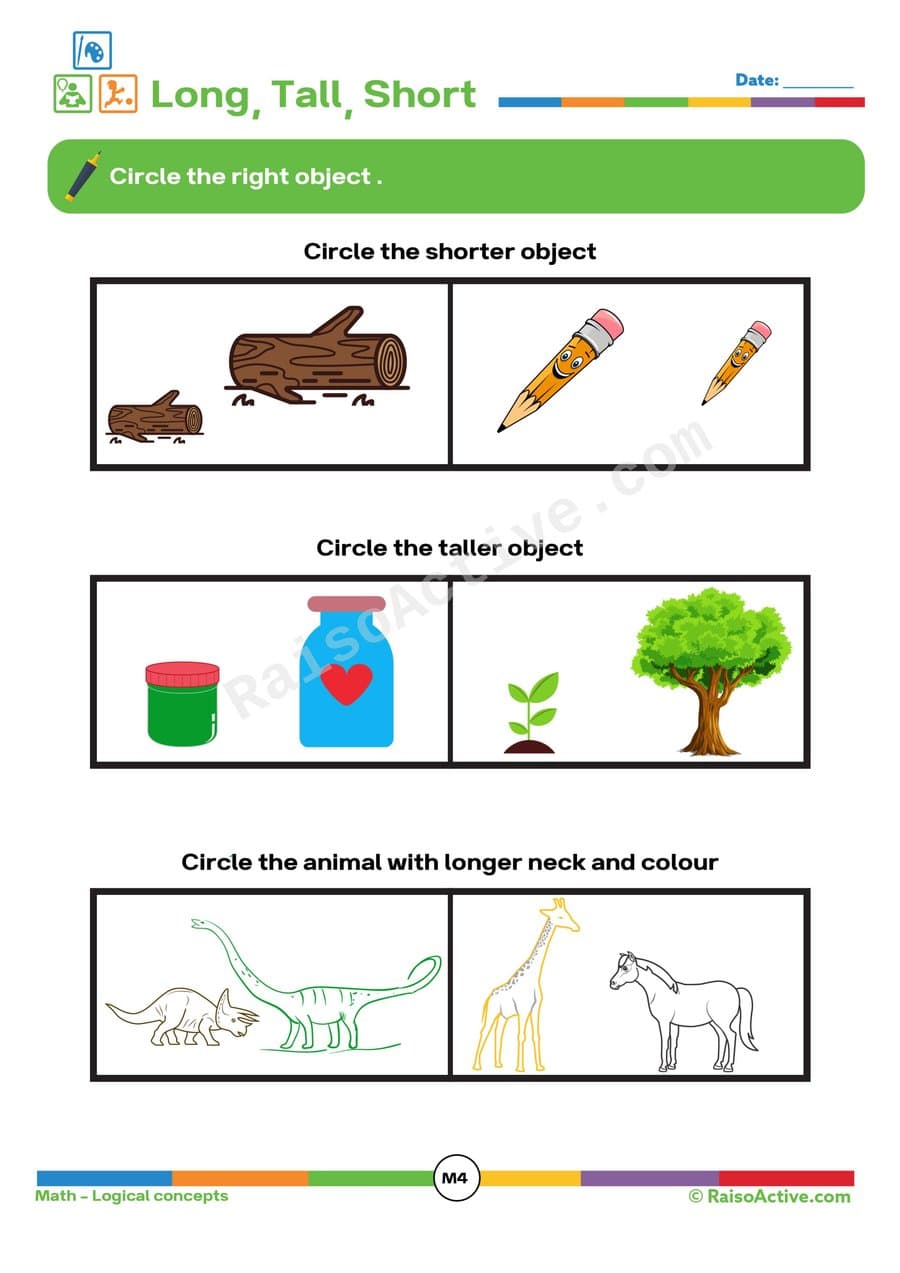
This worksheet guides your child in visually comparing objects based on their length and height, using terms like "long," "tall," and "short." By matching items with specific size descriptions, children aged 3-5 build essential observation skills and foundational pre-math understanding of attributes. This practice helps develop their vocabulary for describing the world around them and strengthens critical thinking as they distinguish subtle differences.
Part of the pack
Month 1: Learning & Development | Ages 4-5Curriculum
How to use this worksheet
Begin by looking at each row of pictures on the worksheet together. For each set, read aloud the instruction, such as "Circle the longest pencil" or "Point to the shortest ladder." Encourage your child to carefully observe and compare the items within that specific group. Once they've identified the object matching the description, have them circle it with a crayon or pencil. Discuss their choices, asking, "Why do you think that one is the tallest?"
Materials needed
- Pencil
- Crayons
Extension activities
- •Go on a "size hunt" around the house, finding one long, one tall, and one short object.
- •Use building blocks or LEGOs to construct towers of different heights and compare which is "taller" or "shorter."
- •Draw two objects, like a snake and a worm, and label them "long" and "short."
- •Compare the lengths of family members' shoes or the heights of different plants in the garden.
- •Read a storybook and identify characters or objects described as long, tall, or short.
Tips for parents and teachers
When working through the worksheet, emphasize the vocabulary "long," "tall," and "short" consistently, pointing to real-world examples. Help children understand that "long" usually refers to horizontal length, while "tall" refers to vertical height. If your child struggles, provide verbal cues or physically line up objects to make comparisons clearer. Celebrate their effort and encourage descriptive language.

Written by
Hemsweta Jain · Teacher Cheena
MBA and Early Childhood Educator, teaching since 2014 · Founder of RaisoActive, Mumbai
Every RaisoActive worksheet is designed and checked by the founder before publishing.
Published · Last reviewed
Related worksheets

Comparing Numbers Worksheet: Greater Than, Less Than, and Equal To!
Children ages 4-6 learn to compare two numbers and choose the correct symbol — greater than, less than, or equal to — building an essential foundation for later work with inequalities and algebra. Comparing quantities and representing the relationship symbolically is a more abstract skill than simple counting, so this worksheet stretches children just past straightforward number recognition into true numerical reasoning.

Many vs. Few: Object Counting Worksheet for Preschoolers
This worksheet builds early quantity comparison skills as children ages 3-5 look at groups of objects and decide whether each group shows 'many' or 'few.' Beyond simple counting, this task develops relative reasoning — understanding that quantity is judged by comparison, not just a fixed number — which lays groundwork for later concepts like greater than and less than. Circling the correct group also reinforces visual scanning and attention to detail.

Counting and Comparing: Greater Than, Less Than, or Equal To Worksheet
This worksheet builds on basic counting by asking children to compare two separate groups of pictures and decide whether one group has more, fewer, or the same number as the other, then represent that relationship with the correct symbol. For four- to six-year-olds, this task combines accurate counting with comparative reasoning, both of which are essential building blocks for later mathematical problem solving.

Alligator Comparison Worksheet: Greater Than, Less Than, and Equal To!
This worksheet teaches children ages 4-6 to compare two numbers using the 'hungry alligator' mnemonic, where the alligator's mouth always opens toward the larger number. Understanding greater than, less than, and equal to is an essential building block for later place value, ordering, and basic algebra concepts.

More or Less Worksheet: Comparing Quantities for Preschoolers
This worksheet helps children ages 3-5 understand the concepts of 'more' and 'less' by counting and comparing different groups of pictured objects, like eggs in a nest or fruits in a basket. Comparing quantities visually and numerically builds early number sense that supports later addition, subtraction, and greater-than or less-than reasoning.

Comparing Numbers: Apples, Soccer Balls, and More! - Math Worksheet
This worksheet teaches children to compare two quantities using the symbols greater than (>), less than (<), and equal to (=) by counting groups of everyday objects like apples and soccer balls. For four- and five-year-olds, learning to read and use comparison symbols is an early step toward understanding mathematical relationships beyond simple counting.

Comparing Objects: A Fun Counting Worksheet for Preschoolers!
This worksheet has 4-5 year olds count two groups of objects and then compare the totals using the greater-than, less-than, and equal-to symbols — an early but genuine step into formal math notation that goes beyond simple counting into representing a comparison symbolically. Because your child has to count accurately before comparing, this worksheet also reinforces that math symbols stand for real relationships between quantities, not arbitrary marks to memorize.

Count and Compare: Fun Math Worksheet for Preschoolers
Counting two groups of objects and then choosing the correct greater-than, less-than, or equal-to symbol introduces children ages 3-5 to comparative reasoning, a step beyond simple counting that asks them to judge relationships between quantities. This worksheet turns an abstract math symbol into something concrete by grounding it in objects they've just counted themselves, rather than presenting the symbol in isolation. Learning to compare quantities this early builds the number sense needed for later addition, subtraction, and general mathematical reasoning.
Guides for this topic
Number Formation Rhymes 0–9 and How to Fix Reversals
Original number formation rhymes for 0–9, the correct stroke order for each digit, why 3, 5 and 7 get reversed most often, and multisensory fixes that work.
Best Worksheets for 3-Year-Olds: What Works and What to Avoid
What works on worksheets for 3-year-olds: short sessions, crayons, tracing lines, matching, cutting, a free weekly plan, and signs one is too advanced.
Age-Appropriate Problem-Solving Activities: Building Critical Thinkers from the Ground Up
Discover fun, age-appropriate problem-solving activities for children ages 1-8. Build critical thinking, logic, and reasoning skills through play-based learning.
Reviews
Every worksheet for ages 3–5, no watermark
Members download the full library of 1,000+ worksheets and every activity pack without watermarks or daily limits. One year costs ₹1,000 in India or $20 elsewhere.
See membership plansOr download any worksheet free with a watermark (5 a day).