Mickey Mouse Number Sequence Worksheet: Counting and Matching
Filling gaps in a number sequence — knowing that 4 comes after 3 and before 5 — is a different skill from simply counting a pile of objects; it asks a 4-6 year old to hold the whole order in mind rather than count from one each time. Cutting and pasting the missing numbers into place adds a fine-motor and precision layer on top of the counting itself.
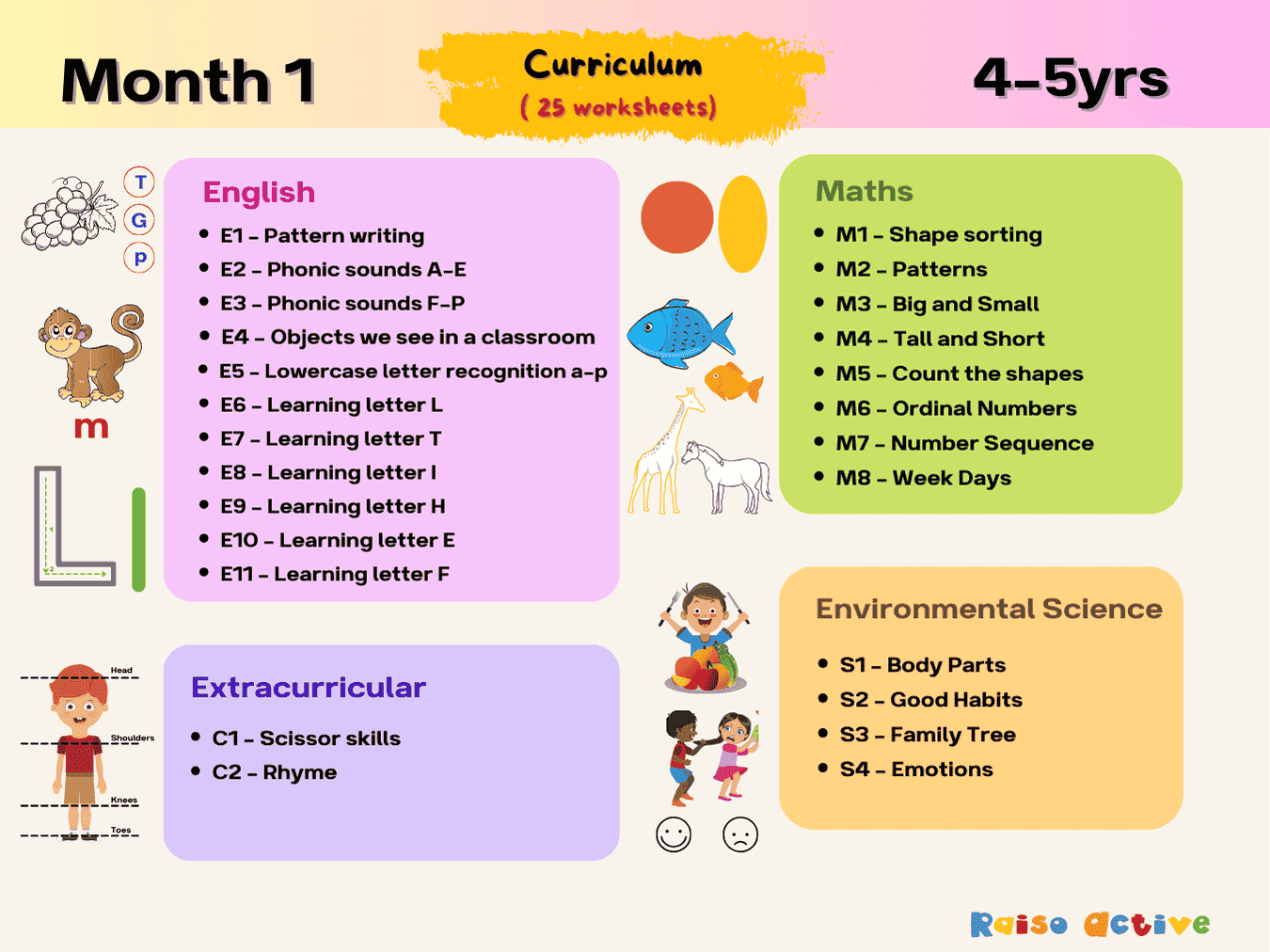
Part of the pack
Month 1: Learning & Development | Ages 4-5
This is page 21 of the pack. Ages 4-5 · Pre-KAges 4-5 · ReceptionAges 4-5 · LKGAges 4-5
Made for your child
Counting to 10, made for your child
A maths pack with your child's name in it: pictures that explain, practice at three levels, puzzles and story sums about them. Print a new set whenever they finish.
Make a maths packFree preview · free for members
Curriculum
- Number Sense > Number Sequencing
How to use this worksheet
Before cutting anything, read the visible numbers on the page aloud in order together, pausing at each gap so your child predicts what number belongs there. Cut apart the loose numbers at the bottom of the page, then have them find the correct one for each gap and glue it in place. Recount the finished sequence from the very start once every gap is filled, to confirm it reads correctly end to end.
Materials needed
- Scissors
- Glue or Tape
- Pencil
Extension activities
- 1Write a number sequence with a gap on a whiteboard and have your child call out the missing number.
- 2Use a deck of cards to lay out a run of numbers with one card flipped face down as the 'missing' one.
- 3Count backward together from the highest number on the page to one.
- 4Hop on one number at a time on a homemade hopscotch grid drawn with chalk.
- 5Line up toy cars and give each one a number, then ask which car is missing when you remove one.

Written by
Hemsweta Jain · Teacher Cheena
MBA and Early Childhood Educator, teaching since 2014 · Founder of RaisoActive, Mumbai
Every RaisoActive worksheet is designed and checked by the founder before publishing.
Published · Last reviewed
More from Month 1: Learning & Development | Ages 4-5

Parent's Guide: Fun Activities for Gross Motor Skills and More!
Ages 3-5 · Preschool–Pre-KAges 3-5 · Nursery–ReceptionAges 3-5 · Nursery–LKGAges 3-5
This parent's guide explains why gross motor skills, the large muscle movements involved in running, jumping, climbing, and balancing, need to develop before fine motor skills like pencil control fully mature in children ages 3-5. Understanding this progression helps a parent or teacher choose age-appropriate physical activities and recognize that time spent climbing, running, and balancing is directly building the strength and coordination needed for later table-top and handwriting tasks.
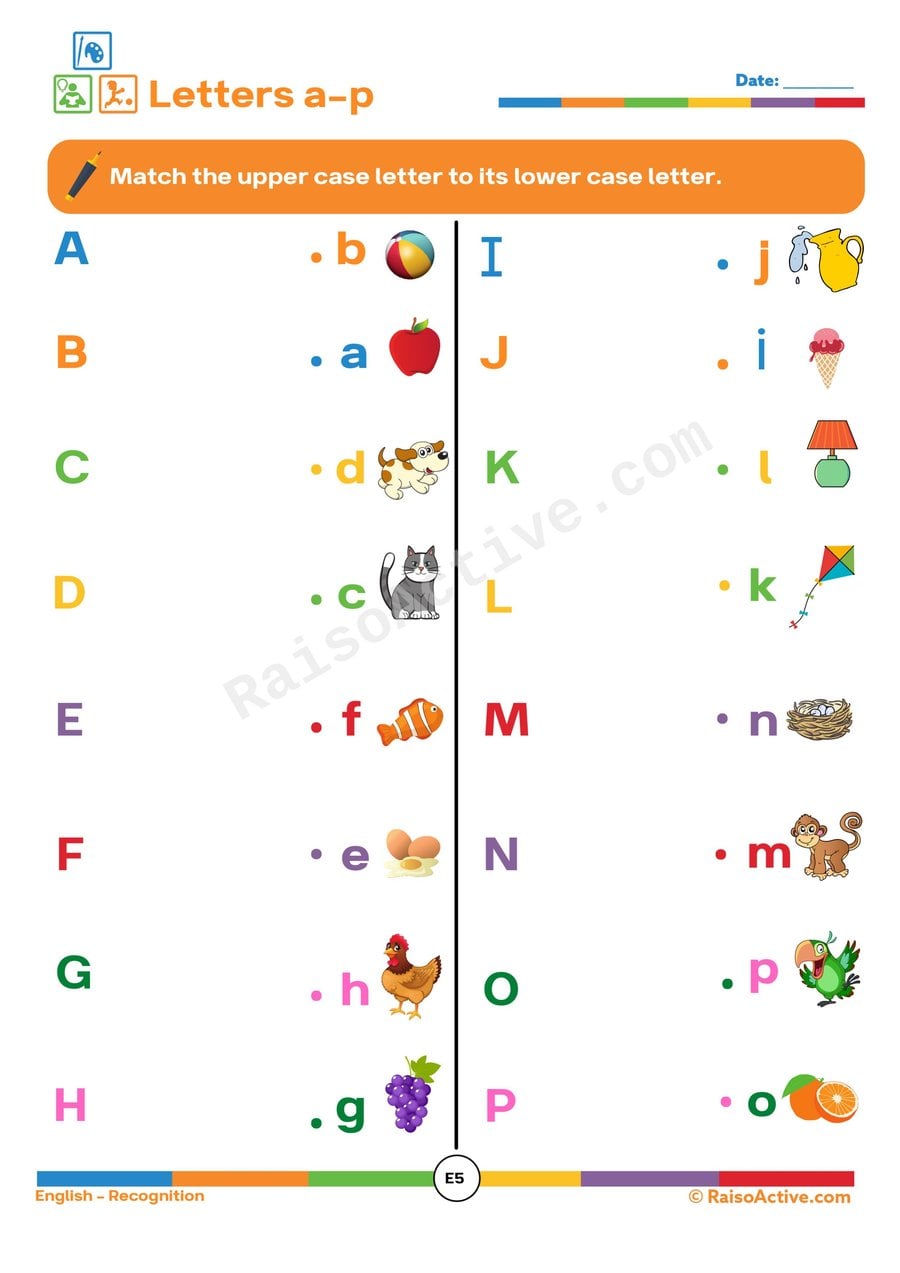
Match the Uppercase Letters: A-P Worksheet
Ages 4-5 · Pre-KAges 4-5 · ReceptionAges 4-5 · LKGAges 4-5
This worksheet strengthens your child's visual discrimination skills by focusing on uppercase letters from A to P. Children aged 4-5 years develop crucial pre-reading abilities as they learn to identify and pair identical letter forms. Mastering this matching task builds a strong foundation for future letter recognition and early literacy success.
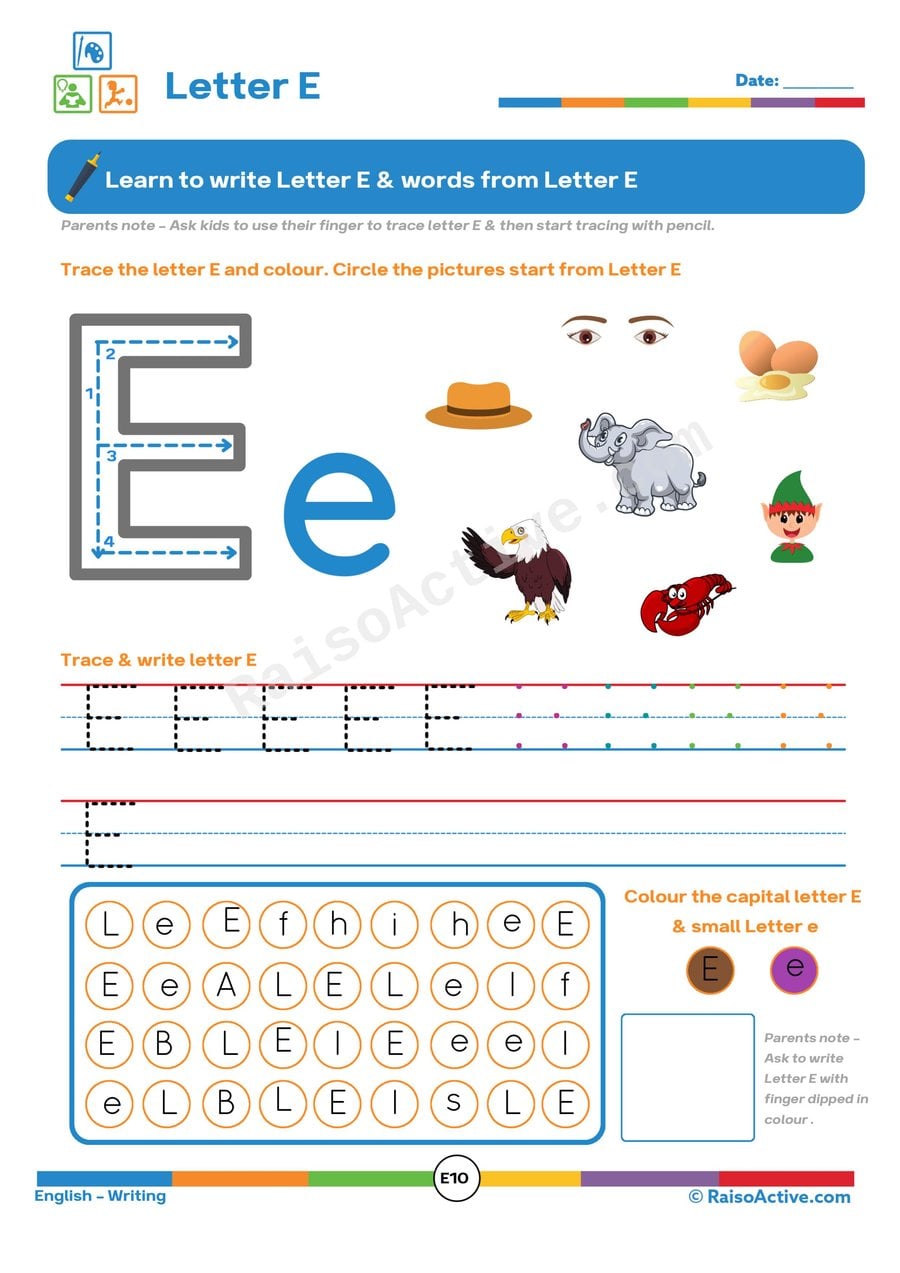
Letter E Fun: Trace, Color, and Learn!
Ages 3-5 · Preschool–Pre-KAges 3-5 · Nursery–ReceptionAges 3-5 · Nursery–LKGAges 3-5
Tracing and writing the letter E gives children ages 3-5 practice with one vertical stroke and three horizontal strokes, a slightly more complex letter shape than single-curve letters, which builds precision in stopping and starting a pencil at the right point. Alongside the physical writing practice, coloring and simple recognition activities reinforce that this shape and sound go together, an early step toward connecting letters with the words they start.
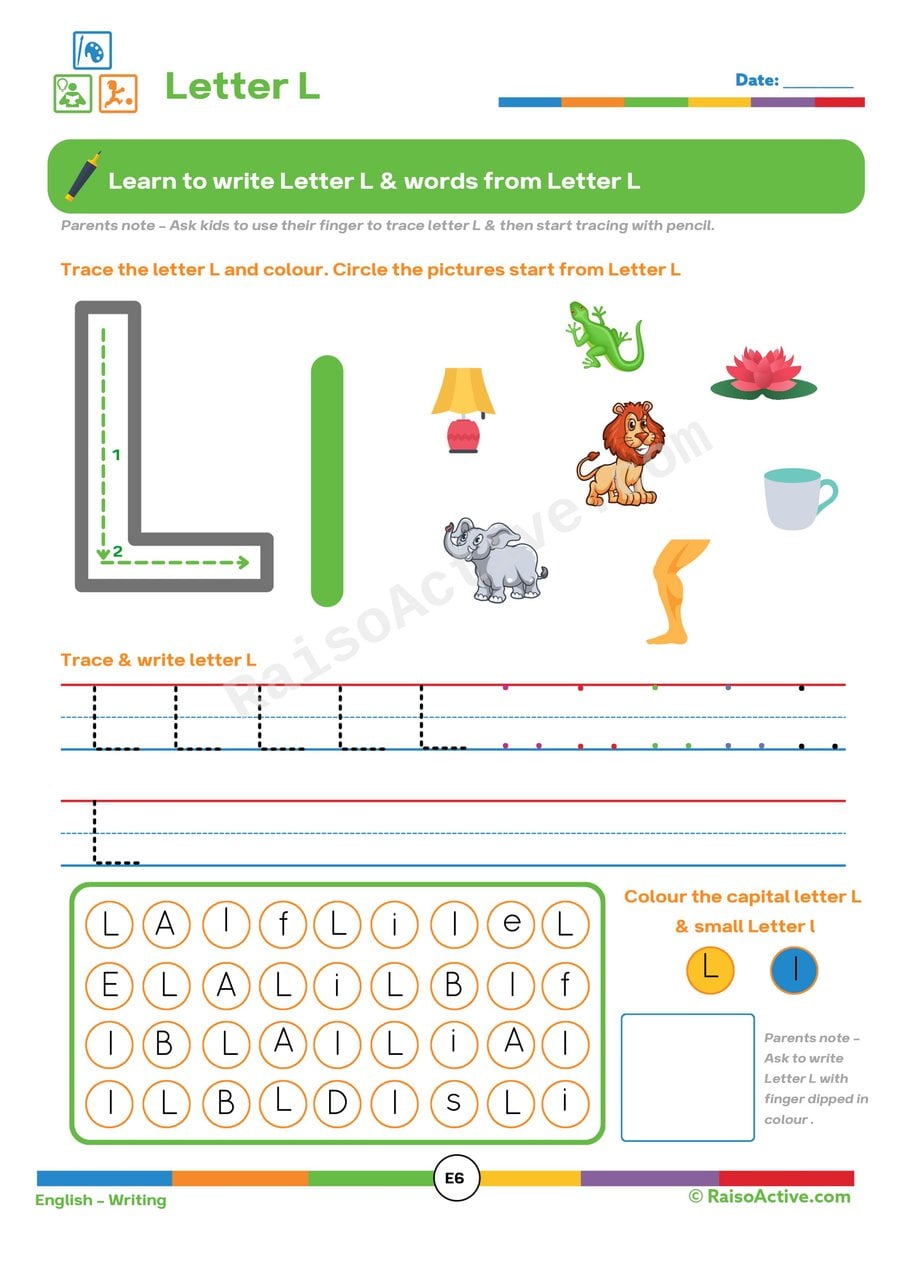
Letter L Worksheet: Trace, Color, and Learn!
Ages 3-5 · Preschool–Pre-KAges 3-5 · Nursery–ReceptionAges 3-5 · Nursery–LKGAges 3-5
Tracing the letter L builds the top-to-bottom, left-to-right pencil strokes that show up again in dozens of other letters, so this is one of the more transferable shapes a 3-5 year old can practice. Naming and coloring objects that start with L — a lion, a ladder, a leaf — ties the shape to its sound, which is exactly how early readers start linking print to speech.

My Body Parts Matching Worksheet for Preschoolers
Ages 3-5 · Preschool–Pre-KAges 3-5 · Nursery–ReceptionAges 3-5 · Nursery–LKGAges 3-5
Matching body part pictures to their names or functions helps children ages 3-5 build body awareness vocabulary, connecting a word like 'elbow' or 'knee' to the correct part of their own body. This kind of labeling activity also supports early self-care and safety skills, since children who can name body parts accurately can better communicate if something hurts or needs attention.
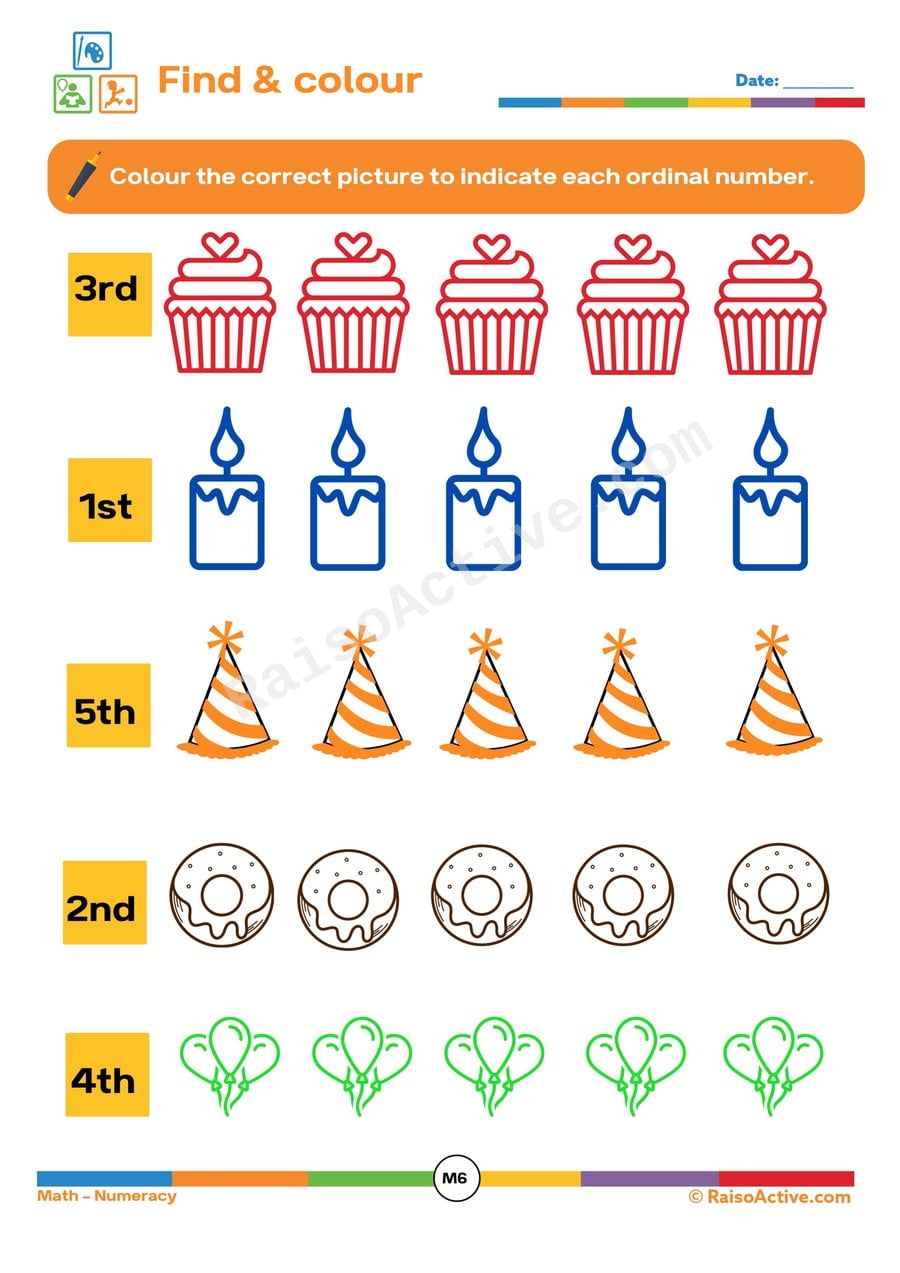
Find and Color Ordinal Numbers Worksheet
Ages 4-6 · Pre-K–KindergartenAges 4-6 · Reception–Year 1Ages 4-6 · LKG–UKGAges 4-6
Finding and coloring items based on their ordinal position, like the third balloon or the first star, teaches children ages 4-6 a different kind of counting than they may be used to. Ordinal numbers describe position in a sequence, first, second, third, rather than quantity, and this distinction is a genuinely tricky concept that takes deliberate practice to master, forming an important foundation for later math concepts like sequencing steps.

Butterfly Cutting Practice Worksheet for Preschoolers
Ages 3-5 · Preschool–Pre-KAges 3-5 · Nursery–ReceptionAges 3-5 · Nursery–LKGAges 3-5
Cutting along a butterfly's wing outline gives children ages 3-5 focused scissor practice with a mix of straight and gently curved edges, building the specific hand strength and control needed for more advanced cutting tasks. Scissor skills like this directly support later pencil control too, since both rely on similar hand muscles and a steady, coordinated grip between two hands.

Diamond Shape Counting and Matching Worksheet for Preschoolers
Ages 3-5 · Preschool–Pre-KAges 3-5 · Nursery–ReceptionAges 3-5 · Nursery–LKGAges 3-5
This diamond-themed worksheet helps 3-5 year olds tell a diamond apart from squares, circles, and triangles by its four slanted sides and pointed top and bottom, a shape many preschoolers find trickier than rounder or more symmetrical ones. Counting the diamonds one at a time builds one-to-one correspondence, and matching same-sized diamonds strengthens visual discrimination, the skill of spotting small differences between similar-looking shapes.
Related worksheets
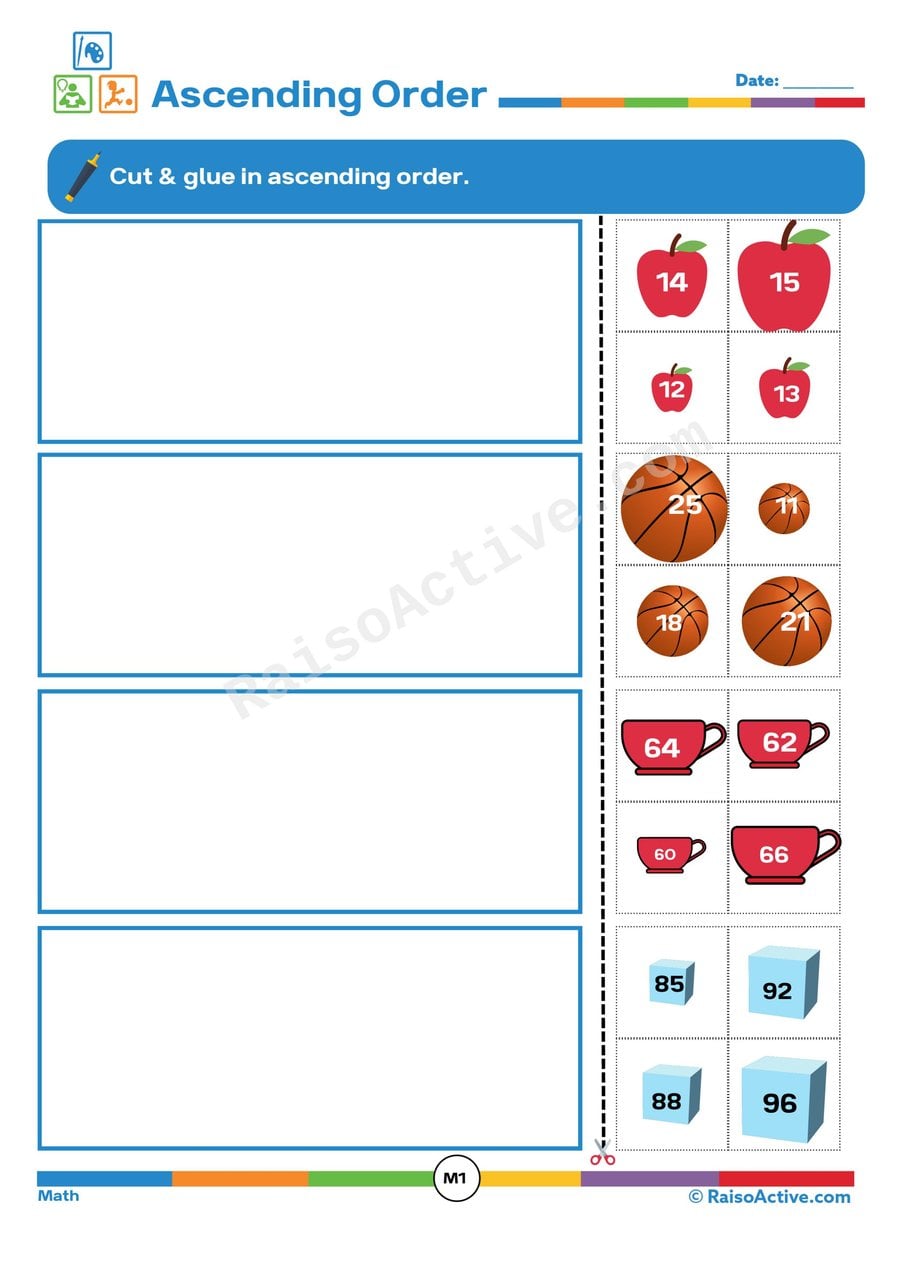
Ascending Order Worksheet: Cut and Paste Numbers!
Ages 4-6 · Pre-K–KindergartenAges 4-6 · Reception–Year 1Ages 4-6 · LKG–UKGAges 4-6
This worksheet has children ages 4-6 physically manipulate number cutouts to arrange them from least to greatest, building both number sequencing and the underlying concept that numbers represent increasing quantity. Because the numbers must be cut, sorted, and glued rather than simply read in order, this activity combines fine motor practice with active number reasoning, requiring children to compare each new number against those already placed.
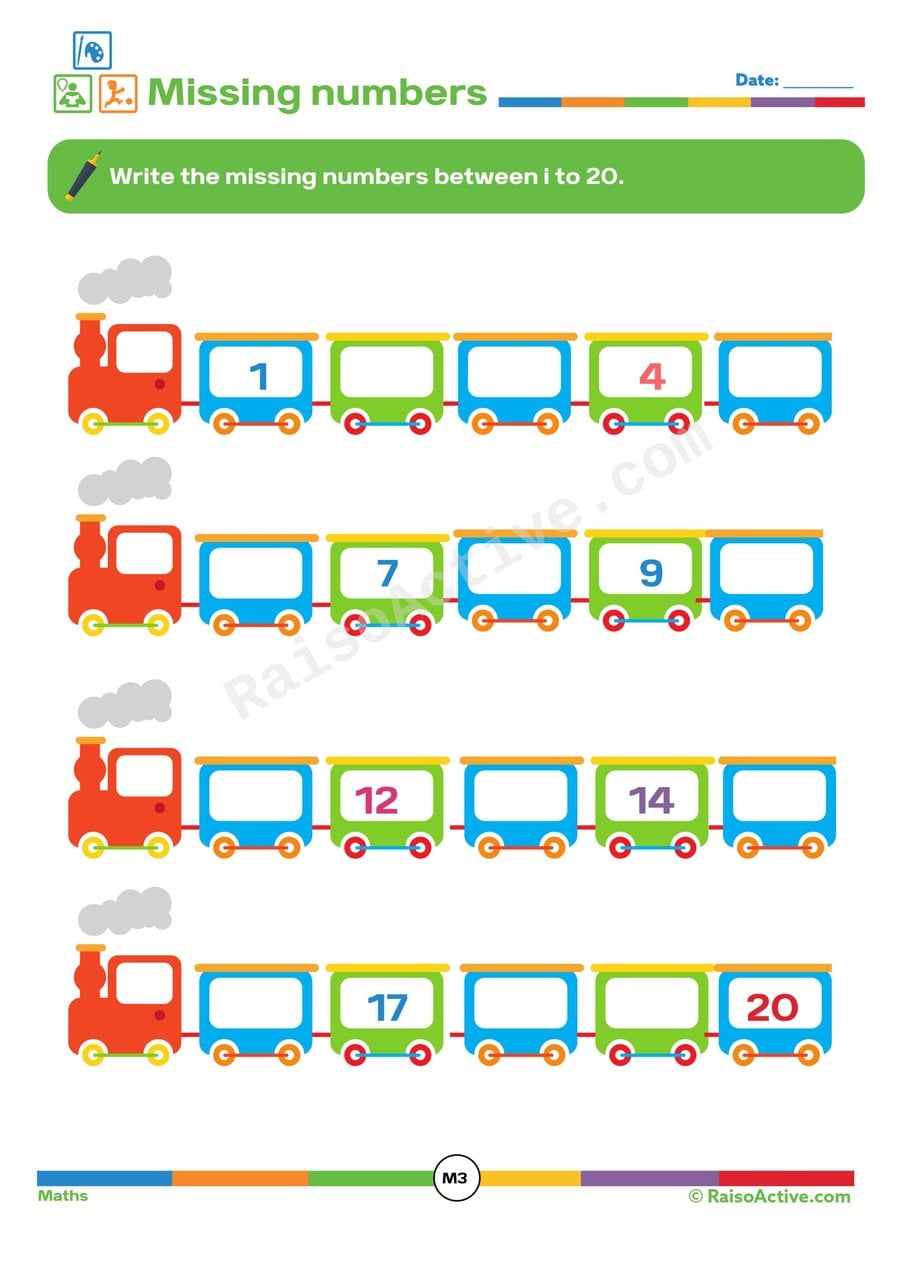
Missing Numbers Train Worksheet: Numbers 1-20
Ages 4-6 · Pre-K–KindergartenAges 4-6 · Reception–Year 1Ages 4-6 · LKG–UKGAges 4-6
This worksheet helps children ages 4-6 practice number recognition and sequencing by filling in missing numbers on a train of cars that counts from 1 to 20, reinforcing that numbers follow a fixed, predictable order. Working with a range this large also builds the stamina and sustained counting skill needed before children move on to skip-counting and simple addition.
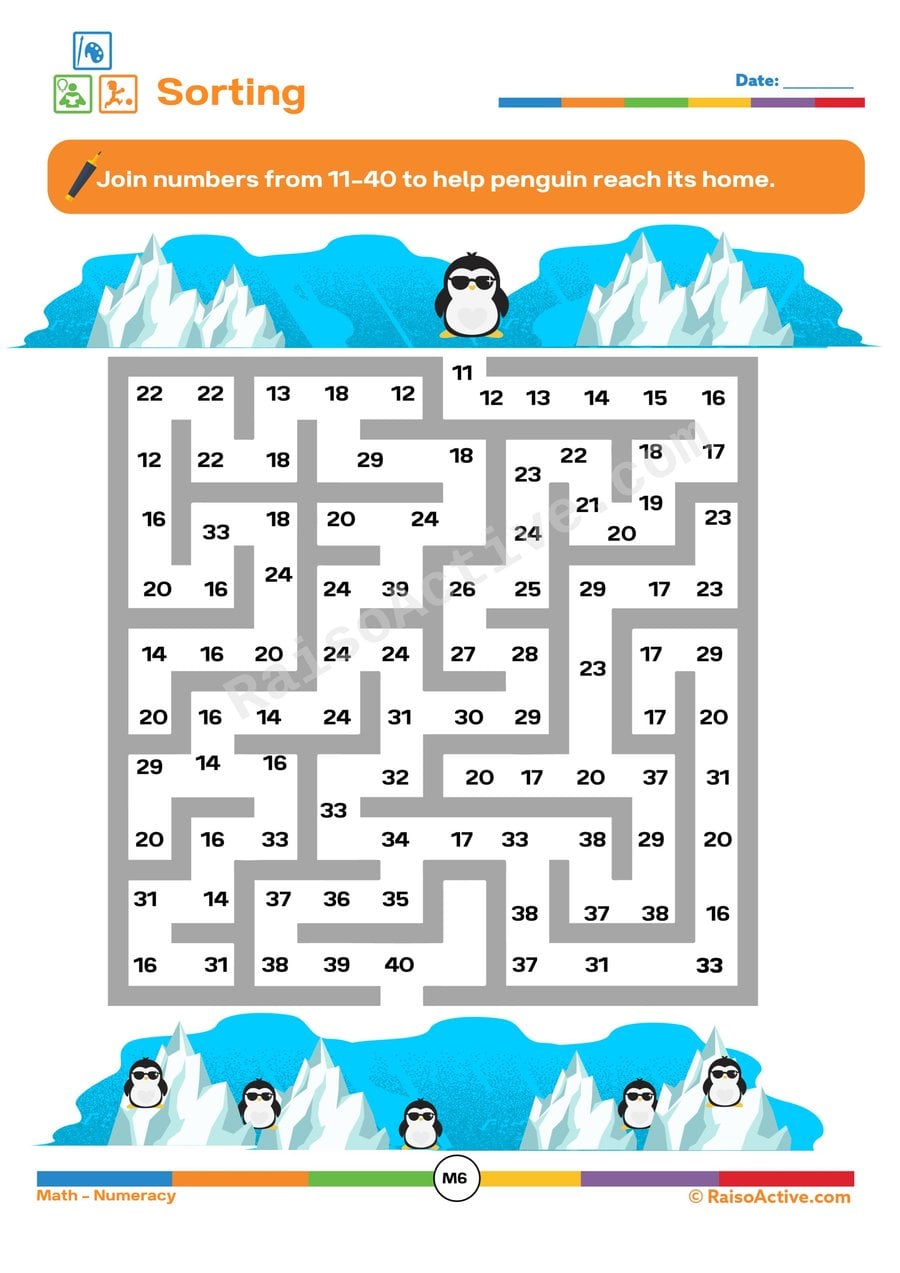
Penguin's Path: A Fun Sorting Worksheet for Kids!
Ages 4-6 · Pre-K–KindergartenAges 4-6 · Reception–Year 1Ages 4-6 · LKG–UKGAges 4-6
This maze worksheet has 4-6 year olds trace a path through numbers 11 to 40, building both number sequencing across a wider range and the fine motor control needed to draw a connected line dot to dot. Because the range spans several decades, your child gets real practice with the trickiest part of early counting — the transitions between decades (19 to 20, 29 to 30) — while the penguin's journey gives the task a clear, motivating goal.
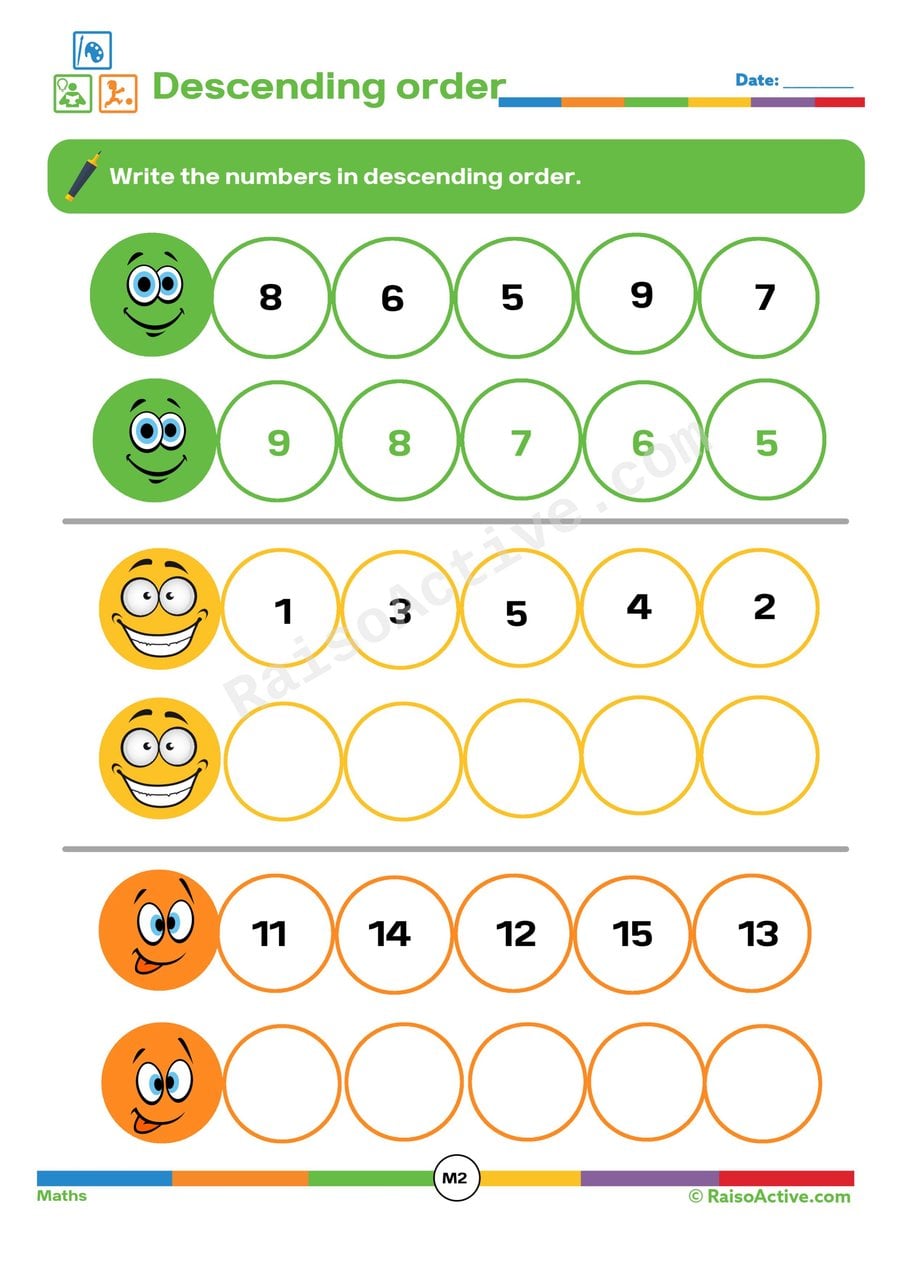
Descending Order Worksheet: Numbers 5-15
Ages 4-5 · Pre-KAges 4-5 · ReceptionAges 4-5 · LKGAges 4-5
Writing numbers in descending order asks 4-5 year olds to hold a full sequence in mind and reverse it — a genuinely different mental task from the more familiar ascending count, since children have to think about 'what comes before' rather than 'what comes after.' Practicing this with numbers 5 through 15 also reinforces number formation and one-to-one number-word correspondence, since each digit has to be written accurately as your child works backward.

Duckling's Number Path: Connect the Dots Worksheet
Ages 3-5 · Preschool–Pre-KAges 3-5 · Nursery–ReceptionAges 3-5 · Nursery–LKGAges 3-5
Children ages 3-5 practice number sequencing and counting up to 30 as they connect numbered dots in order to draw the duckling's path back to its mother, reinforcing number recognition while completing a satisfying, story-driven picture. Following numbers in strict order without skipping builds the counting fluency children need before tackling addition and more advanced number work.

Sequencing Numbers Train Worksheet for Preschoolers
Ages 4-5 · Pre-KAges 4-5 · ReceptionAges 4-5 · LKGAges 4-5
This train-themed worksheet asks children ages 4-5 to fill in missing numbers within a given sequence, which builds a much deeper number sense than simply counting from one — they must recognize what number comes before or after a given value anywhere in the run. Practicing sequencing this way strengthens working memory and prepares children for later mental math skills like skip counting and addition. The train-car format also keeps the abstract task of ordering numbers visually organized and engaging.
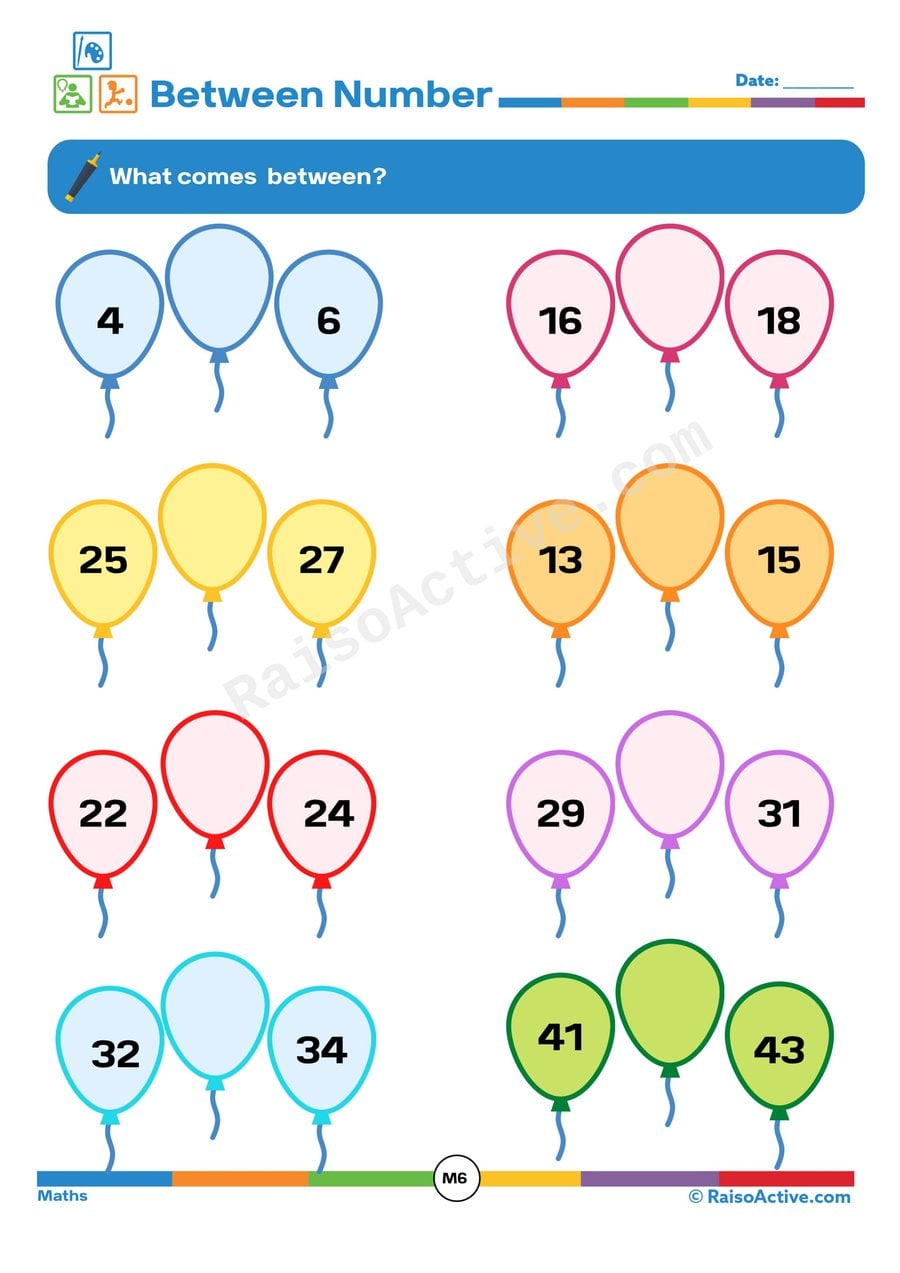
What Comes Between? Number Worksheet for Kids
Ages 4-5 · Pre-KAges 4-5 · ReceptionAges 4-5 · LKGAges 4-5
This worksheet targets a specific numeracy skill, finding the number that falls between two given numbers, which requires children to hold two values in mind and mentally place a third between them. For ages 4-5, this 'in-between' reasoning is more demanding than simply counting forward and strengthens the mental number line that underlies later subtraction and comparison skills.

Before and After: Counting and Sequencing Worksheet
Ages 4-6 · Pre-K–KindergartenAges 4-6 · Reception–Year 1Ages 4-6 · LKG–UKGAges 4-6
Spinning a wheel to find the number that follows a given number, then writing it in the 'after' column, builds number sequencing skills for children ages 4-6 while the matching step connects the abstract number to a picture representation.
Guides for this topic

Number Formation Rhymes 0–9 and How to Fix Reversals
Original number formation rhymes for 0–9, the correct stroke order for each digit, why 3, 5 and 7 get reversed most often, and multisensory fixes that work.

Best Worksheets for 3-Year-Olds: What Works and What to Avoid
What works on worksheets for 3-year-olds: short sessions, crayons, tracing lines, matching, cutting, a free weekly plan, and signs one is too advanced.
Christmas and Winter Activities That Combine Fun and Learning: Creating Magical Educational Experiences
Discover Christmas and winter activities that combine festive fun with real learning. Crafts, counting, literacy, and printable worksheets for ages 2 to 8 — perfect for home and school.
Reviews
Every worksheet for ages 4–6, no watermark
Members download the full library of 1,000+ worksheets and every activity pack without watermarks or daily limits. One year costs ₹999 in India or $20 elsewhere.
See membership plansOr download any worksheet free with a watermark (5 a day).