Alligator Comparison Worksheet: Greater Than, Less Than, and Equal To!
This worksheet teaches children ages 4-6 to compare two numbers using the 'hungry alligator' mnemonic, where the alligator's mouth always opens toward the larger number. Understanding greater than, less than, and equal to is an essential building block for later place value, ordering, and basic algebra concepts.
Part of the pack
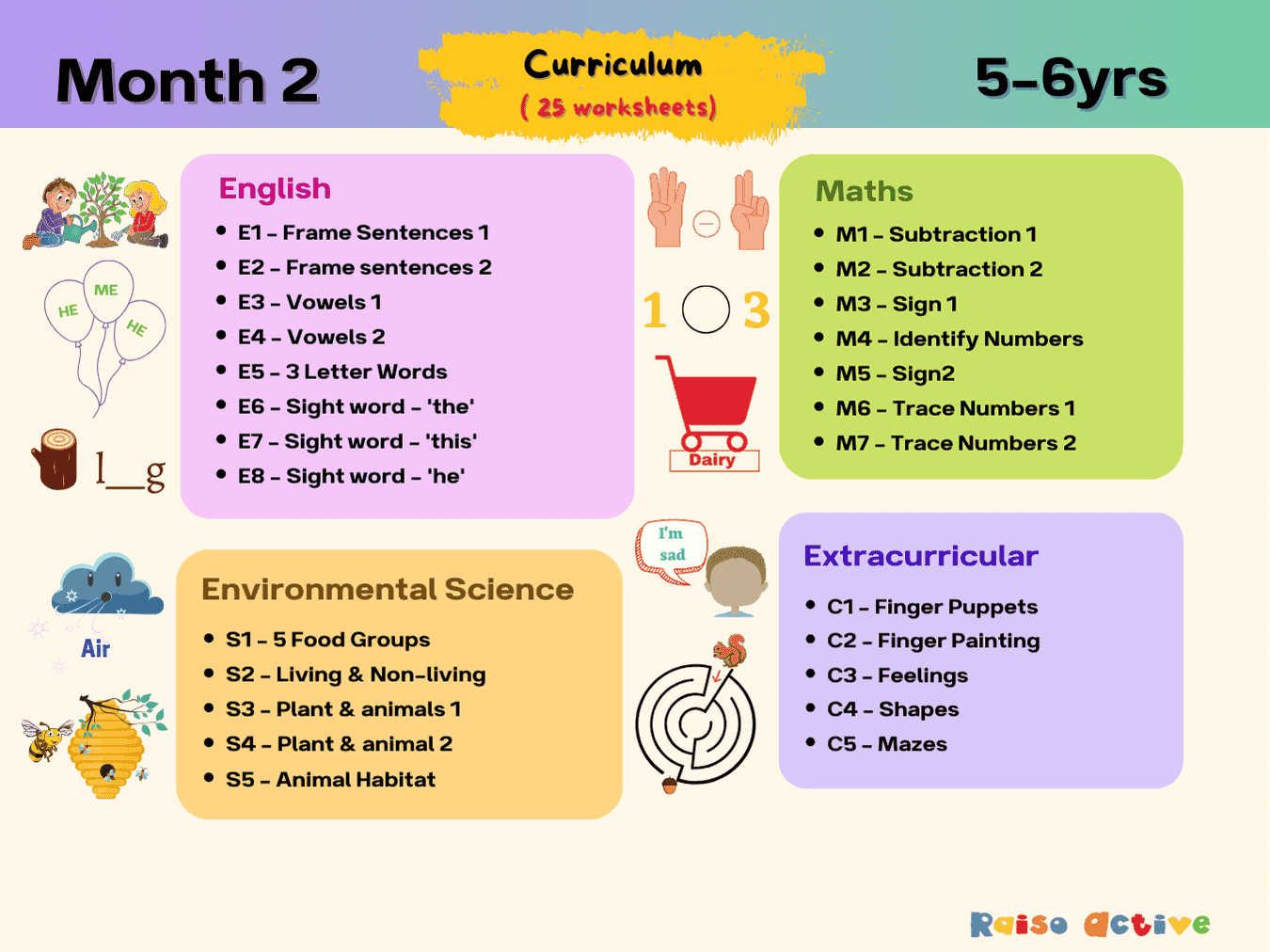
Month 2: Learning & Development | Ages 5-6
This is page 14 of the pack. Ages 5-6 · KindergartenAges 5-6 · Year 1Ages 5-6 · UKGAges 5-6
Made for your child
Counting to 10, made for your child
A maths pack with your child's name in it: pictures that explain, practice at three levels, puzzles and story sums about them. Print a new set whenever they finish.
Make a maths packFree preview · free for members
Curriculum
- Number Sense > Comparing Numbers
How to use this worksheet
Look at the two numbers on either side of the circle with your child and ask them to figure out which one is bigger, using fingers or counters if helpful. Remind them that the alligator is always hungry and wants to 'eat' the bigger number, so its open mouth points toward the larger value. Have your child draw the greater-than, less-than, or equal-to symbol in the circle to show their answer. Work through several rows, having your child say the full comparison sentence aloud each time, like '7 is greater than 4.'
Materials needed
- Pencil
- Eraser
Extension activities
- 1Use two piles of small toys or snacks and have your child physically show which pile the alligator would 'eat' first.
- 2Draw your own alligator symbol on paper and use it to compare pairs of numbers you call out.
- 3Roll two dice and compare the results using greater than, less than, or equal to.
- 4Line up family members by height and use the same comparison language to describe who is taller or shorter.

Written by
Hemsweta Jain · Teacher Cheena
MBA and Early Childhood Educator, teaching since 2014 · Founder of RaisoActive, Mumbai
Every RaisoActive worksheet is designed and checked by the founder before publishing.
Published · Last reviewed
More from Month 2: Learning & Development | Ages 5-6

Counting and Comparing: Greater Than, Less Than, or Equal To Worksheet
Ages 4-6 · Pre-K–KindergartenAges 4-6 · Reception–Year 1Ages 4-6 · LKG–UKGAges 4-6
This worksheet builds on basic counting by asking children to compare two separate groups of pictures and decide whether one group has more, fewer, or the same number as the other, then represent that relationship with the correct symbol. For four- to six-year-olds, this task combines accurate counting with comparative reasoning, both of which are essential building blocks for later mathematical problem solving.

Identify Numbers Worksheet: Matching Numbers and Words
Ages 4-6 · Pre-K–KindergartenAges 4-6 · Reception–Year 1Ages 4-6 · LKG–UKGAges 4-6
This worksheet builds number-word recognition by having children match written number names, like 'seven,' to their corresponding numeral, 7. For four- to six-year-olds, learning to read number words alongside numerals adds an important layer to early numeracy, since numbers appear in both written-word and symbol form in books, signs, and everyday life.
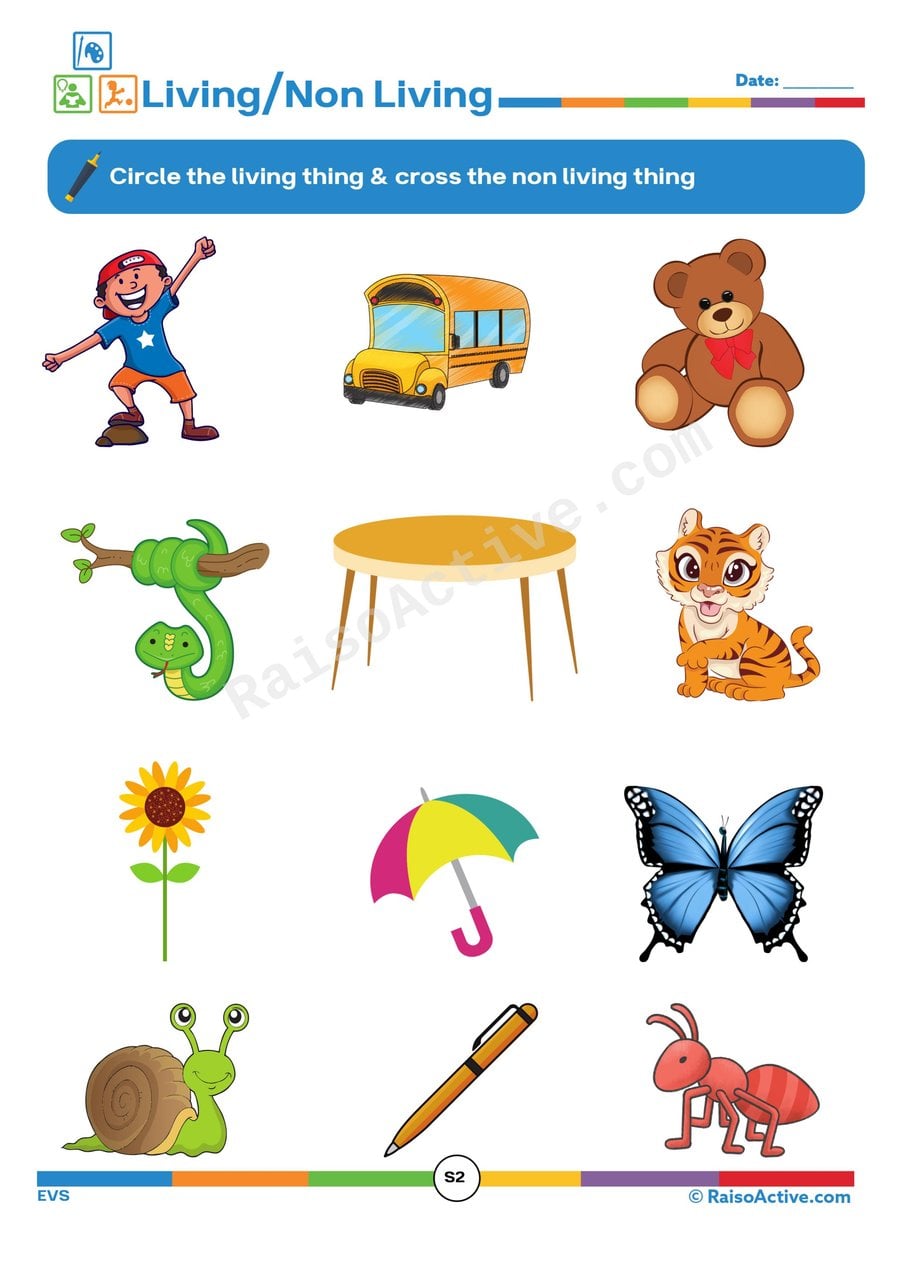
Living and Non-Living Things Worksheet for Kids
Ages 3-5 · Preschool–Pre-KAges 3-5 · Nursery–ReceptionAges 3-5 · Nursery–LKGAges 3-5
Children ages 3-5 practice an early scientific classification skill by deciding whether each pictured object grows, breathes, and moves on its own, versus things like rocks or toys that don't. Sorting living from non-living things builds the observational reasoning that underpins all later science learning.

Vowel Fun! Find, Color, and Fill-in the Missing Vowels Worksheet
Ages 3-5 · Preschool–Pre-KAges 3-5 · Nursery–ReceptionAges 3-5 · Nursery–LKGAges 3-5
This worksheet gives children ages 3-5 focused practice identifying the five vowels, A, E, I, O, U, and recognizing which vowel sound completes a familiar picture word. Because vowels appear in nearly every word, this early, targeted practice builds a phonics foundation that supports reading many more words later.
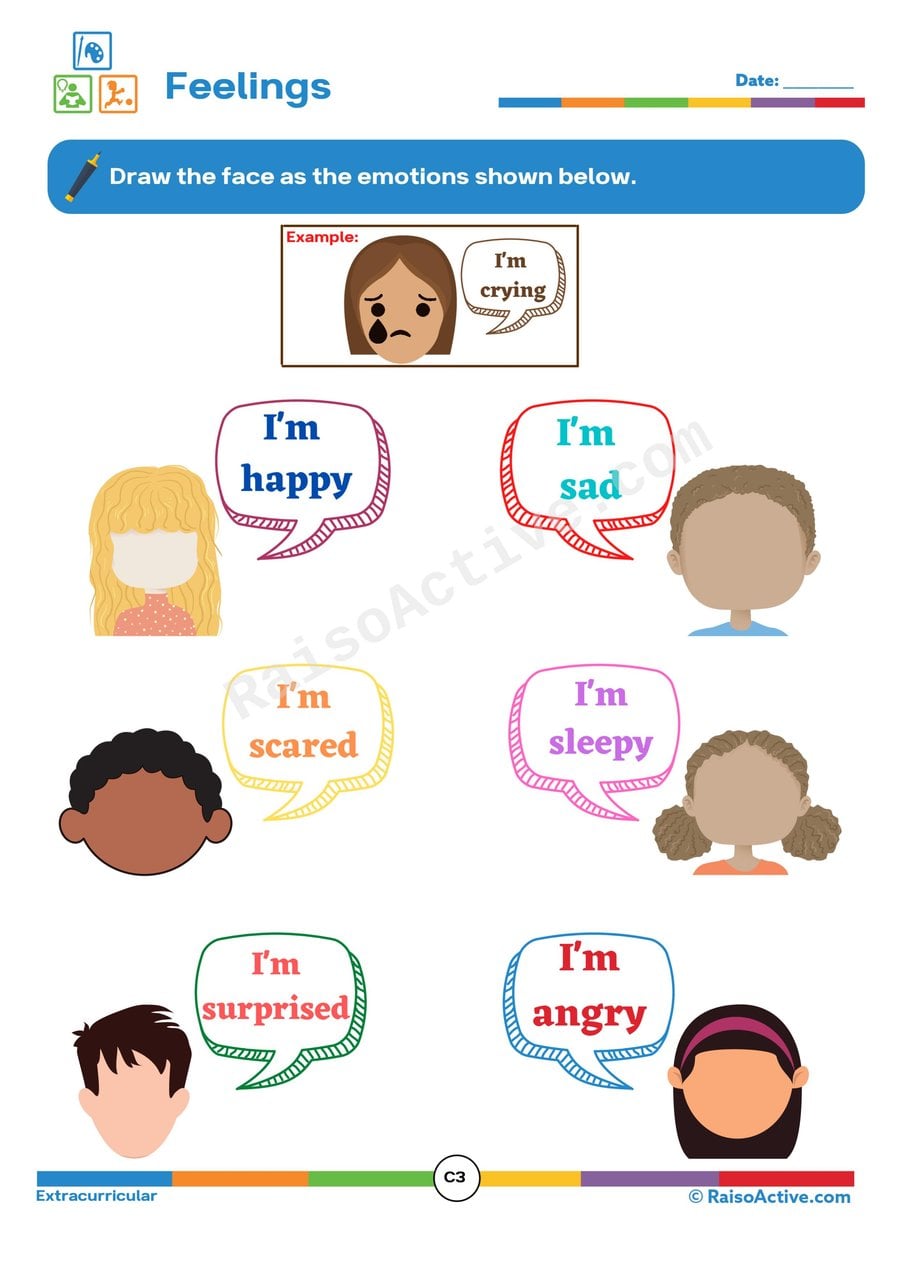
Feelings Worksheet: Draw the Faces!
Ages 3-5 · Preschool–Pre-KAges 3-5 · Nursery–ReceptionAges 3-5 · Nursery–LKGAges 3-5
This worksheet builds emotional literacy by having children draw a face expressing a specific feeling named in a word bubble, such as happy, sad, angry, or surprised. For three- to five-year-olds, practicing how to represent an emotion visually helps them build the vocabulary and self-awareness needed to name and talk about their own feelings, a key early social-emotional skill.

Subtraction Fun: Counting Fingers Worksheet for Kids
Ages 4-5 · Pre-KAges 4-5 · ReceptionAges 4-5 · LKGAges 4-5
Children ages 4-5 use their own fingers as a built-in counting tool to practice subtraction, connecting an abstract number sentence to something they can physically see and touch. This bridges the gap between counting objects and solving take-away problems with numbers alone.

Sight Word 'HE' Worksheet: Trace, Color, and Practice!
Ages 3-5 · Preschool–Pre-KAges 3-5 · Nursery–ReceptionAges 3-5 · Nursery–LKGAges 3-5
This worksheet helps children ages 3-5 learn to recognize, write, and use the sight word 'HE' in simple sentences, giving repeated exposure to a short, high-frequency word that appears in nearly every early reader book. Practicing the word across six different formats, tracing, coloring, circling, writing, filling in, and cutting and pasting, builds recognition through many different types of practice in one sitting.

Frame Sentences Worksheet: Read and Tick the Correct Sentence!
Ages 4-6 · Pre-K–KindergartenAges 4-6 · Reception–Year 1Ages 4-6 · LKG–UKGAges 4-6
This worksheet strengthens early grammar awareness in children ages 4-6 by having them compare two or more versions of a sentence and judge which one is written correctly. Spotting the difference between a correct and incorrect sentence builds the same skimming and comparing skills that support later spelling and editing work.
Related worksheets

Comparing Objects: A Fun Counting Worksheet for Preschoolers!
Ages 4-5 · Pre-KAges 4-5 · ReceptionAges 4-5 · LKGAges 4-5
This worksheet has 4-5 year olds count two groups of objects and then compare the totals using the greater-than, less-than, and equal-to symbols — an early but genuine step into formal math notation that goes beyond simple counting into representing a comparison symbolically. Because your child has to count accurately before comparing, this worksheet also reinforces that math symbols stand for real relationships between quantities, not arbitrary marks to memorize.

More or Less Worksheet: Comparing Quantities for Preschoolers
Ages 3-5 · Preschool–Pre-KAges 3-5 · Nursery–ReceptionAges 3-5 · Nursery–LKGAges 3-5
This worksheet helps children ages 3-5 understand the concepts of 'more' and 'less' by counting and comparing different groups of pictured objects, like eggs in a nest or fruits in a basket. Comparing quantities visually and numerically builds early number sense that supports later addition, subtraction, and greater-than or less-than reasoning.

Many vs. Few: Object Counting Worksheet for Preschoolers
Ages 3-5 · Preschool–Pre-KAges 3-5 · Nursery–ReceptionAges 3-5 · Nursery–LKGAges 3-5
This worksheet builds early quantity comparison skills as children ages 3-5 look at groups of objects and decide whether each group shows 'many' or 'few.' Beyond simple counting, this task develops relative reasoning — understanding that quantity is judged by comparison, not just a fixed number — which lays groundwork for later concepts like greater than and less than. Circling the correct group also reinforces visual scanning and attention to detail.

Tall and Short Worksheet: Comparing Sizes for Preschoolers
Ages 3-5 · Preschool–Pre-KAges 3-5 · Nursery–ReceptionAges 3-5 · Nursery–LKGAges 3-5
Comparing height is one of the earliest measurement concepts children encounter, and this worksheet asks children ages 3-5 to visually judge which of two objects is taller or shorter without using any numbers or rulers. This kind of direct visual comparison builds the intuitive sense of relative size that formal measurement skills will later be built on top of. Practicing the comparison in both directions — identifying the taller object in one set and the shorter object in another — also reinforces that 'tall' and 'short' are relative terms, not fixed labels.

Thick and Thin Worksheet: Identifying Object Thickness
Ages 3-5 · Preschool–Pre-KAges 3-5 · Nursery–ReceptionAges 3-5 · Nursery–LKGAges 3-5
This worksheet asks children ages 3-5 to compare objects and identify which is thickest and which is thinnest in each set, building early comparative reasoning and size-based vocabulary. Comparing objects along a specific dimension like thickness — rather than just overall size — sharpens observational skills and introduces the kind of precise descriptive language children will need for later measurement concepts.

Comparing Numbers: Apples, Soccer Balls, and More! - Math Worksheet
Ages 4-5 · Pre-KAges 4-5 · ReceptionAges 4-5 · LKGAges 4-5
This worksheet teaches children to compare two quantities using the symbols greater than (>), less than (<), and equal to (=) by counting groups of everyday objects like apples and soccer balls. For four- and five-year-olds, learning to read and use comparison symbols is an early step toward understanding mathematical relationships beyond simple counting.
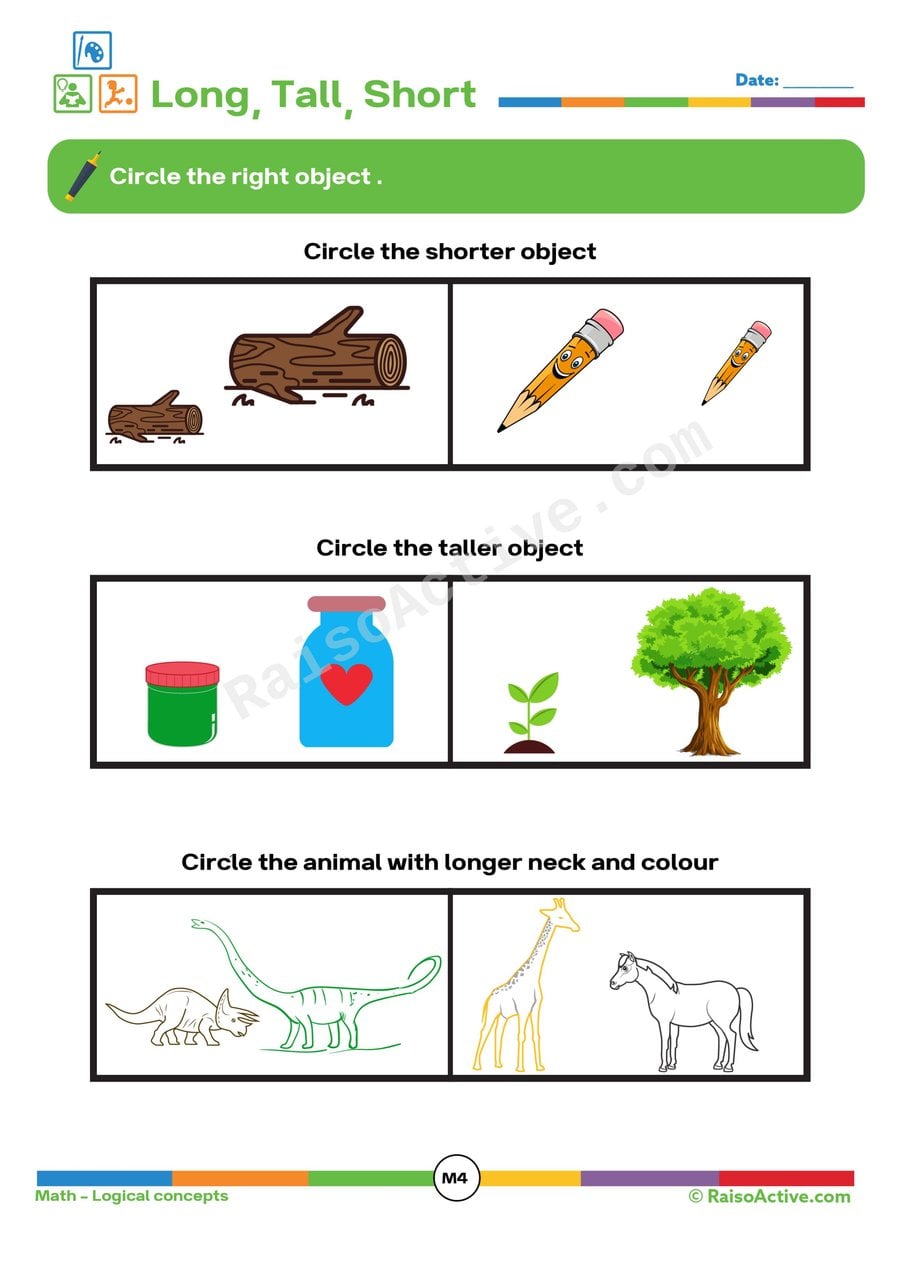
Long, Tall, Short Worksheet: Comparing Objects!
Ages 3-5 · Preschool–Pre-KAges 3-5 · Nursery–ReceptionAges 3-5 · Nursery–LKGAges 3-5
This worksheet guides your child in visually comparing objects based on their length and height, using terms like "long," "tall," and "short." By matching items with specific size descriptions, children aged 3-5 build essential observation skills and foundational pre-math understanding of attributes. This practice helps develop their vocabulary for describing the world around them and strengthens critical thinking as they distinguish subtle differences.

Cut and Glue: Comparing Quantities Worksheet for Preschoolers
Ages 3-5 · Preschool–Pre-KAges 3-5 · Nursery–ReceptionAges 3-5 · Nursery–LKGAges 3-5
Comparing quantities using the greater than, less than, and equal to symbols is an early step toward formal mathematical notation for children ages 3-5, building on the counting skills they already have. This cut-and-paste worksheet asks children to count two sets of objects, decide which set is larger, smaller, or the same, and then physically select and glue the correct comparison symbol between them. Handling the symbol pieces themselves, rather than writing the symbols freehand, lets younger children engage with this abstract math concept before their fine motor skills are ready for symbol writing.
Guides for this topic

Number Formation Rhymes 0–9 and How to Fix Reversals
Original number formation rhymes for 0–9, the correct stroke order for each digit, why 3, 5 and 7 get reversed most often, and multisensory fixes that work.

Age-Appropriate Problem-Solving Activities: Building Critical Thinkers from the Ground Up
Discover fun, age-appropriate problem-solving activities for children ages 1-8. Build critical thinking, logic, and reasoning skills through play-based learning.
Critical Thinking Activities That Actually Work for Young Children: Building Tomorrow's Thinkers Today
Discover proven critical thinking activities for young children. Age-wise logic games, questioning techniques, and hands-on ideas to build thinking skills at home.
Reviews
Every worksheet for ages 4–6, no watermark
Members download the full library of 1,000+ worksheets and every activity pack without watermarks or daily limits. One year costs ₹999 in India or $20 elsewhere.
See membership plansOr download any worksheet free with a watermark (5 a day).