Skip Counting Cupcake Worksheet: Count by 10s!
This worksheet has children ages 4-5 fill in missing numbers while skip counting by tens, then cut and paste the numbers onto a caterpillar in the correct sequence. Skip counting by tens is a crucial stepping stone toward place value and mental math, since it helps children see numbers in efficient groups rather than counting one by one.
Part of the pack
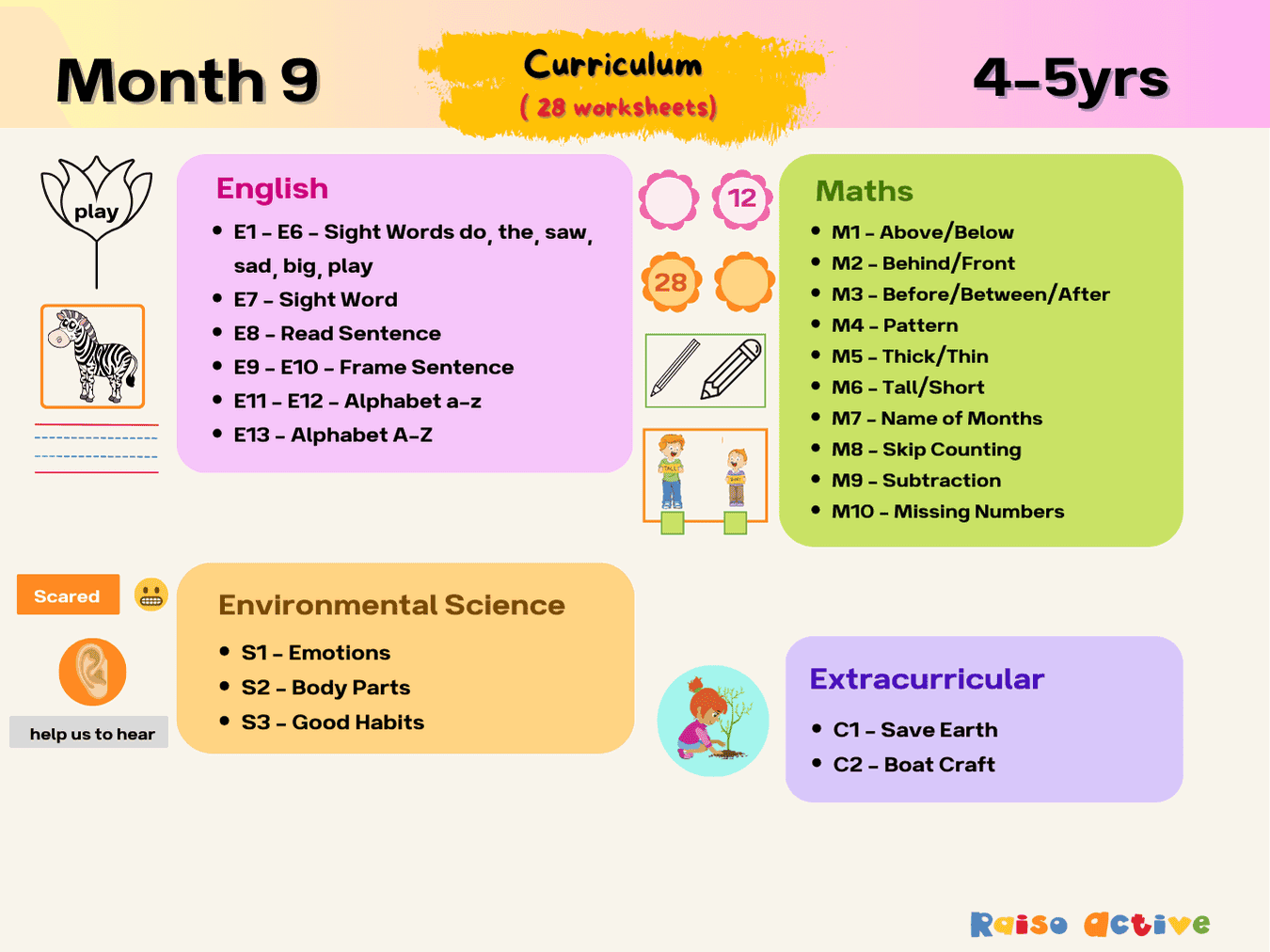
Month 9: Play-Based Preschool Foundational Skills | Ages 4-5
This is page 24 of the pack. Ages 4-5 · Pre-KAges 4-5 · ReceptionAges 4-5 · LKGAges 4-5

Made for your child
2, 5 and 10 times tables, made for your child
A maths pack with your child's name in it: pictures that explain, practice at three levels, puzzles and story sums about them. Print a new set whenever they finish.
Make a maths packFree preview · free for members
Curriculum
- Counting > Skip Counting
How to use this worksheet
Start by counting aloud together by tens — 10, 20, 30 — so your child hears the pattern before working with the page. Have them fill in any missing numbers in the skip-counting sequence shown. Then guide them to cut out the loose numbers at the bottom of the page and paste them onto the caterpillar's body segments in the correct counting-by-tens order, checking the sequence together once complete.
Materials needed
- Pencil
- Scissors
- Glue
Extension activities
- 1Count objects in groups of ten, like counting building blocks or crayons ten at a time, to make the pattern concrete.
- 2Create a number line on paper marking only the multiples of ten and have your child point along it while counting aloud.
- 3Play a hopping game outside, taking one big hop for every ten counted.
- 4Practice skip counting by tens starting from different numbers, like 20, 30, 40, to check real understanding rather than memorized recitation.

Written by
Hemsweta Jain · Teacher Cheena
MBA and Early Childhood Educator, teaching since 2014 · Founder of RaisoActive, Mumbai
Every RaisoActive worksheet is designed and checked by the founder before publishing.
Published · Last reviewed
More from Month 9: Play-Based Preschool Foundational Skills | Ages 4-5

Subtraction Worksheet: Count and Subtract for Preschoolers
Ages 4-6 · Pre-K–KindergartenAges 4-6 · Reception–Year 1Ages 4-6 · LKG–UKGAges 4-6
This worksheet introduces children ages 4-6 to subtraction by having them count a group of objects, take away the indicated amount, and write the resulting difference. Grounding subtraction in physical counting rather than abstract number facts helps children build real number sense, understanding subtraction as 'taking away' rather than just memorizing symbols and answers.

Months of the Year Cut and Paste Worksheet for Preschoolers
Ages 3-5 · Preschool–Pre-KAges 3-5 · Nursery–ReceptionAges 3-5 · Nursery–LKGAges 3-5
Learning the twelve months in order gives children ages 3-5 an early framework for understanding calendars, seasons, and the passage of time, concepts that are quite abstract at this age without a hands-on anchor. This cut-and-paste activity turns that memorization into a physical sorting task, requiring children to recall the correct sequence while also practicing scissor control and precise gluing. Arranging the months onto train cars adds a visual, story-like structure that makes the lengthy sequence easier to hold in memory than a plain list would be.
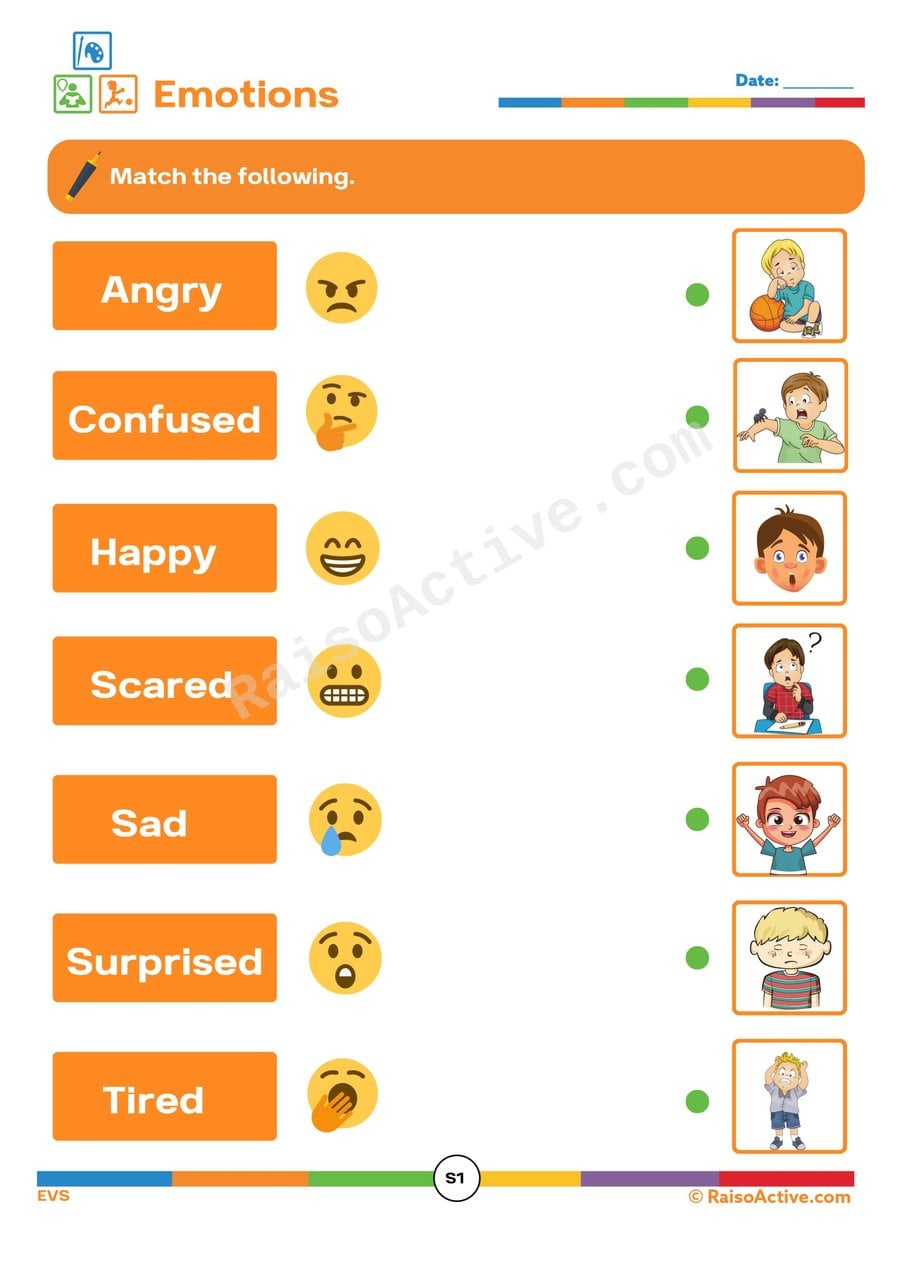
Emotions Matching Worksheet for Preschoolers
Ages 3-5 · Preschool–Pre-KAges 3-5 · Nursery–ReceptionAges 3-5 · Nursery–LKGAges 3-5
Recognizing and naming emotions is a foundational social-emotional skill for children ages 3-5, helping them build the vocabulary needed to express their own feelings and understand the feelings of others. This worksheet asks children to match emotion words to corresponding facial expressions, strengthening their ability to read facial cues — a skill that supports empathy and smoother social interactions. Building this kind of emotional vocabulary early also gives children better tools for self-regulation, since naming a feeling is often the first step toward managing it.

Alphabet Adventures: Write the First Letter - Small Alphabet Worksheet
Ages 4-6 · Pre-K–KindergartenAges 4-6 · Reception–Year 1Ages 4-6 · LKG–UKGAges 4-6
This worksheet strengthens phonemic awareness by asking children ages 4-6 to isolate the very first sound in a spoken word and match it to its lowercase letter - a skill that sits at the heart of early decoding and spelling. Because it uses small (lowercase) letters specifically, it also reinforces letter-case recognition, since children encounter lowercase print far more often than capitals once they begin reading books.

Small Alphabet Letter Practice: Write the First Letter - Worksheet for Kids
Ages 3-5 · Preschool–Pre-KAges 3-5 · Nursery–ReceptionAges 3-5 · Nursery–LKGAges 3-5
Writing lowercase letters correctly is a distinct skill from recognizing them, and this worksheet asks children ages 3-5 to identify a pictured object, isolate its beginning sound, and then physically form the matching lowercase letter from memory. Combining sound identification with independent letter formation — rather than tracing — pushes children a step further toward true early spelling. This is often one of the first times children write letters without a dotted guide to follow, which builds real handwriting confidence.

Sight Word 'Said' Worksheet for Preschoolers: Tracing, Reading, and Writing Fun!
Ages 3-5 · Preschool–Pre-KAges 3-5 · Nursery–ReceptionAges 3-5 · Nursery–LKGAges 3-5
The word 'said' appears constantly in early readers, especially in dialogue, but its spelling doesn't match how it sounds, which makes it a classic sight word that children ages 3-5 must memorize by sight rather than decode. This worksheet reinforces that memorization through multiple formats — coloring, searching, tracing, filling in blanks, and even a dot-to-dot — giving the word repeated exposure in different contexts. Building instant recognition of high-frequency words like 'said' is one of the most efficient ways to boost a young reader's fluency.

Learn the Sight Word 'Do' - Tracing and Practice Worksheet
Ages 3-5 · Preschool–Pre-KAges 3-5 · Nursery–ReceptionAges 3-5 · Nursery–LKGAges 3-5
Sight words like 'do' can't be sounded out using regular phonics rules, so children ages 3-5 need repeated visual exposure and active practice to memorize them by sight — exactly what this multi-part worksheet provides through tracing, highlighting, filling blanks, and even dot-marking the word. Because sight words appear so frequently in early readers, automatic recognition of a word like 'do' removes a major stumbling block that would otherwise interrupt a child's reading flow on nearly every page. Practicing the same word in several different formats within one worksheet builds the strong repetition that sight-word memorization requires.

Save Earth: A Cut and Paste Sorting Worksheet for Kids
Ages 3-5 · Preschool–Pre-KAges 3-5 · Nursery–ReceptionAges 3-5 · Nursery–LKGAges 3-5
This cut-and-paste activity introduces children ages 3-5 to the practical concept of waste sorting by having them classify pictured items as 'wet' or 'dry' waste - an early, hands-on entry point into environmental responsibility. Cutting along the lines and gluing each piece into its correct bin also builds scissor control and precise hand placement, both important fine motor milestones at this age.
Related worksheets

Froggy Skip Counting Worksheet: Practice Number Patterns!
Ages 4-6 · Pre-K–KindergartenAges 4-6 · Reception–Year 1Ages 4-6 · LKG–UKGAges 4-6
This worksheet introduces children ages 4-6 to skip counting — counting forward by a number other than one, such as by 2s or 5s — using a playful frog theme to keep the repetitive number pattern engaging. Recognizing and continuing a skip-counting sequence builds early number pattern awareness, a skill that later supports multiplication, telling time, and counting money.
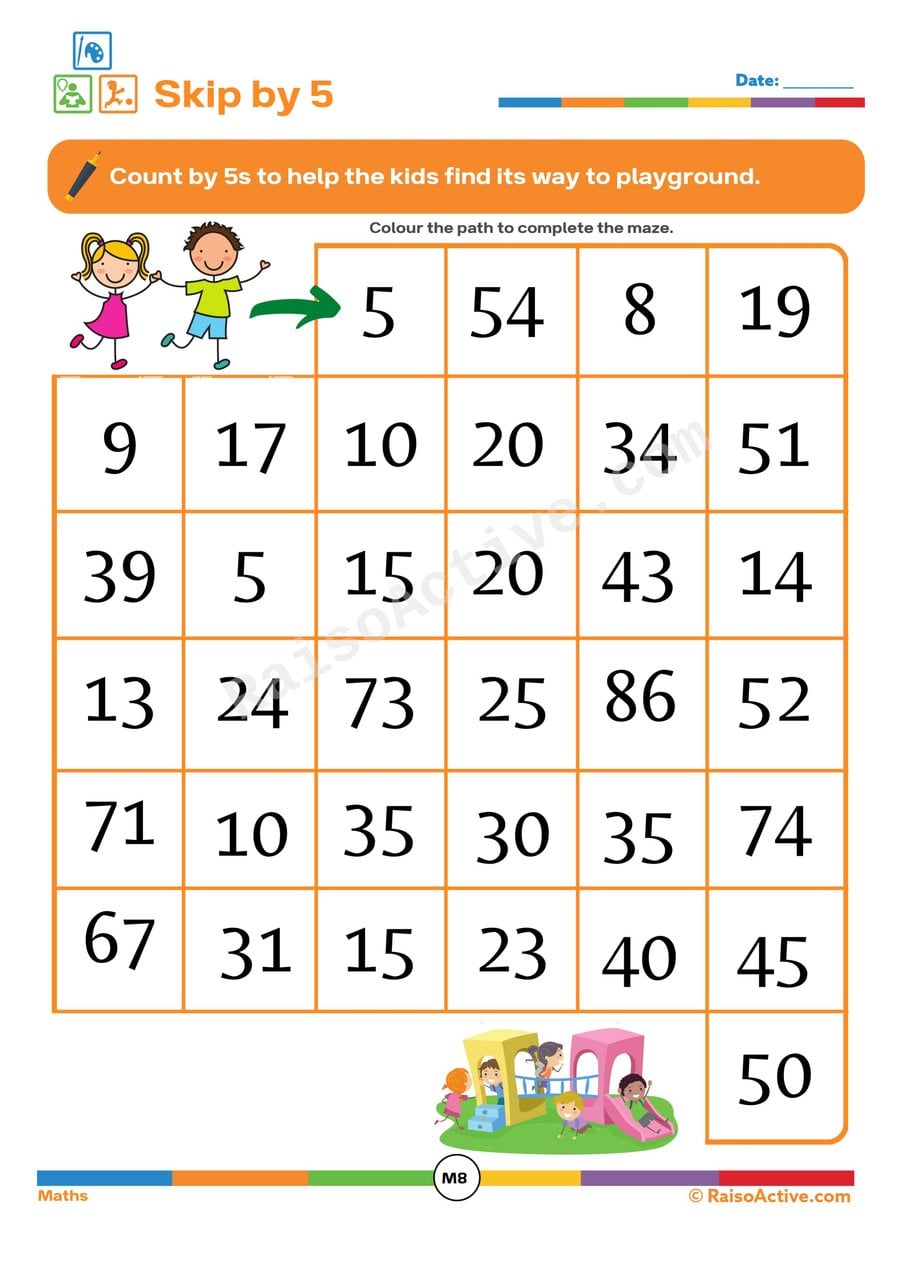
Skip Counting by 5: Maze Worksheet for Kids
Ages 4-6 · Pre-K–KindergartenAges 4-6 · Reception–Year 1Ages 4-6 · LKG–UKGAges 4-6
Skip counting by fives is a stepping stone toward multiplication and telling time on a clock face, and this maze format turns that abstract number pattern into a concrete navigation task. Ages four to six benefit from the built-in feedback a maze provides: choosing the wrong number sends the path to a dead end, so children learn to self-correct their counting in real time.

Skip Counting Adventure: Help Community Helpers! A Fun Math Worksheet
Ages 4-6 · Pre-K–KindergartenAges 4-6 · Reception–Year 1Ages 4-6 · LKG–UKGAges 4-6
Filling in missing numbers while skip counting by 5s and 10s builds a foundation for multiplication and faster counting for children ages 4-6, using a community helpers theme to make the abstract number pattern feel purposeful.

Counting Fun: Count by 5 or 10 Worksheet for Preschoolers!
Ages 4-6 · Pre-K–KindergartenAges 4-6 · Reception–Year 1Ages 4-6 · LKG–UKGAges 4-6
Counting objects arranged in groups of five or ten teaches children ages 4-6 skip counting, a faster strategy for finding a total than counting every single object one by one. This early efficiency strategy builds a foundation for later multiplication and for quickly estimating larger quantities.

Skip Counting by 10 Worksheet: Fill in the Blanks!
Ages 4-5 · Pre-KAges 4-5 · ReceptionAges 4-5 · LKGAges 4-5
This worksheet builds skip counting fluency by 10s, a foundational skill that helps children recognize number patterns and prepares them for place value concepts and faster counting strategies later on. For ages 4-5, seeing numbers grouped in tens on signs reinforces both sequencing and the visual structure of our base-ten number system.

Counting Ones Worksheet: Match and Fill in the Blanks!
Ages 4-6 · Pre-K–KindergartenAges 4-6 · Reception–Year 1Ages 4-6 · LKG–UKGAges 4-6
Children ages 4-6 build early place value understanding by matching numbers to their corresponding sums and filling in blanks with the correct count of ones. This introduces the foundational idea that numbers are made up of countable units, a concept that underlies all later addition, subtraction, and multi-digit math. Matching and filling in blanks together reinforces both number recognition and basic counting accuracy.

Skip Counting Adventure: Fill in the Blanks Worksheet for Numbers 2, 5, and 10!
Ages 4-6 · Pre-K–KindergartenAges 4-6 · Reception–Year 1Ages 4-6 · LKG–UKGAges 4-6
Filling in missing numbers in sequences that count by twos, fives, and tens teaches children ages 4-6 to recognize numerical patterns beyond counting one at a time, an important stepping stone toward multiplication later in school. Because each skip-counting sequence has a consistent gap between numbers, children must notice and apply that pattern rather than simply reciting a memorized list. This worksheet also builds flexible number sense, helping children see numbers as a system with predictable structure rather than an arbitrary list to memorize.
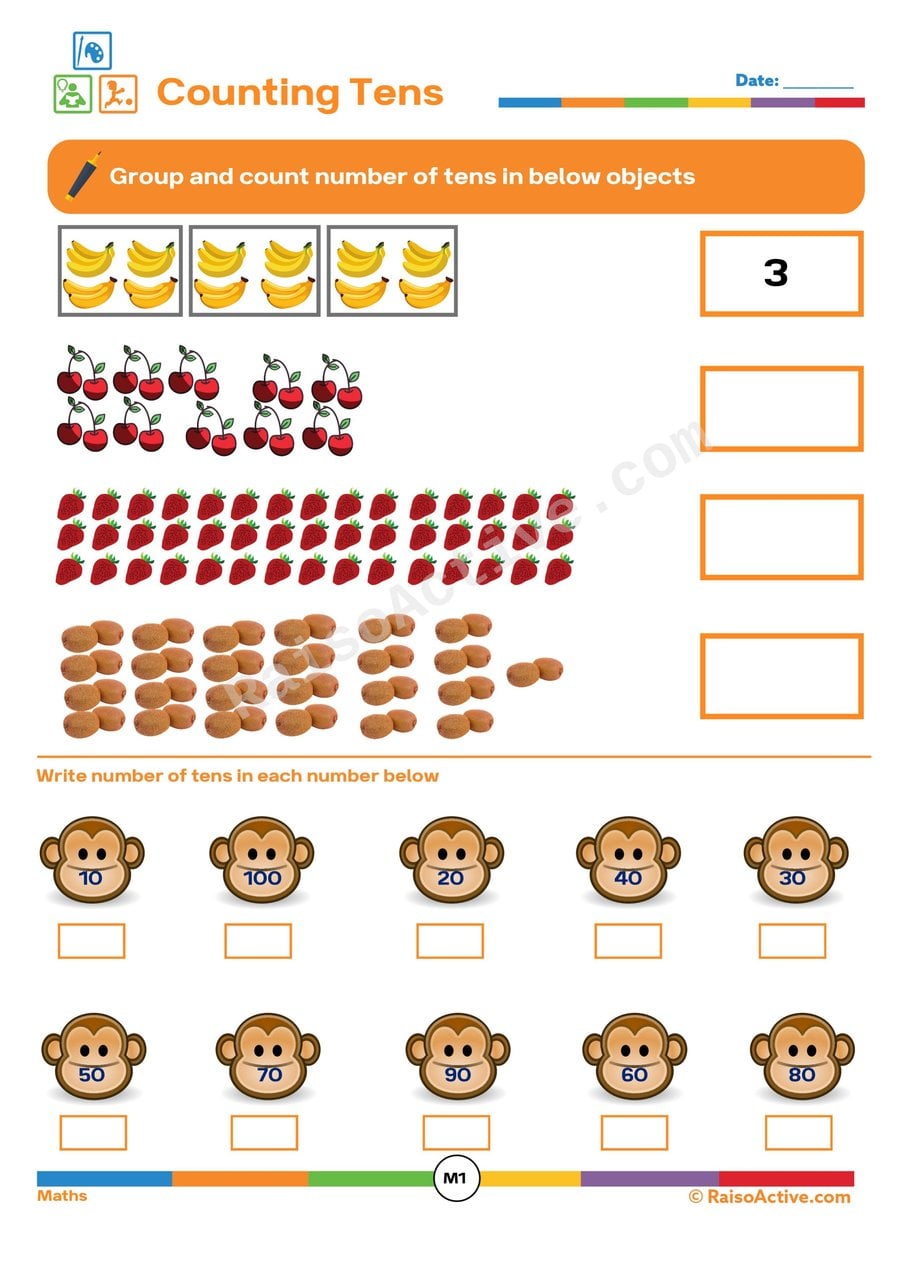
Counting Tens Worksheet: Group and Count!
Ages 4-6 · Pre-K–KindergartenAges 4-6 · Reception–Year 1Ages 4-6 · LKG–UKGAges 4-6
Grouping objects into sets of ten and counting the groups introduces the foundation of place value, the idea that a 'ten' is both ten individual ones and a single unit worth counting on its own. This worksheet gives ages four to six early, hands-on exposure to that concept well before they encounter formal place-value charts in school.
Guides for this topic

Number Formation Rhymes 0–9 and How to Fix Reversals
Original number formation rhymes for 0–9, the correct stroke order for each digit, why 3, 5 and 7 get reversed most often, and multisensory fixes that work.

Christmas and Winter Activities That Combine Fun and Learning: Creating Magical Educational Experiences
Discover Christmas and winter activities that combine festive fun with real learning. Crafts, counting, literacy, and printable worksheets for ages 2 to 8 — perfect for home and school.
Age-Appropriate Halloween Learning Activities: Balancing Spooks and Skills for Young Learners
Discover fun, age-appropriate Halloween learning activities for young children. Spooky crafts, counting games, literacy ideas, and printable worksheets for ages 2 to 8.
Reviews
Every worksheet for ages 4–5, no watermark
Members download the full library of 1,000+ worksheets and every activity pack without watermarks or daily limits. One year costs ₹999 in India or $20 elsewhere.
See membership plansOr download any worksheet free with a watermark (5 a day).