Small Alphabet Letter Practice: Write the First Letter - Worksheet for Kids
Writing lowercase letters correctly is a distinct skill from recognizing them, and this worksheet asks children ages 3-5 to identify a pictured object, isolate its beginning sound, and then physically form the matching lowercase letter from memory. Combining sound identification with independent letter formation — rather than tracing — pushes children a step further toward true early spelling. This is often one of the first times children write letters without a dotted guide to follow, which builds real handwriting confidence.
Part of the pack
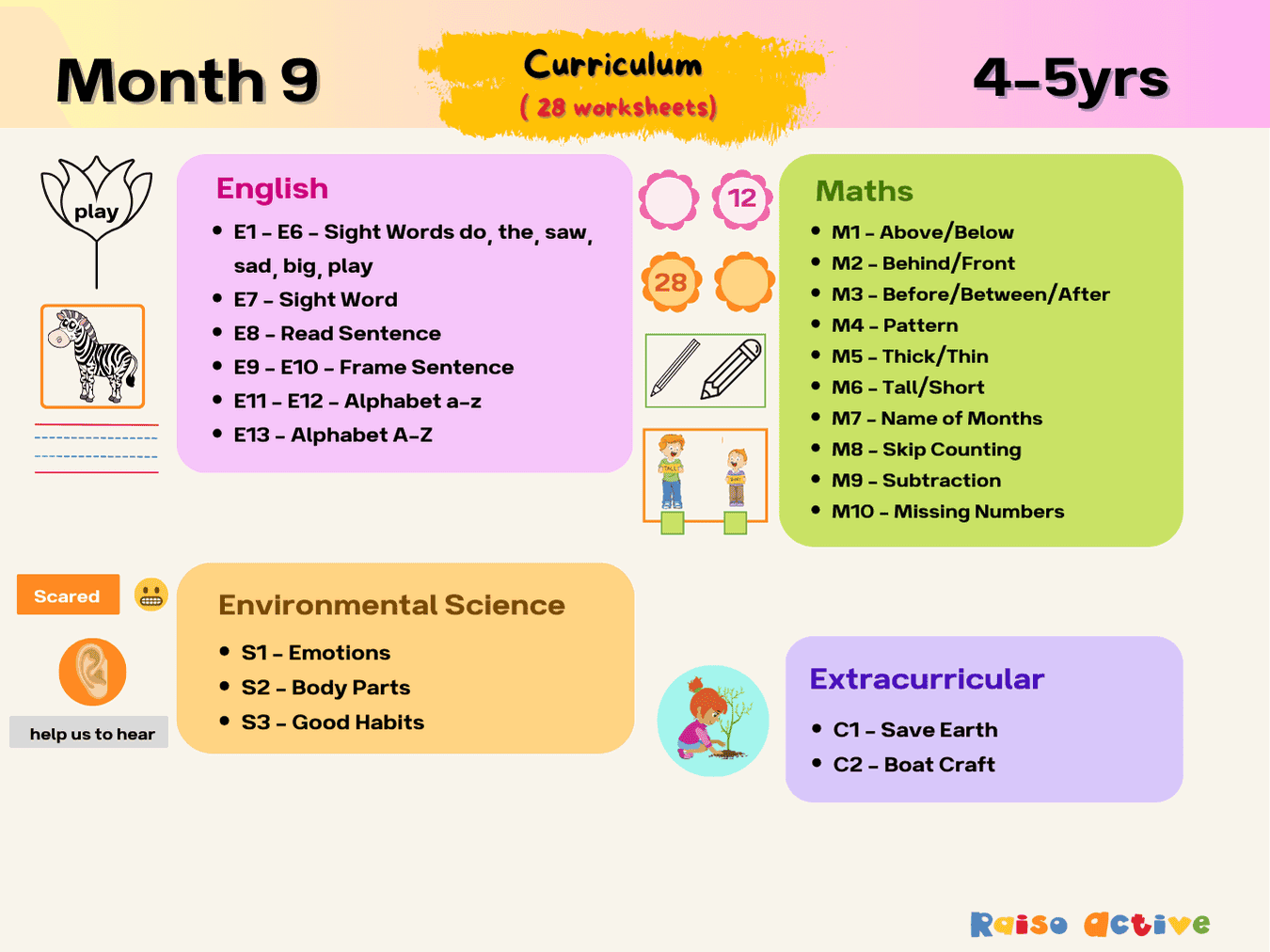
Month 9: Play-Based Preschool Foundational Skills | Ages 4-5
This is page 15 of the pack. Ages 4-5 · Pre-KAges 4-5 · ReceptionAges 4-5 · LKGAges 4-5

Made for your child
A whole activity pack made with their name
60 pages to spot, build, trace and write their own name, plus pages about their favourites, feelings and family. See a free preview with their name.
Make an All About Me packFree preview · free for members
Or start free: a name tracing sheet with their nameCurriculum
- Phonics - Letter Sounds > Beginning Sounds
How to use this worksheet
Look at the picture in the first box together and say its name slowly, listening for the first sound. Ask your child to think about which lowercase letter makes that sound and write it on the line below the picture, without tracing over anything. Move through each box on the page the same way, offering gentle reminders of letter formation only if needed. Review the completed page together, saying each word and its beginning letter one more time.
Materials needed
- Pencil
- Eraser
Extension activities
- 1Have your child draw their own pictures and write the first letter of each word they invent.
- 2Practice writing the entire lowercase alphabet in order on a separate sheet as a follow-up.
- 3Trace letters in a tray of sand, rice, or shaving cream before returning to pencil-and-paper practice.
- 4Play a quick oral game naming objects around the room and having your child say the first letter.

Written by
Hemsweta Jain · Teacher Cheena
MBA and Early Childhood Educator, teaching since 2014 · Founder of RaisoActive, Mumbai
Every RaisoActive worksheet is designed and checked by the founder before publishing.
Published · Last reviewed
More from Month 9: Play-Based Preschool Foundational Skills | Ages 4-5

Learn the Sight Word 'Big' - Fun Worksheet for Preschoolers!
Ages 3-5 · Preschool–Pre-KAges 3-5 · Nursery–ReceptionAges 3-5 · Nursery–LKGAges 3-5
Focused entirely on one high-frequency word, this worksheet helps children ages 3-5 build automatic recognition of 'big' - a word too common and irregular to sound out letter by letter, which is why early readers must memorize it by sight. Tracing and writing the word also develops the pencil control and letter-formation memory needed for independent writing, while the fill-in-the-blank step introduces the idea that words carry meaning inside a sentence.

Match the Patterns: Fun Worksheet for Preschoolers
Ages 3-5 · Preschool–Pre-KAges 3-5 · Nursery–ReceptionAges 3-5 · Nursery–LKGAges 3-5
By connecting each picture to its matching pattern, children ages 3-5 practice visual pattern recognition - the ability to notice a repeating sequence of colors, shapes, or objects - which is an early building block for both math reasoning and reading, since reading also relies on recognizing repeated letter patterns. The worksheet also builds fine motor control as children draw connecting lines with a pencil or crayon.

Front or Behind Sorting Worksheet for Preschoolers
Ages 3-5 · Preschool–Pre-KAges 3-5 · Nursery–ReceptionAges 3-5 · Nursery–LKGAges 3-5
Positional words like 'front' and 'behind' describe relationships between objects rather than the objects themselves, which makes them a genuinely trickier concept for a 3-5 year old than sorting by color or size. Deciding where each picture belongs and sorting it into the right box builds early spatial reasoning that later supports following multi-step directions and understanding maps or diagrams.
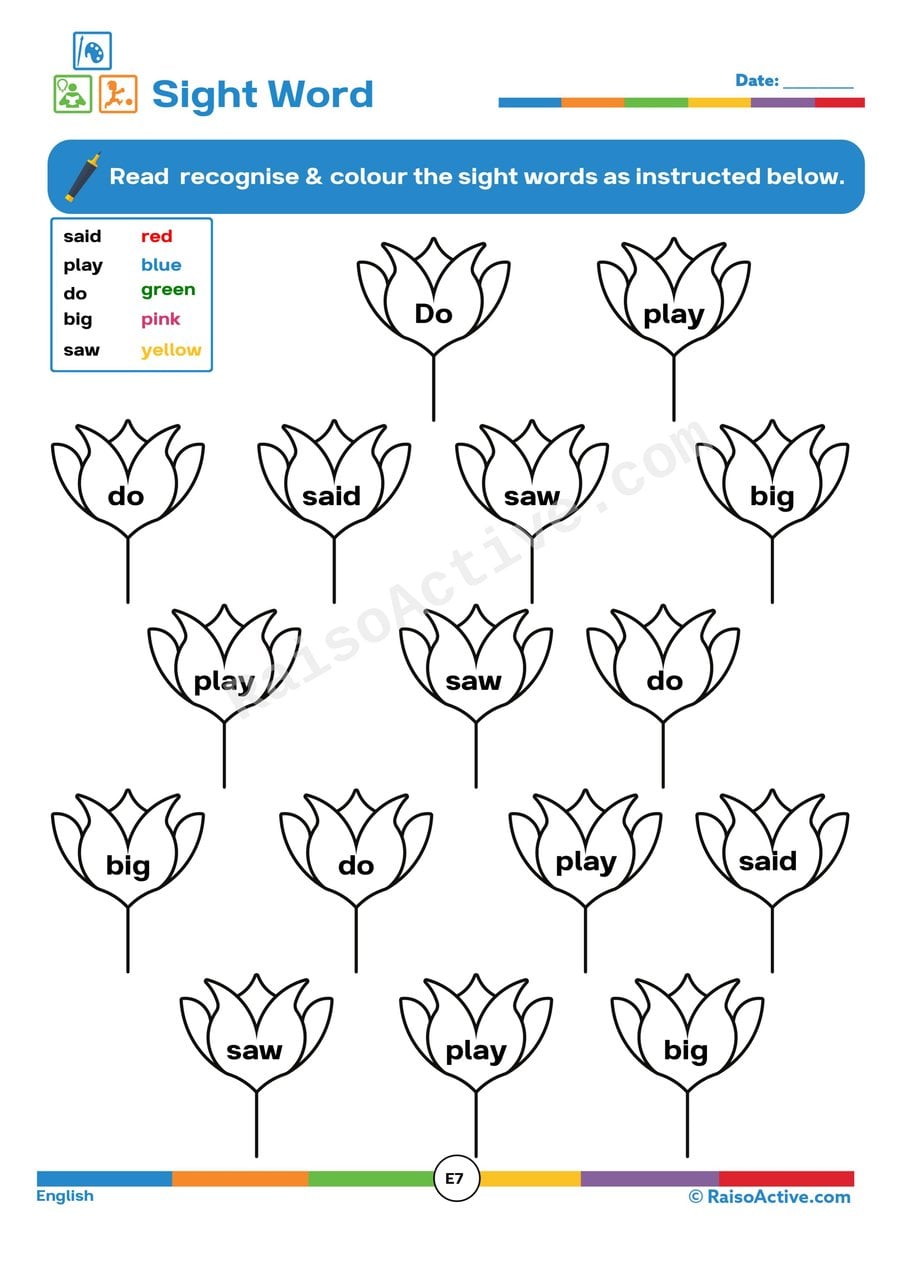
Sight Word Coloring Worksheet: Read and Color!
Ages 3-5 · Preschool–Pre-KAges 3-5 · Nursery–ReceptionAges 3-5 · Nursery–LKGAges 3-5
This worksheet combines sight-word recognition with a coloring activity, asking children ages 3-5 to read a list of common sight words and then find and color matching words hidden inside flower images. Turning word-hunting into a coloring task keeps young children engaged far longer than flashcard drills alone, while still delivering the repeated exposure that sight words require to become automatic.

Read and Match: Sentence Matching Worksheet for Early Readers
Ages 4-6 · Pre-K–KindergartenAges 4-6 · Reception–Year 1Ages 4-6 · LKG–UKGAges 4-6
This worksheet moves children ages 4-6 beyond single words into reading whole simple sentences and matching each one to the picture it describes. Comprehending a full sentence — not just recognizing individual words — is a genuine leap in reading skill, since it requires holding several words in mind together and connecting their combined meaning to an image.
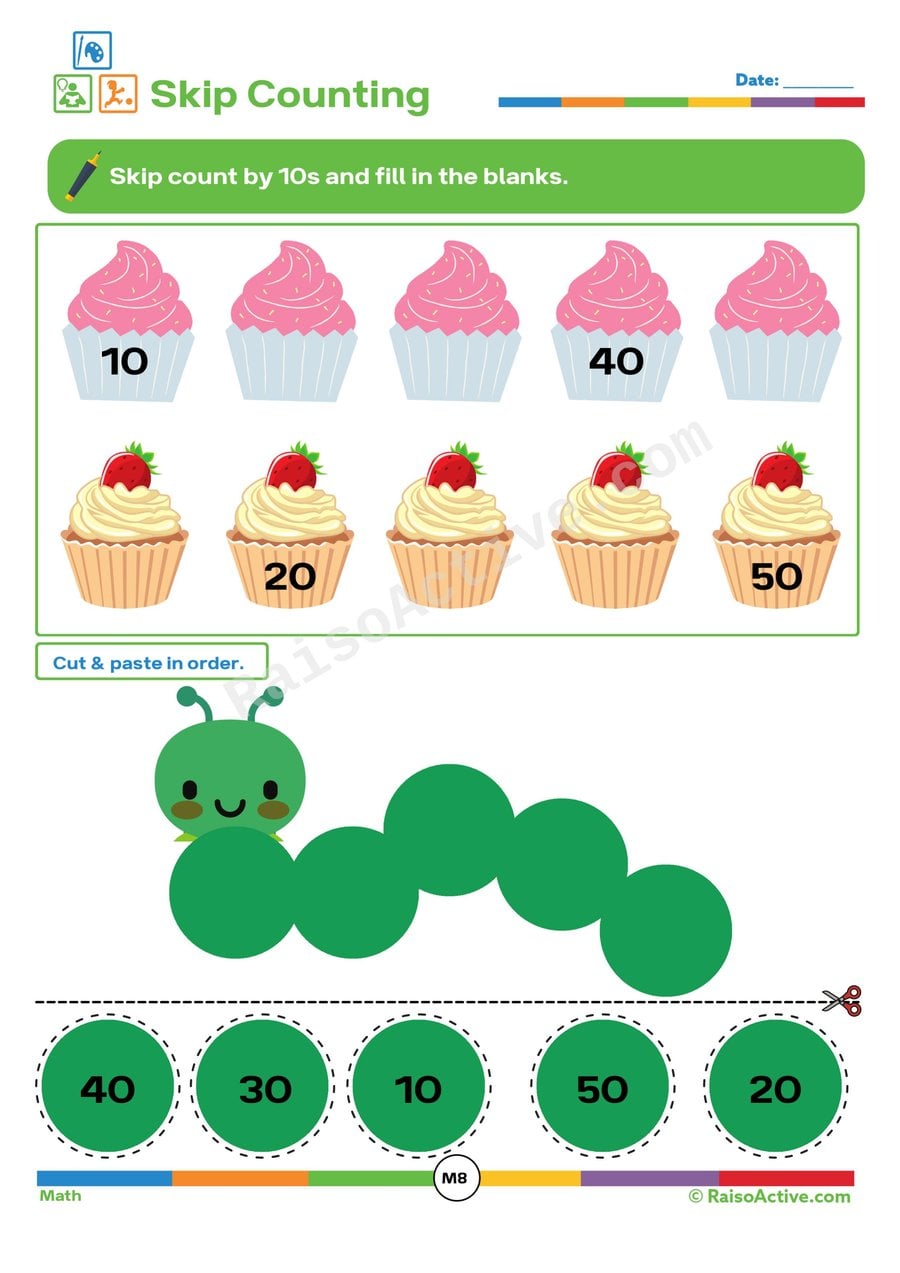
Skip Counting Cupcake Worksheet: Count by 10s!
Ages 4-5 · Pre-KAges 4-5 · ReceptionAges 4-5 · LKGAges 4-5
This worksheet has children ages 4-5 fill in missing numbers while skip counting by tens, then cut and paste the numbers onto a caterpillar in the correct sequence. Skip counting by tens is a crucial stepping stone toward place value and mental math, since it helps children see numbers in efficient groups rather than counting one by one.

Tall and Short Worksheet: Comparing Sizes for Preschoolers
Ages 3-5 · Preschool–Pre-KAges 3-5 · Nursery–ReceptionAges 3-5 · Nursery–LKGAges 3-5
Comparing height is one of the earliest measurement concepts children encounter, and this worksheet asks children ages 3-5 to visually judge which of two objects is taller or shorter without using any numbers or rulers. This kind of direct visual comparison builds the intuitive sense of relative size that formal measurement skills will later be built on top of. Practicing the comparison in both directions — identifying the taller object in one set and the shorter object in another — also reinforces that 'tall' and 'short' are relative terms, not fixed labels.
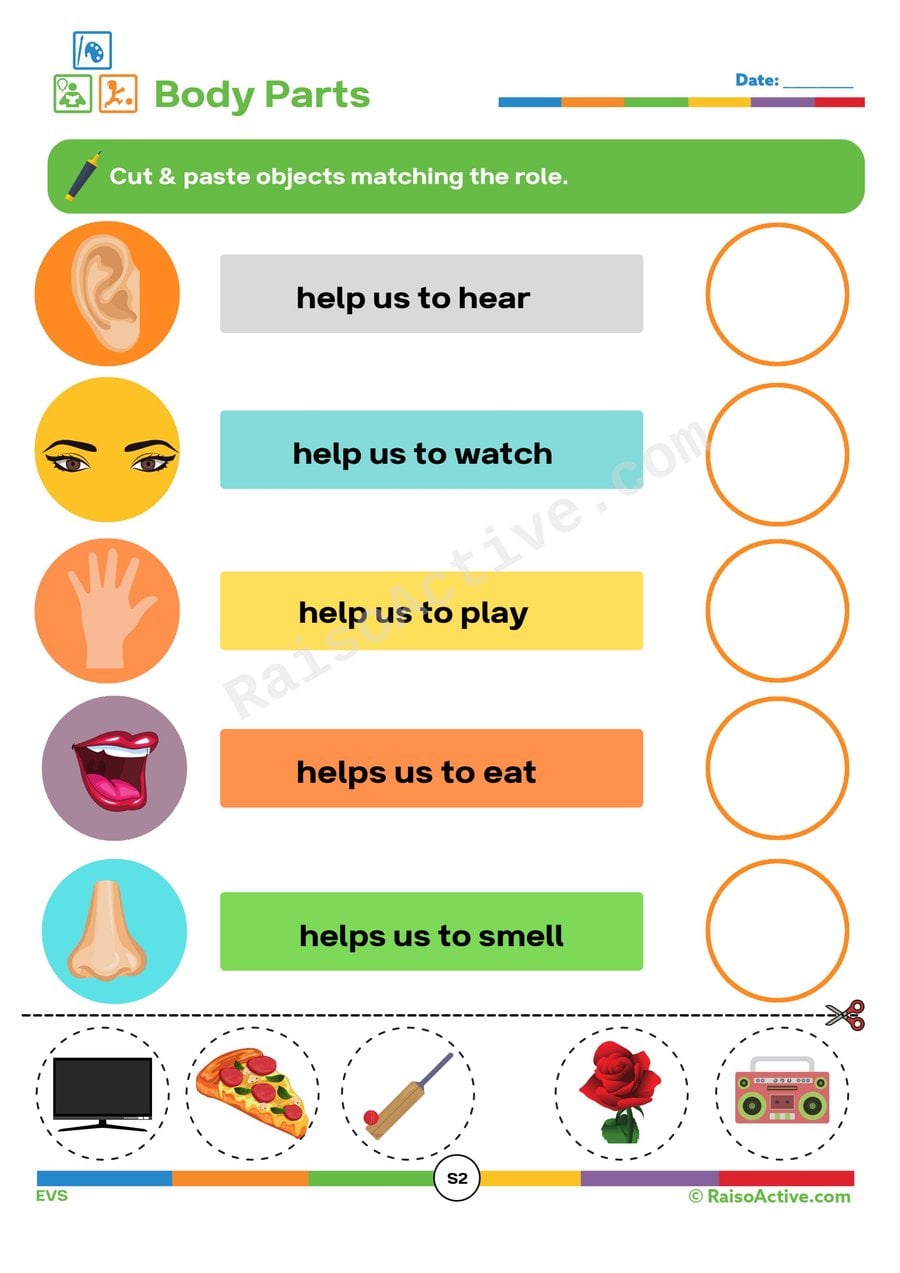
Body Parts Matching Worksheet for Preschoolers
Ages 3-5 · Preschool–Pre-KAges 3-5 · Nursery–ReceptionAges 3-5 · Nursery–LKGAges 3-5
Learning the names of body parts builds early vocabulary and body awareness for children ages 3-5, helping them describe their physical experiences and follow instructions that reference specific parts of the body. This cut-and-paste worksheet asks children to match pictures of body parts to their correct location on a figure, which reinforces spatial understanding of the body alongside vocabulary. Because children physically cut and glue each piece into place, the activity also builds fine motor control at the same time as the science and language content.
Related worksheets

Phonics Fun: Circle the Beginning Letter Worksheet for Kids
Ages 4-6 · Pre-K–KindergartenAges 4-6 · Reception–Year 1Ages 4-6 · LKG–UKGAges 4-6
This 'Circle the Beginning Letter' worksheet strengthens phoneme-grapheme correspondence for children ages 4-6, teaching them to connect the sound they hear at the start of a word to its written letter. Naming each picture aloud and choosing among several letter options builds auditory discrimination, a skill that predicts later decoding success. It also reinforces letter recognition by asking children to distinguish the target letter from visually similar distractors.

Phonics Fun: Match the Letter to the Object Worksheet
Ages 4-5 · Pre-KAges 4-5 · ReceptionAges 4-5 · LKGAges 4-5
This worksheet asks children to connect a printed letter to a picture whose name starts with that letter's sound, then reinforces the connection a second time through color-coded circles, a repetition that research on phonics instruction shows helps move sound-letter pairs from short-term recognition into lasting memory. For four and five year olds, this dual task also builds sustained attention across a slightly longer worksheet than a single matching exercise.

First Letter Fun: Identify and Write! A Worksheet for Young Learners
Ages 3-5 · Preschool–Pre-KAges 3-5 · Nursery–ReceptionAges 3-5 · Nursery–LKGAges 3-5
This worksheet gives 3-5 year olds focused practice isolating the very first sound in a spoken word and writing the matching letter, building the same phonemic awareness skill that underlies spelling later on. Saying each picture's name aloud before writing forces your child to actively listen for the sound rather than guess at a letter from memory, which is what makes this different from copying pre-written letters.

Say My Sound: Beginning Sounds Worksheet for Preschoolers
Ages 3-5 · Preschool–Pre-KAges 3-5 · Nursery–ReceptionAges 3-5 · Nursery–LKGAges 3-5
This worksheet helps children ages 3-5 identify the beginning sounds of familiar words and match them to the correct letters, an essential early phonics skill for sounding out words later. Coloring each picture after identifying its sound keeps the activity playful while still requiring focused listening.

Say My Sound: Beginning Letter Worksheet for Preschoolers
Ages 3-5 · Preschool–Pre-KAges 3-5 · Nursery–ReceptionAges 3-5 · Nursery–LKGAges 3-5
This is a companion beginning-sounds sheet with a new set of pictures, giving your child more practice isolating the first sound of a word — a skill that only really sticks with repeated exposure across different words, not a single worksheet. Circling instead of coloring the answer keeps the response quick and low-effort, so more of the session goes toward the listening task itself.

Alphabet Adventures: Write the First Letter - A to T Worksheet
Ages 4-5 · Pre-KAges 4-5 · ReceptionAges 4-5 · LKGAges 4-5
This worksheet builds early phonemic awareness in children ages 4-5 by asking them to identify a pictured object, say its name aloud, and isolate the very first sound to write as a letter. Practicing this across a wide range of letters, A through T, gives children repeated exposure to the letter-sound connection that underlies all future reading and spelling. It also strengthens letter formation as children physically write each capital letter.

Cut and Paste Initial Sounds Worksheet for Preschoolers
Ages 4-5 · Pre-KAges 4-5 · ReceptionAges 4-5 · LKGAges 4-5
This worksheet asks children to identify the very first sound of a picture's name and then physically select and paste the matching letter, combining phoneme isolation with a hands-on confirmation step that a simple matching line doesn't provide. For ages four to five, the cutting and choosing process slows the task down just enough to make sure the sound-letter connection is deliberate rather than a quick guess.

First Letter Fun: Identify and Write! A Vocabulary Worksheet for Kids
Ages 4-6 · Pre-K–KindergartenAges 4-6 · Reception–Year 1Ages 4-6 · LKG–UKGAges 4-6
Designed for 4-6 year olds, this worksheet pairs vocabulary building with first-letter phonics — your child has to recognize or learn each pictured object's name and then isolate and write its opening sound, which stretches both spoken vocabulary and early spelling skills together. Because this version targets a slightly older age range, it's a good check for whether your child can move through the naming-and-writing process more independently than a beginning 3-year-old would.
Guides for this topic

How to Teach CVC Blending: A Step-by-Step Method That Works in Two Weeks
A step-by-step method for teaching CVC blending, covering continuous sounds, word families, common errors, and a 14-day plan that most children finish reading CVC words.
Phase 2 Phonics at Home: Sound Order, Blending Games, Worksheets
Phase 2 phonics at home: the five sound sets in order, oral blending, tricky words, a two-week routine, common mistakes, and free worksheets.

Reception Year Explained: EYFS Learning and How to Help at Home
A teacher's plain-English guide to the Reception Year: the seven areas of learning, Early Learning Goals, Phase 2/3 phonics, the RBA and home routines.
Reviews
Every worksheet for ages 3–5, no watermark
Members download the full library of 1,000+ worksheets and every activity pack without watermarks or daily limits. One year costs ₹999 in India or $20 elsewhere.
See membership plansOr download any worksheet free with a watermark (5 a day).