First Letter Fun: Identify and Write! A Vocabulary Worksheet for Kids
Designed for 4-6 year olds, this worksheet pairs vocabulary building with first-letter phonics — your child has to recognize or learn each pictured object's name and then isolate and write its opening sound, which stretches both spoken vocabulary and early spelling skills together. Because this version targets a slightly older age range, it's a good check for whether your child can move through the naming-and-writing process more independently than a beginning 3-year-old would.
Part of the pack
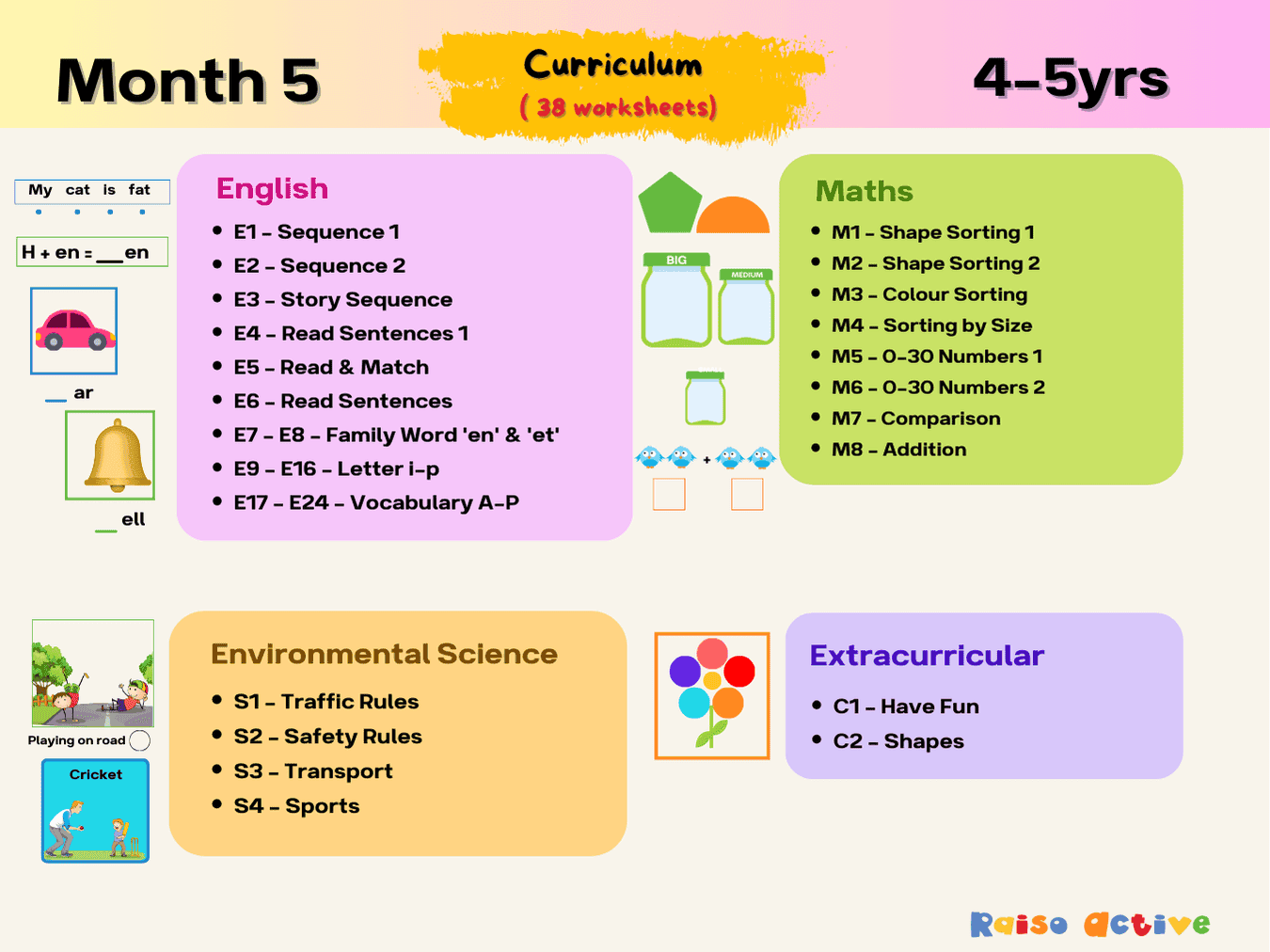
Month 5: Literacy, Math, Environmental Science | Ages 4-5
This is page 27 of the pack. Ages 4-5 · Pre-KAges 4-5 · ReceptionAges 4-5 · LKGAges 4-5
Made for your child
Spelling practice, made for your child
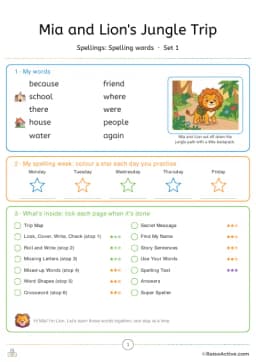
Their own spelling words turned into a pack: trace or look-cover-write-check, roll and write, a secret picture code, a word search, a crossword and a test, with their name in it.
Make a spelling packFree preview · free for members
Or start free: a word search with sight wordsCurriculum
- Phonics - Letter Sounds > Beginning Sounds
How to use this worksheet
Look at each picture and have your child name it independently before offering help. If the word is unfamiliar, say it together a couple of times so your child hears it clearly. Ask your child to identify the first sound in the word and write the matching letter in the blank space. Move through all the pictures, then review the completed page together, rereading each word and its letter.
Materials needed
- Pencil
- Eraser
Extension activities
- 1Draw new pictures of favorite objects and write the first letter of each one.
- 2Search around the house for objects and practice writing their first letters.
- 3Play a vocabulary-building game, describing an object without naming it for your child to guess.
- 4Create a simple picture dictionary page for a letter your child is working on.
- 5Read a book together and pause to name a few objects and their first letters on each page.

Written by
Hemsweta Jain · Teacher Cheena
MBA and Early Childhood Educator, teaching since 2014 · Founder of RaisoActive, Mumbai
Every RaisoActive worksheet is designed and checked by the founder before publishing.
Published · Last reviewed
More from Month 5: Literacy, Math, Environmental Science | Ages 4-5
Letter 'k' Worksheet: Trace, Match, and Color!
Ages 3-5 · Preschool–Pre-KAges 3-5 · Nursery–ReceptionAges 3-5 · Nursery–LKGAges 3-5
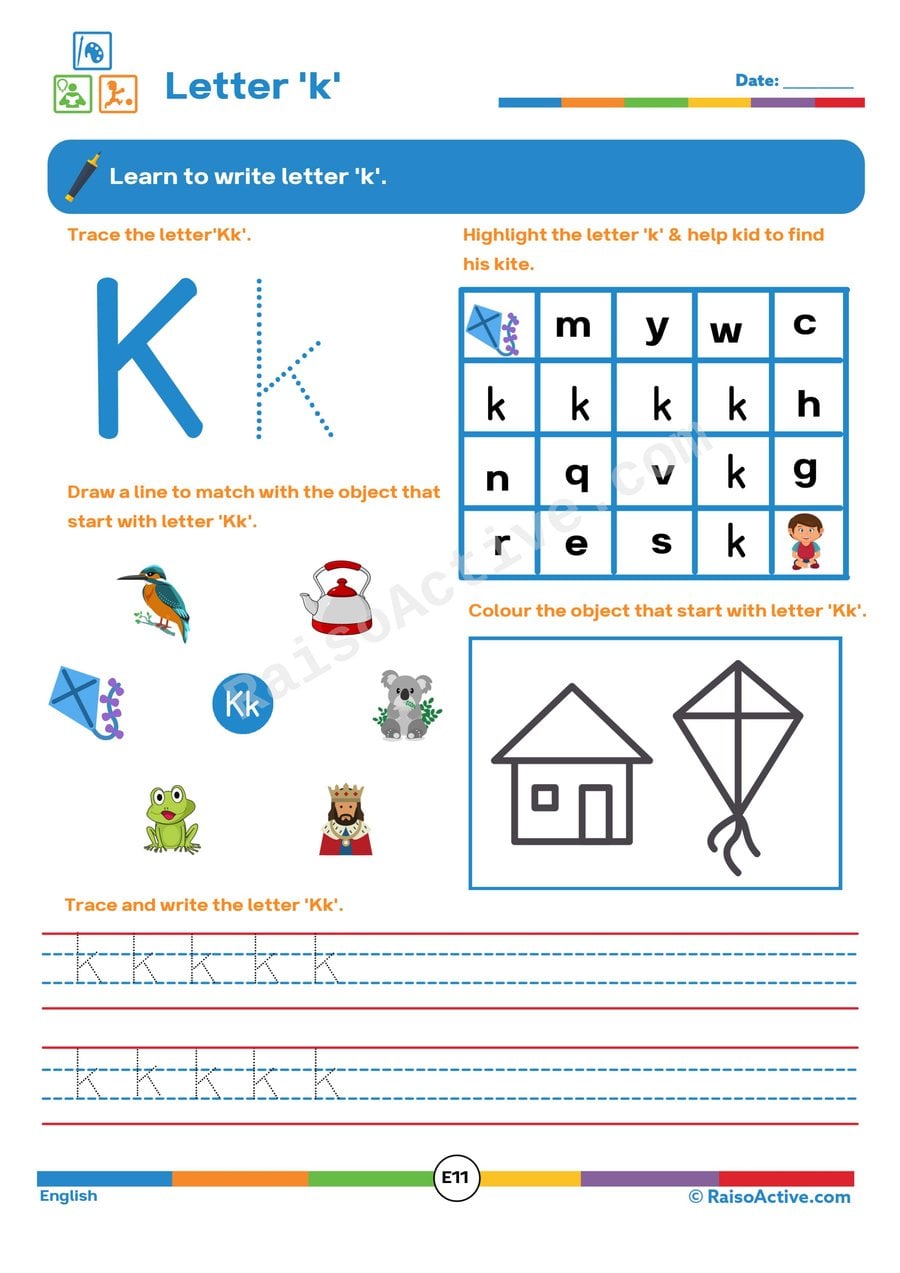
This worksheet builds letter 'k' recognition for 3-5 year olds across three connected activities — tracing its shape, matching it to pictures that start with the same sound, and coloring those matched objects — which reinforces the letter through repetition in different formats rather than a single pass. The 'k' sound and shape are less commonly practiced than more frequent letters, so this worksheet gives your child valuable extra exposure to a trickier letter.
Addition Worksheet: Count and Add!
Ages 4-5 · Pre-KAges 4-5 · ReceptionAges 4-5 · LKGAges 4-5
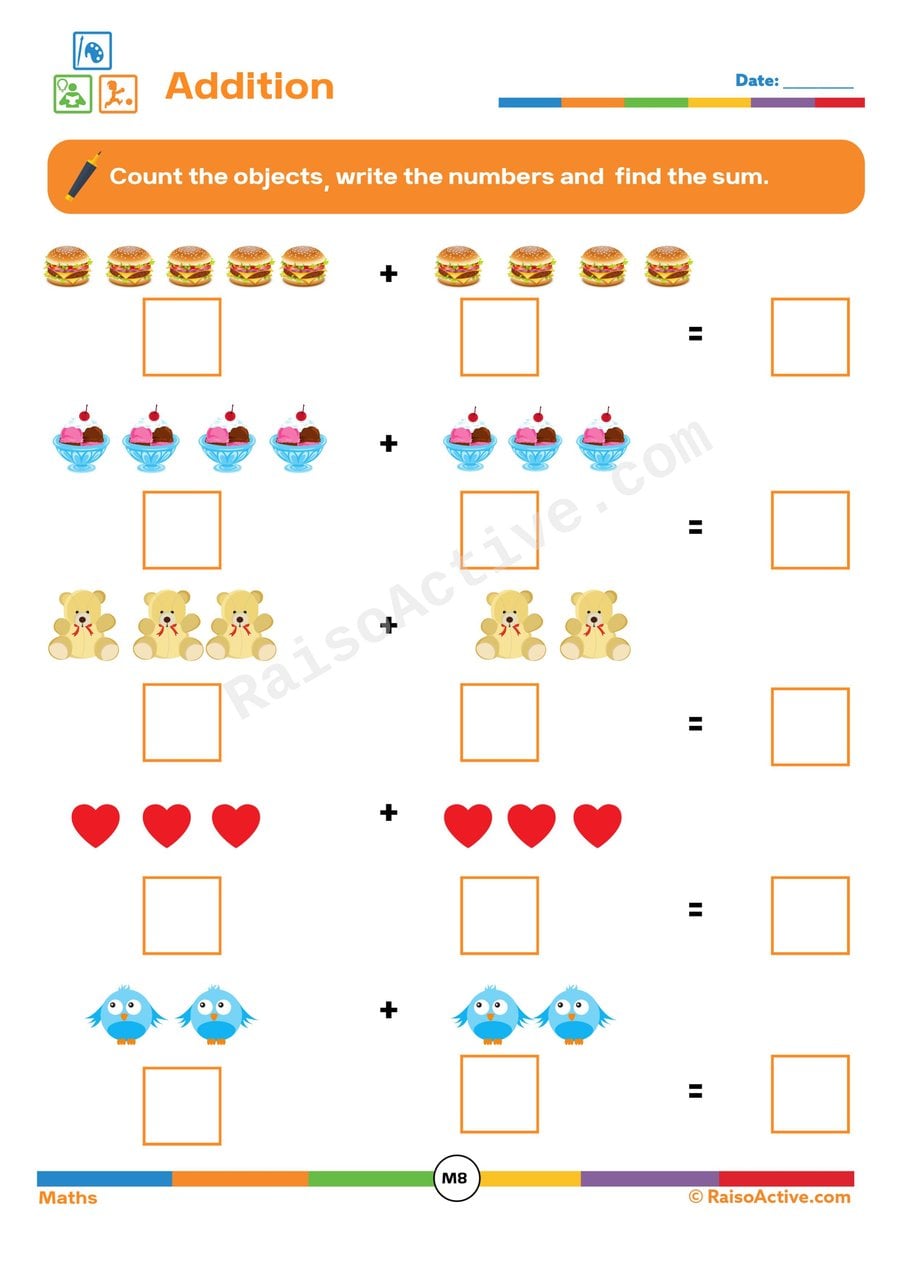
Counting two separate groups of objects and writing the sum teaches children ages 4-5 the basic concept of addition as combining quantities, an essential foundation for all later arithmetic. Writing the number for each group before adding also reinforces accurate one-to-one counting, since an error there would carry through to the final sum.

Beehive Number Fun: Missing Numbers 0-30 Worksheet
Ages 4-6 · Pre-K–KindergartenAges 4-6 · Reception–Year 1Ages 4-6 · LKG–UKGAges 4-6
Filling in missing numbers along a beehive path gives 4-6 year olds practice with the full 0-30 number sequence, a meaningful stretch beyond the more common 1-10 or 1-20 ranges seen in earlier counting worksheets. Because the missing numbers are scattered rather than all at the end, your child has to actually understand what number comes next at multiple points in the sequence, rather than simply continuing a count from a known starting point.

First Letter Fun: Identify and Write the Beginning Sounds Worksheet
Ages 4-5 · Pre-KAges 4-5 · ReceptionAges 4-5 · LKGAges 4-5
Naming each pictured object and writing its first letter helps children ages 4-5 practice phonemic awareness, the skill of isolating the very first sound in a word, which is a key building block for spelling and early reading. This worksheet turns that listening skill into a writing task, reinforcing the connection between a spoken sound and its written letter.

First Letter Fun: Identify and Write! A Fun Vocabulary Worksheet for Kids
Ages 4-6 · Pre-K–KindergartenAges 4-6 · Reception–Year 1Ages 4-6 · LKG–UKGAges 4-6
This worksheet extends beginning-sound practice for children ages 4-6 slightly further than earlier versions, asking them to independently identify an object's name and write its first letter with less visual support. Isolating and writing initial sounds accurately is a strong predictor of later spelling and reading success, since it requires children to translate an auditory skill into a written one. Repeating this process across multiple pictures builds both vocabulary and growing independence in phonics reasoning.
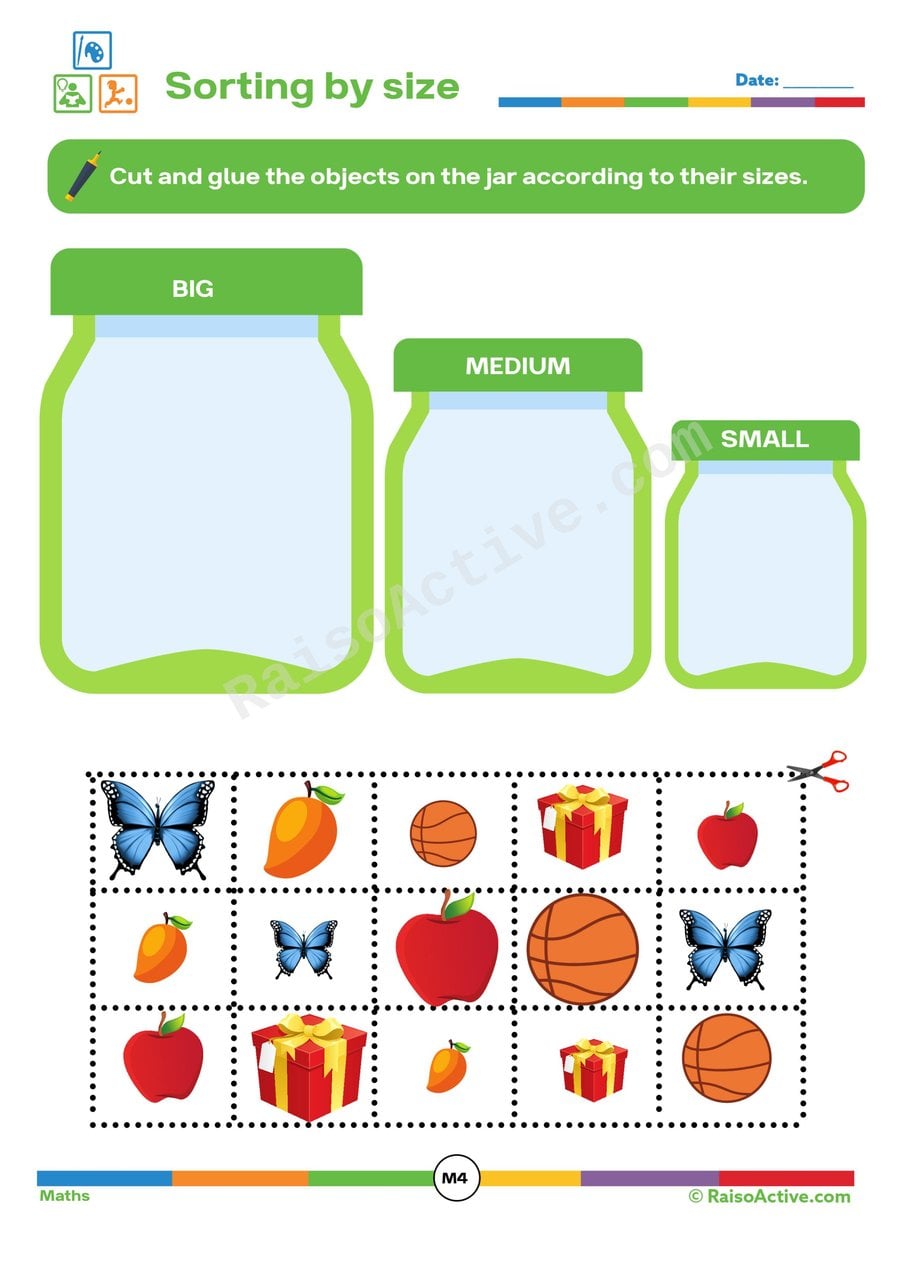
Sorting by Size: Cut and Paste Worksheet
Ages 3-5 · Preschool–Pre-KAges 3-5 · Nursery–ReceptionAges 3-5 · Nursery–LKGAges 3-5
This cut-and-paste worksheet asks 3-5 year olds to compare objects by size — big, medium, and small — and sort them into the correct jar, which is a genuinely tricky comparison since 'medium' only makes sense relative to the other two sizes rather than as an absolute category. Working through this sorting builds early comparative reasoning alongside the fine motor practice of cutting and gluing small pieces accurately.

Sports Match-Up Worksheet for Kids: Match the Sports to Their Equipment!
Ages 4-6 · Pre-K–KindergartenAges 4-6 · Reception–Year 1Ages 4-6 · LKG–UKGAges 4-6
Matching sports to their equipment teaches children ages 4-6 to connect an activity with the tools used to play it, building categorization skills alongside sports vocabulary. This kind of real-world matching helps children make sense of things they may see on television, at the park, or during physical education class.

Sequence the Pictures: Ordering Activities Worksheet for Kids
Ages 3-5 · Preschool–Pre-KAges 3-5 · Nursery–ReceptionAges 3-5 · Nursery–LKGAges 3-5
This worksheet builds logical sequencing skills for 3-5 year olds by having them study a set of three pictures showing an event unfolding and decide which order makes sense — planting a seed before it grows, for example, rather than after. Writing the numbers 1, 2, and 3 under each picture forces your child to commit to a specific reasoning about cause and effect, which is a meaningfully different task than simply describing what's happening in each picture.
Related worksheets
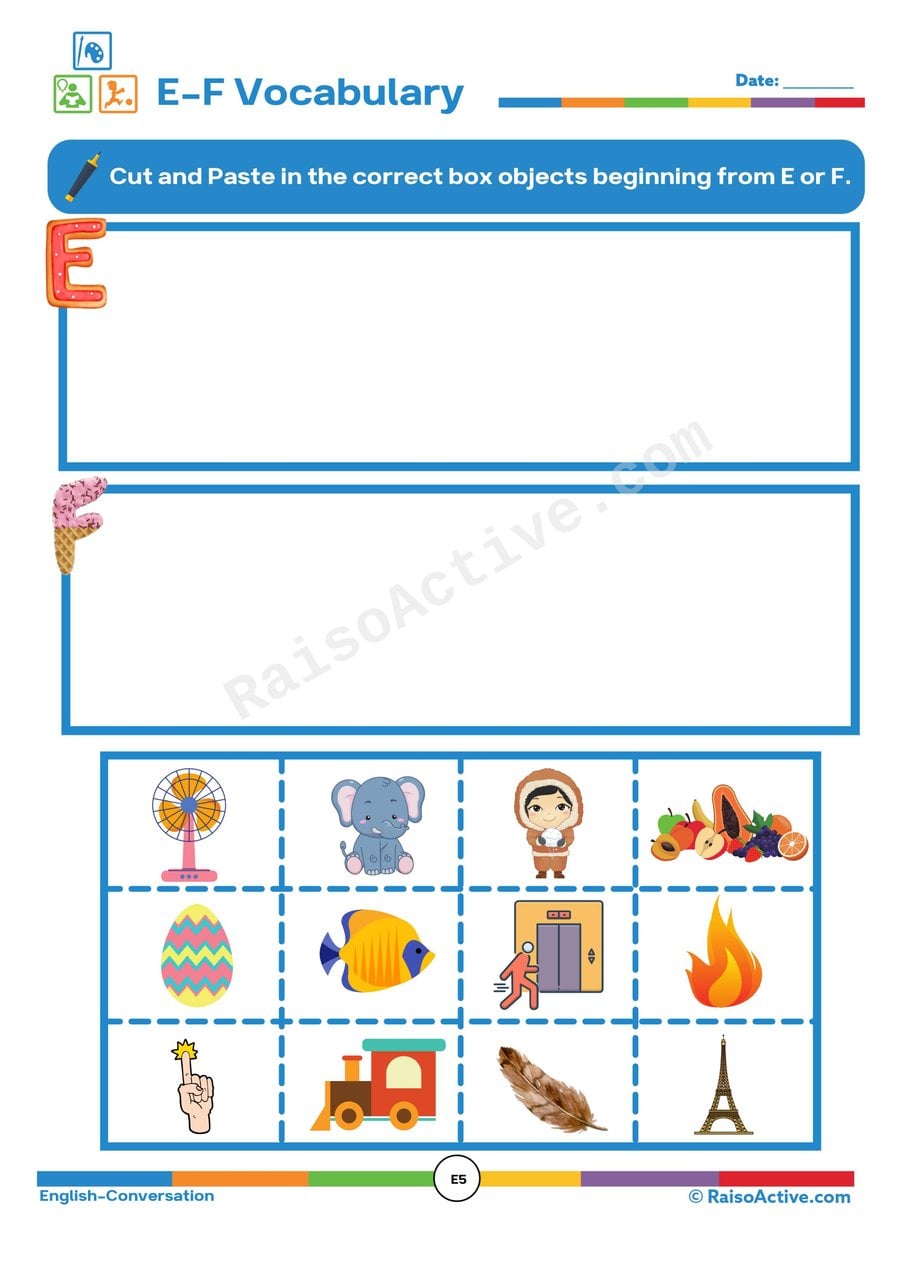
E-F Vocabulary Worksheet: Cut and Paste Fun!
Ages 3-5 · Preschool–Pre-KAges 3-5 · Nursery–ReceptionAges 3-5 · Nursery–LKGAges 3-5
This worksheet builds phonemic awareness and vocabulary as children ages 3-5 sort pictures by their beginning sound, deciding whether each object starts with the letter E or F. Practicing this kind of sound-sorting strengthens the auditory discrimination skills children need before they can reliably match letters to sounds in reading.

Vocabulary Worksheet: Circle the Objects That Start with Letters M, K, X, W, and S!
Ages 4-6 · Pre-K–KindergartenAges 4-6 · Reception–Year 1Ages 4-6 · LKG–UKGAges 4-6
This worksheet asks children ages 4-6 to identify pictured objects and circle the ones that begin with a specific target letter — cycling through M, K, X, W, and S — reinforcing beginning sound recognition across a wider range of letters than a single-letter worksheet would. Working across five different letters in one sitting also helps children practice quickly switching their sound-matching strategy from one letter to the next.
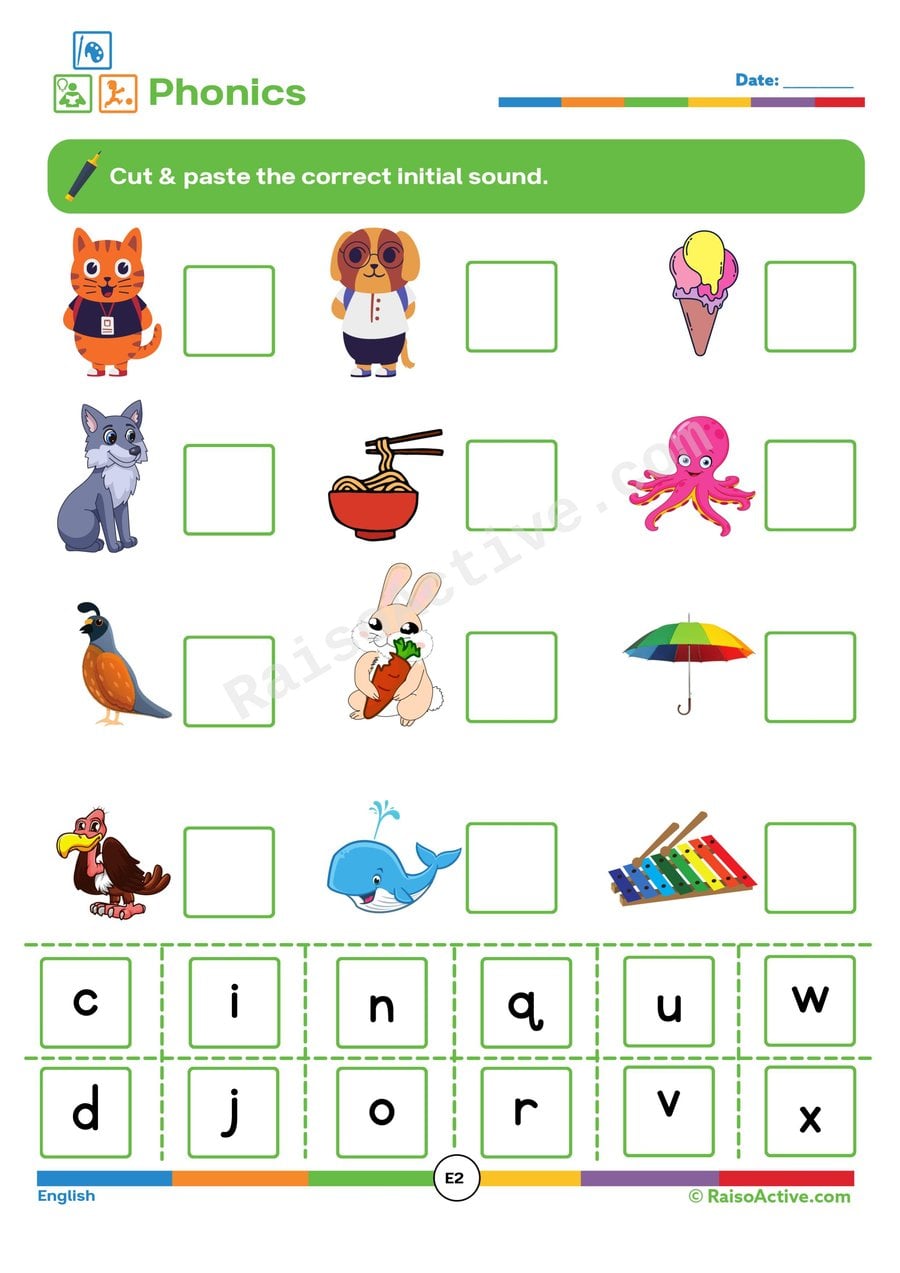
Initial Sound Match: Cut and Paste Worksheet
Ages 4-5 · Pre-KAges 4-5 · ReceptionAges 4-5 · LKGAges 4-5
Children ages 4-5 develop phonemic awareness by identifying the beginning sound of each pictured object and matching it to the correct letter, a critical pre-reading skill for connecting sounds to symbols. This cut-and-paste format adds fine motor practice with scissors and glue alongside the phonics work. Recognizing initial sounds is one of the strongest early predictors of later reading success.

Letter Sounds: Color the Letter Worksheet for Preschoolers
Ages 3-5 · Preschool–Pre-KAges 3-5 · Nursery–ReceptionAges 3-5 · Nursery–LKGAges 3-5
Matching a picture — a ball, a cat, a dog — to the letter it starts with asks a 3-5 year old to isolate the very first sound of a word, which is one of the core building blocks of phonemic awareness before formal reading begins. Coloring the matching letter circle adds a low-pressure, motor-skill layer to what's really a listening and sound-matching task.

Phonics Worksheet: Write the First Letter and Draw!
Ages 3-5 · Preschool–Pre-KAges 3-5 · Nursery–ReceptionAges 3-5 · Nursery–LKGAges 3-5
Identifying the first letter of a pictured object's name and writing it down builds phonemic awareness and letter-formation practice for children ages 3-5, while the follow-up drawing task builds creative thinking and fine motor control.
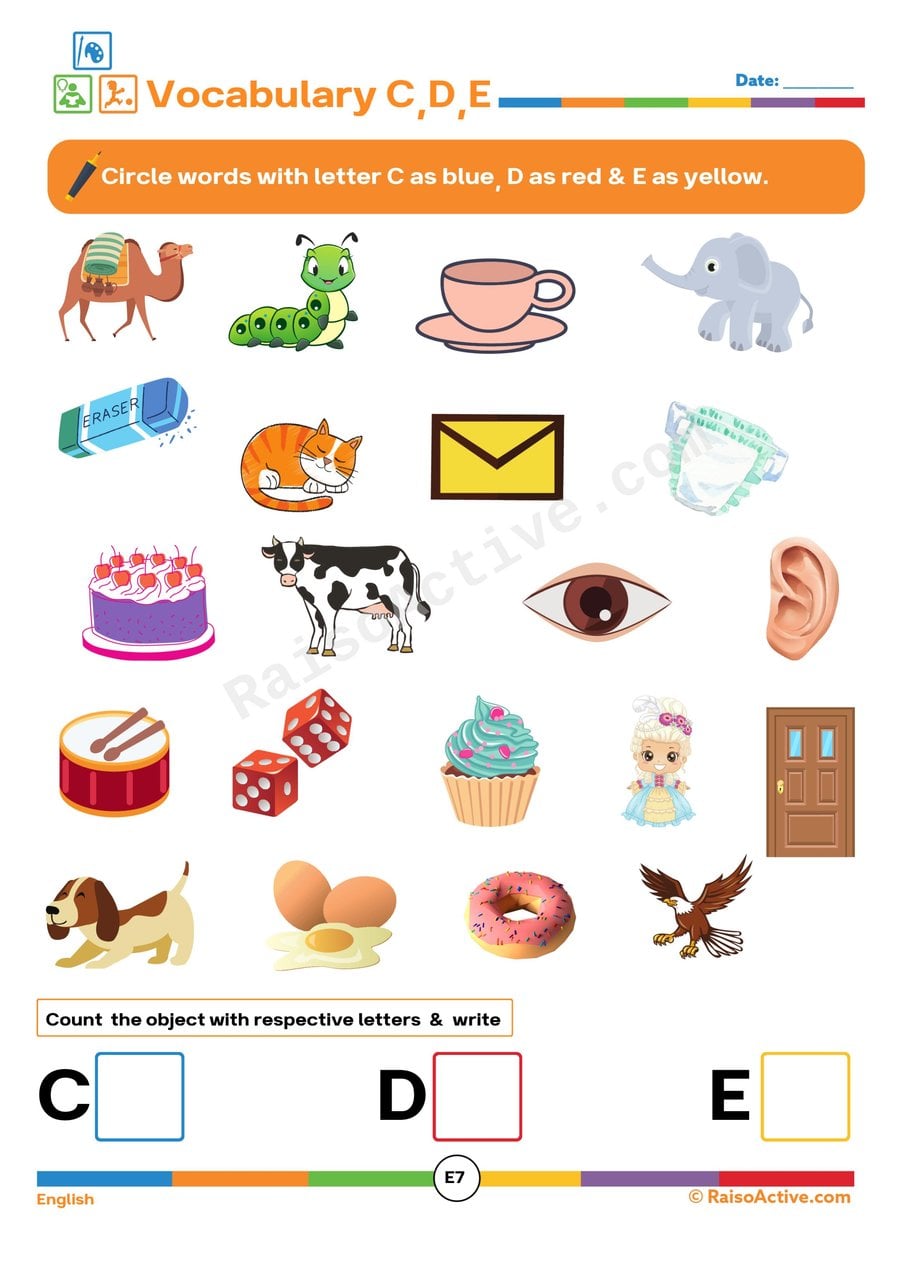
C, D, E Letter Sounds Worksheet: Circle and Count!
Ages 3-5 · Preschool–Pre-KAges 3-5 · Nursery–ReceptionAges 3-5 · Nursery–LKGAges 3-5
This activity gives children ages 3-5 focused practice recognizing the beginning sounds of the letters C, D, and E, asking them to circle matching pictures in different colors for each letter before counting the results. Combining phonics with counting means children practice two skills in one sitting: identifying initial letter sounds and recording a numeric total, both foundational for kindergarten readiness. Color-coding each letter also helps children visually organize the three sounds instead of mixing them together.

Cut and Paste Objects Starting with Letters: Q, R, and S Worksheet
Ages 3-5 · Preschool–Pre-KAges 3-5 · Nursery–ReceptionAges 3-5 · Nursery–LKGAges 3-5
This cut-and-paste worksheet combines beginning-sound recognition with fine motor practice for children ages 3-5, focusing on the letters Q, R, and S — three consonants that appear less often in early vocabulary than letters like B or C, so extra practice helps cement them. Cutting out small object pictures and correctly pasting them beside the matching letter requires your child to first identify the beginning sound, then execute the physical control needed to cut along lines and place glue precisely. This blend of phonics and hands-on craft work builds both academic and physical skills in one sitting.

Phonics Fun: Circle the Beginning Sound Worksheet for Preschoolers
Ages 4-5 · Pre-KAges 4-5 · ReceptionAges 4-5 · LKGAges 4-5
This worksheet builds phonemic awareness by asking children to listen for a picture's beginning sound and circle the letter that matches it, a core early-reading skill that connects spoken sounds to written letters. For ages 4-5, this kind of sound-to-letter matching is one of the clearest predictors of later reading success, since it requires isolating individual sounds within a spoken word.
Guides for this topic

Sight Words by Age: The First 50 Words and How to Teach Them Without Flashcard Fatigue
Which sight words to teach first and why, the heart-word method, a read-trace-write-find routine, games, and a by-age table of typical sight-word progress.
How to Teach CVC Blending: A Step-by-Step Method That Works in Two Weeks
A step-by-step method for teaching CVC blending, covering continuous sounds, word families, common errors, and a 14-day plan that most children finish reading CVC words.
Phase 2 Phonics at Home: Sound Order, Blending Games, Worksheets
Phase 2 phonics at home: the five sound sets in order, oral blending, tricky words, a two-week routine, common mistakes, and free worksheets.
Reviews
Every worksheet for ages 4–6, no watermark
Members download the full library of 1,000+ worksheets and every activity pack without watermarks or daily limits. One year costs ₹999 in India or $20 elsewhere.
See membership plansOr download any worksheet free with a watermark (5 a day).