Sports Match-Up Worksheet for Kids: Match the Sports to Their Equipment!
Matching sports to their equipment teaches children ages 4-6 to connect an activity with the tools used to play it, building categorization skills alongside sports vocabulary. This kind of real-world matching helps children make sense of things they may see on television, at the park, or during physical education class.
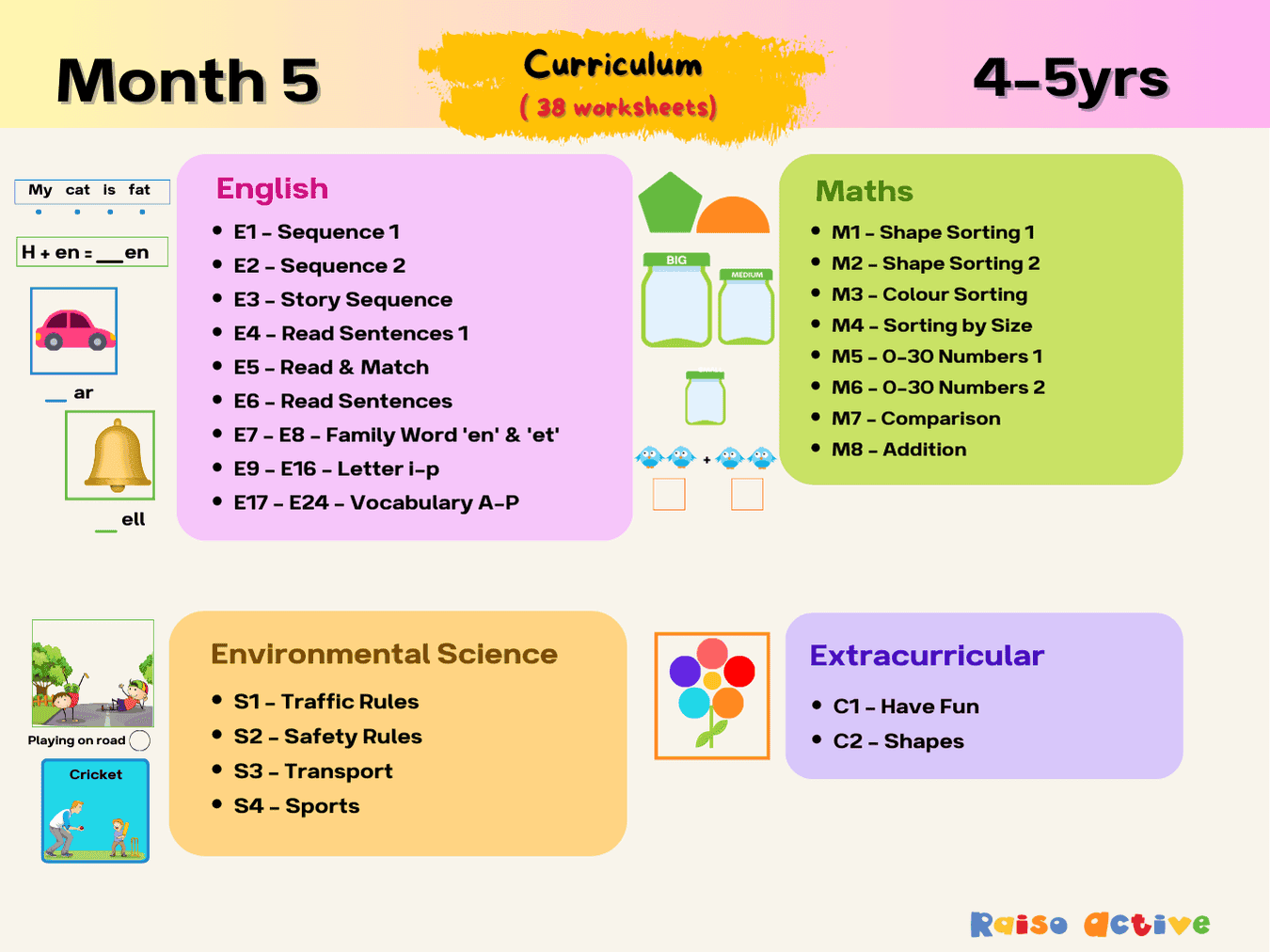
Part of the pack
Month 5: Literacy, Math, Environmental Science | Ages 4-5
This is page 39 of the pack. Ages 4-5 · Pre-KAges 4-5 · ReceptionAges 4-5 · LKGAges 4-5
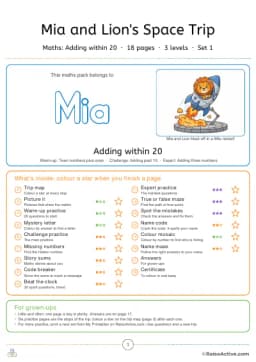
Made for your child
Numbers to 20, made for your child
A maths pack with your child's name in it: pictures that explain, practice at three levels, puzzles and story sums about them. Print a new set whenever they finish.
Make a maths packFree preview · free for members
Curriculum
- Living Things - Animals > Animals & Habitats
How to use this worksheet
Read the list of sport names on the left side of the page together with your child. Look at the equipment pictures on the right and talk about what each item is used for. Have your child draw a line connecting each sport to its matching piece of equipment, checking their reasoning as they go.
Materials needed
- Pencil
- Eraser
Extension activities
- 1Draw a picture of your child's favorite sport along with its equipment.
- 2Talk about the basic rules of one or two sports featured on the worksheet.
- 3Go on a scavenger hunt around the house for sports equipment you already own.
- 4Act out playing different sports using charades so your child can guess which one.
- 5Watch a short video clip of a sport together and identify the equipment being used.

Written by
Hemsweta Jain · Teacher Cheena
MBA and Early Childhood Educator, teaching since 2014 · Founder of RaisoActive, Mumbai
Every RaisoActive worksheet is designed and checked by the founder before publishing.
Published · Last reviewed
More from Month 5: Literacy, Math, Environmental Science | Ages 4-5

Flower Fun: Draw and Color a Flower with Bottle Caps and Bangles!
Ages 3-5 · Preschool–Pre-KAges 3-5 · Nursery–ReceptionAges 3-5 · Nursery–LKGAges 3-5
Tracing around a bottle cap for small circles and a bangle for large circles teaches children ages 3-5 to use everyday objects as drawing tools, building fine motor control and an early sense of composing shapes into a picture. This hands-on approach to drawing a flower also introduces the idea that complex pictures can be built from simple repeated shapes.

Shape Song Fun: Color & Learn Shapes Worksheet for Preschoolers
Ages 3-5 · Preschool–Pre-KAges 3-5 · Nursery–ReceptionAges 3-5 · Nursery–LKGAges 3-5
Coloring each shape according to its outline helps children ages 3-5 practice recognizing 2D shapes while staying within lines, and singing the accompanying shape song adds a rhythmic memory aid that makes shape names easier to recall. Combining a physical coloring task with an auditory song appeals to multiple ways young children learn best.

First Letter Fun: Identify and Write! A Fun Vocabulary Worksheet for Kids
Ages 4-6 · Pre-K–KindergartenAges 4-6 · Reception–Year 1Ages 4-6 · LKG–UKGAges 4-6
This worksheet extends beginning-sound practice for children ages 4-6 slightly further than earlier versions, asking them to independently identify an object's name and write its first letter with less visual support. Isolating and writing initial sounds accurately is a strong predictor of later spelling and reading success, since it requires children to translate an auditory skill into a written one. Repeating this process across multiple pictures builds both vocabulary and growing independence in phonics reasoning.
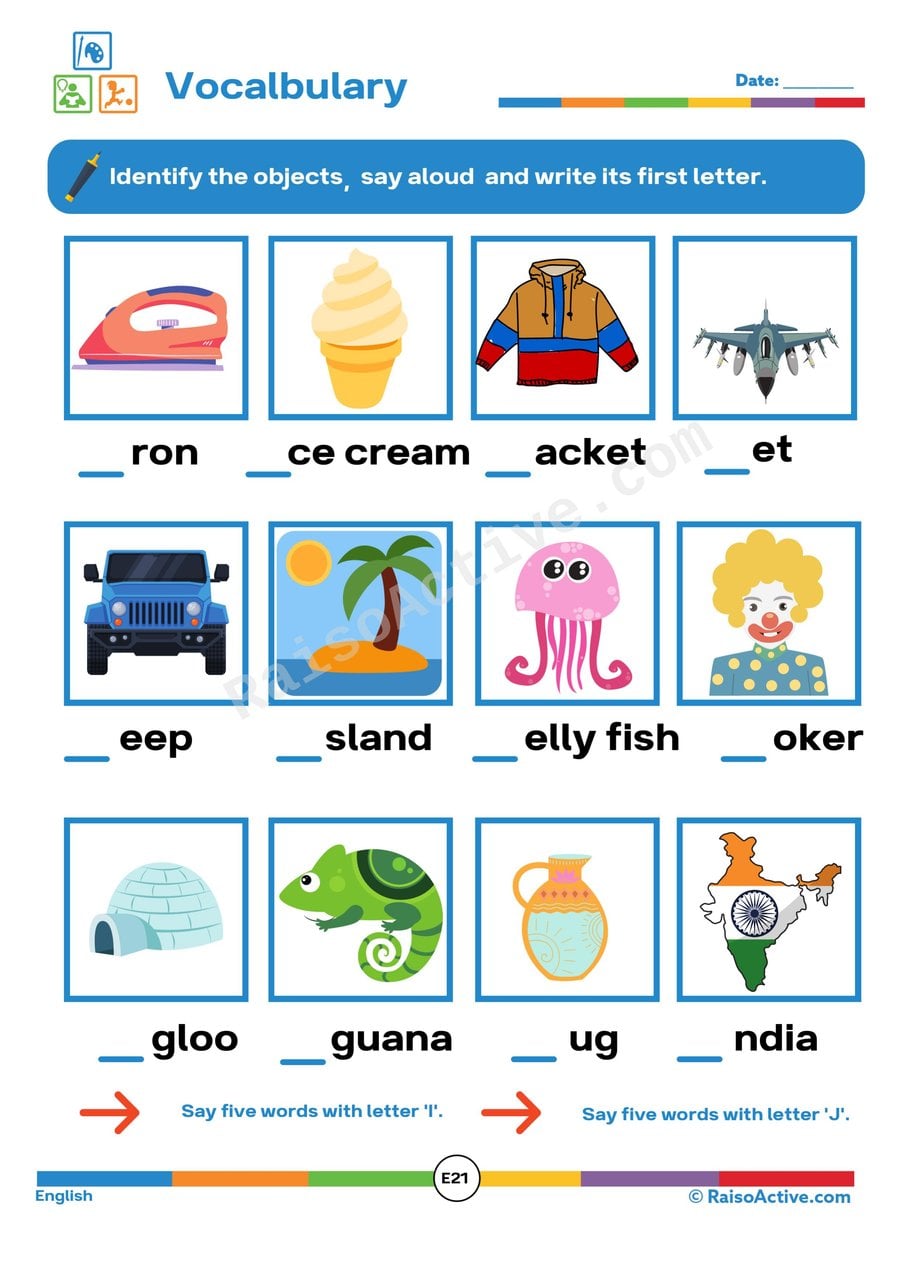
First Letter Fun: Identify and Write! (Ages 3-5)
Ages 3-5 · Preschool–Pre-KAges 3-5 · Nursery–ReceptionAges 3-5 · Nursery–LKGAges 3-5
This worksheet builds foundational alphabet knowledge for 3-5 year olds by combining picture naming with first-sound listening, giving your child practice at the exact skill that underlies early spelling: hearing a word, isolating its opening sound, and matching that sound to a written symbol. Because every picture requires a fresh listening decision, this worksheet resists rote memorization and keeps your child actively engaged with each new word.

Little Red Riding Hood Story Sequencing Worksheet for Preschoolers
Ages 3-5 · Preschool–Pre-KAges 3-5 · Nursery–ReceptionAges 3-5 · Nursery–LKGAges 3-5
Retelling Little Red Riding Hood through sequencing pictures asks 3-5 year olds to understand story structure — that events happen in a specific order and that order affects meaning — which is a foundational reading comprehension skill that comes before children can read the words themselves. Because the pictures have to be cut out and physically arranged, this worksheet also combines comprehension with fine motor practice, and having your child explain each scene before gluing it down pushes them to actively process the story rather than passively recall it.

First Letter Fun: Identify and Write! Vocabulary Worksheet
Ages 3-5 · Preschool–Pre-KAges 3-5 · Nursery–ReceptionAges 3-5 · Nursery–LKGAges 3-5
Naming everyday objects and writing their opening letter builds vocabulary alongside phonics for 3-5 year olds — each picture requires your child to first recall or recognize the object's name, then isolate just its first sound, and finally translate that sound into a written symbol. This vocabulary-first framing makes the worksheet especially useful for children who are still building the words for common objects, not just the letters that start them.

Sequence the Pictures: Ordering Activities Worksheet for Kids
Ages 3-5 · Preschool–Pre-KAges 3-5 · Nursery–ReceptionAges 3-5 · Nursery–LKGAges 3-5
This worksheet builds logical sequencing skills for 3-5 year olds by having them study a set of three pictures showing an event unfolding and decide which order makes sense — planting a seed before it grows, for example, rather than after. Writing the numbers 1, 2, and 3 under each picture forces your child to commit to a specific reasoning about cause and effect, which is a meaningfully different task than simply describing what's happening in each picture.
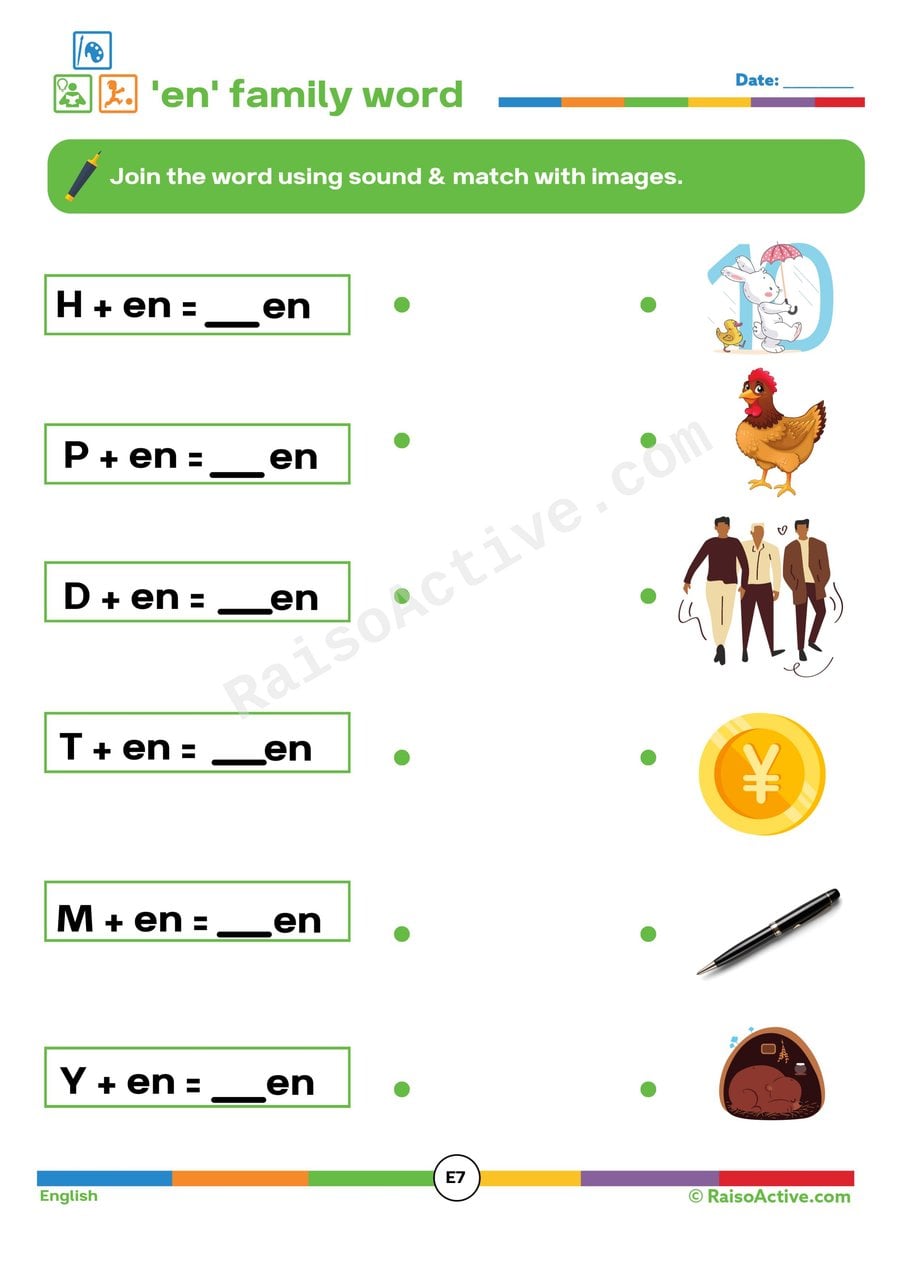
Fun 'en' Family Word Worksheet for Preschoolers
Ages 3-5 · Preschool–Pre-KAges 3-5 · Nursery–ReceptionAges 3-5 · Nursery–LKGAges 3-5
This worksheet introduces 3-5 year olds to the 'en' word family — pen, hen, ten — teaching them that once they know one ending pattern, they can read a whole group of words just by changing the beginning sound. That's a big efficiency gain in early phonics: instead of memorizing each word individually, your child learns to blend a new beginning sound onto a familiar chunk, which is exactly how fluent word-family reading develops.
Related worksheets
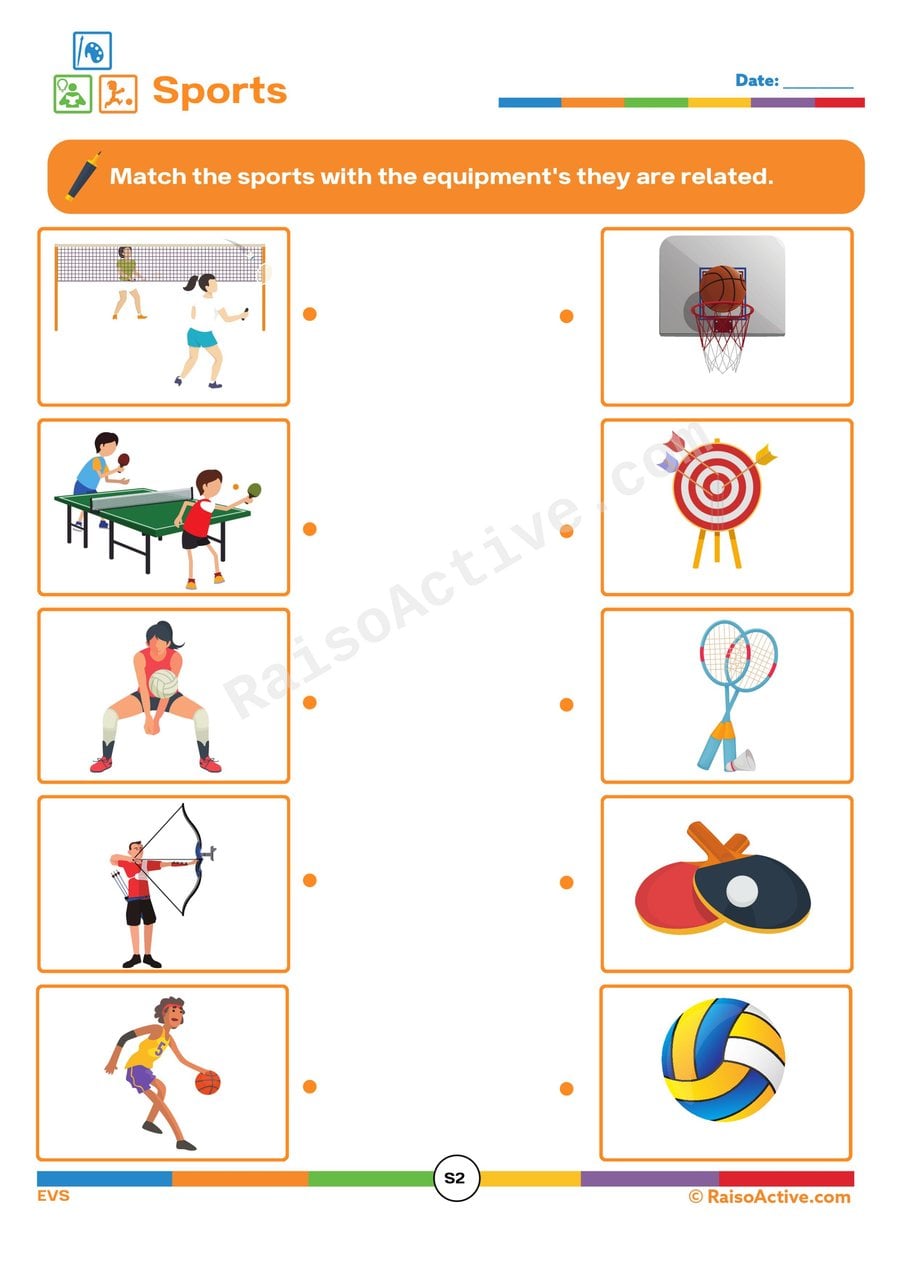
Sports Equipment Match: A Fun Worksheet for Kids!
Ages 3-5 · Preschool–Pre-KAges 3-5 · Nursery–ReceptionAges 3-5 · Nursery–LKGAges 3-5
Matching a sport to its equipment, a bat to baseball or a racket to tennis, asks children to build a mental association between an activity and the tools it requires, strengthening categorization skills and real-world vocabulary. For ages three to five, this kind of practical pairing also supports gross motor development indirectly, since naming and recognizing sports equipment often leads to more engaged physical play.
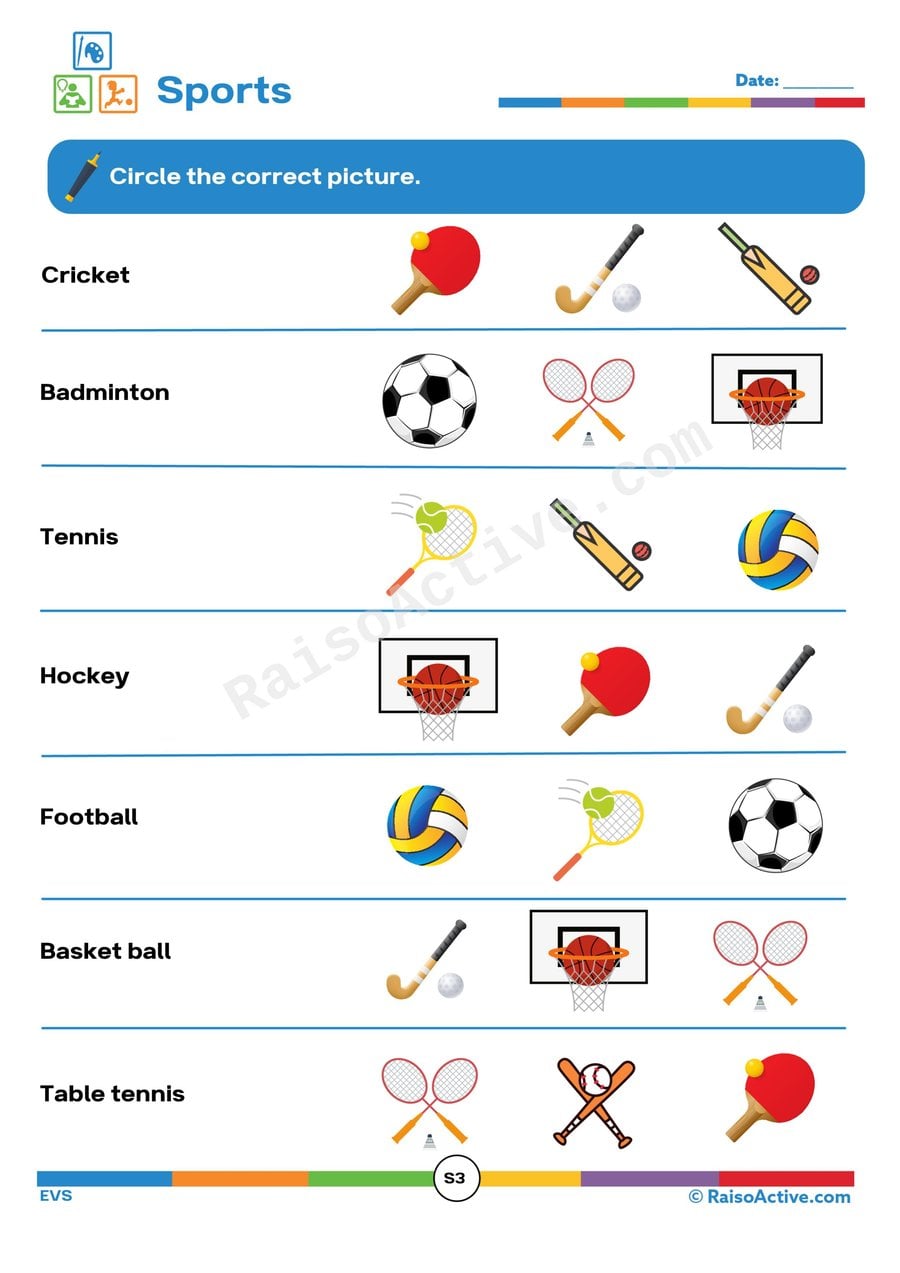
Sports Matching Worksheet for Preschoolers
Ages 3-5 · Preschool–Pre-KAges 3-5 · Nursery–ReceptionAges 3-5 · Nursery–LKGAges 3-5
Matching a sport's written name to its picture builds vocabulary and early reading recognition for children ages 3-5, connecting specific words like 'soccer' or 'swimming' to real, familiar activities. Because sports involve distinct equipment and movements, this task also sharpens visual discrimination, since children must notice small differences between similar-looking pictures to find the correct match.

Symmetry Fun Worksheet for Kids: Complete and Color!
Ages 3-5 · Preschool–Pre-KAges 3-5 · Nursery–ReceptionAges 3-5 · Nursery–LKGAges 3-5
This symmetry worksheet challenges children ages 3-5 to study a half-drawn Christmas picture and draw the missing mirror-image half, introducing the early geometry concept that two sides of a shape can match exactly. Completing and then coloring the picture also builds visual comparison skills, since children must check their drawn half against the original before filling it in with color.
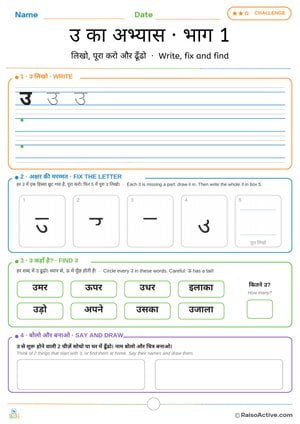
Hindi Letter उ Practice Part 1: Write, Fix and Find | उ का अभ्यास · भाग 1
Ages 3-7 · Preschool–Grade 1Ages 3-7 · Nursery–Year 2Ages 3-7 · Nursery–Class 1Ages 3-7
Children write उ on guide lines, complete four partly drawn letters, circle उ in eight words (while avoiding its look-alike ऊ), count how many they found, then think of two more words at home that start with उ and draw them.

Christmas Matching Worksheet for Preschoolers: Find the Identical Objects!
Ages 3-5 · Preschool–Pre-KAges 3-5 · Nursery–ReceptionAges 3-5 · Nursery–LKGAges 3-5
Comparing objects in a row to find the one that exactly matches the first picture builds visual discrimination in children ages 3-5, a skill that requires noticing small differences in shape, color, and detail. This kind of close looking is a direct precursor to letter recognition, since young readers must later tell apart similarly shaped letters like b and d using the same careful visual comparison. The Christmas theme keeps the repetitive matching task feeling festive rather than tedious.

Easter Egg Color Match Worksheet for Preschoolers
Ages 3-5 · Preschool–Pre-KAges 3-5 · Nursery–ReceptionAges 3-5 · Nursery–LKGAges 3-5
This worksheet builds on color recognition by asking children ages 3-5 to color a full row of eggs so they all match one another, reinforcing visual discrimination alongside color vocabulary. Rather than following a printed key, children must compare their own work egg to egg, which adds a self-checking element to the coloring task.

Stick Man Emotions Worksheet: Happy, Sad, Angry, and Surprised!
Ages 4-6 · Pre-K–KindergartenAges 4-6 · Reception–Year 1Ages 4-6 · LKG–UKGAges 4-6
Children ages 4-6 practice reading facial expressions on this worksheet, matching stick-figure faces to their correct emotion labels by noticing details like mouth shape and eyebrow position. This strengthens emotional literacy — the ability to name and recognize feelings in others — which supports empathy and smoother social interactions as children move into more group play and classroom settings.

Coding Worksheet for Kids: Arrow Codes and Robot Grid
Ages 4-7 · Pre-K–Grade 1Ages 4-7 · Reception–Year 2Ages 4-7 · LKG–Class 1Ages 4-7
Children read arrow codes to move a robot across a grid, write their own arrow code to take the bee to the flower, and spot the one wrong arrow in a code. These are first steps in coding, sequencing and debugging.
Guides for this topic

Best Worksheets for 3-Year-Olds: What Works and What to Avoid
What works on worksheets for 3-year-olds: short sessions, crayons, tracing lines, matching, cutting, a free weekly plan, and signs one is too advanced.
Documenting Learning Without Drowning in Data: A Practical Guide for Parents and Teachers
Learn practical ways to document your child's learning without overwhelm. Simple portfolios, observation tips, and printable trackers for ages 1-8.

Age-Appropriate Problem-Solving Activities: Building Critical Thinkers from the Ground Up
Discover fun, age-appropriate problem-solving activities for children ages 1-8. Build critical thinking, logic, and reasoning skills through play-based learning.
Reviews
Every worksheet for ages 4–6, no watermark
Members download the full library of 1,000+ worksheets and every activity pack without watermarks or daily limits. One year costs ₹999 in India or $20 elsewhere.
See membership plansOr download any worksheet free with a watermark (5 a day).