First Letter Fun: Identify and Write! Vocabulary Worksheet
Naming everyday objects and writing their opening letter builds vocabulary alongside phonics for 3-5 year olds — each picture requires your child to first recall or recognize the object's name, then isolate just its first sound, and finally translate that sound into a written symbol. This vocabulary-first framing makes the worksheet especially useful for children who are still building the words for common objects, not just the letters that start them.
Part of the pack
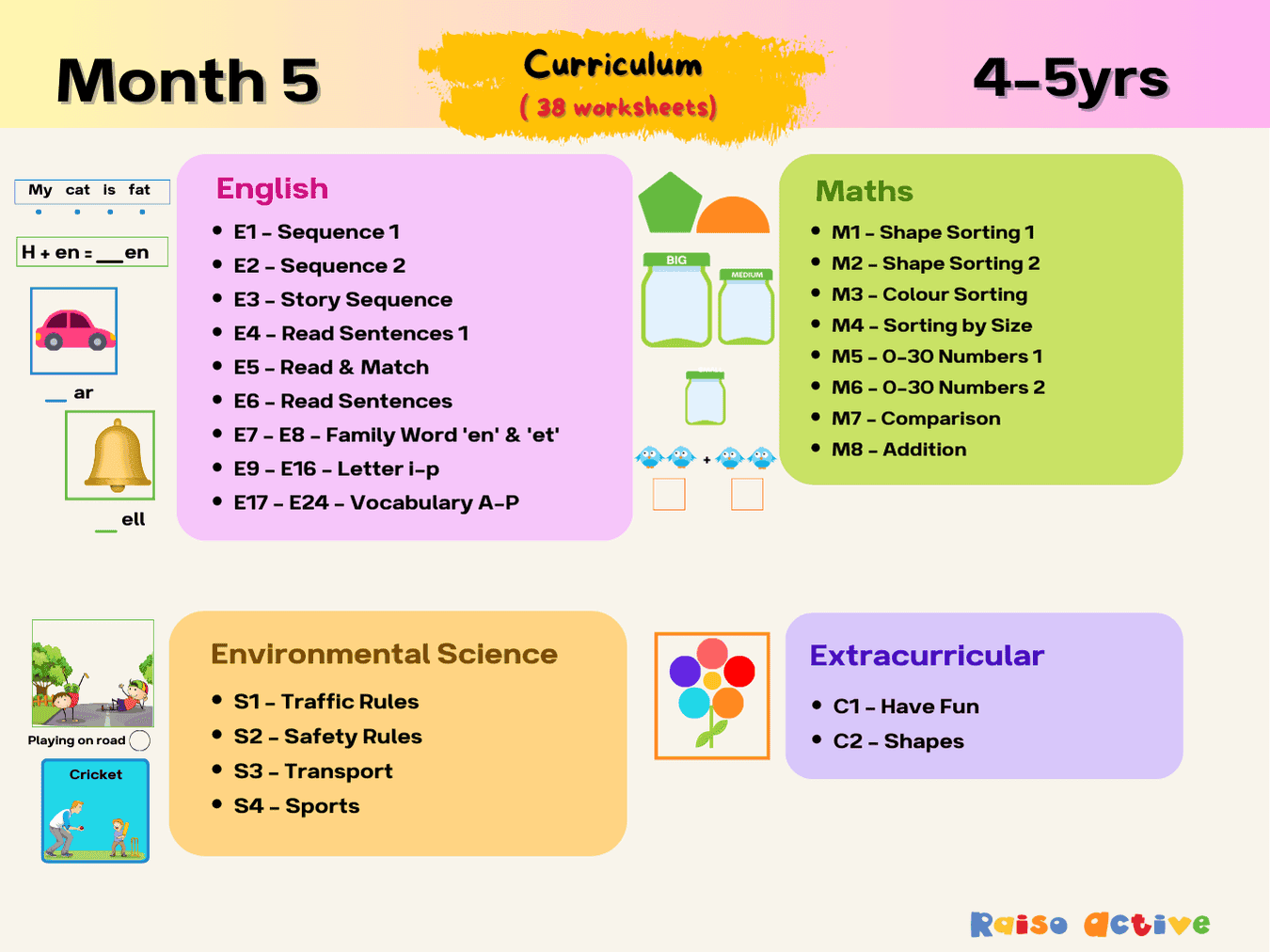
Month 5: Literacy, Math, Environmental Science | Ages 4-5
This is page 26 of the pack. Ages 4-5 · Pre-KAges 4-5 · ReceptionAges 4-5 · LKGAges 4-5
Made for your child
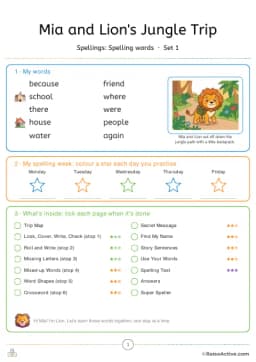
Spelling practice, made for your child
Their own spelling words turned into a pack: trace or look-cover-write-check, roll and write, a secret picture code, a word search, a crossword and a test, with their name in it.
Make a spelling packFree preview · free for members
Or start free: a word search with sight wordsCurriculum
- Phonics - Letter Sounds > Beginning Sounds
How to use this worksheet
Look at each picture and ask your child to name it before doing anything else — if the word isn't familiar, say it together a few times. Once they know the word, ask them to listen for the very first sound in it. Have them write that letter in the space provided, saying the sound again as they write. Move through all the pictures this way, then read back the full list of first letters together at the end.
Materials needed
- Pencil
- Eraser
Extension activities
- 1Look around the house for other objects and figure out their first letters together.
- 2Have your child draw their own pictures of favorite objects and write the first letter of each one.
- 3Play a simple guessing game: describe an object without naming it and have your child guess the word and its first letter.
- 4Create a mini picture dictionary with one page per letter your child has learned.
- 5Read a picture book together and pause on a few pages to name objects and their first letters.

Written by
Hemsweta Jain · Teacher Cheena
MBA and Early Childhood Educator, teaching since 2014 · Founder of RaisoActive, Mumbai
Every RaisoActive worksheet is designed and checked by the founder before publishing.
Published · Last reviewed
More from Month 5: Literacy, Math, Environmental Science | Ages 4-5

Safety Rules Worksheet: Identify Right and Wrong Actions!
Ages 3-5 · Preschool–Pre-KAges 3-5 · Nursery–ReceptionAges 3-5 · Nursery–LKGAges 3-5
Deciding whether a pictured action is safe or unsafe and coloring the matching circle teaches children ages 3-5 to reason about cause and effect in everyday safety situations, building judgment skills that extend beyond the worksheet itself. Using a simple green-for-safe, red-for-unsafe color code also reinforces a color association many children will later see on real traffic signals and safety signs.

First Letter Fun: Identify and Write! A Worksheet for Young Learners
Ages 3-5 · Preschool–Pre-KAges 3-5 · Nursery–ReceptionAges 3-5 · Nursery–LKGAges 3-5
Ages 3-5 are the prime window for phonemic awareness, and this worksheet targets one specific piece of it: isolating the very first sound in a spoken word and mapping it onto a written letter. Each picture forces your child to say the word, listen for the opening sound, and commit a symbol to paper, which is the exact skill that later becomes spelling. It also builds pencil control on single letters rather than whole words, which keeps the writing demand light while the listening demand stays high.

First Letter Fun: Identify and Write! A Worksheet for Young Learners
Ages 3-5 · Preschool–Pre-KAges 3-5 · Nursery–ReceptionAges 3-5 · Nursery–LKGAges 3-5
This worksheet gives 3-5 year olds focused practice isolating the very first sound in a spoken word and writing the matching letter, building the same phonemic awareness skill that underlies spelling later on. Saying each picture's name aloud before writing forces your child to actively listen for the sound rather than guess at a letter from memory, which is what makes this different from copying pre-written letters.
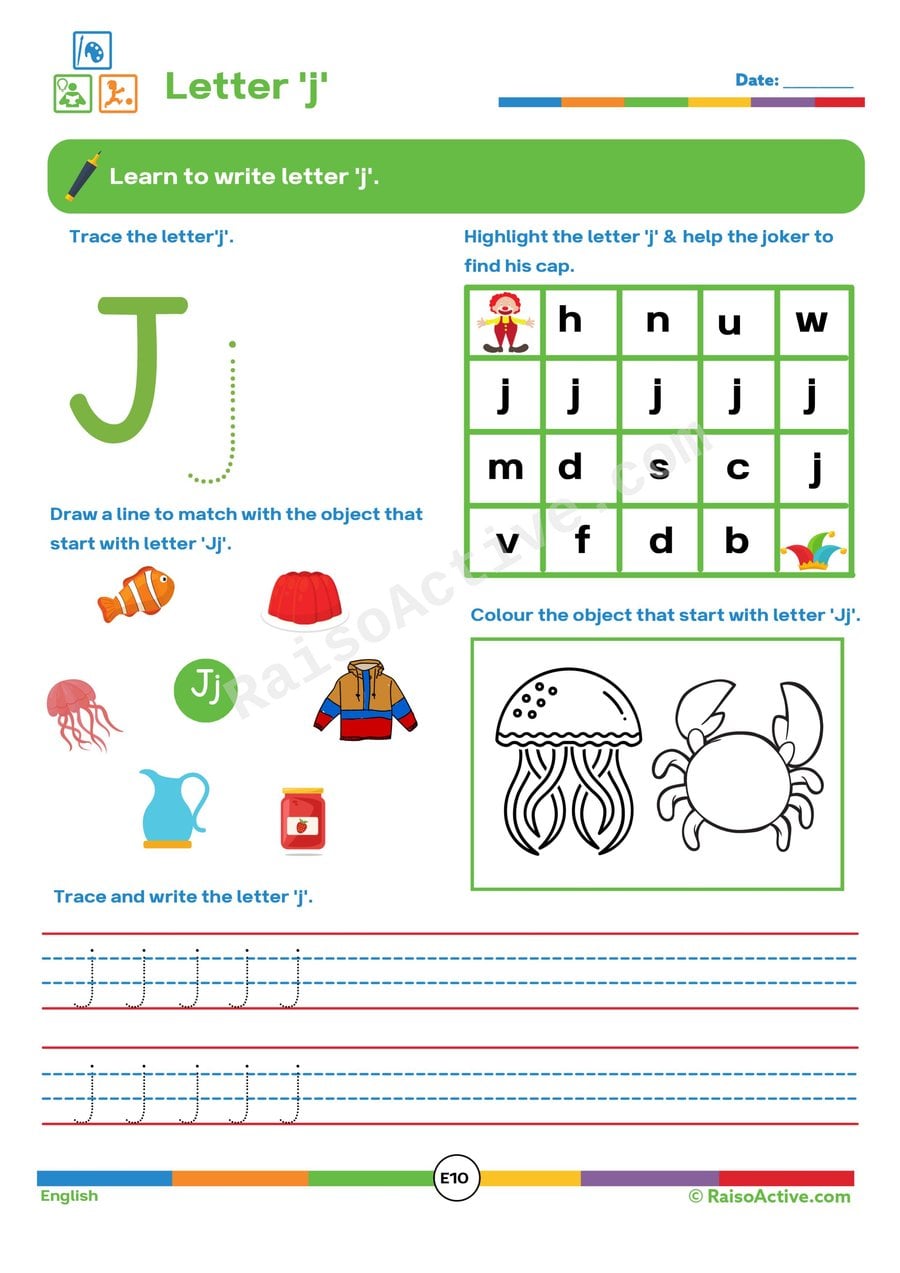
Letter 'j' Worksheet: Trace, Match, and Color!
Ages 3-5 · Preschool–Pre-KAges 3-5 · Nursery–ReceptionAges 3-5 · Nursery–LKGAges 3-5
Tracing the letter 'j' builds the fine motor control and stroke memory children ages 3-5 need for handwriting, while matching it to objects that start with the same sound connects the written letter to its spoken sound. Highlighting and coloring add extra practice recognizing the letter's shape among other letters and pictures.

Little Red Riding Hood Story Sequencing Worksheet for Preschoolers
Ages 3-5 · Preschool–Pre-KAges 3-5 · Nursery–ReceptionAges 3-5 · Nursery–LKGAges 3-5
Retelling Little Red Riding Hood through sequencing pictures asks 3-5 year olds to understand story structure — that events happen in a specific order and that order affects meaning — which is a foundational reading comprehension skill that comes before children can read the words themselves. Because the pictures have to be cut out and physically arranged, this worksheet also combines comprehension with fine motor practice, and having your child explain each scene before gluing it down pushes them to actively process the story rather than passively recall it.

Letter 'i' Tracing and Matching Worksheet for Preschoolers
Ages 3-5 · Preschool–Pre-KAges 3-5 · Nursery–ReceptionAges 3-5 · Nursery–LKGAges 3-5
This worksheet builds recognition of the letter 'i' for 3-5 year olds through tracing, picture matching, and a highlighting activity, giving repeated exposure to both the letter's shape and its sound in a single sitting. Matching objects that start with 'i' alongside the tracing practice connects the visual letter shape to real vocabulary, reinforcing that letters aren't abstract marks but stand for actual sounds your child hears in words they already know.

Parent's Guide: Fun Activities for Storytelling, Addition, and More!
Ages 3-5 · Preschool–Pre-KAges 3-5 · Nursery–ReceptionAges 3-5 · Nursery–LKGAges 3-5
This parent's guide walks through a set of hands-on activities that build storytelling and sequencing through puppet play, early addition through a simple 'addition house,' and sorting skills, giving children ages 3-5 practice across language, number, and reasoning in one sitting. Because the activities are play-based rather than worksheet-based, they let children absorb these concepts through natural exploration.

Match the 'et' Family Words Worksheet for Preschoolers
Ages 4-5 · Pre-KAges 4-5 · ReceptionAges 4-5 · LKGAges 4-5
Matching 'et' family words like bet, net, and pet to their pictures helps children ages 4-5 recognize a common phonics pattern, learning to read new words by swapping the beginning sound while keeping the familiar 'et' ending. This rime-based approach is a powerful early reading strategy that makes decoding faster once a pattern is learned.
Related worksheets

Phonics Fun: Circle the Beginning Sound Worksheet for Preschoolers
Ages 4-5 · Pre-KAges 4-5 · ReceptionAges 4-5 · LKGAges 4-5
This worksheet builds phonemic awareness by asking children to listen for a picture's beginning sound and circle the letter that matches it, a core early-reading skill that connects spoken sounds to written letters. For ages 4-5, this kind of sound-to-letter matching is one of the clearest predictors of later reading success, since it requires isolating individual sounds within a spoken word.

Phonics Fun: Write the First Letter and Draw! (Ages 3-5)
Ages 3-5 · Preschool–Pre-KAges 3-5 · Nursery–ReceptionAges 3-5 · Nursery–LKGAges 3-5
This worksheet asks children ages 3-5 to identify a picture's beginning sound and write the matching letter, then draw their own picture for extra practice, combining phonemic awareness with early letter formation. Writing the letter by hand, rather than just circling it, demands more fine motor control and reinforces the sound-symbol link more deeply than recognition alone. The open-ended drawing task also lets children apply the same beginning sound to a word of their own choosing.

Alphabet Adventures: Circle the Objects! A Fun Letter Recognition Worksheet
Ages 3-5 · Preschool–Pre-KAges 3-5 · Nursery–ReceptionAges 3-5 · Nursery–LKGAges 3-5
This worksheet builds letter-sound correspondence by having children scan a group of pictures and circle only the ones that start with a specific letter. For three- to five-year-olds, this kind of visual search-and-sort task strengthens both phonics recognition and sustained visual attention, since children have to check each picture against the target sound rather than just glancing at the page.

Color the Animals! M, K, S Beginning Sounds Worksheet for Preschool
Ages 3-5 · Preschool–Pre-KAges 3-5 · Nursery–ReceptionAges 3-5 · Nursery–LKGAges 3-5
By coloring circles according to a color key tied to the beginning sound of each animal's name, this worksheet trains children to isolate the very first sound in a word, a skill called phoneme isolation that is one of the strongest early predictors of reading success. Working with the letters M, K, and S specifically gives practice distinguishing sounds that can be tricky to tell apart when spoken quickly.
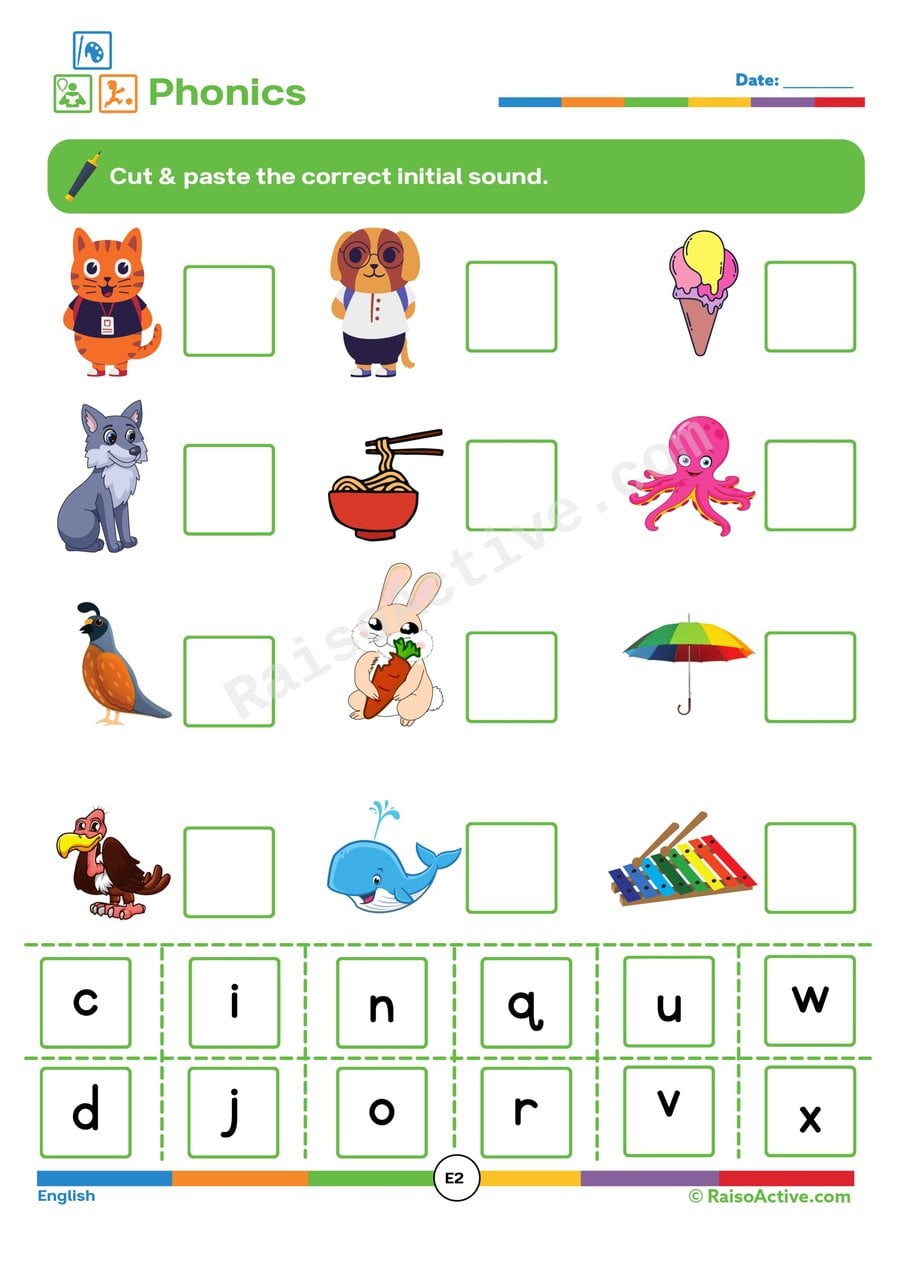
Initial Sound Match: Cut and Paste Worksheet
Ages 4-5 · Pre-KAges 4-5 · ReceptionAges 4-5 · LKGAges 4-5
Children ages 4-5 develop phonemic awareness by identifying the beginning sound of each pictured object and matching it to the correct letter, a critical pre-reading skill for connecting sounds to symbols. This cut-and-paste format adds fine motor practice with scissors and glue alongside the phonics work. Recognizing initial sounds is one of the strongest early predictors of later reading success.
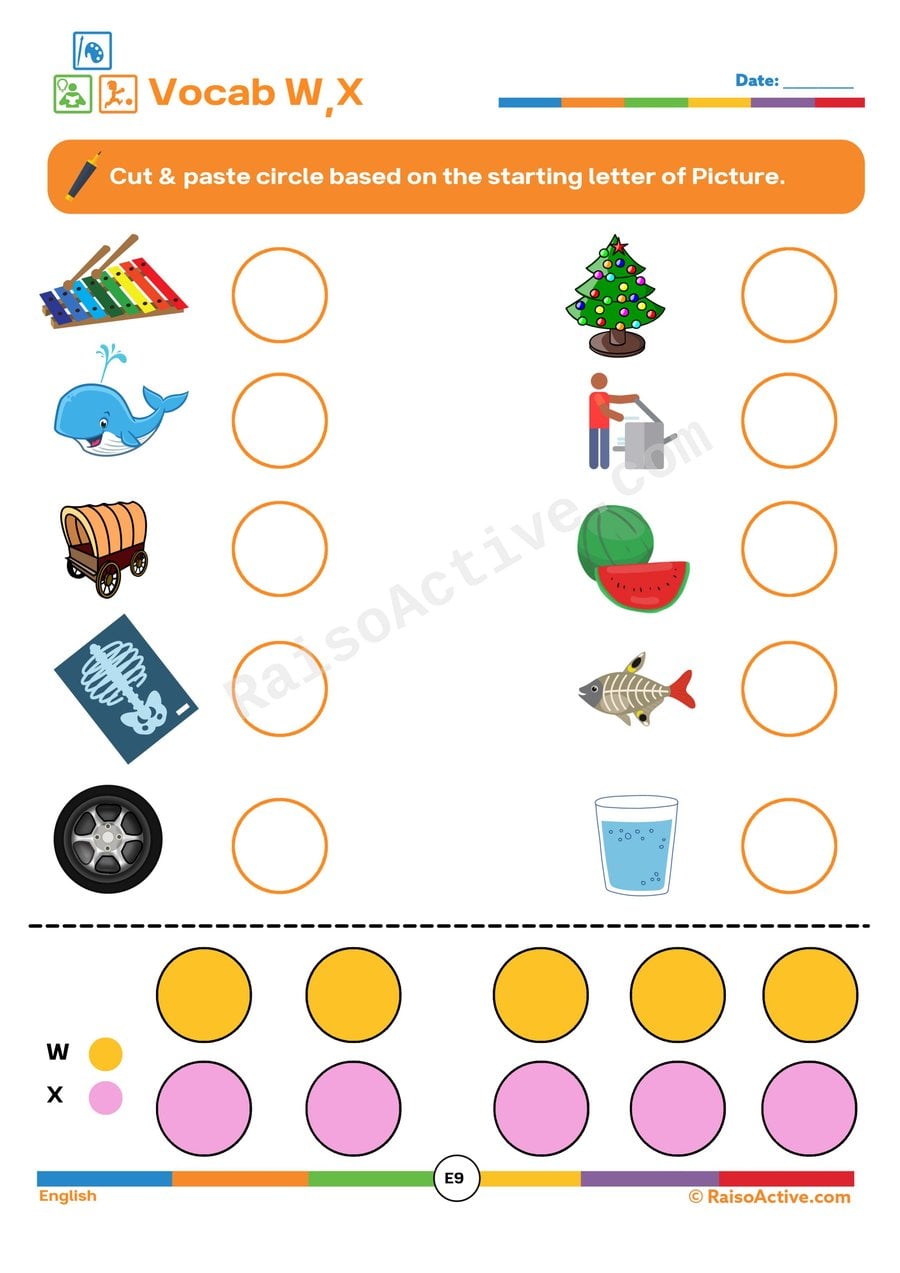
W and X Words Worksheet: Cut and Paste Fun!
Ages 4-5 · Pre-KAges 4-5 · ReceptionAges 4-5 · LKGAges 4-5
Identifying words that start with W and the much rarer letter X gives children practice distinguishing beginning sounds across a wider range of vocabulary, since X-words are less common and require extra attention to hear correctly. For ages four to five, the cut-and-paste format adds a deliberate pause before each answer, helping avoid the rushed guessing that can happen with a quicker matching task.

Phonics Fun: Circle the Beginning Letter Worksheet for Kids
Ages 4-6 · Pre-K–KindergartenAges 4-6 · Reception–Year 1Ages 4-6 · LKG–UKGAges 4-6
This 'Circle the Beginning Letter' worksheet strengthens phoneme-grapheme correspondence for children ages 4-6, teaching them to connect the sound they hear at the start of a word to its written letter. Naming each picture aloud and choosing among several letter options builds auditory discrimination, a skill that predicts later decoding success. It also reinforces letter recognition by asking children to distinguish the target letter from visually similar distractors.

Phonics Fun: Connect the Letters S-X with Starting Sounds Worksheet
Ages 4-6 · Pre-K–KindergartenAges 4-6 · Reception–Year 1Ages 4-6 · LKG–UKGAges 4-6
Connecting pictures to their correct beginning letter across the range S through X helps children ages 4-6 extend their phonics practice beyond the most common early letters, building broader letter-sound matching skills. This wider range also introduces children to less frequently practiced sounds, rounding out their overall phonemic awareness.
Guides for this topic

Sight Words by Age: The First 50 Words and How to Teach Them Without Flashcard Fatigue
Which sight words to teach first and why, the heart-word method, a read-trace-write-find routine, games, and a by-age table of typical sight-word progress.
How to Teach CVC Blending: A Step-by-Step Method That Works in Two Weeks
A step-by-step method for teaching CVC blending, covering continuous sounds, word families, common errors, and a 14-day plan that most children finish reading CVC words.
Phase 2 Phonics at Home: Sound Order, Blending Games, Worksheets
Phase 2 phonics at home: the five sound sets in order, oral blending, tricky words, a two-week routine, common mistakes, and free worksheets.
Reviews
Every worksheet for ages 3–5, no watermark
Members download the full library of 1,000+ worksheets and every activity pack without watermarks or daily limits. One year costs ₹999 in India or $20 elsewhere.
See membership plansOr download any worksheet free with a watermark (5 a day).