First Letter Fun: Identify and Write! A Worksheet for Young Learners
This worksheet gives 3-5 year olds focused practice isolating the very first sound in a spoken word and writing the matching letter, building the same phonemic awareness skill that underlies spelling later on. Saying each picture's name aloud before writing forces your child to actively listen for the sound rather than guess at a letter from memory, which is what makes this different from copying pre-written letters.
Part of the pack
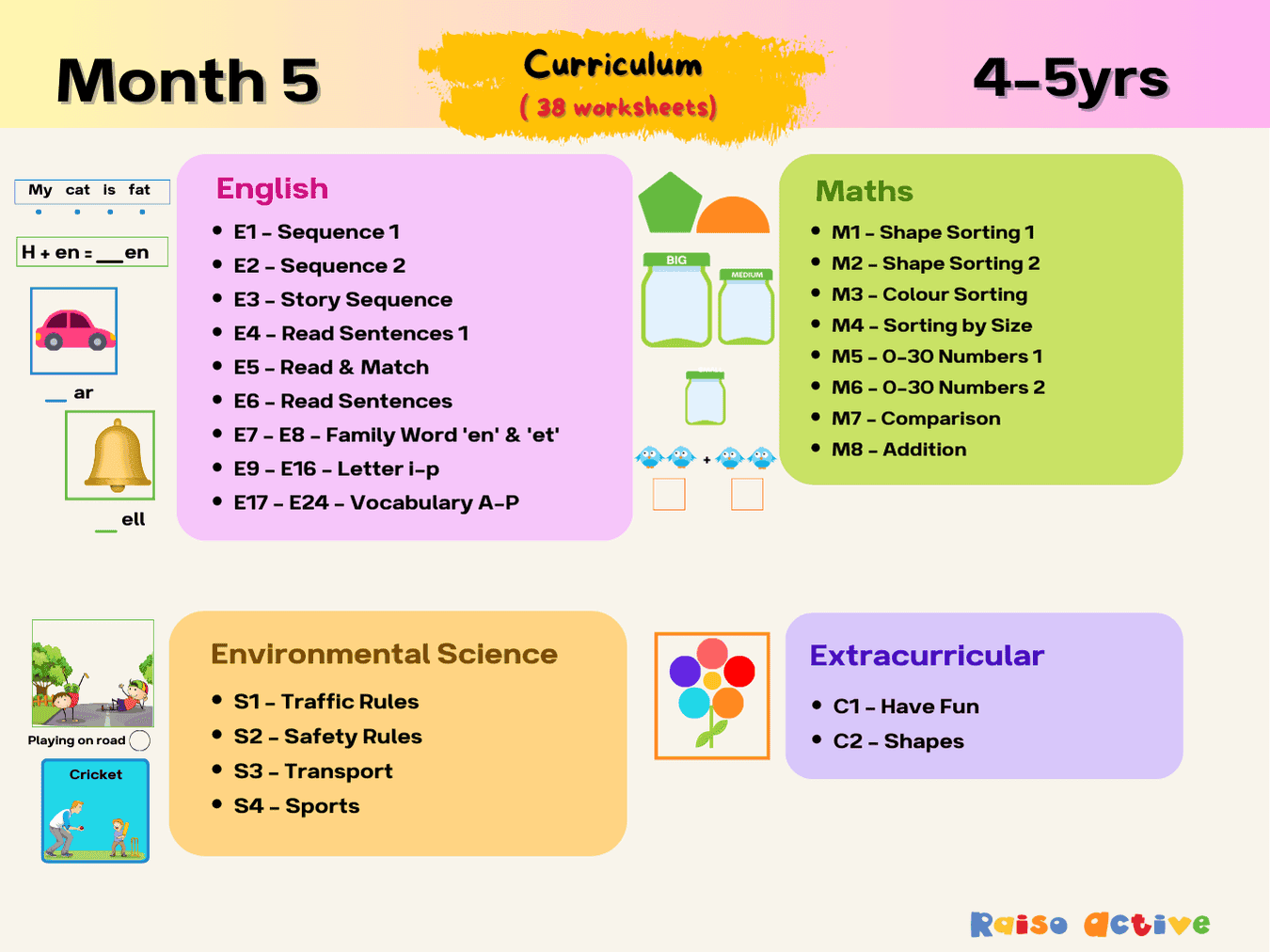
Month 5: Literacy, Math, Environmental Science | Ages 4-5
This is page 20 of the pack. Ages 4-5 · Pre-KAges 4-5 · ReceptionAges 4-5 · LKGAges 4-5
Made for your child
A whole activity pack made with their name
60 pages to spot, build, trace and write their own name, plus pages about their favourites, feelings and family. See a free preview with their name.
Make an All About Me packFree preview · free for members
Or start free: a name tracing sheet with their nameCurriculum
- Phonics - Letter Sounds > Beginning Sounds
How to use this worksheet
Look at the first picture together and have your child say its name clearly out loud. Ask them what sound they hear right at the beginning of the word before picking up the pencil. Have them write that letter on the line, repeating the sound once more as they write. Continue through the remaining pictures the same way, then read all the written letters back together at the end.
Materials needed
- Pencil
- Eraser
Extension activities
- 1Look for objects around the house that start with the same letters as the worksheet pictures.
- 2Have your child draw their own new pictures and write the first letter of each one.
- 3Play an 'I spy' game focused only on first sounds.
- 4Sort a few small toys into groups by their first letter sound.
- 5Make a simple alphabet chart together, adding one new picture per letter over time.

Written by
Hemsweta Jain · Teacher Cheena
MBA and Early Childhood Educator, teaching since 2014 · Founder of RaisoActive, Mumbai
Every RaisoActive worksheet is designed and checked by the founder before publishing.
Published · Last reviewed
More from Month 5: Literacy, Math, Environmental Science | Ages 4-5

Read and Match: Sentence Reading Worksheet for Early Learners
Ages 4-6 · Pre-K–KindergartenAges 4-6 · Reception–Year 1Ages 4-6 · LKG–UKGAges 4-6
This worksheet has 4-6 year olds read a full sentence aloud and then identify which picture actually matches its meaning by coloring the circle beside it, building reading comprehension in a format that requires understanding the whole sentence rather than picking out a single keyword. Because more than one picture on the page may share surface similarities, your child has to genuinely process what the sentence says, which is a stronger comprehension check than simple word-picture matching.
Shape Sorting Fun: Cut and Paste Shapes!
Ages 3-5 · Preschool–Pre-KAges 3-5 · Nursery–ReceptionAges 3-5 · Nursery–LKGAges 3-5
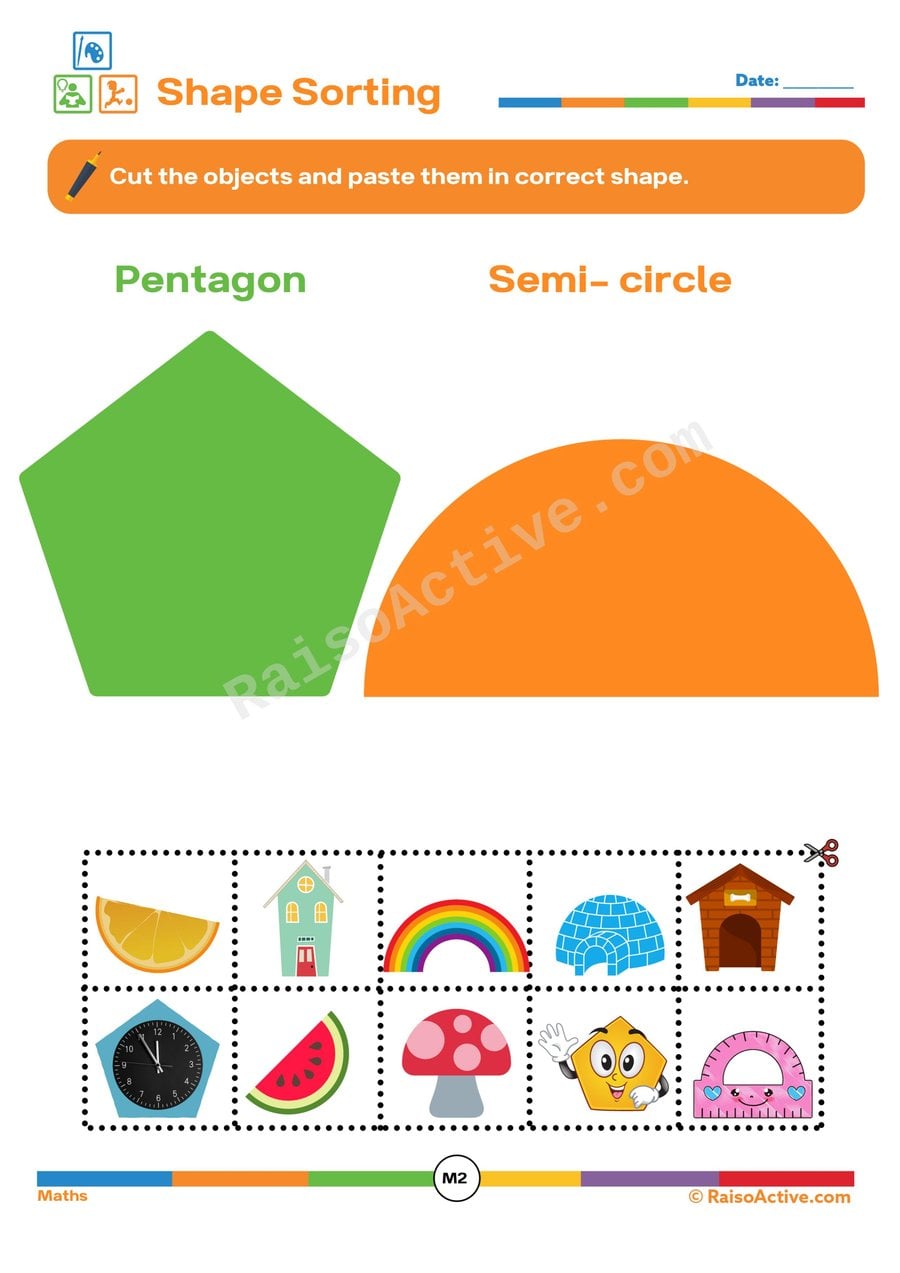
Cutting out shapes and pasting them into matching outlines teaches children ages 3-5 to recognize basic 2D shapes like circles, squares, and triangles by their defining features rather than just their color or size. The cutting and pasting also strengthens the fine motor coordination needed for handwriting later on.

First Letter Fun: Identify and Write! A Vocabulary Worksheet for Kids
Ages 4-6 · Pre-K–KindergartenAges 4-6 · Reception–Year 1Ages 4-6 · LKG–UKGAges 4-6
Designed for 4-6 year olds, this worksheet pairs vocabulary building with first-letter phonics — your child has to recognize or learn each pictured object's name and then isolate and write its opening sound, which stretches both spoken vocabulary and early spelling skills together. Because this version targets a slightly older age range, it's a good check for whether your child can move through the naming-and-writing process more independently than a beginning 3-year-old would.
Fun 'en' Family Word Worksheet for Preschoolers
Ages 3-5 · Preschool–Pre-KAges 3-5 · Nursery–ReceptionAges 3-5 · Nursery–LKGAges 3-5
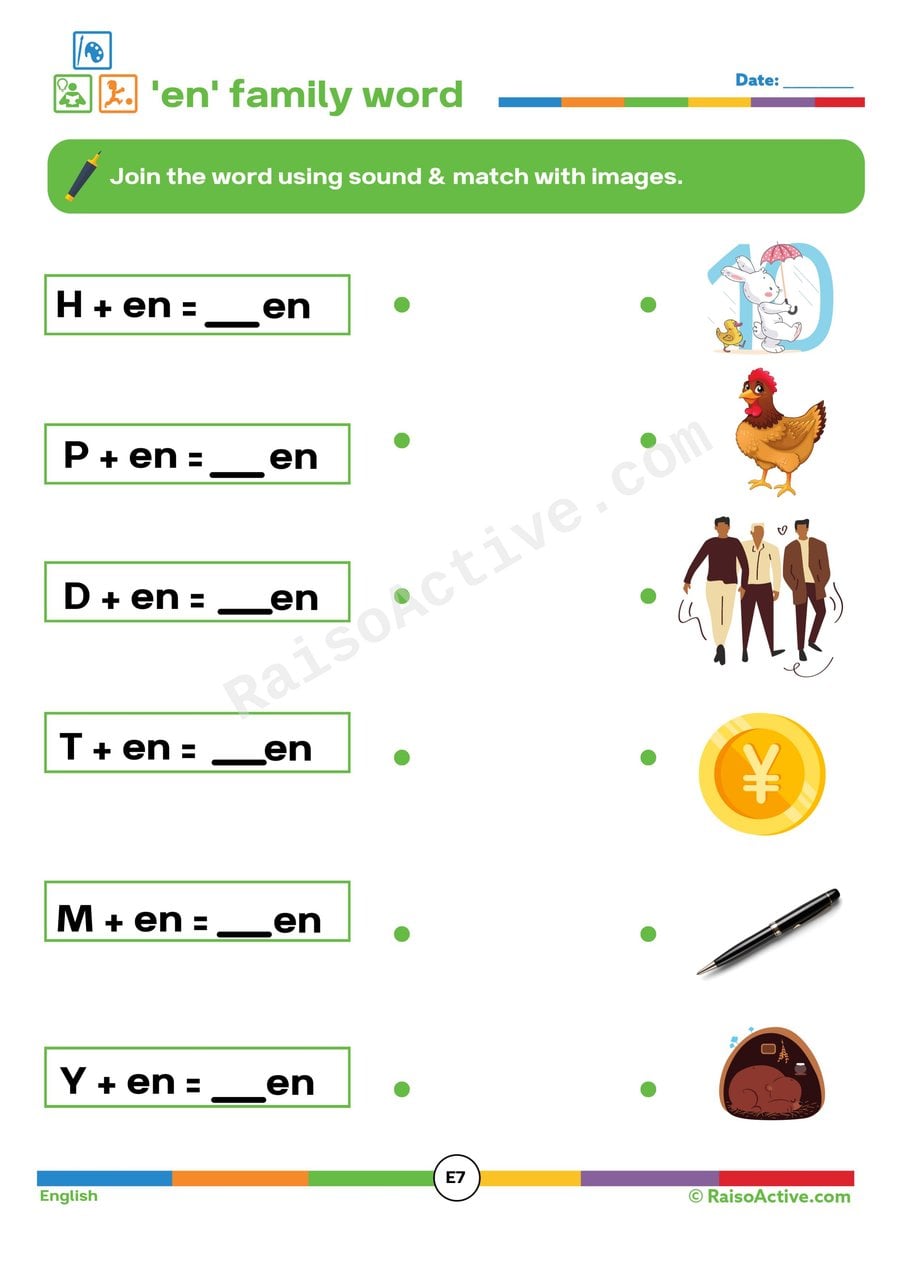
This worksheet introduces 3-5 year olds to the 'en' word family — pen, hen, ten — teaching them that once they know one ending pattern, they can read a whole group of words just by changing the beginning sound. That's a big efficiency gain in early phonics: instead of memorizing each word individually, your child learns to blend a new beginning sound onto a familiar chunk, which is exactly how fluent word-family reading develops.
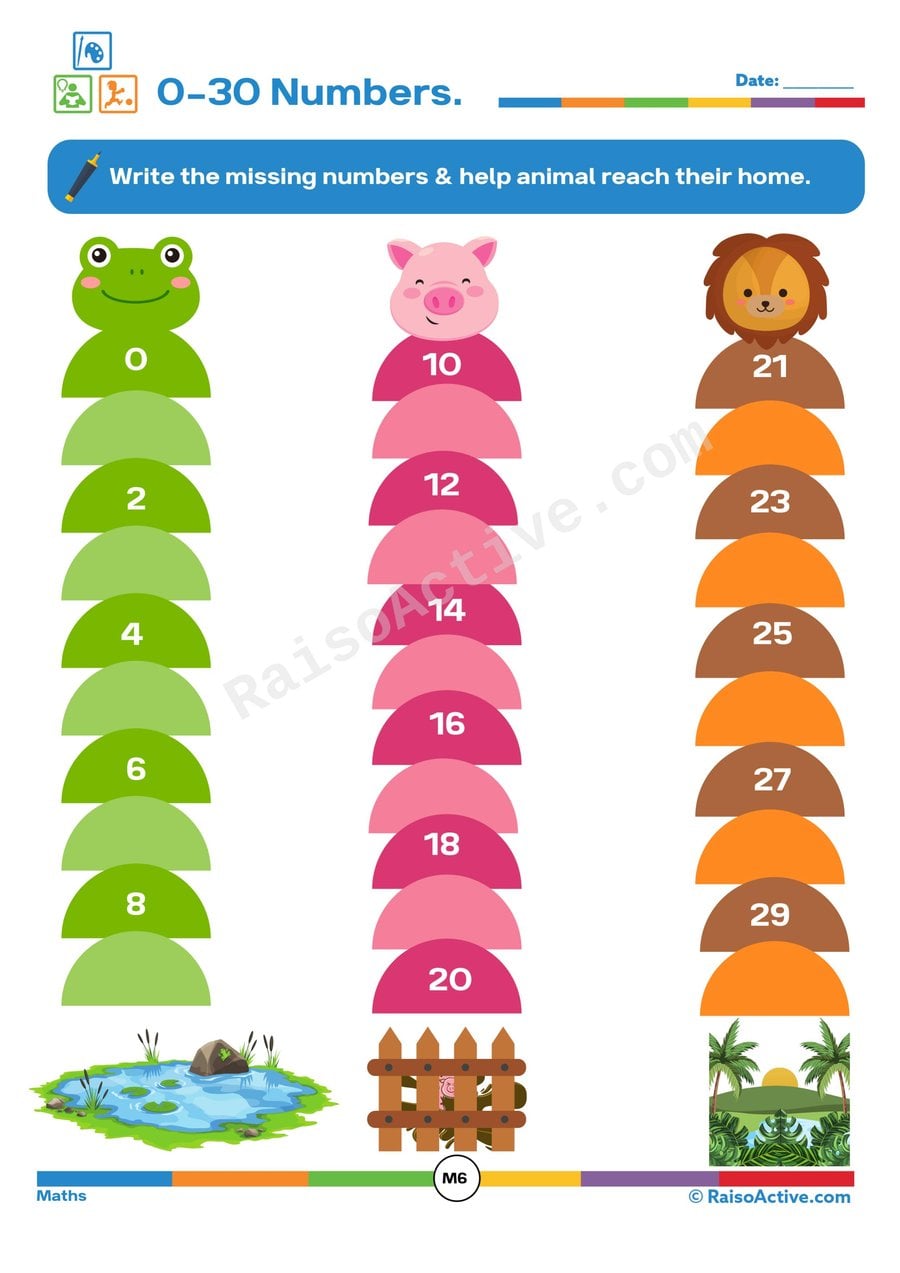
Number Fun: Missing Numbers Worksheet for Kids!
Ages 4-6 · Pre-K–KindergartenAges 4-6 · Reception–Year 1Ages 4-6 · LKG–UKGAges 4-6
Filling in missing numbers from a sequence up to 30 helps children ages 4-6 strengthen number recognition and counting-on, the skill of continuing a sequence without starting over from one each time. Completing the animal path adds a motivating storyline that encourages children to work through the full sequence.

First Letter Fun: Identify and Write! A Fun Vocabulary Worksheet for Kids
Ages 4-6 · Pre-K–KindergartenAges 4-6 · Reception–Year 1Ages 4-6 · LKG–UKGAges 4-6
This worksheet extends beginning-sound practice for children ages 4-6 slightly further than earlier versions, asking them to independently identify an object's name and write its first letter with less visual support. Isolating and writing initial sounds accurately is a strong predictor of later spelling and reading success, since it requires children to translate an auditory skill into a written one. Repeating this process across multiple pictures builds both vocabulary and growing independence in phonics reasoning.

Sports Match-Up Worksheet for Kids: Match the Sports to Their Equipment!
Ages 4-6 · Pre-K–KindergartenAges 4-6 · Reception–Year 1Ages 4-6 · LKG–UKGAges 4-6
Matching sports to their equipment teaches children ages 4-6 to connect an activity with the tools used to play it, building categorization skills alongside sports vocabulary. This kind of real-world matching helps children make sense of things they may see on television, at the park, or during physical education class.

Comparing Objects: A Fun Counting Worksheet for Preschoolers!
Ages 4-5 · Pre-KAges 4-5 · ReceptionAges 4-5 · LKGAges 4-5
This worksheet has 4-5 year olds count two groups of objects and then compare the totals using the greater-than, less-than, and equal-to symbols — an early but genuine step into formal math notation that goes beyond simple counting into representing a comparison symbolically. Because your child has to count accurately before comparing, this worksheet also reinforces that math symbols stand for real relationships between quantities, not arbitrary marks to memorize.
Related worksheets

Phonics Fun: Match the Letter to the Object Worksheet
Ages 4-5 · Pre-KAges 4-5 · ReceptionAges 4-5 · LKGAges 4-5
This worksheet asks children to connect a printed letter to a picture whose name starts with that letter's sound, then reinforces the connection a second time through color-coded circles, a repetition that research on phonics instruction shows helps move sound-letter pairs from short-term recognition into lasting memory. For four and five year olds, this dual task also builds sustained attention across a slightly longer worksheet than a single matching exercise.

Phonics Fun: Circle the Beginning Letter Worksheet for Kids
Ages 4-6 · Pre-K–KindergartenAges 4-6 · Reception–Year 1Ages 4-6 · LKG–UKGAges 4-6
This 'Circle the Beginning Letter' worksheet strengthens phoneme-grapheme correspondence for children ages 4-6, teaching them to connect the sound they hear at the start of a word to its written letter. Naming each picture aloud and choosing among several letter options builds auditory discrimination, a skill that predicts later decoding success. It also reinforces letter recognition by asking children to distinguish the target letter from visually similar distractors.
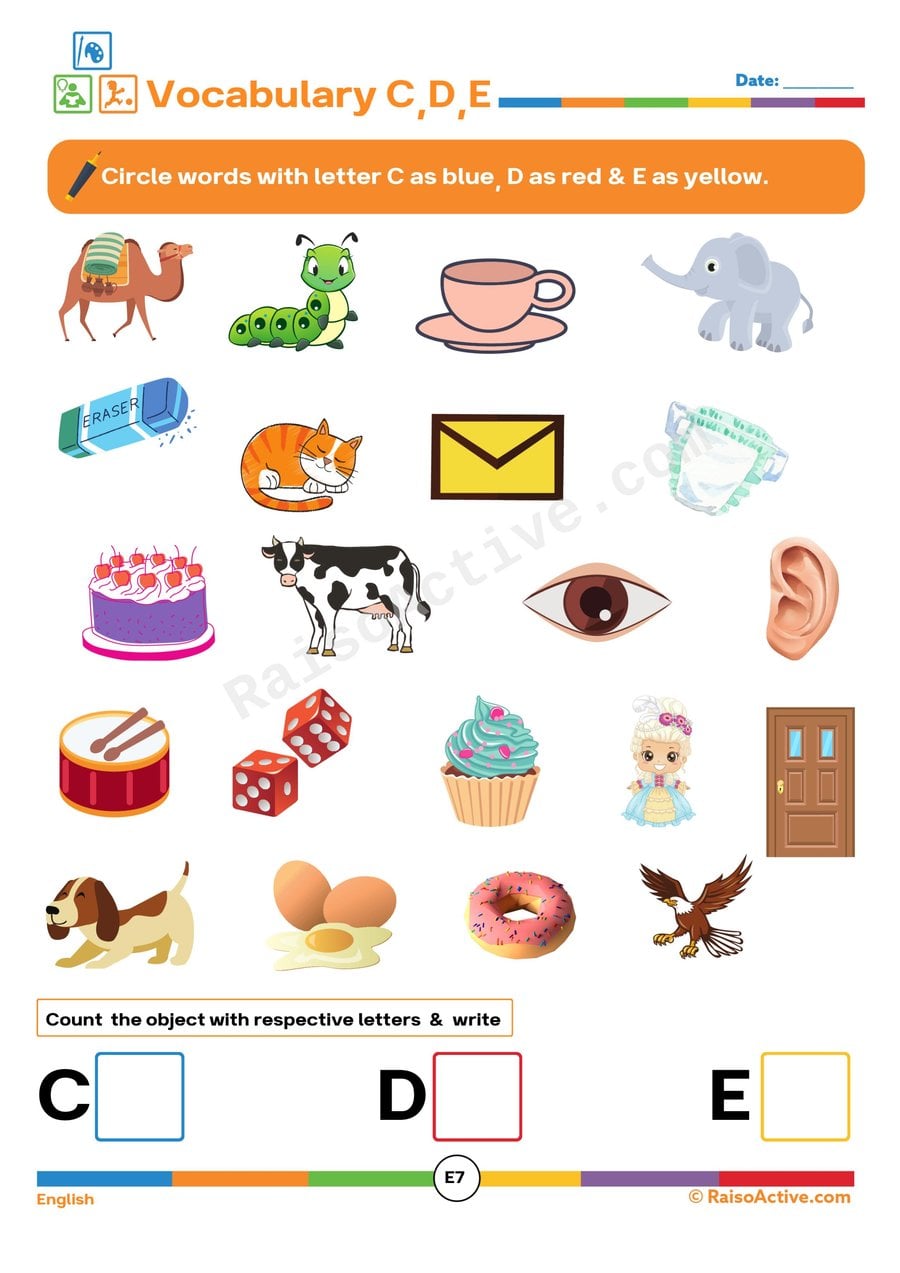
C, D, E Letter Sounds Worksheet: Circle and Count!
Ages 3-5 · Preschool–Pre-KAges 3-5 · Nursery–ReceptionAges 3-5 · Nursery–LKGAges 3-5
This activity gives children ages 3-5 focused practice recognizing the beginning sounds of the letters C, D, and E, asking them to circle matching pictures in different colors for each letter before counting the results. Combining phonics with counting means children practice two skills in one sitting: identifying initial letter sounds and recording a numeric total, both foundational for kindergarten readiness. Color-coding each letter also helps children visually organize the three sounds instead of mixing them together.

Small Alphabet Letter Practice: Write the First Letter - Worksheet for Kids
Ages 3-5 · Preschool–Pre-KAges 3-5 · Nursery–ReceptionAges 3-5 · Nursery–LKGAges 3-5
Writing lowercase letters correctly is a distinct skill from recognizing them, and this worksheet asks children ages 3-5 to identify a pictured object, isolate its beginning sound, and then physically form the matching lowercase letter from memory. Combining sound identification with independent letter formation — rather than tracing — pushes children a step further toward true early spelling. This is often one of the first times children write letters without a dotted guide to follow, which builds real handwriting confidence.

Cut and Paste the First Letter: Fun Phonics Worksheet for Preschoolers
Ages 4-5 · Pre-KAges 4-5 · ReceptionAges 4-5 · LKGAges 4-5
Children ages 4-5 practice identifying the beginning sound of a word and matching it to the correct letter, a core early phonics skill, while also building fine motor control through cutting and pasting. Connecting a picture's name to its first letter sound is one of the clearest building blocks toward independent reading.

Say My Sound: Beginning Letter Worksheet for Preschoolers
Ages 3-5 · Preschool–Pre-KAges 3-5 · Nursery–ReceptionAges 3-5 · Nursery–LKGAges 3-5
This is a companion beginning-sounds sheet with a new set of pictures, giving your child more practice isolating the first sound of a word — a skill that only really sticks with repeated exposure across different words, not a single worksheet. Circling instead of coloring the answer keeps the response quick and low-effort, so more of the session goes toward the listening task itself.

Phonics Fun: Write the First Letter and Draw! (Ages 3-5)
Ages 3-5 · Preschool–Pre-KAges 3-5 · Nursery–ReceptionAges 3-5 · Nursery–LKGAges 3-5
This worksheet asks children ages 3-5 to identify a picture's beginning sound and write the matching letter, then draw their own picture for extra practice, combining phonemic awareness with early letter formation. Writing the letter by hand, rather than just circling it, demands more fine motor control and reinforces the sound-symbol link more deeply than recognition alone. The open-ended drawing task also lets children apply the same beginning sound to a word of their own choosing.

M-R Phonic Beginning Sound Worksheet: Circle the Correct Letter!
Ages 4-6 · Pre-K–KindergartenAges 4-6 · Reception–Year 1Ages 4-6 · LKG–UKGAges 4-6
This phonics worksheet focuses children ages 4-6 on distinguishing between five similar beginning sounds — M, P, O, R, and N — by having them look at a picture, say its name, and circle the correct starting letter from those choices. Including several letters as answer options, rather than just one, makes this a meaningfully harder discrimination task than a single-letter worksheet, since children must rule out close-sounding alternatives.
Guides for this topic

How to Teach CVC Blending: A Step-by-Step Method That Works in Two Weeks
A step-by-step method for teaching CVC blending, covering continuous sounds, word families, common errors, and a 14-day plan that most children finish reading CVC words.
Phase 2 Phonics at Home: Sound Order, Blending Games, Worksheets
Phase 2 phonics at home: the five sound sets in order, oral blending, tricky words, a two-week routine, common mistakes, and free worksheets.

Reception Year Explained: EYFS Learning and How to Help at Home
A teacher's plain-English guide to the Reception Year: the seven areas of learning, Early Learning Goals, Phase 2/3 phonics, the RBA and home routines.
Reviews
Every worksheet for ages 3–5, no watermark
Members download the full library of 1,000+ worksheets and every activity pack without watermarks or daily limits. One year costs ₹999 in India or $20 elsewhere.
See membership plansOr download any worksheet free with a watermark (5 a day).