Sports Equipment Match: A Fun Worksheet for Kids!
Matching a sport to its equipment, a bat to baseball or a racket to tennis, asks children to build a mental association between an activity and the tools it requires, strengthening categorization skills and real-world vocabulary. For ages three to five, this kind of practical pairing also supports gross motor development indirectly, since naming and recognizing sports equipment often leads to more engaged physical play.
Part of the pack
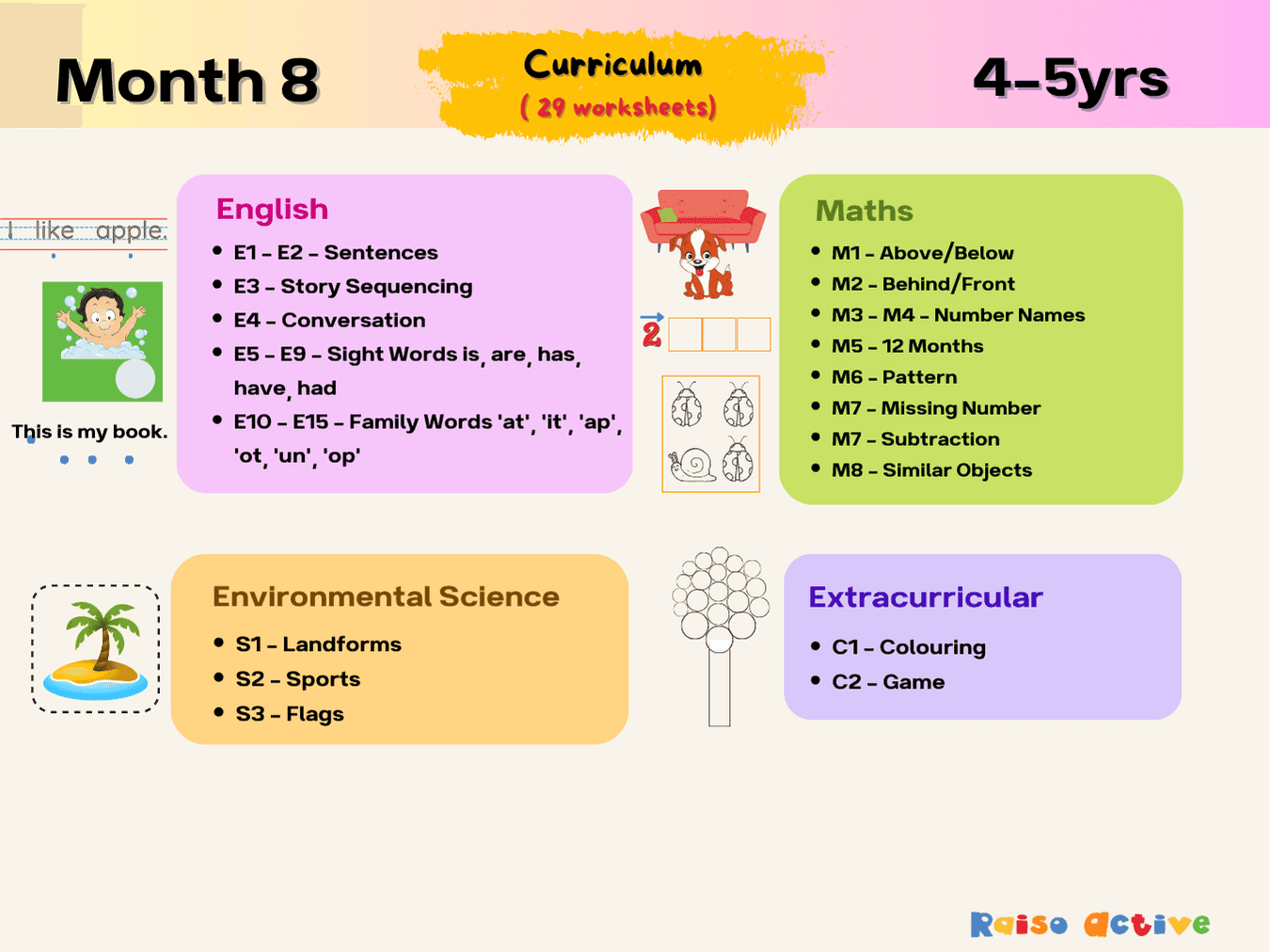
Month 8: English, Math, Science Foundations | Ages 4-5
This is page 29 of the pack. Ages 4-5 · Pre-KAges 4-5 · ReceptionAges 4-5 · LKGAges 4-5
Made for your child
Counting to 10, made for your child
A maths pack with your child's name in it: pictures that explain, practice at three levels, puzzles and story sums about them. Print a new set whenever they finish.
Make a maths packFree preview · free for members
Curriculum
- Living Things - Animals > Animals & Habitats
How to use this worksheet
Look at the sports pictures on the left side of the page first and name each one together. Then look at the equipment pictures on the right and name those too, pointing out any equipment your child may not recognize yet. Have your child draw a line connecting each sport to the equipment used to play it, checking one pair at a time rather than trying to match everything at once. Once finished, ask your child to explain out loud why each pair belongs together.
Materials needed
- Pencil
- Eraser
Extension activities
- 1Gather real or toy sports equipment from home and have your child sort it by which sport it belongs to.
- 2Act out playing each sport with pretend equipment and guess which sport is being mimed.
- 3Watch a short clip of each sport together and point out the equipment being used in action.
- 4Draw a picture of a favorite sport, including the correct equipment.

Written by
Hemsweta Jain · Teacher Cheena
MBA and Early Childhood Educator, teaching since 2014 · Founder of RaisoActive, Mumbai
Every RaisoActive worksheet is designed and checked by the founder before publishing.
Published · Last reviewed
More from Month 8: English, Math, Science Foundations | Ages 4-5

Story Sequencing Worksheet for Kids: Arrange the Pictures!
Ages 3-5 · Preschool–Pre-KAges 3-5 · Nursery–ReceptionAges 3-5 · Nursery–LKGAges 3-5
Arranging four pictures into the correct story order asks children to reason about cause and effect and hold an entire short narrative in mind, a skill directly tied to reading comprehension since understanding 'what happened first, then next' is exactly how children follow storybooks. For ages three to five, this kind of visual sequencing is often an easier entry point into narrative thinking than sequencing with only words.

Above and Below Worksheet: Identifying Object Positions
Ages 3-5 · Preschool–Pre-KAges 3-5 · Nursery–ReceptionAges 3-5 · Nursery–LKGAges 3-5
Positional words like 'above' and 'below' give three-to-five-year-olds a vocabulary for describing where things are in space, a skill that underpins everything from map reading to following multi-step instructions later on. This activity page asks children to look closely at a scene and decide whether each object sits above or below a reference point, sharpening visual scanning and the ability to hold a spatial rule in mind while checking multiple items against it.
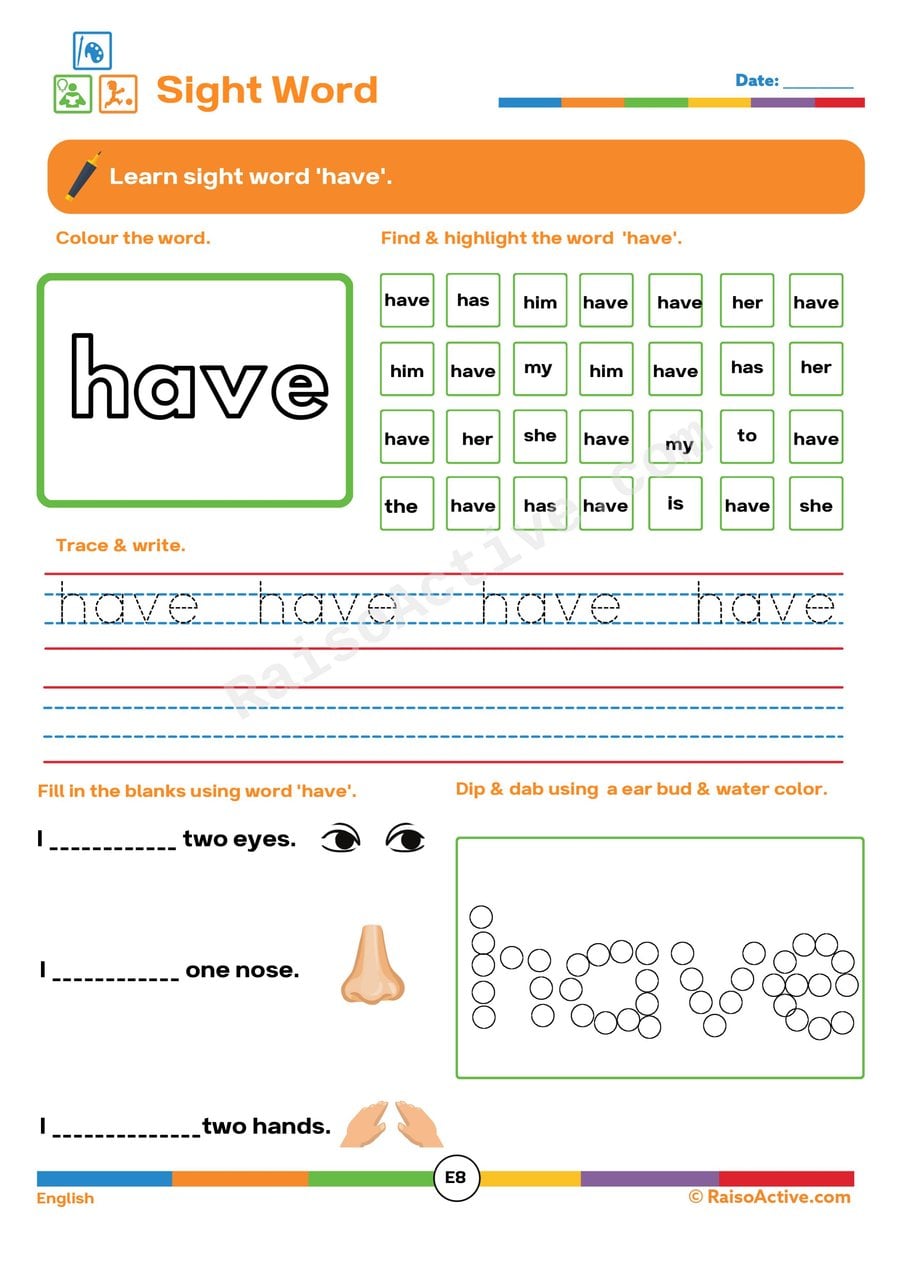
Sight Word 'Have' Worksheet for Early Readers
Ages 4-5 · Pre-KAges 4-5 · ReceptionAges 4-5 · LKGAges 4-5
Children ages 4-5 build automatic recognition of the sight word 'have', a word that must be memorized rather than sounded out phonetically. Coloring, searching, tracing, and writing the word across several exercises gives the repeated exposure needed for a word to become instantly recognizable while reading. Completing fill-in-the-blank sentences also shows children how 'have' functions naturally within everyday spoken and written language.
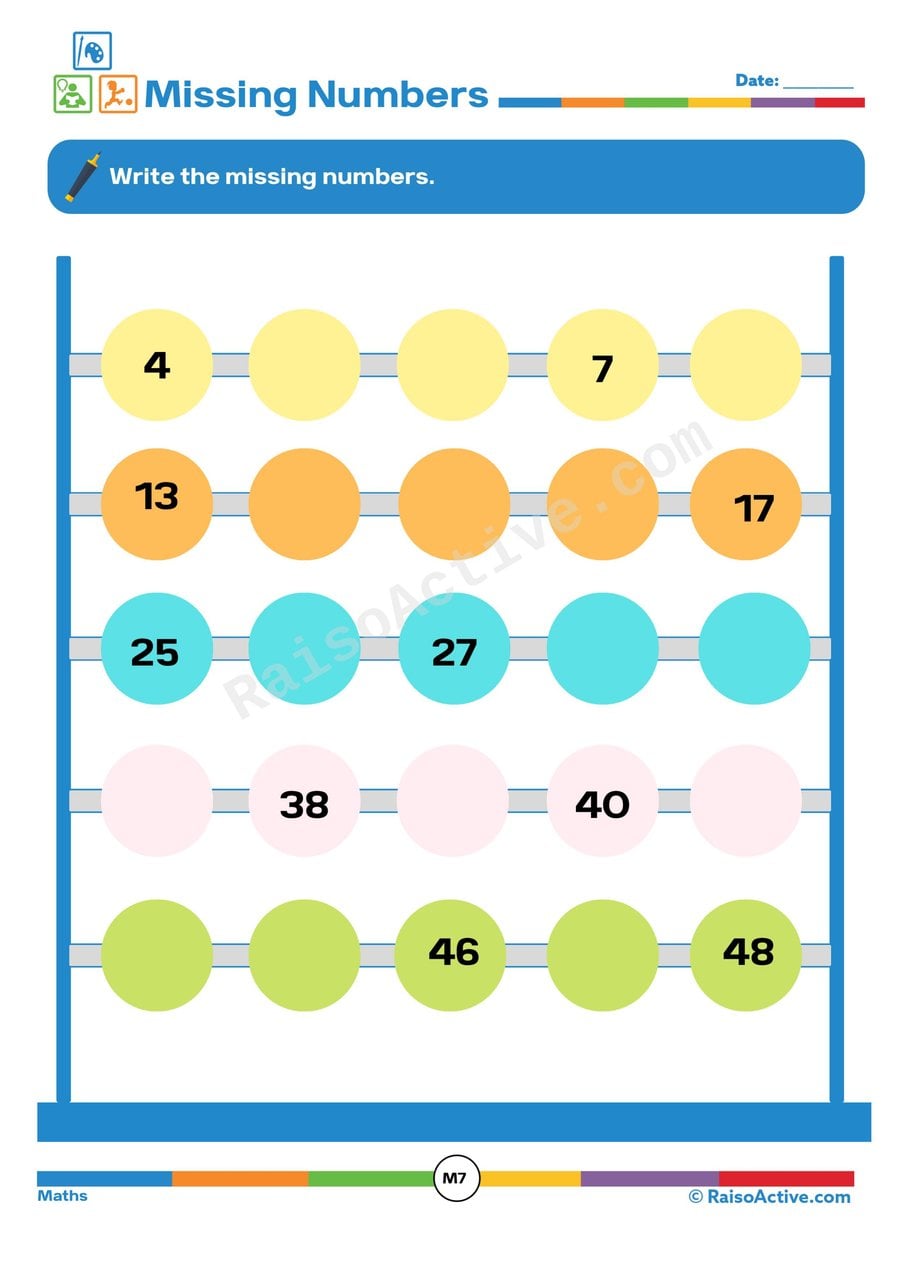
Missing Numbers Worksheet for Preschoolers
Ages 4-5 · Pre-KAges 4-5 · ReceptionAges 4-5 · LKGAges 4-5
Children ages 4-5 strengthen number sequencing by identifying which numbers are missing from a given sequence and filling in the gaps. This task requires understanding the pattern of counting forward by one, rather than simply reciting memorized numbers, which builds a deeper sense of how numbers relate to each other. Successfully finding each missing number also reinforces number formation as children write the answer themselves.

Find the 'ap' Words! A Fun Worksheet for Early Readers
Ages 4-5 · Pre-KAges 4-5 · ReceptionAges 4-5 · LKGAges 4-5
Children ages 4-5 build phonics fluency by reading and writing CVC words in the 'ap' family, like 'cap', 'map', and 'nap'. Recognizing this consistent letter pattern teaches early readers to decode groups of letters as a chunk rather than sounding out every letter individually, speeding up reading over time. Writing each word after finding it also reinforces correct spelling and letter sequencing for early literacy.

I Like Sentences: Tracing and Reading Worksheet for Preschoolers
Ages 3-5 · Preschool–Pre-KAges 3-5 · Nursery–ReceptionAges 3-5 · Nursery–LKGAges 3-5
Tracing and reading simple 'I like' sentences gives children practice connecting handwriting motion with reading comprehension at the same time, since they trace the very words they're learning to recognize and say. For ages three to five, using a repeated sentence frame like 'I like ___' also builds confidence, since only the ending word changes from sentence to sentence.

Learn the Sight Word 'Had' | Fun Reading Worksheet for Preschoolers
Ages 4-5 · Pre-KAges 4-5 · ReceptionAges 4-5 · LKGAges 4-5
Children ages 4-5 build instant recognition of the sight word 'had', another high-frequency word that resists standard phonics decoding and must be memorized visually. This worksheet layers coloring, tracing, writing, grid-searching, and fill-in-the-blank practice, giving the word multiple forms of repeated exposure that solidify memory. Completing sentences with 'had' also shows children how the word is used naturally in storytelling, especially when talking about the past.

Subtraction Worksheet: Practice Subtracting with Fun Pictures!
Ages 4-6 · Pre-K–KindergartenAges 4-6 · Reception–Year 1Ages 4-6 · LKG–UKGAges 4-6
Children ages 4-6 practice subtraction by looking at a set of pictured objects, crossing out or removing the indicated amount, and writing the resulting total. Seeing subtraction visually, rather than only as abstract numbers, helps children genuinely understand what 'taking away' means before relying on memorized facts. This visual approach builds a strong foundation for mental math strategies used in later grades.
Related worksheets

Sports Match-Up Worksheet for Kids: Match the Sports to Their Equipment!
Ages 4-6 · Pre-K–KindergartenAges 4-6 · Reception–Year 1Ages 4-6 · LKG–UKGAges 4-6
Matching sports to their equipment teaches children ages 4-6 to connect an activity with the tools used to play it, building categorization skills alongside sports vocabulary. This kind of real-world matching helps children make sense of things they may see on television, at the park, or during physical education class.
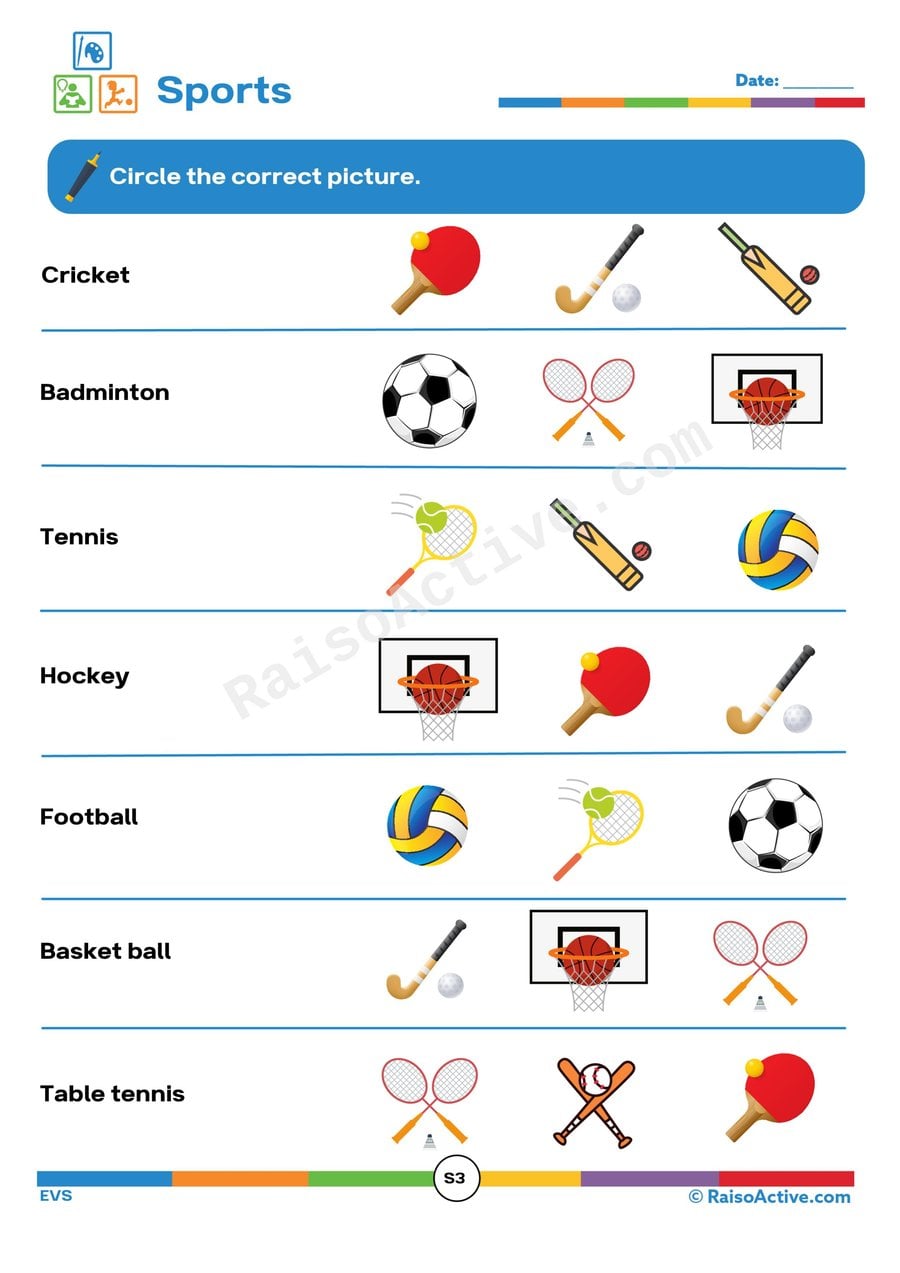
Sports Matching Worksheet for Preschoolers
Ages 3-5 · Preschool–Pre-KAges 3-5 · Nursery–ReceptionAges 3-5 · Nursery–LKGAges 3-5
Matching a sport's written name to its picture builds vocabulary and early reading recognition for children ages 3-5, connecting specific words like 'soccer' or 'swimming' to real, familiar activities. Because sports involve distinct equipment and movements, this task also sharpens visual discrimination, since children must notice small differences between similar-looking pictures to find the correct match.

Clothing Pattern Match Worksheet for Preschoolers
Ages 3-5 · Preschool–Pre-KAges 3-5 · Nursery–ReceptionAges 3-5 · Nursery–LKGAges 3-5
This worksheet has children ages 3-5 study repeating patterns on clothing items — stripes, polka dots, or checks — and match each item to its identical twin, building visual discrimination and early pattern-sequencing skills. Distinguishing between similar-looking patterns also sharpens attention to detail, a skill that later supports letter and word recognition.

Soap & Pepper Science Experiment Worksheet for Preschoolers
Ages 3-5 · Preschool–Pre-KAges 3-5 · Nursery–ReceptionAges 3-5 · Nursery–LKGAges 3-5
This hands-on demonstration shows children ages 3-5 how soap disrupts water's surface tension, using floating pepper as a simple, visible indicator of the change. Because the reaction happens instantly and dramatically, it gives young children a strong, memorable first experience with predicting an outcome and then observing whether their prediction was right.

Spring Sudoku Worksheet: Cut and Paste Puzzle for Kids
Ages 4-6 · Pre-K–KindergartenAges 4-6 · Reception–Year 1Ages 4-6 · LKG–UKGAges 4-6
Placing cut-out pictures into a sudoku-style grid so that no image repeats in any row, column, or box teaches children ages 4-6 early logical reasoning and systematic thinking, since they must check multiple directions before deciding where each piece belongs. Cutting out the small picture squares beforehand also builds scissor control and hand-eye coordination. Together, this combines a pre-math logic puzzle with fine motor practice in a single spring-themed activity.
Easter Egg Patterns Worksheet for Preschoolers
Ages 3-5 · Preschool–Pre-KAges 3-5 · Nursery–ReceptionAges 3-5 · Nursery–LKGAges 3-5
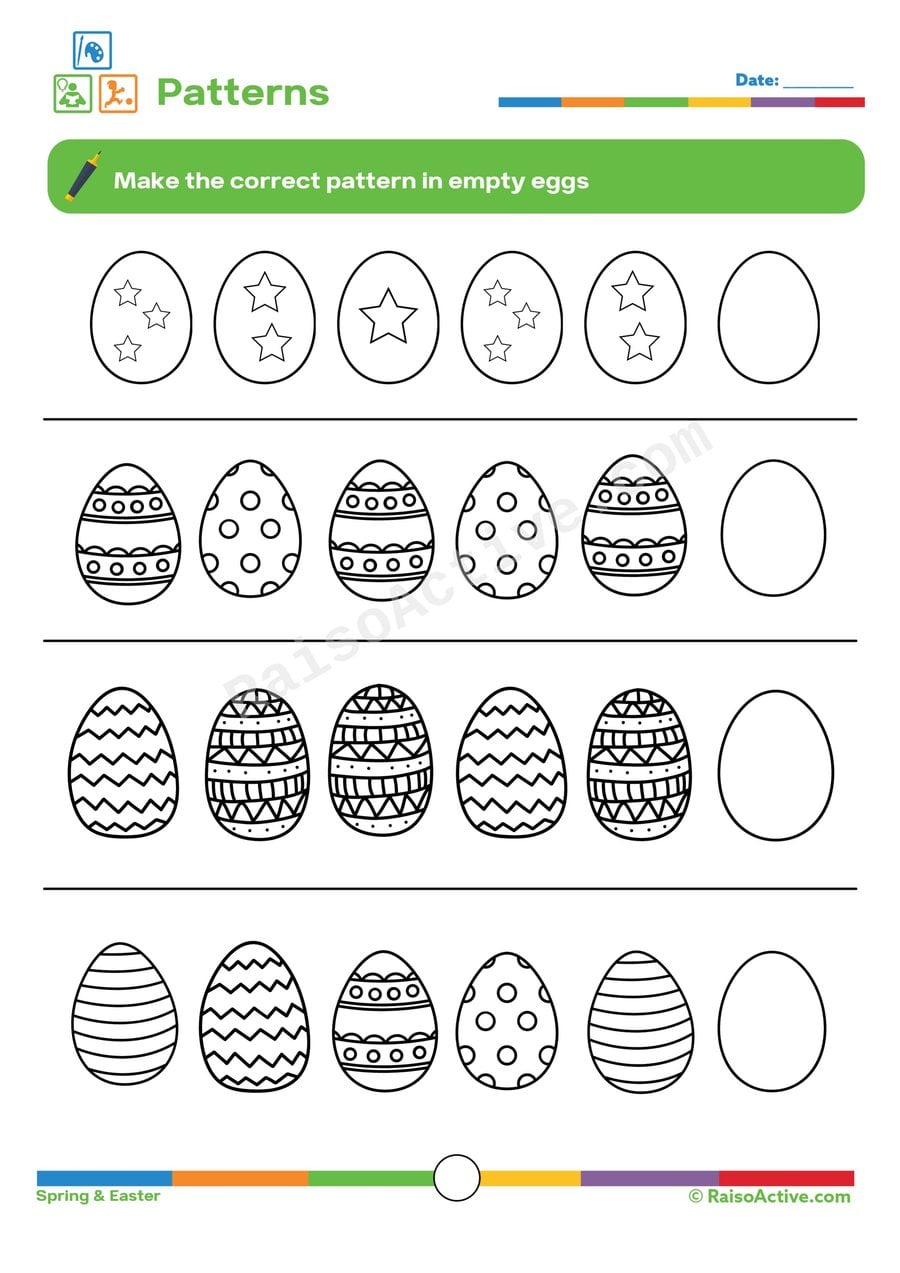
This worksheet asks children ages 3-5 to study a sequence of patterned Easter eggs and figure out what design should come next, then draw it into the empty egg themselves. Predicting and completing a pattern, rather than just matching an existing one, pushes children a step further into the kind of what-comes-next reasoning that underlies early math and logic.
Colour Code Lab: Navratri Fractions, Percentages and Probability
Ages 7-11 · Grade 2–Grade 3Ages 7-11 · Year 3–Year 4Ages 7-11 · Class 2–Class 3Ages 7-11
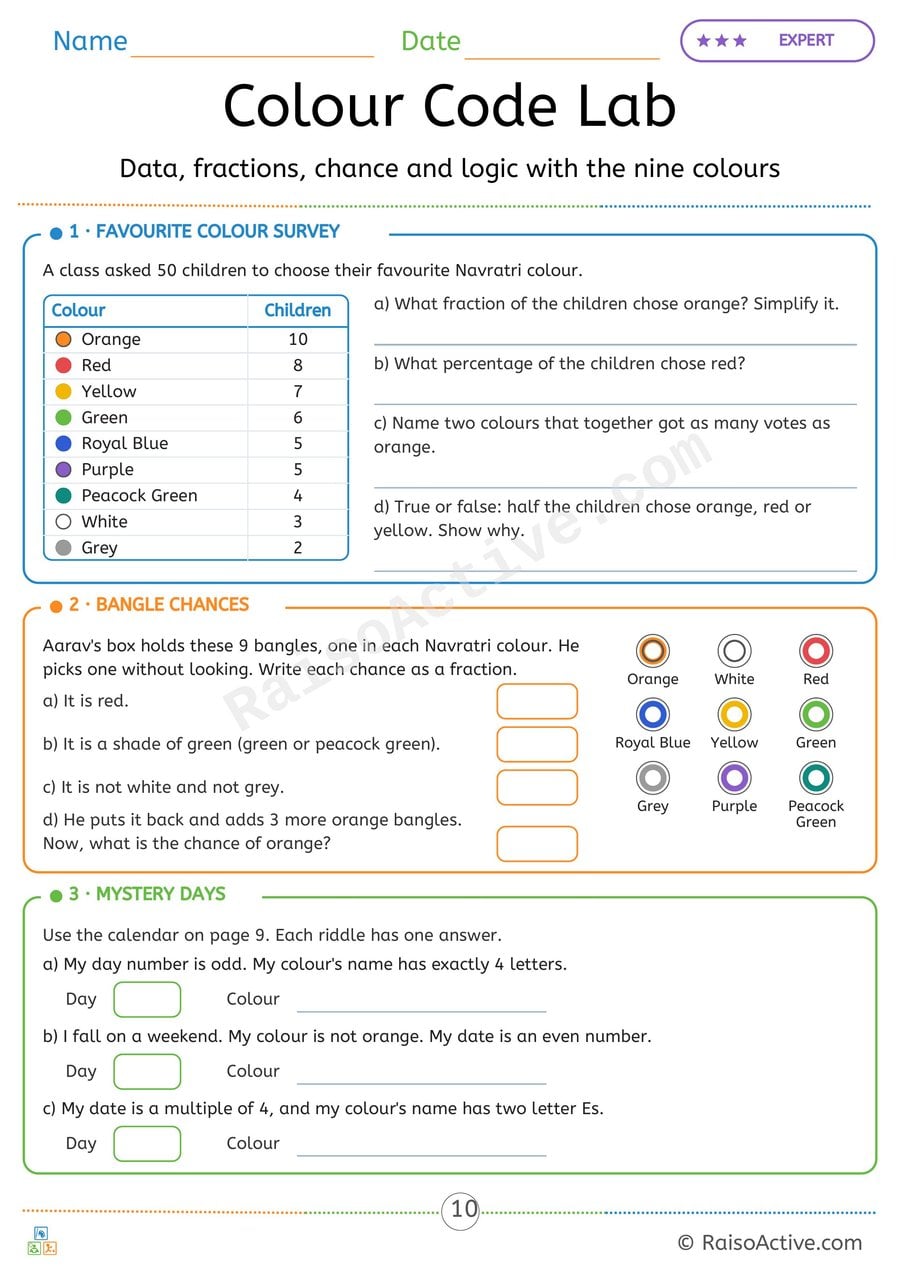
Children read a survey of 50 children's favourite Navratri colours and write fractions and percentages, write the chance of picking each kind of bangle as a fraction, and solve three riddles using the colour calendar on page 9.
Coding Kites Worksheet: Match the Bows!
Ages 3-5 · Preschool–Pre-KAges 3-5 · Nursery–ReceptionAges 3-5 · Nursery–LKGAges 3-5
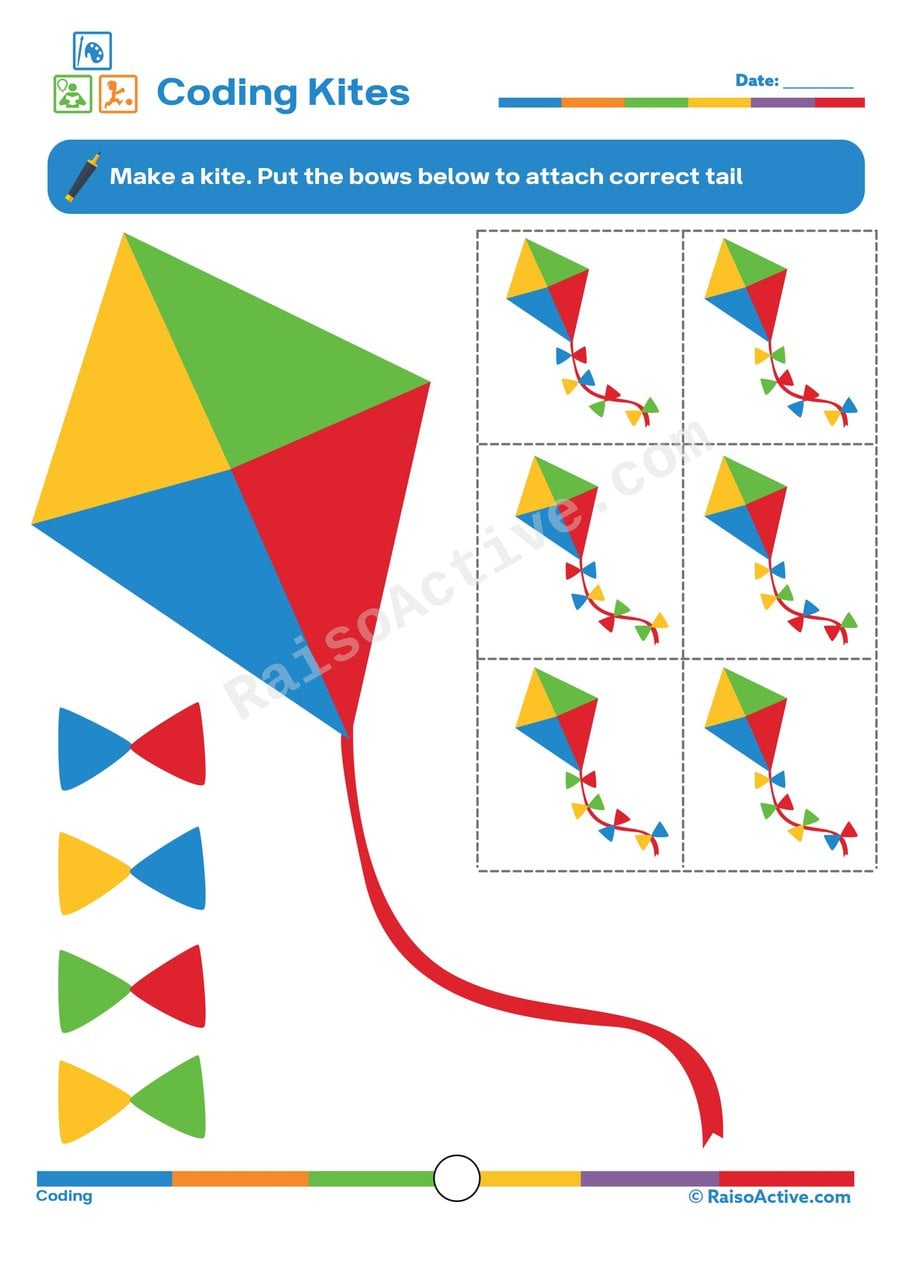
By matching each colorful bow to the kite sharing its color pattern, children ages 3-5 practice visual pattern recognition — an early form of the same logical sequencing used in beginner coding concepts. Cutting, matching, and gluing the correct bow also reinforces color-word vocabulary and precise hand-eye coordination.
Guides for this topic

Best Worksheets for 3-Year-Olds: What Works and What to Avoid
What works on worksheets for 3-year-olds: short sessions, crayons, tracing lines, matching, cutting, a free weekly plan, and signs one is too advanced.

Age-Appropriate Problem-Solving Activities: Building Critical Thinkers from the Ground Up
Discover fun, age-appropriate problem-solving activities for children ages 1-8. Build critical thinking, logic, and reasoning skills through play-based learning.
Critical Thinking Activities That Actually Work for Young Children: Building Tomorrow's Thinkers Today
Discover proven critical thinking activities for young children. Age-wise logic games, questioning techniques, and hands-on ideas to build thinking skills at home.
Reviews
Every worksheet for ages 3–5, no watermark
Members download the full library of 1,000+ worksheets and every activity pack without watermarks or daily limits. One year costs ₹999 in India or $20 elsewhere.
See membership plansOr download any worksheet free with a watermark (5 a day).