Counting Ones Worksheet: Match and Fill in the Blanks!
Children ages 4-6 build early place value understanding by matching numbers to their corresponding sums and filling in blanks with the correct count of ones. This introduces the foundational idea that numbers are made up of countable units, a concept that underlies all later addition, subtraction, and multi-digit math. Matching and filling in blanks together reinforces both number recognition and basic counting accuracy.
Part of the pack
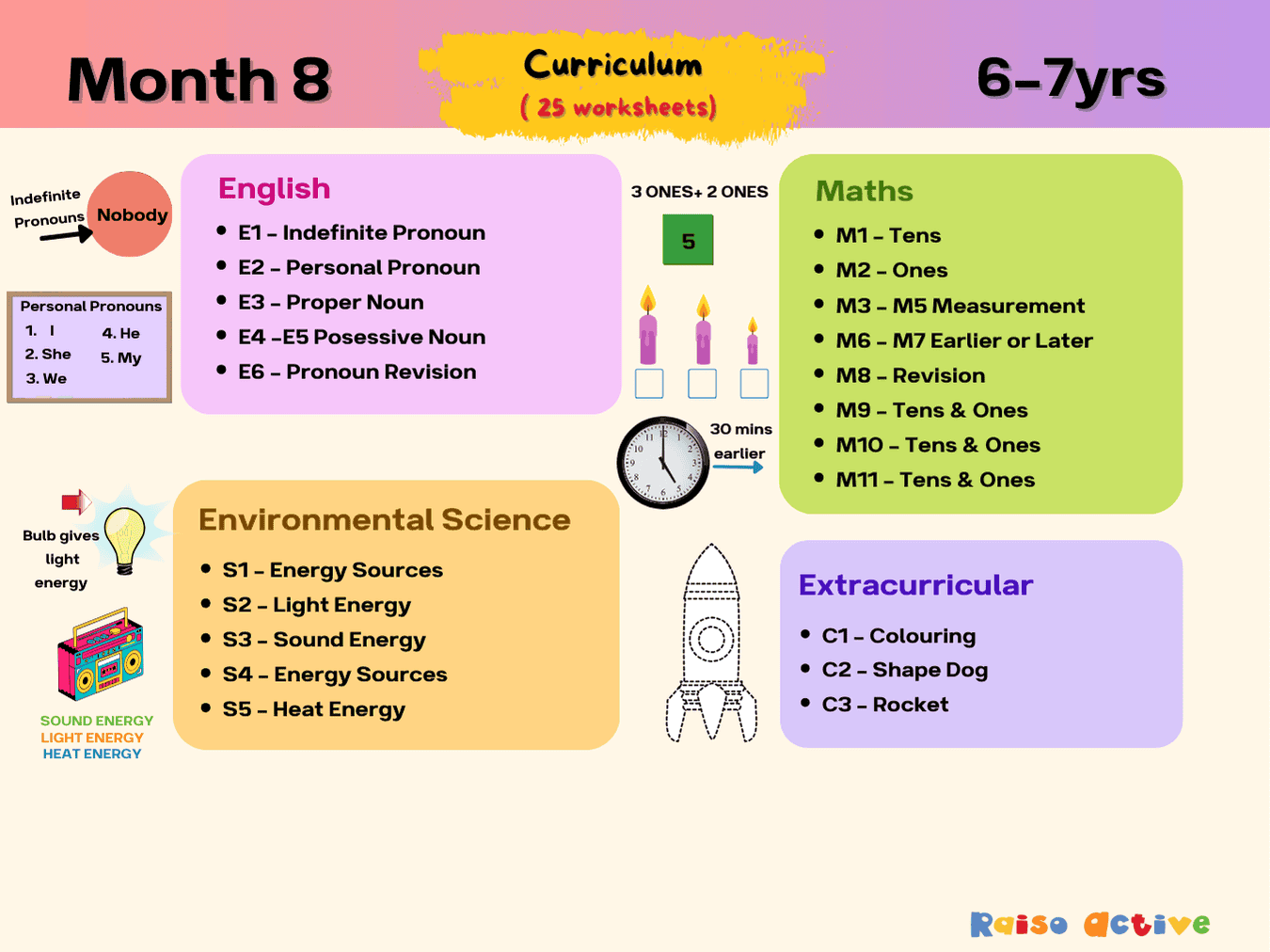
Month 8: English, Math, Science | Ages 6-7
This is page 11 of the pack. Ages 6-7 · Grade 1Ages 6-7 · Year 2Ages 6-7 · Class 1Ages 6-7
Made for your child
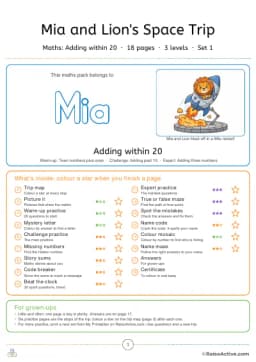
2, 5 and 10 times tables, made for your child
A maths pack with your child's name in it: pictures that explain, practice at three levels, puzzles and story sums about them. Print a new set whenever they finish.
Make a maths packFree preview · free for members
Curriculum
- Counting > Skip Counting
How to use this worksheet
Look at the first number on the left together and read it aloud, then have your child find the matching sum on the right side of the page and draw a connecting line. Continue through each number pair, encouraging your child to count carefully rather than guess. Move to the fill-in-the-blank section, where your child counts a group of ones and writes the correct total number in the blank provided. Review all the completed matches and blanks together at the end.
Materials needed
- Pencil
- Eraser
Extension activities
- 1Use loose counters or buttons to build small groups representing single-digit numbers.
- 2Play a quick matching game pairing number cards with the correct quantity of dot stickers.
- 3Practice counting a handful of small objects together, calling out the total as 'ones'.
- 4Create a simple worksheet of your own with numbers and matching object counts for extra practice.
- 5Count everyday items, like buttons on a shirt or spoons in a drawer, and say the total as ones counted.

Written by
Hemsweta Jain · Teacher Cheena
MBA and Early Childhood Educator, teaching since 2014 · Founder of RaisoActive, Mumbai
Every RaisoActive worksheet is designed and checked by the founder before publishing.
Published · Last reviewed
More from Month 8: English, Math, Science | Ages 6-7

Energy Sources Worksheet: Circle the Energy Sources!
Ages 4-6 · Pre-K–KindergartenAges 4-6 · Reception–Year 1Ages 4-6 · LKG–UKGAges 4-6
This worksheet introduces children ages 4-6 to the basic science concept that certain objects and phenomena — like the sun, batteries, or wind — are sources of energy, while other everyday objects are not. Asking children to circle only the true energy sources from a mixed set of pictures builds early categorization and critical thinking skills, since they must apply a definition rather than just recognize familiar objects. Writing numbers stepwise afterward adds a light sequencing task that keeps the page varied rather than focused on a single skill.

Earlier and Later Time Worksheet for Preschoolers
Ages 4-6 · Pre-K–KindergartenAges 4-6 · Reception–Year 1Ages 4-6 · LKG–UKGAges 4-6
Children ages 4-6 build early time-sequencing skills by comparing clocks and everyday activities to decide which happens earlier and which happens later in the day. This worksheet introduces the abstract idea of time passing through the concrete lens of familiar routines, like meals or bedtime, which children already experience daily. Tracing the arrow toward the later activity also reinforces the logical, forward direction that time moves.

Number Matching and Counting Worksheet for Preschoolers
Ages 3-5 · Preschool–Pre-KAges 3-5 · Nursery–ReceptionAges 3-5 · Nursery–LKGAges 3-5
This worksheet combines counting, cutting and pasting, and a targeted number-recognition task, finding circles with '5' in the ones place, giving children practice with quantity, fine motor coordination, and number pattern spotting all in one page. For ages three to five, recognizing a specific digit within a larger number, like the '5' in '15' or '25', is early groundwork for understanding place value.

Shape Dog Cut and Paste Worksheet for Preschoolers
Ages 3-5 · Preschool–Pre-KAges 3-5 · Nursery–ReceptionAges 3-5 · Nursery–LKGAges 3-5
Preschoolers ages 3-5 practice shape recognition and precise cutting by assembling pre-cut shape pieces into a dog outline, a task that requires matching each shape to its correct spot based on size and form. This shape-based construction builds spatial reasoning, since children must judge how pieces fit together to form a recognizable image. The scissor and glue work also continues strengthening the fine motor control essential for future handwriting.
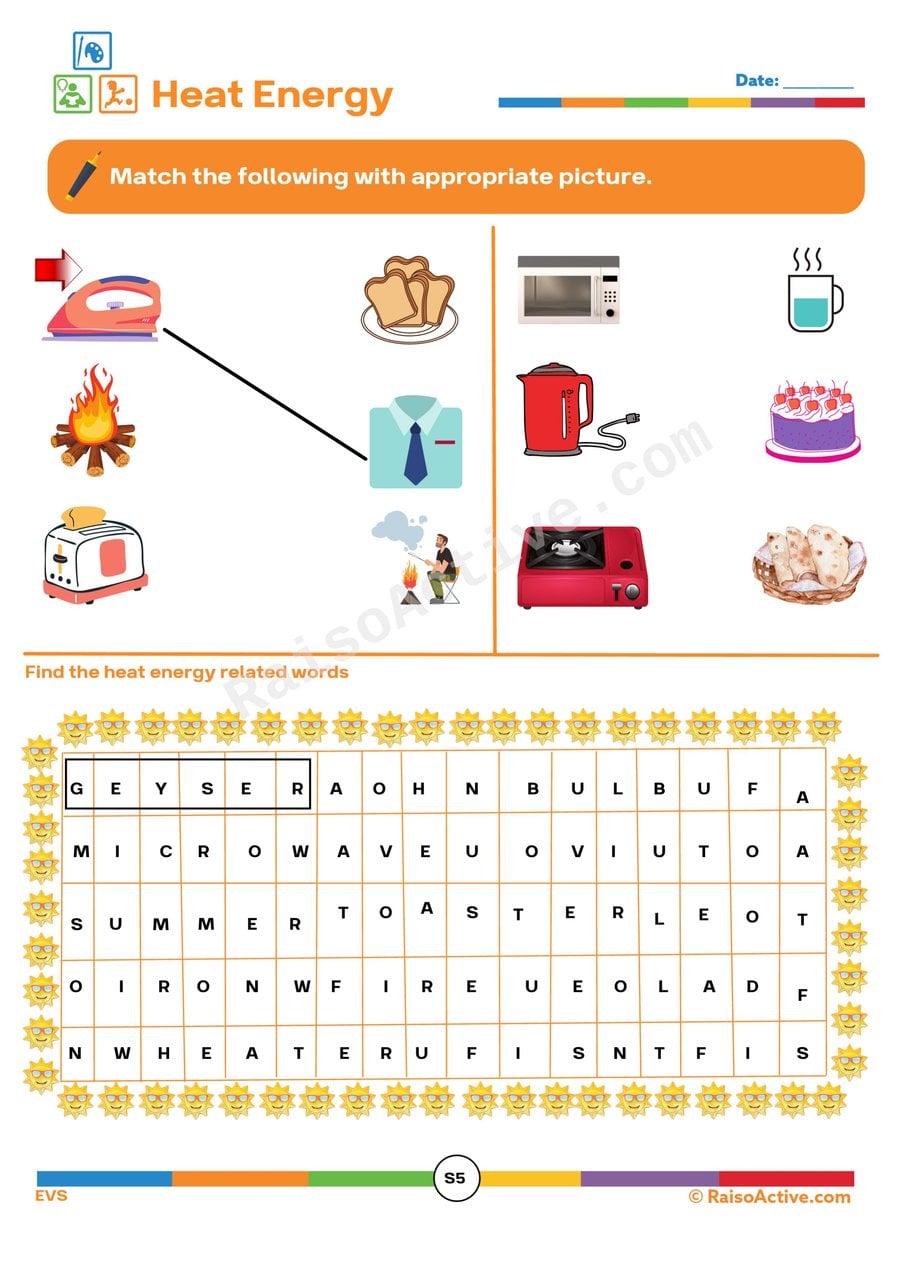
Heat Energy Matching Worksheet for Preschoolers
Ages 3-5 · Preschool–Pre-KAges 3-5 · Nursery–ReceptionAges 3-5 · Nursery–LKGAges 3-5
This worksheet narrows the broad concept of energy down to one specific, easy-to-observe type — heat — and asks children ages 3-5 to match everyday objects to pictures representing heat energy, like a stove, the sun, or a fire. Because heat is something children can directly feel and observe, it's an excellent entry point for early science vocabulary before moving to more abstract energy types like electricity. The word search portion adds early literacy practice, asking children to visually scan for heat-related vocabulary words among a grid of letters.

Measurement Worksheet: Matching and Measuring Objects!
Ages 4-6 · Pre-K–KindergartenAges 4-6 · Reception–Year 1Ages 4-6 · LKG–UKGAges 4-6
This worksheet moves children from an intuitive sense of size toward the more formal skill of using a ruler to measure length in units, bridging estimation with actual measurement. For ages four to six, matching objects to an approximate number of units first, then confirming with a ruler, helps them see measurement as something they can predict and then verify rather than an arbitrary number.

Proper Noun Worksheet for Kids: Fill-in-the-Blanks and Identify!
Ages 4-6 · Pre-K–KindergartenAges 4-6 · Reception–Year 1Ages 4-6 · LKG–UKGAges 4-6
This worksheet teaches children to tell the difference between a common noun and a proper noun, the specific, capitalized name of a particular person, place, or thing, which is foundational for both grammar and correct capitalization in their own writing. Ages four to six are at the right stage to start noticing that names like 'London' or 'Sara' get capital letters while general words like 'city' or 'girl' do not.

Rocket Shapes Worksheet for Preschoolers: Tracing and Matching
Ages 3-5 · Preschool–Pre-KAges 3-5 · Nursery–ReceptionAges 3-5 · Nursery–LKGAges 3-5
Building a rocket picture out of basic shapes helps children ages 3-5 practice shape recognition in a real, assembled context rather than in isolated flashcard form, showing them how circles, triangles, and rectangles combine to make a recognizable object. Circling the shapes found in the picture first sharpens visual discrimination, requiring children to spot a shape even when it's part of a larger, more complex image. The tracing component that follows adds fine motor practice, asking children to follow a dotted outline precisely to complete the rocket shape.
Related worksheets

Skip Counting by 10 Worksheet: Fill in the Blanks!
Ages 4-5 · Pre-KAges 4-5 · ReceptionAges 4-5 · LKGAges 4-5
This worksheet builds skip counting fluency by 10s, a foundational skill that helps children recognize number patterns and prepares them for place value concepts and faster counting strategies later on. For ages 4-5, seeing numbers grouped in tens on signs reinforces both sequencing and the visual structure of our base-ten number system.

Skip Counting Adventure: Fill in the Blanks Worksheet for Numbers 2, 5, and 10!
Ages 4-6 · Pre-K–KindergartenAges 4-6 · Reception–Year 1Ages 4-6 · LKG–UKGAges 4-6
Filling in missing numbers in sequences that count by twos, fives, and tens teaches children ages 4-6 to recognize numerical patterns beyond counting one at a time, an important stepping stone toward multiplication later in school. Because each skip-counting sequence has a consistent gap between numbers, children must notice and apply that pattern rather than simply reciting a memorized list. This worksheet also builds flexible number sense, helping children see numbers as a system with predictable structure rather than an arbitrary list to memorize.
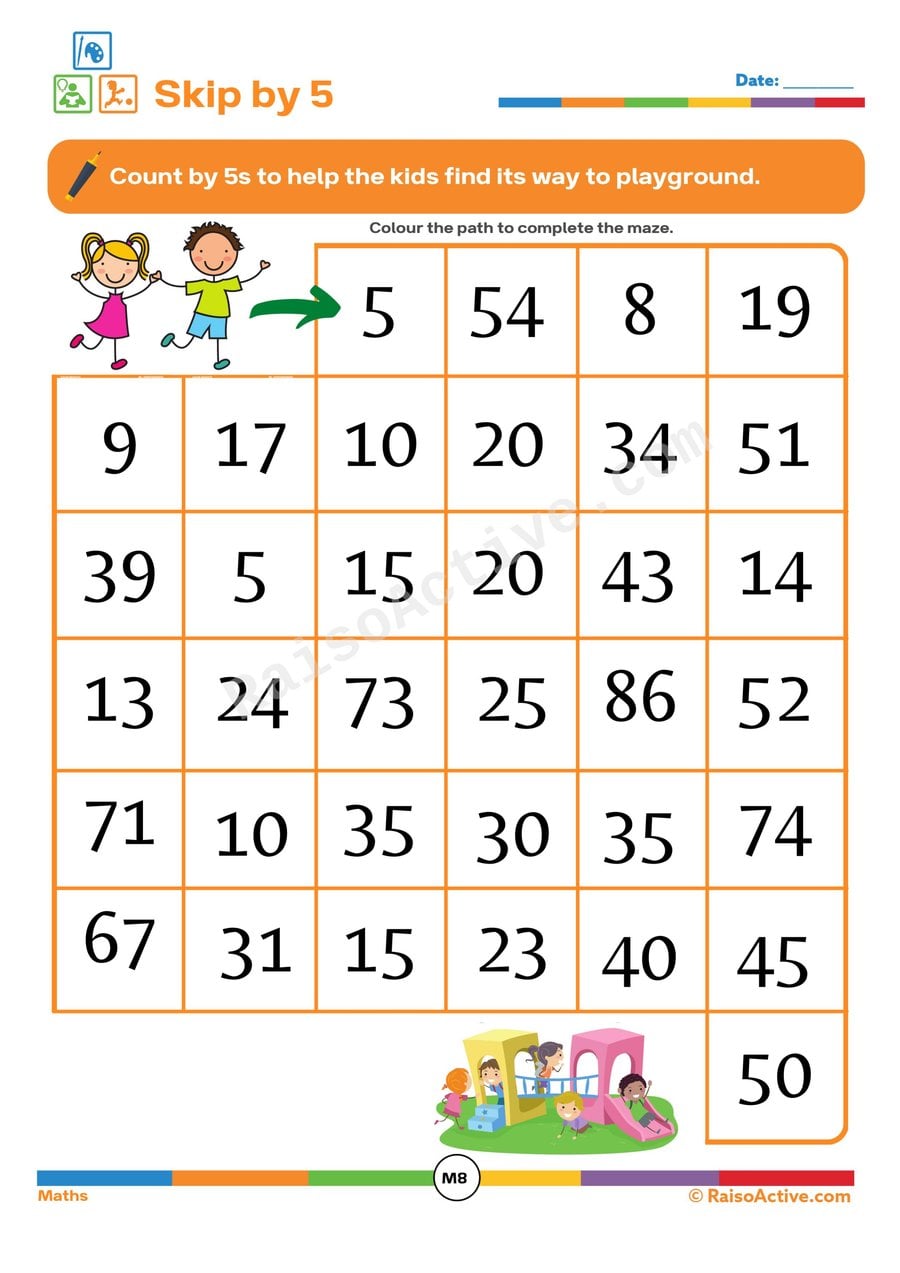
Skip Counting by 5: Maze Worksheet for Kids
Ages 4-6 · Pre-K–KindergartenAges 4-6 · Reception–Year 1Ages 4-6 · LKG–UKGAges 4-6
Skip counting by fives is a stepping stone toward multiplication and telling time on a clock face, and this maze format turns that abstract number pattern into a concrete navigation task. Ages four to six benefit from the built-in feedback a maze provides: choosing the wrong number sends the path to a dead end, so children learn to self-correct their counting in real time.

Froggy Skip Counting Worksheet: Practice Number Patterns!
Ages 4-6 · Pre-K–KindergartenAges 4-6 · Reception–Year 1Ages 4-6 · LKG–UKGAges 4-6
This worksheet introduces children ages 4-6 to skip counting — counting forward by a number other than one, such as by 2s or 5s — using a playful frog theme to keep the repetitive number pattern engaging. Recognizing and continuing a skip-counting sequence builds early number pattern awareness, a skill that later supports multiplication, telling time, and counting money.

Skip Counting Adventure: Help Community Helpers! A Fun Math Worksheet
Ages 4-6 · Pre-K–KindergartenAges 4-6 · Reception–Year 1Ages 4-6 · LKG–UKGAges 4-6
Filling in missing numbers while skip counting by 5s and 10s builds a foundation for multiplication and faster counting for children ages 4-6, using a community helpers theme to make the abstract number pattern feel purposeful.

Counting Fun: Count by 5 or 10 Worksheet for Preschoolers!
Ages 4-6 · Pre-K–KindergartenAges 4-6 · Reception–Year 1Ages 4-6 · LKG–UKGAges 4-6
Counting objects arranged in groups of five or ten teaches children ages 4-6 skip counting, a faster strategy for finding a total than counting every single object one by one. This early efficiency strategy builds a foundation for later multiplication and for quickly estimating larger quantities.
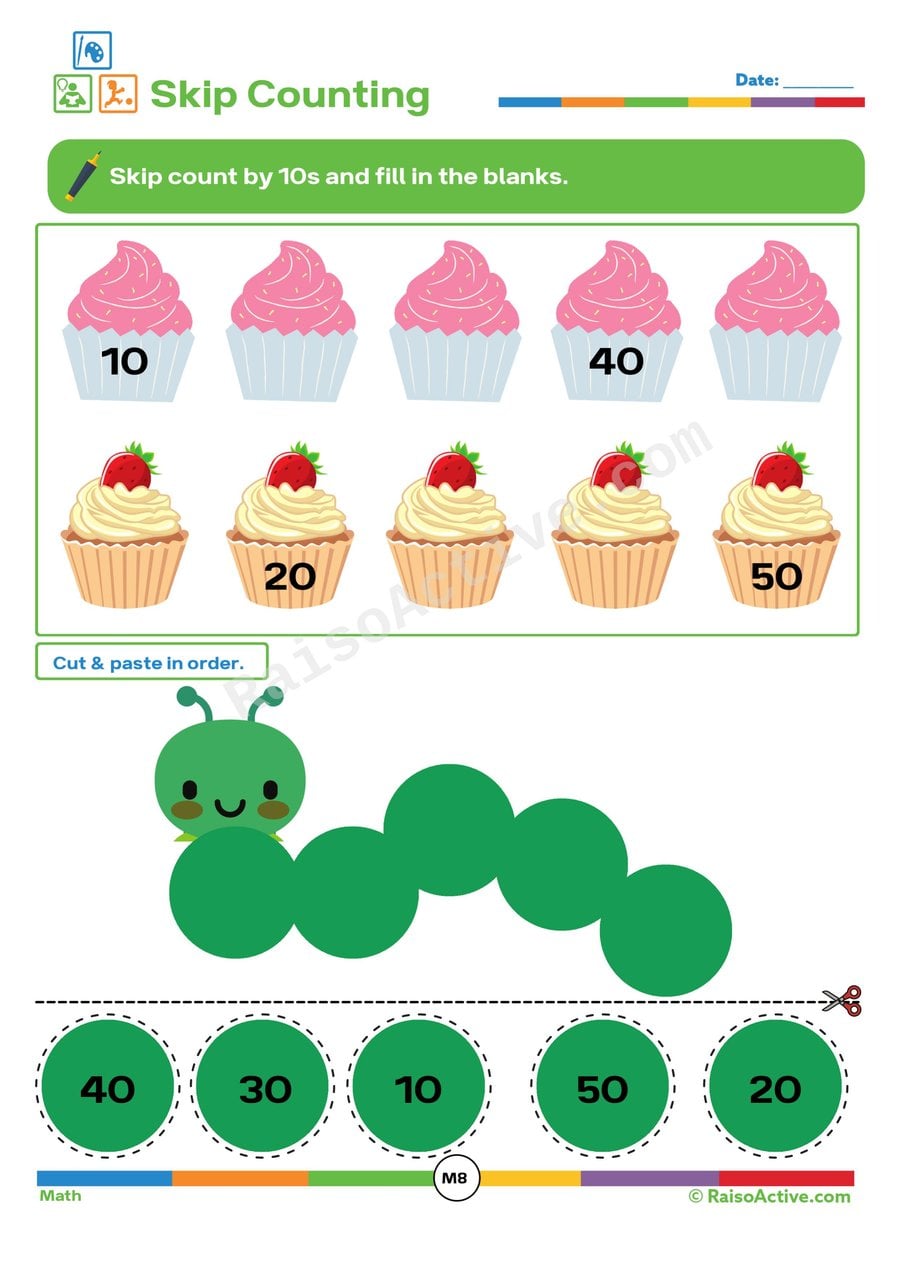
Skip Counting Cupcake Worksheet: Count by 10s!
Ages 4-5 · Pre-KAges 4-5 · ReceptionAges 4-5 · LKGAges 4-5
This worksheet has children ages 4-5 fill in missing numbers while skip counting by tens, then cut and paste the numbers onto a caterpillar in the correct sequence. Skip counting by tens is a crucial stepping stone toward place value and mental math, since it helps children see numbers in efficient groups rather than counting one by one.
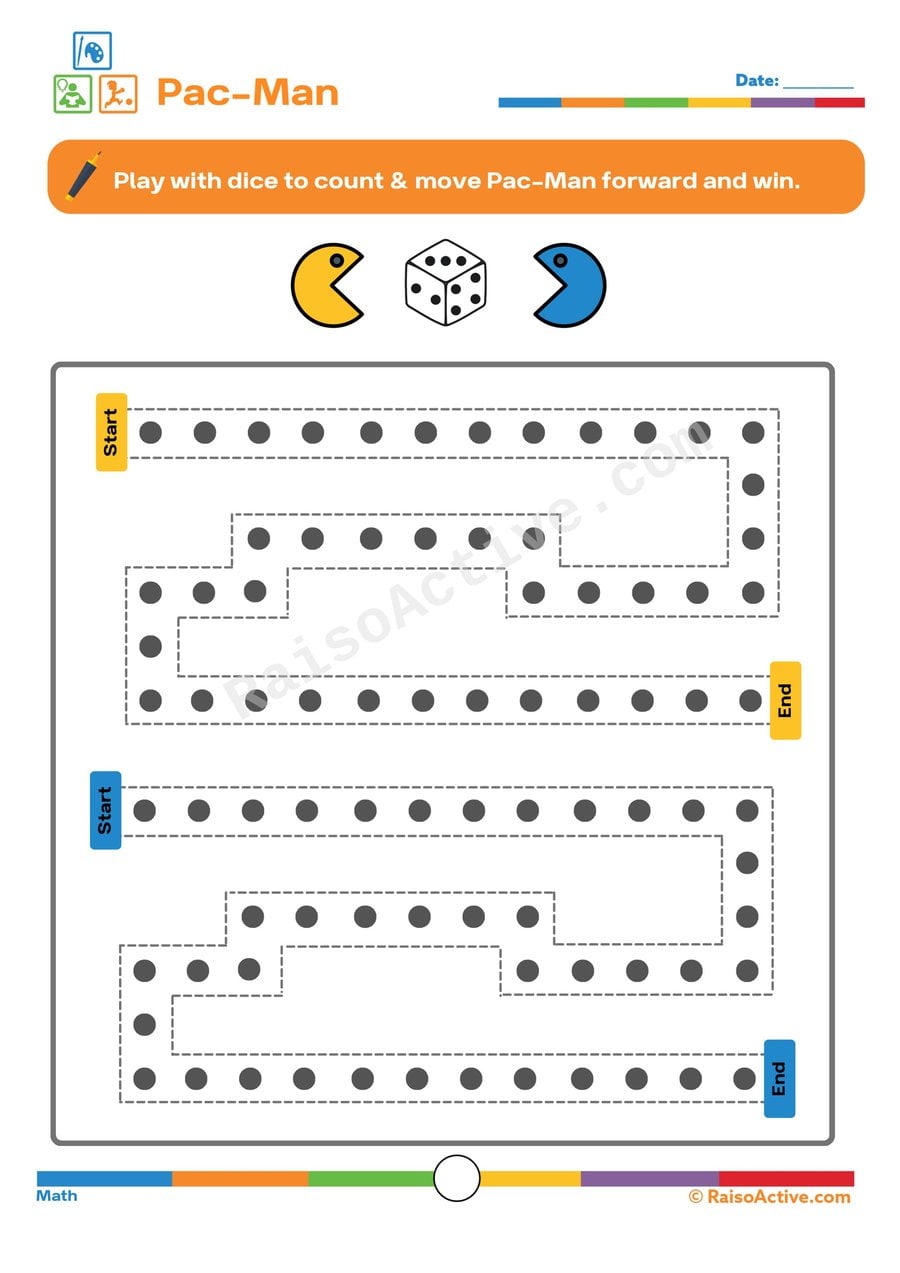
Pac-Man Maze Worksheet: Count and Move!
Ages 3-5 · Preschool–Pre-KAges 3-5 · Nursery–ReceptionAges 3-5 · Nursery–LKGAges 3-5
This dice-driven maze combines counting practice with path-following for children ages 3-5, since they must accurately count dots on a die before moving Pac-Man the matching number of spaces forward. Deciding how far to move and staying on the correct path also builds early strategic thinking, as children track their current position within the maze after each turn.
Guides for this topic

Number Formation Rhymes 0–9 and How to Fix Reversals
Original number formation rhymes for 0–9, the correct stroke order for each digit, why 3, 5 and 7 get reversed most often, and multisensory fixes that work.

Best Worksheets for 3-Year-Olds: What Works and What to Avoid
What works on worksheets for 3-year-olds: short sessions, crayons, tracing lines, matching, cutting, a free weekly plan, and signs one is too advanced.
Christmas and Winter Activities That Combine Fun and Learning: Creating Magical Educational Experiences
Discover Christmas and winter activities that combine festive fun with real learning. Crafts, counting, literacy, and printable worksheets for ages 2 to 8 — perfect for home and school.
Reviews
Every worksheet for ages 4–6, no watermark
Members download the full library of 1,000+ worksheets and every activity pack without watermarks or daily limits. One year costs ₹999 in India or $20 elsewhere.
See membership plansOr download any worksheet free with a watermark (5 a day).