Heat Energy Matching Worksheet for Preschoolers
This worksheet narrows the broad concept of energy down to one specific, easy-to-observe type — heat — and asks children ages 3-5 to match everyday objects to pictures representing heat energy, like a stove, the sun, or a fire. Because heat is something children can directly feel and observe, it's an excellent entry point for early science vocabulary before moving to more abstract energy types like electricity. The word search portion adds early literacy practice, asking children to visually scan for heat-related vocabulary words among a grid of letters.
Part of the pack
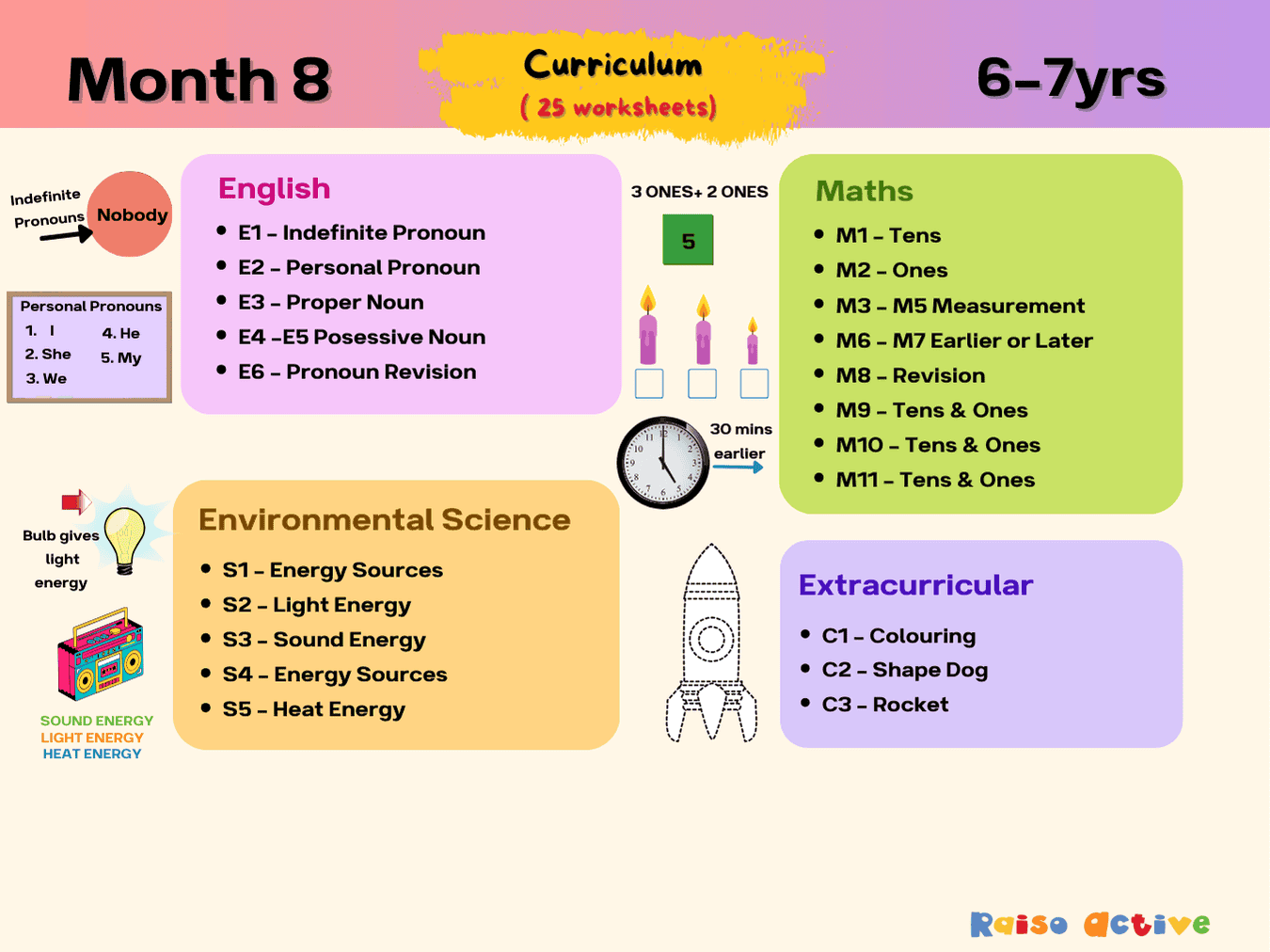
Month 8: English, Math, Science | Ages 6-7
This is page 25 of the pack. Ages 6-7 · Grade 1Ages 6-7 · Year 2Ages 6-7 · Class 1Ages 6-7
Made for your child
Counting to 10, made for your child
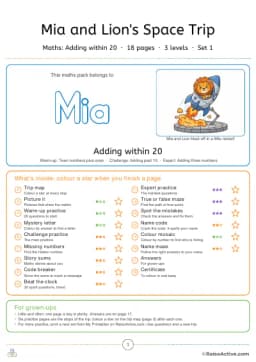
A maths pack with your child's name in it: pictures that explain, practice at three levels, puzzles and story sums about them. Print a new set whenever they finish.
Make a maths packFree preview · free for members
Curriculum
- Earth & Environment > States of Matter
How to use this worksheet
Look at the objects on the left side of the page together and talk about which ones produce or relate to heat. Ask your child to draw a line matching each object to the picture that represents heat energy on the right. Once matching is complete, move to the word search and help your child scan the letter grid to find heat-related words. Circle or highlight each word your child finds, reading it aloud together.
Materials needed
- Pencil
- Crayons
Extension activities
- 1Discuss different sources of heat in the home, like the stove, a heater, or sunlight through a window.
- 2Draw pictures of other objects that produce heat that weren't included on the worksheet.
- 3Safely feel the difference between a cool surface and a slightly warm one, like a sunny windowsill versus a shaded wall, talking about heat.
- 4Talk about how heat can be helpful, like cooking food, and also something to be careful around, like a hot stove.

Written by
Hemsweta Jain · Teacher Cheena
MBA and Early Childhood Educator, teaching since 2014 · Founder of RaisoActive, Mumbai
Every RaisoActive worksheet is designed and checked by the founder before publishing.
Published · Last reviewed
More from Month 8: English, Math, Science | Ages 6-7

Earlier and Later Time Worksheet for Preschoolers
Ages 4-6 · Pre-K–KindergartenAges 4-6 · Reception–Year 1Ages 4-6 · LKG–UKGAges 4-6
Children ages 4-6 build early time-sequencing skills by comparing clocks and everyday activities to decide which happens earlier and which happens later in the day. This worksheet introduces the abstract idea of time passing through the concrete lens of familiar routines, like meals or bedtime, which children already experience daily. Tracing the arrow toward the later activity also reinforces the logical, forward direction that time moves.

Light Energy Worksheet for Preschoolers: Identifying Light Sources
Ages 3-5 · Preschool–Pre-KAges 3-5 · Nursery–ReceptionAges 3-5 · Nursery–LKGAges 3-5
Identifying which objects give off light, the sun, a lamp, a flashlight, introduces preschoolers to the basic science idea that light comes from specific sources rather than simply existing everywhere, an early step toward understanding energy. Ages three to five are naturally curious about how they see the world, making this a good moment to connect that curiosity to real vocabulary about light energy.
Counting Tens Worksheet: Group and Count!
Ages 4-6 · Pre-K–KindergartenAges 4-6 · Reception–Year 1Ages 4-6 · LKG–UKGAges 4-6
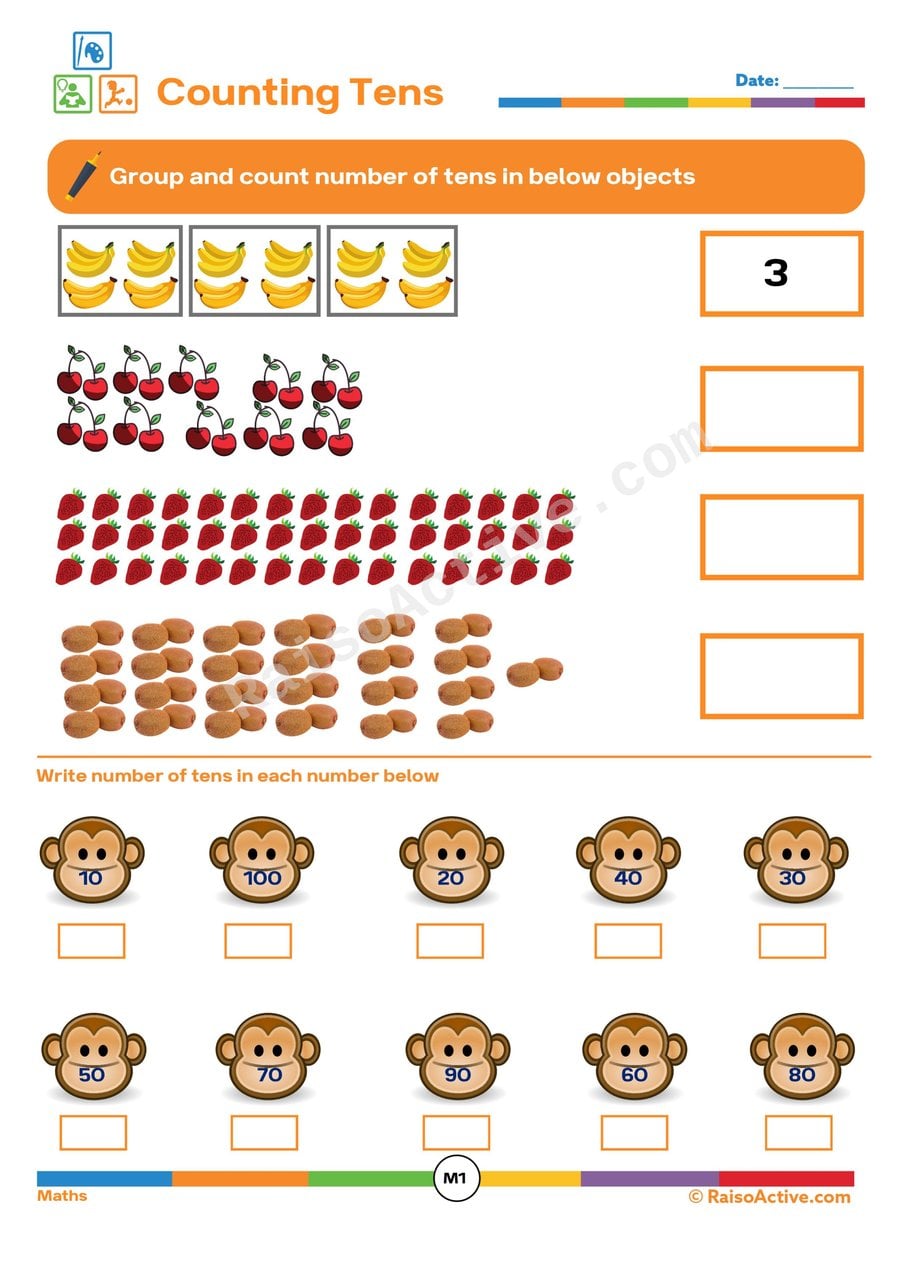
Grouping objects into sets of ten and counting the groups introduces the foundation of place value, the idea that a 'ten' is both ten individual ones and a single unit worth counting on its own. This worksheet gives ages four to six early, hands-on exposure to that concept well before they encounter formal place-value charts in school.

Earlier and Later Time Worksheet: Telling Time Practice
Ages 4-5 · Pre-KAges 4-5 · ReceptionAges 4-5 · LKGAges 4-5
Comparing clock times to determine which is earlier or later is an early step toward telling time for children ages 4-5, requiring them to read a clock face and reason about the order of events across a day. This worksheet builds that skill in two directions: first identifying a time earlier than a given reference point, then identifying a time later than a different clock shown. Practicing both directions helps children understand that 'earlier' and 'later' are relative concepts depending on what they're being compared to, not fixed labels attached to specific times.
Possessive Noun Matching Worksheet for Kids
Ages 4-6 · Pre-K–KindergartenAges 4-6 · Reception–Year 1Ages 4-6 · LKG–UKGAges 4-6
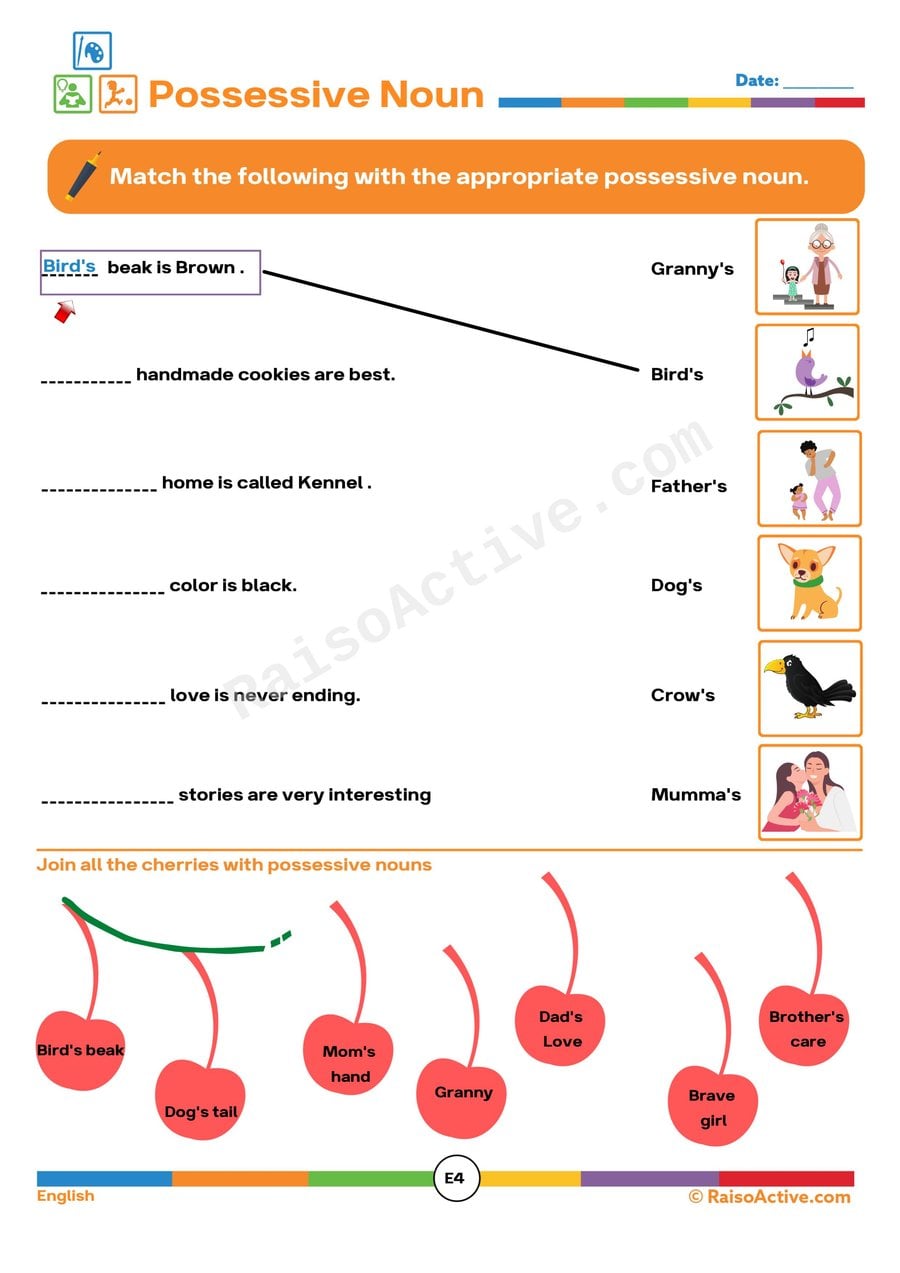
Children ages 4-6 learn to identify possessive nouns, like 'the dog's bone' or 'Mia's book', which show ownership using an apostrophe and 's'. Matching possessive phrases to their meaning builds early grammar awareness that will later support correct sentence writing and reading comprehension. The cherry-connecting activity adds a playful visual-tracking layer to reinforce the matching skill.

Energy Sources Worksheet: Circle the Energy Sources!
Ages 4-6 · Pre-K–KindergartenAges 4-6 · Reception–Year 1Ages 4-6 · LKG–UKGAges 4-6
This worksheet introduces children ages 4-6 to the basic science concept that certain objects and phenomena — like the sun, batteries, or wind — are sources of energy, while other everyday objects are not. Asking children to circle only the true energy sources from a mixed set of pictures builds early categorization and critical thinking skills, since they must apply a definition rather than just recognize familiar objects. Writing numbers stepwise afterward adds a light sequencing task that keeps the page varied rather than focused on a single skill.
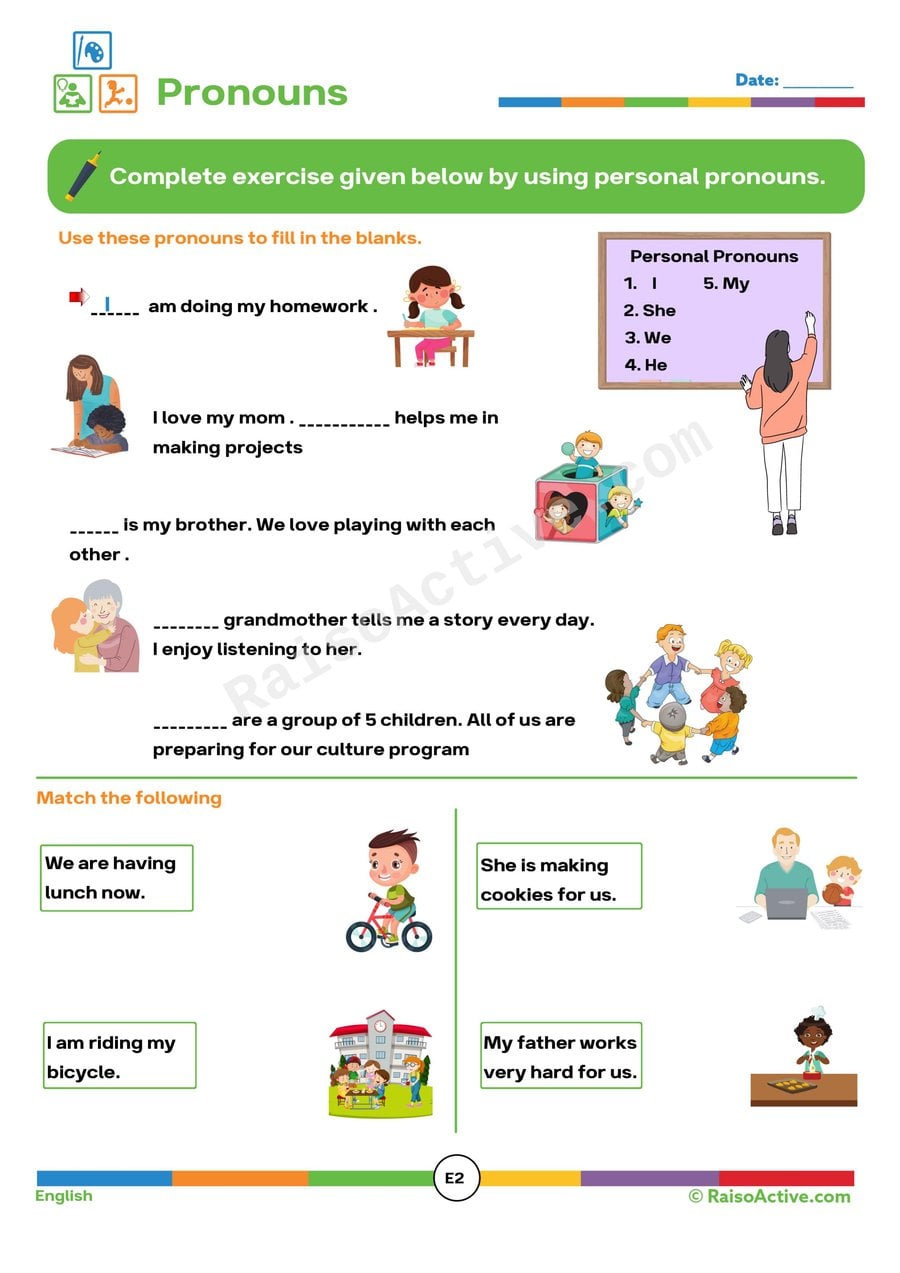
Pronouns Practice Worksheet for Preschoolers
Ages 4-6 · Pre-K–KindergartenAges 4-6 · Reception–Year 1Ages 4-6 · LKG–UKGAges 4-6
Children ages 4-6 practice using personal pronouns like 'I', 'she', 'we', 'he', and 'my' correctly within simple sentences, an early grammar skill that helps their speech and writing sound clear and natural. Matching completed sentences to images afterward reinforces comprehension, ensuring children understand the meaning behind the pronoun they chose rather than guessing. This combination of fill-in-the-blank and picture matching builds both grammar accuracy and reading comprehension together.

Pronoun Power: Fill-in-the-Blanks Worksheet for Kids
Ages 4-6 · Pre-K–KindergartenAges 4-6 · Reception–Year 1Ages 4-6 · LKG–UKGAges 4-6
Children ages 4-6 practice using indefinite pronouns like 'someone', 'anything', or 'everybody' correctly within sentences, an early grammar skill that helps their spoken and written language sound more natural and precise. Filling in blanks with the right pronoun requires reading comprehension, since children must understand the sentence's meaning to choose correctly. The coloring step adds a quick visual check that reinforces the correct answer.
Related worksheets
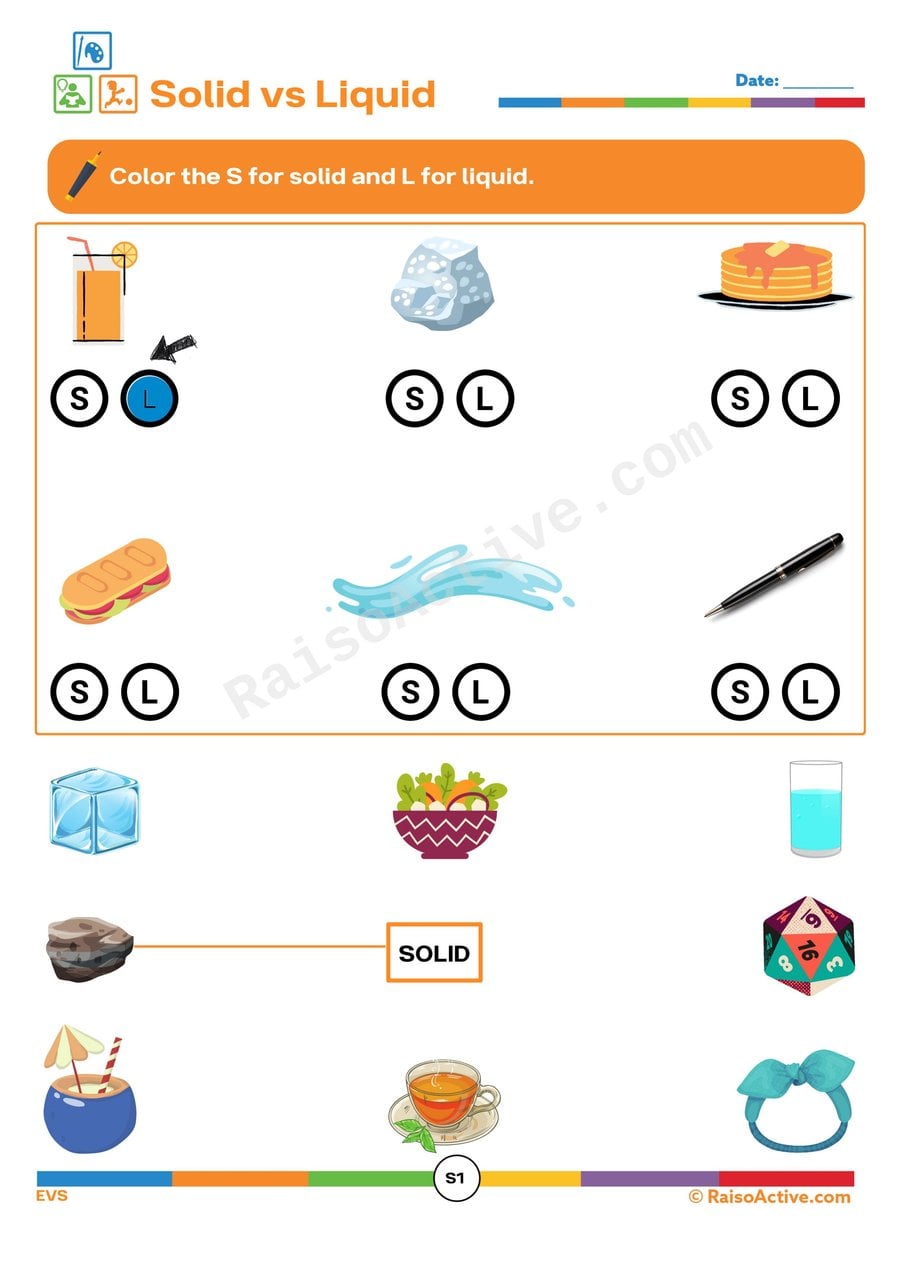
Solid vs. Liquid Worksheet: Color and Learn!
Ages 3-5 · Preschool–Pre-KAges 3-5 · Nursery–ReceptionAges 3-5 · Nursery–LKGAges 3-5
This worksheet introduces children ages 3-5 to the basic science concept of states of matter by having them sort pictured items into solids and liquids and color a corresponding letter, 'S' or 'L'. Early classification of the physical world — noticing that some things hold their shape while others flow and take the shape of their container — is an important first step in scientific thinking and observation.
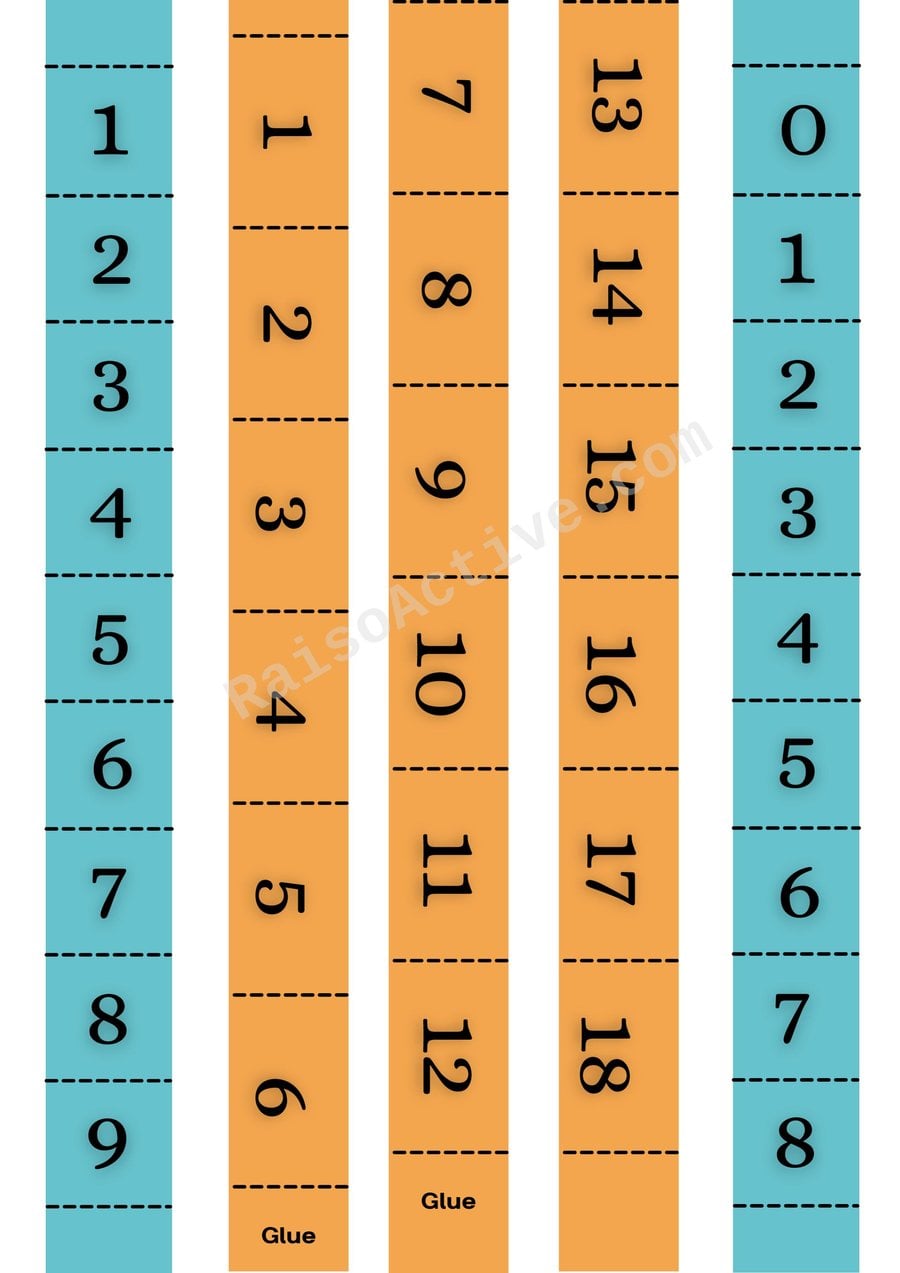
Number Matching Worksheet: 0-18
Ages 3-5 · Preschool–Pre-KAges 3-5 · Nursery–ReceptionAges 3-5 · Nursery–LKGAges 3-5
This activity strengthens numeral recognition for children ages 3-5 by having them find and pair matching numbers from 0 to 18 printed on separate strips. Because the numbers are scattered rather than in order, children must recognize each digit shape on its own rather than relying on counting sequence, which builds true number recognition instead of rote list-reciting.

Easter Egg Match: Add and Find the Matching Designs!
Ages 3-5 · Preschool–Pre-KAges 3-5 · Nursery–ReceptionAges 3-5 · Nursery–LKGAges 3-5
This worksheet blends early addition with visual matching as children ages 3-5 combine two separate shape groups and then search for the Easter egg design that shows the same total. Because the 'answer' is a picture rather than a written number, children practice quantity comparison and pattern-matching without needing to know written numerals yet.

Navratri Colour Hunt: Colour Words, Matching and Bangles
Ages 4-6 · Pre-K–KindergartenAges 4-6 · Reception–Year 1Ages 4-6 · LKG–UKGAges 4-6
Children read colour words, colour bangles to match, count how many of each colour, match everyday things to their colours and find colours around the home.
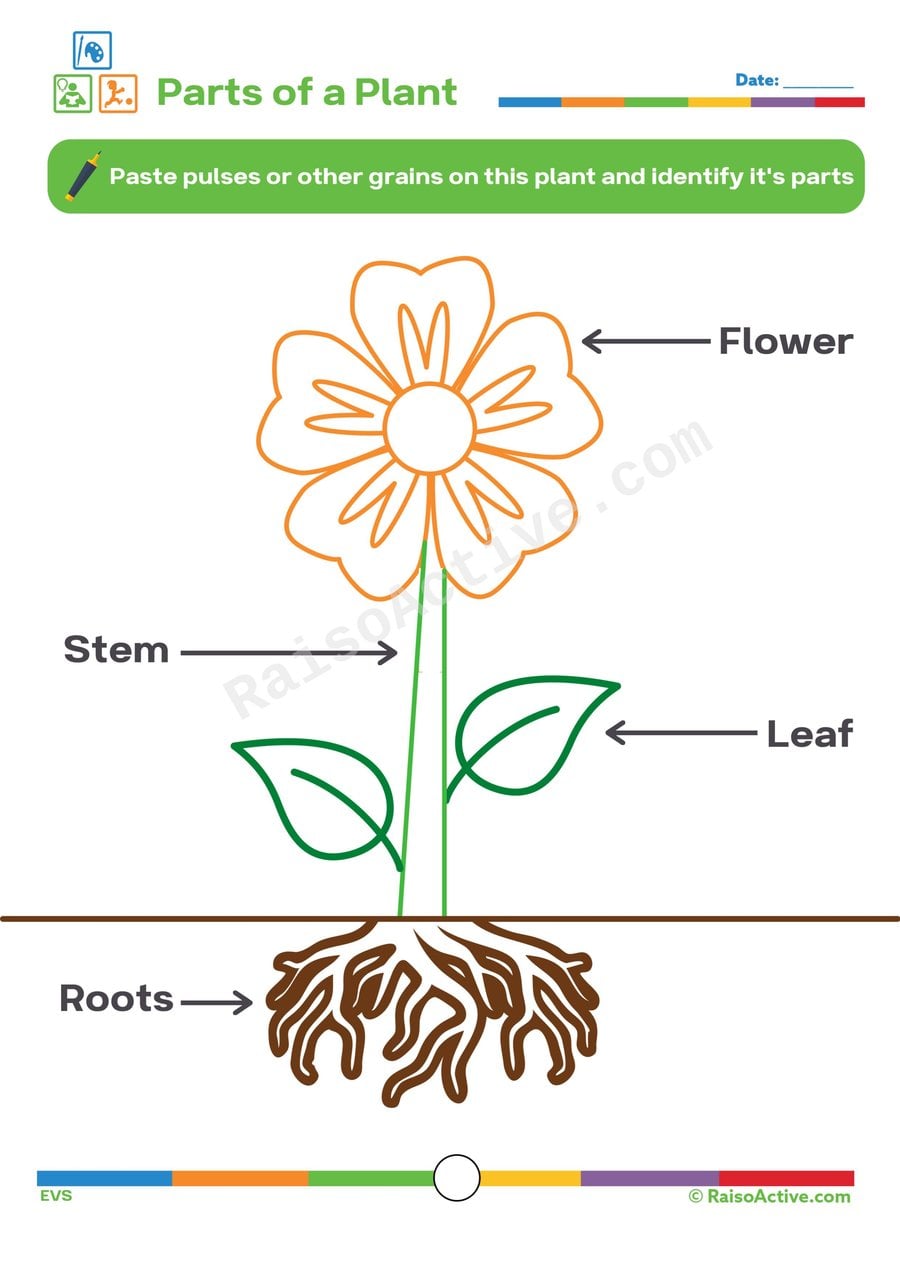
Parts of a Plant Worksheet: Identify and Label!
Ages 3-5 · Preschool–Pre-KAges 3-5 · Nursery–ReceptionAges 3-5 · Nursery–LKGAges 3-5
This activity teaches children ages 3-5 the basic parts of a plant — flower, stem, leaf, and roots — by having them label a diagram and add texture using real pulses or grains glued onto the plant shape. Combining a tactile material with each labeled part helps young children retain the vocabulary better than labeling alone, since touch and sight reinforce the same information.
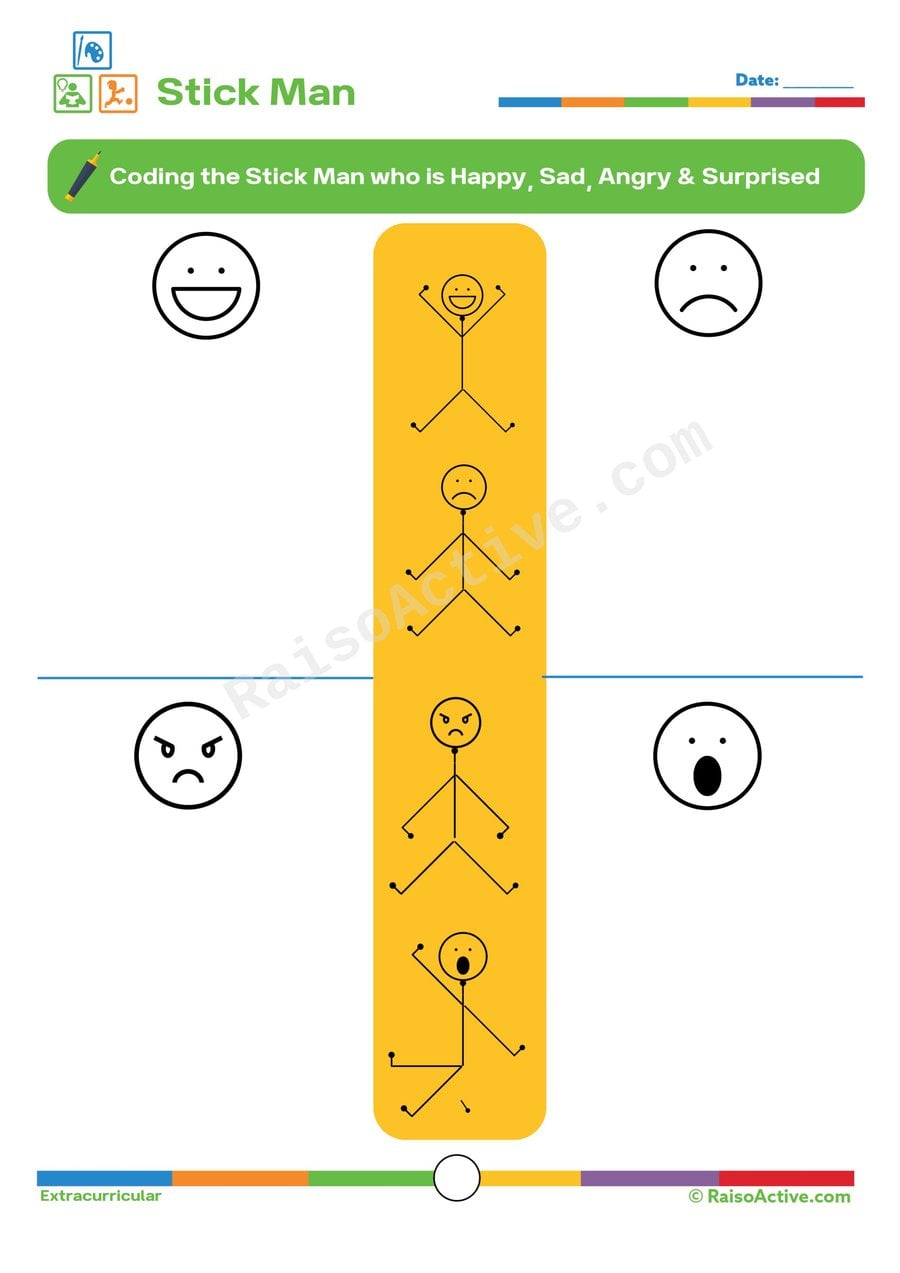
Stick Man Emotions Worksheet: Happy, Sad, Angry & Surprised!
Ages 3-5 · Preschool–Pre-KAges 3-5 · Nursery–ReceptionAges 3-5 · Nursery–LKGAges 3-5
Matching simple stick-figure faces to emotion words helps children ages 3-5 build an early emotional vocabulary, connecting facial cues like a curved mouth or raised eyebrows to specific feeling words. This kind of emotion recognition is a foundational social-emotional skill, helping children name what they and others are feeling instead of just reacting.
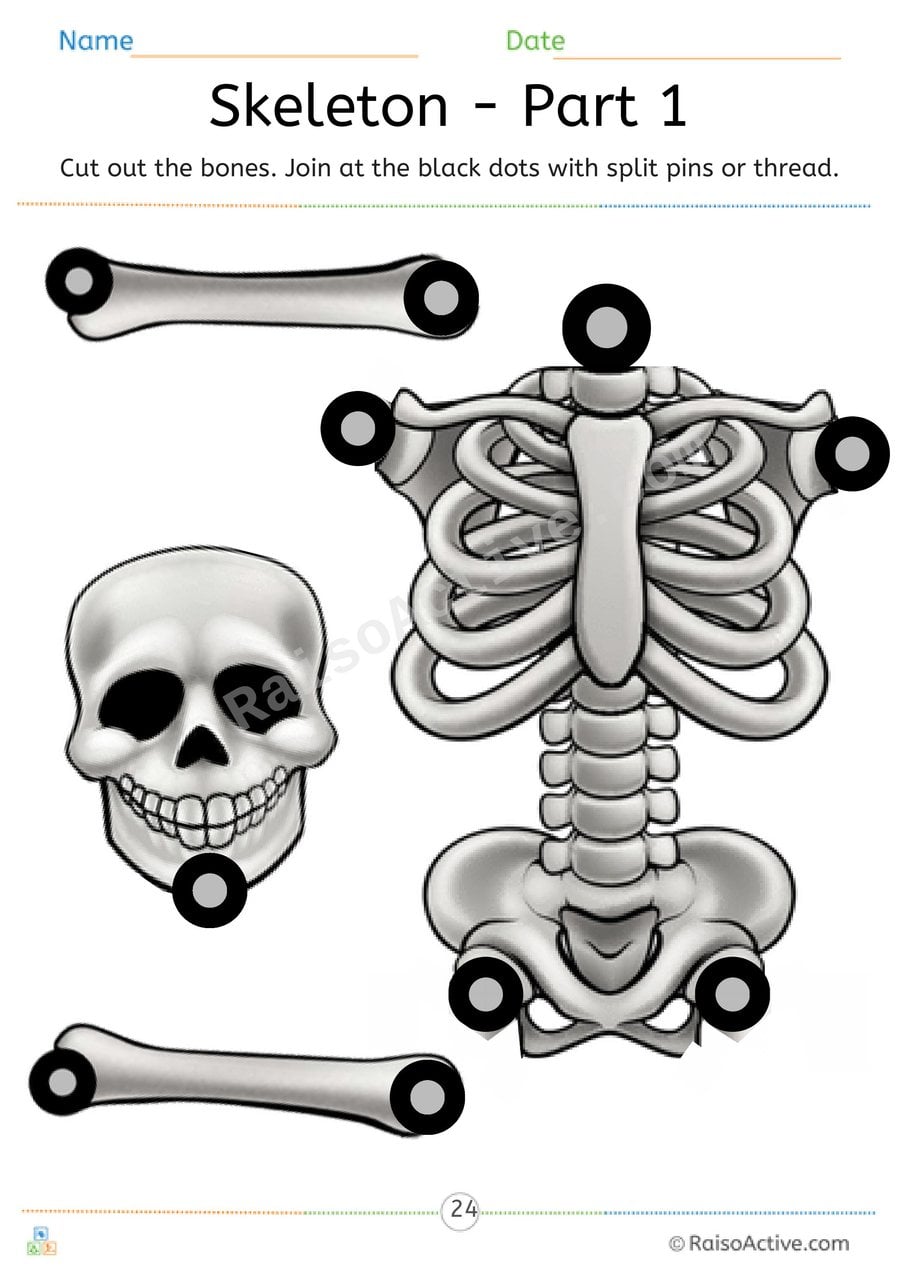
Skeleton Cut and Join Worksheet for Kids
Ages 3-5 · Preschool–Pre-KAges 3-5 · Nursery–ReceptionAges 3-5 · Nursery–LKGAges 3-5
This worksheet has children ages 3-5 cut out individual bone shapes and piece them together to assemble a skeleton, building scissor control and spatial reasoning as they figure out where each bone belongs relative to the others. Gluing the assembled bones onto a backing sheet also gives the activity a lasting, displayable result.

Stick Man Emotions Worksheet: Happy, Sad, Angry, and Surprised!
Ages 4-6 · Pre-K–KindergartenAges 4-6 · Reception–Year 1Ages 4-6 · LKG–UKGAges 4-6
Children ages 4-6 practice reading facial expressions on this worksheet, matching stick-figure faces to their correct emotion labels by noticing details like mouth shape and eyebrow position. This strengthens emotional literacy — the ability to name and recognize feelings in others — which supports empathy and smoother social interactions as children move into more group play and classroom settings.
Guides for this topic

Best Worksheets for 3-Year-Olds: What Works and What to Avoid
What works on worksheets for 3-year-olds: short sessions, crayons, tracing lines, matching, cutting, a free weekly plan, and signs one is too advanced.

Discovering Wonder: Nature-Based Learning Activities That Captivate Young Children
Explore nature-based learning activities for children ages 2–7 — leaf rubbings, bug hunts, nature journals, and seasonal Indian outdoor ideas that spark wonder.
Hands-On Science Fun: Age-Appropriate Science Activities That Spark Curiosity in Preschoolers
Discover 10+ easy science experiments for preschoolers using Indian household items. Spark curiosity in children ages 2-6 with safe, play-based STEM activities.
Reviews
Every worksheet for ages 3–5, no watermark
Members download the full library of 1,000+ worksheets and every activity pack without watermarks or daily limits. One year costs ₹999 in India or $20 elsewhere.
See membership plansOr download any worksheet free with a watermark (5 a day).