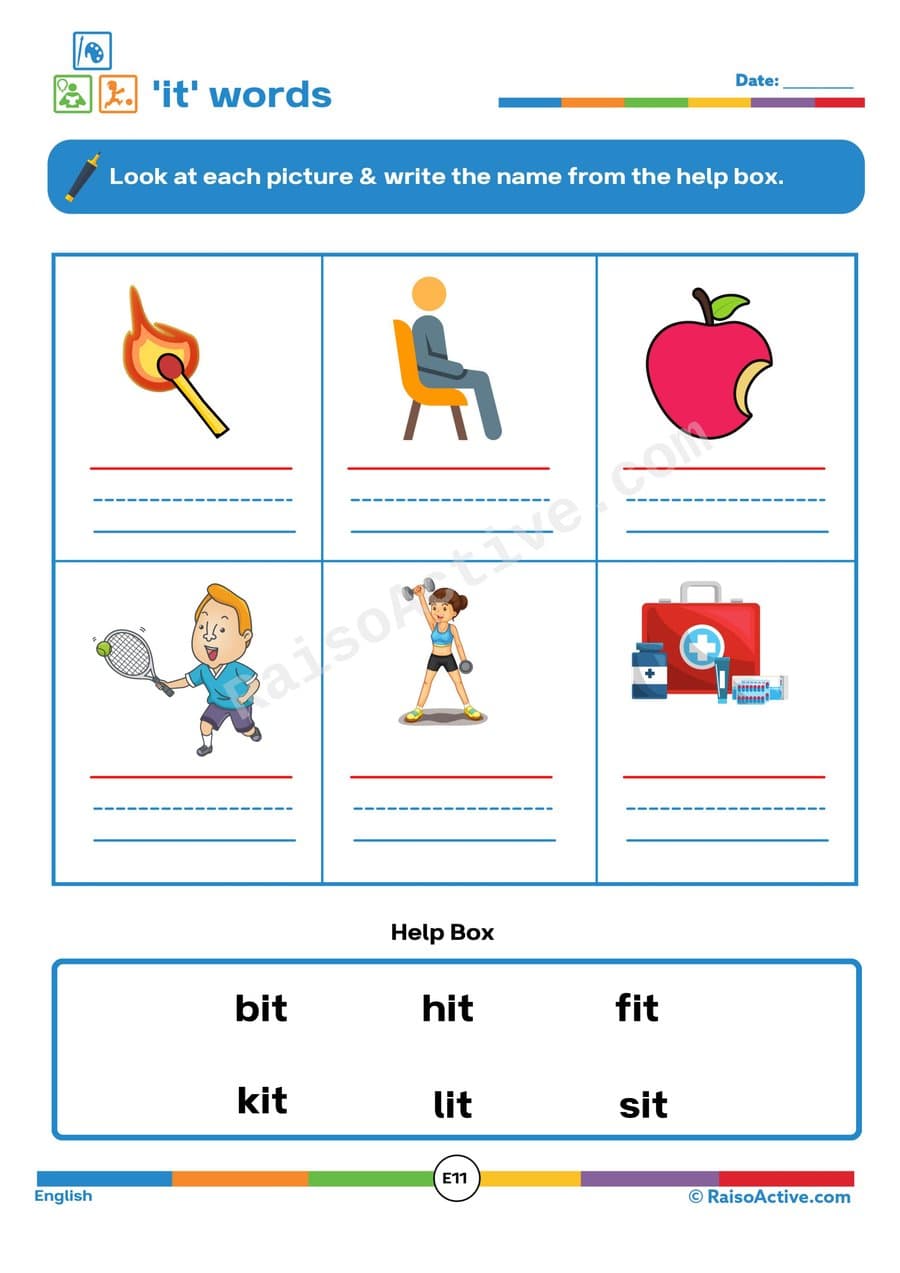
It Words Worksheet: Read and Write 'it' Words!
Children ages 4-6 build phonics fluency by reading and writing CVC words from the 'it' family, such as 'sit', 'bit', and 'fit'. Recognizing this word family pattern teaches children that groups of letters carry predictable, reusable sounds, which speeds up decoding of new words they encounter later. Writing each word after identifying it also reinforces correct spelling and letter sequencing.
Part of the pack
Month 8: English, Math, Science Foundations | Ages 4-5Curriculum
How to use this worksheet
Look at the first picture together and have your child say the word slowly, listening for the shared '-it' ending sound. Point them to the help box at the bottom of the page and have them find the matching word before copying it onto the line beneath the picture. Encourage sounding out each letter as they write, checking that the finished word matches the picture. Continue through each picture, then reread all the completed 'it' words together at the end.
Materials needed
- Pencil
- Eraser
Extension activities
- •Make flashcards of the 'it' words and sort them by how many letters they have.
- •Play charades acting out an 'it' word like 'sit' or 'spit' for others to guess.
- •Build the 'it' words using magnetic letters or letter tiles.
- •Write a two-line rhyme using two of the 'it' words from the worksheet.
- •Go on a hunt for objects that rhyme with 'it', like a mitt or a kit if available at home.
Tips for parents and teachers
Notice if your child is reading the shared '-it' ending as a chunk rather than sounding out from scratch each time, since chunking word families is a more advanced and efficient reading strategy. If a word is tricky, cover the first letter and have them read '-it' first before adding the beginning sound back on. Keep practice light and encouraging, since confidence with word families builds quickly with positive repetition.

Written by
Hemsweta Jain · Teacher Cheena
MBA and Early Childhood Educator, teaching since 2014 · Founder of RaisoActive, Mumbai
Every RaisoActive worksheet is designed and checked by the founder before publishing.
Published · Last reviewed
Related worksheets

It Family Words Worksheet: Read, Trace, and Identify!
This worksheet builds phonics fluency around the 'it' word family, sit, bit, hit, fit, and similar words, teaching children that changing the first letter while keeping a shared ending creates a whole set of related, decodable words. For ages 3-5, word family practice like this is one of the most effective ways to build early reading skills, since it helps children decode new words by recognizing a familiar chunk rather than sounding out every letter individually.
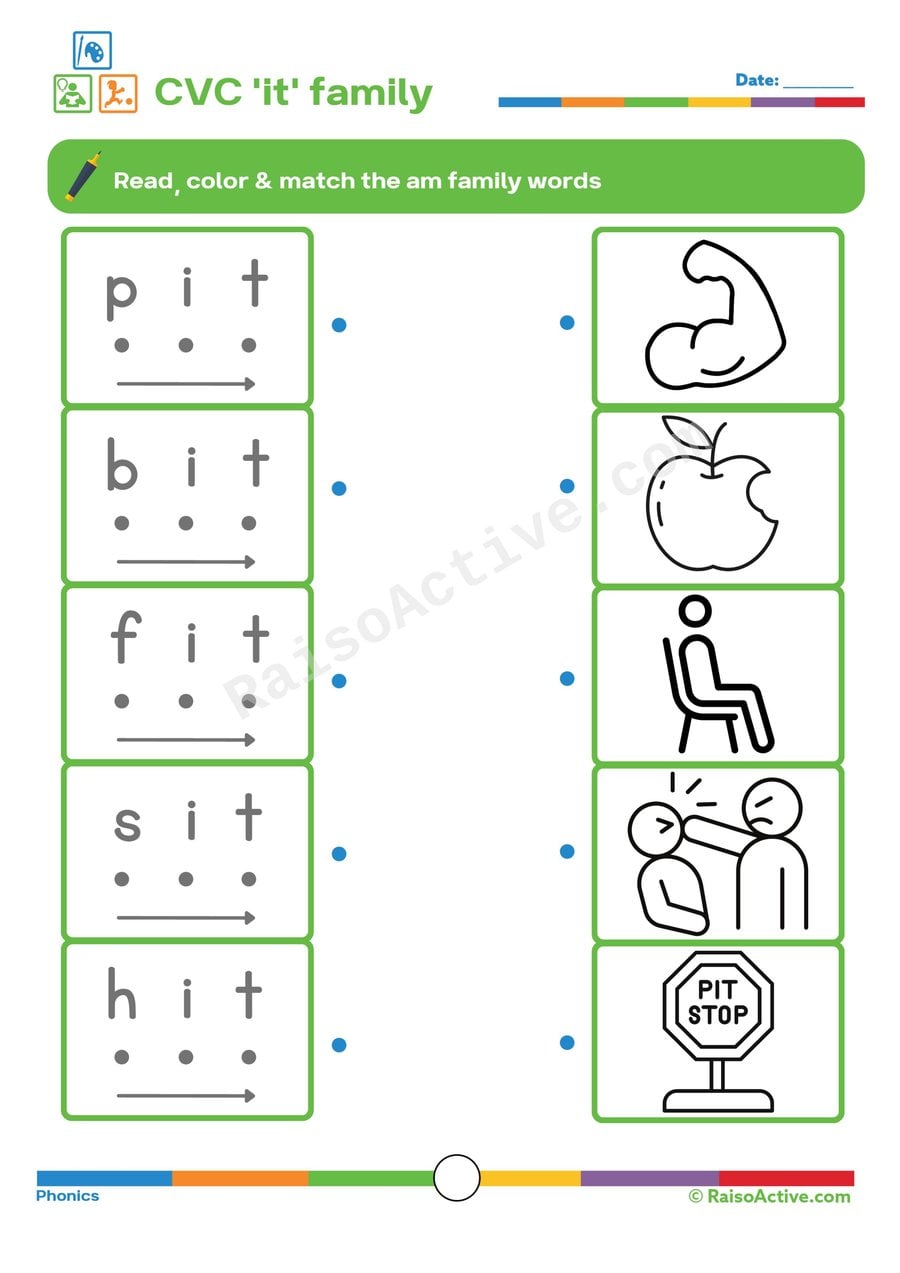
CVC 'it' Family Worksheet: Read, Color & Match!
Working through the 'it' word family (pit, bit, fit, sit, hit) gives children ages 4-5 hands-on practice with one of the most common short-vowel patterns in early reading, since so many beginner books rely on these simple rhyming words. Reading the word, coloring it, and then matching it to a picture asks a child to process the same word visually, orally, and semantically in one activity, which builds a much stronger memory trace than reading alone. This repetition-through-variety approach is especially effective for children who are just starting to decode independently.
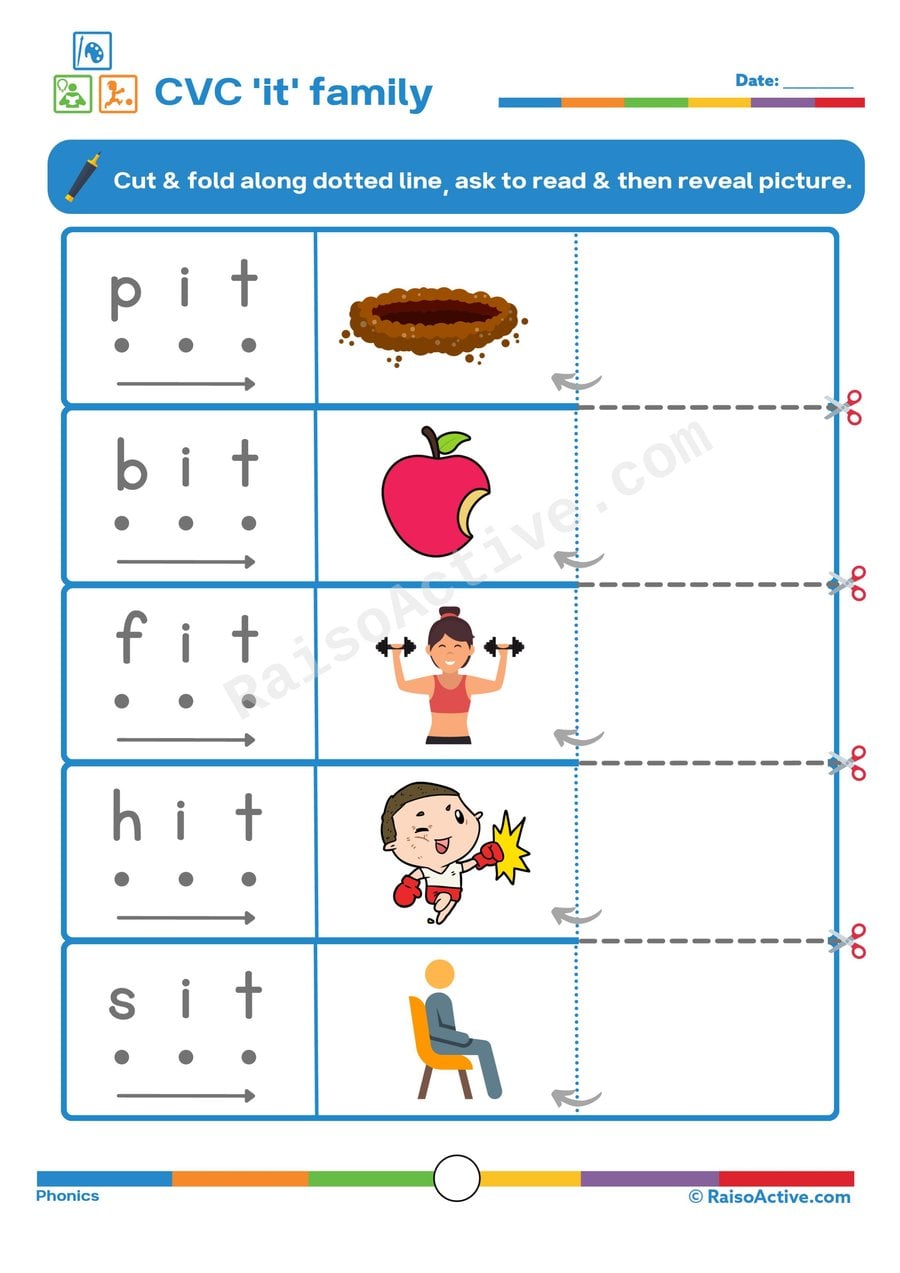
CVC 'it' Family Worksheet: Read, Cut, and Reveal!
The 'it' word family (sit, hit, bit) introduces children ages 3-5 to a short-vowel pattern using the letter i, giving them practice with a sound that's often trickier to hear than a/e because it's a shorter, less distinct vowel. Reading each word before revealing its hidden picture builds decoding confidence and gives an immediate self-check, which helps children trust their own reading rather than relying only on adult confirmation. Repeating the same ending across several words strengthens pattern recognition, a skill that speeds up reading fluency over time.

Trace the Numbers 1-9 Worksheet for Preschoolers
Tracing the numerals 1 through 9 gives children ages 3-5 repeated, guided practice with the specific pencil strokes each number requires, building the fine motor control and muscle memory needed for independent number writing. Because tracing follows a fixed, correct path, it also reinforces accurate numeral recognition, helping children tell visually similar digits apart.
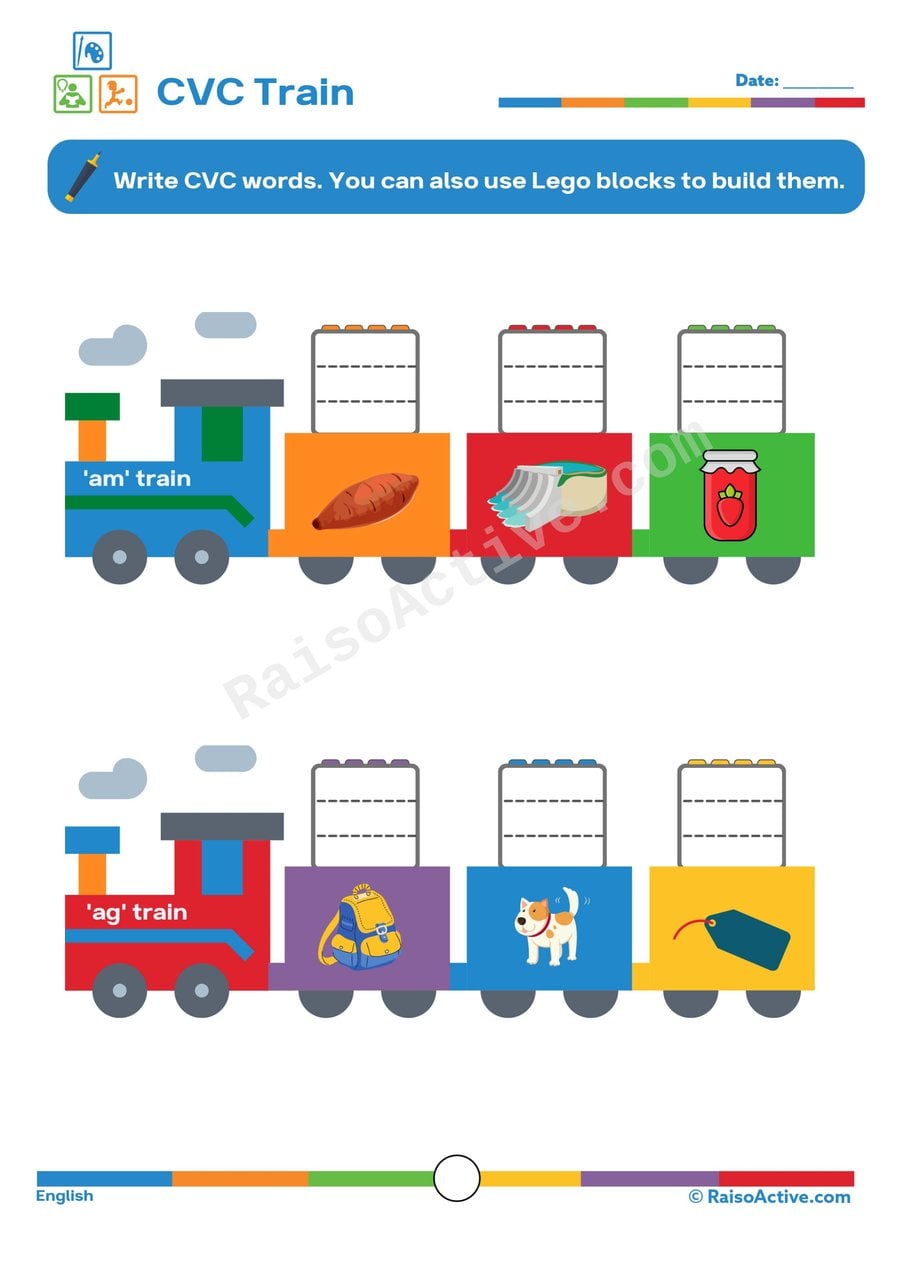
CVC Train Worksheet: Write and Build CVC Words!
This worksheet gives children ages 4-6 focused practice blending letter sounds into consonant-vowel-consonant words, using train-car pictures as clues for words like 'dog,' 'hen,' or 'cup.' Because children both write the word and can optionally build it with Lego blocks, this worksheet reinforces the same phonics skill through two different physical actions — handwriting and hands-on construction — which helps the spelling patterns stick.

Plant Parts Worksheet: Identify and Label the Parts of a Plant!
This worksheet teaches children ages 4-6 to identify and independently label the flower, stem, leaf, and roots of a plant, moving a step beyond simple matching toward recalling vocabulary from memory. Optionally adding pulses or grains to the diagram introduces a tactile, sensory layer that helps reinforce which part is which through touch as well as sight.
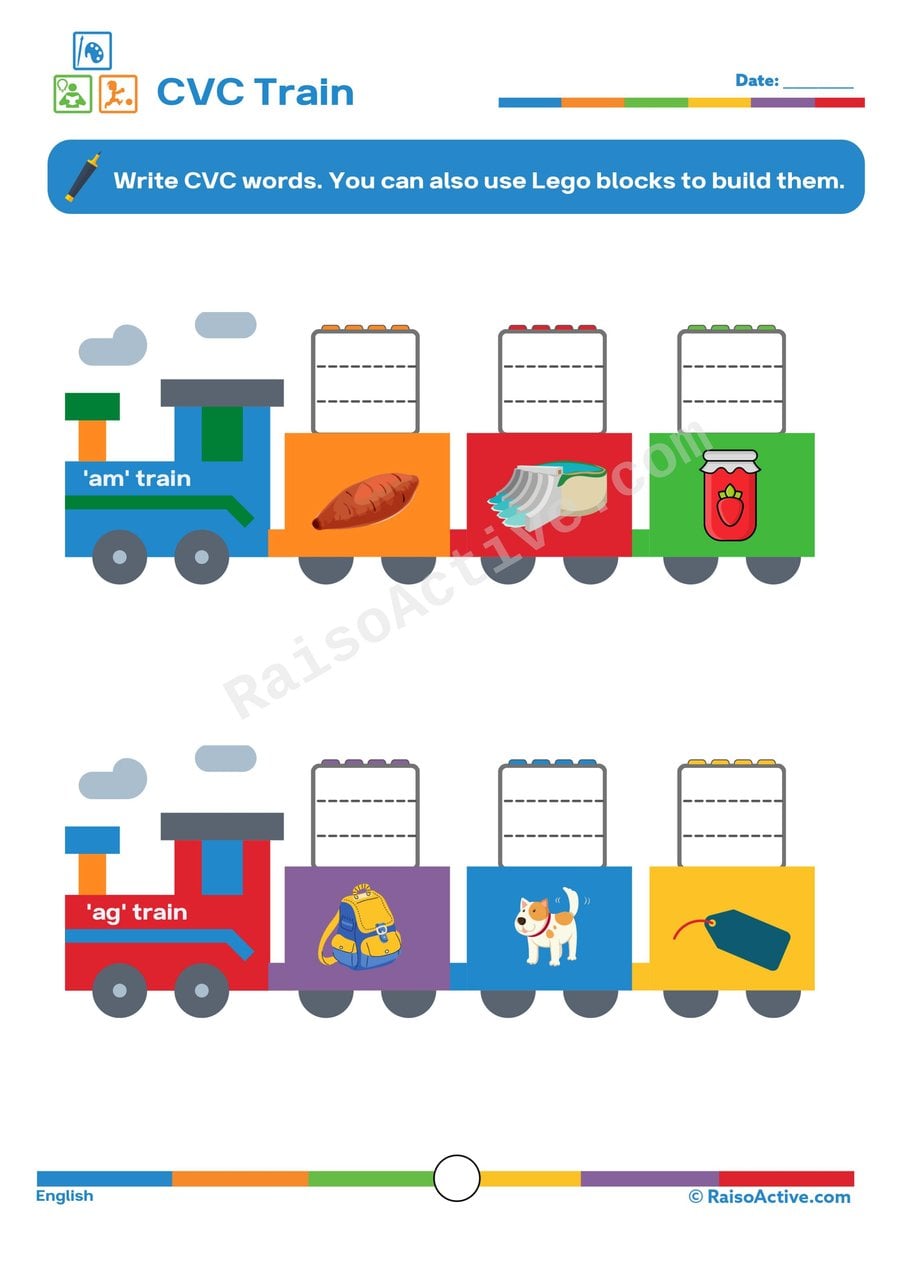
CVC Train Worksheet: Write CVC Words!
Writing consonant-vowel-consonant words like 'cat,' 'sun,' or 'pig' under matching pictures gives children ages 4-6 direct practice with letter-sound blending, a core phonics skill that underpins independent reading. Because each train car pairs a picture clue with a blank space, children also practice translating a spoken word they can sound out into its correctly spelled written form.
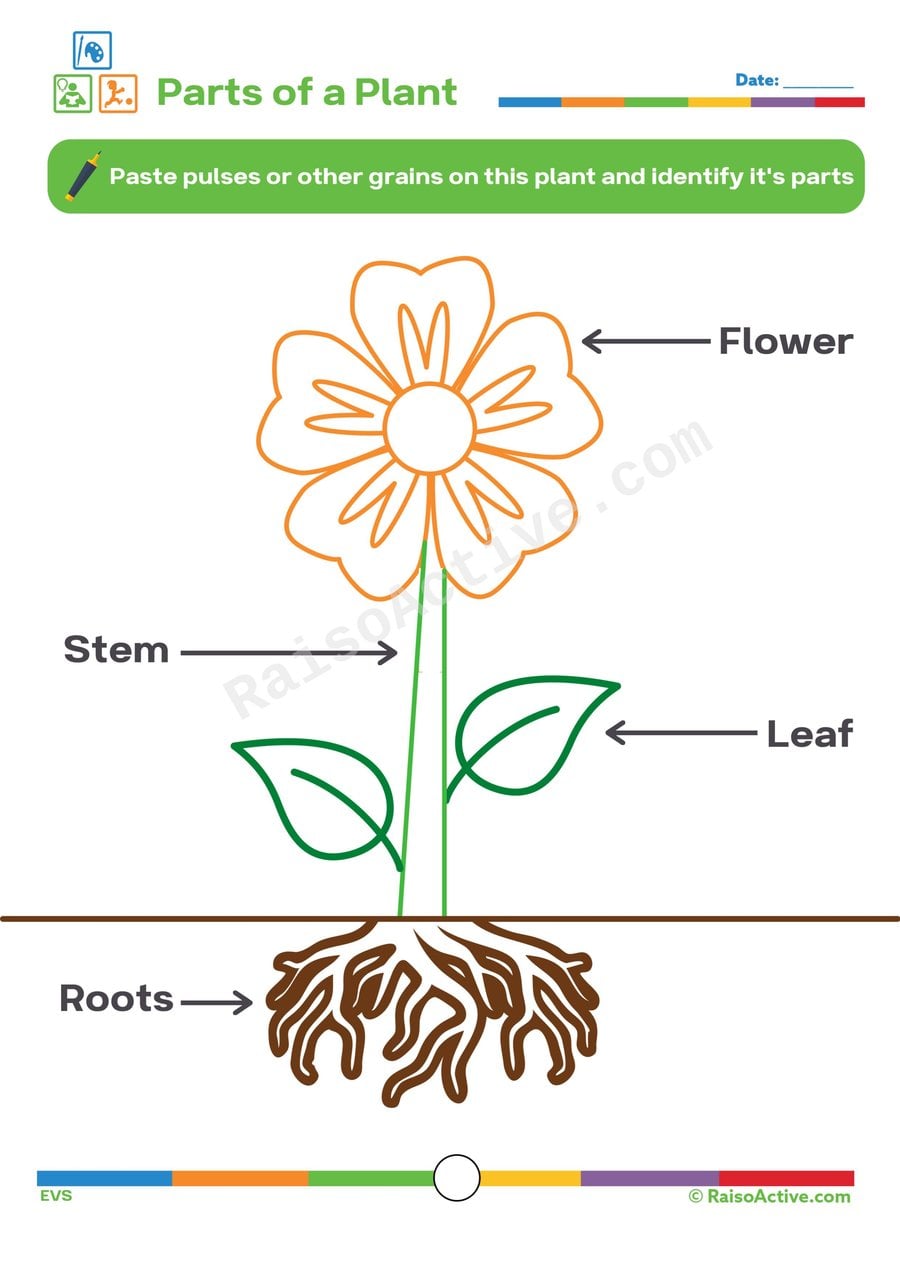
Parts of a Plant Worksheet: Identify and Label!
This activity teaches children ages 3-5 the basic parts of a plant — flower, stem, leaf, and roots — by having them label a diagram and add texture using real pulses or grains glued onto the plant shape. Combining a tactile material with each labeled part helps young children retain the vocabulary better than labeling alone, since touch and sight reinforce the same information.
Guides for this topic
How to Teach CVC Blending: A Step-by-Step Method That Works in Two Weeks
A step-by-step method for teaching CVC blending, covering continuous sounds, word families, common errors, and a 14-day plan that most children finish reading CVC words.
Phase 2 Phonics at Home: Sound Order, Blending Games, Worksheets
Phase 2 phonics at home: the five sound sets in order, oral blending, tricky words, a two-week routine, common mistakes, and free worksheets.
Reception Year Explained: EYFS Learning and How to Help at Home
A teacher's plain-English guide to the Reception Year: the seven areas of learning, Early Learning Goals, Phase 2/3 phonics, the RBA and home routines.
Reviews
Every worksheet for ages 4–6, no watermark
Members download the full library of 1,000+ worksheets and every activity pack without watermarks or daily limits. One year costs ₹1,000 in India or $20 elsewhere.
See membership plansOr download any worksheet free with a watermark (5 a day).