
Summer Shadows Matching Worksheet for Preschoolers
This worksheet has children ages 3-5 match pictures of summer activities, like swimming or building a sandcastle, to their correct shadow silhouettes, building visual discrimination through shape recognition rather than color or detail. Because these shadows represent action scenes rather than single objects, children must recognize more complex outlines, including body positions and poses, which is a step up from matching simpler object shadows. This adds a layer of visual reasoning about how shapes and motion relate.
Curriculum
How to use this worksheet
Look at the summer activity pictures on the left side of the page with your child and talk about what each one shows, such as a child swimming or flying a kite. Then look at the shadows on the right side and help your child compare the outline and pose of each shadow to the activity pictures. Once a match is found, have them draw a line connecting the picture to its shadow, repeating for each pair on the page.
Materials needed
- Pencil
- Crayons
Extension activities
- •Have the child color the pictures after matching to reinforce what each summer activity looks like.
- •Ask the child to describe what each activity is and act it out physically, like pretending to swim or fly a kite.
- •Make hand or body shadows on a sunny wall and guess what shape or pose each one is making.
- •Talk about which summer activity from the worksheet is your child's favorite and why.
Tips for parents and teachers
Matching action shadows is harder than matching still-object shadows, since children must recognize a pose or motion rather than just a static outline, so expect this to take a bit more focused looking. Encourage your child to try acting out an activity's pose themselves if they're stuck, since physically mimicking the shape can help them see the match. Provide assistance if needed, but let your child attempt each match independently first before stepping in.

Written by
Hemsweta Jain · Teacher Cheena
MBA and Early Childhood Educator, teaching since 2014 · Founder of RaisoActive, Mumbai
Every RaisoActive worksheet is designed and checked by the founder before publishing.
Published · Last reviewed
Related worksheets
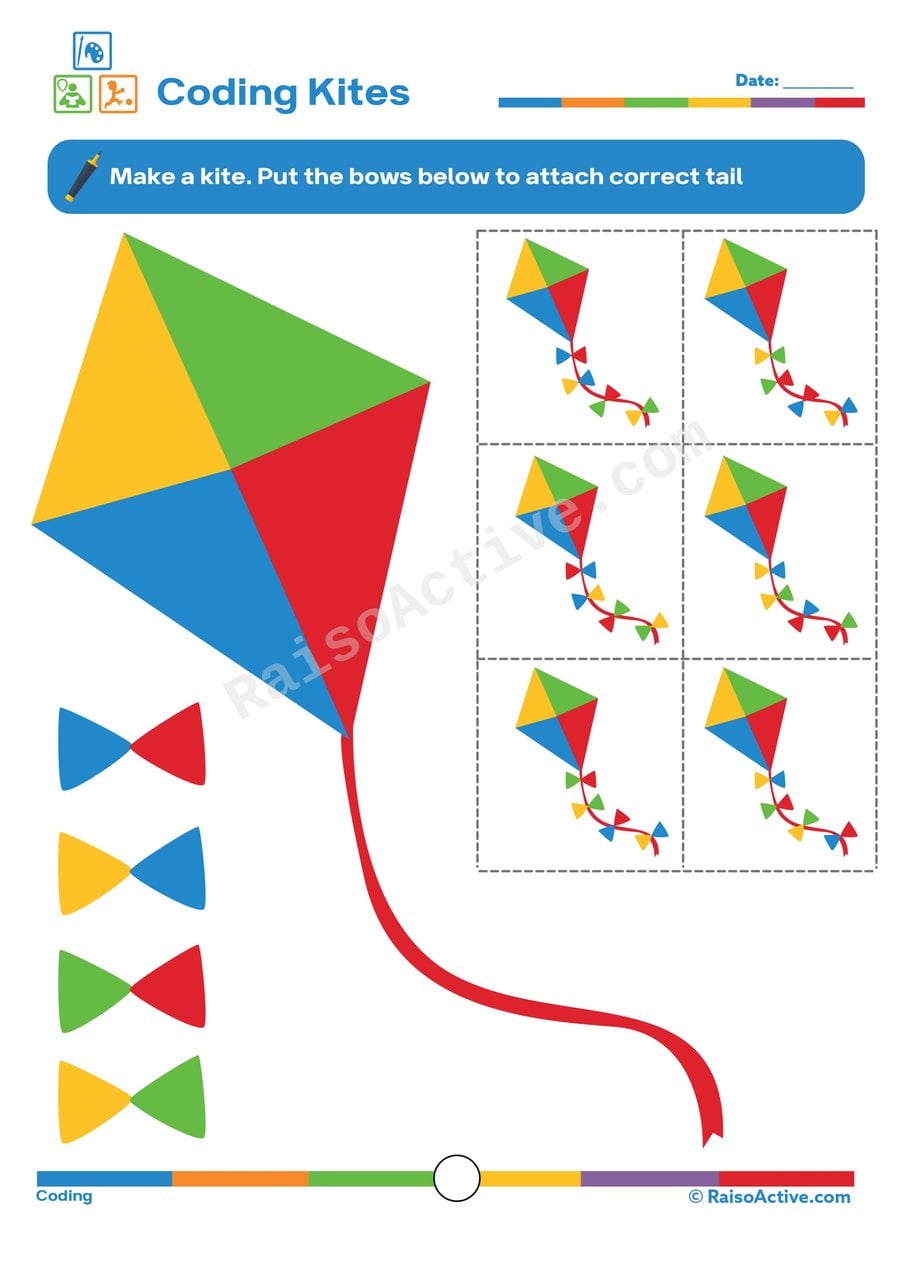
Coding Kites Worksheet: Match the Bows!
This activity sharpens visual observation in children ages 3-5 as they compare color sequences on each kite to a set of loose bows and find the exact match. Careful, systematic comparison — checking each color in order rather than glancing quickly — builds an attention-to-detail habit that transfers directly to early reading and number work.

Lock and Key Matching Worksheet for Preschoolers
Matching each key to the lock sharing the same letter helps children ages 3-5 practice letter recognition in a playful, puzzle-like context rather than rote drilling. Because each key must be checked against several similar-looking locks before finding the right match, this worksheet also builds visual scanning and careful comparison skills that support problem-solving.

States of Matter Worksheet: Exploring Solids, Liquids, and Gases!
This worksheet introduces children ages 4-6 to the three states of matter — solid, liquid, and gas — by having them examine images and sort each one into its correct category. Learning to classify familiar objects (like ice, water, and steam) by their physical state builds early scientific reasoning, since children must look past an object's identity and focus on its underlying properties.

Parts of a Leaf Worksheet for Preschoolers: Learn and Play!
This hands-on activity teaches children ages 3-5 the parts of a leaf — tip, blade, veins, midrib, petiole, and stem — by having them shape a leaf from playdough while comparing it to a real leaf. Building a physical model alongside a real specimen helps children connect abstract vocabulary to tangible features they can see and touch, which is especially effective for this age group.
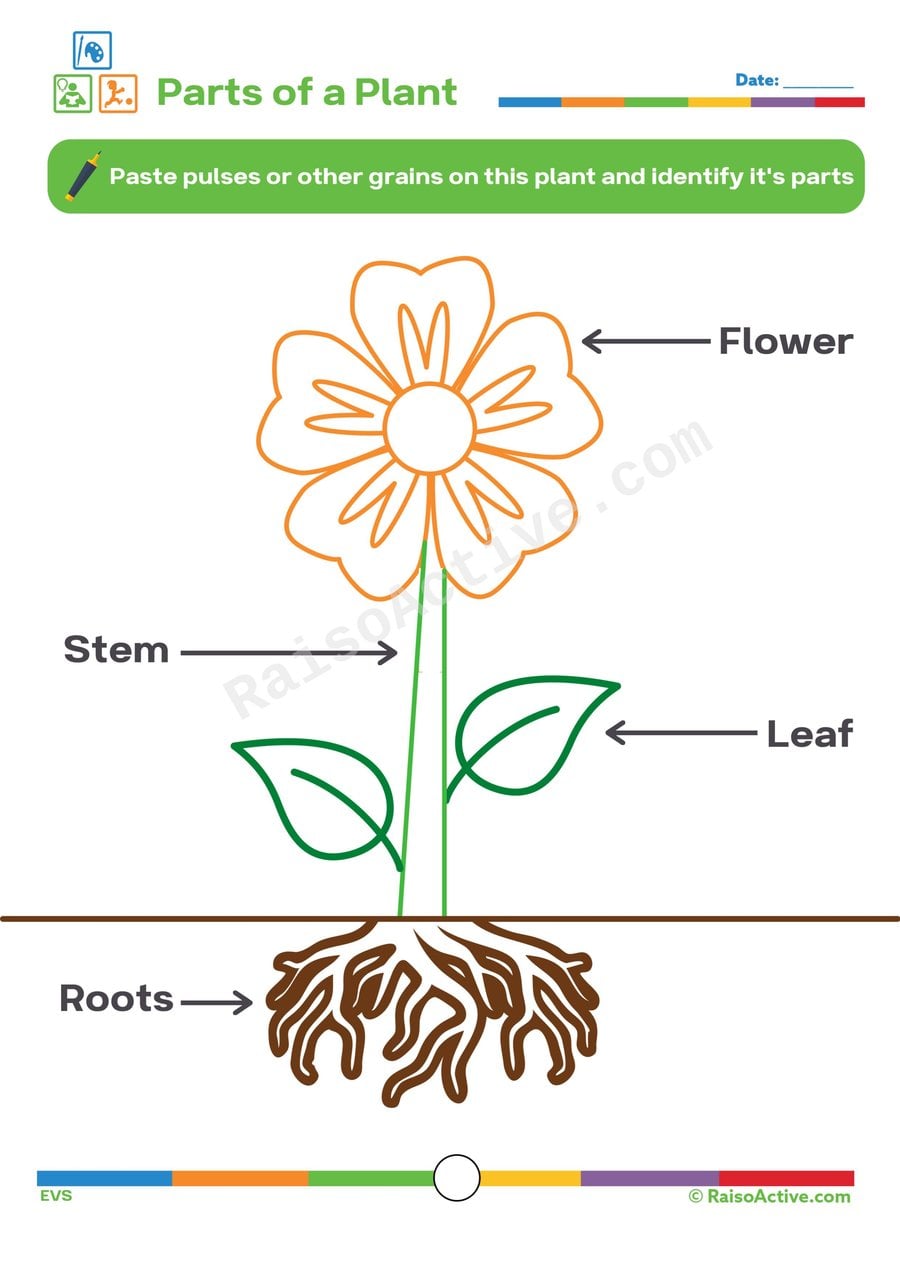
Parts of a Plant Worksheet: Identify and Label!
This activity teaches children ages 3-5 the basic parts of a plant — flower, stem, leaf, and roots — by having them label a diagram and add texture using real pulses or grains glued onto the plant shape. Combining a tactile material with each labeled part helps young children retain the vocabulary better than labeling alone, since touch and sight reinforce the same information.

Indian Cities Crossword Puzzle Worksheet for Kids
This crossword challenges children ages 4-6 to identify famous Indian cities from picture clues of their landmarks and then spell out each city's name in the puzzle grid, combining observation skills with early geography knowledge. Counting the crossword boxes to match each city's letter count also reinforces attention to word length before writing.

Transportation Coloring Worksheet for Preschoolers
This worksheet helps children ages 3-5 practice categorizing vehicles by where they travel — air, water, or land — while strengthening fine motor control through a color-coded coloring task. Following a color key adds a layer of symbolic thinking, since children must hold three rules in mind and apply the correct one to each vehicle. It's a natural bridge between science classification and hands-on art.

Fruit and Vegetable Sorting Worksheet for Preschoolers
This worksheet helps children ages 3-5 practice identifying and categorizing fruits and vegetables by coloring circles next to each pictured food item. Learning to tell fruits and vegetables apart, and eventually name specific ones, builds early categorization skills alongside healthy eating awareness, since recognizing food groups is a foundation for later nutrition education.
Guides for this topic
Best Worksheets for 3-Year-Olds: What Works and What to Avoid
What works on worksheets for 3-year-olds: short sessions, crayons, tracing lines, matching, cutting, a free weekly plan, and signs one is too advanced.
Discovering Wonder: Nature-Based Learning Activities That Captivate Young Children
Explore nature-based learning activities for children ages 2–7 — leaf rubbings, bug hunts, nature journals, and seasonal Indian outdoor ideas that spark wonder.
Spring and Summer Learning Activities: Harnessing Nature's Classroom for Year-Round Growth
Discover heat-safe outdoor activities, monsoon science experiments, and summer holiday learning plans for young children in India. Prevent summer slide with fun ideas for ages 1-8.
Reviews
Every worksheet for ages 3–5, no watermark
Members download the full library of 1,000+ worksheets and every activity pack without watermarks or daily limits. One year costs ₹1,000 in India or $20 elsewhere.
See membership plansOr download any worksheet free with a watermark (5 a day).