Match the Countries with Their Symbols Worksheet
Children ages 4-6 build early social studies awareness by matching country flags to their well-known national symbols, connecting visual recognition with basic geography and cultural knowledge. This kind of matching exercise strengthens careful observation, since children must compare colors, shapes, and details across both the flag and the symbol image. It also plants the seed for understanding that different countries have distinct identities and traditions.
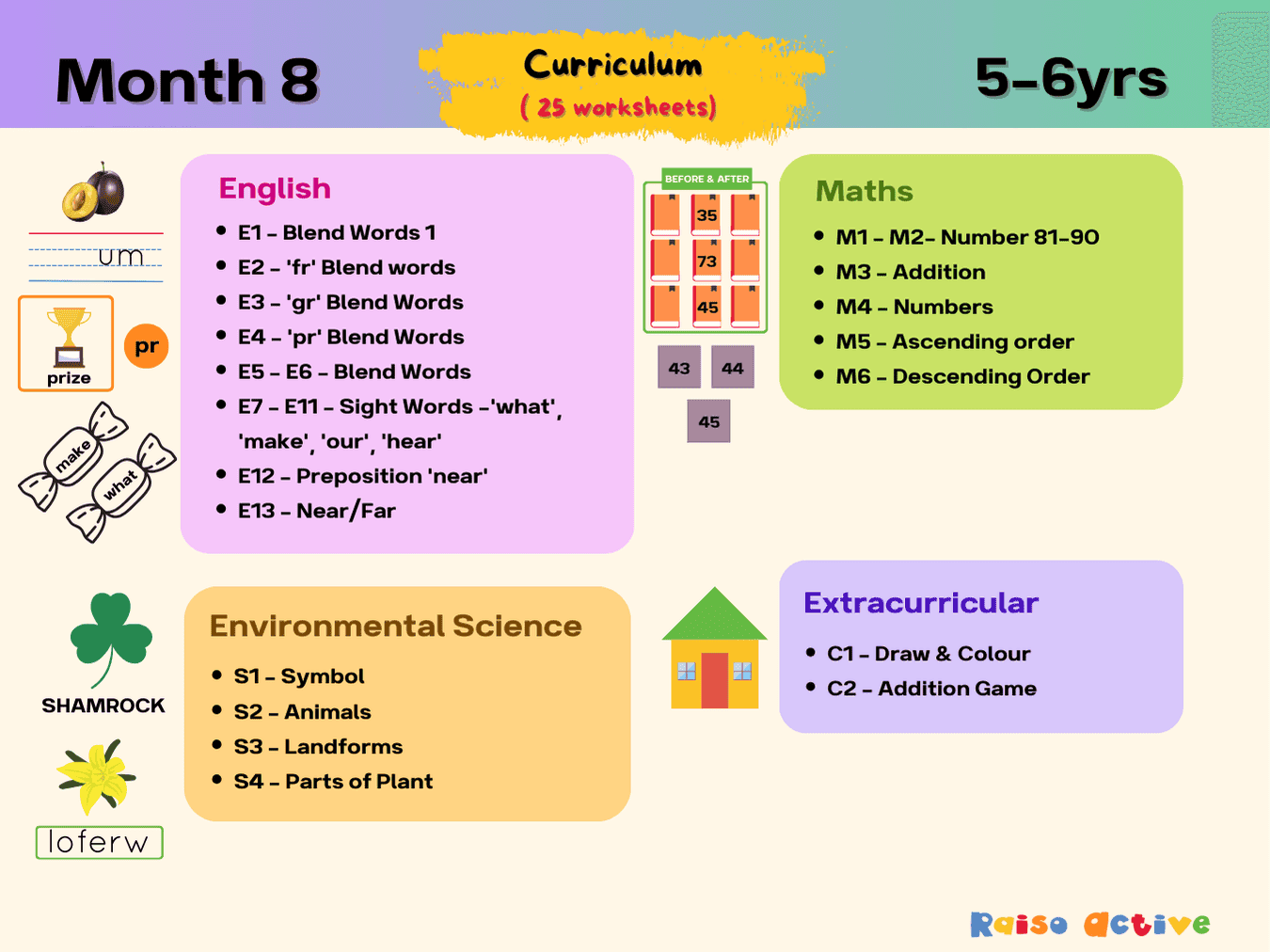
Part of the pack
Month 8: Literacy, Math, Science Foundations | Ages 5-6
This is page 23 of the pack. Ages 5-6 · KindergartenAges 5-6 · Year 1Ages 5-6 · UKGAges 5-6

Made for your child
Counting to 10, made for your child
A maths pack with your child's name in it: pictures that explain, practice at three levels, puzzles and story sums about them. Print a new set whenever they finish.
Make a maths packFree preview · free for members
Curriculum
- Cognitive - Attention > Observation Skills
How to use this worksheet
Look at each flag together first and talk about anything your child notices about its colors or design. Introduce the matching national symbols one at a time, discussing what each one represents if known. Have your child draw a line connecting each flag to its correct symbol, checking their reasoning by asking why they think the two belong together. Once all pairs are matched, review the connections together and name each country if possible.
Materials needed
- Pencil
- Crayons
Extension activities
- 1Look up a quick fact about one of the countries' symbols and share it with your child.
- 2Color the flags and symbols using accurate colors if known, or creative colors for fun.
- 3Find the featured countries on a world map or globe together.
- 4Draw an original symbol that could represent your own family or neighborhood.
- 5Create simple flashcards pairing flags with symbols for a quick matching quiz later.

Written by
Hemsweta Jain · Teacher Cheena
MBA and Early Childhood Educator, teaching since 2014 · Founder of RaisoActive, Mumbai
Every RaisoActive worksheet is designed and checked by the founder before publishing.
Published · Last reviewed
More from Month 8: Literacy, Math, Science Foundations | Ages 5-6

Blend Words Worksheet: See the Pictures and Write the Correct Blend!
Ages 4-6 · Pre-K–KindergartenAges 4-6 · Reception–Year 1Ages 4-6 · LKG–UKGAges 4-6
Children ages 4-6 practice identifying missing consonant blends by looking at a picture, saying the word aloud, and writing the correct blend to complete it. This task requires children to isolate the blended sound at the beginning of a word and match it to its written letter combination, a more advanced phonics skill than single-letter sounds. Successfully completing each word strengthens both spelling accuracy and reading fluency with blended sounds.

Help the Mouse Escape! Numbers 81-90 Maze Worksheet
Ages 4-6 · Pre-K–KindergartenAges 4-6 · Reception–Year 1Ages 4-6 · LKG–UKGAges 4-6
This maze worksheet asks children ages 4-6 to connect numbers in order from 81 to 90, giving practice with number sequencing in the higher tens range while adding a playful story element — helping a mouse escape from cats. Because the numbers must be found and connected in the correct order among a maze of paths, the activity combines number recognition with visual scanning and route planning. Working confidently within the 80s range also builds toward full fluency counting to 100, a key numeracy milestone at this age.
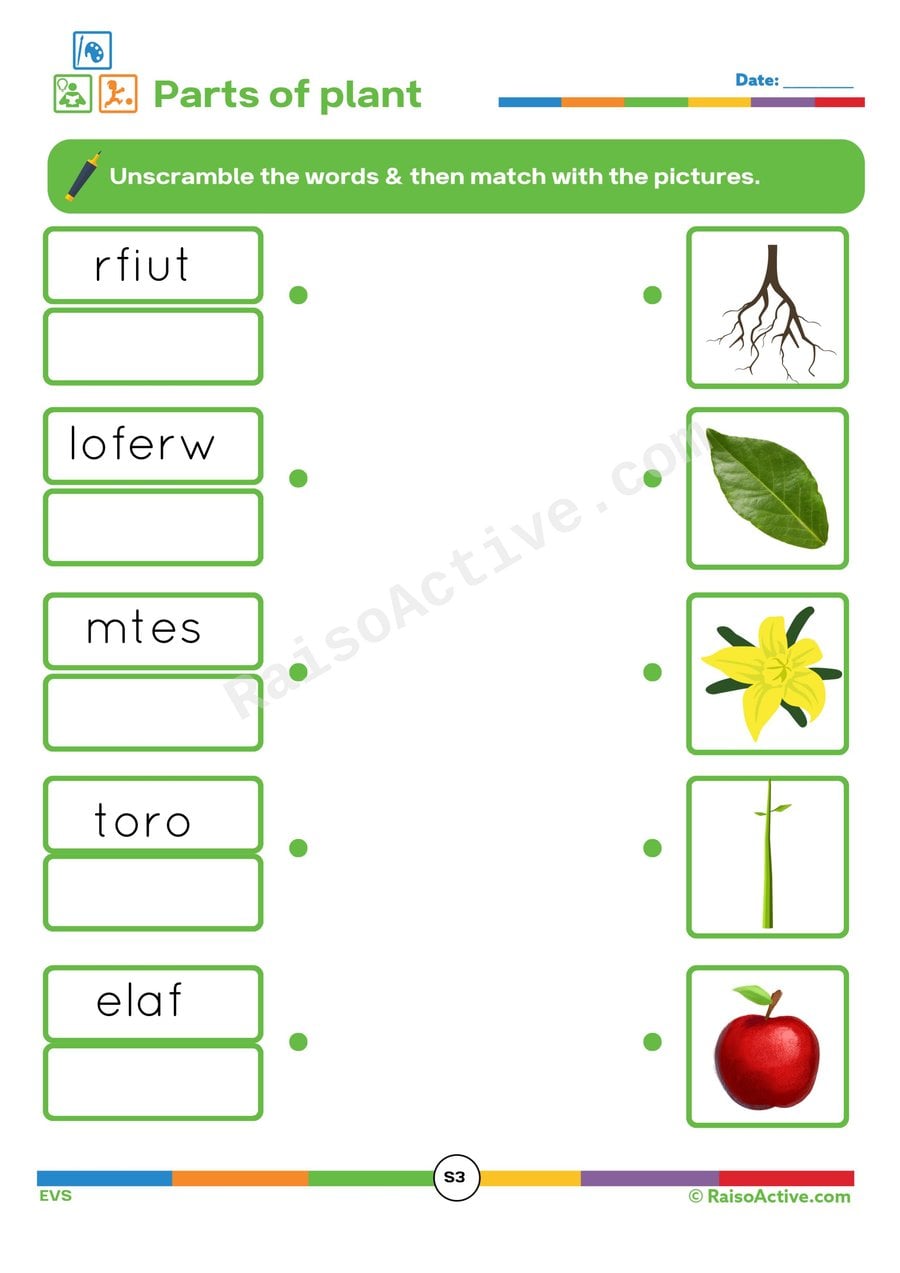
Parts of a Plant Worksheet: Unscramble and Match!
Ages 4-6 · Pre-K–KindergartenAges 4-6 · Reception–Year 1Ages 4-6 · LKG–UKGAges 4-6
Children ages 4-6 learn the names of plant parts — like roots, stem, leaves, and flower — by unscrambling jumbled letters to spell each word and then matching it to the correct picture. Unscrambling requires recognizing familiar letter patterns and sounding out possibilities, a strong spelling and phonics challenge. Matching the unscrambled word to its picture reinforces plant science vocabulary in a hands-on, puzzle-like way.
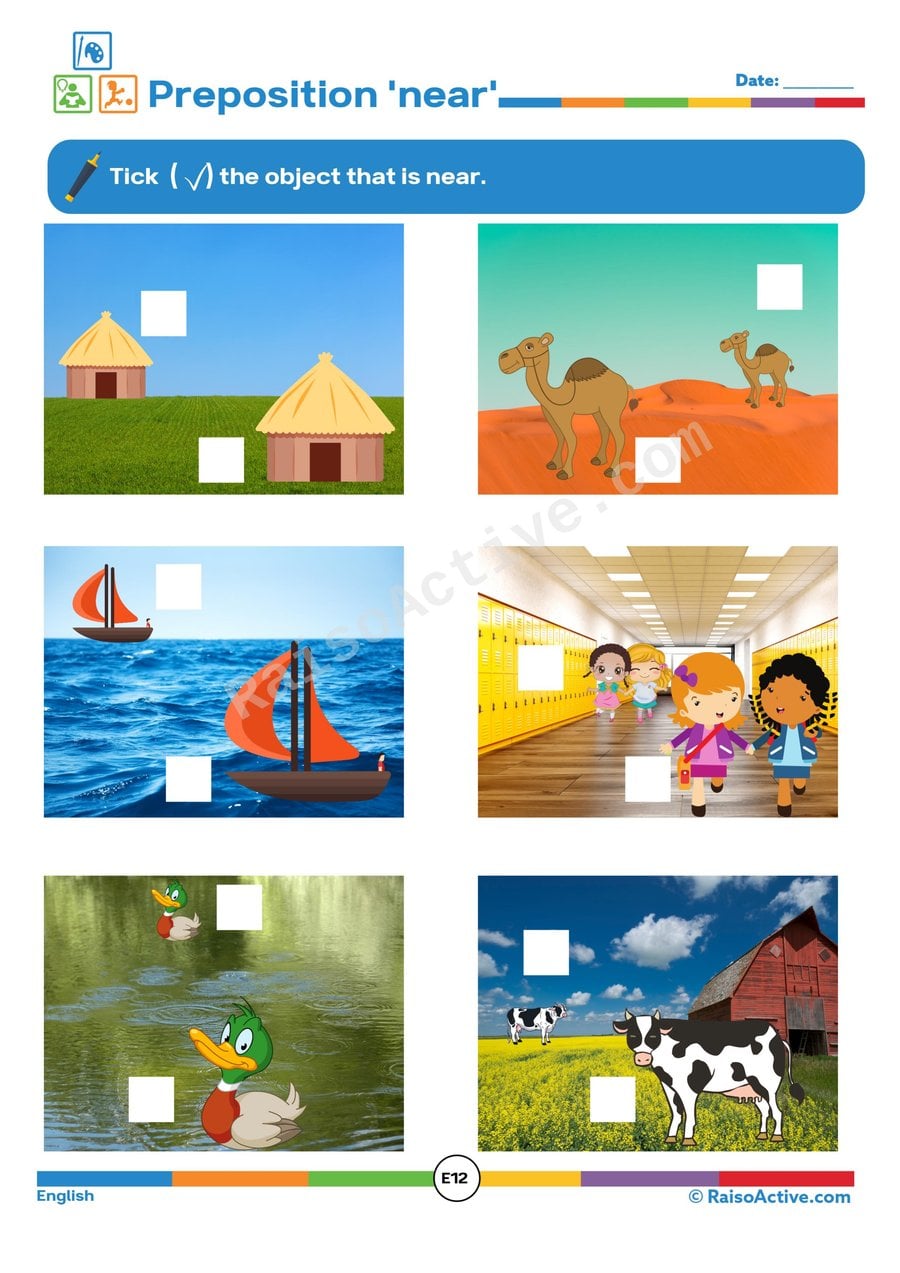
Near or Far? Preposition Worksheet for Kids
Ages 3-5 · Preschool–Pre-KAges 3-5 · Nursery–ReceptionAges 3-5 · Nursery–LKGAges 3-5
Preschoolers ages 3-5 build early spatial vocabulary by identifying which pictured object is positioned 'near' another, a comparative concept that requires judging relative distance between two things. Understanding 'near' versus 'far' lays groundwork for later spatial reasoning skills, like following directions and reading simple maps. Ticking the correct object also sharpens visual comparison and careful observation.

Blend Words Worksheet: Fill in the Blanks with Beginning Blends!
Ages 4-6 · Pre-K–KindergartenAges 4-6 · Reception–Year 1Ages 4-6 · LKG–UKGAges 4-6
Children ages 4-6 practice identifying and writing beginning consonant blends, like 'bl', 'cr', or 'st', by looking at pictures and completing the missing letters to form the full word. This task requires connecting a spoken sound to its written letter combination, deepening phonics skills beyond single-letter sounds into multi-letter blends. Successfully building these words strengthens both spelling and reading fluency.

Ascending Order Trucks Worksheet for Preschoolers
Ages 4-6 · Pre-K–KindergartenAges 4-6 · Reception–Year 1Ages 4-6 · LKG–UKGAges 4-6
Children ages 4-6 practice arranging numbers in ascending order, from smallest to largest, using a playful truck-themed sequencing task. Understanding ascending order requires comparing multiple numbers at once and deciding their correct relative position, a more advanced skill than simple counting forward. This kind of number ordering builds critical number sense that supports later skills like comparing quantities and reading number lines.
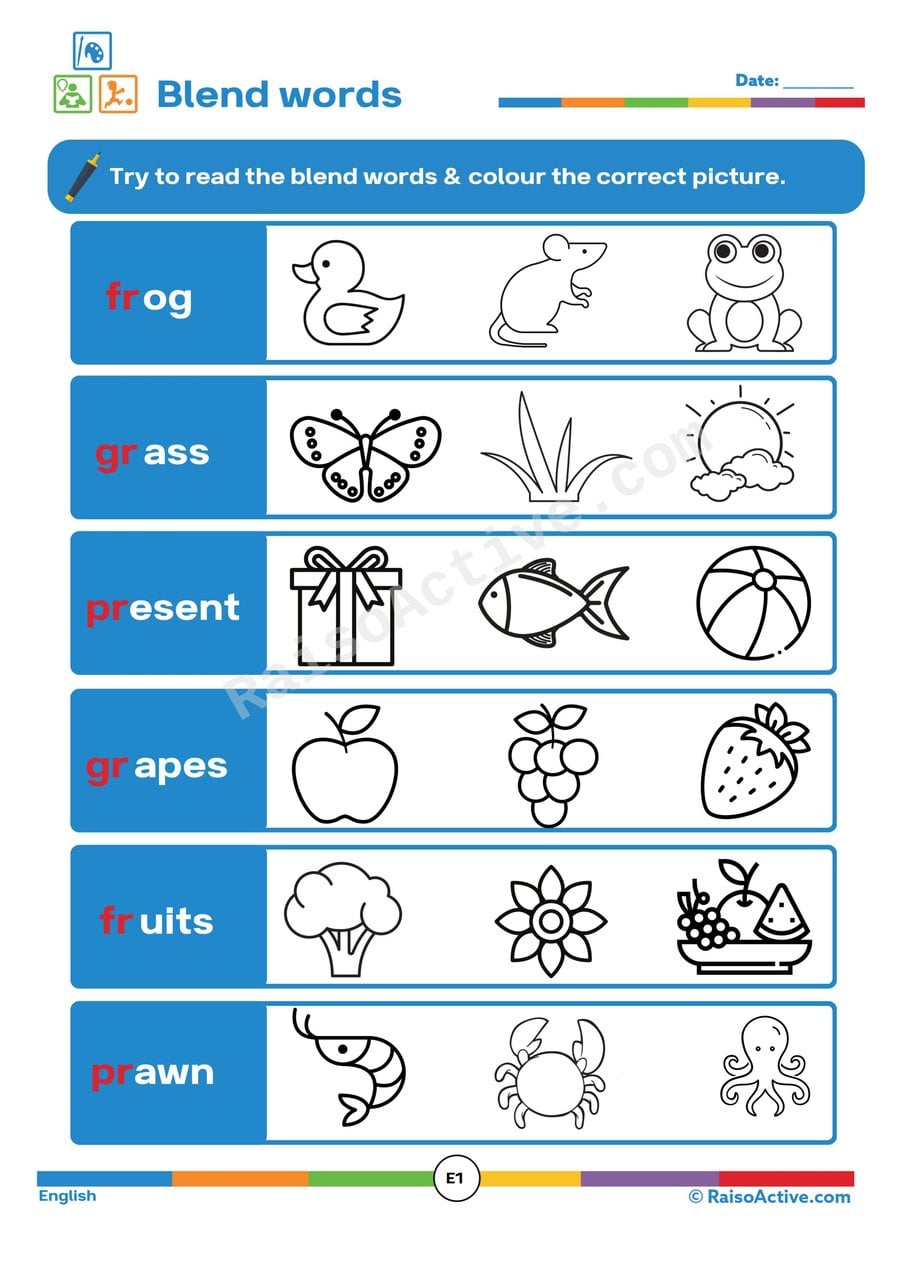
Blend Words Coloring Worksheet for Preschoolers
Ages 4-6 · Pre-K–KindergartenAges 4-6 · Reception–Year 1Ages 4-6 · LKG–UKGAges 4-6
Consonant blends, like 'bl,' 'st,' or 'fr,' require children ages 4-6 to read two consonant sounds together without a vowel between them, which is genuinely more demanding than single-consonant CVC words and represents an important next step in phonics progression. This worksheet asks children to read a blend word and then color the picture that matches it, giving an immediate visual check on whether they decoded the blend correctly. Because coloring is the reward for accurate reading, the activity keeps repeated blend practice feeling engaging rather than repetitive.
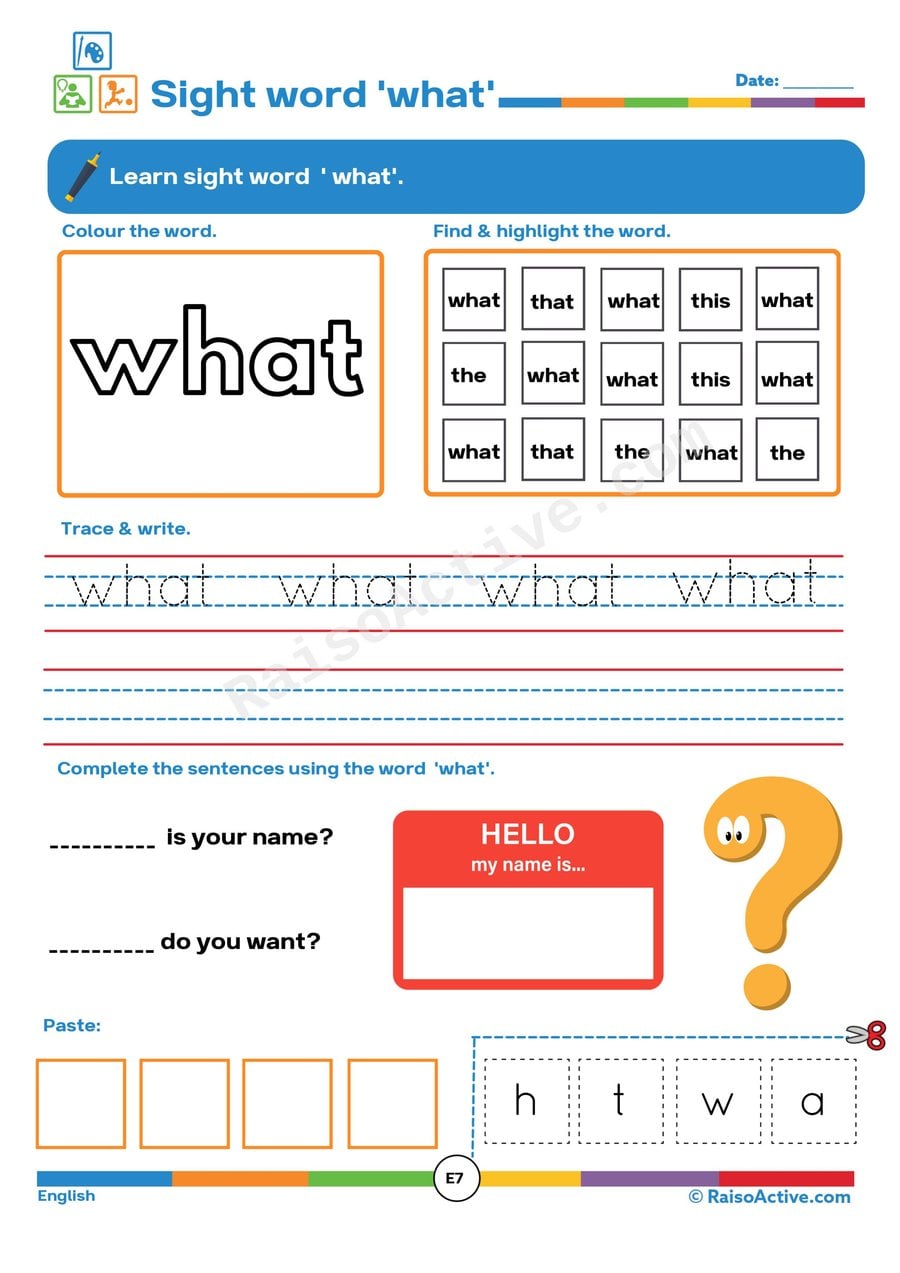
Sight Word 'What' Worksheet: Learn, Trace, and Find!
Ages 4-5 · Pre-KAges 4-5 · ReceptionAges 4-5 · LKGAges 4-5
The word 'what' is a common question word that children ages 4-5 encounter constantly in both spoken conversation and early reading, making it an important addition to their sight word vocabulary. This worksheet builds recognition through several formats — coloring, tracing, word searching, sentence completion, and cut-and-paste spelling — giving the word repeated, varied exposure in a single sitting. Because 'what' is a question word, practicing it in sentences also gives children an early sense of how question structures differ from statement structures.
Related worksheets

Summer T-Shirt Match: A Fun Matching Worksheet for Kids!
Ages 3-5 · Preschool–Pre-KAges 3-5 · Nursery–ReceptionAges 3-5 · Nursery–LKGAges 3-5
This worksheet has children ages 3-5 match fruit designs to summer t-shirts featuring the same pattern, building visual discrimination as they compare details like shape and arrangement across two separate pictures. Because the match depends on recognizing a specific fruit design repeated in a different context, children practice the transferable skill of identifying that two pictures represent the same thing even when shown in a different format. Naming the fruits along the way also builds vocabulary.

Summer Shadows Matching Worksheet for Preschoolers
Ages 3-5 · Preschool–Pre-KAges 3-5 · Nursery–ReceptionAges 3-5 · Nursery–LKGAges 3-5
This worksheet has children ages 3-5 match pictures of summer activities, like swimming or building a sandcastle, to their correct shadow silhouettes, building visual discrimination through shape recognition rather than color or detail. Because these shadows represent action scenes rather than single objects, children must recognize more complex outlines, including body positions and poses, which is a step up from matching simpler object shadows. This adds a layer of visual reasoning about how shapes and motion relate.

Help the Boy Get Home! A Fun Maze Worksheet for Kids
Ages 3-5 · Preschool–Pre-KAges 3-5 · Nursery–ReceptionAges 3-5 · Nursery–LKGAges 3-5
Tracing a path through a maze to help a boy get home builds visual tracking and route-planning skills for children ages 3-5, since they must scan ahead and mentally test paths before committing to one. This kind of trial-and-error problem solving also strengthens the fine motor control needed to keep a pencil line steady along a winding path.

Match the Fruits to Their Plants Worksheet for Preschoolers
Ages 3-5 · Preschool–Pre-KAges 3-5 · Nursery–ReceptionAges 3-5 · Nursery–LKGAges 3-5
This worksheet helps children ages 3-5 build early plant science knowledge by matching common fruits to the plant or tree they actually grow on, such as an apple to a tree or a strawberry to a low bush. This task moves beyond simply naming fruits into understanding where food comes from, an important first step in connecting nature to the food children eat every day.

Transportation Coloring Worksheet for Preschoolers
Ages 3-5 · Preschool–Pre-KAges 3-5 · Nursery–ReceptionAges 3-5 · Nursery–LKGAges 3-5
This worksheet helps children ages 3-5 practice categorizing vehicles by where they travel — air, water, or land — while strengthening fine motor control through a color-coded coloring task. Following a color key adds a layer of symbolic thinking, since children must hold three rules in mind and apply the correct one to each vehicle. It's a natural bridge between science classification and hands-on art.
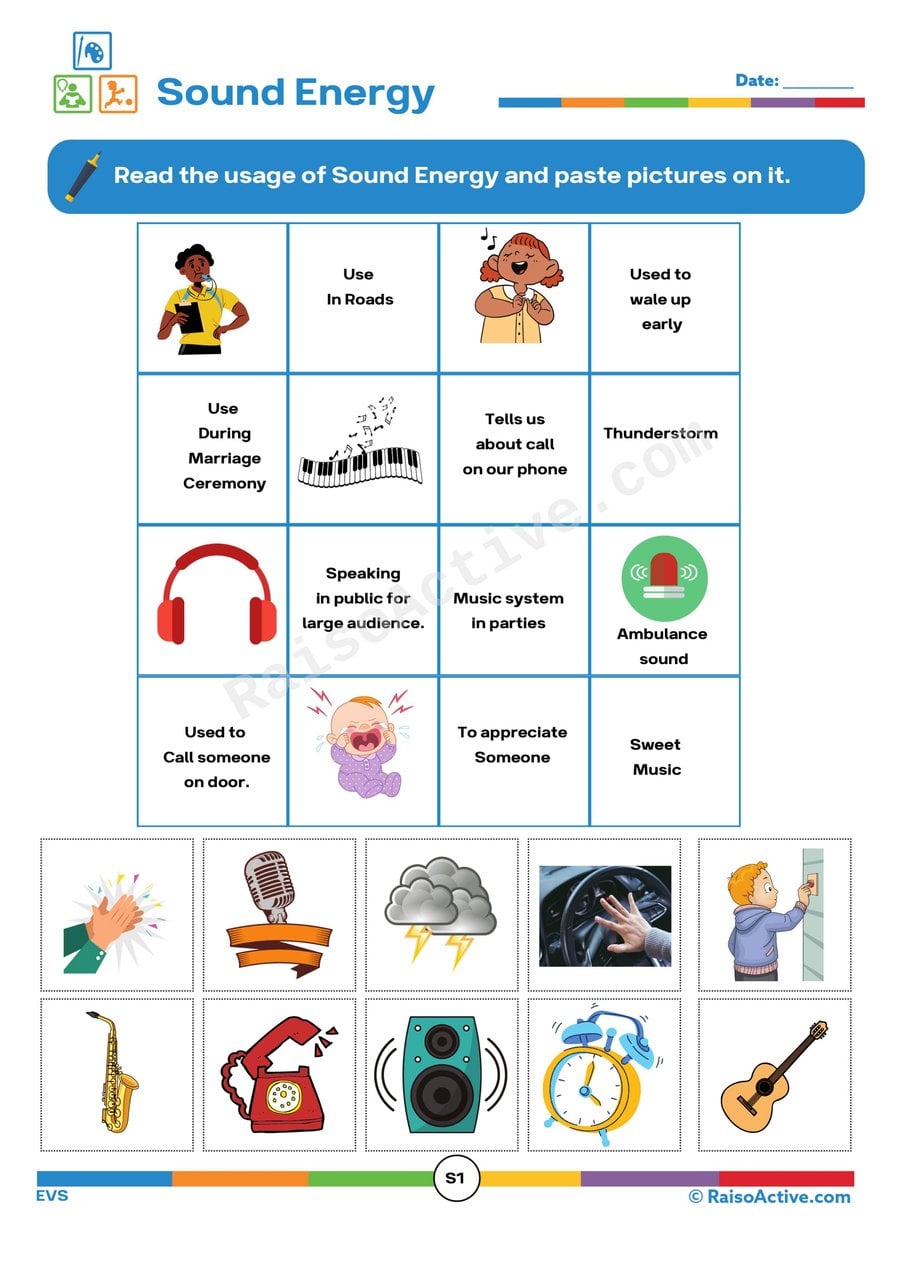
Sound Energy Matching Worksheet for Kids
Ages 4-6 · Pre-K–KindergartenAges 4-6 · Reception–Year 1Ages 4-6 · LKG–UKGAges 4-6
This worksheet introduces children ages 4-6 to the science concept of sound energy by having them match short descriptions of sound sources to the correct picture. Reading or listening to a description and then identifying the matching image builds comprehension alongside early science reasoning, helping children understand that sound is produced by different actions and objects in the world around them.

Light Energy Worksheet: Connect the Sun to Light Sources!
Ages 3-5 · Preschool–Pre-KAges 3-5 · Nursery–ReceptionAges 3-5 · Nursery–LKGAges 3-5
Connecting the sun to other objects that produce light builds early science reasoning for children ages 3-5, introducing the concept that light comes from specific sources rather than simply existing everywhere.

Fruit and Vegetable Sorting Worksheet for Preschoolers
Ages 3-5 · Preschool–Pre-KAges 3-5 · Nursery–ReceptionAges 3-5 · Nursery–LKGAges 3-5
This worksheet helps children ages 3-5 practice identifying and categorizing fruits and vegetables by coloring circles next to each pictured food item. Learning to tell fruits and vegetables apart, and eventually name specific ones, builds early categorization skills alongside healthy eating awareness, since recognizing food groups is a foundation for later nutrition education.
Guides for this topic

Best Worksheets for 3-Year-Olds: What Works and What to Avoid
What works on worksheets for 3-year-olds: short sessions, crayons, tracing lines, matching, cutting, a free weekly plan, and signs one is too advanced.

Age-Appropriate Problem-Solving Activities: Building Critical Thinkers from the Ground Up
Discover fun, age-appropriate problem-solving activities for children ages 1-8. Build critical thinking, logic, and reasoning skills through play-based learning.
Critical Thinking Activities That Actually Work for Young Children: Building Tomorrow's Thinkers Today
Discover proven critical thinking activities for young children. Age-wise logic games, questioning techniques, and hands-on ideas to build thinking skills at home.
Reviews
Every worksheet for ages 4–6, no watermark
Members download the full library of 1,000+ worksheets and every activity pack without watermarks or daily limits. One year costs ₹999 in India or $20 elsewhere.
See membership plansOr download any worksheet free with a watermark (5 a day).