Ascending Order Trucks Worksheet for Preschoolers
Children ages 4-6 practice arranging numbers in ascending order, from smallest to largest, using a playful truck-themed sequencing task. Understanding ascending order requires comparing multiple numbers at once and deciding their correct relative position, a more advanced skill than simple counting forward. This kind of number ordering builds critical number sense that supports later skills like comparing quantities and reading number lines.
Part of the pack
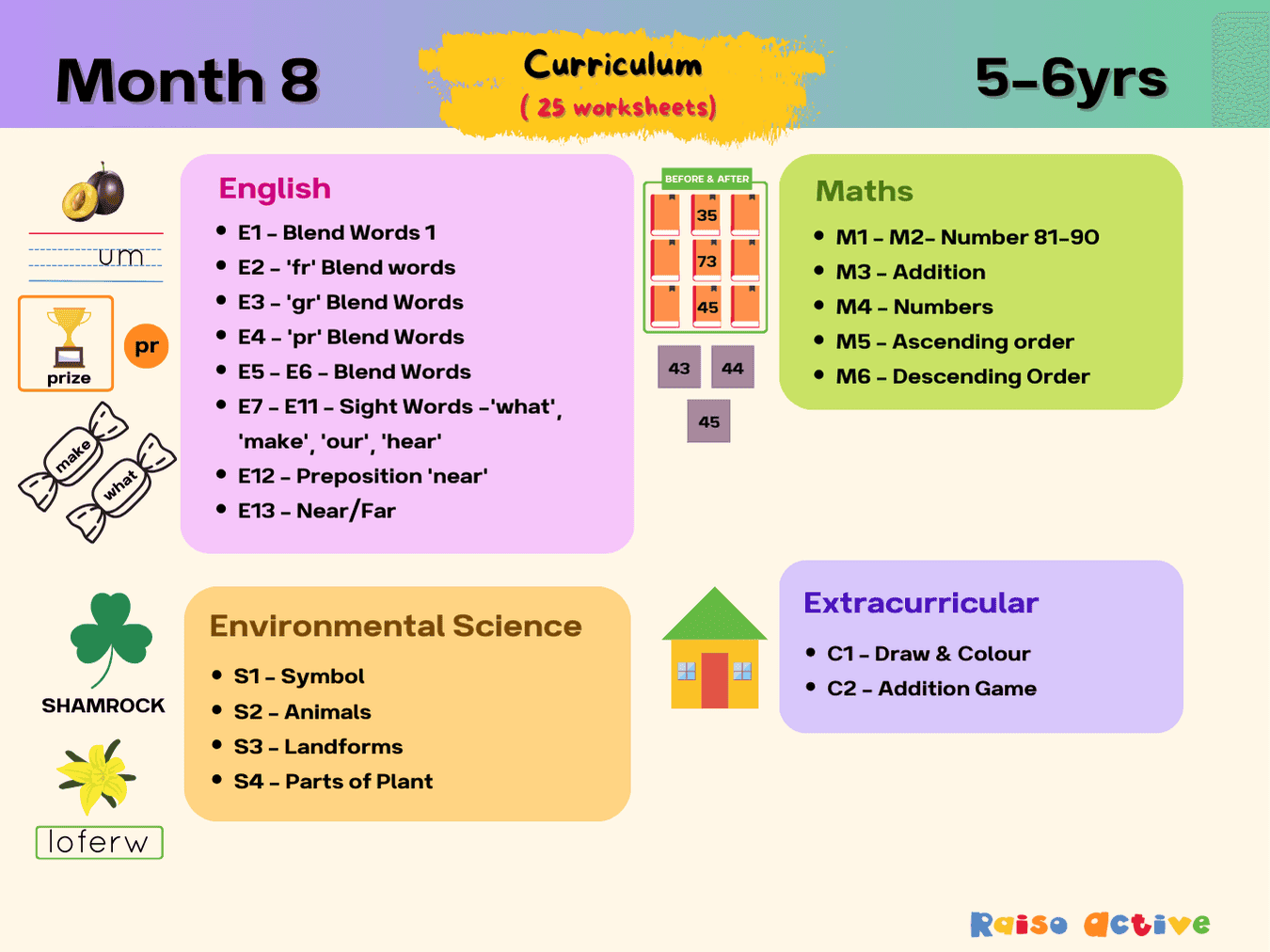
Month 8: Literacy, Math, Science Foundations | Ages 5-6
This is page 21 of the pack. Ages 5-6 · KindergartenAges 5-6 · Year 1Ages 5-6 · UKGAges 5-6
Made for your child
Counting to 10, made for your child
A maths pack with your child's name in it: pictures that explain, practice at three levels, puzzles and story sums about them. Print a new set whenever they finish.
Make a maths packFree preview · free for members
Curriculum
- Number Sense > Number Sequencing
How to use this worksheet
Look at the numbers printed on the trucks together and read each one aloud, discussing which numbers are bigger and which are smaller. Ask your child to identify which number should come first if arranging them from smallest to largest. Have them write the numbers into the empty trucks in the correct ascending order, checking each placement against the others already written. Once finished, read the full sequence aloud together to confirm the order is correct from smallest to largest.
Materials needed
- Pencil
- Eraser
Extension activities
- 1Write a small set of numbers on cards and have your child physically arrange them from smallest to largest.
- 2Use toy trucks or cars labeled with numbers and line them up in ascending order.
- 3Practice the opposite skill by arranging a new set of numbers from largest to smallest.
- 4Compare two numbers at a time using the words 'bigger' and 'smaller' during daily routines.
- 5Create your own ascending order sequence using numbers your child hasn't practiced yet.

Written by
Hemsweta Jain · Teacher Cheena
MBA and Early Childhood Educator, teaching since 2014 · Founder of RaisoActive, Mumbai
Every RaisoActive worksheet is designed and checked by the founder before publishing.
Published · Last reviewed
More from Month 8: Literacy, Math, Science Foundations | Ages 5-6
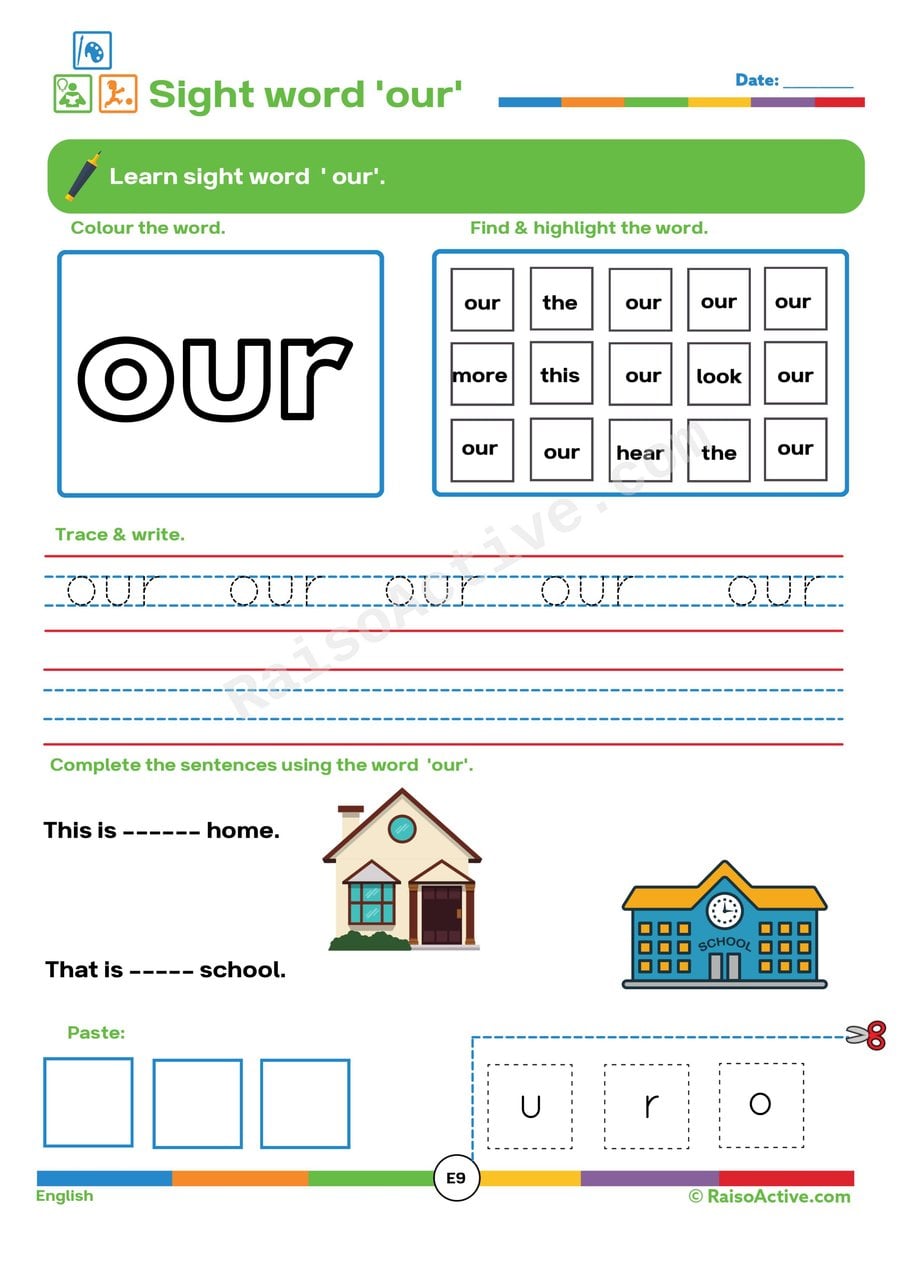
Our Sight Word Fun: Trace, Find, and Paste!
Ages 4-5 · Pre-KAges 4-5 · ReceptionAges 4-5 · LKGAges 4-5
The possessive word 'our' appears often in classroom and family language, and this worksheet gives children ages 4-5 focused, multi-format practice recognizing it — tracing, word searching, sentence completion, and a cut-and-paste spelling activity. Repeated exposure across these different formats is what moves a word from effortful sounding-out into instant sight recognition, which is essential since 'our' doesn't follow predictable phonics rules cleanly. Practicing the word inside full sentences also reinforces its meaning as a word that shows shared ownership, a slightly abstract grammar concept for this age.
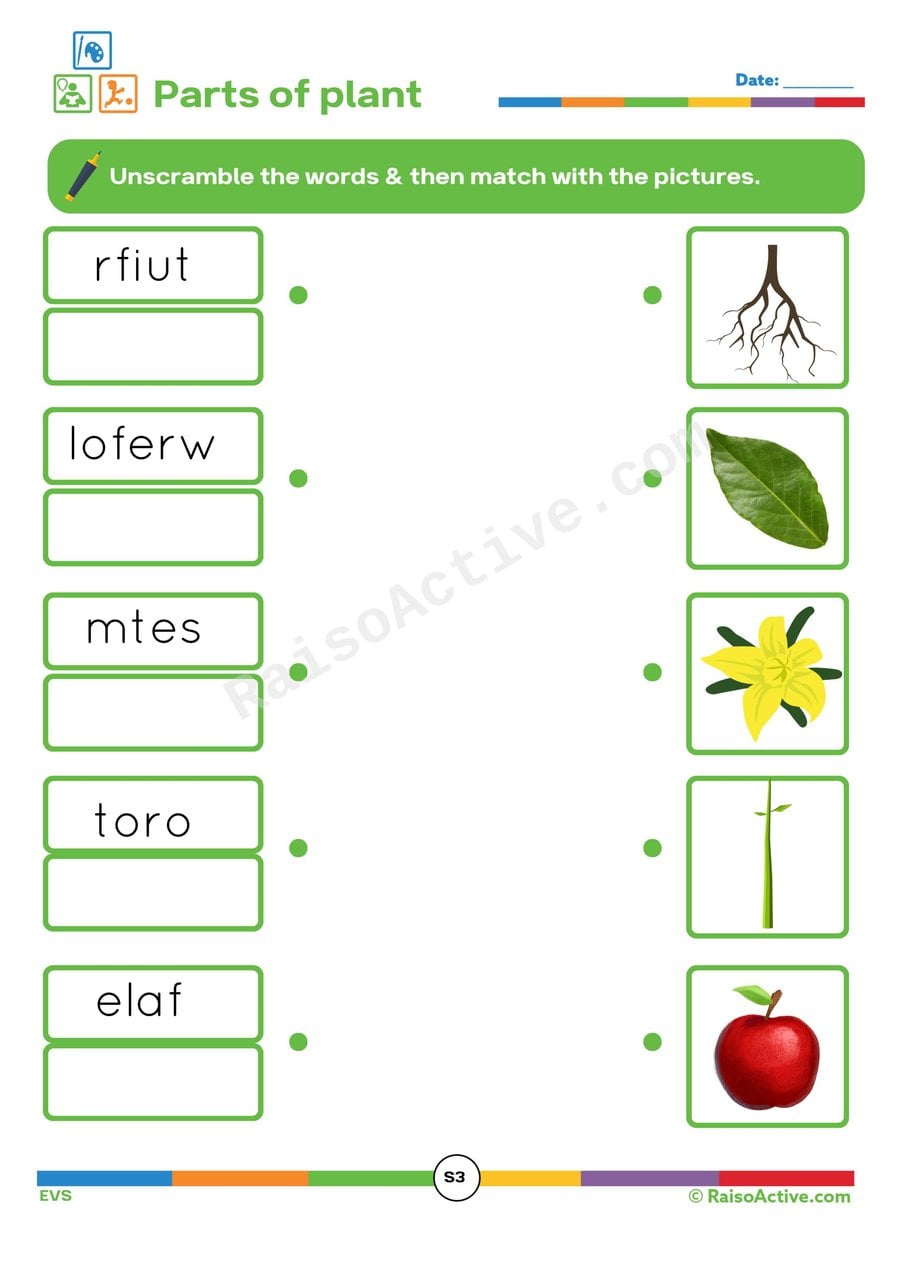
Parts of a Plant Worksheet: Unscramble and Match!
Ages 4-6 · Pre-K–KindergartenAges 4-6 · Reception–Year 1Ages 4-6 · LKG–UKGAges 4-6
Children ages 4-6 learn the names of plant parts — like roots, stem, leaves, and flower — by unscrambling jumbled letters to spell each word and then matching it to the correct picture. Unscrambling requires recognizing familiar letter patterns and sounding out possibilities, a strong spelling and phonics challenge. Matching the unscrambled word to its picture reinforces plant science vocabulary in a hands-on, puzzle-like way.
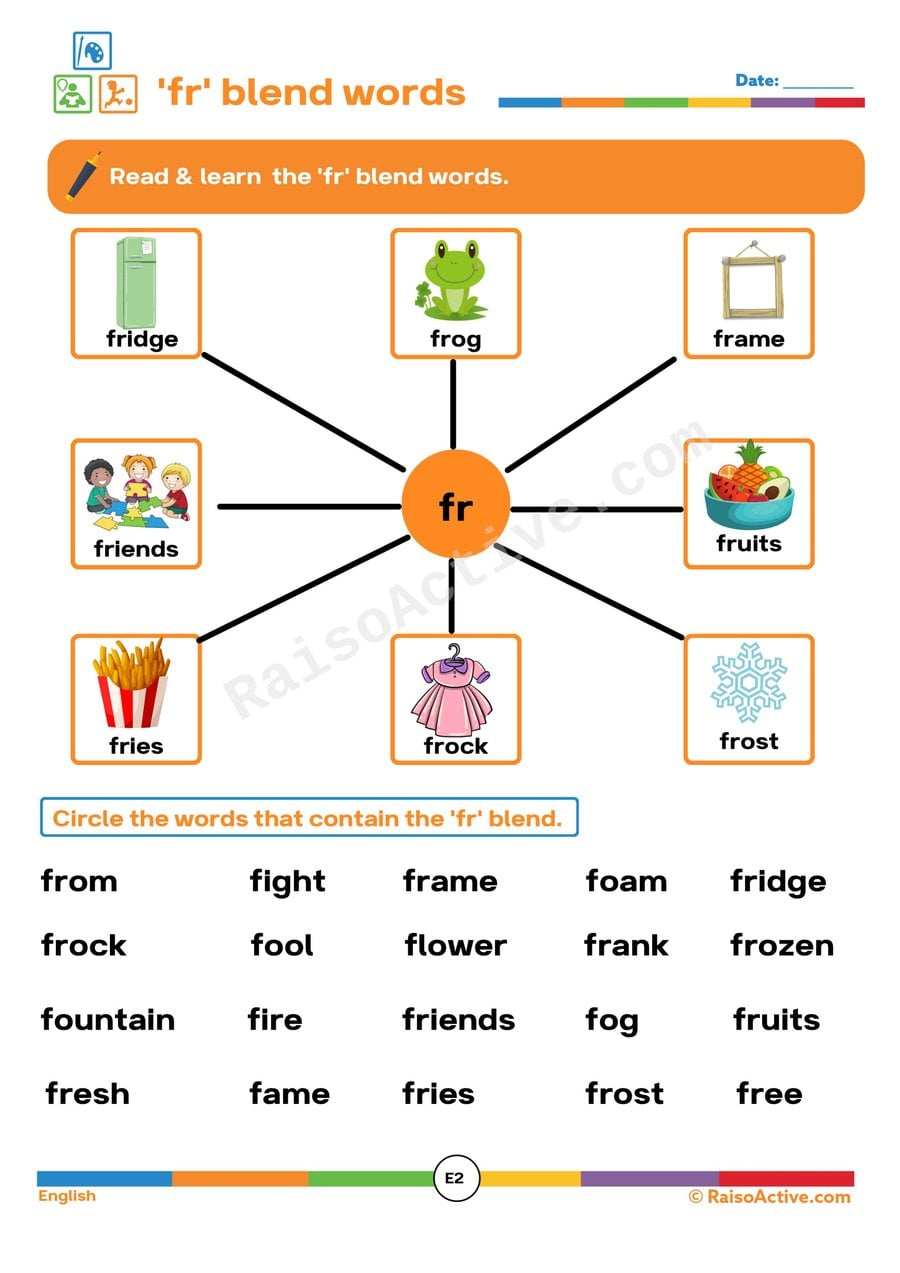
FR Blend Words Worksheet: Circle the Words!
Ages 4-6 · Pre-K–KindergartenAges 4-6 · Reception–Year 1Ages 4-6 · LKG–UKGAges 4-6
Children ages 4-6 practice recognizing the 'fr' consonant blend at the start of words, like 'frog' and 'friend', which requires blending two distinct sounds smoothly together rather than reading them as separate letters. Circling the correct words trains visual scanning alongside auditory sound recognition, both essential for fluent early reading. This kind of blend practice moves children beyond single-letter phonics into more complex word decoding.

Wild or Domestic? Animal Sorting Worksheet for Kids
Ages 3-5 · Preschool–Pre-KAges 3-5 · Nursery–ReceptionAges 3-5 · Nursery–LKGAges 3-5
Preschoolers ages 3-5 practice classifying animals into wild and domestic categories, an early science skill that builds understanding of how living things relate to their environment and to humans. Cutting, sorting, and labeling each animal with 'W' or 'D' reinforces the vocabulary of the two categories while strengthening fine motor skills through scissor and glue work. This classification task is a foundational step toward broader scientific thinking about categories and groups.
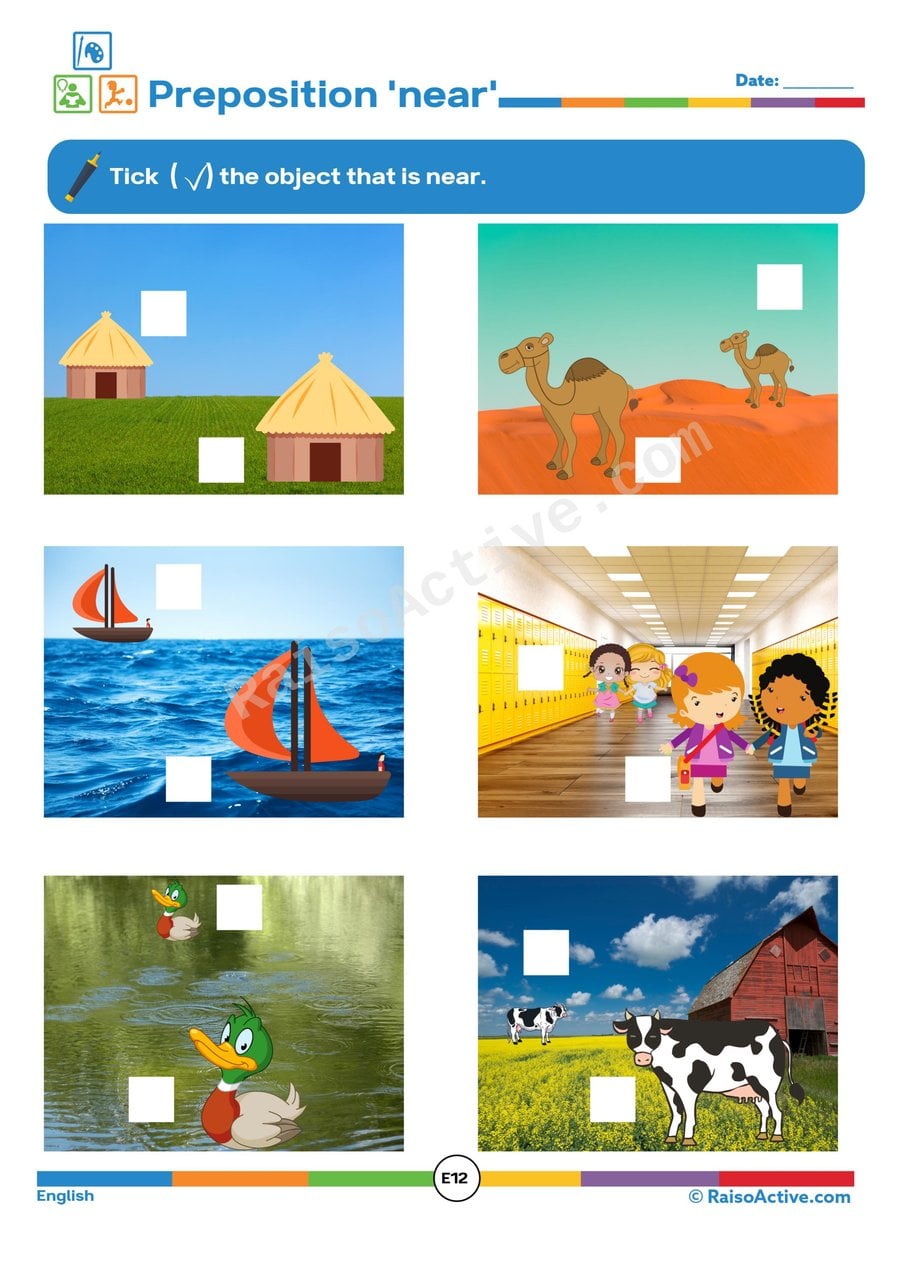
Near or Far? Preposition Worksheet for Kids
Ages 3-5 · Preschool–Pre-KAges 3-5 · Nursery–ReceptionAges 3-5 · Nursery–LKGAges 3-5
Preschoolers ages 3-5 build early spatial vocabulary by identifying which pictured object is positioned 'near' another, a comparative concept that requires judging relative distance between two things. Understanding 'near' versus 'far' lays groundwork for later spatial reasoning skills, like following directions and reading simple maps. Ticking the correct object also sharpens visual comparison and careful observation.
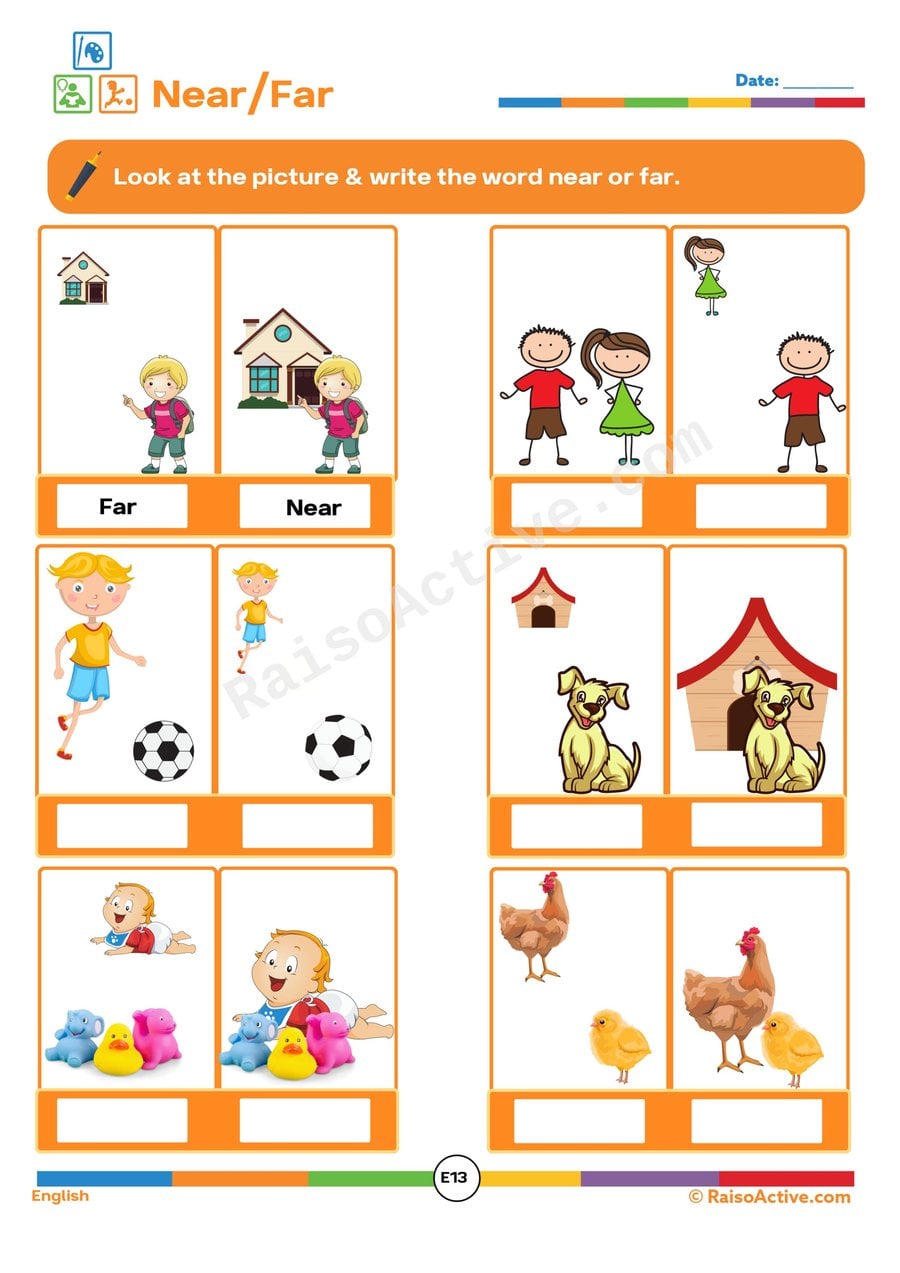
Near and Far Worksheet for Preschoolers
Ages 3-5 · Preschool–Pre-KAges 3-5 · Nursery–ReceptionAges 3-5 · Nursery–LKGAges 3-5
Understanding 'near' and 'far' introduces children ages 3-5 to relative distance, a spatial concept that supports later skills like reading maps, estimating measurement, and following directional instructions. This worksheet asks children to look at pictures and judge whether an object or person is positioned close by or at a distance, sharpening visual observation alongside vocabulary development. Because near and far are relative terms rather than fixed categories, this practice also introduces the idea that some concepts depend on comparison rather than having one single correct answer.

Help the Mouse Escape! Numbers 81-90 Maze Worksheet
Ages 4-6 · Pre-K–KindergartenAges 4-6 · Reception–Year 1Ages 4-6 · LKG–UKGAges 4-6
This maze worksheet asks children ages 4-6 to connect numbers in order from 81 to 90, giving practice with number sequencing in the higher tens range while adding a playful story element — helping a mouse escape from cats. Because the numbers must be found and connected in the correct order among a maze of paths, the activity combines number recognition with visual scanning and route planning. Working confidently within the 80s range also builds toward full fluency counting to 100, a key numeracy milestone at this age.

Learn to Read: Sight Word 'Hear' Worksheet for Preschoolers
Ages 3-5 · Preschool–Pre-KAges 3-5 · Nursery–ReceptionAges 3-5 · Nursery–LKGAges 3-5
'Hear' is a sight word children ages 3-5 encounter often in early books, and its spelling doesn't clearly match its sound, so children need repeated exposure to recognize it instantly rather than sound it out each time. This worksheet reinforces the word through five different activities — coloring, searching, tracing, sentence completion, and cut-and-paste spelling — which research on early literacy shows builds much stronger retention than repeating a single format. Because 'hear' is often confused with the similar-sounding word 'here,' practicing it in full sentences also helps children start to notice the meaning difference between the two.
Related worksheets
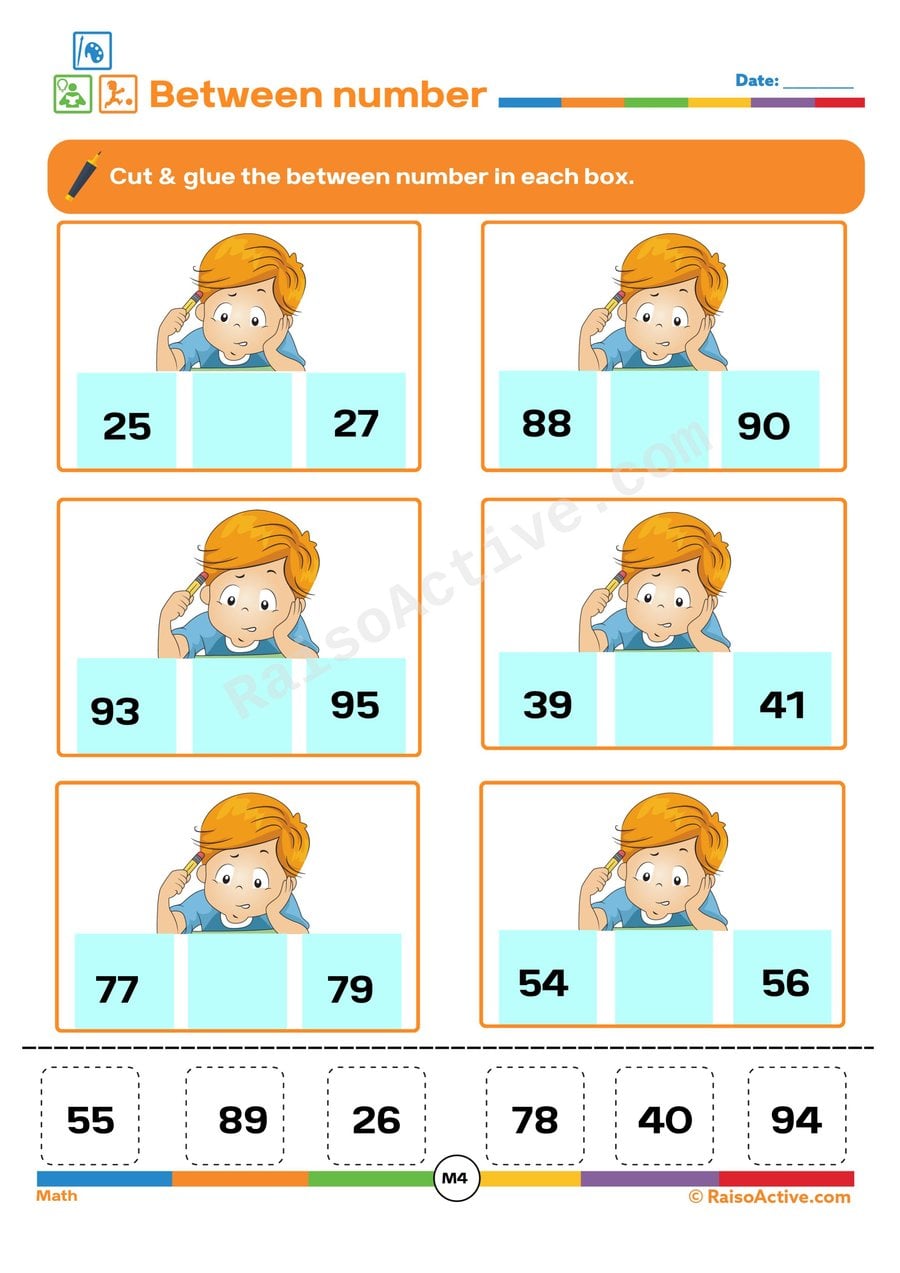
Find the Missing Number Worksheet for Kids
Ages 4-5 · Pre-KAges 4-5 · ReceptionAges 4-5 · LKGAges 4-5
Children ages 4-5 strengthen number recognition and sequencing by figuring out which number is missing from a short sequence, then physically cutting and pasting the correct number into place. The cut-and-paste format adds a search-and-select step on top of the math, since children must locate the right numeral among several choices before placing it, reinforcing both number recognition and careful visual scanning.

Sequencing Numbers Train Worksheet for Preschoolers
Ages 4-5 · Pre-KAges 4-5 · ReceptionAges 4-5 · LKGAges 4-5
This train-themed worksheet asks children ages 4-5 to fill in missing numbers within a given sequence, which builds a much deeper number sense than simply counting from one — they must recognize what number comes before or after a given value anywhere in the run. Practicing sequencing this way strengthens working memory and prepares children for later mental math skills like skip counting and addition. The train-car format also keeps the abstract task of ordering numbers visually organized and engaging.
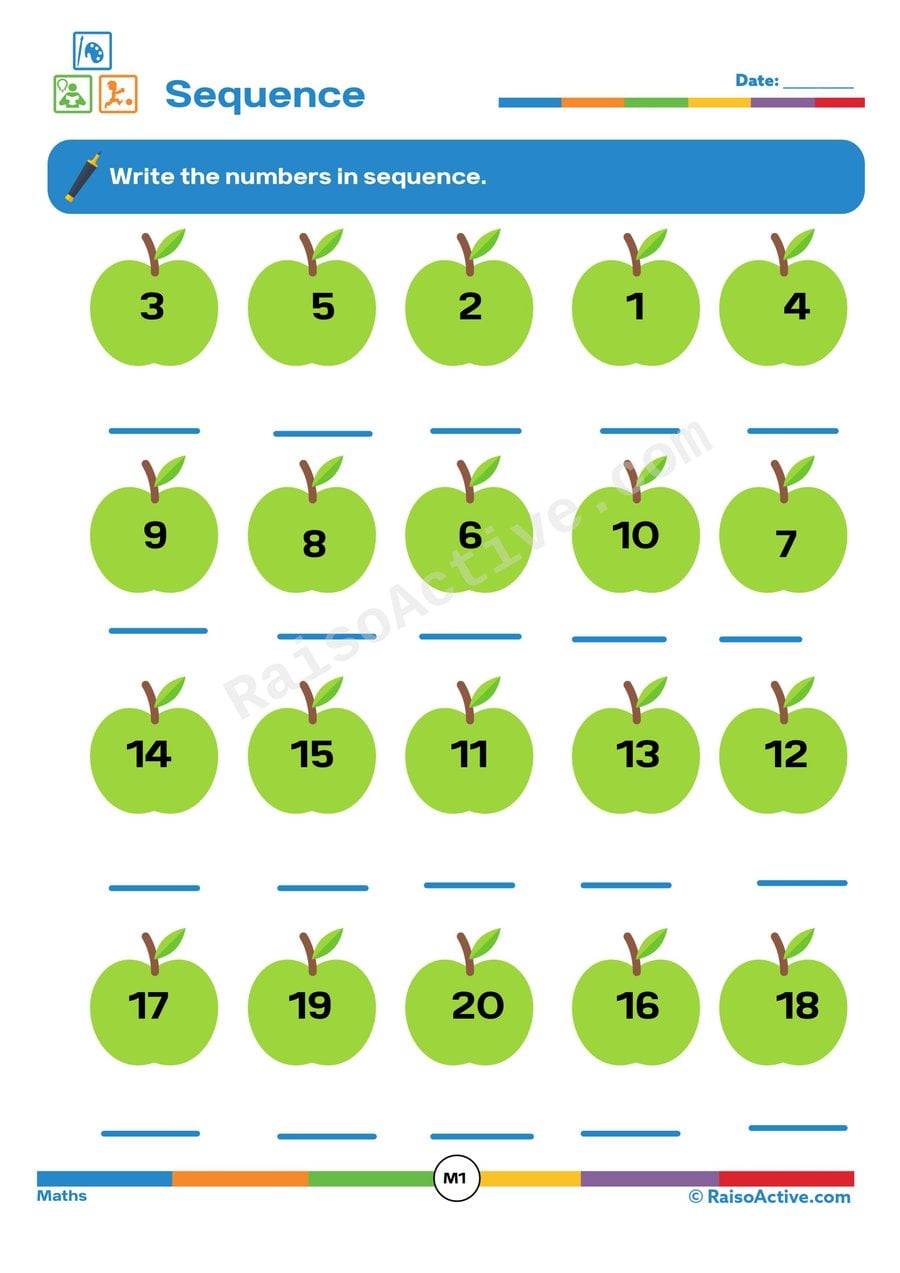
Sequence Fun: Writing Numbers in Order Worksheet
Ages 4-5 · Pre-KAges 4-5 · ReceptionAges 4-5 · LKGAges 4-5
This worksheet helps children ages 4-5 practice writing numbers in the correct sequence, reinforcing both number recognition and the concept that numbers have a fixed, predictable order. Filling in missing numbers along a row of apples also builds the pattern-recognition skills that underlie later skip-counting and place value work.
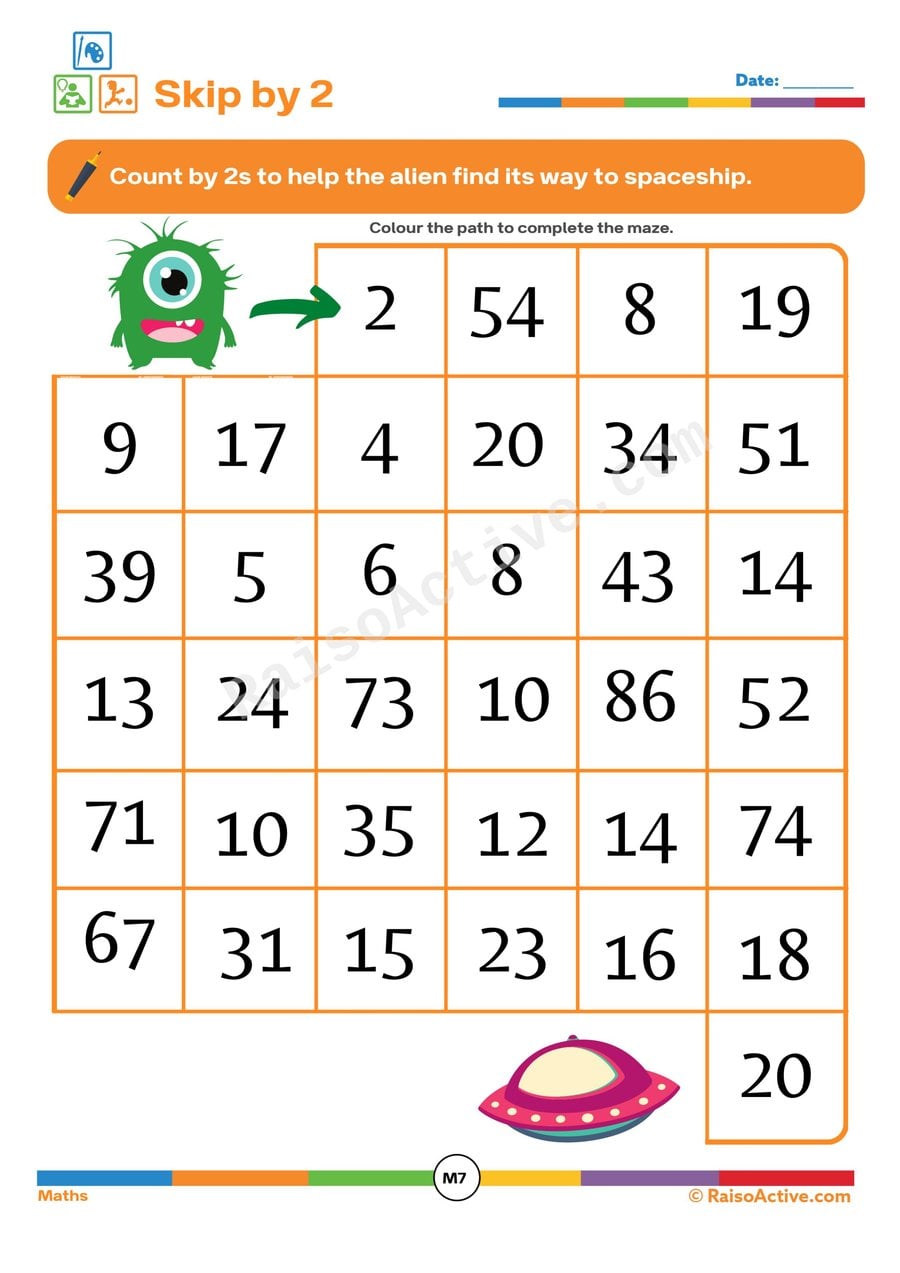
Alien Maze: Skip Counting by 2s Worksheet
Ages 3-5 · Preschool–Pre-KAges 3-5 · Nursery–ReceptionAges 3-5 · Nursery–LKGAges 3-5
This maze worksheet combines skip counting by 2s with fine motor tracing, requiring children to find and follow the correct numerical path from number 2 up through the sequence to reach the spaceship. For ages 3-5, this pairs a physical, engaging maze format with the numeracy skill of counting by 2s, which lays groundwork for later even-number recognition and faster counting strategies.

Missing Numbers Worksheet: Before, Between, and After
Ages 4-6 · Pre-K–KindergartenAges 4-6 · Reception–Year 1Ages 4-6 · LKG–UKGAges 4-6
This worksheet asks children ages 4-6 to fill in missing numbers that come before, between, or after given numbers in a sequence, building a deeper understanding of number order than simple counting alone. Recognizing what number is missing from a sequence requires children to mentally hold the number line and reason about relative position, a skill that supports later addition and subtraction.

Before and After Numbers Worksheet for Preschoolers
Ages 3-5 · Preschool–Pre-KAges 3-5 · Nursery–ReceptionAges 3-5 · Nursery–LKGAges 3-5
Identifying which numbers come immediately before or after a given number and physically sorting pictures into place links number sequence recall with the fine motor practice of cutting and pasting, building confidence for children ages 3-5.

Recite Numbers Worksheet: Connect the Dots and Practice Number Sequencing!
Ages 3-5 · Preschool–Pre-KAges 3-5 · Nursery–ReceptionAges 3-5 · Nursery–LKGAges 3-5
Children ages 3-5 practice number sequencing and recitation as they connect numbered dots in order to reveal a hidden picture, reinforcing both number recognition and the ability to count forward smoothly without skipping. Saying each number aloud while connecting it also builds the verbal counting fluency children need before they can count objects accurately.
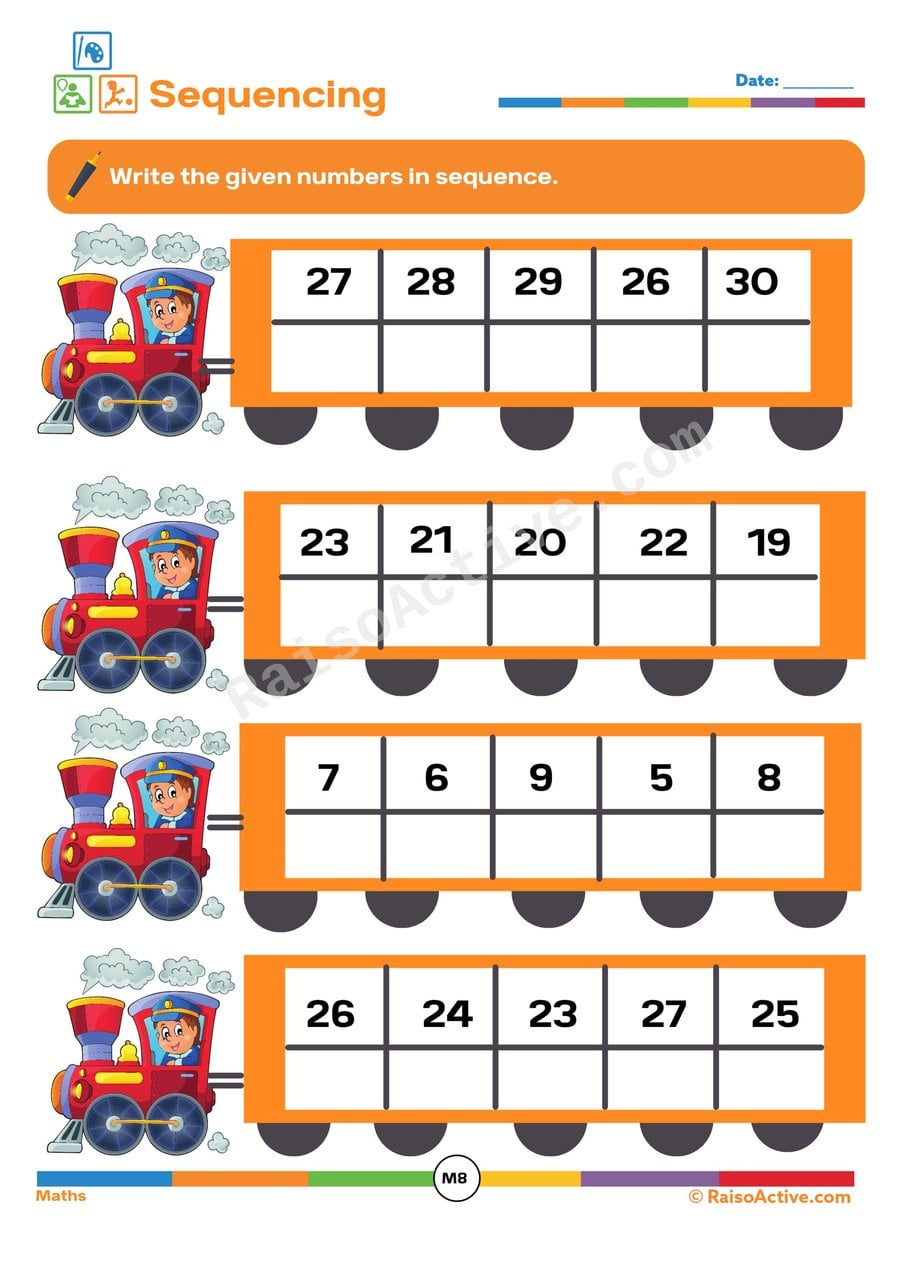
Number Sequencing Train Worksheet for Kids
Ages 4-6 · Pre-K–KindergartenAges 4-6 · Reception–Year 1Ages 4-6 · LKG–UKGAges 4-6
This train-themed sequencing worksheet challenges children ages 4-6 to fill in missing numbers scattered throughout a sequence, requiring them to recognize number order well enough to identify a gap anywhere in the run rather than only counting forward from the start. This deeper sequencing skill supports later math concepts like skip counting, addition, and number lines. Writing the missing numbers by hand, rather than just saying them aloud, also reinforces number formation alongside number order.
Guides for this topic

Number Formation Rhymes 0–9 and How to Fix Reversals
Original number formation rhymes for 0–9, the correct stroke order for each digit, why 3, 5 and 7 get reversed most often, and multisensory fixes that work.

Coding Activities for Preschoolers: Building Tomorrow's Thinkers Today
Discover 15+ unplugged and screen-based coding activities for preschoolers that build sequencing, logic, and problem-solving skills through play. NEP 2020 aligned.

Christmas and Winter Activities That Combine Fun and Learning: Creating Magical Educational Experiences
Discover Christmas and winter activities that combine festive fun with real learning. Crafts, counting, literacy, and printable worksheets for ages 2 to 8 — perfect for home and school.
Reviews
Every worksheet for ages 4–6, no watermark
Members download the full library of 1,000+ worksheets and every activity pack without watermarks or daily limits. One year costs ₹999 in India or $20 elsewhere.
See membership plansOr download any worksheet free with a watermark (5 a day).