Summer Symmetry Worksheet for Preschoolers: Complete and Color!
This worksheet introduces children ages 3-5 to the concept of symmetry by having them draw the missing half of a summer object, such as completing one side of a picture to mirror the other. This exercise builds an early sense of balance and proportion, an important visual-spatial skill that supports later geometry and art. Coloring the completed picture afterward adds fine motor practice while reinforcing the finished, whole shape they just created.
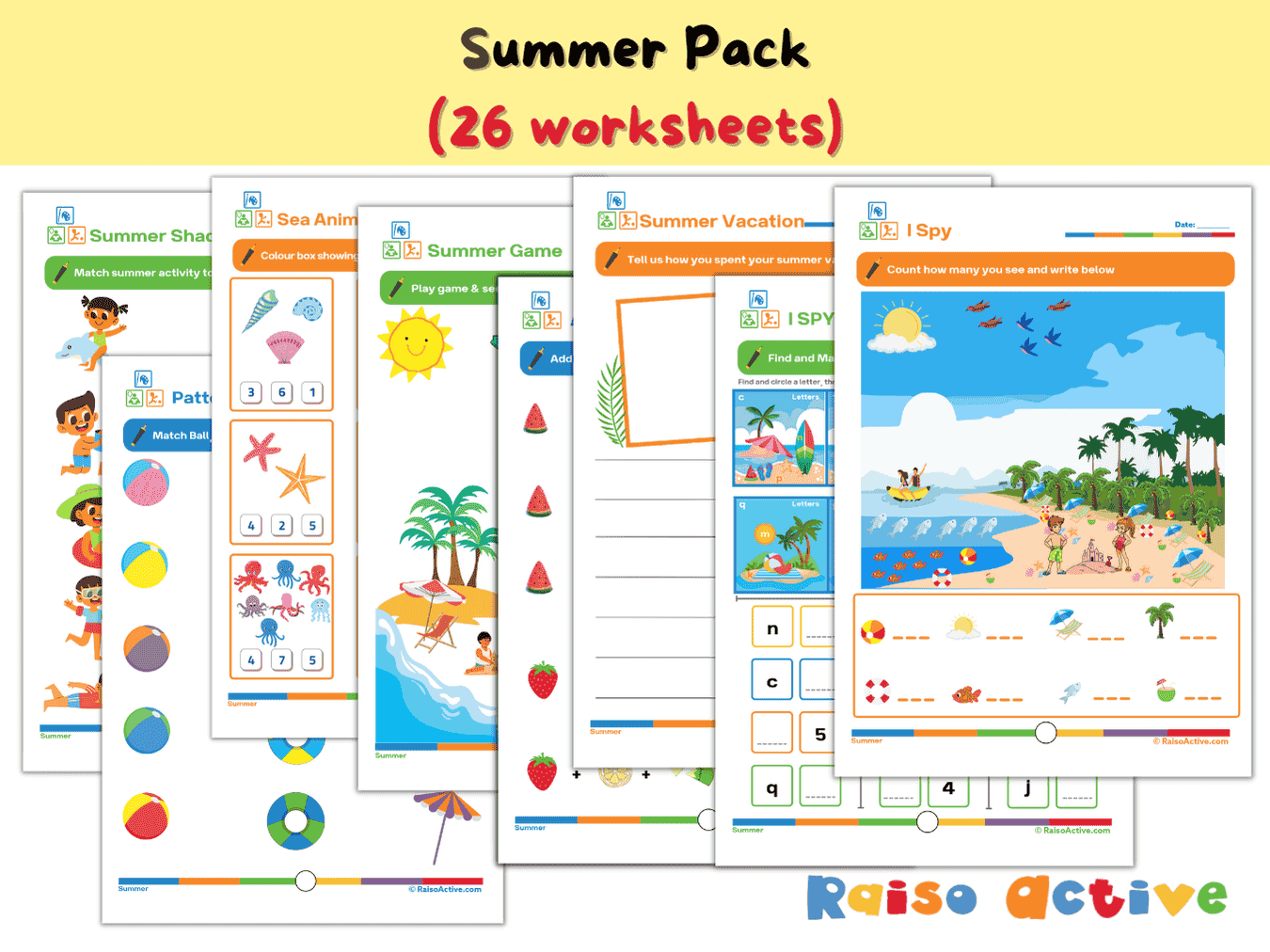
Part of the pack
Summer Activity Pack: Math, Literacy, Puzzles & More for Preschool & Kindergarten
This is page 7 of the pack. Ages 3-7 · Preschool–Grade 1Ages 3-7 · Nursery–Year 2Ages 3-7 · Nursery–Class 1Ages 3-7
Made for your child
A whole activity pack made with their name
60 pages to spot, build, trace and write their own name, plus pages about their favourites, feelings and family. See a free preview with their name.
Make an All About Me packFree preview · free for members
Or start free: a name tracing sheet with their nameCurriculum
- SEL - Self-Awareness > Summer Activities
How to use this worksheet
Show your child the half-completed summer picture and point out the line down the middle, explaining that whatever is drawn on one side needs to be matched on the other side. Have them look closely at the shape, color, and size of the existing half before drawing the missing half with a pencil, checking in periodically to help them line things up. Once the drawing is complete and both halves look balanced, let your child color the whole picture with crayons or colored pencils.
Materials needed
- Pencil
- Crayons or colored pencils
Extension activities
- 1Fold a piece of paper in half, drip a small amount of paint on one side, and press the paper closed to reveal a symmetrical butterfly shape.
- 2Hold a small mirror up to one half of a simple drawing and see how it completes the picture.
- 3Look for symmetrical objects around the house, like a butterfly picture, a heart shape, or a table, and talk about what makes them symmetrical.
- 4Draw a simple shape on one side of a line and challenge your child to complete the other side freehand.

Written by
Hemsweta Jain · Teacher Cheena
MBA and Early Childhood Educator, teaching since 2014 · Founder of RaisoActive, Mumbai
Every RaisoActive worksheet is designed and checked by the founder before publishing.
Published · Last reviewed
More from Summer Activity Pack: Math, Literacy, Puzzles & More for Preschool & Kindergarten

Count the Sea Animals! A Fun Counting Worksheet for Kids
Ages 3-5 · Preschool–Pre-KAges 3-5 · Nursery–ReceptionAges 3-5 · Nursery–LKGAges 3-5
This worksheet has children ages 3-5 count different sea animals grouped in boxes and then identify the matching numeral for each group, strengthening one-to-one correspondence alongside early ocean and marine-life vocabulary. Because each box features a different sea creature, such as fish, crabs, or starfish, children also practice sorting attention between groups rather than counting one long continuous row. This variety keeps the counting task from becoming rote repetition.

My Summer Vacation Worksheet: Write and Draw About Your Fun!
Ages 4-6 · Pre-K–KindergartenAges 4-6 · Reception–Year 1Ages 4-6 · LKG–UKGAges 4-6
This worksheet has children ages 4-6 write about their own summer vacation and draw a picture to match, practicing personal narrative writing, one of the earliest and most motivating forms of writing since it draws on a child's real memories rather than an assigned topic. Because children are describing something they actually experienced, this task builds both sentence-forming skills and the confidence that comes from writing about a subject they already know well. Pairing the writing with a drawing also lets children who aren't yet strong writers still fully express their ideas.

Summer Counting Worksheet: Count and Color Summer Objects!
Ages 3-5 · Preschool–Pre-KAges 3-5 · Nursery–ReceptionAges 3-5 · Nursery–LKGAges 3-5
This summer-themed counting page has children ages 3-5 count groups of sun, beach, and vacation-related objects and write the matching numeral in a box, directly practicing one-to-one correspondence, the skill of counting each item exactly once. Because the objects are grouped by theme rather than lined up in neat rows, children also practice visually organizing a scattered set before counting it, a slightly harder skill than counting objects in a straight line. Writing the total afterward connects the physical act of counting to the abstract symbol that represents it.
Summer Sudoku Worksheet for Kids
Ages 4-6 · Pre-K–KindergartenAges 4-6 · Reception–Year 1Ages 4-6 · LKG–UKGAges 4-6
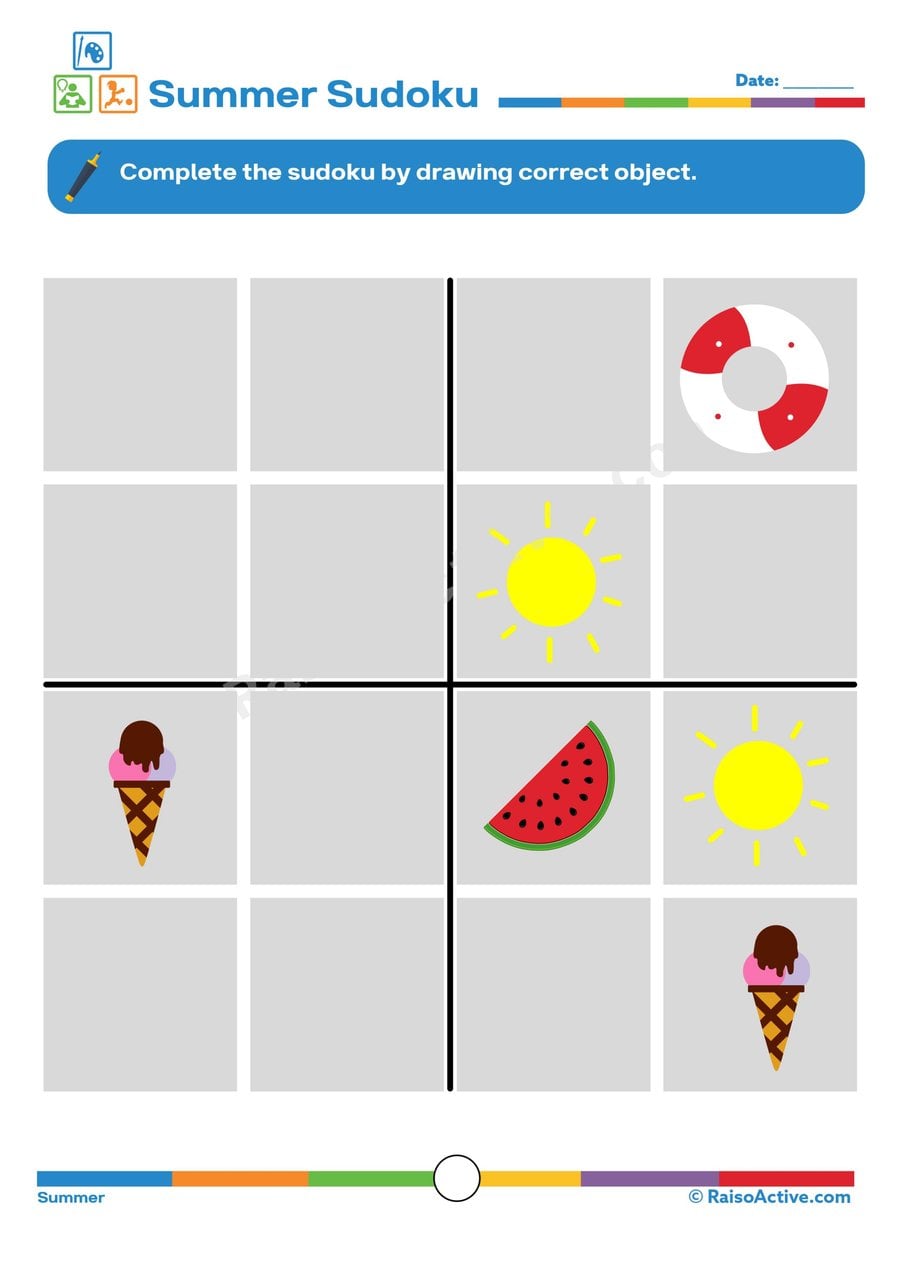
This simplified Sudoku puzzle has children ages 4-6 fill empty boxes with summer pictures so each row, column, and small 2x2 square contains every image exactly once, introducing early logical reasoning through visual clues instead of numbers. Because the grid uses a smaller 2x2 structure rather than the larger 3x3 blocks used in classic Sudoku, it's an accessible entry point into the process of elimination that more advanced logic puzzles require. Completing it builds patience and systematic thinking, since guessing randomly rarely works.

Summer Words ABC Order Worksheet for Preschoolers
Ages 4-5 · Pre-KAges 4-5 · ReceptionAges 4-5 · LKGAges 4-5
This worksheet has children ages 4-5 practice putting summer-themed words in alphabetical order, a key pre-reading skill that requires comparing the first letters of multiple words and understanding that the alphabet has a fixed sequence. Because children must hold several words in mind and decide their relative order rather than just recognizing a single letter, this task builds early sequencing and comparison skills alongside letter knowledge. Writing the words out afterward also reinforces spelling and handwriting practice.

I Spy Summer Fun Worksheet: Counting and Identifying Objects!
Ages 3-5 · Preschool–Pre-KAges 3-5 · Nursery–ReceptionAges 3-5 · Nursery–LKGAges 3-5
This 'I Spy Summer Fun' worksheet helps young learners (ages 3-5) master one-to-one correspondence, a crucial foundational math skill, by counting specific summer-themed objects within a busy scene. Children will practice associating a number name with each item they touch or point to, building early number sense and visual discrimination. This activity strengthens their ability to accurately count quantities up to 20, preparing them for more complex mathematical concepts.

Summer Word Unscramble Worksheet for Preschoolers
Ages 3-5 · Preschool–Pre-KAges 3-5 · Nursery–ReceptionAges 3-5 · Nursery–LKGAges 3-5
This worksheet has children ages 3-5 unscramble jumbled letters to spell summer-themed words, practicing early phonics and spelling by sounding out letters and considering how they might combine into a familiar word. Because the letters are already given but out of order, children focus specifically on sequencing and sound-blending rather than recalling spelling from scratch, making this an accessible entry point into word-building. Writing the corrected word afterward reinforces handwriting alongside the phonics practice.

Color Code Shorts: A Fun Summer Coloring Worksheet!
Ages 3-5 · Preschool–Pre-KAges 3-5 · Nursery–ReceptionAges 3-5 · Nursery–LKGAges 3-5
This worksheet has children ages 3-5 use a color-by-number code to color a pair of summer shorts, matching each numbered section to the correct color listed in a key at the bottom of the page. This activity strengthens number recognition, since children must match numerals to their position in a code, while also reinforcing color names and fine motor control as they color within smaller, numbered sections. Following a color code is also an early introduction to reading and applying a visual key, a skill used again in maps and charts later on.
Related worksheets

Reindeer Craft: Follow Instructions and Create a Festive Decoration!
Ages 3-5 · Preschool–Pre-KAges 3-5 · Nursery–ReceptionAges 3-5 · Nursery–LKGAges 3-5
This multi-step reindeer craft has children ages 3-5 follow a sequence of folding and assembly instructions to build a three-dimensional decoration, strengthening both listening comprehension and the fine motor skills needed to position and attach small pieces accurately. Because each step depends on the one before it, children also practice patience and sequencing, skills that carry over into following any multi-step task.

Navratri Nine Colours Colouring Page: Colour the Garba Dancers
Ages 4-6 · Pre-K–KindergartenAges 4-6 · Reception–Year 1Ages 4-6 · LKG–UKGAges 4-6
Children learn the colour linked with each of the nine days of Navratri 2026 and practise colouring inside the lines.

Navratri Rangoli Colour by Number and Symmetry Diya
Ages 4-6 · Pre-K–KindergartenAges 4-6 · Reception–Year 1Ages 4-6 · LKG–UKGAges 4-6
Children match numbers to colours using a key, colour a rangoli pattern carefully and draw the other half of a shape so both sides match.

Elephant Shapes: Fun Sorting Worksheet for Preschoolers!
Ages 3-5 · Preschool–Pre-KAges 3-5 · Nursery–ReceptionAges 3-5 · Nursery–LKGAges 3-5
This playful sorting worksheet has children ages 3-5 use an elephant's 'trunk' (their own hand reaching through a cut circle) to pick and sort shapes, building both shape recognition and simple classification skills. Physically selecting and grouping shapes by type, rather than just naming them on sight, helps solidify the concept that shapes can share a category even when their size or color differs.
Colour the औ Words – Hindi Letter औ (au) Colouring Worksheet | औ वाली चीज़ों में रंग भरो
Ages 3-7 · Preschool–Grade 1Ages 3-7 · Nursery–Year 2Ages 3-7 · Nursery–Class 1Ages 3-7
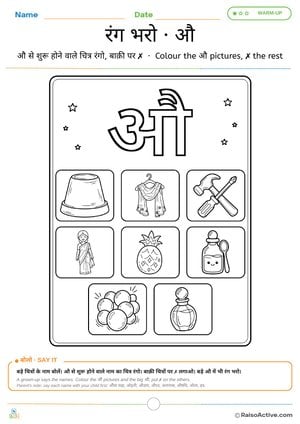
Children say each picture name aloud, decide whether it starts with औ, colour the matching pictures (औंधा घड़ा, औज़ार, औरत and औषधि) and the big outline letter, and put a cross on the rest. Sorting by first sound trains the ear and colouring builds hand control.

Pumpkin Shapes and Sizes: Halloween Ordering and Shapes Worksheet
Ages 4-8 · Pre-K–Grade 2Ages 4-8 · Reception–Year 3Ages 4-8 · LKG–Class 2Ages 4-8
Children order objects by size, recognise and count triangles, circles, squares and stars, and use shapes to design a face.

Rocking Santa Card Craft Worksheet for Preschoolers
Ages 3-5 · Preschool–Pre-KAges 3-5 · Nursery–ReceptionAges 3-5 · Nursery–LKGAges 3-5
This rocking Santa card craft has children ages 3-5 cut out individual shape pieces and assemble them onto a folded card base, combining scissor control with an early understanding of how folding creates movement, since the 'rocking' effect comes from the card's fold. Following the assembly steps in order also reinforces sequencing and attention to visual instructions.
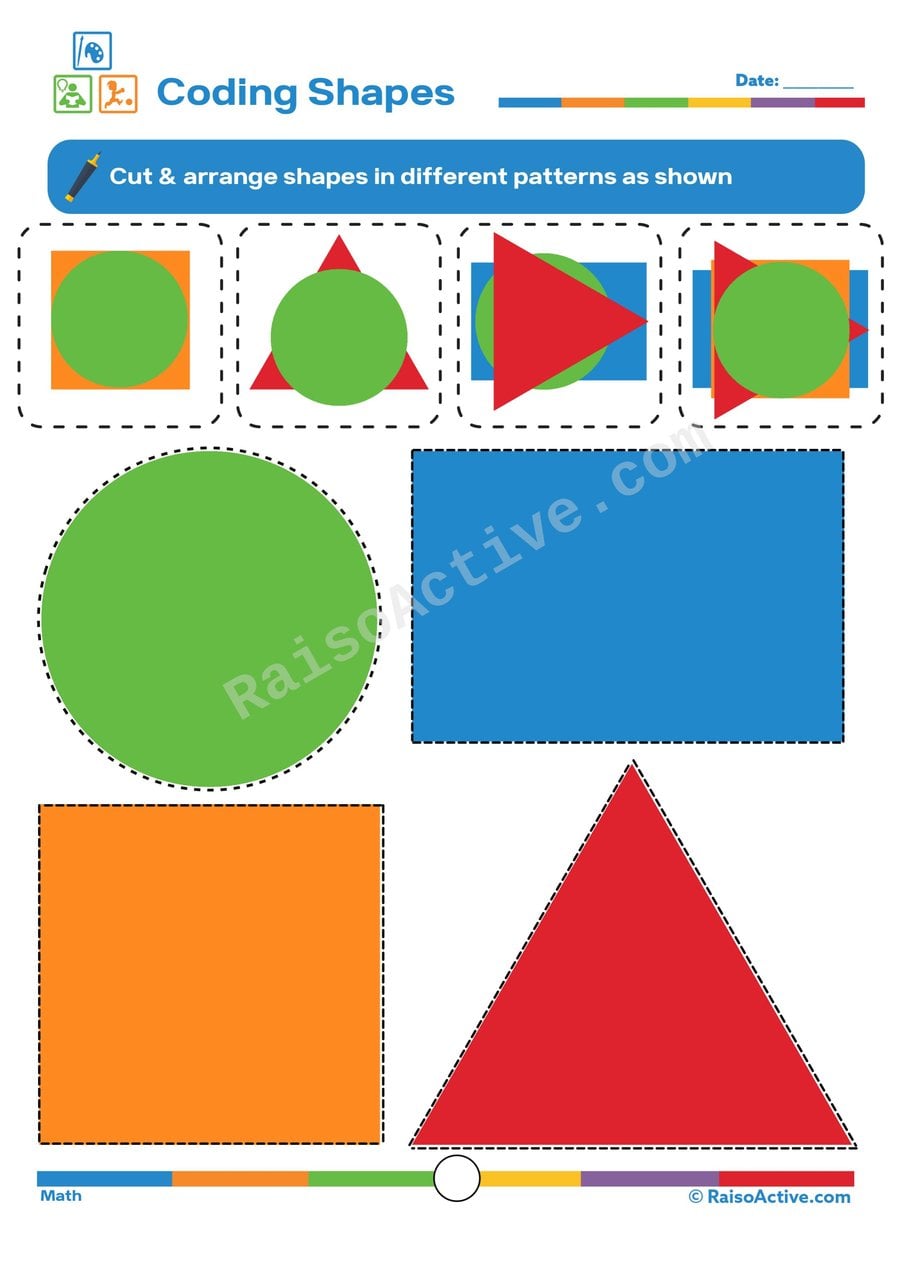
Coding Shapes Worksheet: Cut and Arrange Shapes!
Ages 3-5 · Preschool–Pre-KAges 3-5 · Nursery–ReceptionAges 3-5 · Nursery–LKGAges 3-5
This cut-and-paste worksheet has children ages 3-5 recreate example shape sequences by cutting out individual pieces and arranging them to match, combining shape recognition with the ordered, step-by-step thinking used in early coding and pattern logic. The physical act of cutting and precisely placing each piece also strengthens fine motor control and spatial planning.
Guides for this topic

Best Worksheets for 3-Year-Olds: What Works and What to Avoid
What works on worksheets for 3-year-olds: short sessions, crayons, tracing lines, matching, cutting, a free weekly plan, and signs one is too advanced.
Fostering Creativity in Structured Learning: The Perfect Balance for Young Minds
Learn how to blend creativity with structured learning for children ages 1-8. Practical strategies, activities, and printable worksheets for parents and teachers.
Spring and Summer Learning Activities: Harnessing Nature's Classroom for Year-Round Growth
Discover heat-safe outdoor activities, monsoon science experiments, and summer holiday learning plans for young children in India. Prevent summer slide with fun ideas for ages 1-8.
Reviews
Every worksheet for ages 3–5, no watermark
Members download the full library of 1,000+ worksheets and every activity pack without watermarks or daily limits. One year costs ₹999 in India or $20 elsewhere.
See membership plansOr download any worksheet free with a watermark (5 a day).