Summer Word Unscramble Worksheet for Preschoolers
This worksheet has children ages 3-5 unscramble jumbled letters to spell summer-themed words, practicing early phonics and spelling by sounding out letters and considering how they might combine into a familiar word. Because the letters are already given but out of order, children focus specifically on sequencing and sound-blending rather than recalling spelling from scratch, making this an accessible entry point into word-building. Writing the corrected word afterward reinforces handwriting alongside the phonics practice.
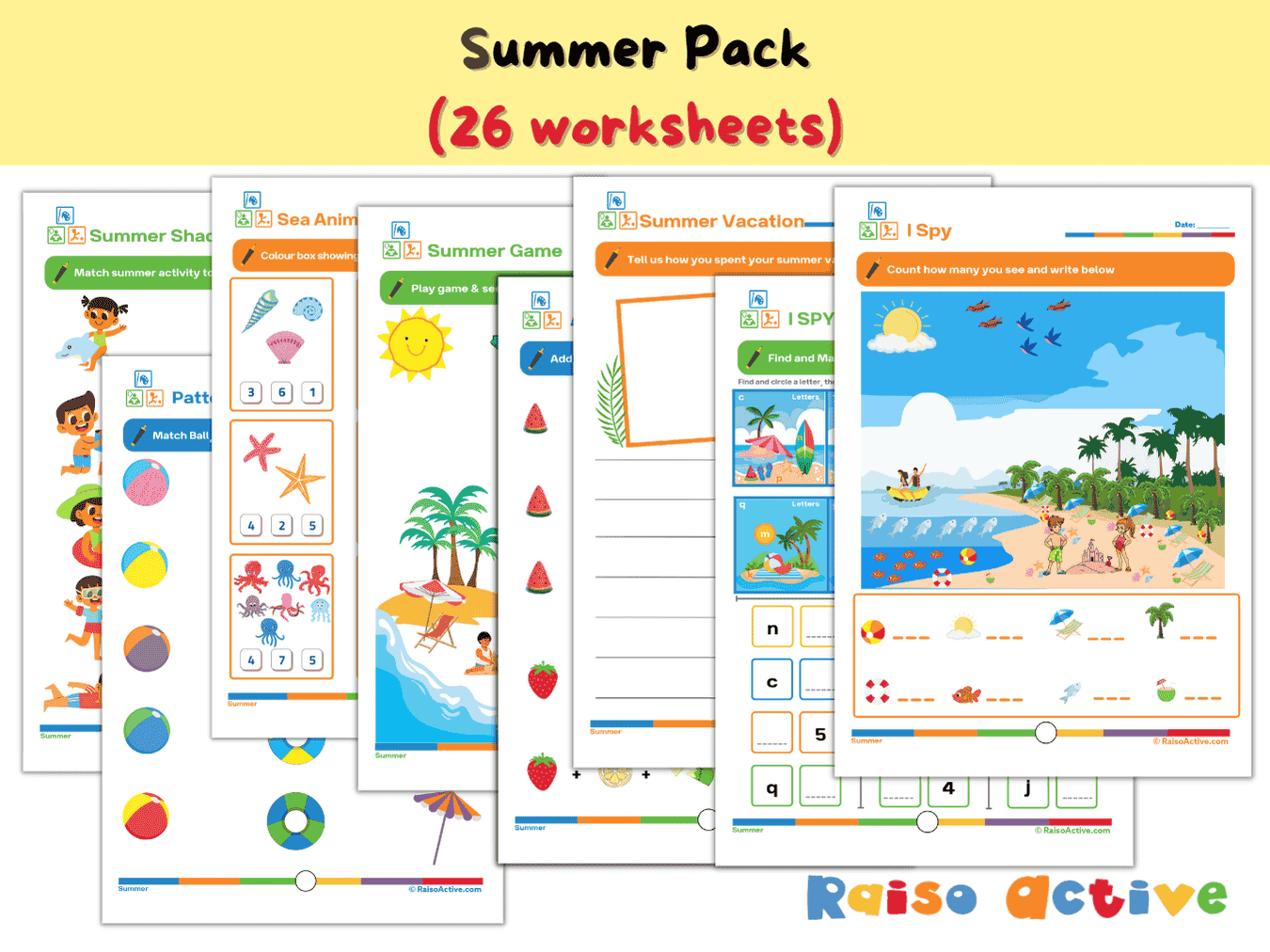
Part of the pack
Summer Activity Pack: Math, Literacy, Puzzles & More for Preschool & Kindergarten
This is page 24 of the pack. Ages 3-7 · Preschool–Grade 1Ages 3-7 · Nursery–Year 2Ages 3-7 · Nursery–Class 1Ages 3-7
Made for your child
Spelling practice, made for your child
Their own spelling words turned into a pack: trace or look-cover-write-check, roll and write, a secret picture code, a word search, a crossword and a test, with their name in it.
Make a spelling packFree preview · free for members
Or start free: a word search with sight wordsCurriculum
- SEL - Self-Awareness > Summer Activities
How to use this worksheet
Look at the first set of jumbled letters with your child and say each letter sound out loud together. Encourage your child to guess what summer word the letters might spell, using any picture clues on the page if included, and rearrange the letters mentally or by pointing to them in a new order. Once they've figured out the word, have them write it correctly on the line provided, then repeat the process for the remaining scrambled words.
Materials needed
- Pencil
Extension activities
- 1Draw a picture of each summer word after it's unscrambled and written correctly.
- 2Use the unscrambled words in a simple spoken sentence together.
- 3Make your own letter cards and scramble a new summer word for your child to solve.
- 4Play an oral game where you say a scrambled word out loud and your child guesses it without seeing the letters.

Written by
Hemsweta Jain · Teacher Cheena
MBA and Early Childhood Educator, teaching since 2014 · Founder of RaisoActive, Mumbai
Every RaisoActive worksheet is designed and checked by the founder before publishing.
Published · Last reviewed
More from Summer Activity Pack: Math, Literacy, Puzzles & More for Preschool & Kindergarten

Color Code Shorts: A Fun Summer Coloring Worksheet!
Ages 3-5 · Preschool–Pre-KAges 3-5 · Nursery–ReceptionAges 3-5 · Nursery–LKGAges 3-5
This worksheet has children ages 3-5 use a color-by-number code to color a pair of summer shorts, matching each numbered section to the correct color listed in a key at the bottom of the page. This activity strengthens number recognition, since children must match numerals to their position in a code, while also reinforcing color names and fine motor control as they color within smaller, numbered sections. Following a color code is also an early introduction to reading and applying a visual key, a skill used again in maps and charts later on.
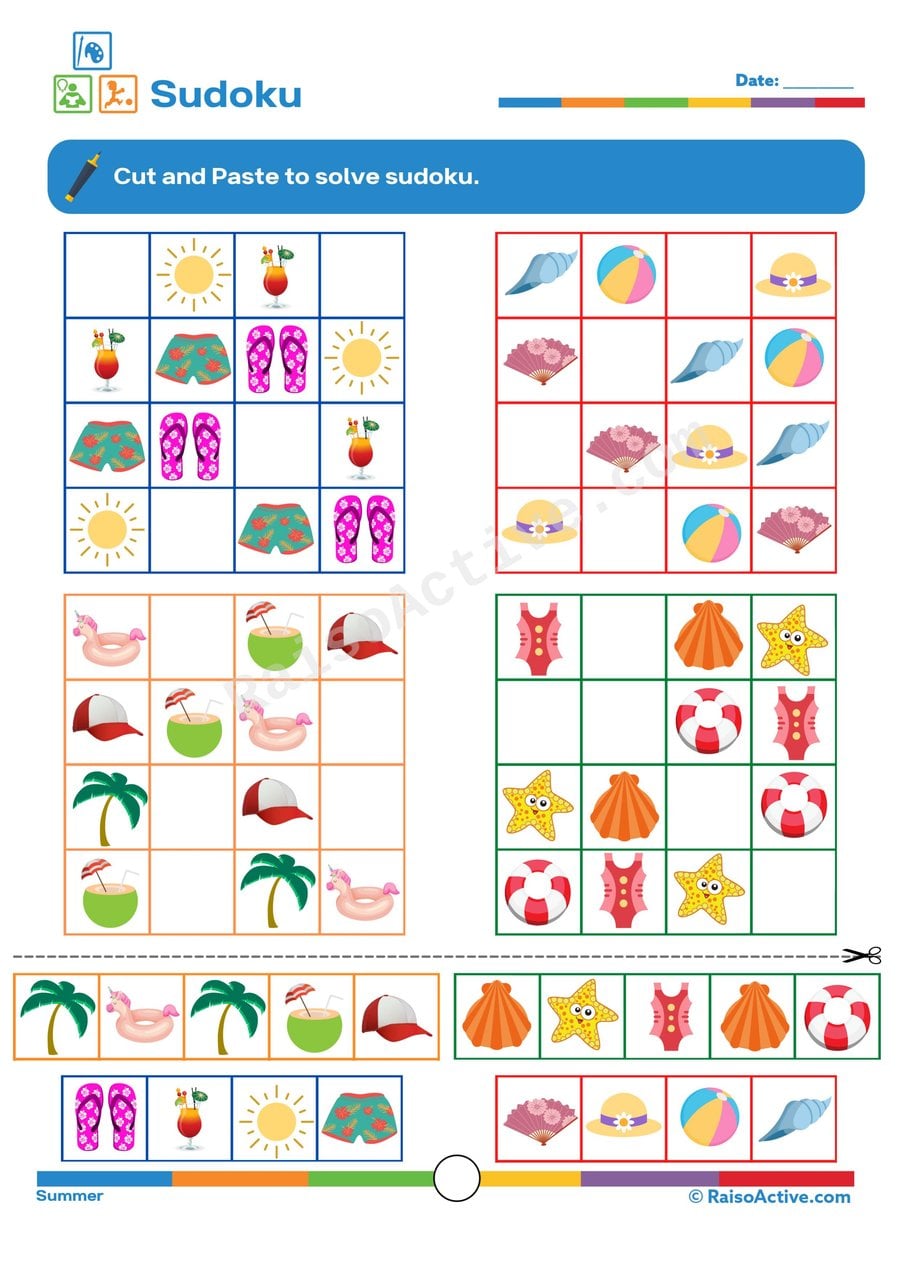
Summer Sudoku: Cut and Paste Worksheet for Kids
Ages 4-6 · Pre-K–KindergartenAges 4-6 · Reception–Year 1Ages 4-6 · LKG–UKGAges 4-6
This worksheet combines cutting and pasting with logical puzzle-solving for children ages 4-6, who must cut out small summer images and paste each one into the correct empty square of a Sudoku grid so no image repeats in any row, column, or smaller square. Beyond the reasoning skills of a typical Sudoku, this version adds scissor practice and precise placement with glue, building fine motor coordination alongside logical thinking. Handling small cut-out pieces and placing them accurately also demands more spatial planning than simply coloring or drawing a picture.

Summer Game Worksheet: Following Instructions and Counting Fun!
Ages 3-5 · Preschool–Pre-KAges 3-5 · Nursery–ReceptionAges 3-5 · Nursery–LKGAges 3-5
This worksheet has children ages 3-5 follow a numbered path from a 'Start' point to a 'Finish' point, counting each number in sequence as they move along the trail, combining counting practice with the ability to follow a visual path in order. Because the path likely winds and turns rather than running in a straight line, children also practice tracking a sequence visually across a page, a skill useful for later map-reading and following diagrams. Counting in the correct order along a path adds a playful, game-like structure to number sequencing.
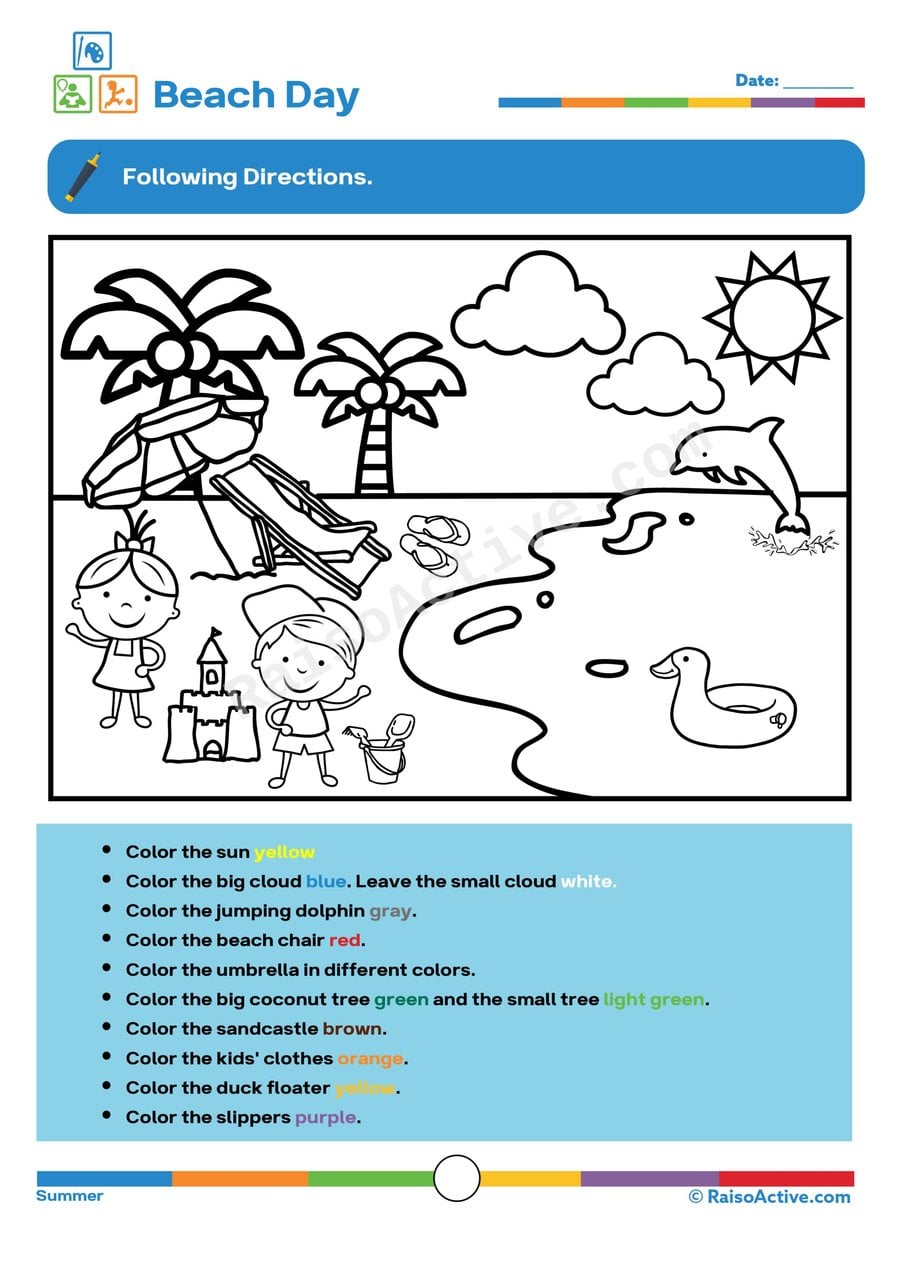
Beach Day Coloring Worksheet for Preschoolers
Ages 3-5 · Preschool–Pre-KAges 3-5 · Nursery–ReceptionAges 3-5 · Nursery–LKGAges 3-5
This worksheet has children ages 3-5 read or listen to specific color instructions, like coloring the sun yellow and a cloud blue, and then apply the correct color to each part of a beach scene. Following multi-part color instructions builds listening comprehension and the ability to hold several separate directions in mind at once, both important readiness skills for classroom instructions. It also reinforces color-word vocabulary and fine motor control as children color within the lines of each shape.
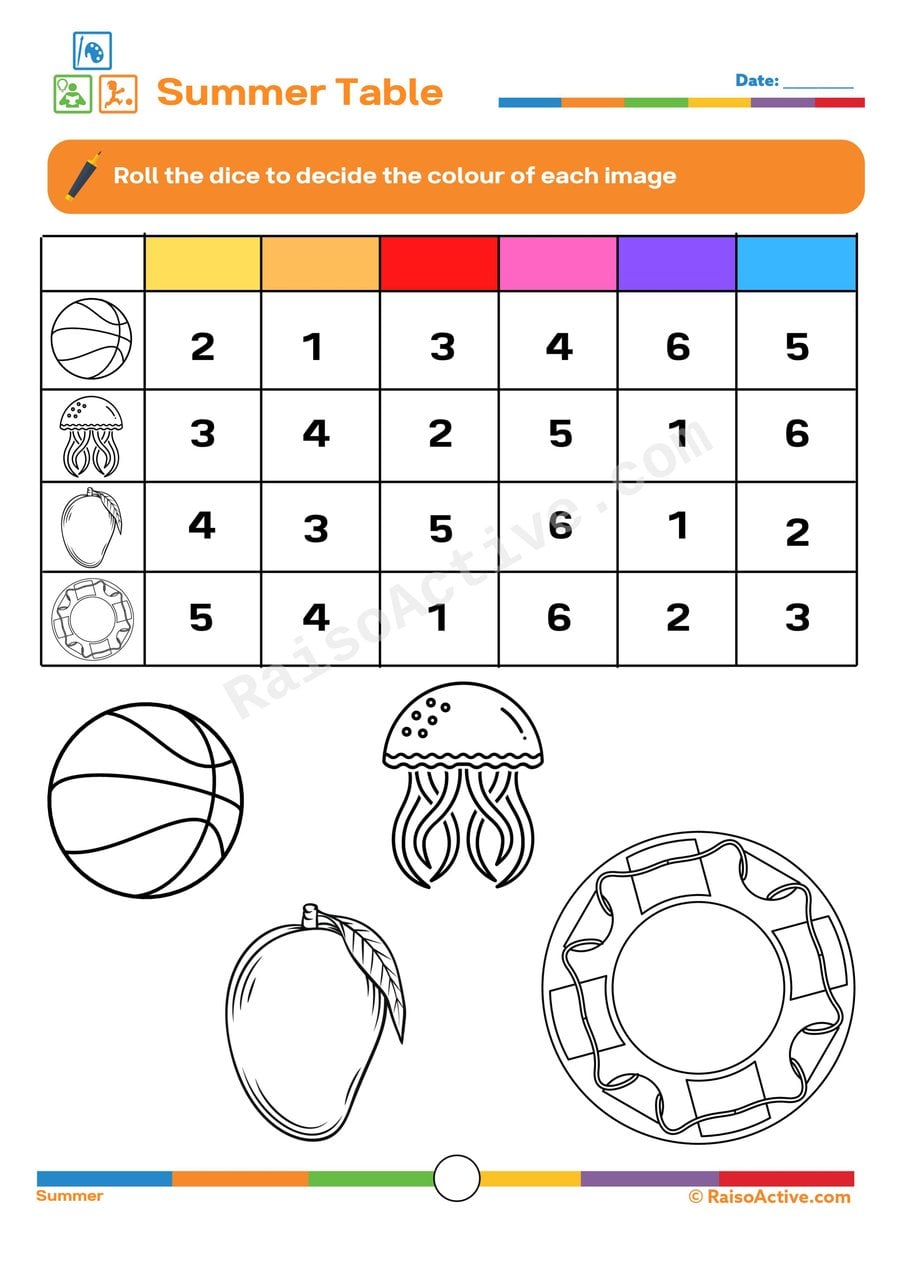
Summer Colors Worksheet: Roll the Dice and Color!
Ages 3-5 · Preschool–Pre-KAges 3-5 · Nursery–ReceptionAges 3-5 · Nursery–LKGAges 3-5
This worksheet turns color recognition into a game for children ages 3-5, who roll a die and then color part of a summer picture based on a color chart that assigns a color to each number. Beyond simply recognizing colors, children practice matching a rolled numeral to its position on a chart and following a multi-step instruction, both important readiness skills before formal schoolwork. The randomness of the dice also keeps the activity fresh each time it's played, unlike a fixed coloring page.

Summer T-Shirt Match: A Fun Matching Worksheet for Kids!
Ages 3-5 · Preschool–Pre-KAges 3-5 · Nursery–ReceptionAges 3-5 · Nursery–LKGAges 3-5
This worksheet has children ages 3-5 match fruit designs to summer t-shirts featuring the same pattern, building visual discrimination as they compare details like shape and arrangement across two separate pictures. Because the match depends on recognizing a specific fruit design repeated in a different context, children practice the transferable skill of identifying that two pictures represent the same thing even when shown in a different format. Naming the fruits along the way also builds vocabulary.
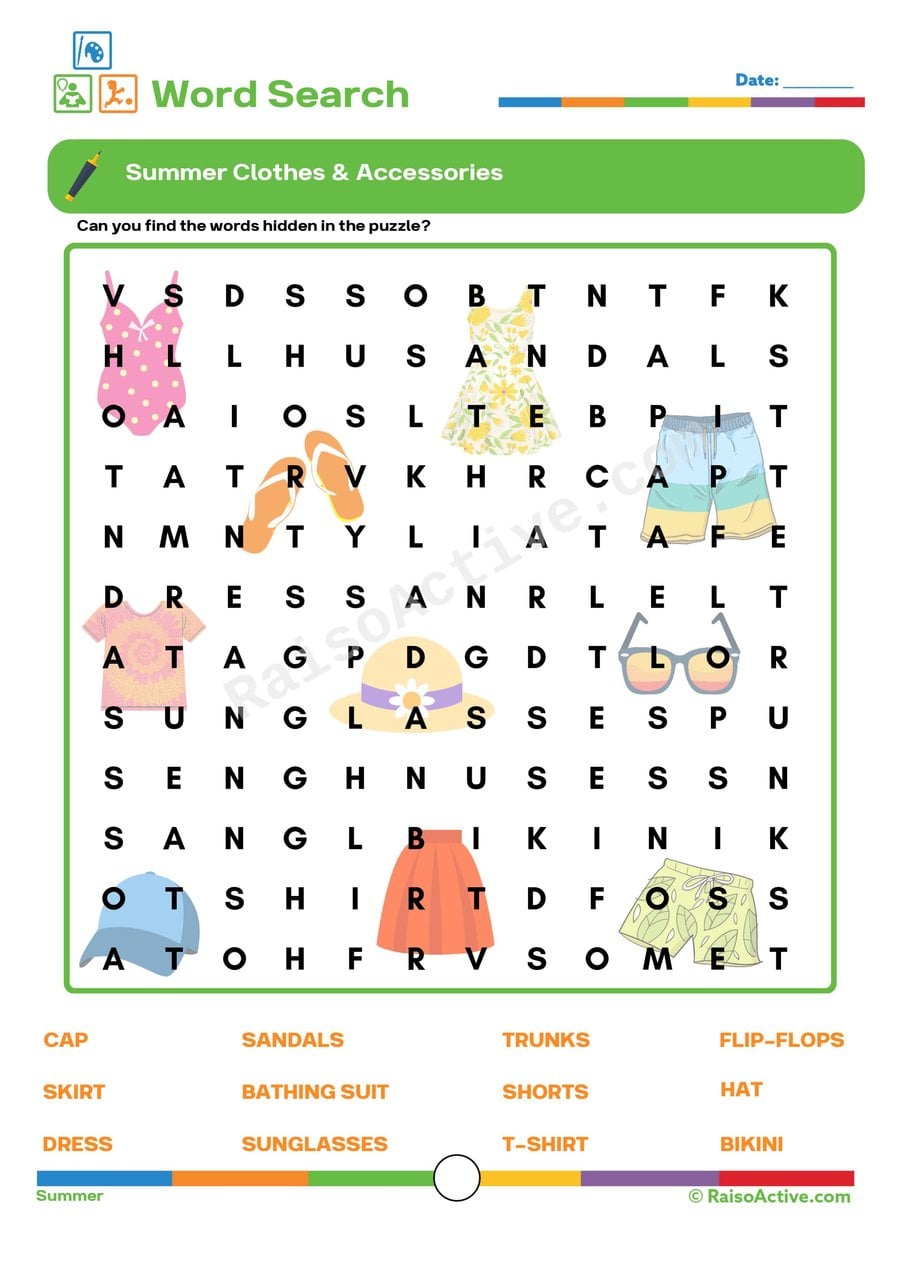
Summer Clothes Word Search Worksheet for Kids
Ages 3-5 · Preschool–Pre-KAges 3-5 · Nursery–ReceptionAges 3-5 · Nursery–LKGAges 3-5
Scanning a letter grid to find whole words — sunhat, swimsuit, sandals — builds visual tracking and left-to-right scanning skills that carry directly over into reading full sentences later. Because every word on this list relates to summer clothing, it also reinforces a themed vocabulary cluster, which research on early reading shows helps new words stick better than unrelated word lists.
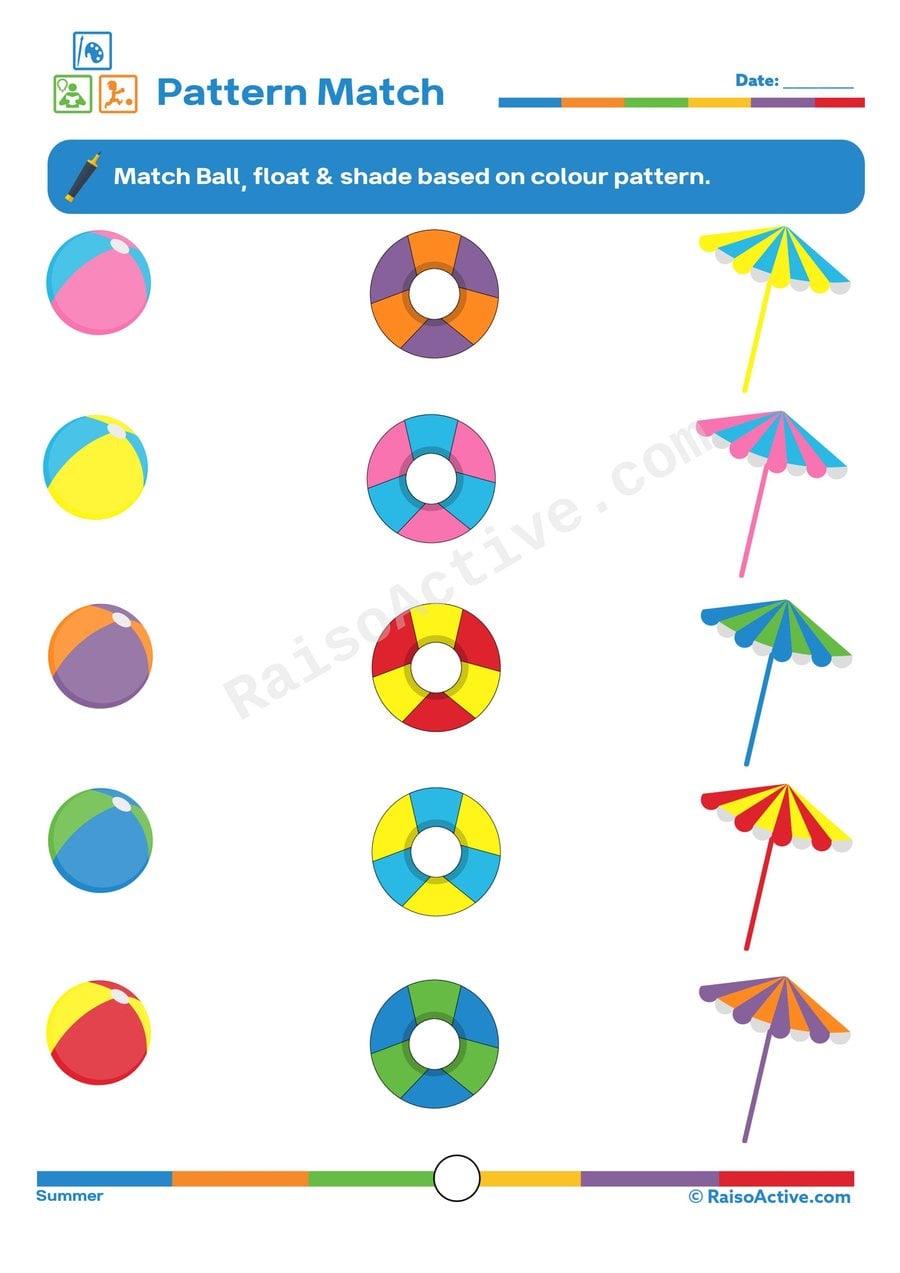
Summer Pattern Match Worksheet for Preschoolers
Ages 3-5 · Preschool–Pre-KAges 3-5 · Nursery–ReceptionAges 3-5 · Nursery–LKGAges 3-5
This worksheet asks children ages 3-5 to study the color pattern on a beach ball, pool float, and sun umbrella and match each item to its correctly patterned counterpart, building early pattern recognition, a foundational skill for later math concepts like sequencing and algebraic thinking. Because the match depends on noticing the order and repetition of colors rather than just matching a single color, children must compare details carefully rather than glance quickly. This strengthens visual attention alongside the pattern skill itself.
Related worksheets

Easter Egg Color by Hints Worksheet for Preschoolers
Ages 3-5 · Preschool–Pre-KAges 3-5 · Nursery–ReceptionAges 3-5 · Nursery–LKGAges 3-5
This worksheet has children ages 3-5 listen to or read simple written hints describing shapes and colors, then apply that information correctly while coloring each Easter egg, building early reading comprehension and the ability to follow multi-step verbal instructions. Because the hints must be followed precisely rather than colored freely, children also practice patience and careful attention to detail.

Christmas Fill-in-the-Blanks Worksheet for Preschoolers
Ages 3-5 · Preschool–Pre-KAges 3-5 · Nursery–ReceptionAges 3-5 · Nursery–LKGAges 3-5
Filling in missing letters of Christmas words like 'S_ _W' or 'TR_ _' helps children ages 3-5 connect letter sounds to their written form, an essential early step toward independent spelling. Using the accompanying picture as a clue also teaches them to cross-check visual and phonetic information — a strategy they'll rely on throughout early reading.

Phonics Level 3 Long Vowels Certificate of Achievement
Ages 5-7 · Kindergarten–Grade 1Ages 5-7 · Year 1–Year 2Ages 5-7 · UKG–Class 1Ages 5-7
Children celebrate finishing Phonics Level 3 and look back at the five long vowel sounds they can now read: long a, e, i, o and u.
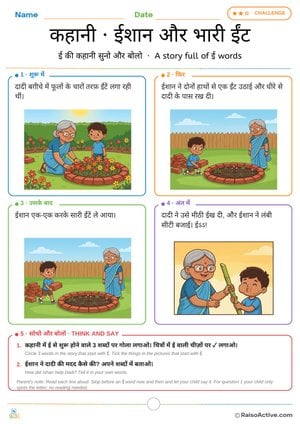
Letter ई Story: Ishaan and the Heavy Bricks | कहानी ईशान और भारी ईंट
Ages 3-7 · Preschool–Grade 1Ages 3-7 · Nursery–Year 2Ages 3-7 · Nursery–Class 1Ages 3-7
Ishaan helps Dadi build a flower bed by carrying bricks one by one, and she thanks him with sweet sugarcane. Children listen, look at the four pictures, spot the words that start with ई and retell what happened in their own words.
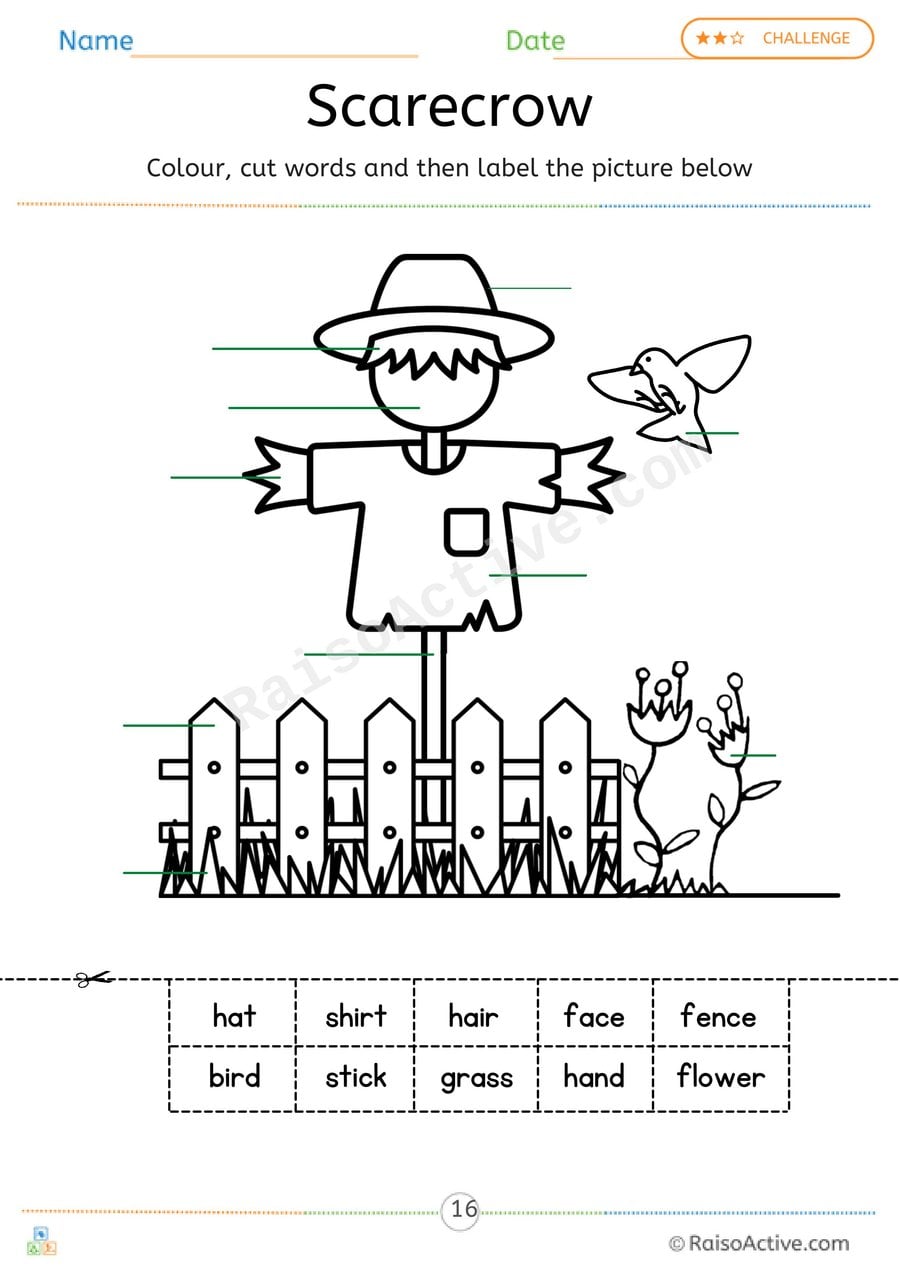
Scarecrow Labeling Worksheet for Preschoolers
Ages 3-5 · Preschool–Pre-KAges 3-5 · Nursery–ReceptionAges 3-5 · Nursery–LKGAges 3-5
This worksheet has children ages 3-5 color a scarecrow, then cut out word labels for its parts, hat, straw, shirt, gloves, and glue each label onto the correct spot, connecting written words directly to the objects they name. Tracing the labels afterward adds letter-formation practice on top of the vocabulary-building label matching.

Complete the Words: Identify the Animals Worksheet for Preschoolers
Ages 3-5 · Preschool–Pre-KAges 3-5 · Nursery–ReceptionAges 3-5 · Nursery–LKGAges 3-5
This worksheet helps children ages 3-5 practice early letter recognition and spelling by filling in missing letters to complete animal names using picture clues. Working from a picture to a partially completed word builds phonics skills gradually, since children only need to identify one or two missing sounds rather than spelling an entire word from scratch.

Feelings Word Wheel: 24 Feeling Words in Six Families and How Big Each One Feels
Ages 7-10 · Grade 2–Grade 3Ages 7-10 · Year 3–Year 4Ages 7-10 · Class 2–Class 3Ages 7-10
Children build a richer feelings vocabulary with 24 words in six colour-coded families, from annoyed to furious and content to overjoyed. They learn that words in a family are cousins, not the same.
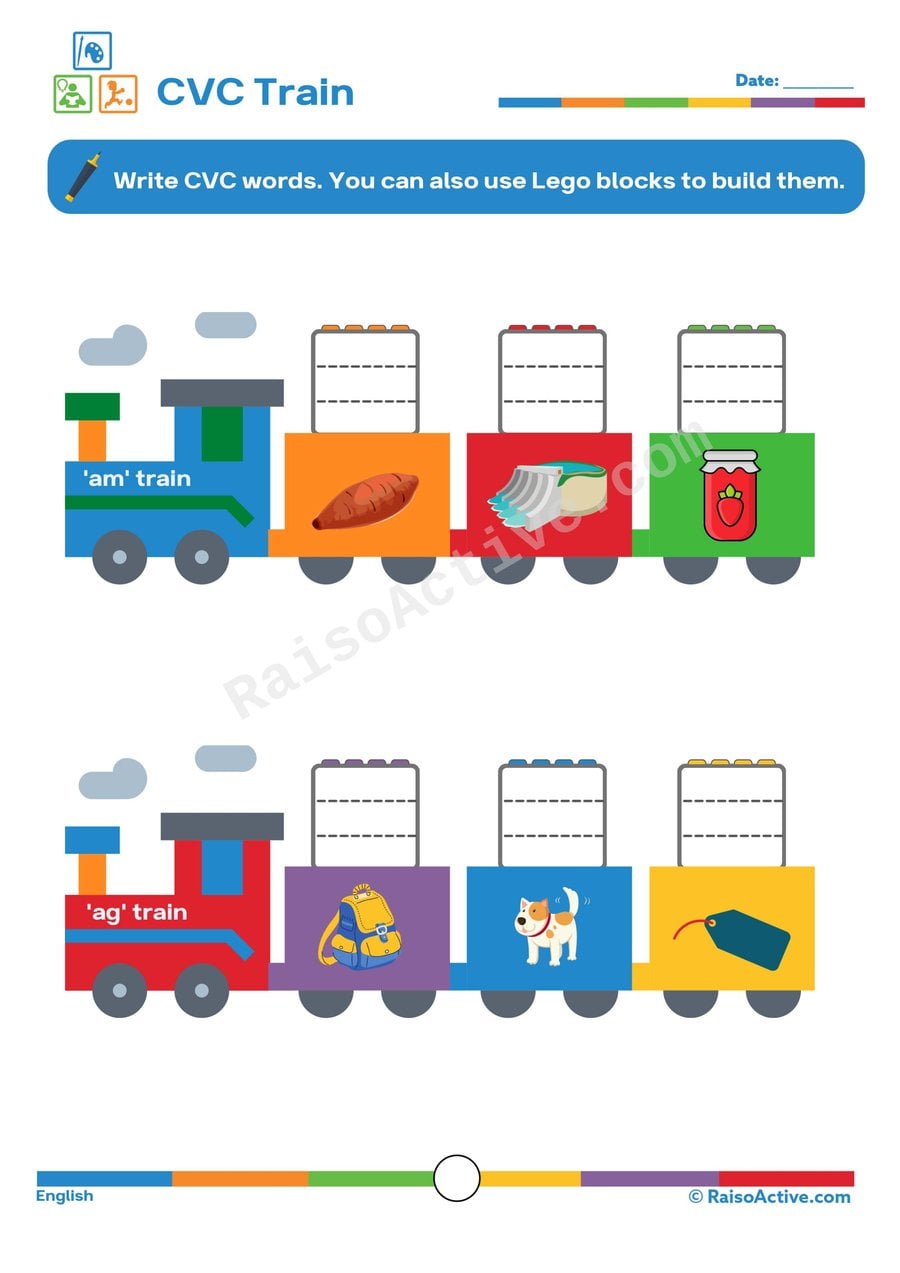
CVC Train Worksheet: Write CVC Words!
Ages 4-6 · Pre-K–KindergartenAges 4-6 · Reception–Year 1Ages 4-6 · LKG–UKGAges 4-6
Writing consonant-vowel-consonant words like 'cat,' 'sun,' or 'pig' under matching pictures gives children ages 4-6 direct practice with letter-sound blending, a core phonics skill that underpins independent reading. Because each train car pairs a picture clue with a blank space, children also practice translating a spoken word they can sound out into its correctly spelled written form.
Guides for this topic

Sight Words by Age: The First 50 Words and How to Teach Them Without Flashcard Fatigue
Which sight words to teach first and why, the heart-word method, a read-trace-write-find routine, games, and a by-age table of typical sight-word progress.
How to Teach CVC Blending: A Step-by-Step Method That Works in Two Weeks
A step-by-step method for teaching CVC blending, covering continuous sounds, word families, common errors, and a 14-day plan that most children finish reading CVC words.

Documenting Learning Without Drowning in Data: A Practical Guide for Parents and Teachers
Learn practical ways to document your child's learning without overwhelm. Simple portfolios, observation tips, and printable trackers for ages 1-8.
Reviews
Every worksheet for ages 3–5, no watermark
Members download the full library of 1,000+ worksheets and every activity pack without watermarks or daily limits. One year costs ₹999 in India or $20 elsewhere.
See membership plansOr download any worksheet free with a watermark (5 a day).