Honeycomb Pattern Matching Worksheet for Preschoolers
Cutting out hexagon shapes and matching their patterns to complete an incomplete honeycomb teaches children ages 3-5 pattern recognition, requiring them to notice details like color, design, or line placement before deciding where a piece belongs. Because hexagons fit together in a specific interlocking way, this activity also introduces early tessellation and spatial reasoning, concepts that support later geometry learning. The cutting and gluing steps add fine motor practice on top of the visual pattern-matching task.
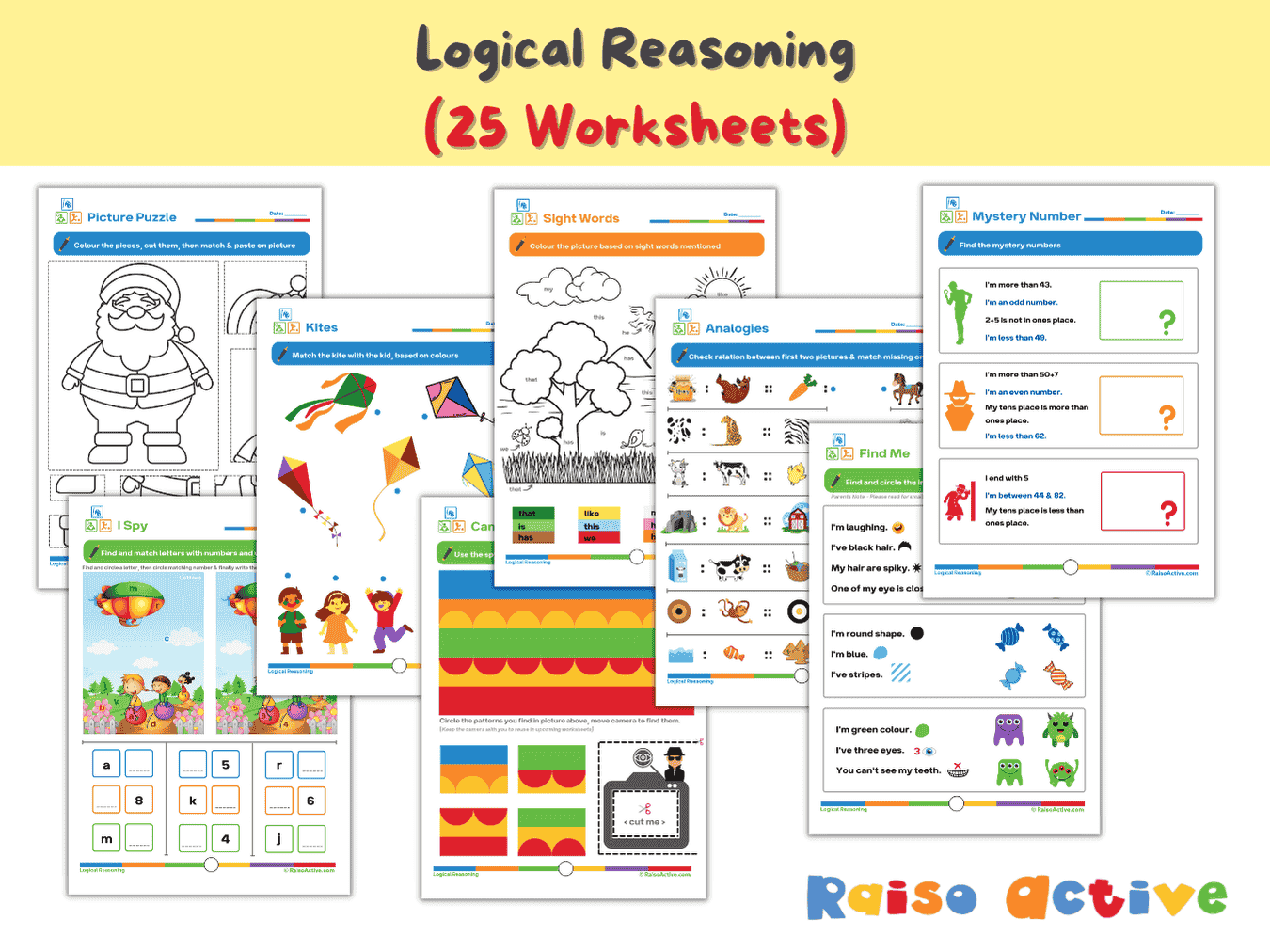
Part of the pack
Logical Reasoning Activity Book for Preschool & Kindergarten | Patterns, Puzzles & Analogies
This is page 15 of the pack. Ages 4-7 · Pre-K–Grade 1Ages 4-7 · Reception–Year 2Ages 4-7 · LKG–Class 1Ages 4-7
Curriculum
How to use this worksheet
Have your child cut out the hexagon shapes at the bottom of the page along the dotted lines. Look at the first incomplete honeycomb pattern together and ask your child what they notice is missing from the design. Have them search through the cut-out hexagons to find the one that completes the pattern correctly, checking the pattern details carefully before gluing it into place. Continue through each incomplete honeycomb section on the page, comparing patterns closely each time.
Materials needed
- Scissors
- Glue
- Pencil
Extension activities
- 1Create your own simple pattern using paper shapes and leave one piece blank for someone else to complete.
- 2Look at pictures of real bee honeycombs and talk about why hexagons fit together so well.
- 3Build a repeating pattern using blocks or beads, like red, yellow, red, yellow, and predict what comes next.
- 4Draw a large hexagon and decorate it with a pattern, then challenge someone to copy it exactly.
- 5Sort the leftover hexagon pieces by pattern type before starting the gluing step.

Written by
Hemsweta Jain · Teacher Cheena
MBA and Early Childhood Educator, teaching since 2014 · Founder of RaisoActive, Mumbai
Every RaisoActive worksheet is designed and checked by the founder before publishing.
Published · Last reviewed
More from Logical Reasoning Activity Book for Preschool & Kindergarten | Patterns, Puzzles & Analogies

I Spy Letter and Number Matching Worksheet for Preschoolers
Ages 3-5 · Preschool–Pre-KAges 3-5 · Nursery–ReceptionAges 3-5 · Nursery–LKGAges 3-5
Finding and circling a target letter, then finding and circling its matching number before writing the letter in a blank space, gives children ages 3-5 combined practice in visual scanning, letter recognition, and number recognition within a single multi-step task. Because the activity moves between two different symbol systems, letters and numbers, children build flexible attention and the ability to switch between related but distinct types of thinking. Writing the letter as a final step also reinforces handwriting practice on top of the visual search components.
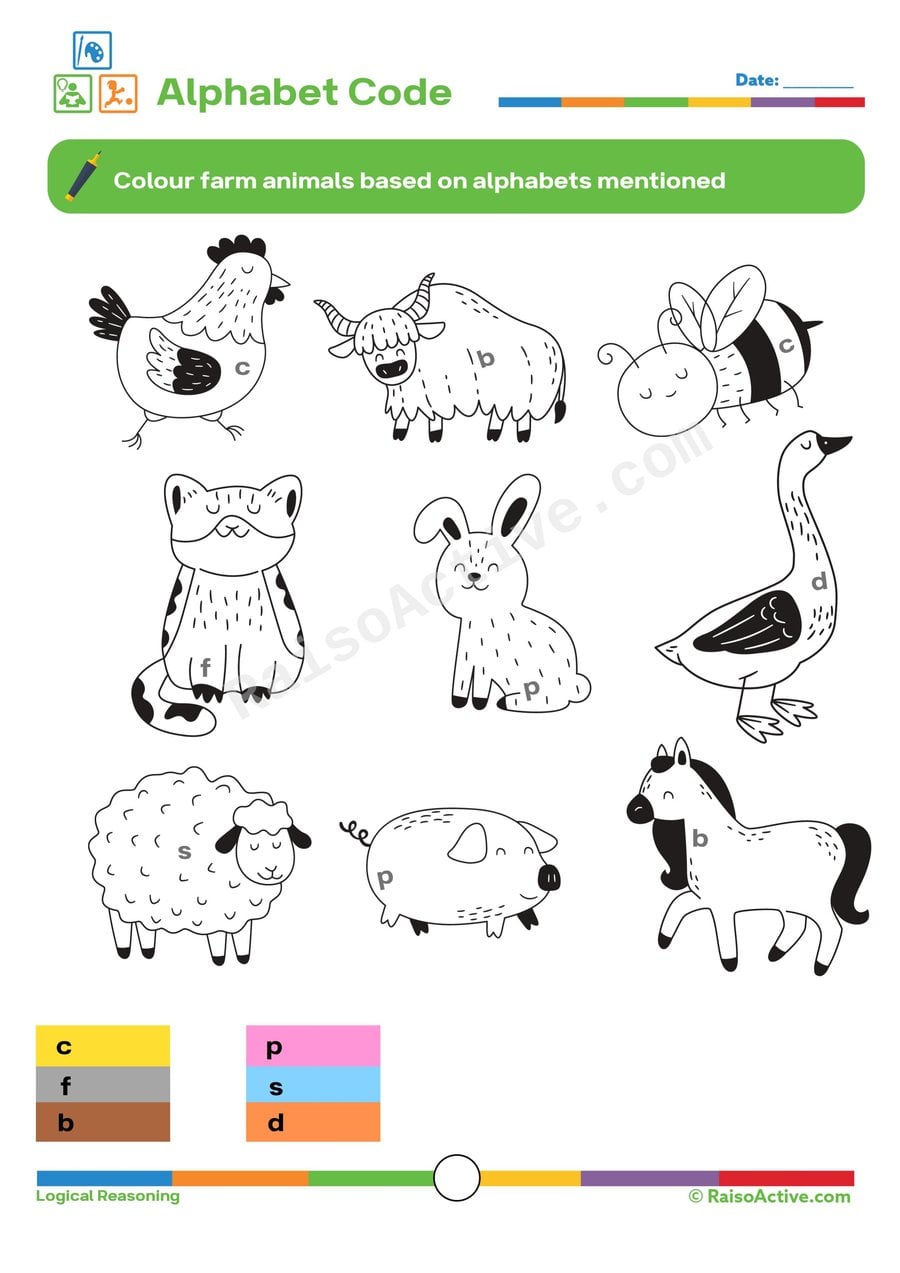
Color the Farm Animals! Alphabet Code Worksheet
Ages 3-5 · Preschool–Pre-KAges 3-5 · Nursery–ReceptionAges 3-5 · Nursery–LKGAges 3-5
Children ages 3-5 practice letter recognition and instruction-following by coloring farm animals according to a color code tied to specific letters. Matching a letter to its assigned color adds an extra layer of symbolic thinking beyond simple coloring, since children must hold both a letter and a color in mind at once.

Camera Spy: Find the Patterns Worksheet for Preschoolers
Ages 3-5 · Preschool–Pre-KAges 3-5 · Nursery–ReceptionAges 3-5 · Nursery–LKGAges 3-5
This pattern-recognition worksheet has children ages 3-5 study a set pattern shown at the top of the page and then locate that same repeating sequence within smaller boxes below, training visual comparison and pattern-matching across separate parts of a page. Unlike simply continuing a pattern, this format asks children to recognize an identical pattern elsewhere, a subtly different and useful skill for later tasks like matching sets or comparing groups. Repeating this scan-and-match process across several boxes builds sustained visual attention.
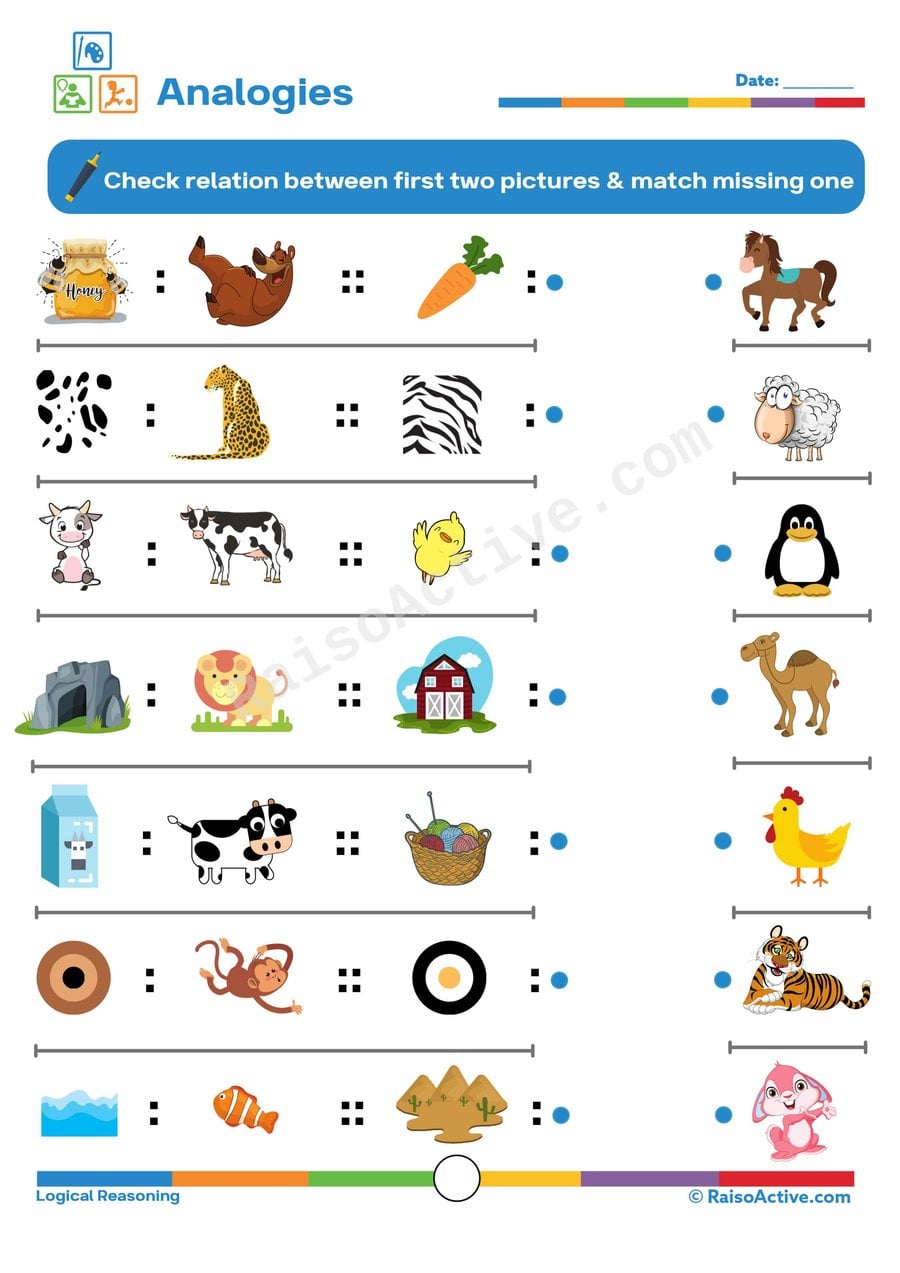
Analogies Worksheet: Match the Pictures!
Ages 4-6 · Pre-K–KindergartenAges 4-6 · Reception–Year 1Ages 4-6 · LKG–UKGAges 4-6
Identifying the relationship between two pictures and then finding a third picture that completes the same relationship teaches children ages 4-6 an early form of analogical reasoning, a skill that underlies much of later logical and mathematical thinking. Because children must first figure out an abstract relationship, like cause and effect or part to whole, before applying it to a new pair, this worksheet is more advanced than simple picture matching. Drawing a line to connect the completed analogy gives a clear, hands-on way to show their reasoning.
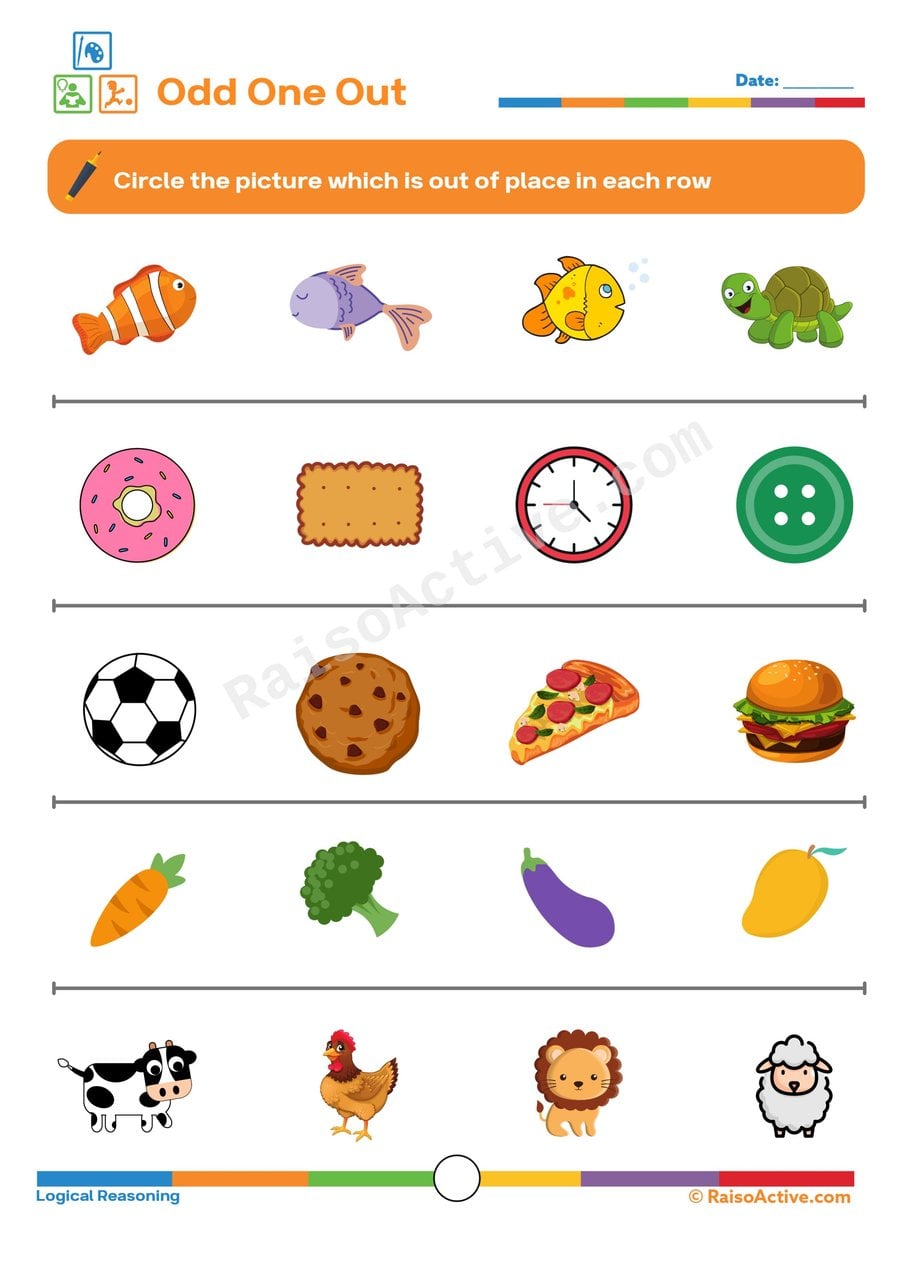
Odd One Out Worksheet: Spot the Differences!
Ages 4-6 · Pre-K–KindergartenAges 4-6 · Reception–Year 1Ages 4-6 · LKG–UKGAges 4-6
Identifying which picture in a row is different from the others builds visual discrimination and logical reasoning in children ages 4-6, requiring them to compare multiple objects at once and notice a distinguishing feature rather than just spotting an obvious mismatch. This skill directly supports later academic tasks like sorting, categorizing, and comparing, since children must articulate what makes an item different, not just recognize that it is. Explaining their reasoning out loud after choosing also builds early verbal reasoning and communication skills.

Mystery Numbers Worksheet: Find the Hidden Numbers!
Ages 4-6 · Pre-K–KindergartenAges 4-6 · Reception–Year 1Ages 4-6 · LKG–UKGAges 4-6
This 'Mystery Numbers' worksheet challenges children ages 4-6 to use logical reasoning and clue-reading to identify a hidden number, moving them beyond simple counting into deductive thinking. Each clue narrows down the possibilities, so children practice holding multiple pieces of information in mind at once, an early step toward number sense and problem-solving. It also reinforces number recognition as they check candidate numbers against every clue before settling on an answer.

Camera Spy: Find the Patterns Worksheet for Preschoolers
Ages 3-5 · Preschool–Pre-KAges 3-5 · Nursery–ReceptionAges 3-5 · Nursery–LKGAges 3-5
This 'camera spy' activity gives children ages 3-5 practice identifying repeating visual patterns within a busy scene, using a cut-out paper camera as a fun framing tool to focus their attention on one section at a time. Framing pattern-spotting as detective work keeps young children motivated through a task that otherwise requires sustained visual scanning. This early pattern recognition in a complex scene is more demanding than spotting patterns in a simple row, since children must first locate the pattern before they can identify it.

Color by Number Snowman Worksheet for Preschoolers
Ages 3-5 · Preschool–Pre-KAges 3-5 · Nursery–ReceptionAges 3-5 · Nursery–LKGAges 3-5
This color-by-number worksheet helps children ages 3-5 practice number recognition and color matching simultaneously, using a snowman picture divided into numbered sections. Reading a number key and applying it consistently across an entire picture builds sustained attention and careful visual tracking, since a single mistake can be spotted easily against the intended design. This combination of numeracy and following directions makes color-by-number activities a favorite bridge between math and art.
Related worksheets

Simple Pattern Worksheet for Preschoolers: Fill in the Sequence!
Ages 3-5 · Preschool–Pre-KAges 3-5 · Nursery–ReceptionAges 3-5 · Nursery–LKGAges 3-5
Recognizing and continuing a pattern is one of the earliest building blocks of mathematical and logical thinking for children ages 3-5, since it requires noticing a repeating rule and predicting what comes next based on that rule. This worksheet uses both shapes and numbers to build pattern awareness, asking children to fill in missing elements in a sequence and then match related number sequences together. Pattern recognition like this underpins later skills in math, reading, and even everyday problem-solving, since spotting repeating structures is a skill that transfers well beyond this one worksheet.
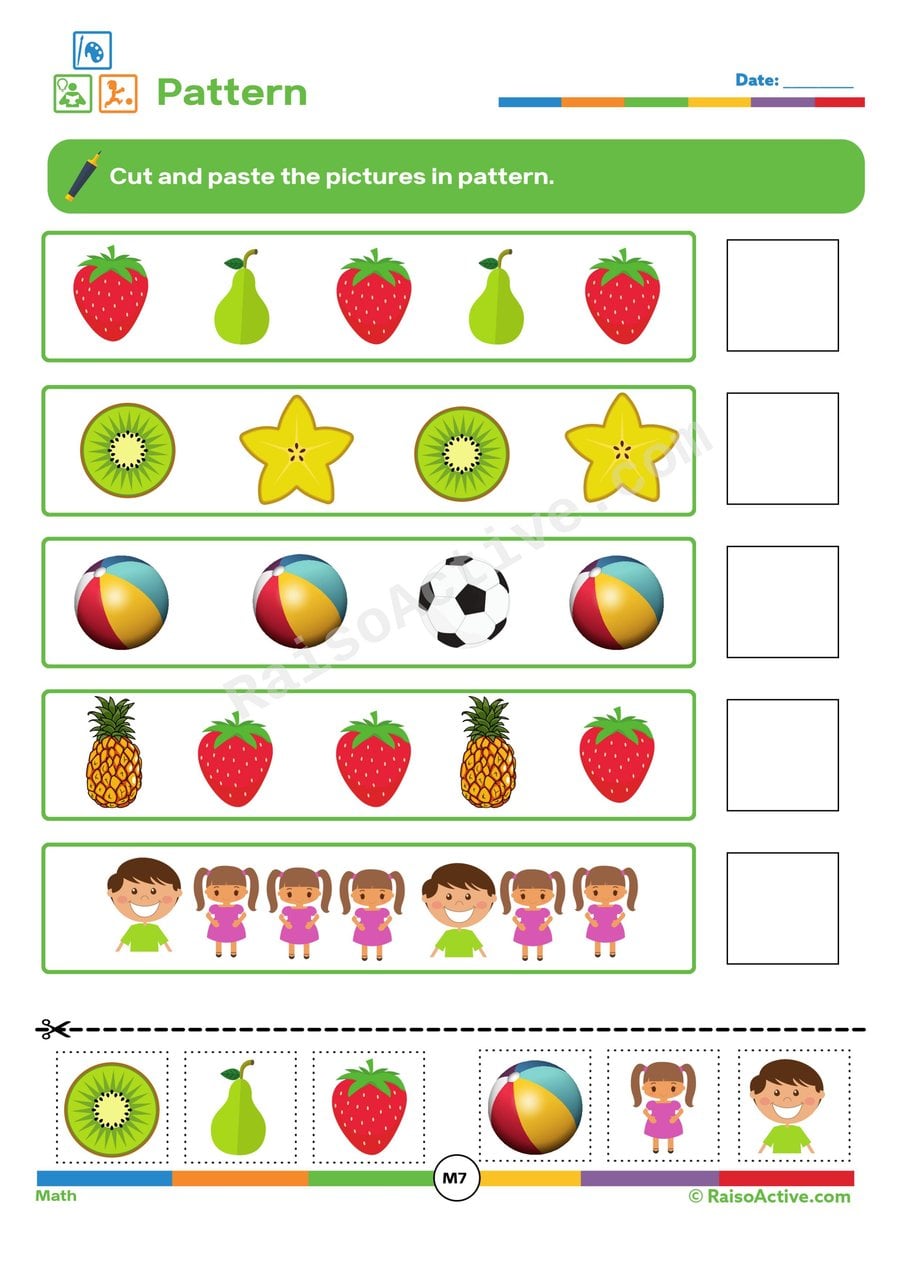
Fruit and Friends Pattern Worksheet
Ages 3-5 · Preschool–Pre-KAges 3-5 · Nursery–ReceptionAges 3-5 · Nursery–LKGAges 3-5
Identifying a repeating sequence of fruits or characters and choosing the correct picture to continue it builds pattern-recognition skills for children ages 3-5, an early form of logical reasoning that connects directly to later math concepts like skip counting.
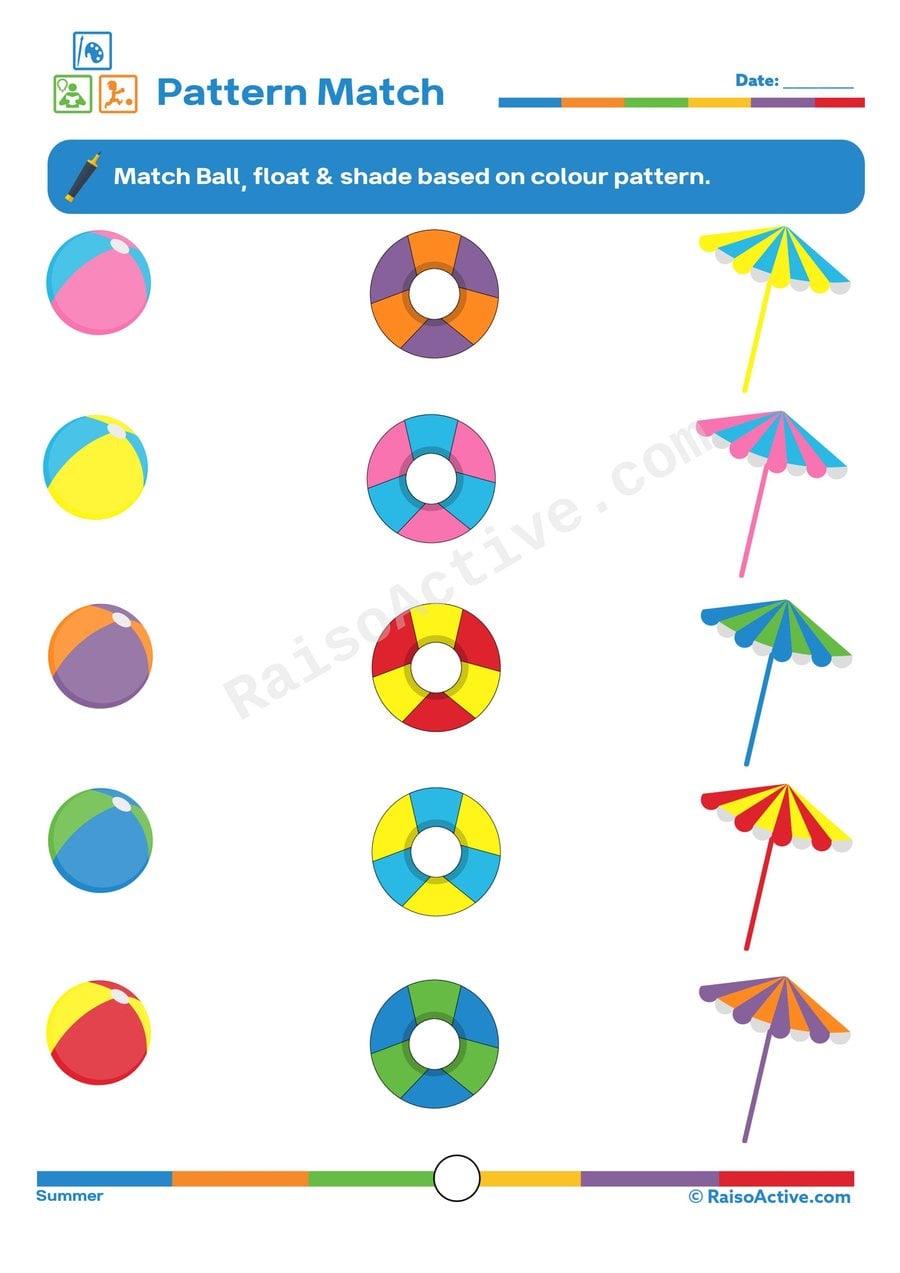
Summer Pattern Match Worksheet for Preschoolers
Ages 3-5 · Preschool–Pre-KAges 3-5 · Nursery–ReceptionAges 3-5 · Nursery–LKGAges 3-5
This worksheet asks children ages 3-5 to study the color pattern on a beach ball, pool float, and sun umbrella and match each item to its correctly patterned counterpart, building early pattern recognition, a foundational skill for later math concepts like sequencing and algebraic thinking. Because the match depends on noticing the order and repetition of colors rather than just matching a single color, children must compare details carefully rather than glance quickly. This strengthens visual attention alongside the pattern skill itself.

Pattern Power! What Comes Next? Worksheet for Preschoolers
Ages 3-5 · Preschool–Pre-KAges 3-5 · Nursery–ReceptionAges 3-5 · Nursery–LKGAges 3-5
This worksheet builds pattern recognition, an early algebraic thinking skill, as children ages 3-5 study a repeating sequence of shapes, letters, or numbers and figure out what belongs next. Spotting what repeats and predicting what comes after it trains logical reasoning and attention to detail that later transfers directly to math sequences and number patterns.
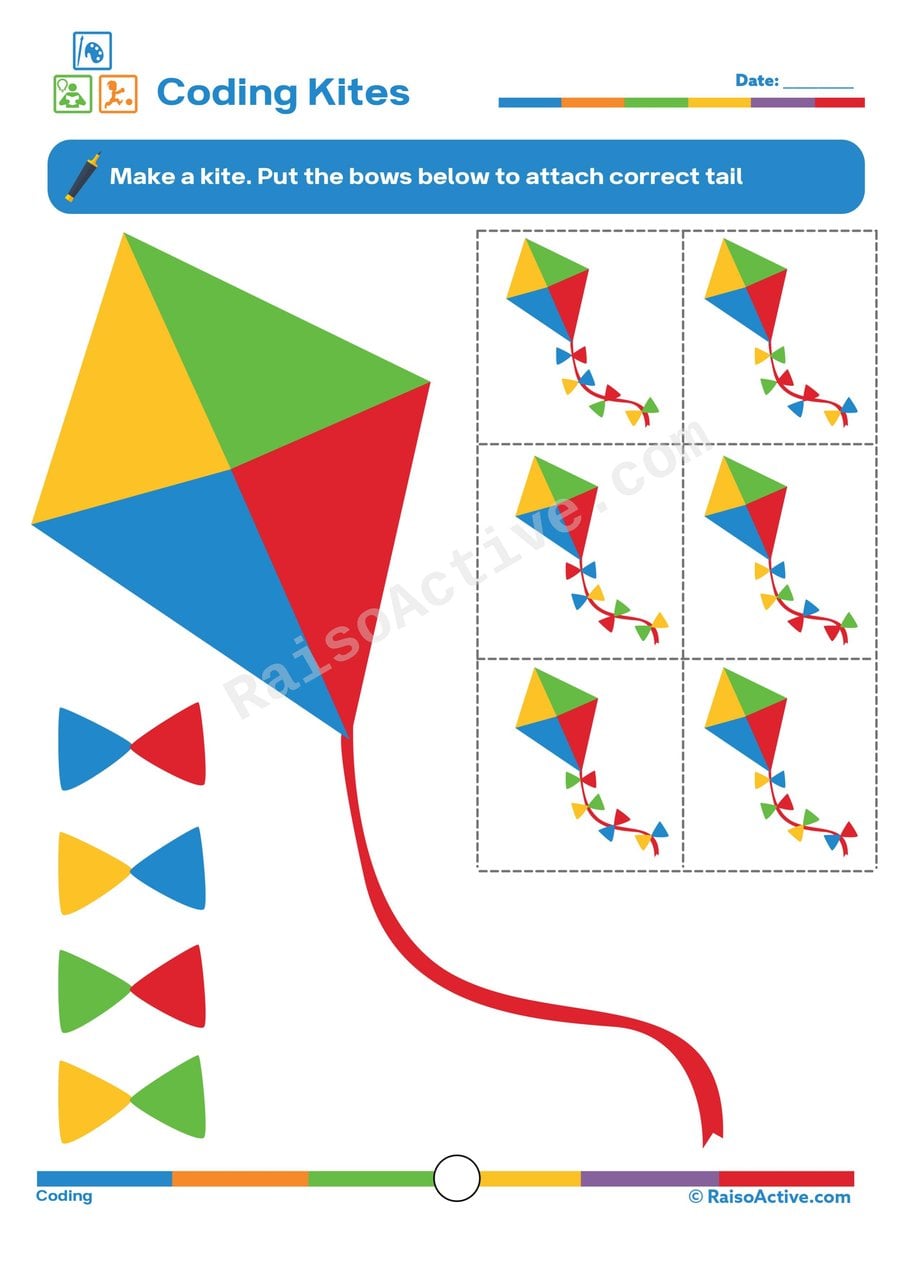
Coding Kites Worksheet: Match the Bows!
Ages 3-5 · Preschool–Pre-KAges 3-5 · Nursery–ReceptionAges 3-5 · Nursery–LKGAges 3-5
By matching each colorful bow to the kite sharing its color pattern, children ages 3-5 practice visual pattern recognition — an early form of the same logical sequencing used in beginner coding concepts. Cutting, matching, and gluing the correct bow also reinforces color-word vocabulary and precise hand-eye coordination.
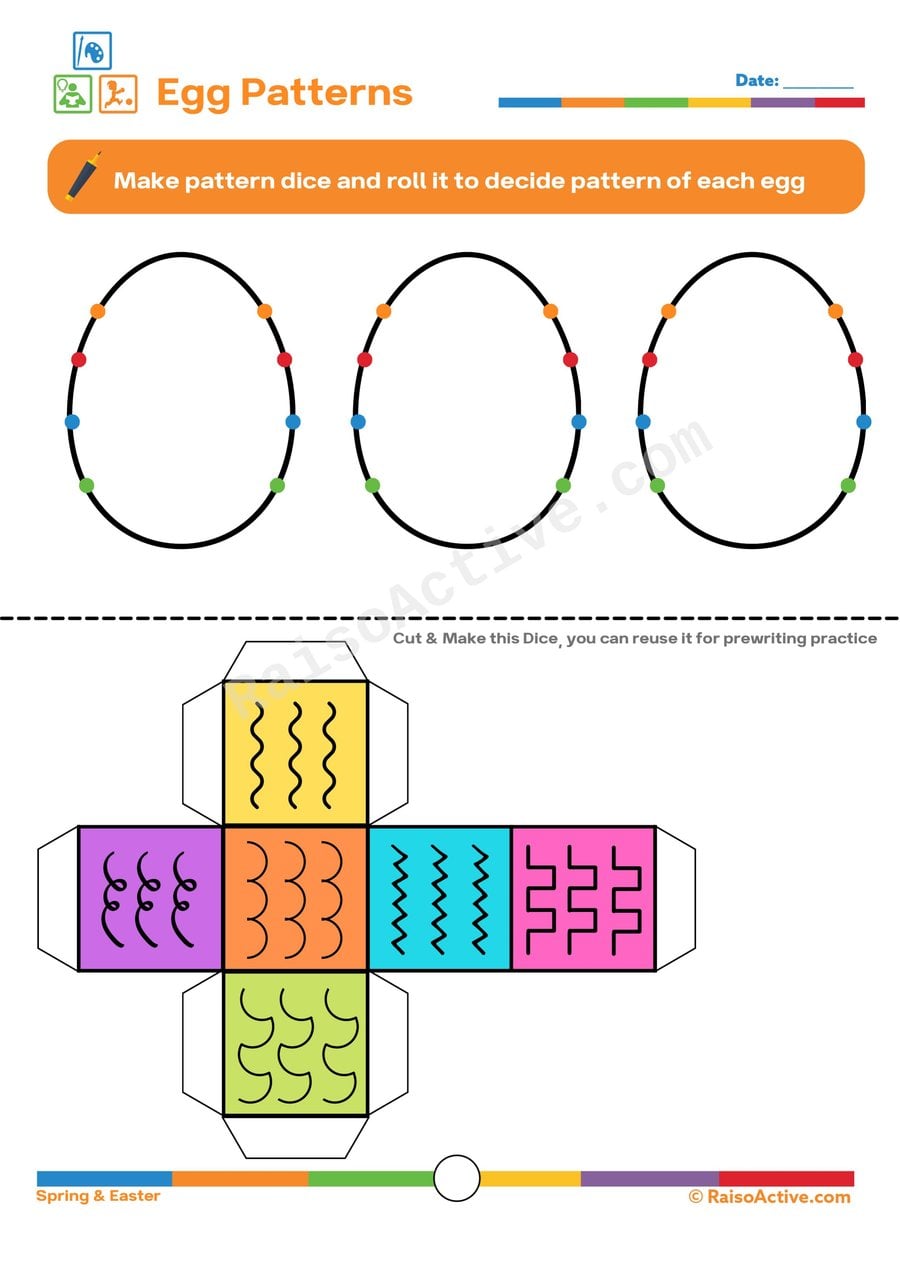
Egg Pattern Worksheet: Create and Match Patterns!
Ages 3-5 · Preschool–Pre-KAges 3-5 · Nursery–ReceptionAges 3-5 · Nursery–LKGAges 3-5
This egg-pattern activity has children ages 3-5 build a simple pattern dice and use it to generate and recreate repeating designs, developing pattern-recognition skills that underpin later math concepts like sequencing and multiplication. Rolling the dice and transferring the result onto each egg also connects a random outcome to a deliberate drawing action, strengthening cause-and-effect thinking.

Fall Leaf Patterns Matching Worksheet for Preschoolers
Ages 3-5 · Preschool–Pre-KAges 3-5 · Nursery–ReceptionAges 3-5 · Nursery–LKGAges 3-5
Children ages 3-5 build pattern recognition and logical reasoning skills by matching colored fall leaves to complete repeating patterns in a grid. Recognizing and continuing a pattern is an early algebraic thinking skill, teaching children to notice what comes next based on a repeating sequence — a foundation for later math concepts.
Pattern Fun: Identify and Complete the Sequences!
Ages 4-6 · Pre-K–KindergartenAges 4-6 · Reception–Year 1Ages 4-6 · LKG–UKGAges 4-6
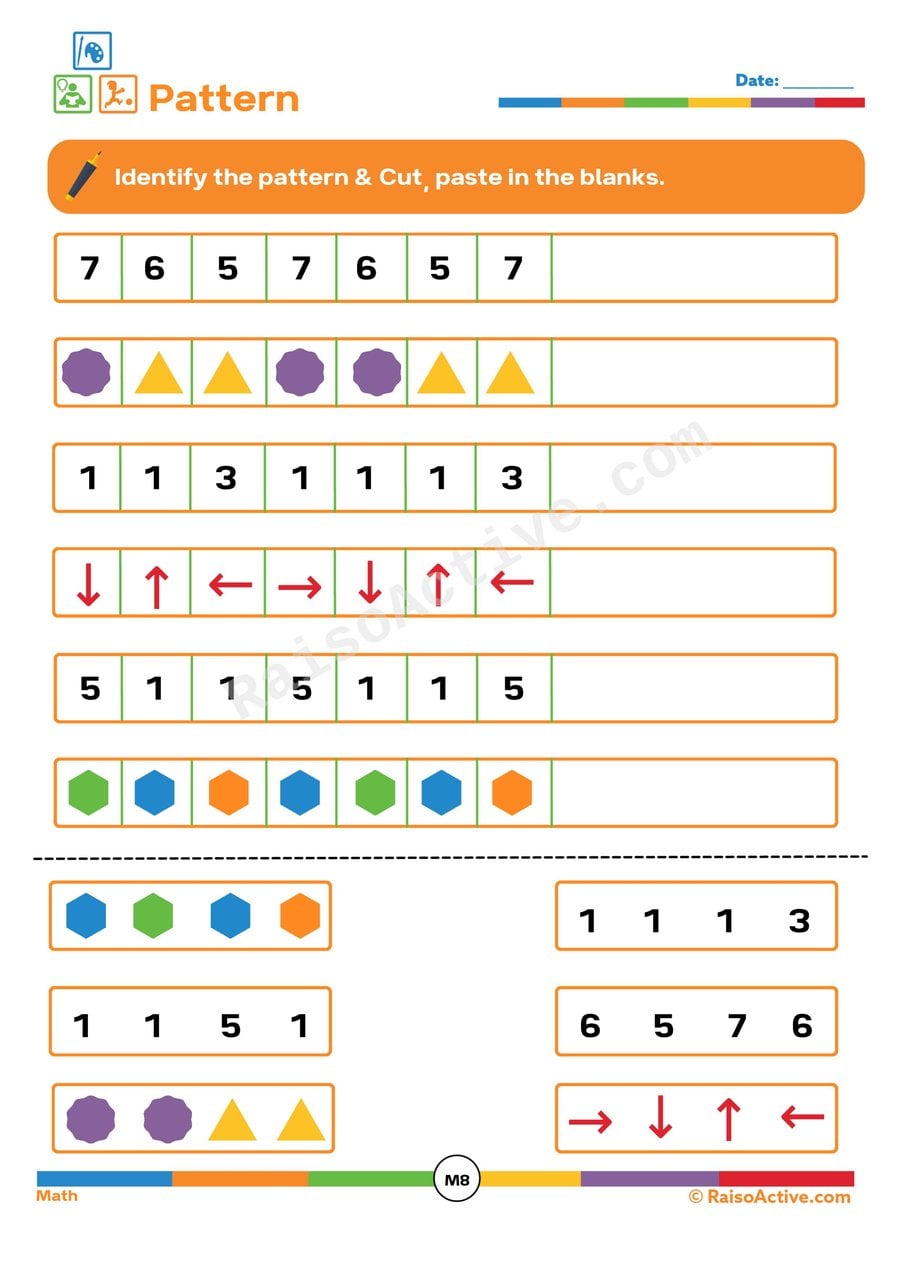
This worksheet mixes numbers, shapes, and symbols across different pattern types, pushing children to apply the same pattern-recognition logic flexibly rather than to just one familiar format. For ages four to six, practicing across varied pattern types builds a more transferable understanding of sequences, which will support both math and reading skills that rely on recognizing regular structures.
Guides for this topic

Pre-Writing Strokes in Order: From Standing Lines to Loops (With Printable Patterns)
The developmental order of pre-writing strokes, from vertical lines to loops, and why practicing them in sequence makes letter formation much easier to learn.

Best Worksheets for 3-Year-Olds: What Works and What to Avoid
What works on worksheets for 3-year-olds: short sessions, crayons, tracing lines, matching, cutting, a free weekly plan, and signs one is too advanced.

Age-Appropriate Problem-Solving Activities: Building Critical Thinkers from the Ground Up
Discover fun, age-appropriate problem-solving activities for children ages 1-8. Build critical thinking, logic, and reasoning skills through play-based learning.
Reviews
Every worksheet for ages 3–5, no watermark
Members download the full library of 1,000+ worksheets and every activity pack without watermarks or daily limits. One year costs ₹999 in India or $20 elsewhere.
See membership plansOr download any worksheet free with a watermark (5 a day).