
Mystery Numbers Worksheet: Find the Hidden Numbers!
This 'Mystery Numbers' worksheet challenges children ages 4-6 to use logical reasoning and clue-reading to identify a hidden number, moving them beyond simple counting into deductive thinking. Each clue narrows down the possibilities, so children practice holding multiple pieces of information in mind at once, an early step toward number sense and problem-solving. It also reinforces number recognition as they check candidate numbers against every clue before settling on an answer.
Curriculum
How to use this worksheet
Start by reading the first clue for a mystery number aloud together, and ask your child what numbers could fit. Move to the second clue and narrow the list of possible numbers, eliminating any that no longer match. Continue through all the clues for that number until only one number remains, then have your child write it in the answer box. Repeat the process for each new mystery number on the page, encouraging your child to explain their reasoning as they go.
Materials needed
- Pencil
Extension activities
- •Create your own mystery number clues for a friend to solve.
- •Use a number line to help you visualize the clues.
- •Play a real-life guessing game finding a number between 1 and 20 using yes/no clues.
- •Hide number cards around the room and give clues for your child to find the right one.
- •Ask your child to make up a clue about their own age or house number.
Tips for parents and teachers
Watch whether your child tries to hold all the clues in mind at once or forgets earlier ones as they go, since it's common at this age to need each clue re-read. If they guess without checking every clue, gently ask 'does that number fit this clue too?' to build the habit of verifying. Celebrate the process of elimination, not just the final right answer.

Written by
Hemsweta Jain · Teacher Cheena
MBA and Early Childhood Educator, teaching since 2014 · Founder of RaisoActive, Mumbai
Every RaisoActive worksheet is designed and checked by the founder before publishing.
Published · Last reviewed
Related worksheets

Clothing Pattern Match Worksheet for Preschoolers
This worksheet has children ages 3-5 study repeating patterns on clothing items — stripes, polka dots, or checks — and match each item to its identical twin, building visual discrimination and early pattern-sequencing skills. Distinguishing between similar-looking patterns also sharpens attention to detail, a skill that later supports letter and word recognition.

Trace the Numbers 1-9 Worksheet for Preschoolers
Tracing the numerals 1 through 9 gives children ages 3-5 repeated, guided practice with the specific pencil strokes each number requires, building the fine motor control and muscle memory needed for independent number writing. Because tracing follows a fixed, correct path, it also reinforces accurate numeral recognition, helping children tell visually similar digits apart.
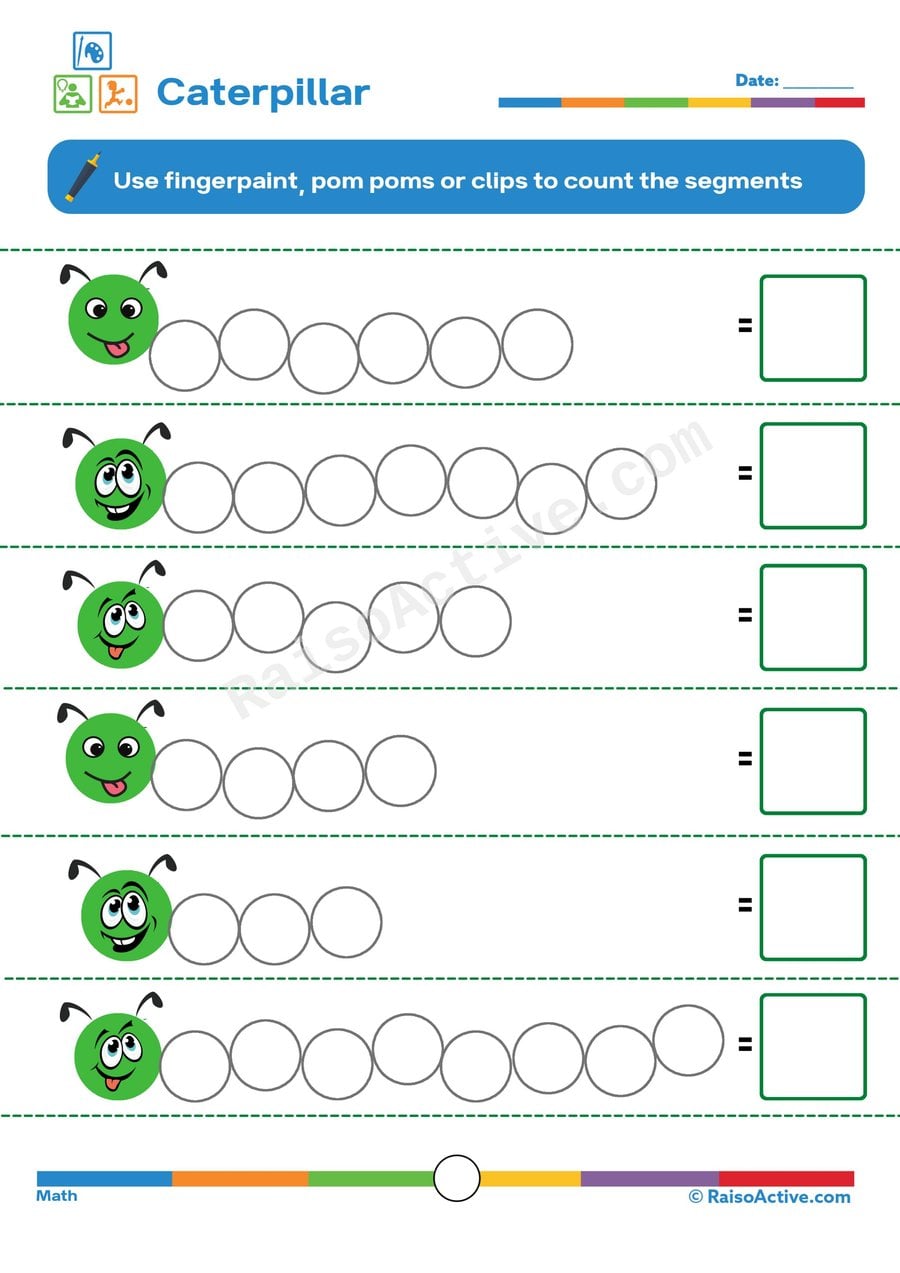
Caterpillar Counting Worksheet for Preschoolers
Counting the segments of each caterpillar teaches children ages 3-5 one-to-one correspondence — touching or marking each segment exactly once while saying a number — which is the core skill underlying accurate counting. Writing the final total in a box also connects the physical act of counting to its written numeral, reinforcing early number-writing practice.
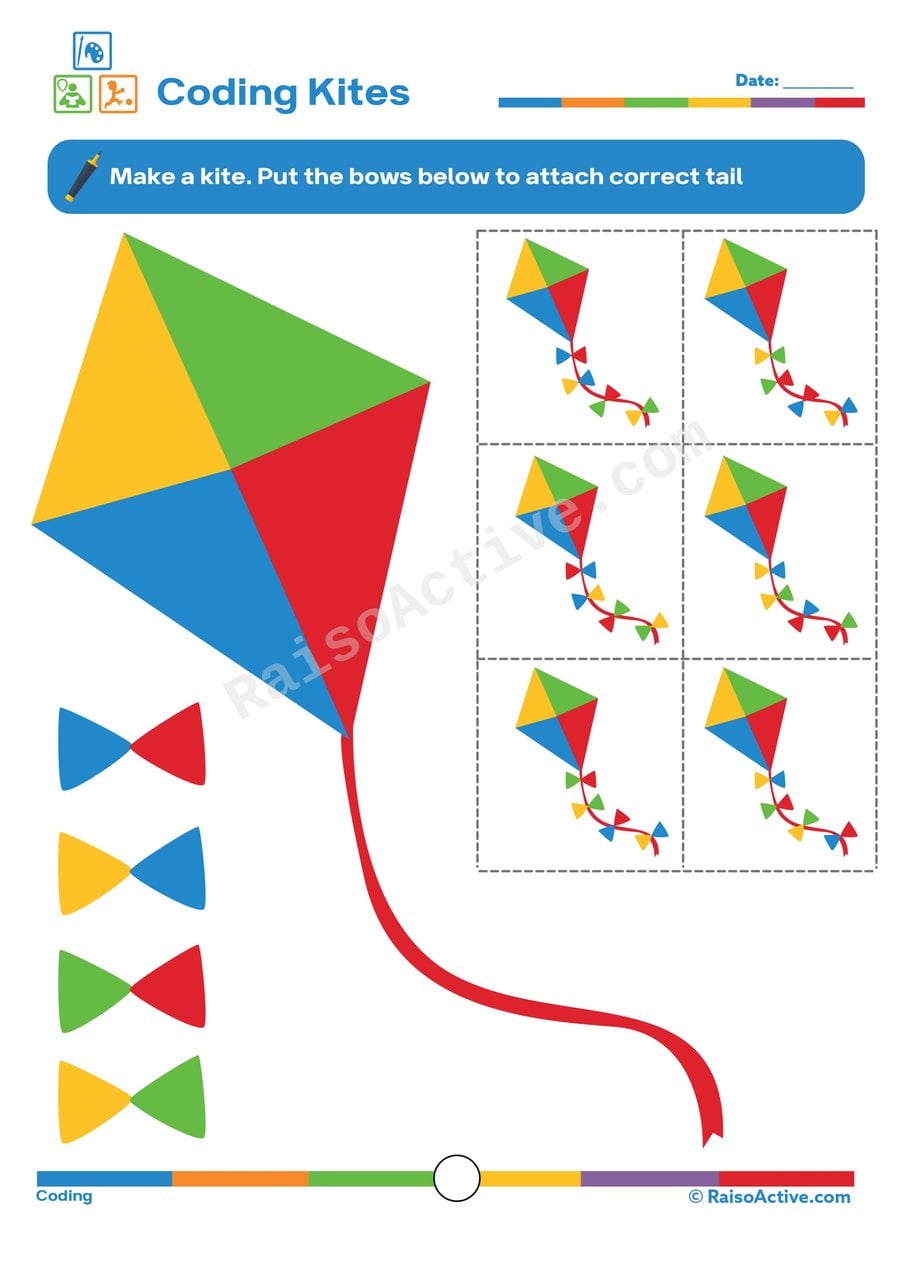
Coding Kites Worksheet: Match the Bows!
This activity sharpens visual observation in children ages 3-5 as they compare color sequences on each kite to a set of loose bows and find the exact match. Careful, systematic comparison — checking each color in order rather than glancing quickly — builds an attention-to-detail habit that transfers directly to early reading and number work.

Lock and Key Matching Worksheet for Preschoolers
Matching each key to the lock sharing the same letter helps children ages 3-5 practice letter recognition in a playful, puzzle-like context rather than rote drilling. Because each key must be checked against several similar-looking locks before finding the right match, this worksheet also builds visual scanning and careful comparison skills that support problem-solving.

Plant Parts Worksheet: Identify and Label the Parts of a Plant!
This worksheet teaches children ages 4-6 to identify and independently label the flower, stem, leaf, and roots of a plant, moving a step beyond simple matching toward recalling vocabulary from memory. Optionally adding pulses or grains to the diagram introduces a tactile, sensory layer that helps reinforce which part is which through touch as well as sight.

Soap & Pepper Science Experiment Worksheet for Preschoolers
This simple experiment introduces children ages 3-5 to the basic science of surface tension and how soap breaks it, using pepper flakes sprinkled on water as a visual demonstration. Watching the pepper scatter away the instant soap touches the water gives children a concrete, memorable example of cause and effect, an early building block for scientific thinking.

Balloon Pattern Matching Worksheet for Preschoolers
Children ages 3-5 build early pattern-recognition skills on this worksheet by studying a sequence of colored balloons and finding the matching set to complete it. Recognizing and continuing a repeating sequence is a foundational pre-math skill that later supports understanding of number patterns, skip counting, and simple algebraic thinking.
Guides for this topic
Number Formation Rhymes 0–9 and How to Fix Reversals
Original number formation rhymes for 0–9, the correct stroke order for each digit, why 3, 5 and 7 get reversed most often, and multisensory fixes that work.
Discovering Wonder: Nature-Based Learning Activities That Captivate Young Children
Explore nature-based learning activities for children ages 2–7 — leaf rubbings, bug hunts, nature journals, and seasonal Indian outdoor ideas that spark wonder.
Nurturing Your Gifted Child: How to Provide Appropriate Challenges at Home
Discover how to recognise giftedness in young children and provide meaningful challenges at home without burnout. Practical strategies for Indian parents.
Reviews
Every worksheet for ages 4–6, no watermark
Members download the full library of 1,000+ worksheets and every activity pack without watermarks or daily limits. One year costs ₹1,000 in India or $20 elsewhere.
See membership plansOr download any worksheet free with a watermark (5 a day).