My Family Tree Worksheet: Paste & Learn!
This worksheet helps children ages 3-5 build vocabulary around family relationships while practicing pasting skills and personal storytelling. Creating a visual, personalized family tree helps children organize and talk about the people closest to them, an early step in understanding relationships and social structure.
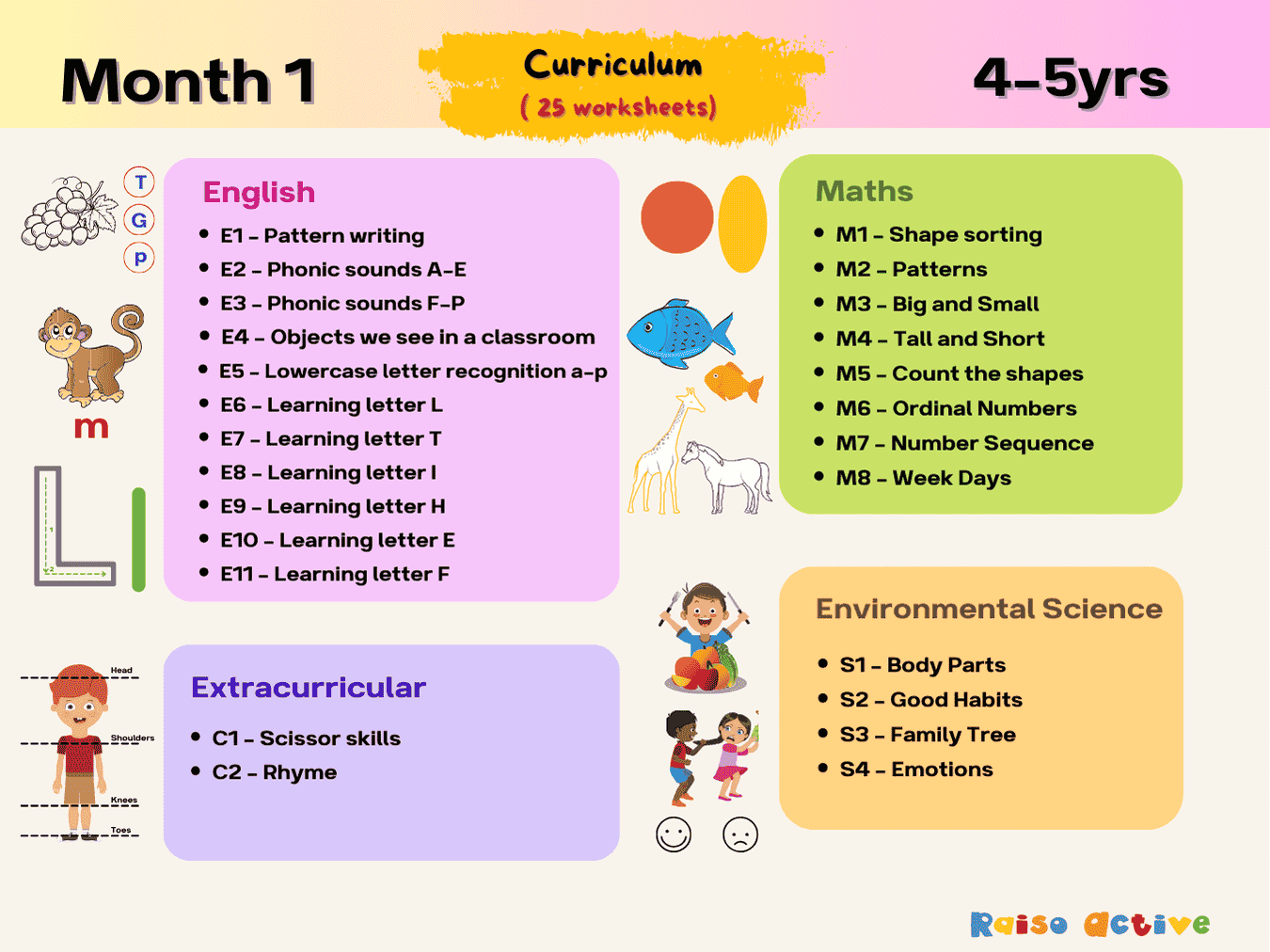
Part of the pack
Play-Based Learning Activity Book for 4-5 Year Olds | Literacy, Math & EVS
This is page 25 of the pack. Ages 4-5 · Pre-KAges 4-5 · ReceptionAges 4-5 · LKGAges 4-5
Made for your child
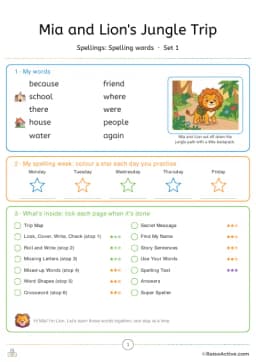
Spelling practice, made for your child
Their own spelling words turned into a pack: trace or look-cover-write-check, roll and write, a secret picture code, a word search, a crossword and a test, with their name in it.
Make a spelling packFree preview · free for members
Or start free: a word search with sight wordsCurriculum
- My Family & Community > My Family
How to use this worksheet
Gather a few small pictures of family members before starting, if available. Have your child paste each picture into one of the apple shapes on the tree, choosing where each person goes. Help them write or trace the name of each family member below their picture. Once complete, ask your child to point to each person and describe their relationship, such as 'this is my grandma.'
Materials needed
- Pictures of family members
- Glue
- Pencil or marker
Extension activities
- 1Draw pictures of family members if photos aren't available, adding your own creative details.
- 2Talk about the roles of each family member and something you love about them.
- 3Make a second family tree showing extended family, like cousins, aunts, and uncles.
- 4Interview one family member about a favorite memory and share it together.
- 5Create a simple family photo album alongside the finished tree.

Written by
Hemsweta Jain · Teacher Cheena
MBA and Early Childhood Educator, teaching since 2014 · Founder of RaisoActive, Mumbai
Every RaisoActive worksheet is designed and checked by the founder before publishing.
Published · Last reviewed
More from Play-Based Learning Activity Book for 4-5 Year Olds | Literacy, Math & EVS

Animal Babies Tracing Worksheet: Help the Babies Find Their Mothers!
Ages 3-5 · Preschool–Pre-KAges 3-5 · Nursery–ReceptionAges 3-5 · Nursery–LKGAges 3-5
This tracing worksheet has children ages 3-5 trace dotted lines to connect each baby animal to its correct mother, combining pencil control practice with early science knowledge about animal families. Learning which baby belongs to which adult animal — like a calf to a cow, or a cub to a lion — builds vocabulary and categorization skills that go beyond the tracing itself. Because the correct line only makes sense if the child recognizes the right animal pairing first, this activity blends fine motor practice with genuine content knowledge.

Happy Face Cut and Paste Worksheet for Preschoolers
Ages 3-5 · Preschool–Pre-KAges 3-5 · Nursery–ReceptionAges 3-5 · Nursery–LKGAges 3-5
This worksheet helps children ages 3-5 learn the names of facial features while practicing scissor control and precise gluing. Assembling a face piece by piece — eyes, nose, mouth, ears — reinforces body part vocabulary in a hands-on way that's more memorable than simply pointing at a picture.

Mickey Mouse Number Sequence Worksheet: Paste the Missing Numbers!
Ages 4-5 · Pre-KAges 4-5 · ReceptionAges 4-5 · LKGAges 4-5
This cut-and-paste worksheet uses a Mickey Mouse theme to give children ages 4-5 practice recognizing and completing number sequences by identifying missing numbers within numbered frames and pasting them into place. Because the missing numbers appear in the middle of a sequence rather than only at the end, children must think about both the number before and after a gap, a more demanding skill than simple 'what comes next' counting. The familiar character theme adds motivation to a task that is fundamentally about numerical reasoning.

Butterfly Cutting Practice Worksheet for Preschoolers
Ages 3-5 · Preschool–Pre-KAges 3-5 · Nursery–ReceptionAges 3-5 · Nursery–LKGAges 3-5
This cutting-practice worksheet gives children ages 3-5 dedicated repetition in guiding scissors along a straight or gently curved dotted line, a core pre-writing and self-help skill that strengthens hand strength and bilateral coordination. Framing the goal as 'reaching the butterflies' gives children a visual reward for careful, controlled cutting rather than treating scissor practice as an isolated drill. Building this scissor control early supports later success with more complex cut-and-paste crafts.

Parent's Guide: Fun Activities for Gross Motor Development and Emotional Learning
Ages 3-5 · Preschool–Pre-KAges 3-5 · Nursery–ReceptionAges 3-5 · Nursery–LKGAges 3-5
This parent guide equips caregivers of children ages 3-5 with activities spanning gross motor skills, emotional expression, family concepts, shape recognition, and calendar awareness, using role play, finger puppets, and simple games. Combining physical movement with emotional vocabulary practice, such as making different facial expressions, helps children build body awareness and feelings vocabulary side by side. Rotating through several distinct activity types in one guide also keeps a young child's attention across a longer play session.

Big and Small Fish Counting Worksheet for Preschoolers
Ages 3-5 · Preschool–Pre-KAges 3-5 · Nursery–ReceptionAges 3-5 · Nursery–LKGAges 3-5
This counting worksheet gives children ages 3-5 practice with one-to-one correspondence — touching and counting each fish exactly once — while also comparing two groups by size. Splitting the fish into 'big' and 'small' groups before counting adds a light classification step that sharpens observation skills alongside basic numeracy. Recording each total as a written numeral also connects counting aloud to number formation.

Learn to Write Letter L Worksheet for Preschoolers
Ages 3-5 · Preschool–Pre-KAges 3-5 · Nursery–ReceptionAges 3-5 · Nursery–LKGAges 3-5
This worksheet builds fine motor control and letter formation skills in children ages 3-5 as they trace and then independently write the capital letter L, while also identifying words that begin with the same letter. Practicing the simple two-stroke shape of L — a straight line down and a straight line across — is a good early letter for building confidence, since its strokes are more forgiving than curved letters. Coloring L-word pictures afterward reinforces the letter-sound connection alongside the shape practice.

Letter Sounds Worksheet: Color the Letter That Begins the Word!
Ages 4-5 · Pre-KAges 4-5 · ReceptionAges 4-5 · LKGAges 4-5
This worksheet strengthens phonemic awareness in children ages 4-5 by asking them to isolate the very first sound of a picture's name and match it to its printed letter. Identifying beginning sounds is one of the strongest early predictors of reading success, since it teaches children that spoken words are made of individual sounds that map onto letters. The coloring component adds a motivating, low-pressure way to record each answer.
Related worksheets
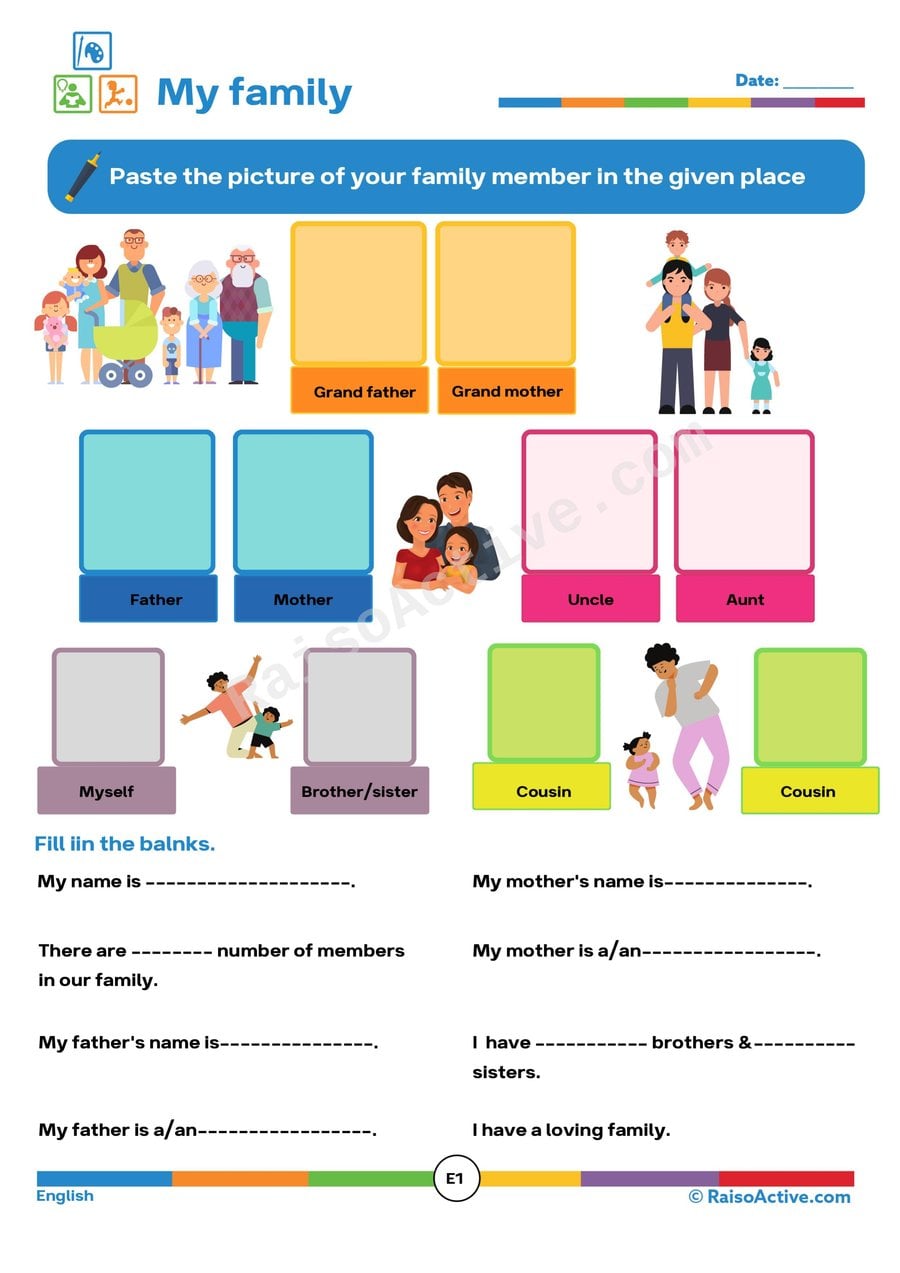
My Family Worksheet: Learn About Family Members!
Ages 3-5 · Preschool–Pre-KAges 3-5 · Nursery–ReceptionAges 3-5 · Nursery–LKGAges 3-5
Describing and pasting pictures of family members helps children practice using descriptive language about people they know well, building both vocabulary and an early sense of identity and belonging. For ages three to five, talking about family structure also introduces social-emotional vocabulary, since children learn to name relationships and describe why family matters to them.
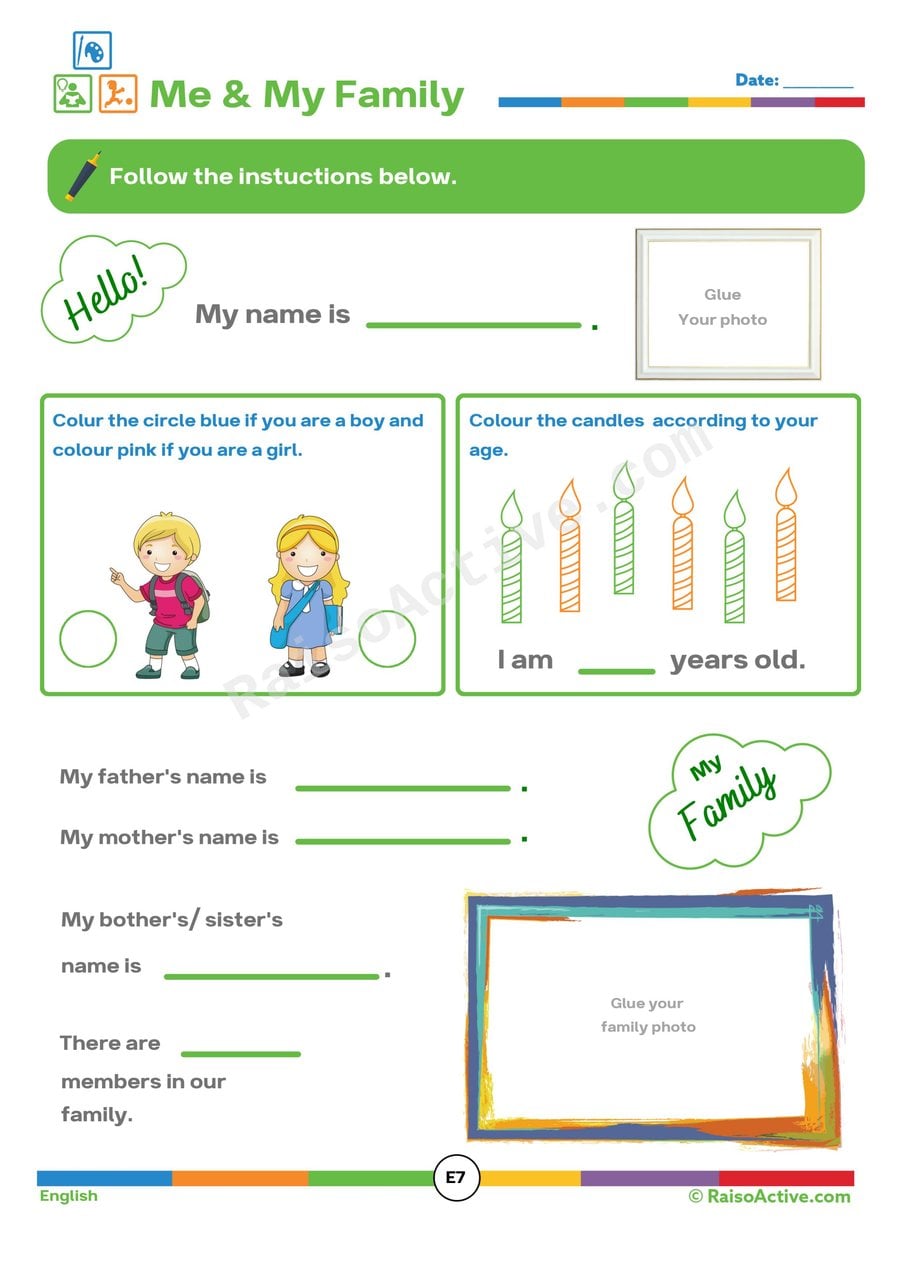
My Family Worksheet: Fun Activities for Kids!
Ages 3-5 · Preschool–Pre-KAges 3-5 · Nursery–ReceptionAges 3-5 · Nursery–LKGAges 3-5
This worksheet builds early writing and self-expression skills by having children fill in personal information about themselves and their family members, along with a color-the-candles activity representing their age. For ages 3-5, writing about their own family in a structured but personal format helps children practice functional writing while reinforcing their sense of identity and belonging.
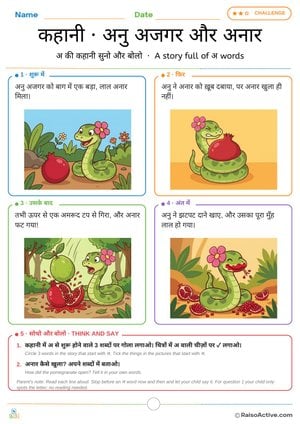
Letter अ Story: Anu Ajgar and the Pomegranate | कहानी अनु अजगर और अनार
Ages 3-7 · Preschool–Grade 1Ages 3-7 · Nursery–Year 2Ages 3-7 · Nursery–Class 1Ages 3-7
Anu the python finds a big red pomegranate in the garden, squeezes it, and a guava falls from the tree and bursts it open. Children listen, look at the four pictures, spot the words that start with अ and retell what happened in their own words.
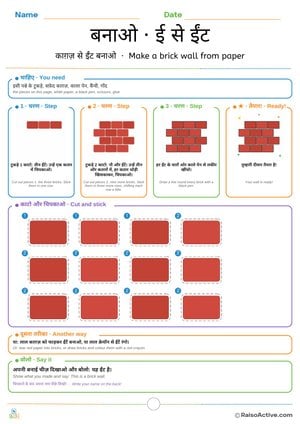
Make a Paper Brick Wall: Hindi Letter ई Craft | बनाओ · ई से ईंट
Ages 3-7 · Preschool–Grade 1Ages 3-7 · Nursery–Year 2Ages 3-7 · Nursery–Class 1Ages 3-7
Children cut out the pieces, put them together following three step pictures and make a paper brick wall. Saying the word ईंट as they make it links the sound ई to something they built themselves.

Indian Cities Crossword Puzzle Worksheet for Kids
Ages 4-6 · Pre-K–KindergartenAges 4-6 · Reception–Year 1Ages 4-6 · LKG–UKGAges 4-6
This crossword challenges children ages 4-6 to identify famous Indian cities from picture clues of their landmarks and then spell out each city's name in the puzzle grid, combining observation skills with early geography knowledge. Counting the crossword boxes to match each city's letter count also reinforces attention to word length before writing.

Coding Shapes Worksheet for Preschoolers: Cut and Paste Patterns
Ages 3-5 · Preschool–Pre-KAges 3-5 · Nursery–ReceptionAges 3-5 · Nursery–LKGAges 3-5
This cut-and-paste activity has children ages 3-5 recreate shape sequences shown in sample boxes, combining shape recognition with the same ordered, step-by-step thinking used in beginner coding concepts. Cutting out individual shapes and arranging them in the correct sequence also builds fine motor precision and spatial planning.

Spring Vocabulary Unscramble Worksheet for Preschoolers
Ages 4-5 · Pre-KAges 4-5 · ReceptionAges 4-5 · LKGAges 4-5
This unscrambling worksheet has children ages 4-5 rearrange jumbled letters into correctly spelled spring vocabulary words, strengthening letter-sound awareness and reinforcing the idea that letters have a fixed, meaningful order. Working from a picture clue to a written word also builds the bridge between spoken vocabulary and early spelling.
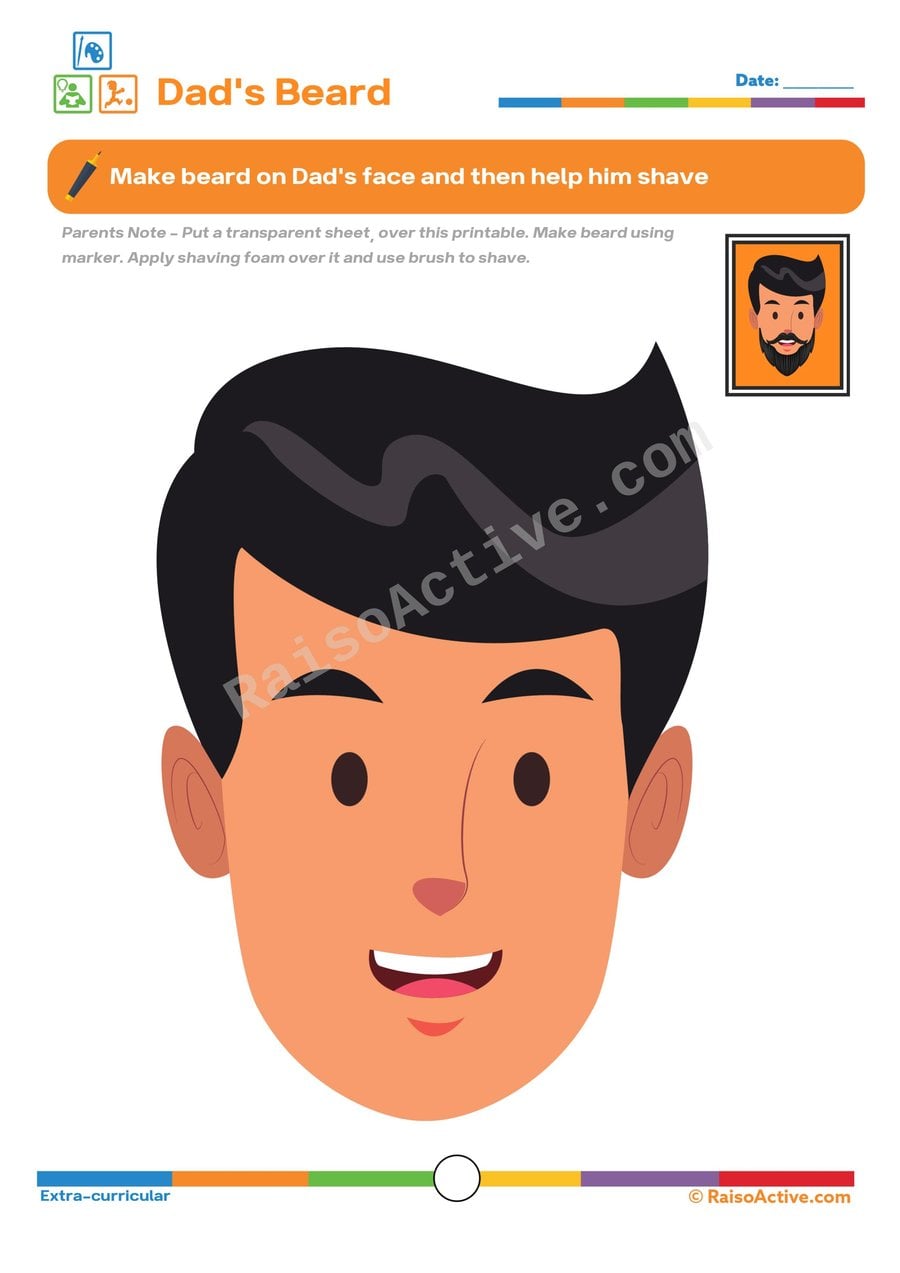
Dad's Beard: A Fun Shaving Activity for Kids!
Ages 3-5 · Preschool–Pre-KAges 3-5 · Nursery–ReceptionAges 3-5 · Nursery–LKGAges 3-5
This sensory pretend-shaving activity builds fine motor precision and hand control in children ages 3-5, as they draw a beard with a marker and then carefully brush away shaving foam in controlled strokes. Beyond motor skills, it gives children a playful, low-stakes way to imitate a grown-up grooming routine they've likely observed at home.
Guides for this topic

Sight Words by Age: The First 50 Words and How to Teach Them Without Flashcard Fatigue
Which sight words to teach first and why, the heart-word method, a read-trace-write-find routine, games, and a by-age table of typical sight-word progress.
How to Teach CVC Blending: A Step-by-Step Method That Works in Two Weeks
A step-by-step method for teaching CVC blending, covering continuous sounds, word families, common errors, and a 14-day plan that most children finish reading CVC words.

Bridging Two Worlds: A Complete Guide to Teaching Heritage Languages Alongside English
A practical guide to raising bilingual children who speak both their heritage language and English with confidence. Research-backed strategies, activities, and tips for Indian families.
Reviews
Every worksheet for ages 3–5, no watermark
Members download the full library of 1,000+ worksheets and every activity pack without watermarks or daily limits. One year costs ₹999 in India or $20 elsewhere.
See membership plansOr download any worksheet free with a watermark (5 a day).