Animal Babies Tracing Worksheet: Help the Babies Find Their Mothers!
This tracing worksheet has children ages 3-5 trace dotted lines to connect each baby animal to its correct mother, combining pencil control practice with early science knowledge about animal families. Learning which baby belongs to which adult animal — like a calf to a cow, or a cub to a lion — builds vocabulary and categorization skills that go beyond the tracing itself. Because the correct line only makes sense if the child recognizes the right animal pairing first, this activity blends fine motor practice with genuine content knowledge.
Part of the pack
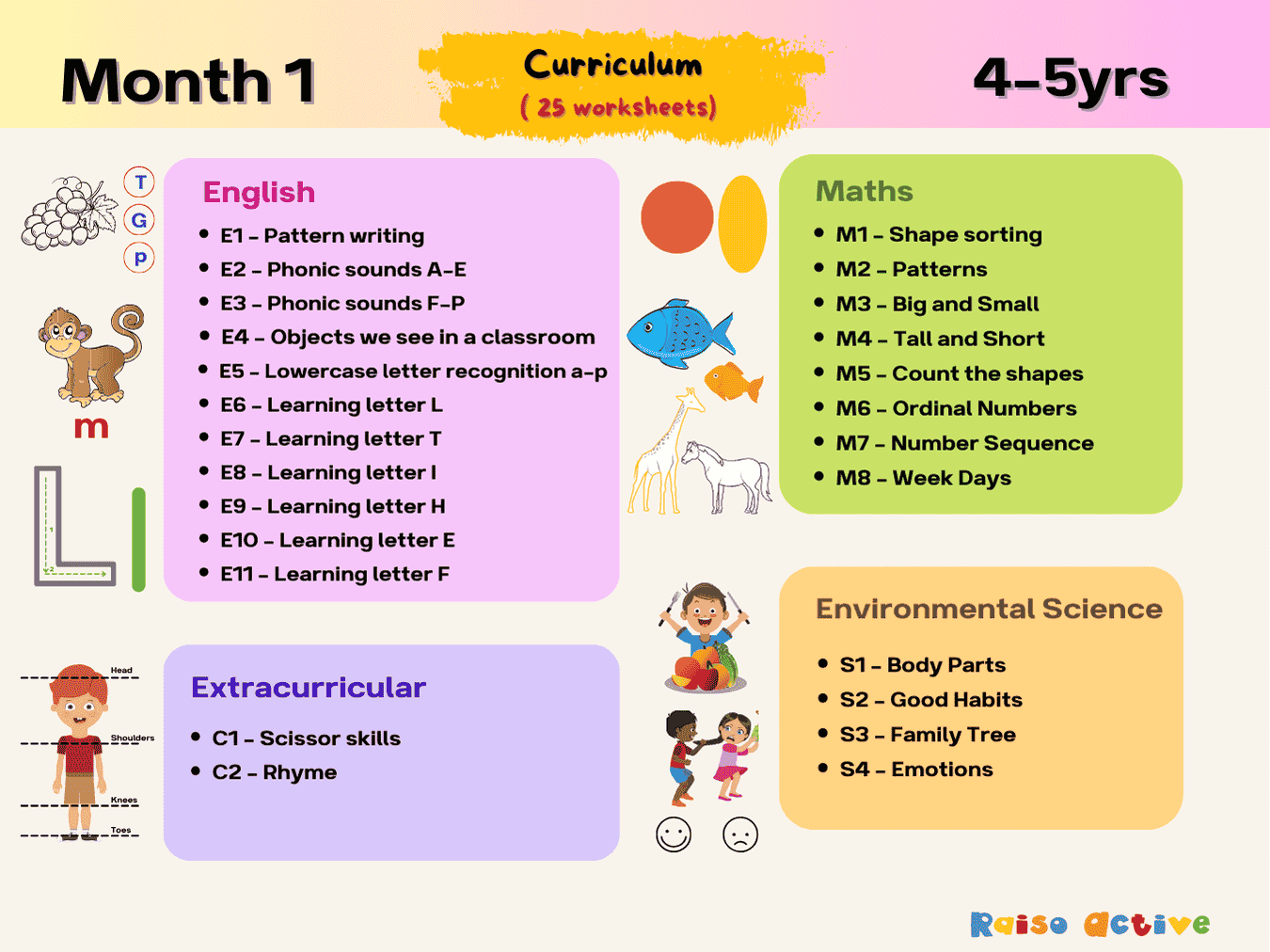
Play-Based Learning Activity Book for 4-5 Year Olds | Literacy, Math & EVS
This is page 4 of the pack. Ages 4-5 · Pre-KAges 4-5 · ReceptionAges 4-5 · LKGAges 4-5

Made for your child
A whole activity pack made with their name
60 pages to spot, build, trace and write their own name, plus pages about their favourites, feelings and family. See a free preview with their name.
Make an All About Me packFree preview · free for members
Or start free: a name tracing sheet with their nameCurriculum
- Living Things - Animals > Animals & Habitats
How to use this worksheet
Look at each baby animal on one side of the page and each mother animal on the other side, naming them together. Ask your child which mother belongs to which baby animal, based on what they already know or can guess from appearance. Once they've identified the correct pairs, have them trace the dotted line connecting each baby to its mother. Review the completed page together, confirming each pairing makes sense.
Materials needed
- Pencil
- Crayons
Extension activities
- 1Color the animals after tracing the lines, discussing their similar features.
- 2Discuss the different animal families and what the babies eat.
- 3Look up the special names for baby animals, like 'joey' for a kangaroo or 'kid' for a goat.
- 4Sort a set of animal picture cards into mother and baby pairs.
- 5Watch a short video of a real animal family to see the mother and baby interacting.

Written by
Hemsweta Jain · Teacher Cheena
MBA and Early Childhood Educator, teaching since 2014 · Founder of RaisoActive, Mumbai
Every RaisoActive worksheet is designed and checked by the founder before publishing.
Published · Last reviewed
More from Play-Based Learning Activity Book for 4-5 Year Olds | Literacy, Math & EVS

Shape Pattern Fun: Complete the Pattern Worksheet for Preschoolers
Ages 3-5 · Preschool–Pre-KAges 3-5 · Nursery–ReceptionAges 3-5 · Nursery–LKGAges 3-5
This worksheet introduces children ages 3-5 to pattern recognition using shapes, asking them to notice a repeating sequence and supply the missing piece. Continuing a pattern requires children to detect a rule and predict what comes next, an early form of the logical reasoning that later supports algebra and sequencing skills. Cutting and pasting the correct shape also reinforces shape recognition and fine motor precision.
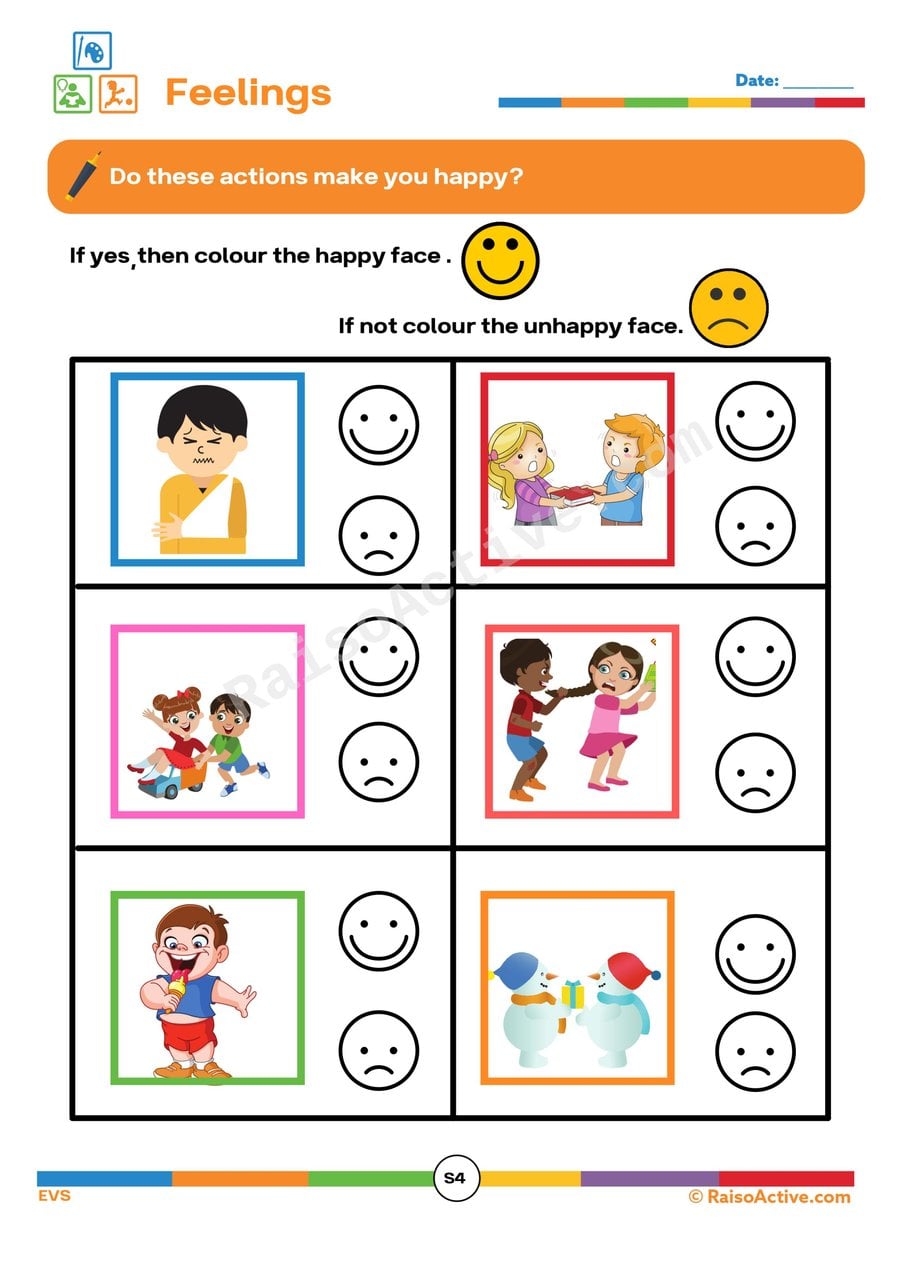
Feelings Worksheet: Happy or Sad?
Ages 3-5 · Preschool–Pre-KAges 3-5 · Nursery–ReceptionAges 3-5 · Nursery–LKGAges 3-5
Children ages 3-5 build emotional vocabulary and self-awareness as they decide whether different everyday situations would make them feel happy or sad. Naming and sorting emotions based on a scenario is an early social-emotional skill that helps children recognize and eventually talk about their own feelings more clearly.

Letter E Tracing and Coloring Worksheet for Preschoolers
Ages 3-5 · Preschool–Pre-KAges 3-5 · Nursery–ReceptionAges 3-5 · Nursery–LKGAges 3-5
This tracing and coloring worksheet teaches children ages 3-5 to recognize and write both the uppercase and lowercase letter E, while also identifying pictures of objects that begin with that letter's sound. Practicing a letter in both its capital and lowercase forms helps children see that they represent the same sound despite looking different, an important early literacy concept. Circling matching pictures alongside the tracing also connects the visual letter shape to its corresponding beginning sound in spoken words.

Letter H Worksheet: Trace, Write, and Color the Letter H!
Ages 3-5 · Preschool–Pre-KAges 3-5 · Nursery–ReceptionAges 3-5 · Nursery–LKGAges 3-5
This worksheet gives children ages 3-5 layered practice with the letter H, moving from finger tracing to pencil tracing and finally to identifying and coloring pictures that begin with the H sound. Starting with a finger trace before picking up a pencil is a gentle way to build the motor pattern for a letter's shape without the added challenge of pencil control, making this a good scaffolded approach for less confident writers. Circling H pictures afterward reinforces the connection between the letter's shape and its beginning sound.
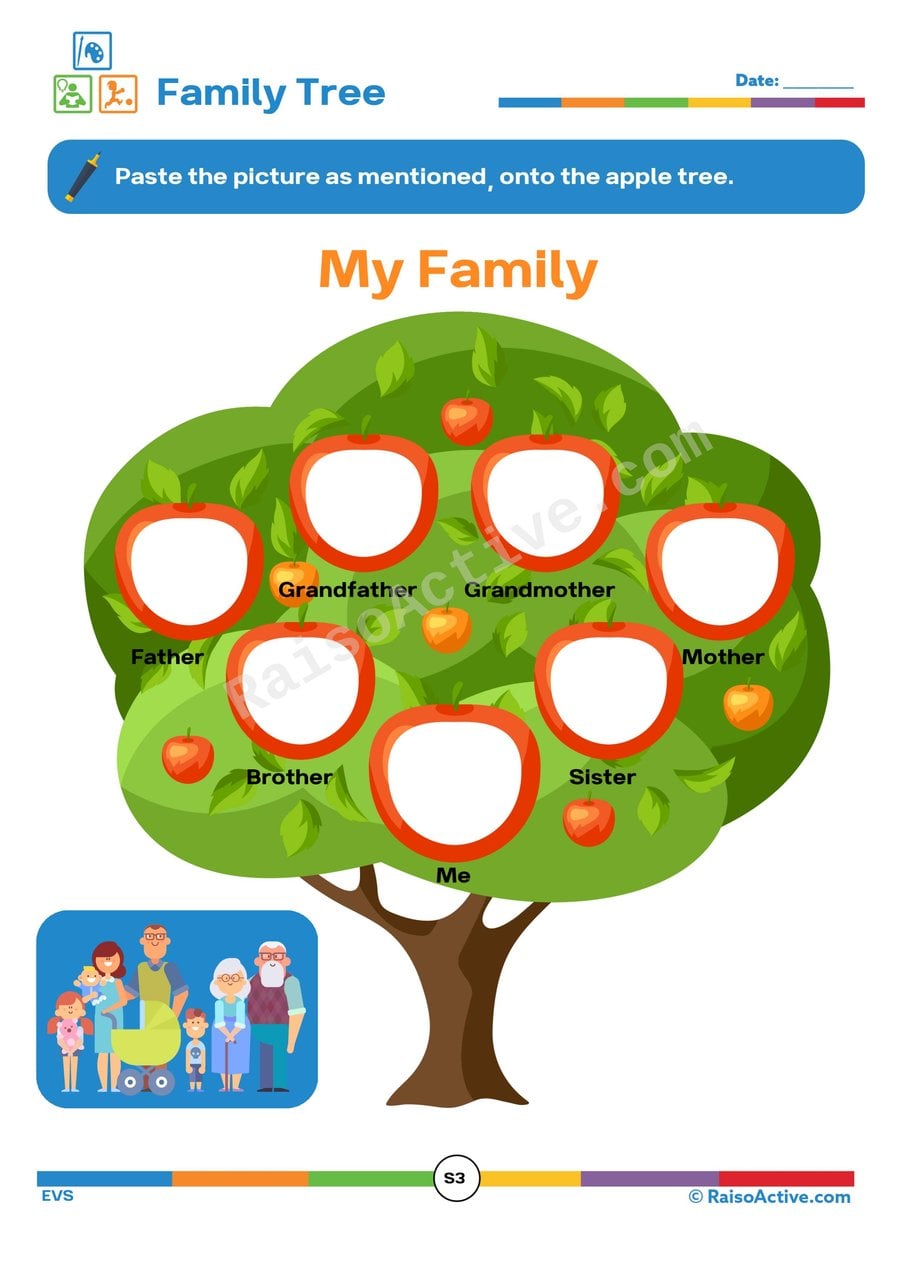
My Family Tree Worksheet: Paste & Learn!
Ages 3-5 · Preschool–Pre-KAges 3-5 · Nursery–ReceptionAges 3-5 · Nursery–LKGAges 3-5
This worksheet helps children ages 3-5 build vocabulary around family relationships while practicing pasting skills and personal storytelling. Creating a visual, personalized family tree helps children organize and talk about the people closest to them, an early step in understanding relationships and social structure.

Ordinal Numbers Coloring Worksheet for Preschoolers
Ages 3-5 · Preschool–Pre-KAges 3-5 · Nursery–ReceptionAges 3-5 · Nursery–LKGAges 3-5
This coloring worksheet introduces children ages 3-5 to ordinal numbers — 1st, 2nd, 3rd, 4th, 5th — by having them identify and color the picture in a row that matches a given ordinal position. Ordinal numbers describe order and rank rather than quantity, which is a meaningfully different concept from the cardinal counting children usually practice first. This distinction is an important step toward understanding sequences, rankings, and everyday language like 'first place' or 'third in line.'

Shape Sorting Fun: Cut and Paste Worksheet for Preschoolers
Ages 3-5 · Preschool–Pre-KAges 3-5 · Nursery–ReceptionAges 3-5 · Nursery–LKGAges 3-5
This cut-and-paste worksheet helps children ages 3-5 practice visually matching real-world objects to their underlying geometric shape, specifically distinguishing circles from ovals. Learning to see the circle or oval 'hiding' inside everyday objects, like a clock or an egg, builds the shape-recognition foundation that supports later geometry and spatial reasoning. Cutting and gluing each piece also strengthens fine motor precision.

Butterfly Cutting Practice Worksheet for Preschoolers
Ages 3-5 · Preschool–Pre-KAges 3-5 · Nursery–ReceptionAges 3-5 · Nursery–LKGAges 3-5
This cutting-practice worksheet gives children ages 3-5 dedicated repetition in guiding scissors along a straight or gently curved dotted line, a core pre-writing and self-help skill that strengthens hand strength and bilateral coordination. Framing the goal as 'reaching the butterflies' gives children a visual reward for careful, controlled cutting rather than treating scissor practice as an isolated drill. Building this scissor control early supports later success with more complex cut-and-paste crafts.
Related worksheets

Match the Baby Animals Worksheet for Preschoolers
Ages 3-5 · Preschool–Pre-KAges 3-5 · Nursery–ReceptionAges 3-5 · Nursery–LKGAges 3-5
Matching adult animals to their babies teaches children ages 3-5 specific animal vocabulary — like calf, cub, and kit — while sharpening visual comparison skills as they look for physical similarities between the pictures. This kind of pairing task also builds early categorization thinking, since children must recognize that a baby animal, despite looking different from its parent, still belongs to the same animal family.

Domestic vs. Wild Animals Sorting Worksheet for Preschoolers
Ages 3-5 · Preschool–Pre-KAges 3-5 · Nursery–ReceptionAges 3-5 · Nursery–LKGAges 3-5
Sorting animal pictures into domestic and wild categories teaches children ages 3-5 early classification skills, requiring them to consider a shared trait, like whether an animal lives with humans or in the wild, rather than just naming individual animals. This kind of categorization is a foundational science and logical-thinking skill, since sorting by an abstract rule is more advanced than simply identifying objects one at a time. Cutting and gluing the animals into their correct groups also adds fine motor practice to the sorting task.

Wild or Domestic? Animal Sorting Worksheet for Preschoolers
Ages 3-5 · Preschool–Pre-KAges 3-5 · Nursery–ReceptionAges 3-5 · Nursery–LKGAges 3-5
This worksheet helps children ages 3-5 learn to differentiate between wild and domestic animals by looking closely at each picture and deciding where the animal lives and how it relates to people. Sorting animals into these two categories builds early classification skills, an important foundation for later scientific thinking.
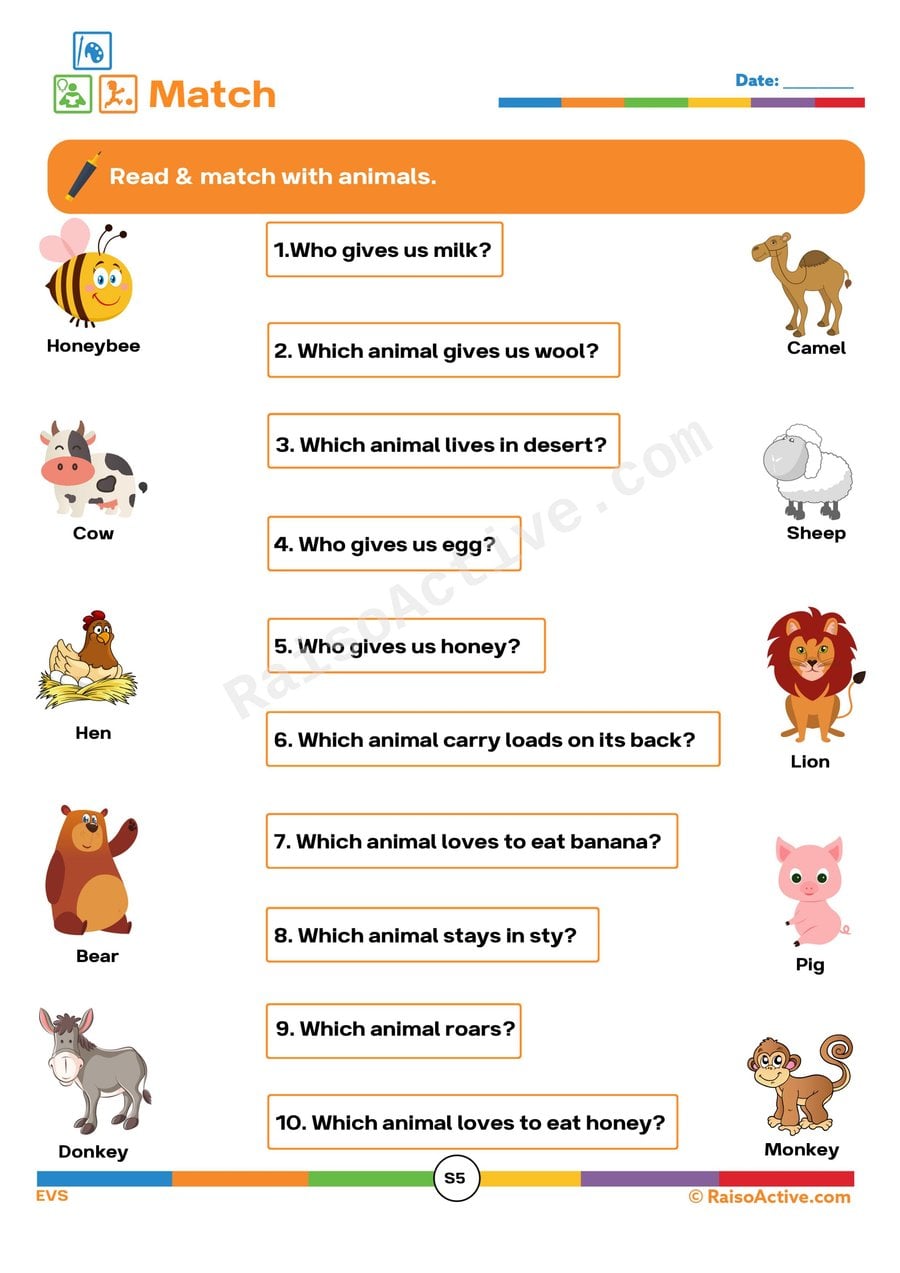
Match the Animals! A Fun Worksheet for Kids
Ages 3-5 · Preschool–Pre-KAges 3-5 · Nursery–ReceptionAges 3-5 · Nursery–LKGAges 3-5
This worksheet helps children ages 3-5 build observation and reasoning skills as they read a simple question or clue about an animal and match it to the correct picture. Rather than matching by appearance alone, children must connect descriptive language to an animal's known characteristics, which strengthens both listening comprehension and early vocabulary about animals.

Animal Identification Worksheet for Preschoolers: Color the Correct Animal!
Ages 3-5 · Preschool–Pre-KAges 3-5 · Nursery–ReceptionAges 3-5 · Nursery–LKGAges 3-5
Reading or listening to a simple question and then coloring the animal that answers it correctly builds listening comprehension and animal knowledge in children ages 3-5, requiring them to match a spoken clue to the right picture rather than just naming animals they already recognize. This task strengthens the ability to process a question, consider several possible answers, and select the correct one, an early form of reasoning that supports later reading comprehension. The coloring step at the end also adds a satisfying creative reward for correctly identifying each animal.

Animal Match: Skin, Babies, Sounds, and Food Worksheet
Ages 3-5 · Preschool–Pre-KAges 3-5 · Nursery–ReceptionAges 3-5 · Nursery–LKGAges 3-5
This worksheet deepens children ages 3-5's animal knowledge across four different categories at once — matching animals to their skin or fur type, their babies, the sounds they make, and the food they eat. Covering several related facts about the same set of animals helps children build a richer, more connected understanding than a single-category matching worksheet would.

Domestic Animals Cut and Paste Worksheet for Kids
Ages 3-5 · Preschool–Pre-KAges 3-5 · Nursery–ReceptionAges 3-5 · Nursery–LKGAges 3-5
Children ages 3-5 practice classifying domestic animals by recognizing which animals typically live around a house or garden, building early animal-classification knowledge alongside fine motor cutting and pasting skills. Sorting animals by where they live is a first step toward broader science categorization skills.

Animal Babies Tracing Worksheet: Help the Babies Find Their Mothers!
Ages 3-5 · Preschool–Pre-KAges 3-5 · Nursery–ReceptionAges 3-5 · Nursery–LKGAges 3-5
This tracing worksheet sharpens fine motor skills and hand-eye coordination as children carefully follow the dotted lines. It helps them develop the controlled pencil movements essential for pre-writing while reinforcing visual discrimination to match baby animals with their mothers. Children also expand their vocabulary by identifying different animal families and their offspring.
Guides for this topic

Discovering Wonder: Nature-Based Learning Activities That Captivate Young Children
Explore nature-based learning activities for children ages 2–7 — leaf rubbings, bug hunts, nature journals, and seasonal Indian outdoor ideas that spark wonder.

Creating Engaging Themed Learning Units for Young Children: A Complete Guide to Integrated Learning
Discover how to create engaging themed learning units for young children that integrate literacy, maths, science, and art — with practical examples and free worksheets.
Hands-On Science Fun: Age-Appropriate Science Activities That Spark Curiosity in Preschoolers
Discover 10+ easy science experiments for preschoolers using Indian household items. Spark curiosity in children ages 2-6 with safe, play-based STEM activities.
Reviews
Every worksheet for ages 3–5, no watermark
Members download the full library of 1,000+ worksheets and every activity pack without watermarks or daily limits. One year costs ₹999 in India or $20 elsewhere.
See membership plansOr download any worksheet free with a watermark (5 a day).