Domestic Animals Cut and Paste Worksheet for Kids
Children ages 3-5 practice classifying domestic animals by recognizing which animals typically live around a house or garden, building early animal-classification knowledge alongside fine motor cutting and pasting skills. Sorting animals by where they live is a first step toward broader science categorization skills.

Part of the pack
Month 12: Learning & Development | Ages Up to 4
This is page 24 of the pack. Ages 2-4 · PreschoolAges 2-4 · NurseryAges 2-4
Curriculum
- Living Things - Animals > Animals & Habitats
How to use this worksheet
Cut out each animal picture at the bottom of the page, helping your child with the scissors as needed. Talk about each animal together — where does it usually live, and how do people care for it? Have your child glue each animal picture into the house or garden scene shown on the page, discussing each animal's name and sound as they paste it in place.
Materials needed
- Scissors
- Glue
- Pencil
Extension activities
- 1Discuss where each animal on the worksheet actually lives, like a chicken coop or a doghouse.
- 2Ask your child to make the sound each domestic animal makes as they name it.
- 3Draw your favorite domestic animal and describe how you would take care of it.
- 4Visit a farm, petting zoo, or a neighbor's pet to see domestic animals in person.

Written by
Hemsweta Jain · Teacher Cheena
MBA and Early Childhood Educator, teaching since 2014 · Founder of RaisoActive, Mumbai
Every RaisoActive worksheet is designed and checked by the founder before publishing.
Published · Last reviewed
More from Month 12: Learning & Development | Ages Up to 4

Number Path Adventure: Write Numbers 1-20 Worksheet
Ages 4-6 · Pre-K–KindergartenAges 4-6 · Reception–Year 1Ages 4-6 · LKG–UKGAges 4-6
Children ages 4-6 practice writing numerals in correct sequence as they fill in missing numbers along a path of stepping stones from 1 to 20. This strengthens number-order memory and numeral formation together, both needed before a child can count on reliably or recognize number patterns like the teens. Following a winding path also adds a light visual-tracking challenge that keeps attention on the correct next stone.
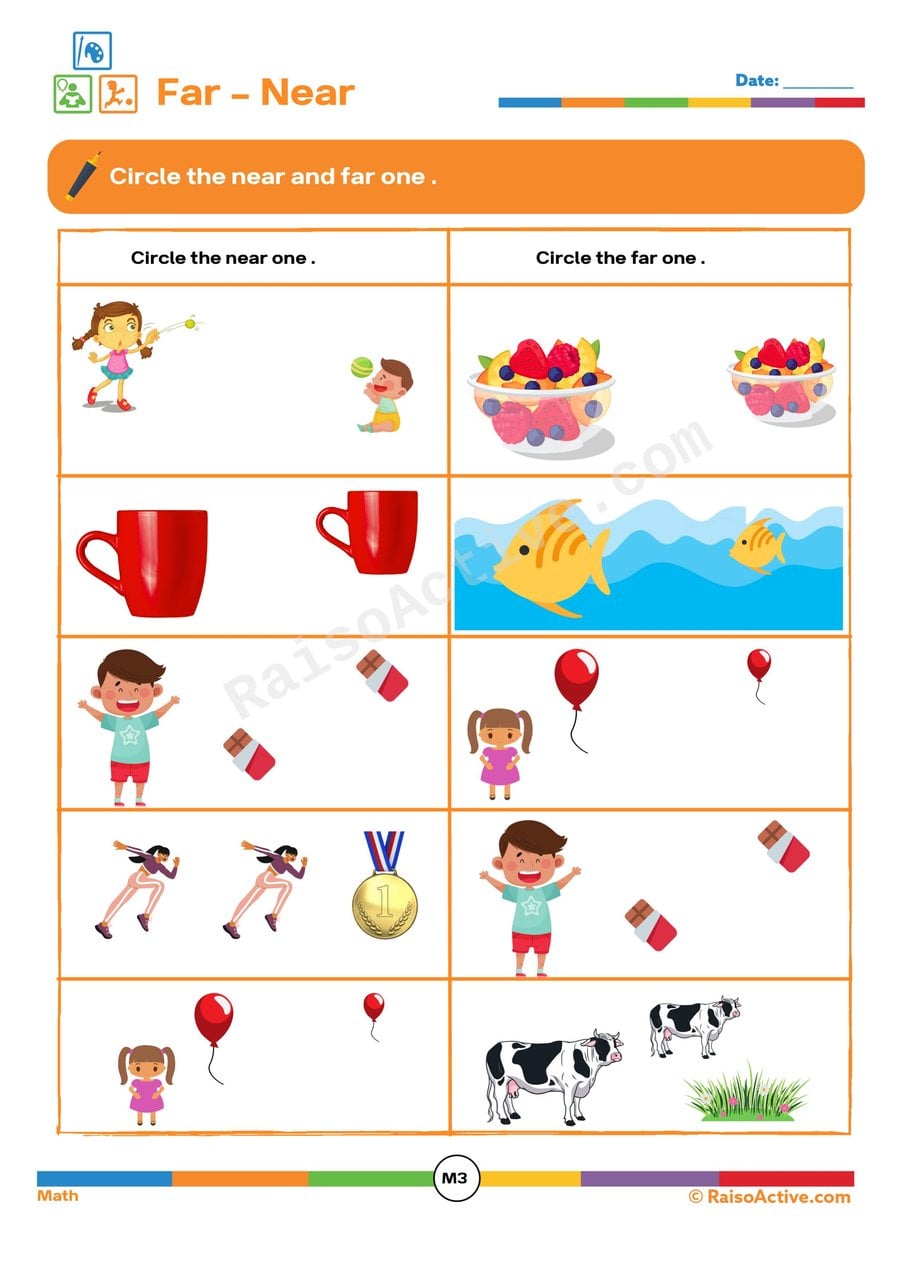
Far and Near Worksheet: Circle the Objects!
Ages 3-5 · Preschool–Pre-KAges 3-5 · Nursery–ReceptionAges 3-5 · Nursery–LKGAges 3-5
Children ages 3-5 build early spatial reasoning by comparing the relative distance of paired objects and deciding which is 'near' and which is 'far,' a foundational concept for understanding position and distance in the world around them. This kind of comparative thinking also supports later math concepts like measurement and estimation.
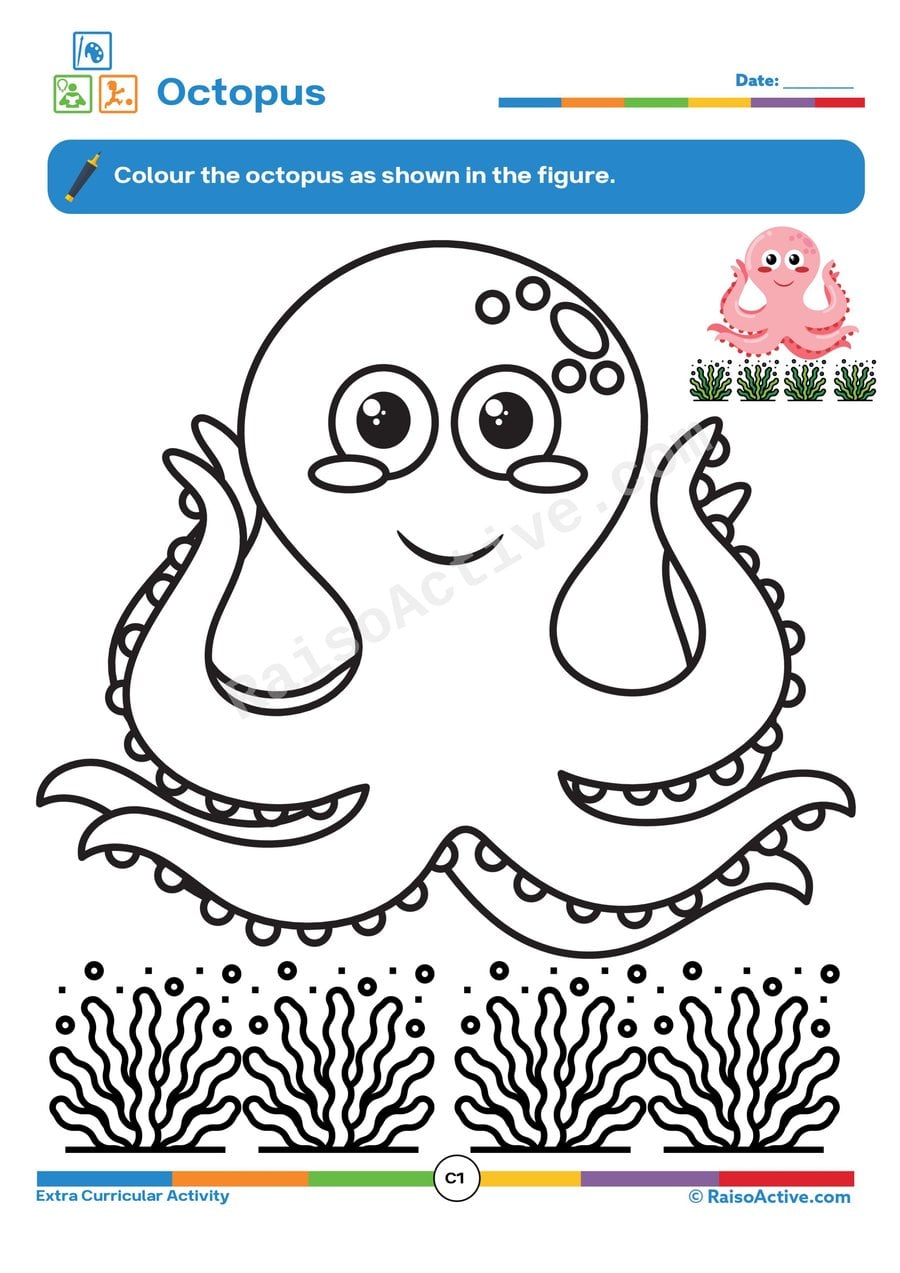
Color the Octopus Worksheet for Preschoolers
Ages 3-5 · Preschool–Pre-KAges 3-5 · Nursery–ReceptionAges 3-5 · Nursery–LKGAges 3-5
Children ages 3-5 practice fine motor control and following a color example by coloring a detailed octopus picture, strengthening the hand control and attention needed for later writing tasks. Matching a model image also builds visual observation skills as they compare their work to the example provided.

Cut and Paste a Turtle Worksheet for Preschoolers
Ages 3-5 · Preschool–Pre-KAges 3-5 · Nursery–ReceptionAges 3-5 · Nursery–LKGAges 3-5
Children ages 3-5 build fine motor precision and shape recognition by cutting out individual geometric pieces and assembling them into a complete turtle picture. Because each shape must be correctly identified and positioned — the oval for the shell, circles for the head and legs — this activity trains spatial reasoning alongside scissor and gluing skills. Completing a recognizable image from separate parts also strengthens whole-to-part visual thinking.

Froggy Skip Counting Worksheet: Practice Number Patterns!
Ages 4-6 · Pre-K–KindergartenAges 4-6 · Reception–Year 1Ages 4-6 · LKG–UKGAges 4-6
This worksheet introduces children ages 4-6 to skip counting — counting forward by a number other than one, such as by 2s or 5s — using a playful frog theme to keep the repetitive number pattern engaging. Recognizing and continuing a skip-counting sequence builds early number pattern awareness, a skill that later supports multiplication, telling time, and counting money.

Before and After: Counting and Sequencing Worksheet
Ages 4-6 · Pre-K–KindergartenAges 4-6 · Reception–Year 1Ages 4-6 · LKG–UKGAges 4-6
Spinning a wheel to find the number that follows a given number, then writing it in the 'after' column, builds number sequencing skills for children ages 4-6 while the matching step connects the abstract number to a picture representation.

Road Safety Worksheet for Preschoolers: Safe Travel Fun!
Ages 3-5 · Preschool–Pre-KAges 3-5 · Nursery–ReceptionAges 3-5 · Nursery–LKGAges 3-5
Identifying safe versus unsafe travel behaviors by ticking pictures and circling thumbs up or thumbs down builds early critical thinking about real-world safety for children ages 3-5, connecting classroom learning to a practical life skill.

Alphabet Games Worksheet: Match the Letters to the Games!
Ages 4-6 · Pre-K–KindergartenAges 4-6 · Reception–Year 1Ages 4-6 · LKG–UKGAges 4-6
This worksheet helps children ages 4-6 practice beginning-sound letter recognition by matching alphabet cards to pictures of games whose names start with that letter. Placing a letter card on its matching game picture, rather than simply circling an answer, adds a hands-on sorting element that keeps the activity active and physical rather than purely paper-based.
Related worksheets

Match the Baby Animals Worksheet for Preschoolers
Ages 3-5 · Preschool–Pre-KAges 3-5 · Nursery–ReceptionAges 3-5 · Nursery–LKGAges 3-5
Matching adult animals to their babies teaches children ages 3-5 specific animal vocabulary — like calf, cub, and kit — while sharpening visual comparison skills as they look for physical similarities between the pictures. This kind of pairing task also builds early categorization thinking, since children must recognize that a baby animal, despite looking different from its parent, still belongs to the same animal family.

Animal Match: Skin, Babies, Sounds, and Food Worksheet
Ages 3-5 · Preschool–Pre-KAges 3-5 · Nursery–ReceptionAges 3-5 · Nursery–LKGAges 3-5
This worksheet deepens children ages 3-5's animal knowledge across four different categories at once — matching animals to their skin or fur type, their babies, the sounds they make, and the food they eat. Covering several related facts about the same set of animals helps children build a richer, more connected understanding than a single-category matching worksheet would.

Animal Maze Adventure: Help the Animals Find Their Food!
Ages 3-5 · Preschool–Pre-KAges 3-5 · Nursery–ReceptionAges 3-5 · Nursery–LKGAges 3-5
This worksheet helps children ages 3-5 develop problem-solving skills and visual discrimination by guiding different animals through mazes to reach their favorite food, requiring them to scan ahead and choose the correct path before committing to a route. Matching each animal to a food that makes sense for it also builds early general knowledge about what different animals eat.
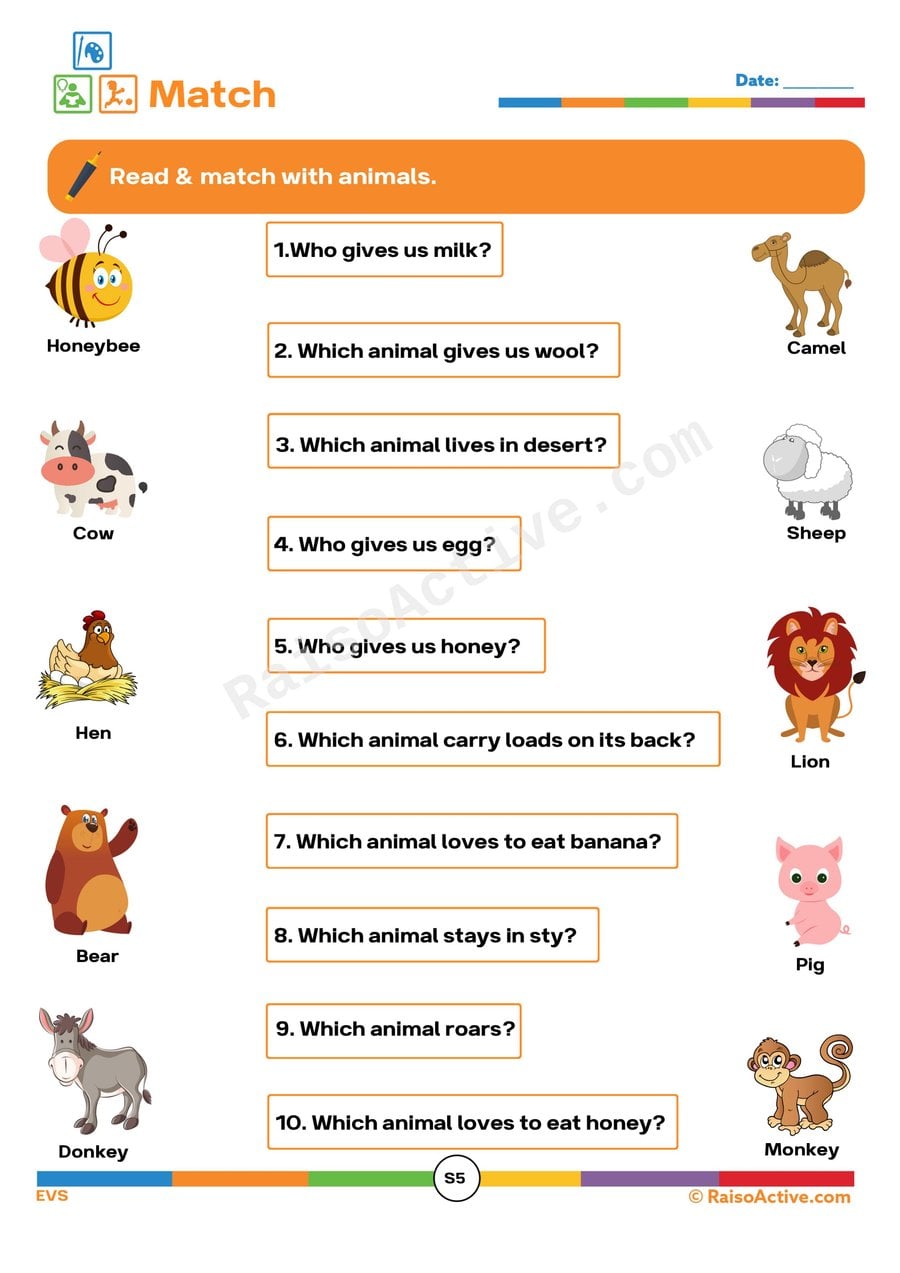
Match the Animals! A Fun Worksheet for Kids
Ages 3-5 · Preschool–Pre-KAges 3-5 · Nursery–ReceptionAges 3-5 · Nursery–LKGAges 3-5
This worksheet helps children ages 3-5 build observation and reasoning skills as they read a simple question or clue about an animal and match it to the correct picture. Rather than matching by appearance alone, children must connect descriptive language to an animal's known characteristics, which strengthens both listening comprehension and early vocabulary about animals.

The Hungry Ant: Fruit Matching Worksheet for Kids
Ages 3-5 · Preschool–Pre-KAges 3-5 · Nursery–ReceptionAges 3-5 · Nursery–LKGAges 3-5
Cutting out fruit pictures and matching them to an ant's trail builds scissor control in children ages 3-5 while also reinforcing counting and fruit vocabulary as they sort or count pieces before gluing. The hungry ant theme gives the matching task a simple narrative reason, finding food for the ant, which tends to hold young children's attention better than an unconnected matching exercise.

Animal Babies Tracing Worksheet: Help the Babies Find Their Mothers!
Ages 3-5 · Preschool–Pre-KAges 3-5 · Nursery–ReceptionAges 3-5 · Nursery–LKGAges 3-5
This tracing worksheet has children ages 3-5 trace dotted lines to connect each baby animal to its correct mother, combining pencil control practice with early science knowledge about animal families. Learning which baby belongs to which adult animal — like a calf to a cow, or a cub to a lion — builds vocabulary and categorization skills that go beyond the tracing itself. Because the correct line only makes sense if the child recognizes the right animal pairing first, this activity blends fine motor practice with genuine content knowledge.

Match the Baby Animals Worksheet for Preschoolers
Ages 3-5 · Preschool–Pre-KAges 3-5 · Nursery–ReceptionAges 3-5 · Nursery–LKGAges 3-5
Connecting adult animals to their babies builds specific vocabulary for children ages 3-5, like puppy, kitten, and fawn, while training visual comparison skills as they look for matching features between each pair. This activity also introduces the early biology concept that offspring, though smaller and sometimes differently colored, belong to the same animal family as their parent.

Animal Skin Pattern Matching Worksheet for Preschoolers
Ages 3-5 · Preschool–Pre-KAges 3-5 · Nursery–ReceptionAges 3-5 · Nursery–LKGAges 3-5
Children ages 3-5 build visual discrimination and early biology awareness as they match animals to their distinctive skin patterns, like stripes on a zebra or spots on a leopard. Noticing and matching these patterns helps children practice careful visual comparison, a skill closely related to letter and word recognition, while also introducing the science idea that patterns serve a purpose for animals in the wild.
Guides for this topic

Age-Appropriate Problem-Solving Activities: Building Critical Thinkers from the Ground Up
Discover fun, age-appropriate problem-solving activities for children ages 1-8. Build critical thinking, logic, and reasoning skills through play-based learning.

Christmas and Winter Activities That Combine Fun and Learning: Creating Magical Educational Experiences
Discover Christmas and winter activities that combine festive fun with real learning. Crafts, counting, literacy, and printable worksheets for ages 2 to 8 — perfect for home and school.

Creating Engaging Themed Learning Units for Young Children: A Complete Guide to Integrated Learning
Discover how to create engaging themed learning units for young children that integrate literacy, maths, science, and art — with practical examples and free worksheets.
Reviews
Every worksheet for ages 3–5, no watermark
Members download the full library of 1,000+ worksheets and every activity pack without watermarks or daily limits. One year costs ₹999 in India or $20 elsewhere.
See membership plansOr download any worksheet free with a watermark (5 a day).