Color the Octopus Worksheet for Preschoolers
Children ages 3-5 practice fine motor control and following a color example by coloring a detailed octopus picture, strengthening the hand control and attention needed for later writing tasks. Matching a model image also builds visual observation skills as they compare their work to the example provided.

Part of the pack
Month 12: Learning & Development | Ages Up to 4
This is page 27 of the pack. Ages 2-4 · PreschoolAges 2-4 · NurseryAges 2-4

Made for your child
A whole activity pack made with their name
60 pages to spot, build, trace and write their own name, plus pages about their favourites, feelings and family. See a free preview with their name.
Make an All About Me packFree preview · free for members
Or start free: a name tracing sheet with their nameCurriculum
- Living Things - Animals > Animals & Habitats
How to use this worksheet
Show your child the example picture of the colored octopus and talk about the colors used for the body and each tentacle. Have your child choose crayons or colored pencils that match, encouraging them to stay within the lines as they color each section. Once finished, compare their colored octopus to the example together and talk about any colors they chose differently.
Materials needed
- Crayons
- Pencil
Extension activities
- 1Draw a simple ocean scene together and add the colored octopus to it.
- 2Count the eight tentacles on the octopus together, pointing to each one.
- 3Look up real photos or videos of octopuses and talk about how they change color in real life.
- 4Make a pretend octopus using a paper plate and eight paper strips for tentacles.

Written by
Hemsweta Jain · Teacher Cheena
MBA and Early Childhood Educator, teaching since 2014 · Founder of RaisoActive, Mumbai
Every RaisoActive worksheet is designed and checked by the founder before publishing.
Published · Last reviewed
More from Month 12: Learning & Development | Ages Up to 4

Living or Non-Living? A Fun Sorting Worksheet for Preschoolers
Ages 3-5 · Preschool–Pre-KAges 3-5 · Nursery–ReceptionAges 3-5 · Nursery–LKGAges 3-5
This sorting worksheet introduces children ages 3-5 to one of science's foundational classification concepts: distinguishing living things from non-living things. Deciding whether to tick or cross each picture pushes children to apply criteria — does it grow, move, breathe, or need food — rather than sort by appearance alone, an early form of scientific reasoning. This distinction also builds vocabulary they'll use throughout later nature and biology topics.
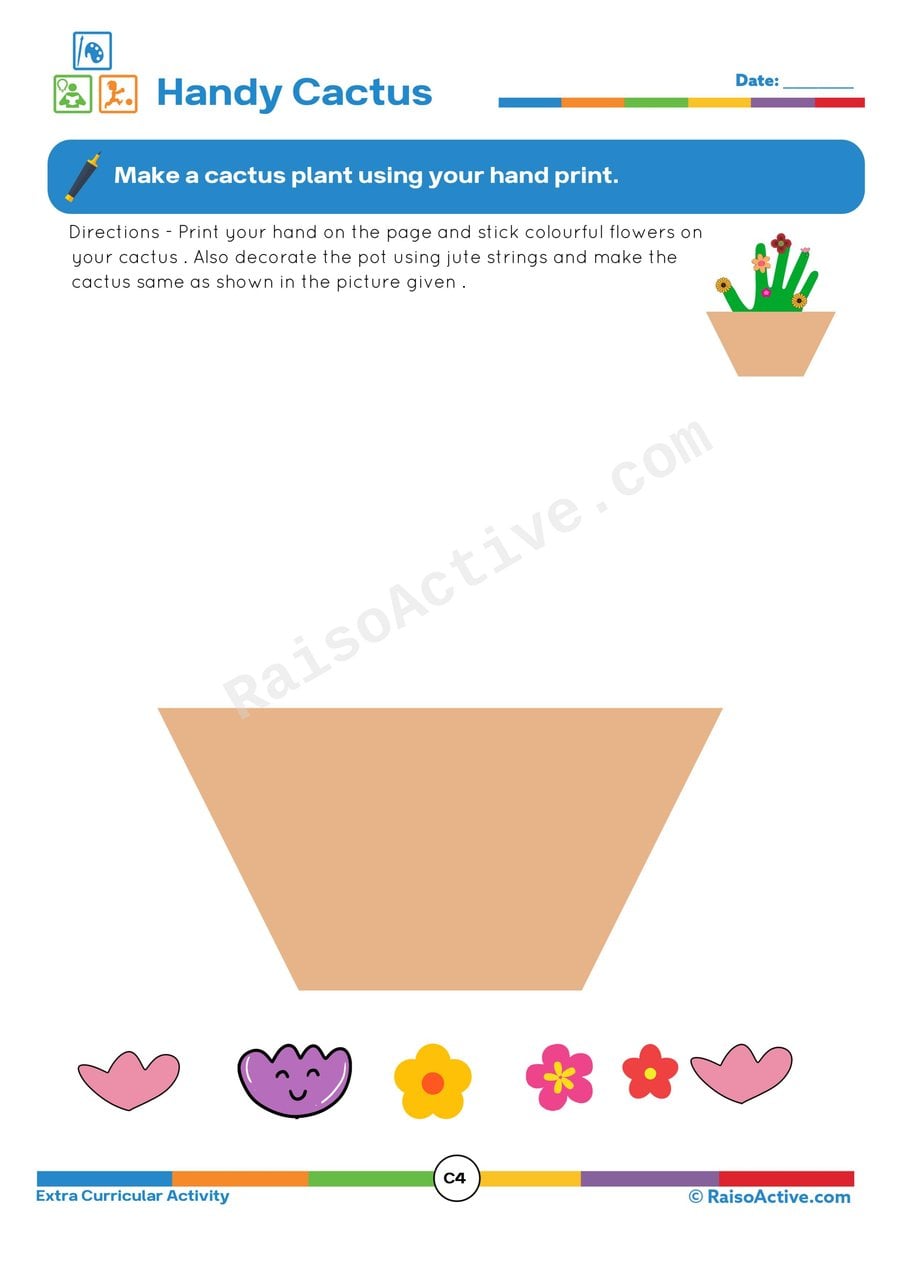
Handprint Cactus Craft Worksheet for Kids
Ages 3-5 · Preschool–Pre-KAges 3-5 · Nursery–ReceptionAges 3-5 · Nursery–LKGAges 3-5
Tracing and decorating a handprint into cactus shapes builds fine motor control and following-directions skills for children ages 3-5, since they must coordinate cutting, gluing, and arranging several craft pieces to match a shown example.

Before and After: Counting and Sequencing Worksheet
Ages 4-6 · Pre-K–KindergartenAges 4-6 · Reception–Year 1Ages 4-6 · LKG–UKGAges 4-6
Spinning a wheel to find the number that follows a given number, then writing it in the 'after' column, builds number sequencing skills for children ages 4-6 while the matching step connects the abstract number to a picture representation.

Sentence Sorting Fun: Speak Sentences with Words! (Ages 3-5)
Ages 3-5 · Preschool–Pre-KAges 3-5 · Nursery–ReceptionAges 3-5 · Nursery–LKGAges 3-5
This worksheet builds oral sentence construction for children ages 3-5 by having them place a cutout Pacman piece on a word and then speak a full sentence using that word aloud. Because the task requires generating spoken language on the spot rather than selecting a pre-written answer, it strengthens expressive vocabulary and sentence-building skills in a playful, low-pressure format.
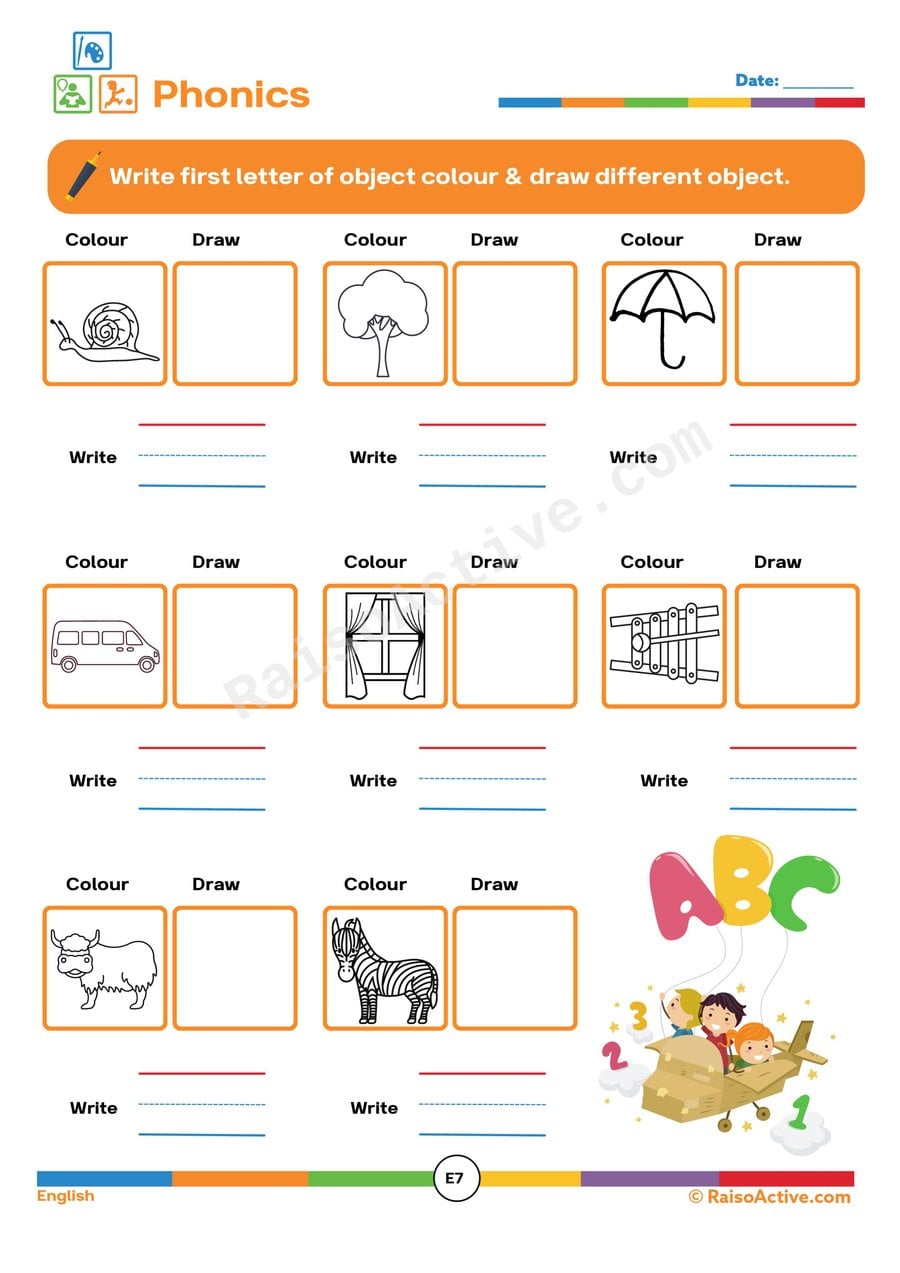
Phonics Fun: Color, Draw, and Write! (Ages 3-5)
Ages 3-5 · Preschool–Pre-KAges 3-5 · Nursery–ReceptionAges 3-5 · Nursery–LKGAges 3-5
Coloring a picture, drawing a related object, and writing its first letter combines three literacy-building tasks in one activity for children ages 3-5 — visual recognition, creative expression, and beginning-sound identification.

Domestic Animals Cut and Paste Worksheet for Kids
Ages 3-5 · Preschool–Pre-KAges 3-5 · Nursery–ReceptionAges 3-5 · Nursery–LKGAges 3-5
Children ages 3-5 practice classifying domestic animals by recognizing which animals typically live around a house or garden, building early animal-classification knowledge alongside fine motor cutting and pasting skills. Sorting animals by where they live is a first step toward broader science categorization skills.

Rainbow Sequence Cut and Paste Worksheet for Preschoolers
Ages 4-6 · Pre-K–KindergartenAges 4-6 · Reception–Year 1Ages 4-6 · LKG–UKGAges 4-6
Children ages 4-6 practice numerical sequencing by arranging rainbow picture pieces in the correct numbered order, while also building fine motor control through cutting and gluing. Combining sequencing with a cut-and-paste format makes an abstract ordering skill into a tactile, visual task.

Traffic Signals Cut and Paste Worksheet for Preschoolers
Ages 3-5 · Preschool–Pre-KAges 3-5 · Nursery–ReceptionAges 3-5 · Nursery–LKGAges 3-5
Children ages 3-5 learn to recognize red, yellow, and green traffic signals and connect each color to its meaning, an early road-safety skill that also reinforces color recognition and matching. Understanding what each signal means builds real-world safety awareness they'll use as pedestrians and passengers.
Related worksheets

Animal Match: Skin, Babies, Sounds, and Food Worksheet
Ages 3-5 · Preschool–Pre-KAges 3-5 · Nursery–ReceptionAges 3-5 · Nursery–LKGAges 3-5
This worksheet deepens children ages 3-5's animal knowledge across four different categories at once — matching animals to their skin or fur type, their babies, the sounds they make, and the food they eat. Covering several related facts about the same set of animals helps children build a richer, more connected understanding than a single-category matching worksheet would.

Animal Identification Worksheet for Preschoolers: Color the Correct Animal!
Ages 3-5 · Preschool–Pre-KAges 3-5 · Nursery–ReceptionAges 3-5 · Nursery–LKGAges 3-5
Reading or listening to a simple question and then coloring the animal that answers it correctly builds listening comprehension and animal knowledge in children ages 3-5, requiring them to match a spoken clue to the right picture rather than just naming animals they already recognize. This task strengthens the ability to process a question, consider several possible answers, and select the correct one, an early form of reasoning that supports later reading comprehension. The coloring step at the end also adds a satisfying creative reward for correctly identifying each animal.

Domestic vs. Wild Animals Sorting Worksheet for Preschoolers
Ages 3-5 · Preschool–Pre-KAges 3-5 · Nursery–ReceptionAges 3-5 · Nursery–LKGAges 3-5
Sorting animal pictures into domestic and wild categories teaches children ages 3-5 early classification skills, requiring them to consider a shared trait, like whether an animal lives with humans or in the wild, rather than just naming individual animals. This kind of categorization is a foundational science and logical-thinking skill, since sorting by an abstract rule is more advanced than simply identifying objects one at a time. Cutting and gluing the animals into their correct groups also adds fine motor practice to the sorting task.

The Hungry Ant: Fruit Matching Worksheet for Kids
Ages 3-5 · Preschool–Pre-KAges 3-5 · Nursery–ReceptionAges 3-5 · Nursery–LKGAges 3-5
Cutting out fruit pictures and matching them to an ant's trail builds scissor control in children ages 3-5 while also reinforcing counting and fruit vocabulary as they sort or count pieces before gluing. The hungry ant theme gives the matching task a simple narrative reason, finding food for the ant, which tends to hold young children's attention better than an unconnected matching exercise.

Animal Maze Adventure: Help the Animals Find Their Food!
Ages 3-5 · Preschool–Pre-KAges 3-5 · Nursery–ReceptionAges 3-5 · Nursery–LKGAges 3-5
This worksheet helps children ages 3-5 develop problem-solving skills and visual discrimination by guiding different animals through mazes to reach their favorite food, requiring them to scan ahead and choose the correct path before committing to a route. Matching each animal to a food that makes sense for it also builds early general knowledge about what different animals eat.

Animal Sounds Matching Worksheet for Preschoolers
Ages 3-5 · Preschool–Pre-KAges 3-5 · Nursery–ReceptionAges 3-5 · Nursery–LKGAges 3-5
This worksheet builds vocabulary and auditory memory by asking children to match each animal picture to the sound it makes, such as connecting a cow to 'moo' or a duck to 'quack.' For three- to five-year-olds, linking an animal's appearance to its sound strengthens both early science knowledge and the kind of associative memory that supports vocabulary growth.

Match the Baby Animals Worksheet for Preschoolers
Ages 3-5 · Preschool–Pre-KAges 3-5 · Nursery–ReceptionAges 3-5 · Nursery–LKGAges 3-5
Matching adult animals to their babies teaches children ages 3-5 specific animal vocabulary — like calf, cub, and kit — while sharpening visual comparison skills as they look for physical similarities between the pictures. This kind of pairing task also builds early categorization thinking, since children must recognize that a baby animal, despite looking different from its parent, still belongs to the same animal family.
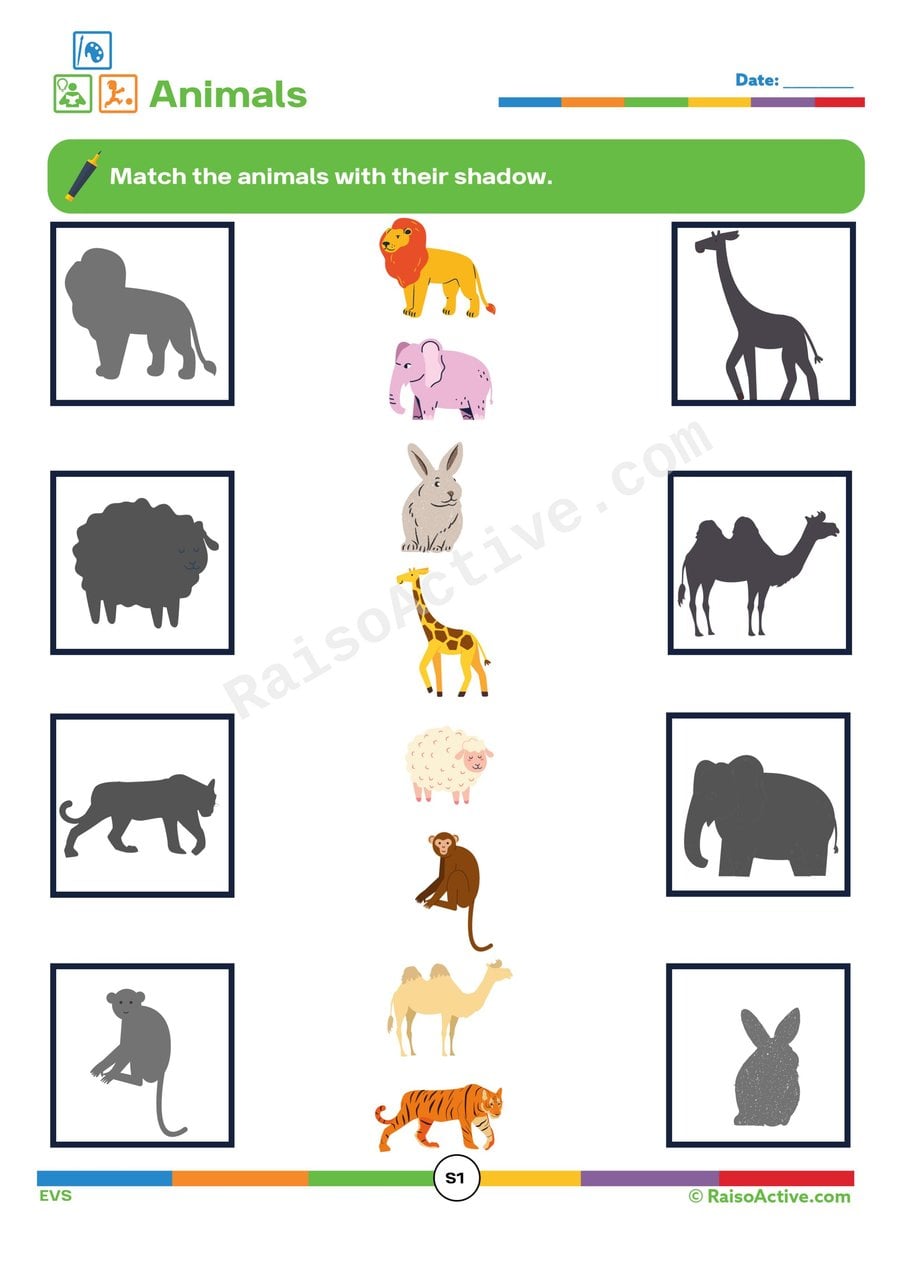
Animal Shadow Match Worksheet for Preschoolers
Ages 3-5 · Preschool–Pre-KAges 3-5 · Nursery–ReceptionAges 3-5 · Nursery–LKGAges 3-5
This worksheet builds visual discrimination skills for children ages 3-5 by having them match each animal to its correct silhouette or shadow shape. Because a shadow strips away color and detail, leaving only outline and proportion, this task requires more careful visual analysis than typical picture matching, sharpening the kind of attention to shape and form that supports later letter and word recognition.
Guides for this topic

Best Worksheets for 3-Year-Olds: What Works and What to Avoid
What works on worksheets for 3-year-olds: short sessions, crayons, tracing lines, matching, cutting, a free weekly plan, and signs one is too advanced.
Fostering Creativity in Structured Learning: The Perfect Balance for Young Minds
Learn how to blend creativity with structured learning for children ages 1-8. Practical strategies, activities, and printable worksheets for parents and teachers.

Discovering Wonder: Nature-Based Learning Activities That Captivate Young Children
Explore nature-based learning activities for children ages 2–7 — leaf rubbings, bug hunts, nature journals, and seasonal Indian outdoor ideas that spark wonder.
Reviews
Every worksheet for ages 3–5, no watermark
Members download the full library of 1,000+ worksheets and every activity pack without watermarks or daily limits. One year costs ₹999 in India or $20 elsewhere.
See membership plansOr download any worksheet free with a watermark (5 a day).