Happy Face Cut and Paste Worksheet for Preschoolers
This worksheet helps children ages 3-5 learn the names of facial features while practicing scissor control and precise gluing. Assembling a face piece by piece — eyes, nose, mouth, ears — reinforces body part vocabulary in a hands-on way that's more memorable than simply pointing at a picture.
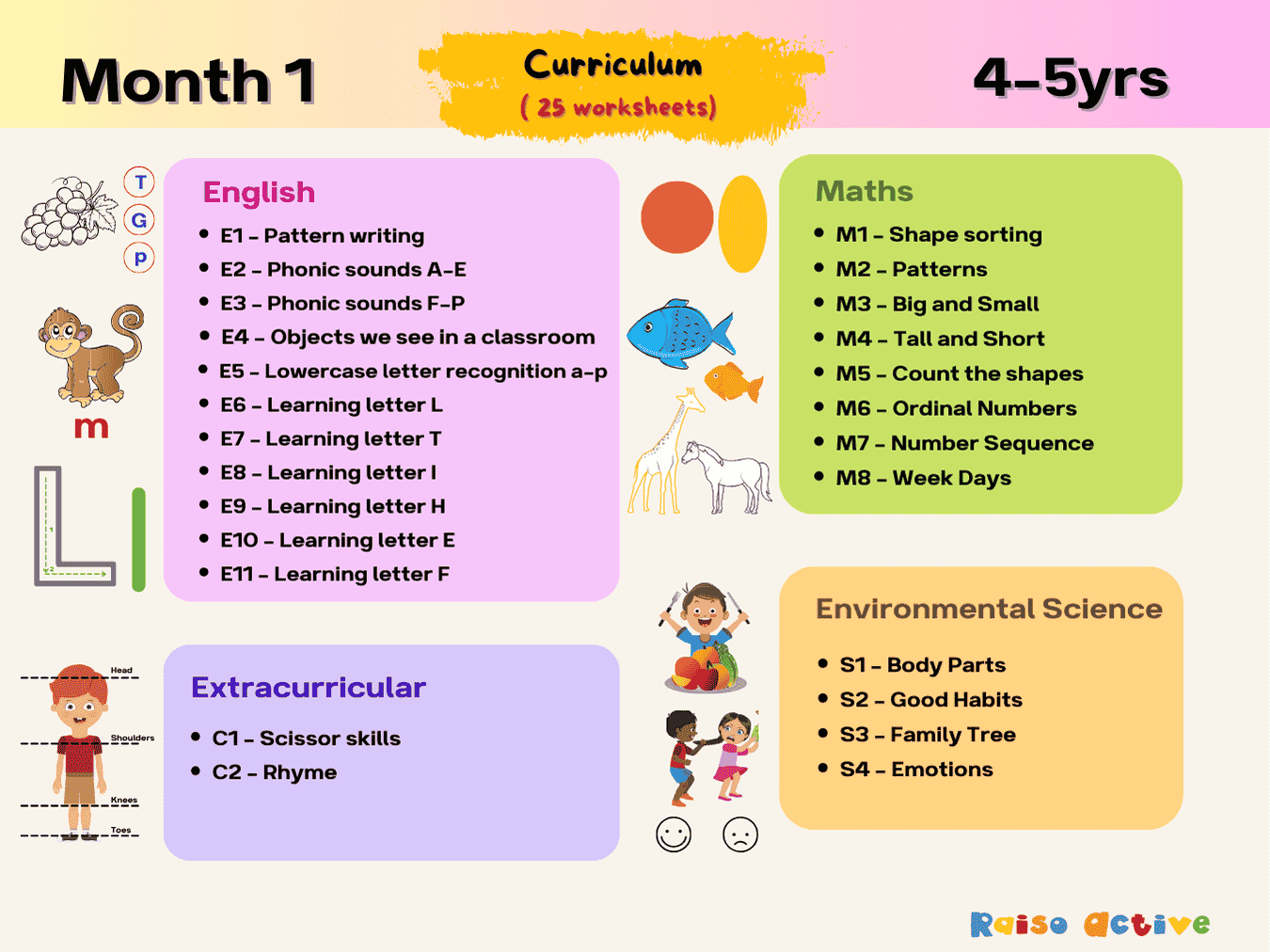
Part of the pack
Play-Based Learning Activity Book for 4-5 Year Olds | Literacy, Math & EVS
This is page 28 of the pack. Ages 4-5 · Pre-KAges 4-5 · ReceptionAges 4-5 · LKGAges 4-5
Curriculum
- My Body > Five Senses
How to use this worksheet
Have your child cut out each face part, naming it aloud as they go — eyes, nose, mouth, ears. Lay the pieces near the blank face outline so your child can plan where each one belongs before gluing. Guide them to glue each part into its correct position, checking that the finished face looks balanced. Once assembled, let your child color the completed face using crayons or colored pencils.
Materials needed
- Scissors
- Glue
- Crayons or colored pencils
Extension activities
- 1Sing the 'Head, Shoulders, Knees, and Toes' song and point to each body part as you sing.
- 2Draw and label other body parts not included on the worksheet, like hair or eyebrows.
- 3Create a paper doll and dress it up, talking about clothing and body parts together.
- 4Play a 'Simon says' game using body part names as instructions.
- 5Look in a mirror together and name each facial feature your child sees.

Written by
Hemsweta Jain · Teacher Cheena
MBA and Early Childhood Educator, teaching since 2014 · Founder of RaisoActive, Mumbai
Every RaisoActive worksheet is designed and checked by the founder before publishing.
Published · Last reviewed
More from Play-Based Learning Activity Book for 4-5 Year Olds | Literacy, Math & EVS

Letter I Tracing and Coloring Worksheet for Preschoolers
Ages 3-5 · Preschool–Pre-KAges 3-5 · Nursery–ReceptionAges 3-5 · Nursery–LKGAges 3-5
This worksheet helps children ages 3-5 build fine motor skills and letter recognition by tracing both the uppercase and lowercase forms of the letter I, then applying that recognition in a coloring task and a letter-hunt word search. Practicing a short, simple letter like I builds early writing confidence, while the letter-hunt component adds a visual-scanning challenge that pushes recognition beyond just copying a shape. Coloring pictures that start with I connects the shape to its beginning sound.

Letter H Worksheet: Trace, Write, and Color the Letter H!
Ages 3-5 · Preschool–Pre-KAges 3-5 · Nursery–ReceptionAges 3-5 · Nursery–LKGAges 3-5
This worksheet gives children ages 3-5 layered practice with the letter H, moving from finger tracing to pencil tracing and finally to identifying and coloring pictures that begin with the H sound. Starting with a finger trace before picking up a pencil is a gentle way to build the motor pattern for a letter's shape without the added challenge of pencil control, making this a good scaffolded approach for less confident writers. Circling H pictures afterward reinforces the connection between the letter's shape and its beginning sound.

Mickey Mouse Number Sequence Worksheet: Paste the Missing Numbers!
Ages 4-5 · Pre-KAges 4-5 · ReceptionAges 4-5 · LKGAges 4-5
This cut-and-paste worksheet uses a Mickey Mouse theme to give children ages 4-5 practice recognizing and completing number sequences by identifying missing numbers within numbered frames and pasting them into place. Because the missing numbers appear in the middle of a sequence rather than only at the end, children must think about both the number before and after a gap, a more demanding skill than simple 'what comes next' counting. The familiar character theme adds motivation to a task that is fundamentally about numerical reasoning.

Ordinal Numbers Coloring Worksheet for Preschoolers
Ages 3-5 · Preschool–Pre-KAges 3-5 · Nursery–ReceptionAges 3-5 · Nursery–LKGAges 3-5
This coloring worksheet introduces children ages 3-5 to ordinal numbers — 1st, 2nd, 3rd, 4th, 5th — by having them identify and color the picture in a row that matches a given ordinal position. Ordinal numbers describe order and rank rather than quantity, which is a meaningfully different concept from the cardinal counting children usually practice first. This distinction is an important step toward understanding sequences, rankings, and everyday language like 'first place' or 'third in line.'

Animal Babies Tracing Worksheet: Help the Babies Find Their Mothers!
Ages 3-5 · Preschool–Pre-KAges 3-5 · Nursery–ReceptionAges 3-5 · Nursery–LKGAges 3-5
This tracing worksheet has children ages 3-5 trace dotted lines to connect each baby animal to its correct mother, combining pencil control practice with early science knowledge about animal families. Learning which baby belongs to which adult animal — like a calf to a cow, or a cub to a lion — builds vocabulary and categorization skills that go beyond the tracing itself. Because the correct line only makes sense if the child recognizes the right animal pairing first, this activity blends fine motor practice with genuine content knowledge.

Shape Count Worksheet: Count and Decorate the Crown!
Ages 3-5 · Preschool–Pre-KAges 3-5 · Nursery–ReceptionAges 3-5 · Nursery–LKGAges 3-5
Counting diamond shapes and matching each group to its correct number builds one-to-one correspondence and numeral recognition in children ages 3-5, while identifying the shape itself reinforces basic geometry vocabulary. Coloring, cutting, and gluing the diamonds onto a crown afterward adds a craft element that rewards accurate counting with a wearable, decorative result. Combining counting, shape recognition, and a craft project gives this worksheet several layers of skill practice within one engaging activity.

Butterfly Cutting Practice Worksheet for Preschoolers
Ages 3-5 · Preschool–Pre-KAges 3-5 · Nursery–ReceptionAges 3-5 · Nursery–LKGAges 3-5
This cutting-practice worksheet gives children ages 3-5 dedicated repetition in guiding scissors along a straight or gently curved dotted line, a core pre-writing and self-help skill that strengthens hand strength and bilateral coordination. Framing the goal as 'reaching the butterflies' gives children a visual reward for careful, controlled cutting rather than treating scissor practice as an isolated drill. Building this scissor control early supports later success with more complex cut-and-paste crafts.
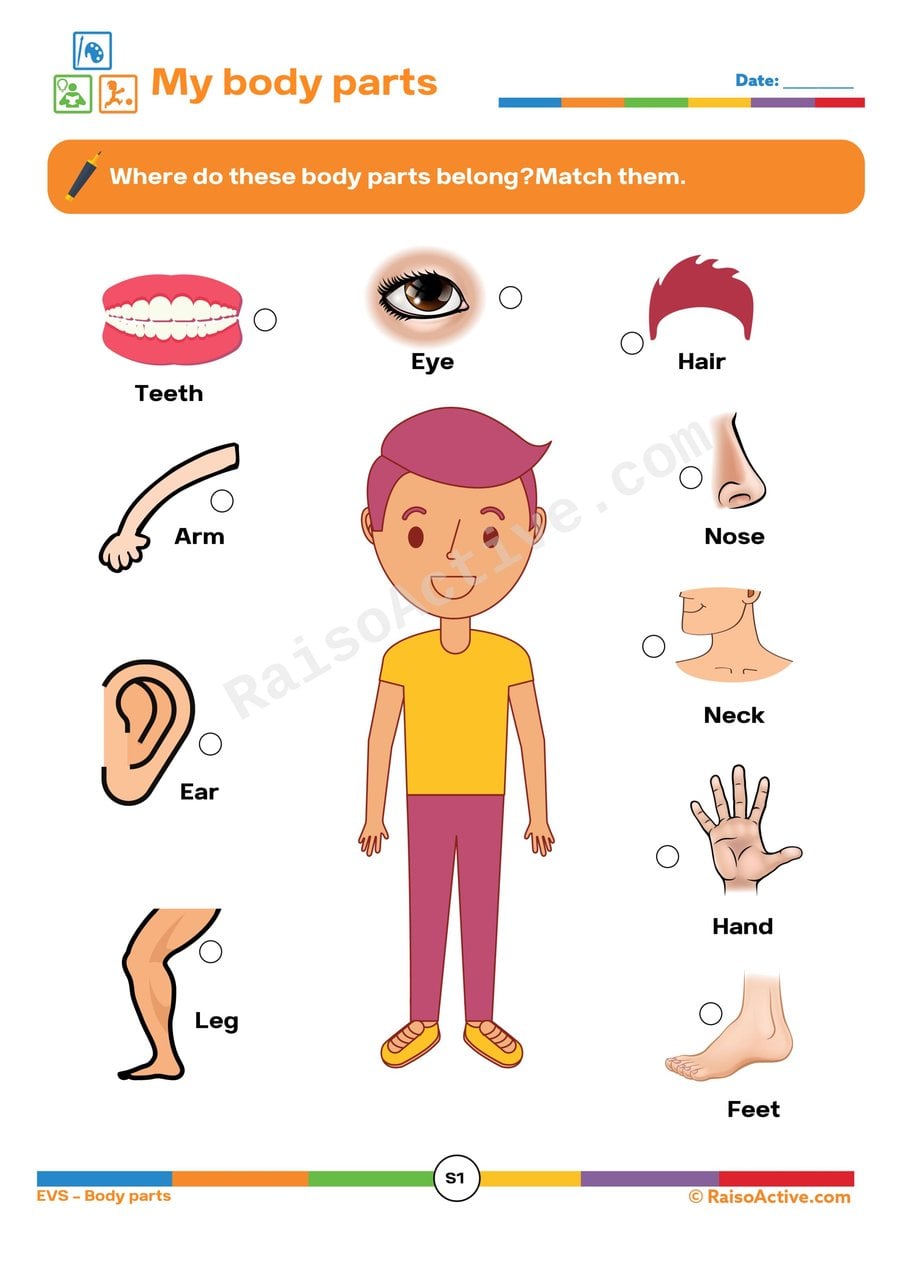
Match the Body Parts! A Fun Worksheet for Kids
Ages 3-5 · Preschool–Pre-KAges 3-5 · Nursery–ReceptionAges 3-5 · Nursery–LKGAges 3-5
Drawing lines from body part pictures to their correct location on a human figure helps children ages 3-5 build vocabulary for parts of the body, like arms, legs, and ears, while practicing visual-spatial matching between a small picture and its larger corresponding location. This worksheet strengthens the link between a spoken body part name and its physical location, a skill children also use constantly in daily routines like getting dressed or washing up. Matching pictures to a full-body diagram, rather than just naming parts in isolation, builds a more complete mental map of the body.
Related worksheets

Body Parts Matching Worksheet for Preschoolers
Ages 3-5 · Preschool–Pre-KAges 3-5 · Nursery–ReceptionAges 3-5 · Nursery–LKGAges 3-5
Children ages 3-5 practice matching each body part to its specific function, like eyes to seeing or legs to walking, building early awareness of how their own body works. This connects body-part vocabulary to real-world purpose rather than just naming parts in isolation.
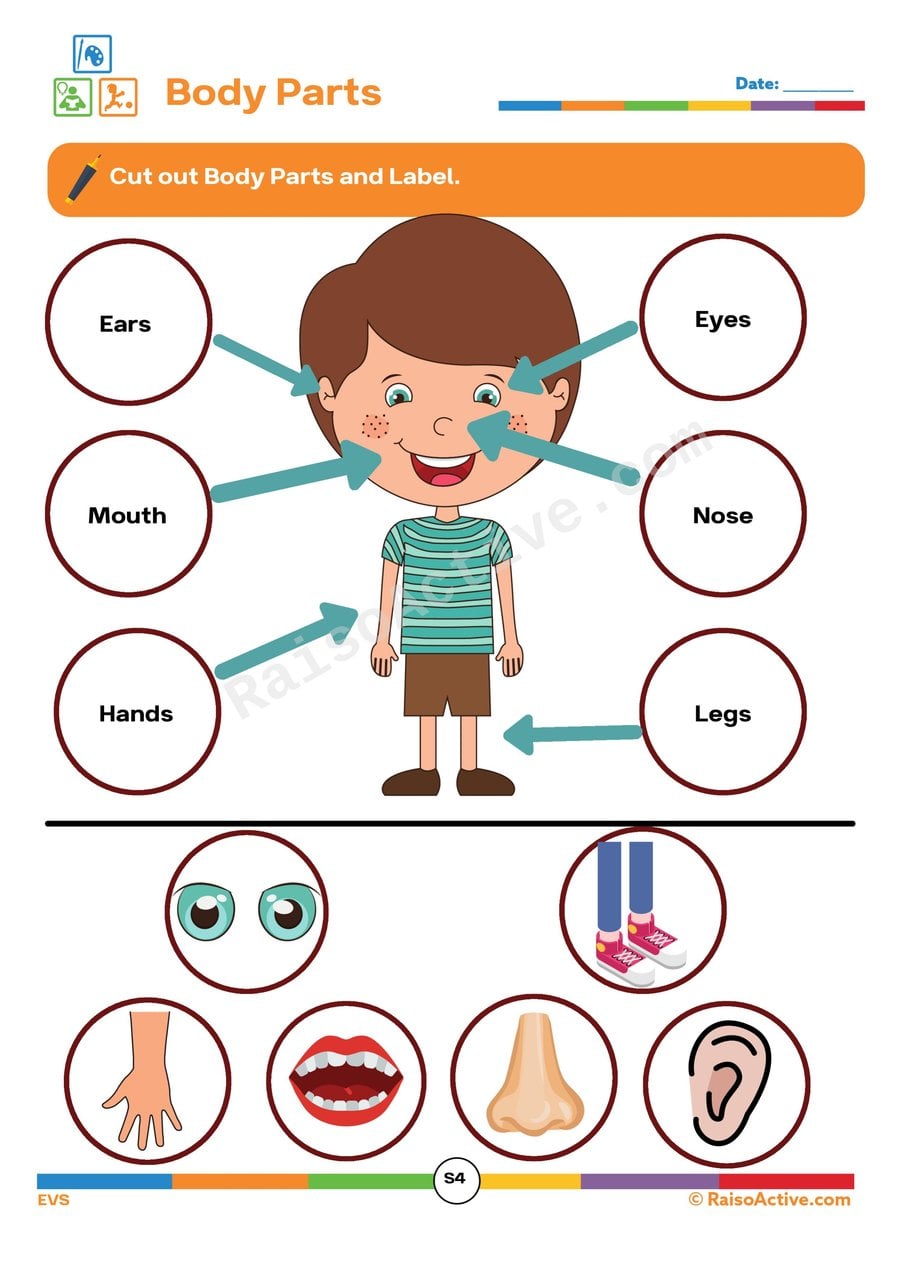
Body Parts Worksheet: Cut and Label!
Ages 3-5 · Preschool–Pre-KAges 3-5 · Nursery–ReceptionAges 3-5 · Nursery–LKGAges 3-5
Cutting out labeled body part images and gluing them onto a figure teaches children ages 3-5 the names and locations of body parts like arms, legs, and ears, connecting spoken vocabulary to a visual, physical location on the body. The cutting and pasting process also strengthens fine motor control, giving this worksheet a combined literacy and hand-strength benefit. Because the body is something children can also touch and point to on themselves, this activity bridges paper-based learning with real, physical self-awareness.
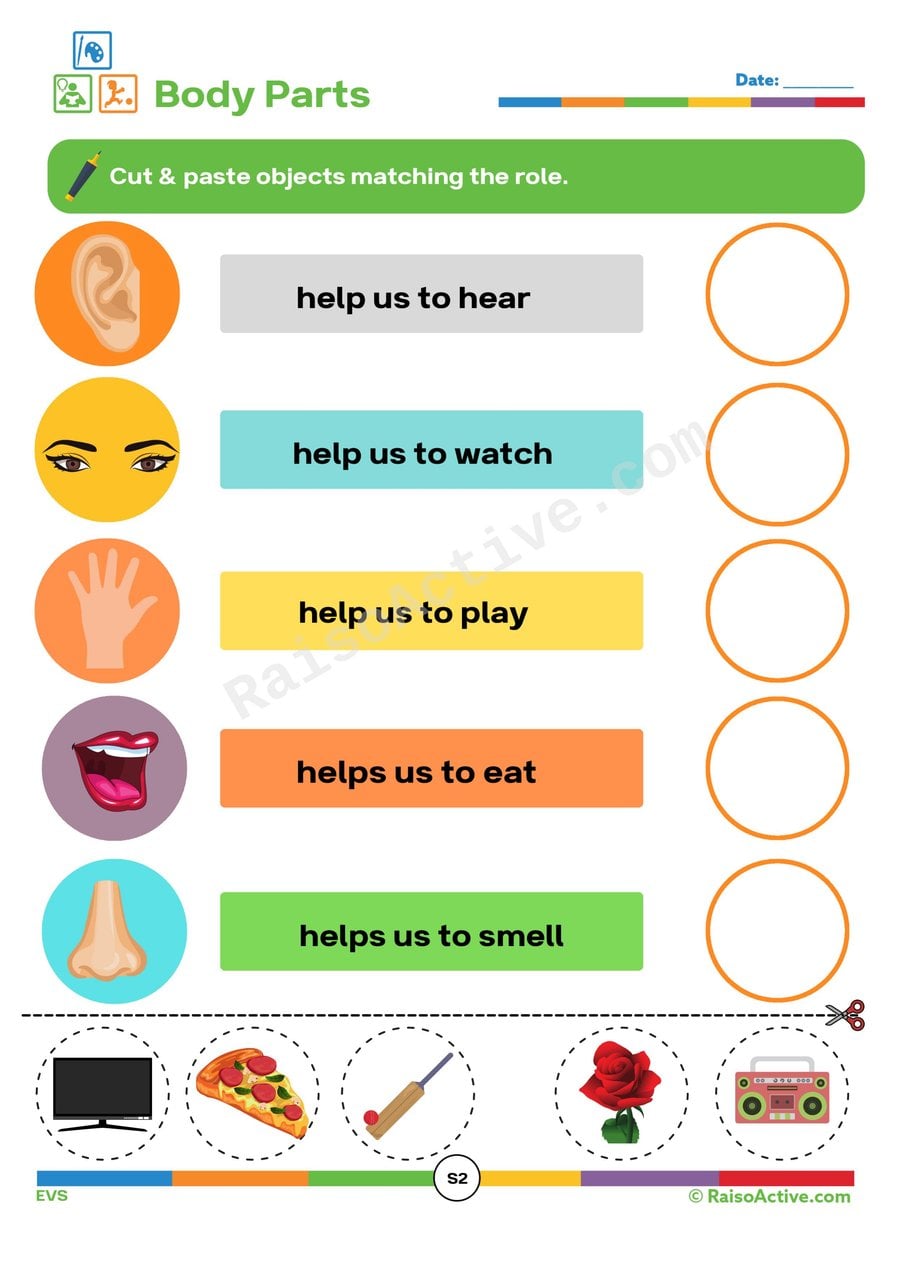
Body Parts Matching Worksheet for Preschoolers
Ages 3-5 · Preschool–Pre-KAges 3-5 · Nursery–ReceptionAges 3-5 · Nursery–LKGAges 3-5
Learning the names of body parts builds early vocabulary and body awareness for children ages 3-5, helping them describe their physical experiences and follow instructions that reference specific parts of the body. This cut-and-paste worksheet asks children to match pictures of body parts to their correct location on a figure, which reinforces spatial understanding of the body alongside vocabulary. Because children physically cut and glue each piece into place, the activity also builds fine motor control at the same time as the science and language content.

Body Parts Cut and Paste Worksheet for Preschoolers
Ages 3-5 · Preschool–Pre-KAges 3-5 · Nursery–ReceptionAges 3-5 · Nursery–LKGAges 3-5
Cutting out body part pictures and gluing them to match written sentences builds vocabulary for children ages 3-5 while reinforcing fine motor skills, connecting a spoken or written body part name to its correct image.
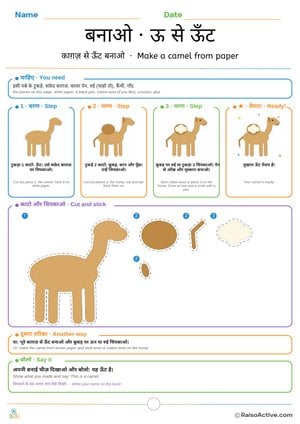
Make a Paper Camel: Hindi Letter ऊ Craft | बनाओ · ऊ से ऊँट
Ages 3-7 · Preschool–Grade 1Ages 3-7 · Nursery–Year 2Ages 3-7 · Nursery–Class 1Ages 3-7
Children cut out the pieces, put them together following three step pictures and make a paper camel. Saying the word ऊँट as they make it links the sound ऊ to something they built themselves.

Human Skeleton Cut and Join Worksheet for Preschoolers
Ages 4-6 · Pre-K–KindergartenAges 4-6 · Reception–Year 1Ages 4-6 · LKG–UKGAges 4-6
This hands-on worksheet introduces children ages 4-6 to basic human anatomy as they cut out individual bone shapes, like the skull, ribs, arms, and legs, and assemble them into a complete skeleton. Beyond scissor control, the activity requires spatial reasoning, since children must figure out where each bone belongs relative to the others to build an accurate body shape.
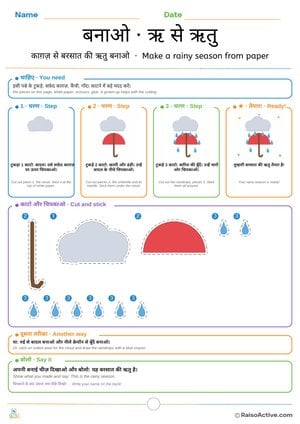
Make a Paper Rainy Season: Hindi Letter ऋ (ri) Cut and Stick Craft | बनाओ · ऋ से ऋतु
Ages 4-7 · Pre-K–Grade 1Ages 4-7 · Reception–Year 2Ages 4-7 · LKG–Class 1Ages 4-7
Children cut out the numbered pieces and stick them in order to make a rainy season scene with a cloud, umbrella and rain, then show it and say a full sentence about it. It links the letter ऋ with a real picture word, ऋतु (season), and practises scissor control and following steps.
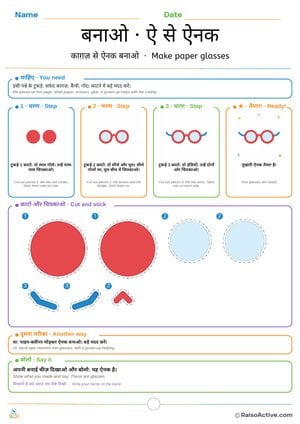
Make Paper Glasses: Hindi Letter ऐ (ai) Cut and Stick Craft | बनाओ · ऐ से ऐनक
Ages 4-7 · Pre-K–Grade 1Ages 4-7 · Reception–Year 2Ages 4-7 · LKG–Class 1Ages 4-7
Children cut out the numbered pieces and stick them in order to make a pair of glasses with two red rims, two lenses and two arms, then show it and say a full sentence about it. It links the letter ऐ with a real picture word, ऐनक, and practises scissor control and following steps.
Guides for this topic

How to Teach Cutting Skills to Your Preschooler: A Complete Guide for Parents and Teachers
Help your child master scissor skills safely. Expert guide covering readiness signs, scissor types, progression steps, pre-cutting exercises, and fun practice ideas for ages 2-6.
Christmas and Winter Activities That Combine Fun and Learning: Creating Magical Educational Experiences
Discover Christmas and winter activities that combine festive fun with real learning. Crafts, counting, literacy, and printable worksheets for ages 2 to 8 — perfect for home and school.
Age-Appropriate Halloween Learning Activities: Balancing Spooks and Skills for Young Learners
Discover fun, age-appropriate Halloween learning activities for young children. Spooky crafts, counting games, literacy ideas, and printable worksheets for ages 2 to 8.
Reviews
Every worksheet for ages 3–5, no watermark
Members download the full library of 1,000+ worksheets and every activity pack without watermarks or daily limits. One year costs ₹999 in India or $20 elsewhere.
See membership plansOr download any worksheet free with a watermark (5 a day).