Body Parts Worksheet: Cut and Label!
Cutting out labeled body part images and gluing them onto a figure teaches children ages 3-5 the names and locations of body parts like arms, legs, and ears, connecting spoken vocabulary to a visual, physical location on the body. The cutting and pasting process also strengthens fine motor control, giving this worksheet a combined literacy and hand-strength benefit. Because the body is something children can also touch and point to on themselves, this activity bridges paper-based learning with real, physical self-awareness.
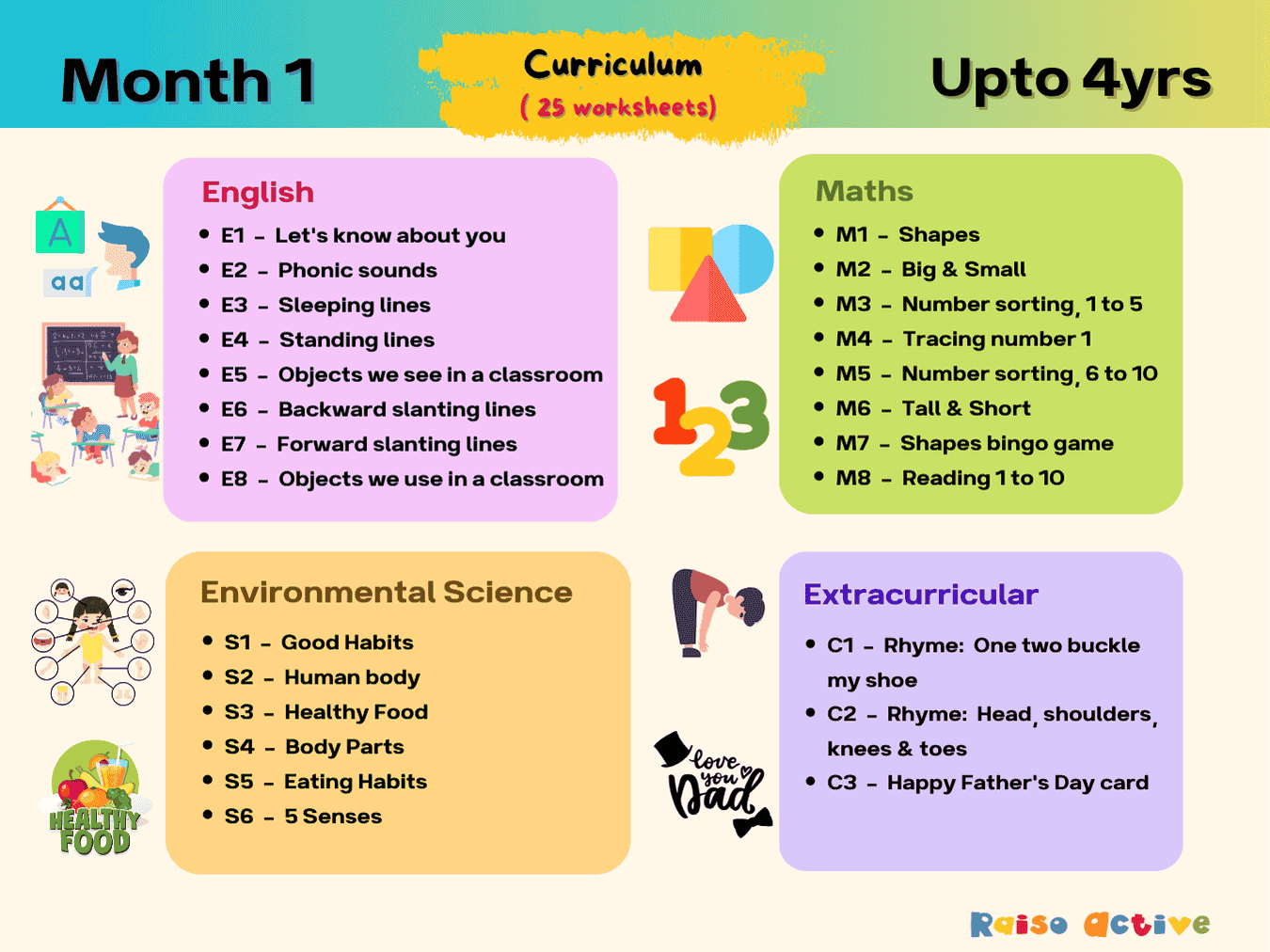
Part of the pack
Month 1: Learning & Development | Ages Up to 4
This is page 23 of the pack. Ages 3-4 · PreschoolAges 3-4 · NurseryAges 3-4
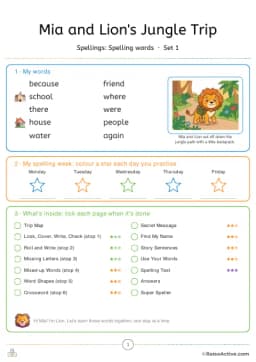
Made for your child
Spelling practice, made for your child
Their own spelling words turned into a pack: trace or look-cover-write-check, roll and write, a secret picture code, a word search, a crossword and a test, with their name in it.
Make a spelling packFree preview · free for members
Or start free: a word search with sight wordsCurriculum
- My Body > Human Body
How to use this worksheet
Have your child cut out each body part image at the bottom of the page along the dotted lines. Read the label next to each spot on the boy's body outline aloud, and ask your child to find the matching cut-out image for that body part. Once they've found the correct piece, have them glue it into place next to its label, saying the body part's name out loud as they do. Continue until every labeled spot has its matching body part glued in place, then review the completed figure together.
Materials needed
- Scissors
- Glue
- Pencil or Marker
Extension activities
- 1Point to and name the same body parts on your own body, taking turns calling out a part for the other person to touch.
- 2Draw a full outline of your child's body by tracing them on large paper, then help them label the parts.
- 3Play a 'Simon Says' game using only body part names from the worksheet.
- 4Create a body parts collage using photos or drawings cut from magazines.
- 5Sing a body parts song, like 'Head, Shoulders, Knees, and Toes,' and connect the lyrics to the worksheet.

Written by
Hemsweta Jain · Teacher Cheena
MBA and Early Childhood Educator, teaching since 2014 · Founder of RaisoActive, Mumbai
Every RaisoActive worksheet is designed and checked by the founder before publishing.
Published · Last reviewed
More from Month 1: Learning & Development | Ages Up to 4

Let's Talk About Me! Fun Conversation Worksheet for Kids
Ages 3-5 · Preschool–Pre-KAges 3-5 · Nursery–ReceptionAges 3-5 · Nursery–LKGAges 3-5
This worksheet gives children ages 3-5 a structured way to practice self-expression, prompting them to fill in blanks, draw, and color as they answer simple personal questions like their favorite color or food. Talking about themselves in a guided format builds both vocabulary and the confidence to share personal information out loud, a skill that supports classroom participation and social conversation. Combining writing, drawing, and coloring in one activity also keeps the session engaging across several different response styles.

Fine Motor Skills Activities for Kids: Parent's Guide
Ages 3-5 · Preschool–Pre-KAges 3-5 · Nursery–ReceptionAges 3-5 · Nursery–LKGAges 3-5
This guide gives parents and teachers of children ages 3-5 a set of hands-on activities — using grains, flowers, textured cloth, and salt or sugar — that build the small hand muscles and finger control needed for holding a pencil correctly and writing later on. Working with varied, everyday materials rather than a single worksheet page exposes children to different grips, pressures, and textures, which develops fine motor strength more broadly than pencil-and-paper practice alone.

Trace the Standing Lines to Reach the Ice Cream! A Pre-Writing Worksheet
Ages 3-5 · Preschool–Pre-KAges 3-5 · Nursery–ReceptionAges 3-5 · Nursery–LKGAges 3-5
This worksheet builds pencil control in children ages 3-5 by having them trace vertical, 'standing' lines connecting children to their ice cream cones, a companion skill to horizontal line tracing that together forms the basis for writing many letters and numbers. Vertical strokes require a different hand motion than horizontal ones, so practicing both directions gives children a fuller foundation for handwriting readiness.

Color the Numbers: Sorting Worksheet for Preschoolers
Ages 3-5 · Preschool–Pre-KAges 3-5 · Nursery–ReceptionAges 3-5 · Nursery–LKGAges 3-5
This worksheet helps children ages 3-5 practice number recognition by reading a color key and coloring each numeral in the circle below according to its assigned color, combining early sorting logic with numeral identification. Applying a symbolic rule — 'this number means this color' — across a whole page trains children to hold and consistently apply an instruction, a skill that carries over into following multi-step directions elsewhere.
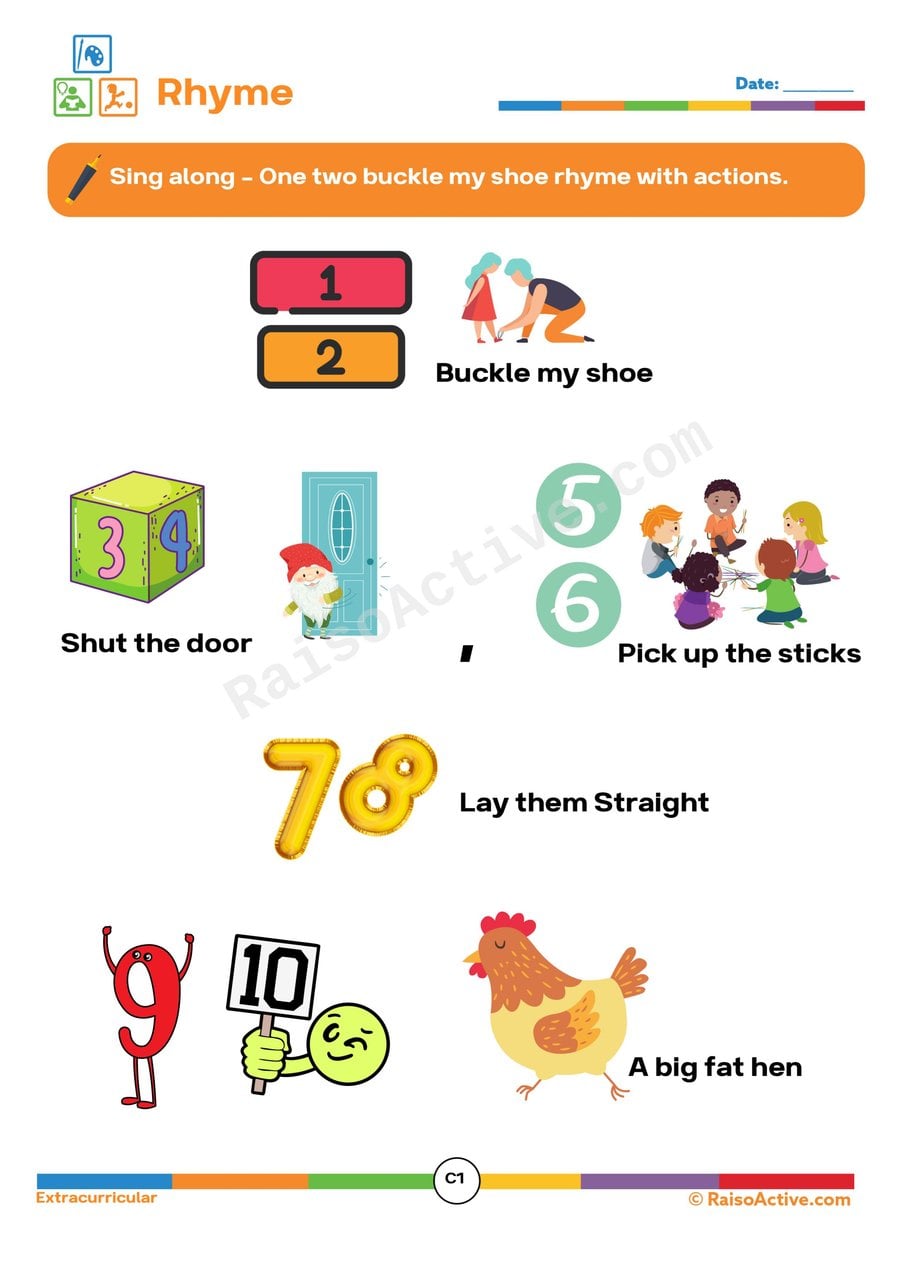
Rhyme Time! Sing Along and Learn Numbers 1-10
Ages 3-5 · Preschool–Pre-KAges 3-5 · Nursery–ReceptionAges 3-5 · Nursery–LKGAges 3-5
This activity worksheet helps children ages 3-5 build number recognition for 1 through 10 through the natural memory support of rhyme and repetition, pairing each number with a rhyming action to act out. Rhymes and songs are proven to help young children retain sequences, including number order, more easily than flat repetition alone. Acting out each rhyme's action also links movement to the number word, reinforcing learning through more than one sense.

Big and Small Objects: Coloring Worksheet for Preschoolers
Ages 3-5 · Preschool–Pre-KAges 3-5 · Nursery–ReceptionAges 3-5 · Nursery–LKGAges 3-5
This coloring worksheet helps children ages 3-5 practice comparative size reasoning by identifying and coloring the larger object within each paired set of pictures. Making a size judgment before coloring means the coloring itself becomes a way to record and confirm the child's reasoning, rather than being purely decorative. Repeated practice comparing 'big' and 'small' objects supports later measurement and comparison skills in early math.
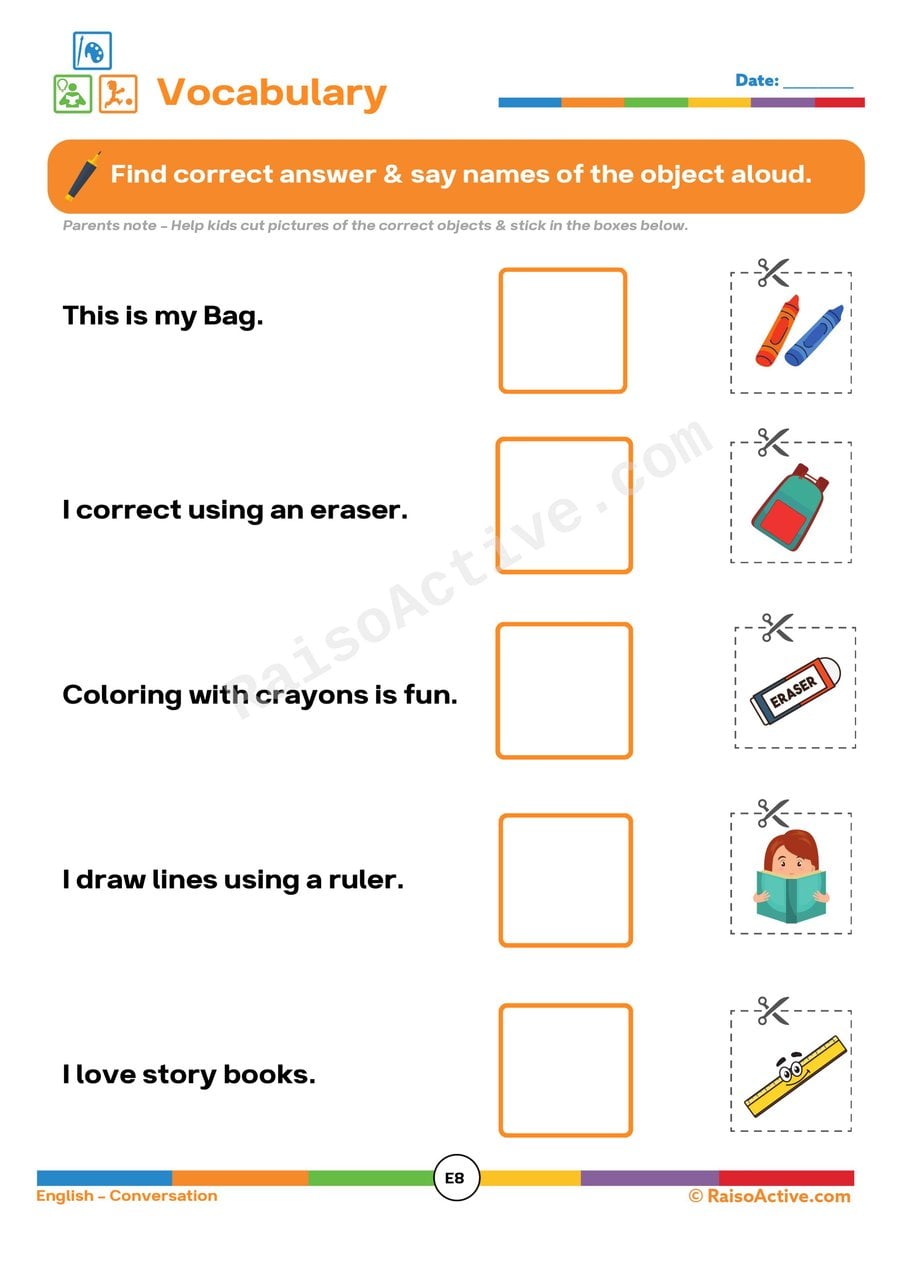
Vocabulary Fun: Match the Pictures! (Ages 3-5)
Ages 3-5 · Preschool–Pre-KAges 3-5 · Nursery–ReceptionAges 3-5 · Nursery–LKGAges 3-5
Cutting out pictures and matching them to sentences builds early reading comprehension in children ages 3-5, since they must listen to or read a sentence and connect its meaning to the correct image rather than just recognizing an isolated word. This combination of cutting, listening, and matching strengthens vocabulary retention because the word is reinforced through multiple senses at once: hearing it, seeing it in print, and seeing its picture. Pasting the correct picture into place also adds fine motor practice to the vocabulary lesson.

Slanting Line Tracing Worksheet: Help the Balls Roll Down!
Ages 3-5 · Preschool–Pre-KAges 3-5 · Nursery–ReceptionAges 3-5 · Nursery–LKGAges 3-5
Tracing diagonal lines that guide a ball down a slide teaches children ages 3-5 a prewriting stroke that's more challenging than straight horizontal or vertical lines, since slanted strokes require angling the wrist and controlling direction at the same time. This kind of diagonal line practice directly prepares the hand for letters like A, K, and X, which all rely on slanted strokes. The playful slide-and-ball theme gives an otherwise repetitive motor exercise a sense of motion and purpose.
Related worksheets
Body Parts Matching Worksheet for Preschoolers
Ages 3-5 · Preschool–Pre-KAges 3-5 · Nursery–ReceptionAges 3-5 · Nursery–LKGAges 3-5
Learning the names of body parts builds early vocabulary and body awareness for children ages 3-5, helping them describe their physical experiences and follow instructions that reference specific parts of the body. This cut-and-paste worksheet asks children to match pictures of body parts to their correct location on a figure, which reinforces spatial understanding of the body alongside vocabulary. Because children physically cut and glue each piece into place, the activity also builds fine motor control at the same time as the science and language content.

Happy Face Cut and Paste Worksheet for Preschoolers
Ages 3-5 · Preschool–Pre-KAges 3-5 · Nursery–ReceptionAges 3-5 · Nursery–LKGAges 3-5
This worksheet helps children ages 3-5 learn the names of facial features while practicing scissor control and precise gluing. Assembling a face piece by piece — eyes, nose, mouth, ears — reinforces body part vocabulary in a hands-on way that's more memorable than simply pointing at a picture.

Body Parts Matching Worksheet for Preschoolers
Ages 3-5 · Preschool–Pre-KAges 3-5 · Nursery–ReceptionAges 3-5 · Nursery–LKGAges 3-5
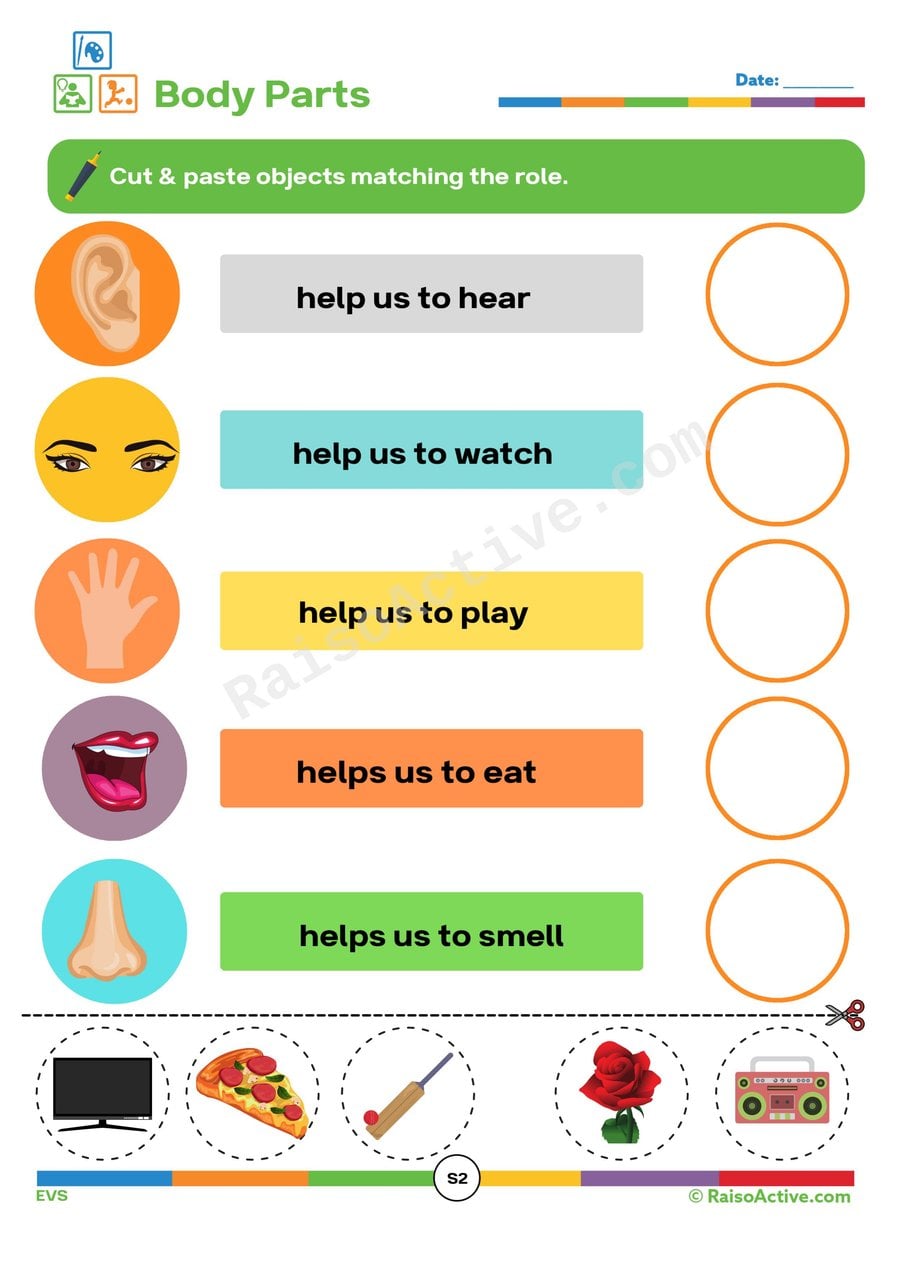
Children ages 3-5 practice matching each body part to its specific function, like eyes to seeing or legs to walking, building early awareness of how their own body works. This connects body-part vocabulary to real-world purpose rather than just naming parts in isolation.
Match the Body Parts! A Fun Worksheet for Kids
Ages 3-5 · Preschool–Pre-KAges 3-5 · Nursery–ReceptionAges 3-5 · Nursery–LKGAges 3-5
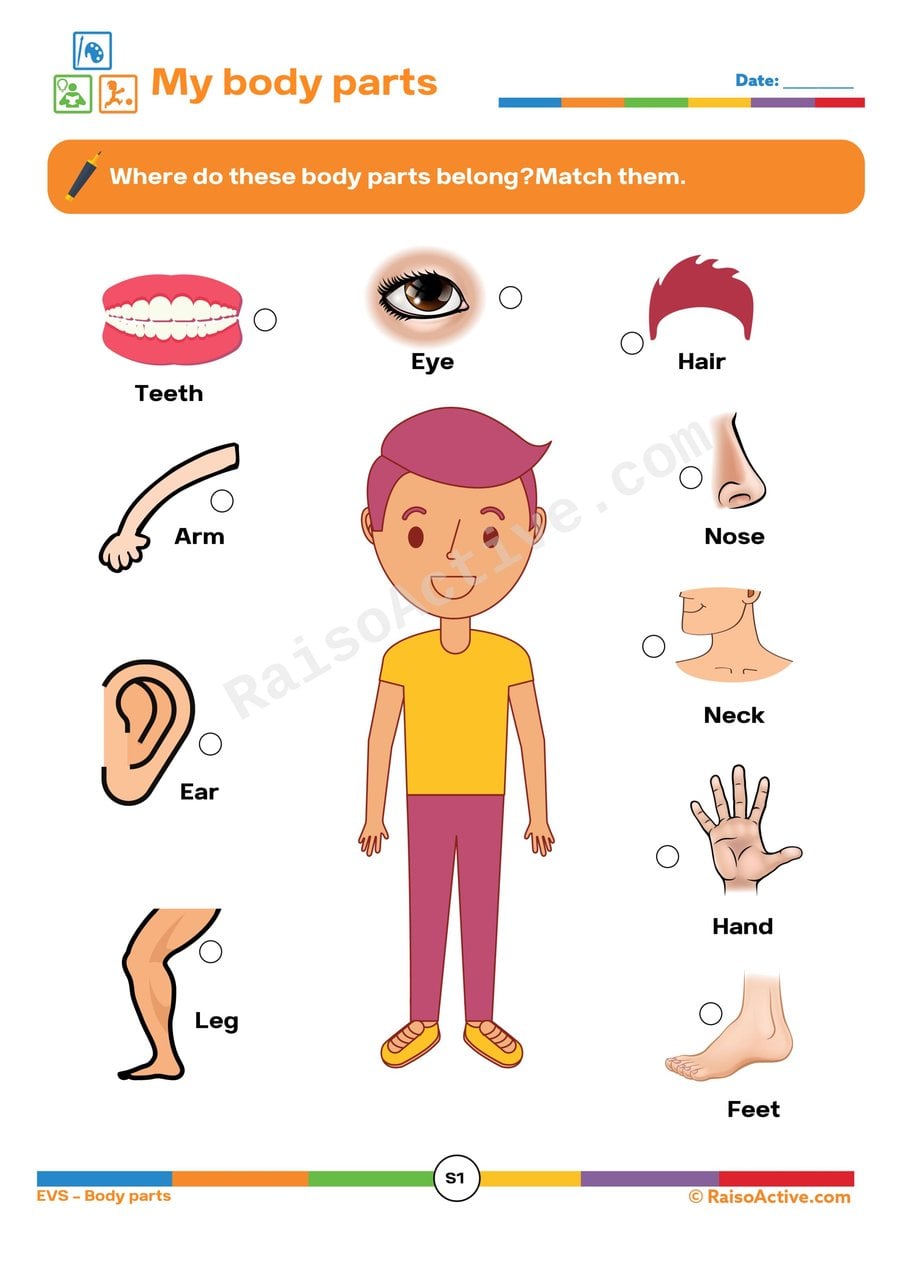
Drawing lines from body part pictures to their correct location on a human figure helps children ages 3-5 build vocabulary for parts of the body, like arms, legs, and ears, while practicing visual-spatial matching between a small picture and its larger corresponding location. This worksheet strengthens the link between a spoken body part name and its physical location, a skill children also use constantly in daily routines like getting dressed or washing up. Matching pictures to a full-body diagram, rather than just naming parts in isolation, builds a more complete mental map of the body.

Body Parts Cut and Paste Worksheet for Preschoolers
Ages 3-5 · Preschool–Pre-KAges 3-5 · Nursery–ReceptionAges 3-5 · Nursery–LKGAges 3-5
Cutting out body part pictures and gluing them to match written sentences builds vocabulary for children ages 3-5 while reinforcing fine motor skills, connecting a spoken or written body part name to its correct image.
Dad's Beard: A Fun Shaving Activity for Kids!
Ages 3-5 · Preschool–Pre-KAges 3-5 · Nursery–ReceptionAges 3-5 · Nursery–LKGAges 3-5
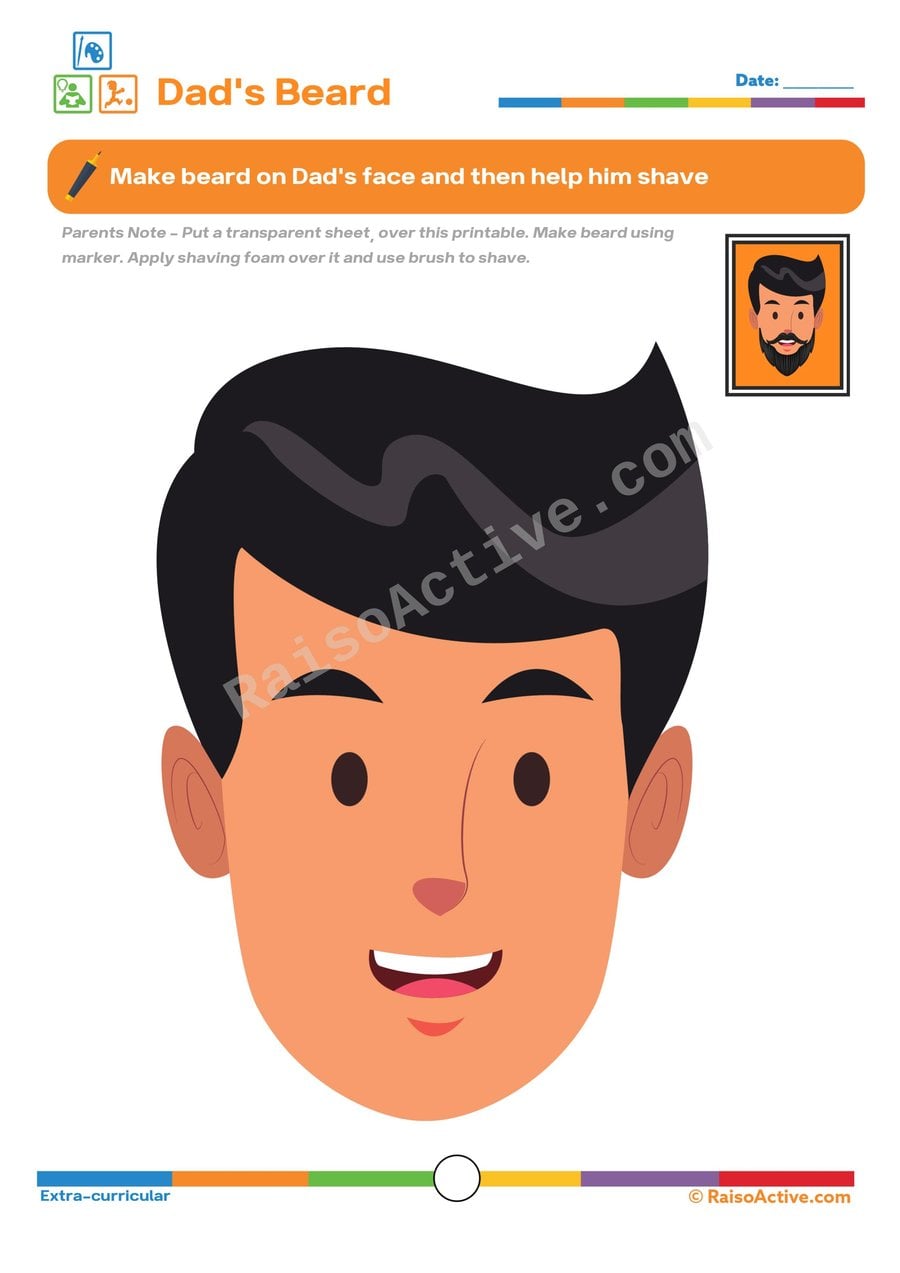
This sensory pretend-shaving activity builds fine motor precision and hand control in children ages 3-5, as they draw a beard with a marker and then carefully brush away shaving foam in controlled strokes. Beyond motor skills, it gives children a playful, low-stakes way to imitate a grown-up grooming routine they've likely observed at home.
Shape Elves Worksheet: Cut, Paste, and Create!
Ages 3-5 · Preschool–Pre-KAges 3-5 · Nursery–ReceptionAges 3-5 · Nursery–LKGAges 3-5
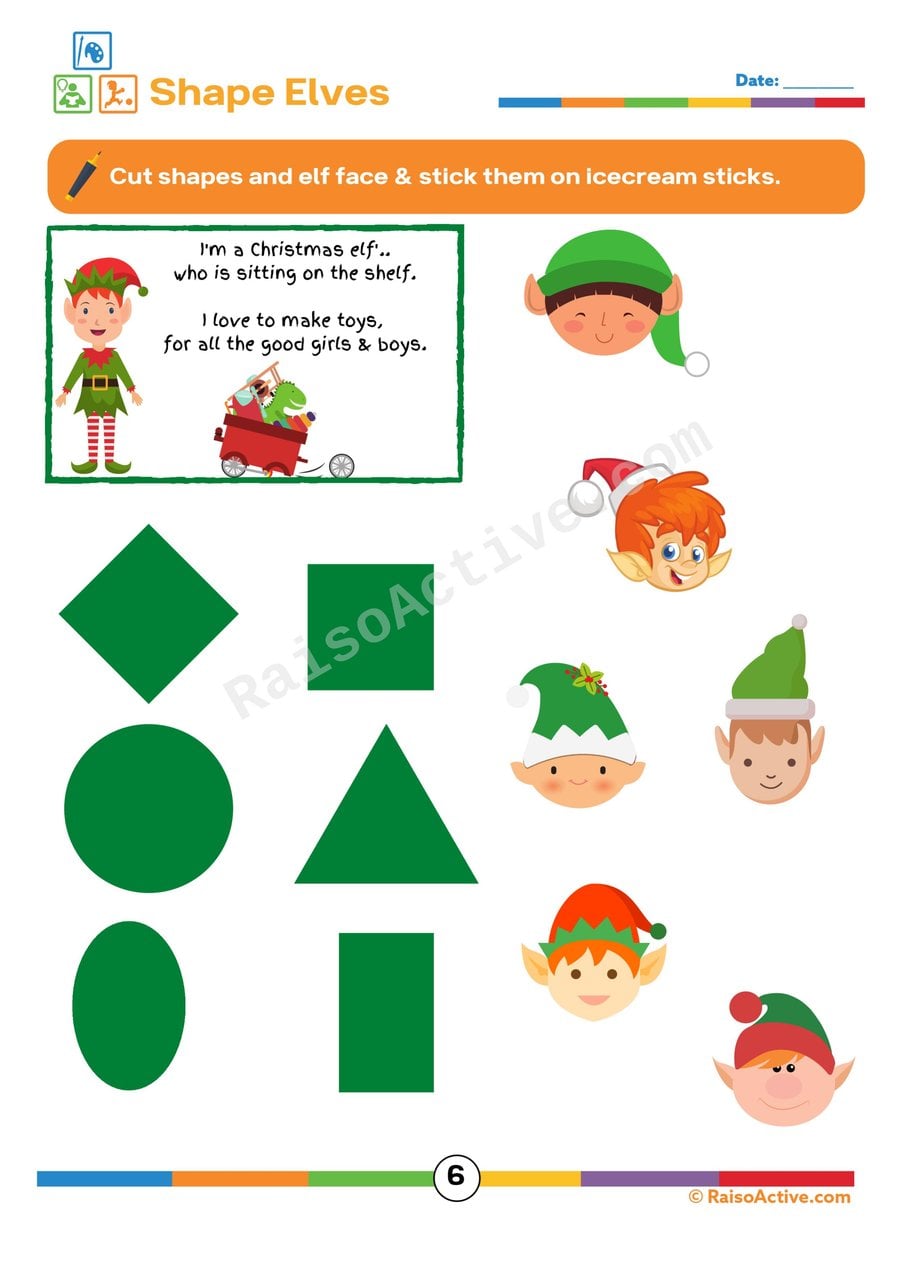
Cutting out circles, triangles, and rectangles to assemble an elf face teaches children ages 3-5 to recognize and name basic 2D shapes while practicing scissor control along both straight and curved lines. Because each shape has to go in a specific spot to form a recognizable face, children also build spatial reasoning as they figure out which shape works as eyes, a nose, or a hat. Turning geometry into a craft project makes an abstract math concept feel like creative play.
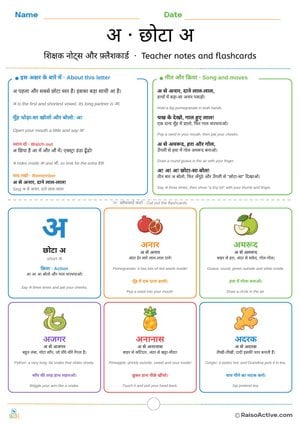
Hindi Letter अ (a) Teacher Notes and Flashcards | अ · छोटा अ
Ages 3-7 · Preschool–Grade 1Ages 3-7 · Nursery–Year 2Ages 3-7 · Nursery–Class 1Ages 3-7
Children meet the short vowel अ with a short note for adults, a song with actions and cut-out flashcards for अनार (pomegranate), अमरूद (guava), अजगर (python), अनानास (pineapple), अदरक (ginger). They hear the sound at the start of real words and link it to a hand action.
Guides for this topic

Sight Words by Age: The First 50 Words and How to Teach Them Without Flashcard Fatigue
Which sight words to teach first and why, the heart-word method, a read-trace-write-find routine, games, and a by-age table of typical sight-word progress.
How to Teach CVC Blending: A Step-by-Step Method That Works in Two Weeks
A step-by-step method for teaching CVC blending, covering continuous sounds, word families, common errors, and a 14-day plan that most children finish reading CVC words.

Bridging Two Worlds: A Complete Guide to Teaching Heritage Languages Alongside English
A practical guide to raising bilingual children who speak both their heritage language and English with confidence. Research-backed strategies, activities, and tips for Indian families.
Reviews
Every worksheet for ages 3–5, no watermark
Members download the full library of 1,000+ worksheets and every activity pack without watermarks or daily limits. One year costs ₹999 in India or $20 elsewhere.
See membership plansOr download any worksheet free with a watermark (5 a day).