The Hungry Ant: Feed the Ant by Cutting and Pasting Fruits Worksheet
Children ages 4-6 practice sequencing and vocabulary by associating specific fruits with each day of the week as they feed a hungry ant. Following a fixed weekly order while matching new vocabulary (fruit names) to each day builds both memory sequencing and category-association skills useful across early literacy and science tasks.
Part of the pack
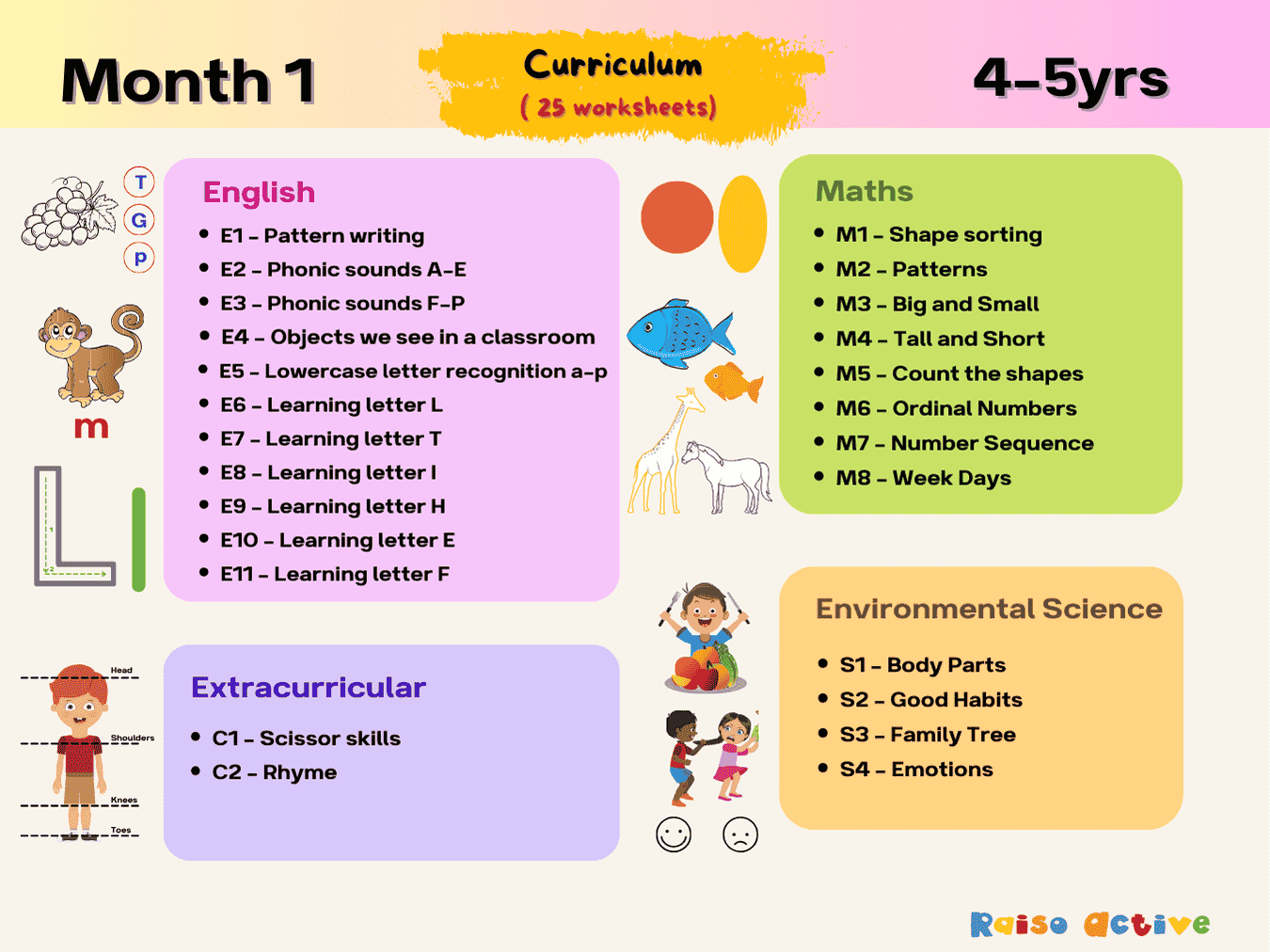
Play-Based Learning Activity Book for 4-5 Year Olds | Literacy, Math & EVS
This is page 22 of the pack. Ages 4-5 · Pre-KAges 4-5 · ReceptionAges 4-5 · LKGAges 4-5
Curriculum
- Time > Days of the Week
How to use this worksheet
Read through the days of the week together first, pointing to each one in order on the worksheet. Have your child cut out the fruit pictures at the bottom of the page, then look at the example to understand which fruit belongs on which day. Guide them to paste each fruit next to its matching day, saying the day and fruit name aloud as they glue. Once complete, read through the whole week together, naming each day's fruit in order.
Materials needed
- Scissors
- Glue
- Pencil
Extension activities
- 1Have your child draw their favorite fruit and say which day of the week they'd like to eat it.
- 2Discuss the colors and shapes of the different fruits used in the activity.
- 3Practice the days of the week with a song or rhyme to reinforce the sequence.
- 4Create a simple weekly fruit chart at home and check off each fruit as your family eats it.
- 5Sort the fruit cutouts by color or size as an additional matching activity.

Written by
Hemsweta Jain · Teacher Cheena
MBA and Early Childhood Educator, teaching since 2014 · Founder of RaisoActive, Mumbai
Every RaisoActive worksheet is designed and checked by the founder before publishing.
Published · Last reviewed
More from Play-Based Learning Activity Book for 4-5 Year Olds | Literacy, Math & EVS

Shape Pattern Fun: Complete the Pattern Worksheet for Preschoolers
Ages 3-5 · Preschool–Pre-KAges 3-5 · Nursery–ReceptionAges 3-5 · Nursery–LKGAges 3-5
This worksheet introduces children ages 3-5 to pattern recognition using shapes, asking them to notice a repeating sequence and supply the missing piece. Continuing a pattern requires children to detect a rule and predict what comes next, an early form of the logical reasoning that later supports algebra and sequencing skills. Cutting and pasting the correct shape also reinforces shape recognition and fine motor precision.

Shape Sorting Fun: Cut and Paste Worksheet for Preschoolers
Ages 3-5 · Preschool–Pre-KAges 3-5 · Nursery–ReceptionAges 3-5 · Nursery–LKGAges 3-5
This cut-and-paste worksheet helps children ages 3-5 practice visually matching real-world objects to their underlying geometric shape, specifically distinguishing circles from ovals. Learning to see the circle or oval 'hiding' inside everyday objects, like a clock or an egg, builds the shape-recognition foundation that supports later geometry and spatial reasoning. Cutting and gluing each piece also strengthens fine motor precision.

Parent's Guide: Fun Activities for Gross Motor Development and Emotional Learning
Ages 3-5 · Preschool–Pre-KAges 3-5 · Nursery–ReceptionAges 3-5 · Nursery–LKGAges 3-5
This parent guide equips caregivers of children ages 3-5 with activities spanning gross motor skills, emotional expression, family concepts, shape recognition, and calendar awareness, using role play, finger puppets, and simple games. Combining physical movement with emotional vocabulary practice, such as making different facial expressions, helps children build body awareness and feelings vocabulary side by side. Rotating through several distinct activity types in one guide also keeps a young child's attention across a longer play session.

Say My Sound: Beginning Letter Sounds Worksheet for Preschoolers
Ages 3-5 · Preschool–Pre-KAges 3-5 · Nursery–ReceptionAges 3-5 · Nursery–LKGAges 3-5
Saying a picture's name aloud and then circling the letter that matches its beginning sound builds phonemic awareness in children ages 3-5, teaching them to isolate the very first sound in a spoken word before connecting it to a printed letter. Because several letter options are given for each picture, this worksheet requires children to actively compare sounds rather than simply recognize a single correct letter by memory. This kind of applied letter-sound practice is one of the strongest early predictors of later reading success.
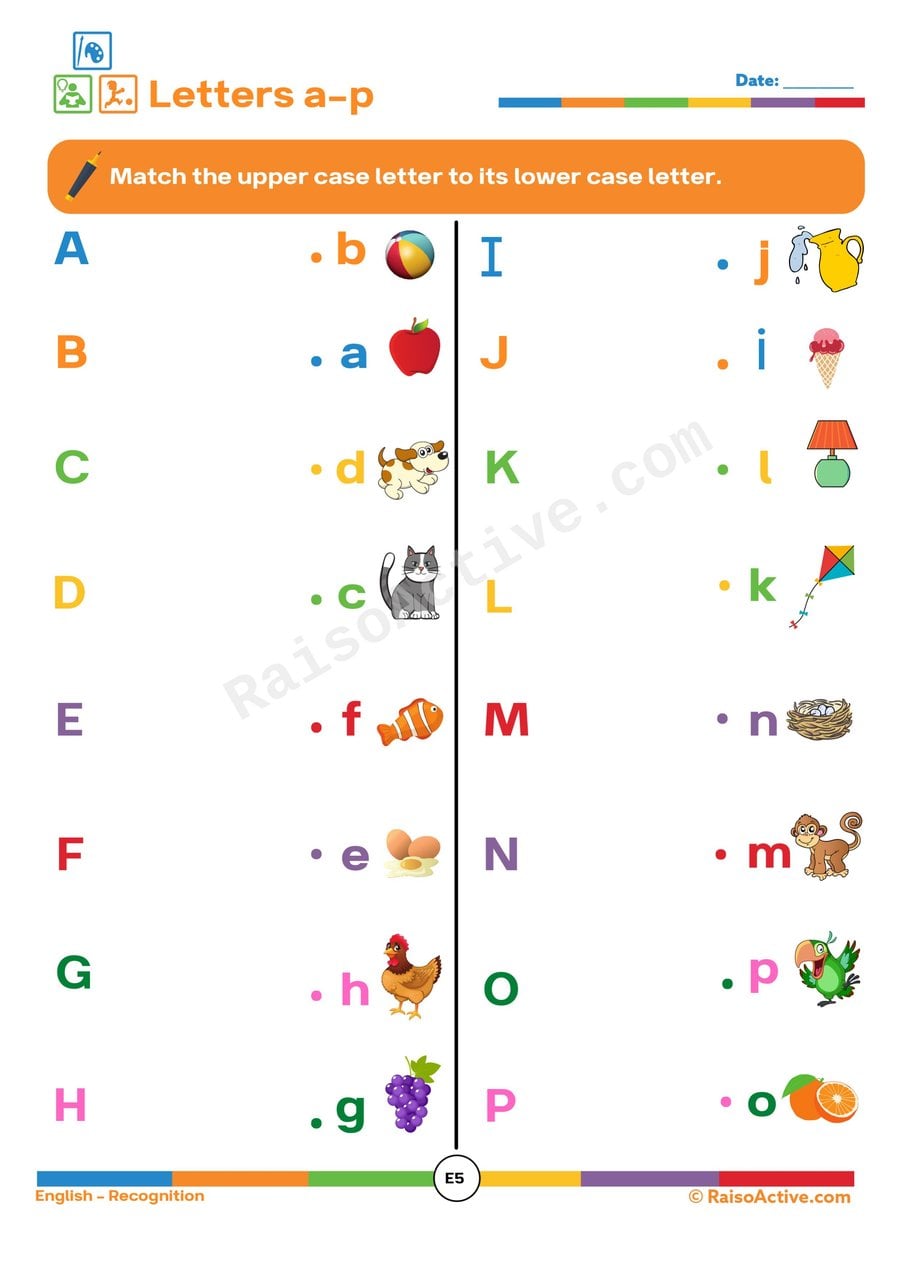
Match the Uppercase Letters: a-p Worksheet
Ages 4-6 · Pre-K–KindergartenAges 4-6 · Reception–Year 1Ages 4-6 · LKG–UKGAges 4-6
This worksheet helps children ages 4-6 practice matching uppercase letters to their corresponding lowercase forms across the first half of the alphabet, letters A through P. Recognizing that an uppercase and lowercase letter, even ones that look quite different like G and g, represent the same letter is an essential skill for reading printed text, which mixes both cases constantly. Covering a larger range of letters than a single-letter worksheet also builds broader alphabet fluency in one sitting.

Letter F Worksheet: Trace, Write, and Color the Letter F!
Ages 3-5 · Preschool–Pre-KAges 3-5 · Nursery–ReceptionAges 3-5 · Nursery–LKGAges 3-5
This worksheet gives children ages 3-5 structured practice tracing, then independently writing, the letter F in both its uppercase and lowercase forms, building the fine motor precision needed for legible handwriting. Moving from a traced guide to writing F on plain lines is an important step up in independence for early writers. Coloring pictures of F words afterward reinforces the connection between the letter's shape and its beginning sound.

Letter T Tracing and Coloring Worksheet for Preschoolers
Ages 3-5 · Preschool–Pre-KAges 3-5 · Nursery–ReceptionAges 3-5 · Nursery–LKGAges 3-5
This worksheet helps children ages 3-5 build the fine motor control and directional awareness needed to form the letter T correctly, tracing both its uppercase and lowercase forms along guided dotted lines. Repeated tracing builds the muscle memory in small hand muscles that eventually allows children to write letters independently without a guide. Coloring pictures that begin with T and hunting for the letter in a grid also reinforce letter-sound and letter-shape recognition side by side.
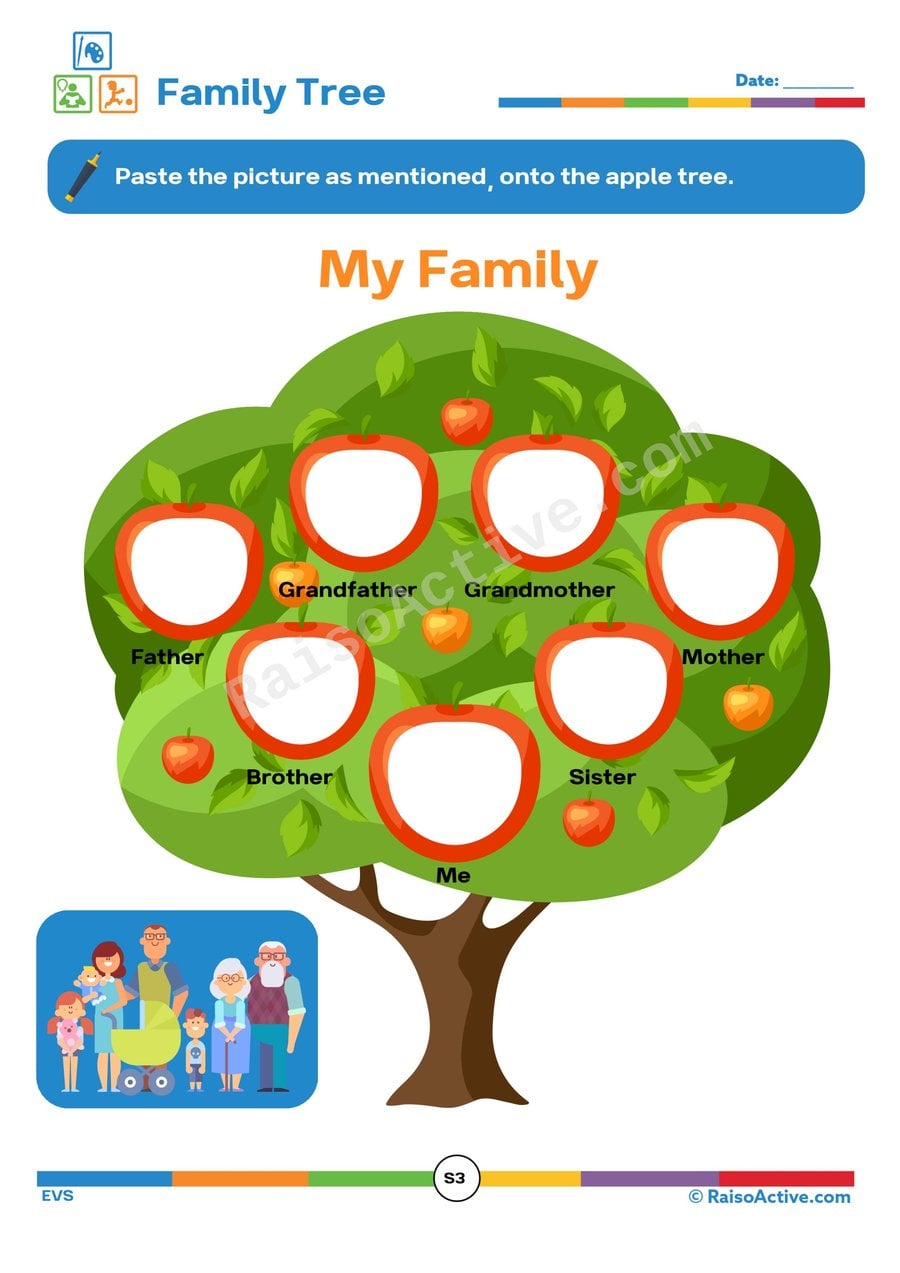
My Family Tree Worksheet: Paste & Learn!
Ages 3-5 · Preschool–Pre-KAges 3-5 · Nursery–ReceptionAges 3-5 · Nursery–LKGAges 3-5
This worksheet helps children ages 3-5 build vocabulary around family relationships while practicing pasting skills and personal storytelling. Creating a visual, personalized family tree helps children organize and talk about the people closest to them, an early step in understanding relationships and social structure.
Related worksheets

Coding Shapes Worksheet for Preschoolers: Cut and Paste Patterns
Ages 3-5 · Preschool–Pre-KAges 3-5 · Nursery–ReceptionAges 3-5 · Nursery–LKGAges 3-5
This cut-and-paste activity has children ages 3-5 recreate shape sequences shown in sample boxes, combining shape recognition with the same ordered, step-by-step thinking used in beginner coding concepts. Cutting out individual shapes and arranging them in the correct sequence also builds fine motor precision and spatial planning.

Spring Sudoku Worksheet: Cut and Paste Puzzle for Kids
Ages 4-6 · Pre-K–KindergartenAges 4-6 · Reception–Year 1Ages 4-6 · LKG–UKGAges 4-6
Placing cut-out pictures into a sudoku-style grid so that no image repeats in any row, column, or box teaches children ages 4-6 early logical reasoning and systematic thinking, since they must check multiple directions before deciding where each piece belongs. Cutting out the small picture squares beforehand also builds scissor control and hand-eye coordination. Together, this combines a pre-math logic puzzle with fine motor practice in a single spring-themed activity.

Color the Reindeer! Christmas Coloring Worksheet for Kids
Ages 3-5 · Preschool–Pre-KAges 3-5 · Nursery–ReceptionAges 3-5 · Nursery–LKGAges 3-5
Coloring the reindeer and gift bag illustrations gives children ages 3-5 focused practice with crayon control and color selection, helping them build the hand strength and precision needed for later handwriting tasks. Choosing colors for a familiar character like a reindeer also encourages imaginative decision-making, since there's no single 'correct' color for a fictional animal's coat or a wrapped gift. The festive subject matter keeps a repetitive fine motor task feeling like a treat rather than a chore.

Easter Maze Adventure: Help the Bunny Find the Carrot!
Ages 3-5 · Preschool–Pre-KAges 3-5 · Nursery–ReceptionAges 3-5 · Nursery–LKGAges 3-5
Tracing a path from the bunny to the carrot builds fine motor control and pencil steadiness in children ages 3-5, since staying within the maze's narrow lines requires more precision than open coloring. Navigating around dead ends also develops early problem-solving and planning skills, as children learn to look ahead and backtrack when a path doesn't work out. This kind of visual-spatial puzzle strengthens the ability to plan a route mentally before committing it to paper, a skill that supports later map-reading and logical thinking.

Gingerbread Man Coloring Worksheet for Preschoolers
Ages 3-5 · Preschool–Pre-KAges 3-5 · Nursery–ReceptionAges 3-5 · Nursery–LKGAges 3-5
This gingerbread man worksheet gives children ages 3-5 practice coloring within a simple, familiar outline while also adding their own decorative details like buttons and a bow, encouraging creative choices within a structured shape. Deciding where to place each decoration also builds early spatial awareness, since buttons and a bow need to be positioned in specific spots on the body.

Human Skeleton Cut and Join Worksheet for Preschoolers
Ages 4-6 · Pre-K–KindergartenAges 4-6 · Reception–Year 1Ages 4-6 · LKG–UKGAges 4-6
This hands-on worksheet introduces children ages 4-6 to basic human anatomy as they cut out individual bone shapes, like the skull, ribs, arms, and legs, and assemble them into a complete skeleton. Beyond scissor control, the activity requires spatial reasoning, since children must figure out where each bone belongs relative to the others to build an accurate body shape.
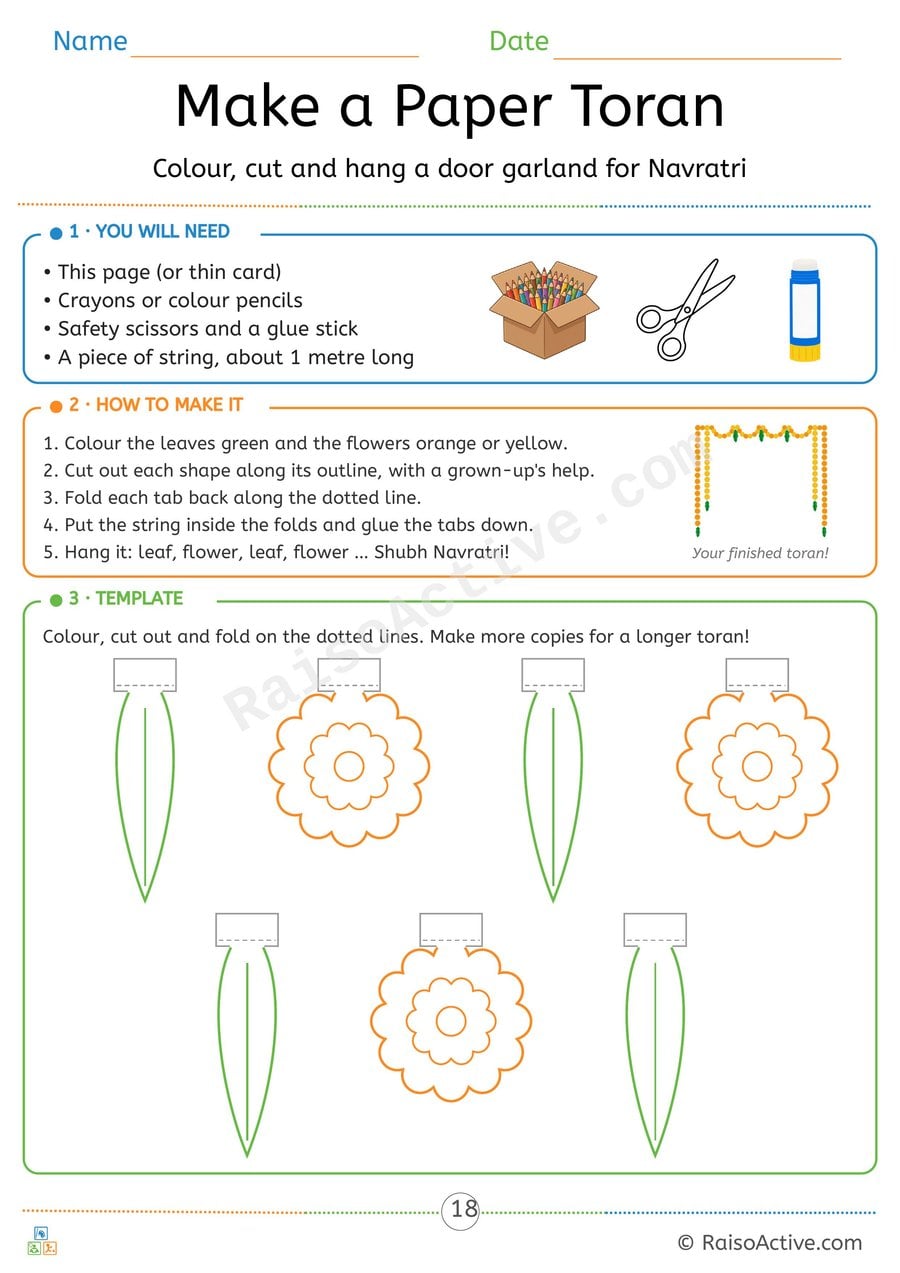
Make a Paper Toran: Navratri Craft Template
Ages 4-6 · Pre-K–KindergartenAges 4-6 · Reception–Year 1Ages 4-6 · LKG–UKGAges 4-6
Children follow step-by-step instructions to colour, cut, fold and glue a festival decoration, building scissor skills and fine motor control.
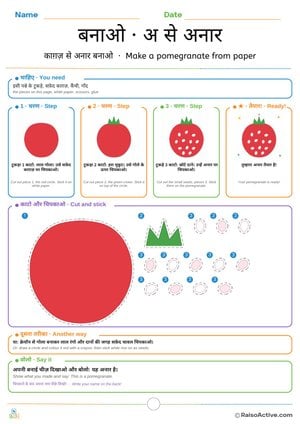
Make a Paper Pomegranate: Hindi Letter अ Craft | बनाओ · अ से अनार
Ages 3-7 · Preschool–Grade 1Ages 3-7 · Nursery–Year 2Ages 3-7 · Nursery–Class 1Ages 3-7
Children cut out the pieces, put them together following three step pictures and make a paper pomegranate. Saying the word अनार as they make it links the sound अ to something they built themselves.
Guides for this topic

Coding Activities for Preschoolers: Building Tomorrow's Thinkers Today
Discover 15+ unplugged and screen-based coding activities for preschoolers that build sequencing, logic, and problem-solving skills through play. NEP 2020 aligned.

How to Teach Cutting Skills to Your Preschooler: A Complete Guide for Parents and Teachers
Help your child master scissor skills safely. Expert guide covering readiness signs, scissor types, progression steps, pre-cutting exercises, and fun practice ideas for ages 2-6.
Christmas and Winter Activities That Combine Fun and Learning: Creating Magical Educational Experiences
Discover Christmas and winter activities that combine festive fun with real learning. Crafts, counting, literacy, and printable worksheets for ages 2 to 8 — perfect for home and school.
Reviews
Every worksheet for ages 4–6, no watermark
Members download the full library of 1,000+ worksheets and every activity pack without watermarks or daily limits. One year costs ₹999 in India or $20 elsewhere.
See membership plansOr download any worksheet free with a watermark (5 a day).