Road Safety Cut and Paste Worksheet for Kids
Children ages 3-5 practice identifying safe versus unsafe behaviors near roads and traffic by sorting pictures into 'Do's' and 'Don'ts' columns, building early safety awareness alongside basic classification skills. Talking through why each picture belongs in its column helps children move beyond simply memorizing rules toward actually understanding the reasoning behind road safety.
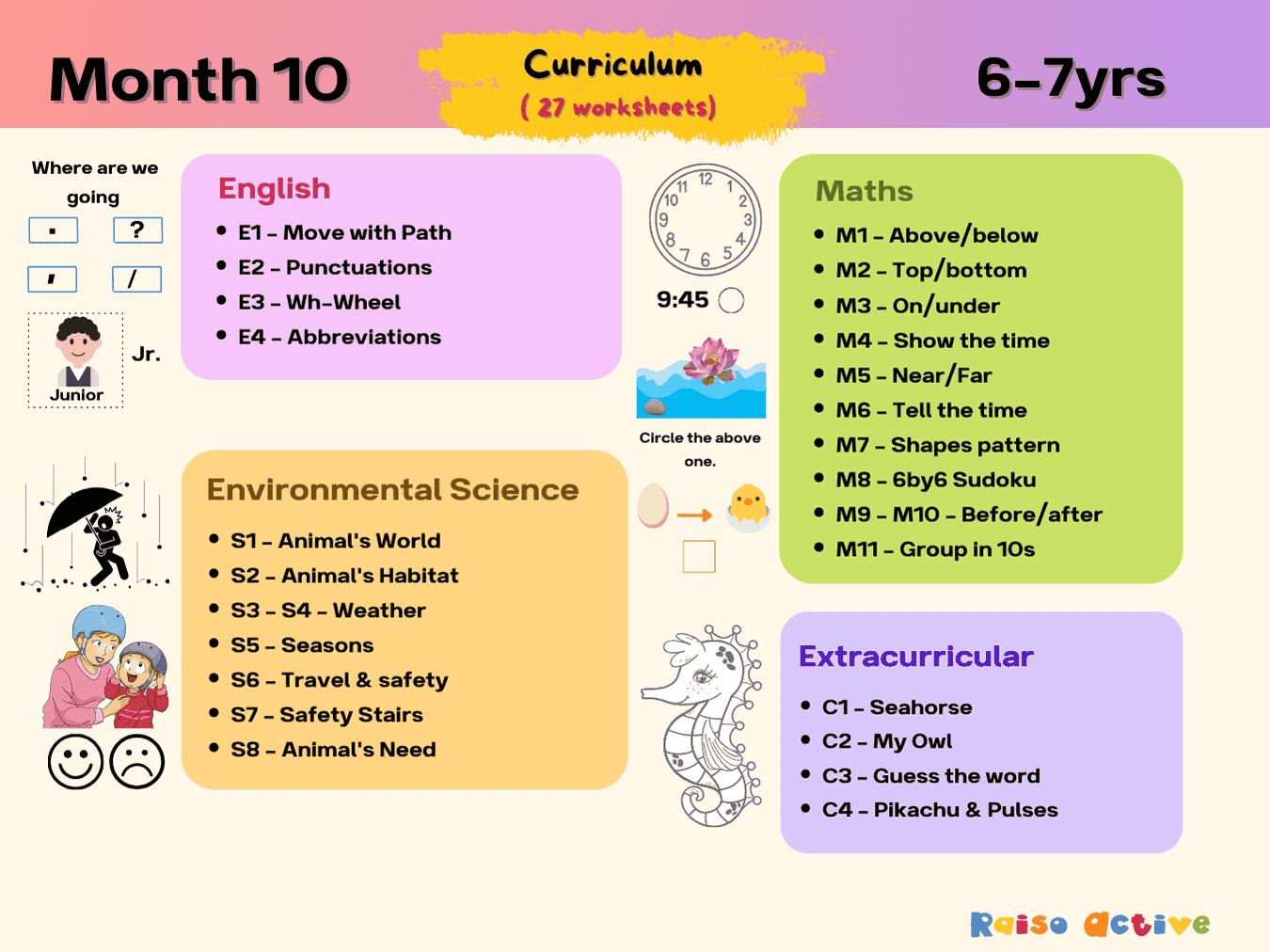
Part of the pack
Month 10: Learning & Development | Ages 6-7
This is page 24 of the pack. Ages 6-7 · Grade 1Ages 6-7 · Year 2Ages 6-7 · Class 1Ages 6-7
Curriculum
- Safety > Road Safety
How to use this worksheet
Look at the pictures at the bottom of the page together and describe what's happening in each one before your child starts cutting. Have your child cut out each picture, then decide together whether it shows a safe action, like holding an adult's hand while crossing, or an unsafe one, like running into the street. Glue each picture into the correct 'Do's' or 'Don'ts' column, discussing the reasoning behind the placement as you go.
Materials needed
- Scissors
- Glue
- Pencil
Extension activities
- 1Discuss each picture in detail and talk through why it is safe or unsafe in real-life terms.
- 2Draw your own safe road scene showing people crossing correctly and using a crosswalk.
- 3Practice looking both ways and holding hands before crossing a real street together, narrating the safe steps out loud.
- 4Act out a short role-play with toy cars and figures showing a safe versus unsafe road crossing.

Written by
Hemsweta Jain · Teacher Cheena
MBA and Early Childhood Educator, teaching since 2014 · Founder of RaisoActive, Mumbai
Every RaisoActive worksheet is designed and checked by the founder before publishing.
Published · Last reviewed
More from Month 10: Learning & Development | Ages 6-7

Near and Far Worksheet: Identifying and Connecting Objects
Ages 3-5 · Preschool–Pre-KAges 3-5 · Nursery–ReceptionAges 3-5 · Nursery–LKGAges 3-5
This worksheet introduces children ages 3-5 to the comparative spatial concepts of 'near' and 'far' by having them draw connecting lines based on relative distance in a picture. Understanding proximity words builds an early vocabulary foundation for describing the physical world, which later supports map reading and measurement concepts. The connect-the-line format also reinforces visual tracking and following printed instructions accurately.

Shape Pattern Cut and Paste Worksheet for Preschoolers
Ages 3-5 · Preschool–Pre-KAges 3-5 · Nursery–ReceptionAges 3-5 · Nursery–LKGAges 3-5
This worksheet asks children ages 3-5 to identify the rule in a repeating shape pattern and select the correct cut-out shape to complete it, combining shape recognition with early sequencing logic. Recognizing and continuing patterns strengthens the kind of predictive thinking that later supports skip counting and multiplication concepts. Precisely cutting and placing each small shape piece also builds fine motor control.

Punctuation Fun: Practice Using Punctuation Marks!
Ages 4-6 · Pre-K–KindergartenAges 4-6 · Reception–Year 1Ages 4-6 · LKG–UKGAges 4-6
Choosing the correct punctuation mark to complete a sentence teaches children ages 4-6 that periods, question marks, and other marks change how a sentence should be read and understood, not just how it looks on paper. Matching sentences to their correct punctuation marks reinforces this by requiring children to recognize the tone or purpose of a sentence, whether it's a statement, a question, or an exclamation. This early grammar practice builds the foundation for reading with expression and writing complete, correctly punctuated sentences later on.

Safety Stairs Worksheet: Matching Traffic Signs and Following Directions
Ages 3-5 · Preschool–Pre-KAges 3-5 · Nursery–ReceptionAges 3-5 · Nursery–LKGAges 3-5
This worksheet builds road safety awareness in children ages 3-5 while also practicing sign recognition, visual matching, and following a multi-step path from start to finish. Matching sign names to sign shapes teaches children to recognize traffic signs by both their look and their meaning, a real-world reading skill that supports their safety once they're out walking or biking.

Animal Habitats Matching Worksheet for Preschoolers
Ages 3-5 · Preschool–Pre-KAges 3-5 · Nursery–ReceptionAges 3-5 · Nursery–LKGAges 3-5
This worksheet helps children ages 3-5 connect specific animals to their natural homes, reinforcing early science vocabulary around habitats like forests, oceans, and deserts. Matching an animal to its habitat circle first, then cutting and pasting the same animal into a corresponding box, gives two rounds of practice with the same concept using different formats. This repetition helps solidify the animal-habitat pairing in memory.
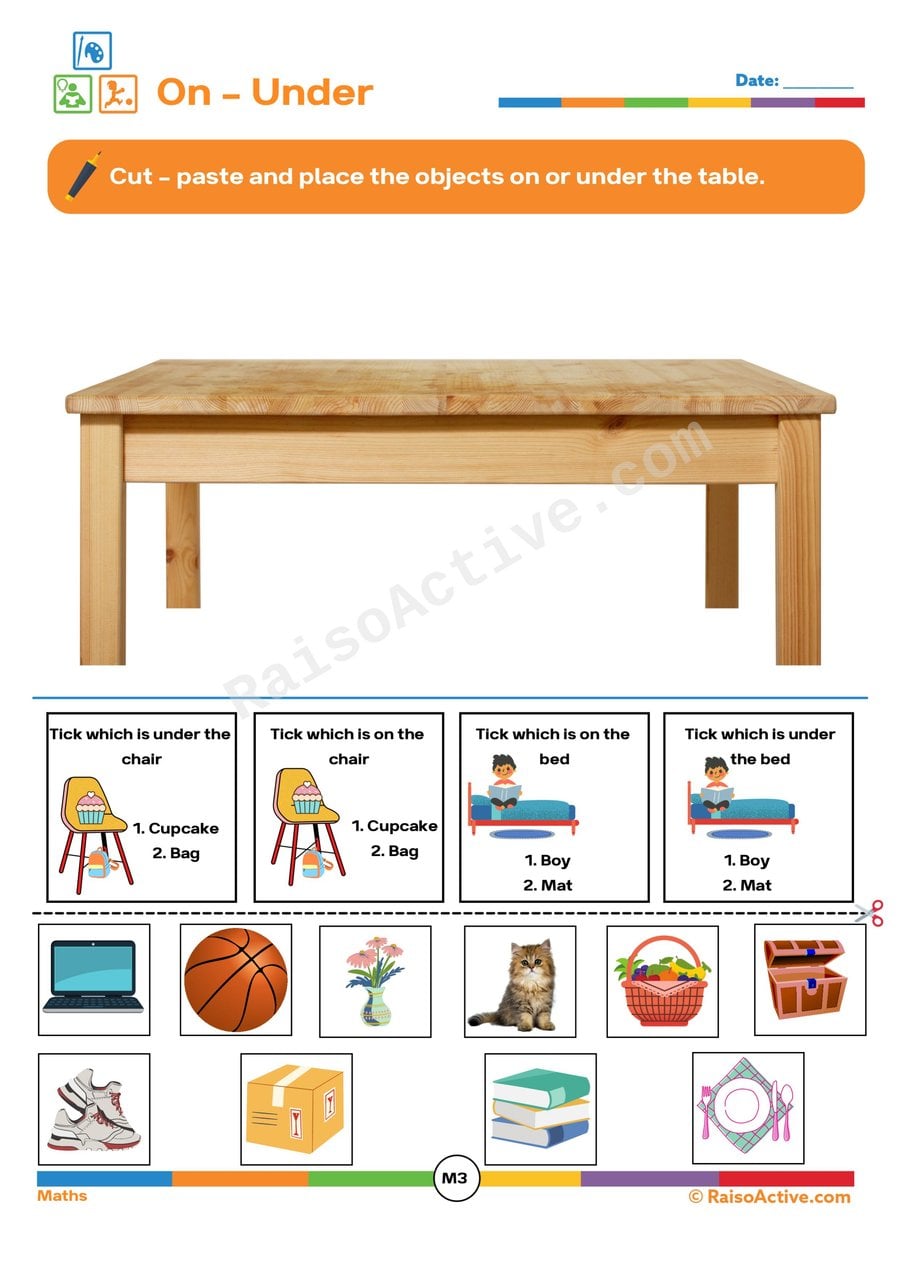
On and Under Worksheet: Table Placement Fun!
Ages 3-5 · Preschool–Pre-KAges 3-5 · Nursery–ReceptionAges 3-5 · Nursery–LKGAges 3-5
Cutting out pictures and gluing them either on or under a table teaches children ages 3-5 the spatial prepositions 'on' and 'under' by requiring them to physically place an object according to a specific instruction rather than just hearing the words. This hands-on placement task builds spatial reasoning and reinforces receptive language, since children must correctly interpret which word means which position before acting on it. Prepositions like these are often tricky to grasp through listening alone, so the visual, hands-on nature of this worksheet makes the concept concrete.
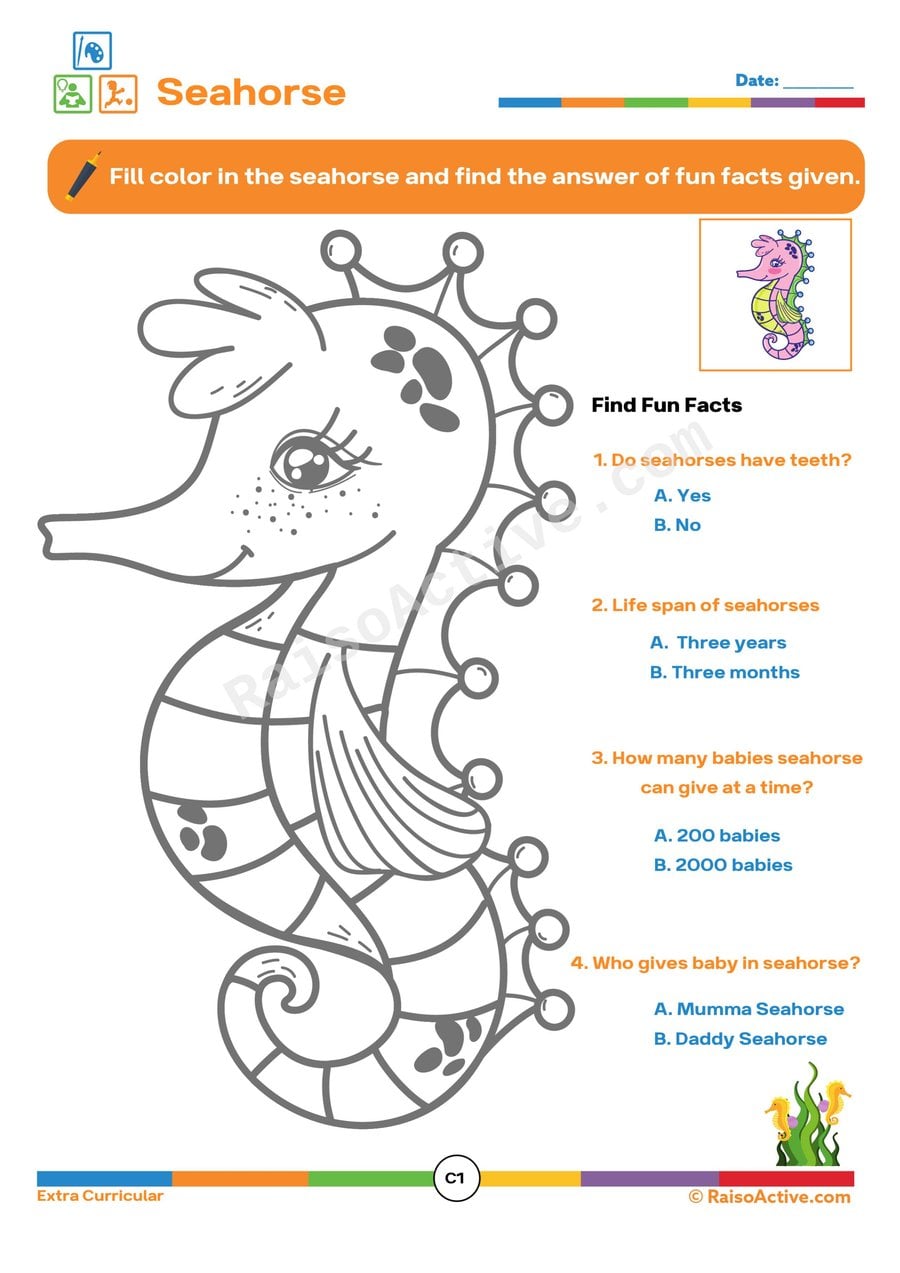
Seahorse Fun Facts Worksheet for Kids
Ages 3-5 · Preschool–Pre-KAges 3-5 · Nursery–ReceptionAges 3-5 · Nursery–LKGAges 3-5
This worksheet combines coloring practice with early reading comprehension by having children ages 3-5 color a seahorse illustration and then answer simple fact-based questions about it by circling the correct choice. Learning specific facts about an unusual sea creature — like that seahorses swim upright or that males carry the eggs — builds background science knowledge that supports later reading comprehension in nonfiction texts. The coloring portion also keeps fine motor practice woven into a subject-focused activity.
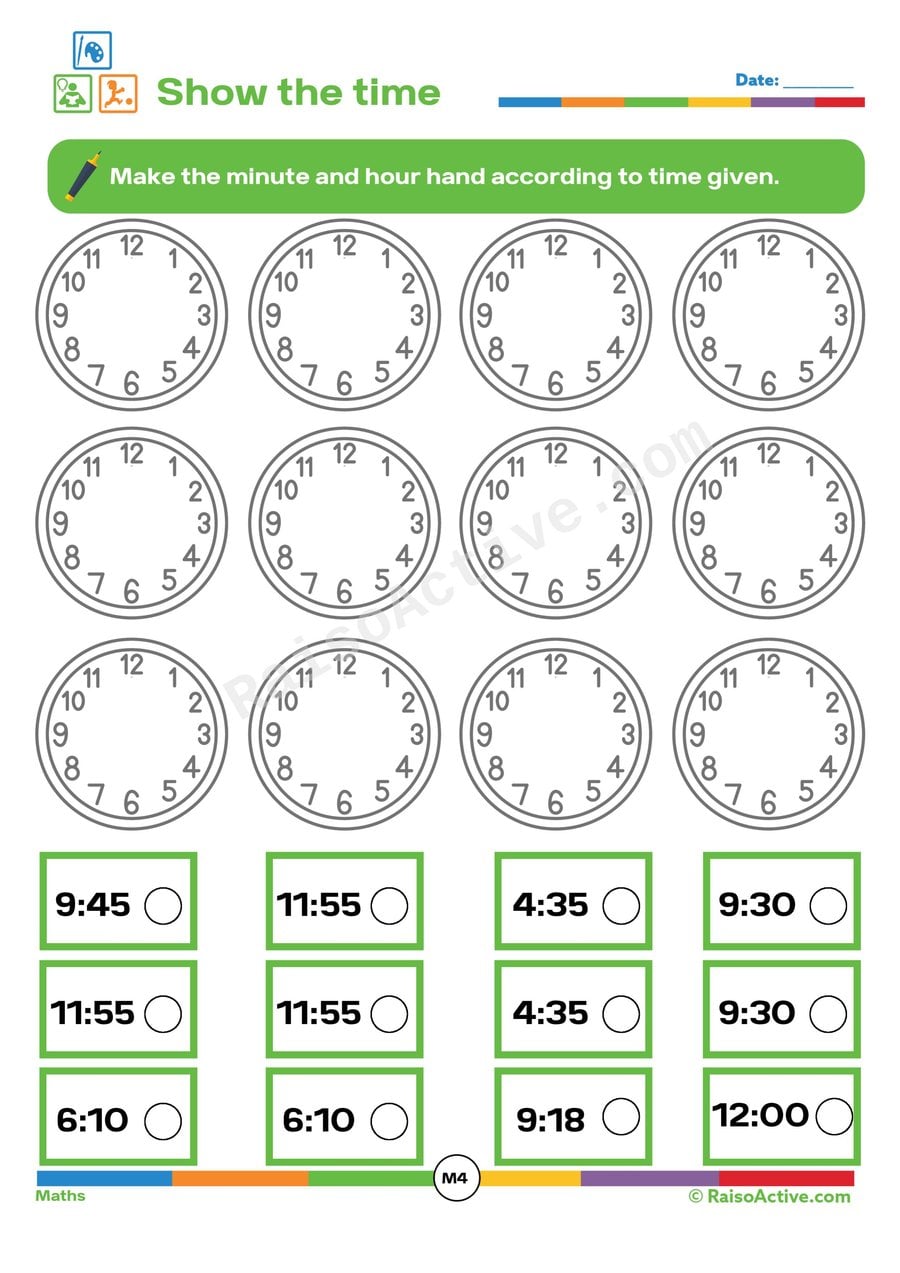
Time Telling Fun: Draw the Clock Hands! (3-5 Years)
Ages 3-5 · Preschool–Pre-KAges 3-5 · Nursery–ReceptionAges 3-5 · Nursery–LKGAges 3-5
This clock-hands activity teaches children ages 3-5 the very first steps of telling time by having them draw the hour and minute hands onto a blank clock face to match a given time. Because young children at this age typically focus on hour-level time recognition, the worksheet builds foundational awareness of how a clock's two hands work together before introducing the more complex idea of minutes. Repeated practice drawing hands in the correct position and length also reinforces fine motor control alongside the time concept.
Related worksheets
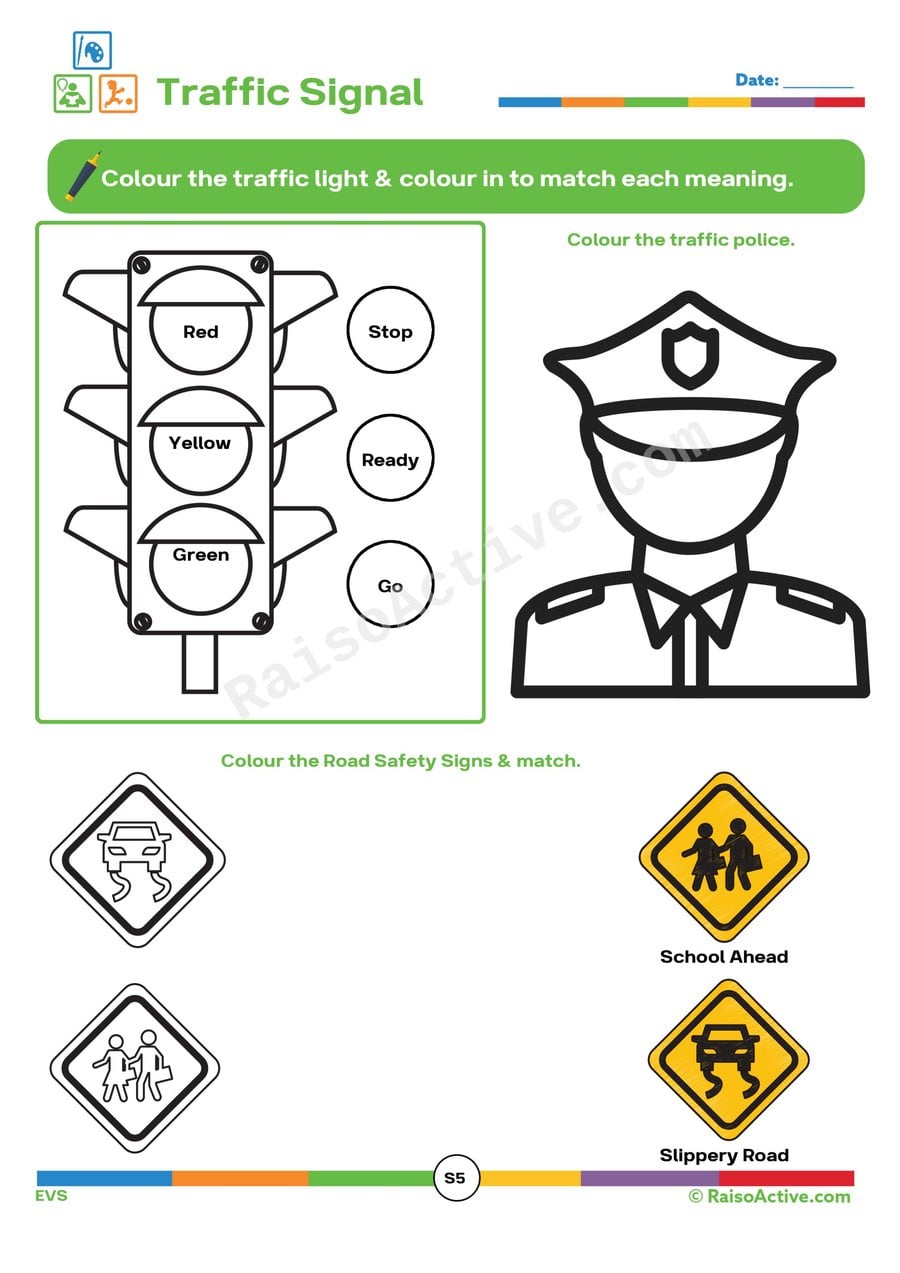
Traffic Signal Fun: Color and Match the Meanings!
Ages 3-5 · Preschool–Pre-KAges 3-5 · Nursery–ReceptionAges 3-5 · Nursery–LKGAges 3-5
Coloring traffic lights and matching words to their meanings teaches children ages 3-5 that colors carry specific, important messages in the real world, an early and practical form of symbol recognition and road safety awareness. Matching written words to the correct traffic light or road sign also reinforces early reading skills by connecting simple vocabulary to something visually familiar from everyday outings. Understanding what red, yellow, and green mean at a traffic light gives children knowledge they can apply immediately as pedestrians and future road users.

Road Safety Signs Matching Worksheet for Preschoolers
Ages 3-5 · Preschool–Pre-KAges 3-5 · Nursery–ReceptionAges 3-5 · Nursery–LKGAges 3-5
Matching road safety signs teaches 3-5 year olds to recognize specific shapes, colors, and symbols and connect them to their real-world meaning — an early form of symbol literacy that matters well beyond the worksheet, since these are signs your child will actually encounter on walks and car rides. Coloring the signs first, then matching them, reinforces visual recognition through repetition before the matching task asks them to recall each sign's identity without color cues alone.
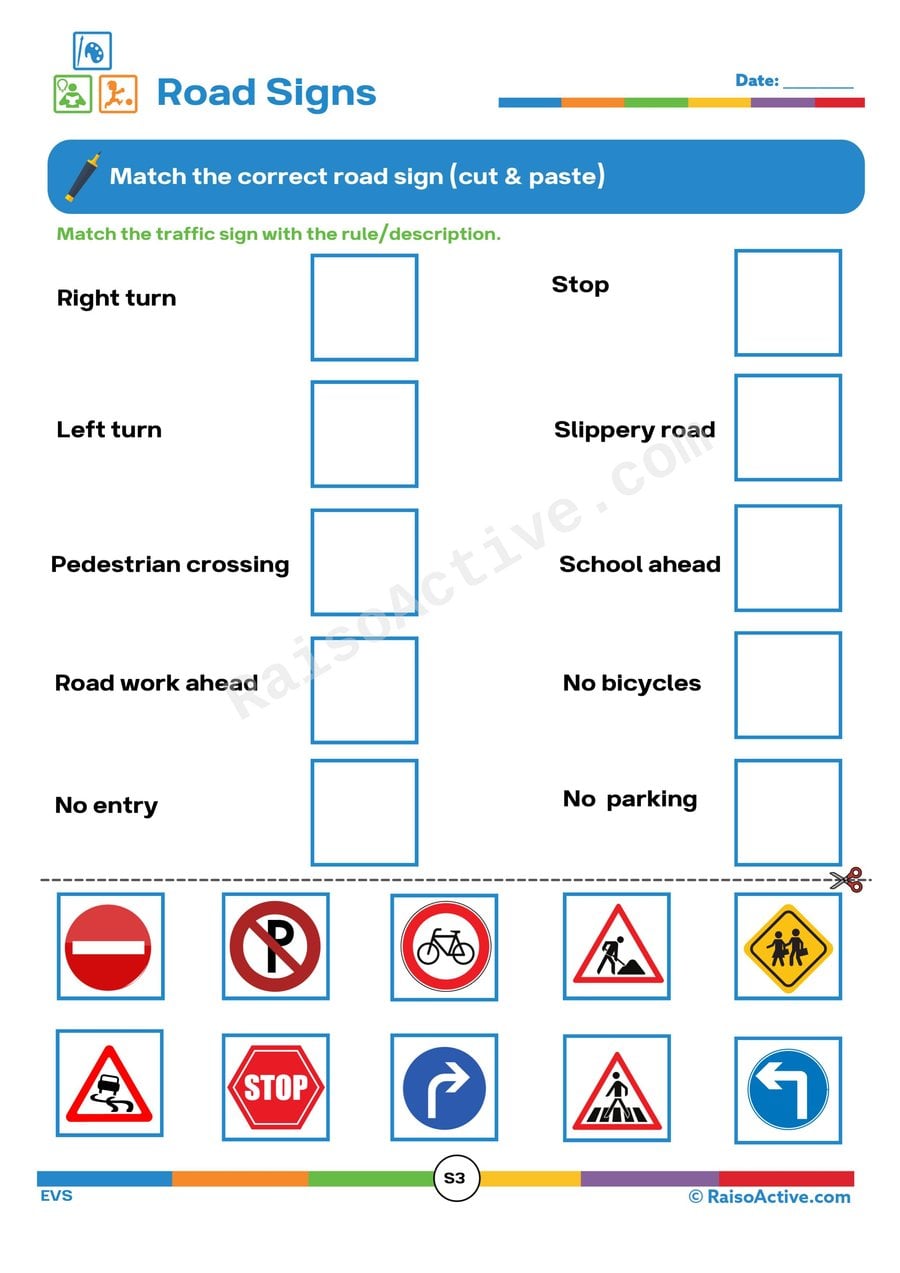
Road Signs Matching Worksheet for Preschoolers
Ages 3-5 · Preschool–Pre-KAges 3-5 · Nursery–ReceptionAges 3-5 · Nursery–LKGAges 3-5
This cut-and-paste worksheet helps children ages 3-5 build early road safety literacy by matching common signs — such as stop, crosswalk, and traffic light — to their correct meanings, while also practicing scissor control and precise gluing. Recognizing road signs by shape and color is a practical real-world skill that keeps children safer as pedestrians and future road users.
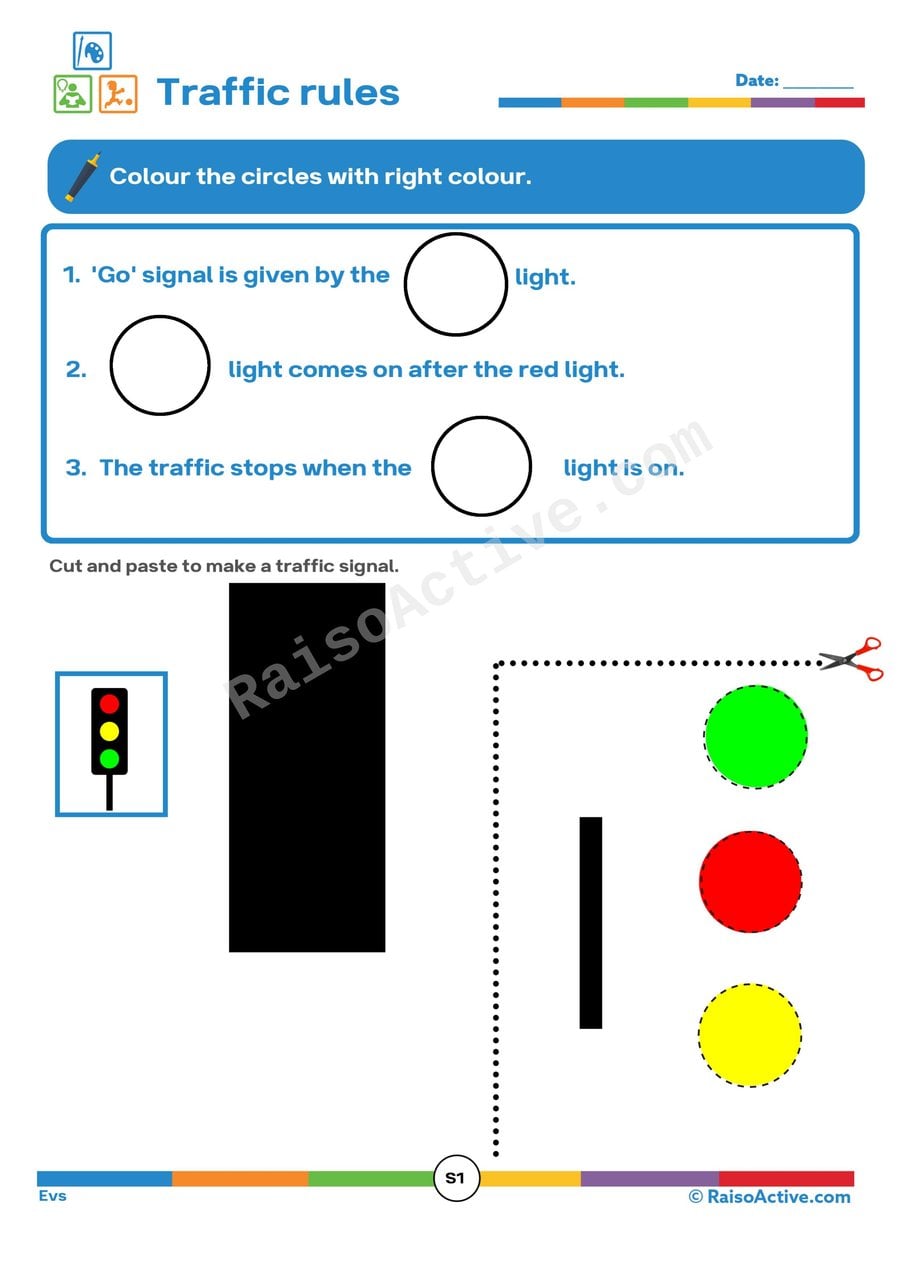
Traffic Light Colors Worksheet for Kids
Ages 3-5 · Preschool–Pre-KAges 3-5 · Nursery–ReceptionAges 3-5 · Nursery–LKGAges 3-5
Coloring the traffic light and completing the signal teaches children ages 3-5 what each color means, connecting red, yellow, and green to stop, wait, and go in a way that supports real road safety awareness. Cutting and pasting the finished signal also gives extra fine motor practice tied directly to the lesson.

Traffic Rules Worksheet: Cut and Glue the Traffic Signs!
Ages 3-5 · Preschool–Pre-KAges 3-5 · Nursery–ReceptionAges 3-5 · Nursery–LKGAges 3-5
Cutting out traffic sign pictures and matching them to their correct labels builds early sign recognition and vocabulary for children ages 3-5, connecting a familiar shape and color to its real-world safety meaning.

Road Safety Worksheet for Preschoolers: Safe Travel Fun!
Ages 3-5 · Preschool–Pre-KAges 3-5 · Nursery–ReceptionAges 3-5 · Nursery–LKGAges 3-5
Identifying safe versus unsafe travel behaviors by ticking pictures and circling thumbs up or thumbs down builds early critical thinking about real-world safety for children ages 3-5, connecting classroom learning to a practical life skill.

Traffic Rules Worksheet for Kids: Learn Road Safety!
Ages 3-5 · Preschool–Pre-KAges 3-5 · Nursery–ReceptionAges 3-5 · Nursery–LKGAges 3-5
This worksheet builds children ages 3-5's understanding of basic traffic rules, including who controls traffic, where it's safe to cross, and what each traffic light color means, through a combination of circling correct answers and coloring a traffic signal. Learning these rules early helps children build genuine road safety awareness rather than just memorized instructions.

Safe Walker Worksheet: Following Pedestrian Rules for Kids
Ages 3-5 · Preschool–Pre-KAges 3-5 · Nursery–ReceptionAges 3-5 · Nursery–LKGAges 3-5
This worksheet teaches children ages 3-5 the core rules of safe pedestrian behavior — looking both ways, using crosswalks, and holding an adult's hand — by having them read simple instructions and fill in the correct safety word. Learning these specific rules early builds habits that matter for real-world safety long before a child is old enough to cross streets independently.
Guides for this topic

Age-Appropriate Problem-Solving Activities: Building Critical Thinkers from the Ground Up
Discover fun, age-appropriate problem-solving activities for children ages 1-8. Build critical thinking, logic, and reasoning skills through play-based learning.
Critical Thinking Activities That Actually Work for Young Children: Building Tomorrow's Thinkers Today
Discover proven critical thinking activities for young children. Age-wise logic games, questioning techniques, and hands-on ideas to build thinking skills at home.

Preparing Your Child for a Rapidly Changing World: Essential Skills for Future Success
Discover the essential 21st century skills your child needs for future success. Practical tips on creativity, critical thinking, digital literacy & emotional intelligence for ages 1-8.
Reviews
Every worksheet for ages 3–5, no watermark
Members download the full library of 1,000+ worksheets and every activity pack without watermarks or daily limits. One year costs ₹999 in India or $20 elsewhere.
See membership plansOr download any worksheet free with a watermark (5 a day).