On and Under Worksheet: Table Placement Fun!
Cutting out pictures and gluing them either on or under a table teaches children ages 3-5 the spatial prepositions 'on' and 'under' by requiring them to physically place an object according to a specific instruction rather than just hearing the words. This hands-on placement task builds spatial reasoning and reinforces receptive language, since children must correctly interpret which word means which position before acting on it. Prepositions like these are often tricky to grasp through listening alone, so the visual, hands-on nature of this worksheet makes the concept concrete.
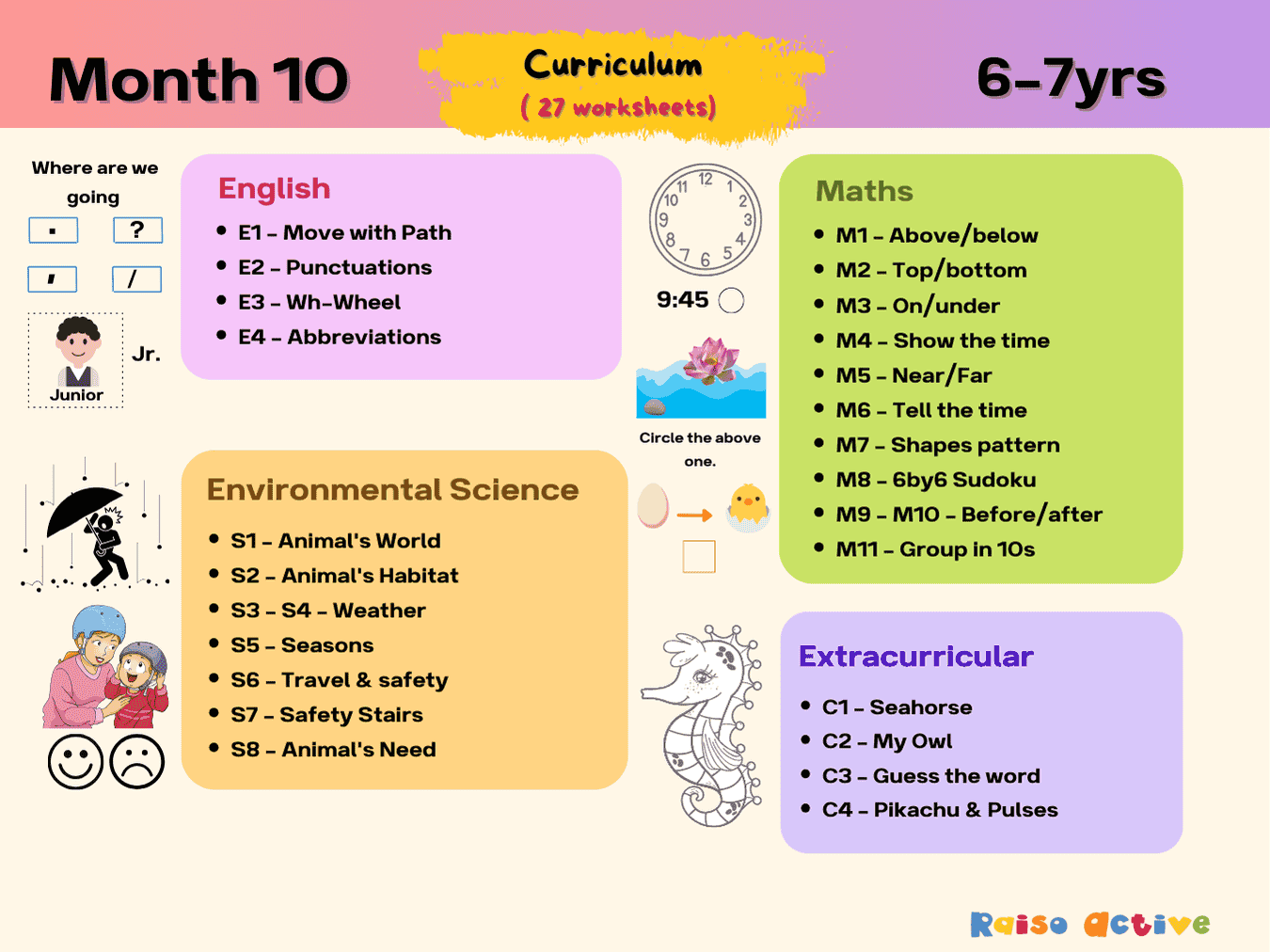
Part of the pack
Month 10: Learning & Development | Ages 6-7
This is page 10 of the pack. Ages 6-7 · Grade 1Ages 6-7 · Year 2Ages 6-7 · Class 1Ages 6-7
Curriculum
- Spatial Sense > Spatial Concepts
How to use this worksheet
Cut out the small pictures at the bottom of the page together, keeping them in a loose pile within reach. Read the instruction for the first section aloud, telling your child whether the object should go on top of or underneath the table in the picture. Have your child choose the matching picture, glue it in the correct position, and say the word 'on' or 'under' out loud as they place it. Continue through each section of the page, checking together that each object ended up in the position the instruction described.
Materials needed
- Scissors
- Glue
- Pencil or Marker
Extension activities
- 1Place real toys on and under a table at home, calling out the position each time as a quick game.
- 2Play a 'Simon Says' version using only the words on and under, like 'Simon says put your hands under the table.'
- 3Draw a picture of a room and have your child add objects on and under different pieces of furniture.
- 4Hide a small toy either on or under a piece of furniture and have your child guess which one before looking.
- 5Read a picture book and pause to ask whether something in the illustration is on or under something else.

Written by
Hemsweta Jain · Teacher Cheena
MBA and Early Childhood Educator, teaching since 2014 · Founder of RaisoActive, Mumbai
Every RaisoActive worksheet is designed and checked by the founder before publishing.
Published · Last reviewed
More from Month 10: Learning & Development | Ages 6-7

Tell the Time Worksheet: Clock Reading Practice for Kids
Ages 4-6 · Pre-K–KindergartenAges 4-6 · Reception–Year 1Ages 4-6 · LKG–UKGAges 4-6
This worksheet helps children ages 4-6 practice reading an analog clock by looking at the position of the hour and minute hands and writing down the time shown. Analog clock reading is a genuinely challenging skill that combines number recognition with an understanding of two hands moving at different speeds, making repeated, varied practice like this essential before a child can read time confidently on their own.

Guess the Word: Cut and Paste Worksheet for Early Learners
Ages 3-5 · Preschool–Pre-KAges 3-5 · Nursery–ReceptionAges 3-5 · Nursery–LKGAges 3-5
This cut-and-paste activity asks children ages 3-5 to look at picture clues, say the words aloud, and paste the correct picture to complete a combined word, giving them early practice in visual word-building and vocabulary expansion. Working with picture combinations helps children understand that some words are made by joining two smaller ideas together, a concept that supports later compound word recognition in reading. Saying each word out loud before pasting also builds the habit of connecting spoken language to printed or pictured words.

Above and Below Worksheet: Counting and Spatial Reasoning for Kids
Ages 4-6 · Pre-K–KindergartenAges 4-6 · Reception–Year 1Ages 4-6 · LKG–UKGAges 4-6
This worksheet combines spatial reasoning and counting for children ages 4-6, asking them to identify whether objects are positioned above or below a reference point and then use that understanding to answer counting questions. Understanding relative position words like 'above' and 'below' supports later skills in reading diagrams, maps, and graphs. Pairing the concept with counting also reinforces that spatial language can describe quantities, not just single objects.

Animal Habitats Matching Worksheet for Preschoolers
Ages 3-5 · Preschool–Pre-KAges 3-5 · Nursery–ReceptionAges 3-5 · Nursery–LKGAges 3-5
This worksheet helps children ages 3-5 connect specific animals to their natural homes, reinforcing early science vocabulary around habitats like forests, oceans, and deserts. Matching an animal to its habitat circle first, then cutting and pasting the same animal into a corresponding box, gives two rounds of practice with the same concept using different formats. This repetition helps solidify the animal-habitat pairing in memory.

Animal's World: Sorting Animals by Land, Water, and Air - Printable Worksheet
Ages 4-6 · Pre-K–KindergartenAges 4-6 · Reception–Year 1Ages 4-6 · LKG–UKGAges 4-6
This sorting worksheet teaches children ages 4-6 to classify animals into three habitat categories — land, water, and air — based on where each animal naturally lives and moves. Classifying by habitat rather than by appearance alone encourages children to think about an animal's features, like fins, wings, or legs, and connect them to function. This three-way sort is more complex than a simple two-category sort, building more advanced categorization skills.

Before and After Shapes Worksheet: Coloring and Identifying Shapes
Ages 3-5 · Preschool–Pre-KAges 3-5 · Nursery–ReceptionAges 3-5 · Nursery–LKGAges 3-5
This worksheet combines shape identification with sequencing for children ages 3-5, asking them to color shapes accurately and then determine which shape comes before or after a given one in a sequence. Applying 'before' and 'after' to shapes rather than pictures of events pushes children to think about order in a more abstract way. Coloring within defined shape outlines also builds hand control and attention to boundaries.

Superhero Grouping in Tens: A Fun Counting Worksheet for Preschoolers!
Ages 4-5 · Pre-KAges 4-5 · ReceptionAges 4-5 · LKGAges 4-5
Using a superhero theme, this worksheet helps children ages 4-5 practice counting objects accurately and matching a counted group to its written number, an early step toward understanding place value through grouping in tens. Circling objects according to a given number afterward reinforces the connection between a numeral and the actual quantity it represents, rather than just reciting numbers in order.

Cut and Paste Owl Shapes Worksheet for Preschoolers
Ages 3-5 · Preschool–Pre-KAges 3-5 · Nursery–ReceptionAges 3-5 · Nursery–LKGAges 3-5
This owl-building craft gives children ages 3-5 hands-on practice recognizing and naming basic shapes — circles, triangles, ovals — while developing the scissor and gluing skills needed for more complex crafts later on. Assembling a recognizable owl from separate shape pieces also reinforces spatial reasoning, since children must figure out how individual parts combine into a whole picture. Naming each shape as it's placed connects the fun of crafting directly to early geometry vocabulary.
Related worksheets

Over and Under Worksheet: Identifying Object Positions
Ages 3-5 · Preschool–Pre-KAges 3-5 · Nursery–ReceptionAges 3-5 · Nursery–LKGAges 3-5
This worksheet helps children ages 3-5 learn and identify the spatial concepts of 'over' and 'under' by examining pictures and deciding which positional word correctly describes what they see. Practicing this distinction builds the vocabulary foundation children need to follow multi-step directions involving location.
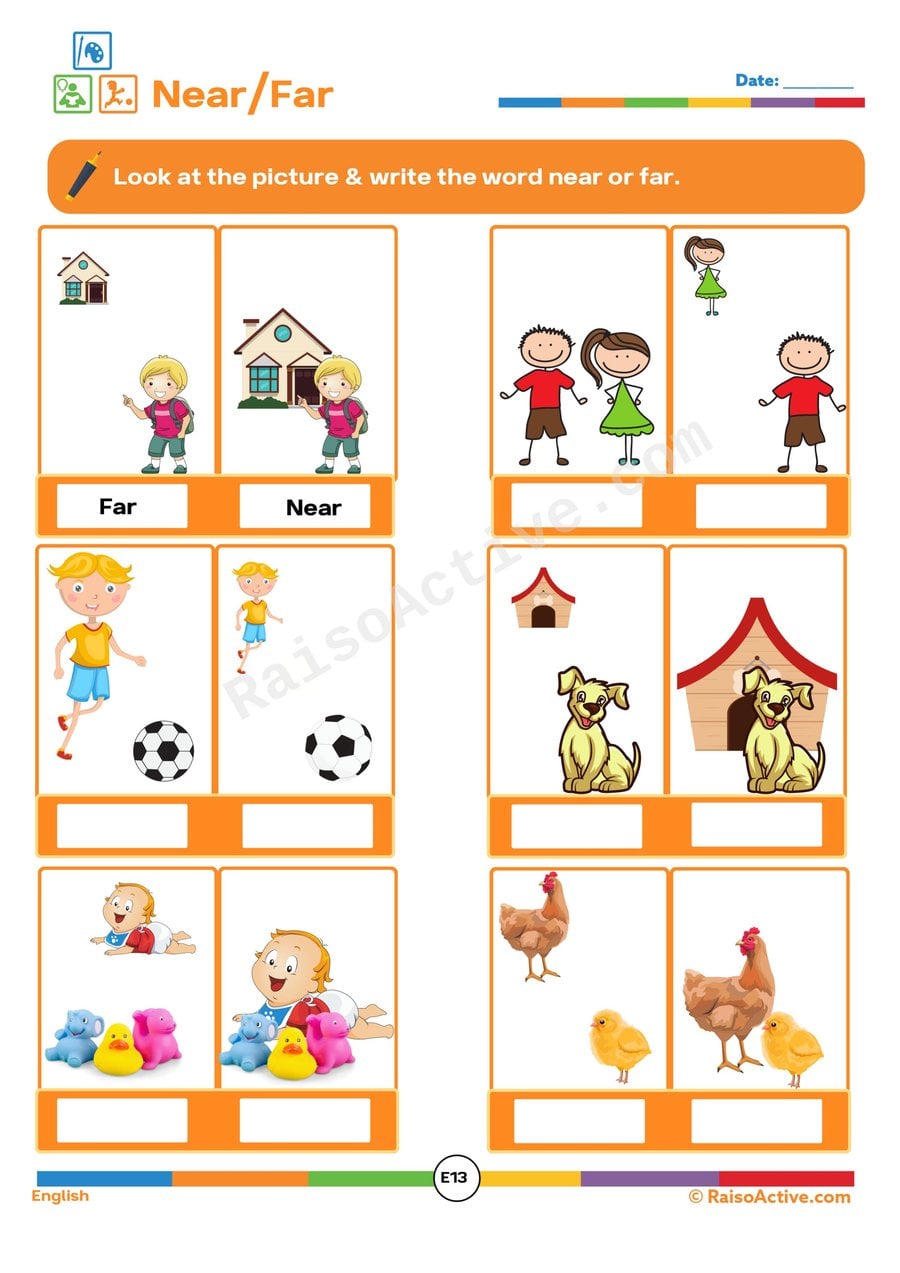
Near and Far Worksheet for Preschoolers
Ages 3-5 · Preschool–Pre-KAges 3-5 · Nursery–ReceptionAges 3-5 · Nursery–LKGAges 3-5
Understanding 'near' and 'far' introduces children ages 3-5 to relative distance, a spatial concept that supports later skills like reading maps, estimating measurement, and following directional instructions. This worksheet asks children to look at pictures and judge whether an object or person is positioned close by or at a distance, sharpening visual observation alongside vocabulary development. Because near and far are relative terms rather than fixed categories, this practice also introduces the idea that some concepts depend on comparison rather than having one single correct answer.
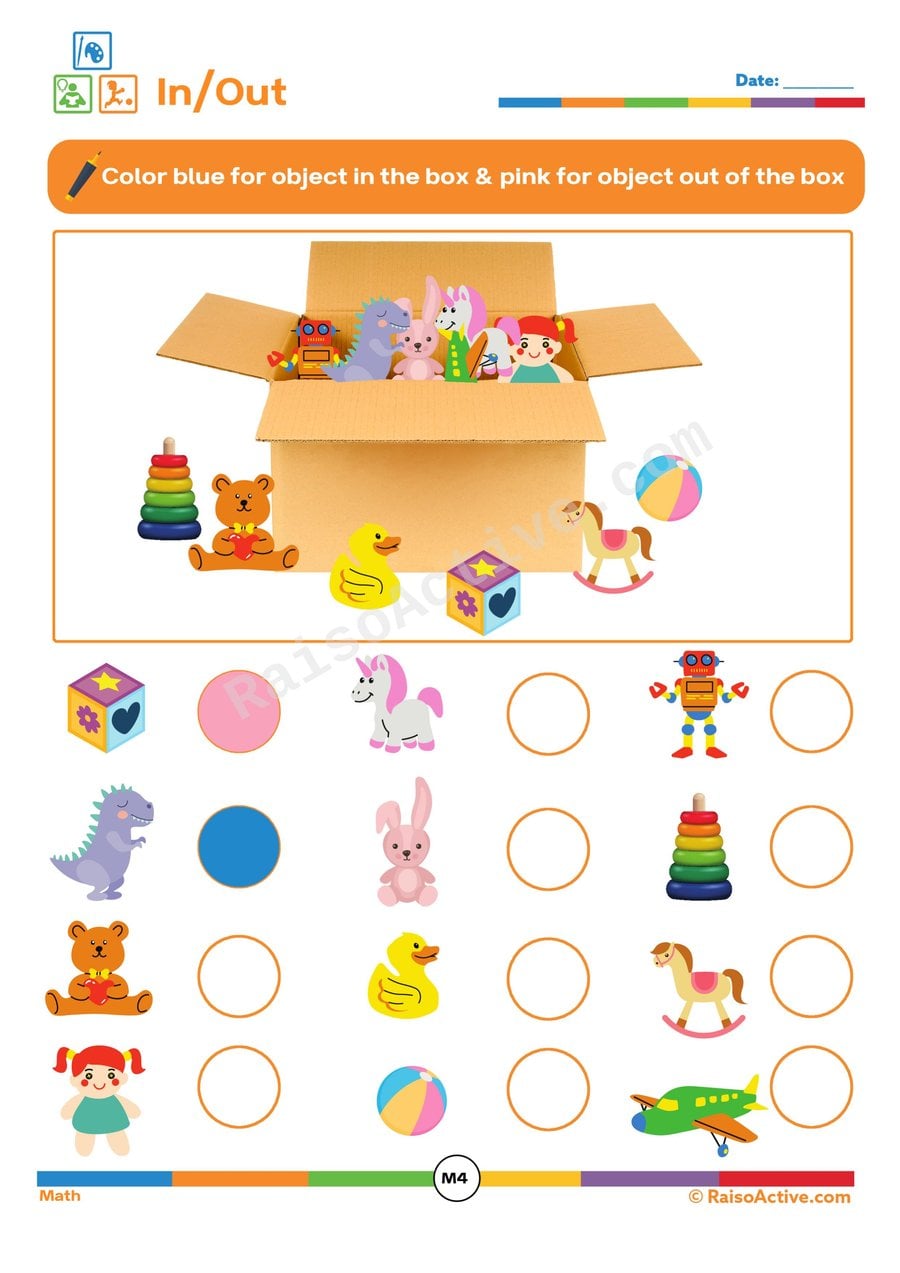
In/Out Sorting Worksheet: Color the Objects!
Ages 3-5 · Preschool–Pre-KAges 3-5 · Nursery–ReceptionAges 3-5 · Nursery–LKGAges 3-5
Sorting objects as 'in' or 'out' of a box builds on the positional vocabulary preschoolers need before they can follow multi-step directions or understand simple math concepts like sets and groups. Using color as the sorting tool here, blue for inside and pink for outside, also strengthens the ability to hold two rules in mind simultaneously and apply the correct one to each object in turn.
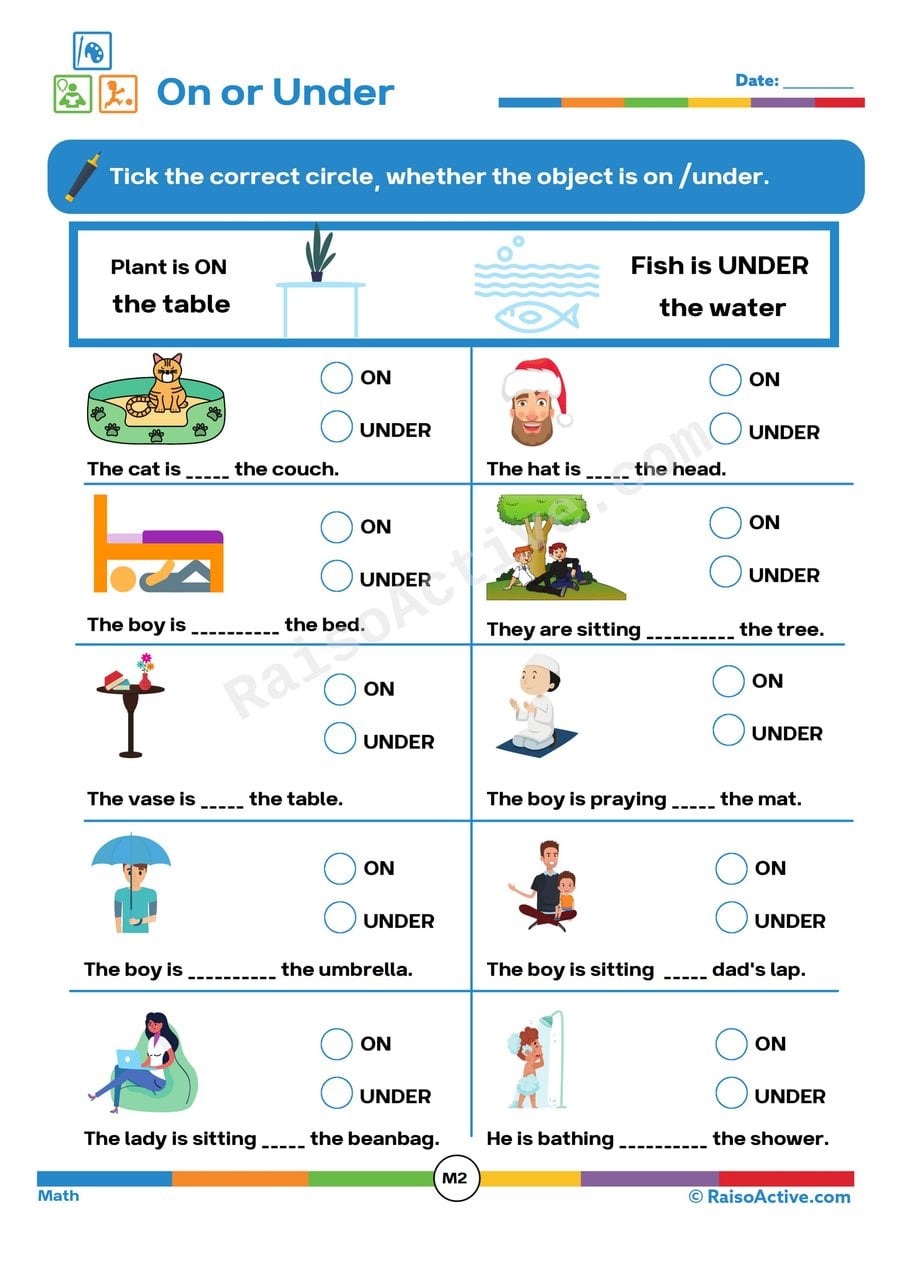
On or Under Worksheet: Where is the Object?
Ages 3-5 · Preschool–Pre-KAges 3-5 · Nursery–ReceptionAges 3-5 · Nursery–LKGAges 3-5
Reading a short sentence describing an object's location and then ticking the picture that matches teaches children ages 3-5 to connect spoken or written prepositions, 'on' and 'under,' to a visual representation, strengthening both listening comprehension and spatial vocabulary. This worksheet requires children to hold a sentence in mind and compare it against a picture, which is a slightly more advanced skill than simply naming a position they can already see. Understanding prepositions like these supports later reading comprehension, since so many simple stories depend on describing where things are.

Above and Below Worksheet: Identifying Object Positions
Ages 3-5 · Preschool–Pre-KAges 3-5 · Nursery–ReceptionAges 3-5 · Nursery–LKGAges 3-5
Positional words like 'above' and 'below' give three-to-five-year-olds a vocabulary for describing where things are in space, a skill that underpins everything from map reading to following multi-step instructions later on. This activity page asks children to look closely at a scene and decide whether each object sits above or below a reference point, sharpening visual scanning and the ability to hold a spatial rule in mind while checking multiple items against it.

Open and Close Worksheet: Circle the Open and Closed Objects!
Ages 3-5 · Preschool–Pre-KAges 3-5 · Nursery–ReceptionAges 3-5 · Nursery–LKGAges 3-5
Children ages 3-5 build early categorization skills by identifying whether pictured objects, like a door, a box, or a jar, are open or closed. This concept requires observing a physical state and applying a descriptive word correctly, an important early step in building descriptive vocabulary. Recognizing open versus closed also has practical safety value, connecting worksheet learning to real-world awareness.
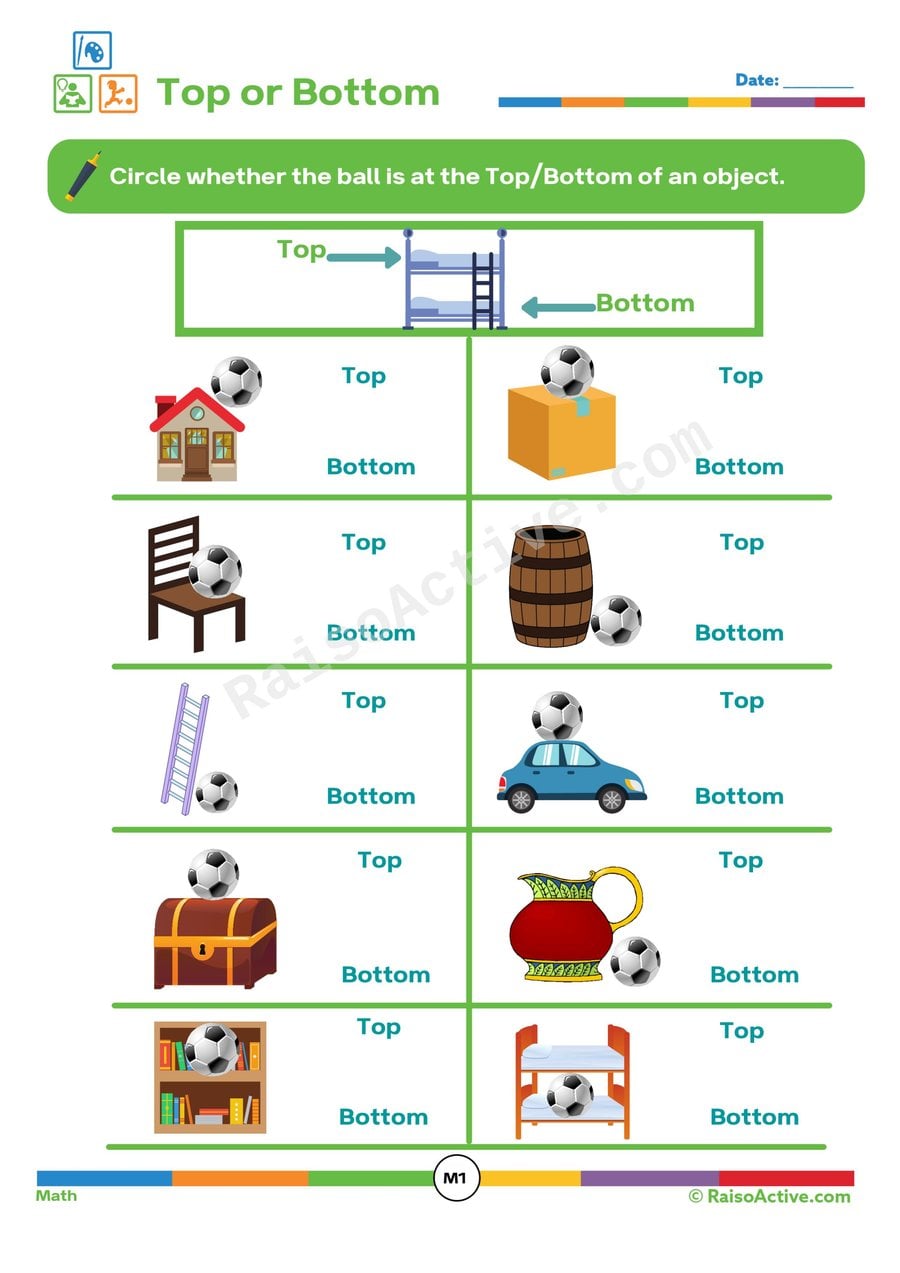
Top or Bottom? Fun Worksheet for Kids!
Ages 3-5 · Preschool–Pre-KAges 3-5 · Nursery–ReceptionAges 3-5 · Nursery–LKGAges 3-5
Deciding whether a ball is positioned at the top or bottom of another object teaches children ages 3-5 the spatial concepts of 'top' and 'bottom,' foundational positional vocabulary that supports later skills like reading a page from top to bottom or following multi-step directions. This worksheet asks children to look carefully at a picture and make a judgment about relative position, which strengthens visual-spatial reasoning alongside vocabulary development. Positional words like these are often first understood through pictures before children can reliably use them in their own speech.
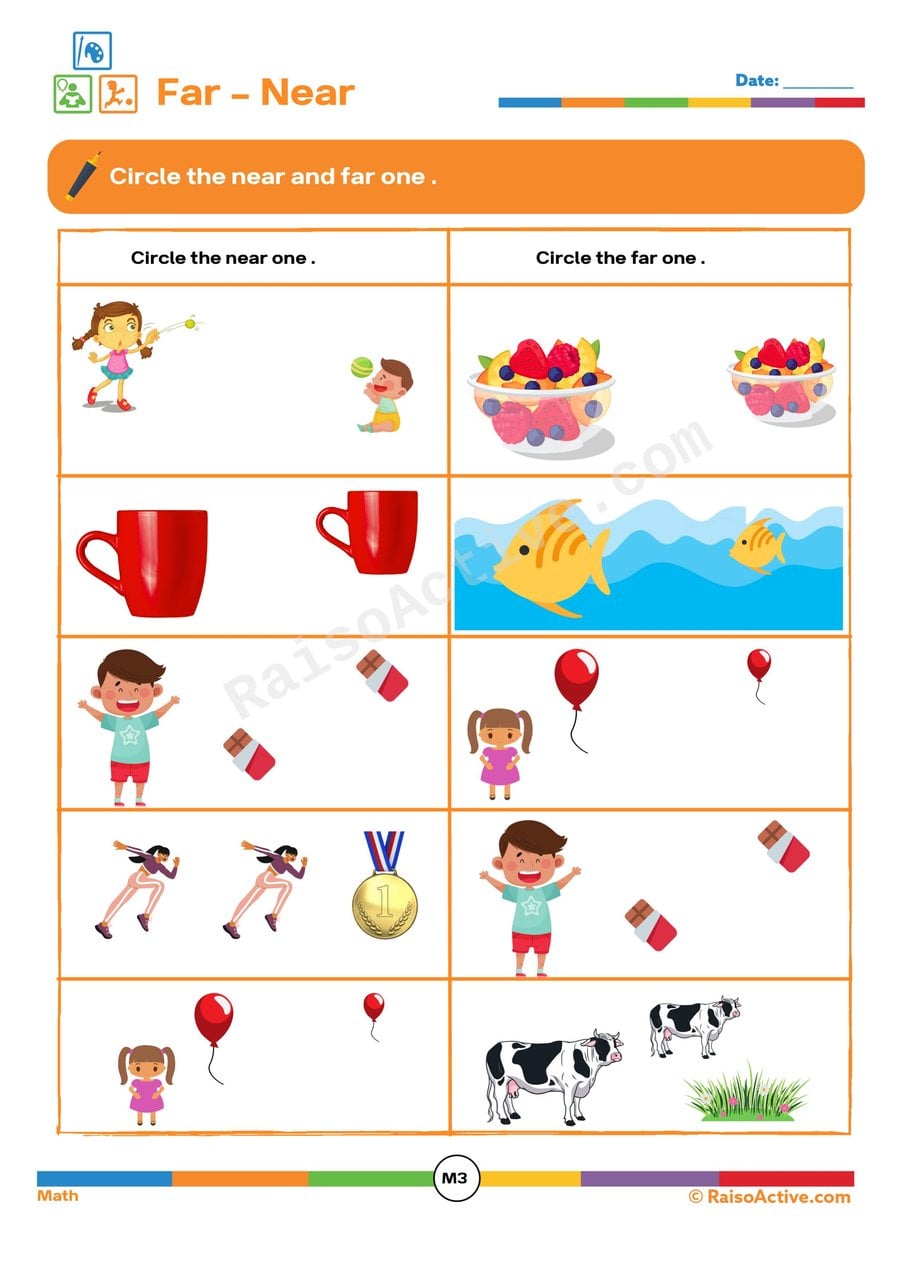
Far and Near Worksheet: Circle the Objects!
Ages 3-5 · Preschool–Pre-KAges 3-5 · Nursery–ReceptionAges 3-5 · Nursery–LKGAges 3-5
Children ages 3-5 build early spatial reasoning by comparing the relative distance of paired objects and deciding which is 'near' and which is 'far,' a foundational concept for understanding position and distance in the world around them. This kind of comparative thinking also supports later math concepts like measurement and estimation.
Guides for this topic

Christmas and Winter Activities That Combine Fun and Learning: Creating Magical Educational Experiences
Discover Christmas and winter activities that combine festive fun with real learning. Crafts, counting, literacy, and printable worksheets for ages 2 to 8 — perfect for home and school.
Age-Appropriate Halloween Learning Activities: Balancing Spooks and Skills for Young Learners
Discover fun, age-appropriate Halloween learning activities for young children. Spooky crafts, counting games, literacy ideas, and printable worksheets for ages 2 to 8.
Reviews
Every worksheet for ages 3–5, no watermark
Members download the full library of 1,000+ worksheets and every activity pack without watermarks or daily limits. One year costs ₹999 in India or $20 elsewhere.
See membership plansOr download any worksheet free with a watermark (5 a day).