
Community Helpers & Early Learning Activities Worksheet
This worksheet bundles several community-helper-themed activities, coloring, role-play, and object identification, to build vocabulary and social understanding around the different people who help in a community, like police officers or firefighters. For ages 3-5, learning about community helpers builds both social awareness and early classification skills as children learn to associate specific tools or uniforms with specific jobs.
Part of the pack
Month 5: Preschool Subjects and Play | Ages Up to 4Curriculum
How to use this worksheet
Read through each section of the worksheet with your child first to understand what's being asked, since it includes multiple activity types. Work through the coloring portion, having your child color the community helper pictures using realistic or their own chosen colors. Move to the identification activities, where your child matches or circles objects associated with a specific community helper's job. Finish with the role-play prompt, encouraging your child to act out being that community helper for a few minutes, in character.
Materials needed
- Pencil
- Crayons
- Flashcards (optional)
Extension activities
- •Visit a real community helper location nearby, like a fire station or police station, if possible.
- •Set up a pretend dress-up box with simple props representing different community helper roles.
- •Read books featuring different community helpers and their day-to-day jobs.
- •Create matching flashcards pairing a community helper with the tools or vehicle they use.
- •Interview a family friend or neighbor who works as a community helper about what their job involves.
Tips for parents and teachers
Since this worksheet mixes several activity types, feel free to spread it across more than one sitting rather than completing everything at once. Use flashcards or real photos alongside the worksheet if your child needs extra support connecting a community helper to their specific tools or role. The role-play section works best with enthusiastic participation from an adult, since acting alongside your child makes the pretend scenario feel more real and engaging.

Written by
Hemsweta Jain · Teacher Cheena
MBA and Early Childhood Educator, teaching since 2014 · Founder of RaisoActive, Mumbai
Every RaisoActive worksheet is designed and checked by the founder before publishing.
Published · Last reviewed
Related worksheets
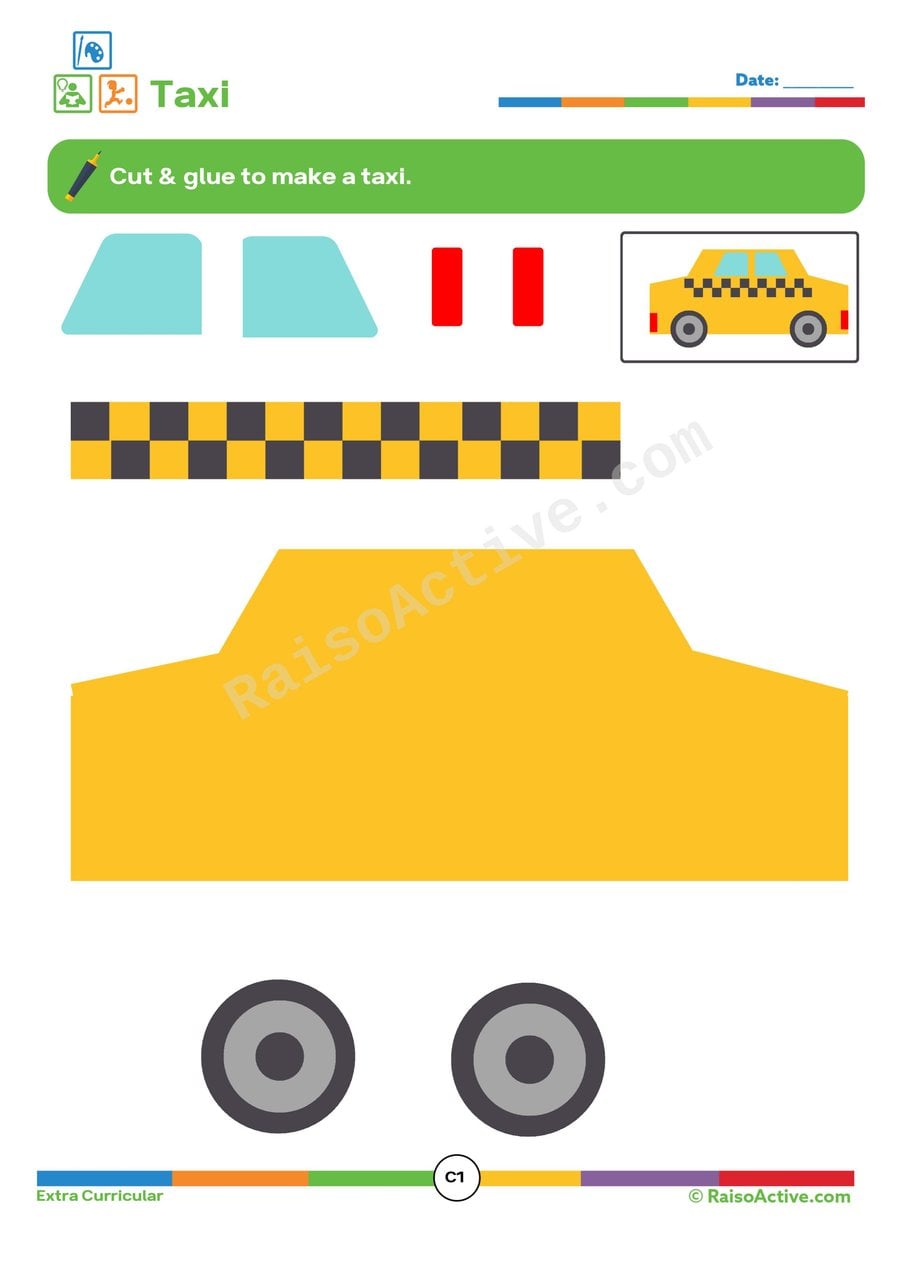
Taxi Cut and Paste Worksheet for Preschoolers
This craft-style worksheet gives children ages 3-5 focused practice with cutting along both straight and curved lines and assembling several separate pieces into one recognizable picture — a taxi. Building an image from multiple cut-out parts requires spatial planning, since children must figure out where each piece belongs relative to the others before gluing. The community-helper theme also introduces vocabulary around transportation and the people who drive it.

Community Helpers Cut and Paste Worksheet for Kids
This cut-and-paste worksheet helps children ages 3-5 connect community helpers, such as a firefighter or doctor, to the tools and equipment each one uses in their job. Handling scissors to cut out small pictures and precisely placing them in the correct box builds fine motor control and hand-eye coordination, while the matching task itself deepens understanding of community roles and how people help one another.

Doctor Role Play Worksheet: Patient Emergency Form
Through pretend-play as a doctor filling out a patient form, children practice early functional writing and decision-making, selecting a 'patient,' identifying what hurts, and choosing a treatment. This kind of role play also builds empathy and emotional vocabulary around illness and care, helping ages 3-5 process what happens during real doctor visits in a low-stakes, imaginative context.

Doctor's Tools: Circle the Items! - Worksheet for Kids
This worksheet builds visual discrimination and category knowledge by asking children to identify which pictured items belong to a doctor's toolkit, like a stethoscope or thermometer, versus items that don't. For ages 3-5, sorting objects by their real-world function is an early classification skill, and the community-helper theme also builds vocabulary around health and care.

Community Helpers Cut and Paste Worksheet for Preschoolers
This cut-and-paste worksheet focuses specifically on firefighters for children ages 3-5, teaching them to recognize firefighting equipment like a hose, helmet, or ladder and connect each item to a firefighter's job. Learning about a single community helper in depth, rather than several at once, lets young children build a richer, more detailed understanding of what that job actually involves. The cutting, gluing, and circling tasks also build the fine motor coordination needed for more complex craft and writing activities later.
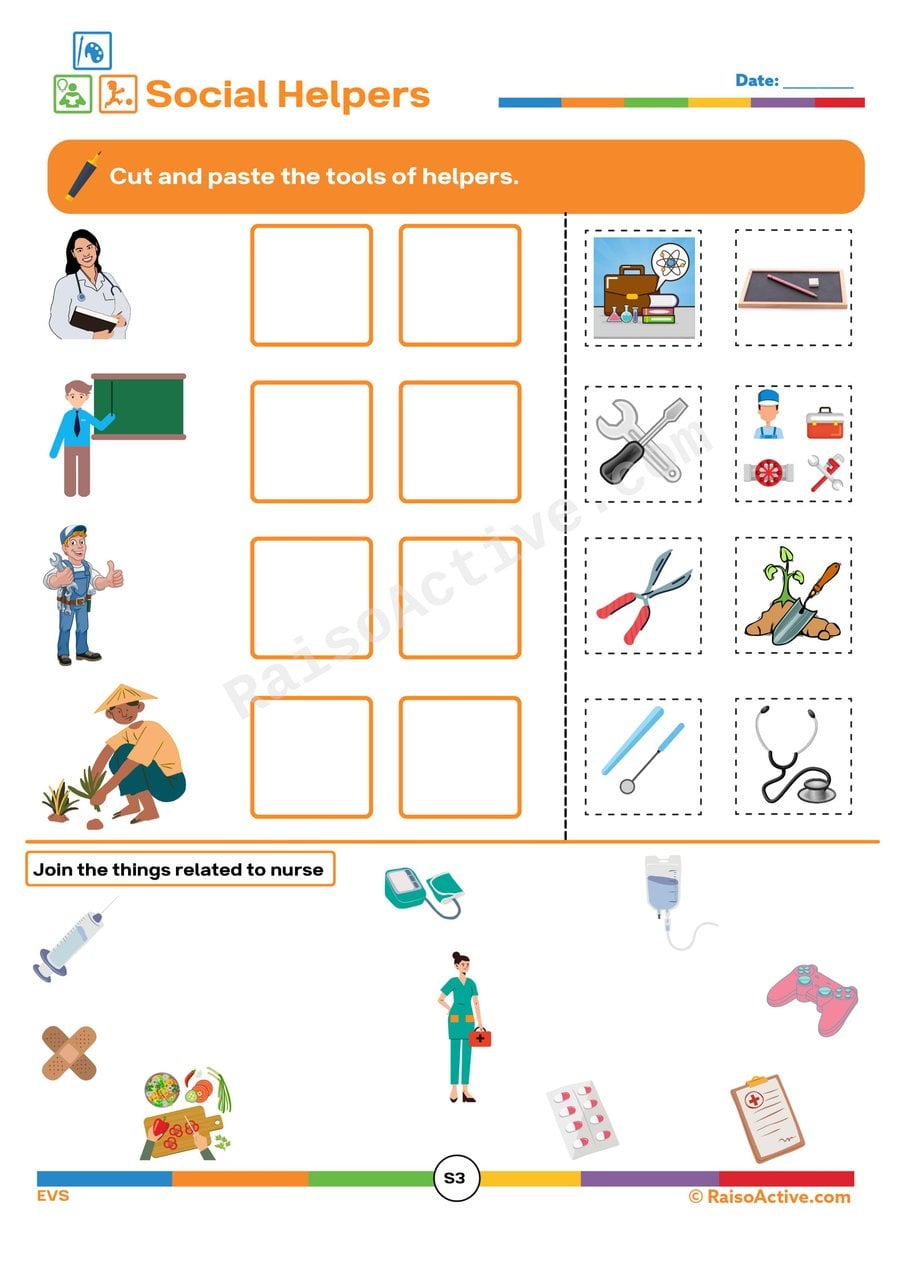
Social Helpers Tools Worksheet for Kids
This worksheet teaches children ages 3-5 to connect community helpers with the tools and equipment they use in their jobs, building early social studies knowledge alongside visual matching skills. Recognizing that a stethoscope belongs to a doctor or a hose belongs to a firefighter helps children understand how tools relate to specific roles and responsibilities in their community. The cut-and-paste and joining activities also reinforce fine motor control and visual discrimination as children sort similar-looking small pictures.

Clothing Pattern Match Worksheet for Preschoolers
This worksheet has children ages 3-5 study repeating patterns on clothing items — stripes, polka dots, or checks — and match each item to its identical twin, building visual discrimination and early pattern-sequencing skills. Distinguishing between similar-looking patterns also sharpens attention to detail, a skill that later supports letter and word recognition.

Elephant Shapes: Fun Sorting Worksheet for Preschoolers!
This playful sorting worksheet has children ages 3-5 use an elephant's 'trunk' (their own hand reaching through a cut circle) to pick and sort shapes, building both shape recognition and simple classification skills. Physically selecting and grouping shapes by type, rather than just naming them on sight, helps solidify the concept that shapes can share a category even when their size or color differs.
Guides for this topic
Best Worksheets for 3-Year-Olds: What Works and What to Avoid
What works on worksheets for 3-year-olds: short sessions, crayons, tracing lines, matching, cutting, a free weekly plan, and signs one is too advanced.
Age-Appropriate Problem-Solving Activities: Building Critical Thinkers from the Ground Up
Discover fun, age-appropriate problem-solving activities for children ages 1-8. Build critical thinking, logic, and reasoning skills through play-based learning.
Critical Thinking Activities That Actually Work for Young Children: Building Tomorrow's Thinkers Today
Discover proven critical thinking activities for young children. Age-wise logic games, questioning techniques, and hands-on ideas to build thinking skills at home.
Reviews
Every worksheet for ages 3–5, no watermark
Members download the full library of 1,000+ worksheets and every activity pack without watermarks or daily limits. One year costs ₹1,000 in India or $20 elsewhere.
See membership plansOr download any worksheet free with a watermark (5 a day).