Number 8 Worksheet: Trace, Count, and Color Butterflies!
Tracing the number 8 while counting and coloring eight butterflies helps children ages 3-5 connect the written numeral to the actual quantity it represents, reinforcing number sense alongside handwriting. The final step, drawing any eight objects of the child's choosing, moves beyond guided practice into independent application, checking whether the concept of 'eight' has truly transferred rather than just been copied. This progression from tracing to counting to free drawing builds a complete, layered understanding of one specific number.
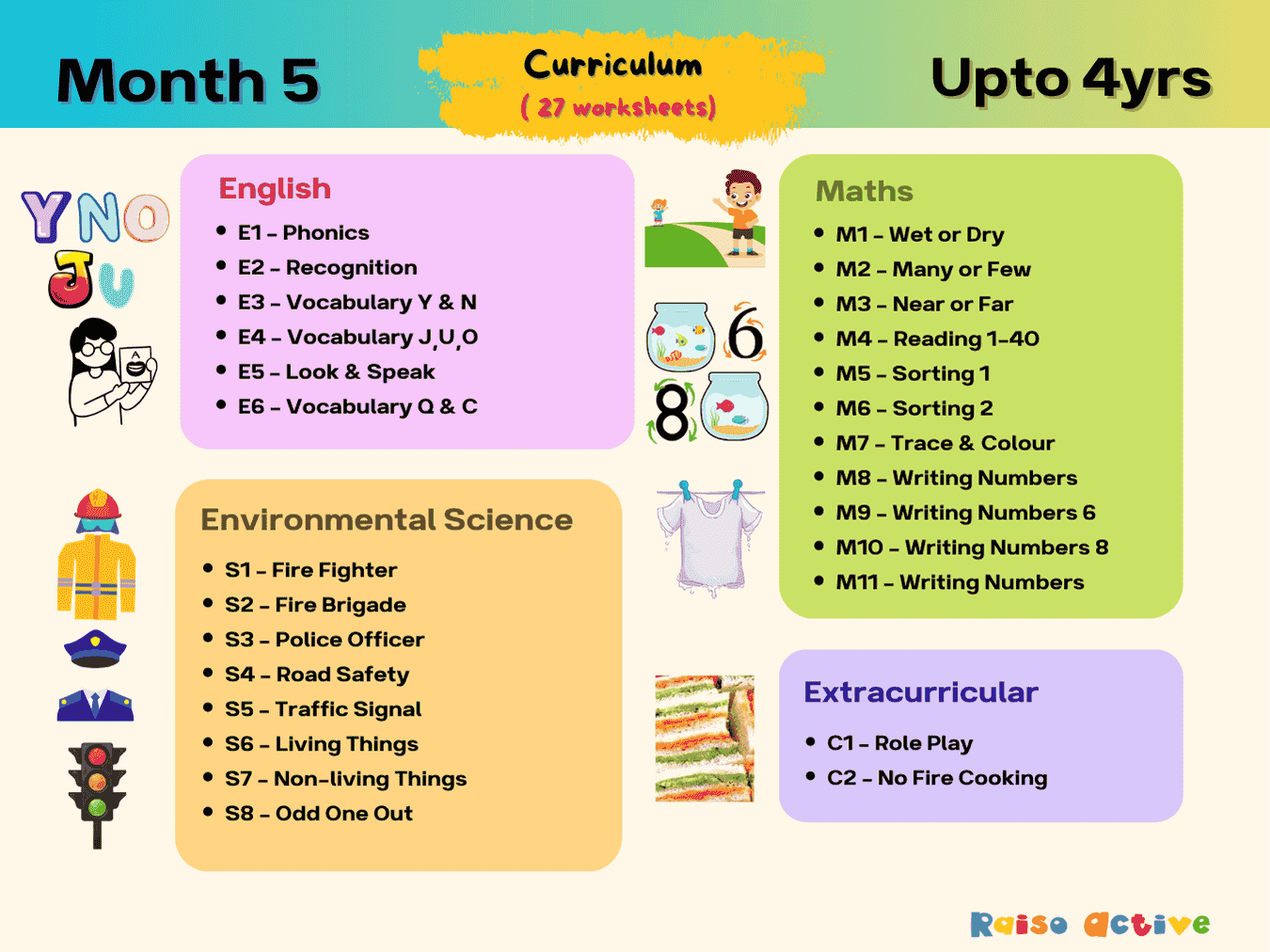
Part of the pack
Month 5: Preschool Subjects and Play | Ages Up to 4
This is page 19 of the pack. Ages 2-4 · PreschoolAges 2-4 · NurseryAges 2-4
Made for your child
Counting to 10, made for your child
A maths pack with your child's name in it: pictures that explain, practice at three levels, puzzles and story sums about them. Print a new set whenever they finish.
Make a maths packFree preview · free for members
Curriculum
- Number Recognition > Number Tracing 1-10
How to use this worksheet
Begin by tracing the number 8, guiding your child's pencil through its two connected loops while counting aloud from one to eight. Move to the butterfly section, where your child counts out exactly eight butterflies and colors each one as they count, touching each butterfly to keep an accurate tally. Finally, give your child a blank space and ask them to draw any eight objects they like, encouraging them to count aloud as they draw each one to confirm the total.
Materials needed
- Pencil
- Crayons
Extension activities
- 1Search the house for exactly eight of any object, like eight socks or eight crayons.
- 2Practice forming the number 8 in a sand or rice tray for extra tactile repetition.
- 3Build a group of eight objects using blocks or small toys and count them together.
- 4Play a simple game where you ask 'can you find eight of something?' around the house.
- 5Draw eight of your child's favorite animal or food item and count them together once finished.

Written by
Hemsweta Jain · Teacher Cheena
MBA and Early Childhood Educator, teaching since 2014 · Founder of RaisoActive, Mumbai
Every RaisoActive worksheet is designed and checked by the founder before publishing.
Published · Last reviewed
More from Month 5: Preschool Subjects and Play | Ages Up to 4
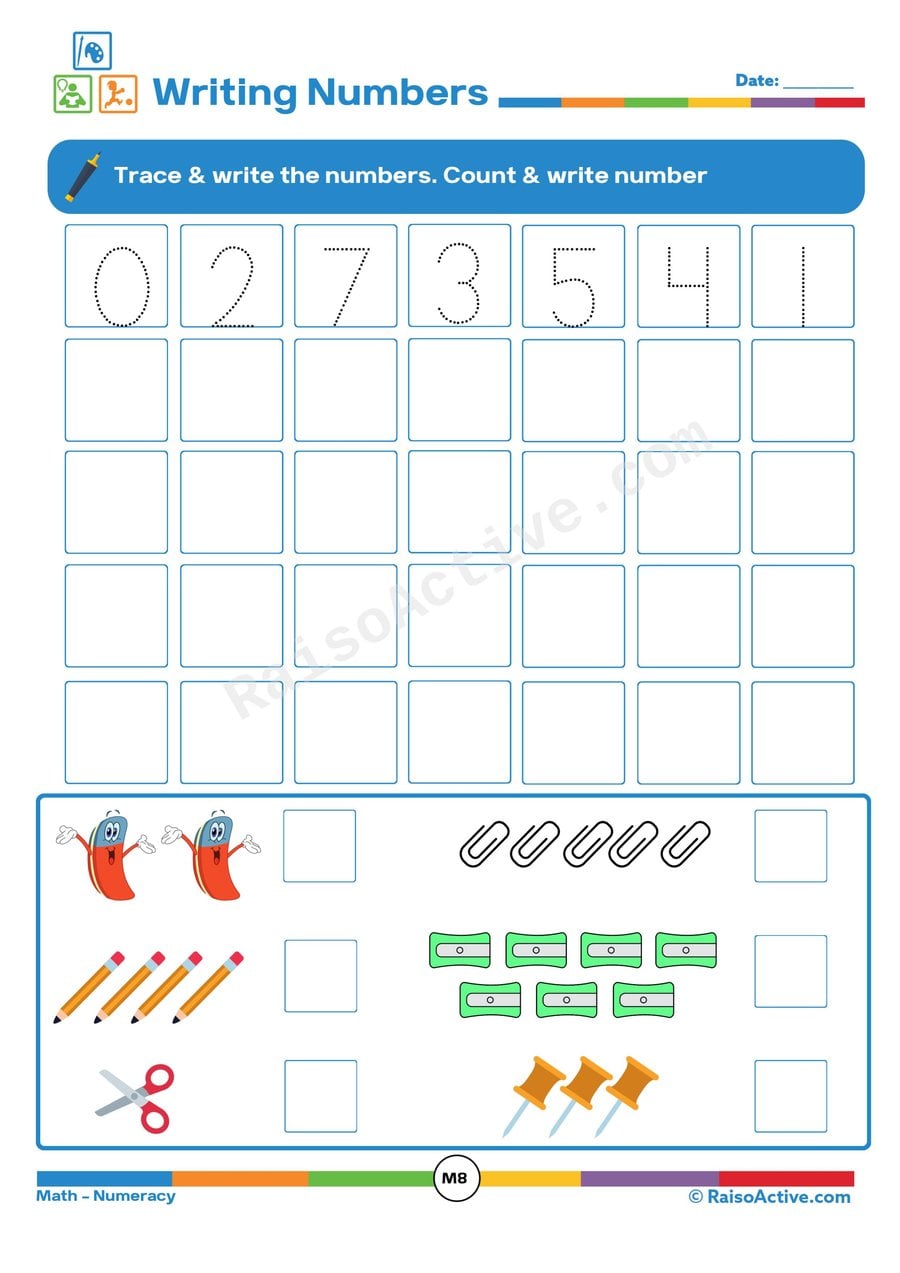
Trace and Write Numbers 0-5 Worksheet
Ages 3-5 · Preschool–Pre-KAges 3-5 · Nursery–ReceptionAges 3-5 · Nursery–LKGAges 3-5
Tracing and writing the numbers 0 through 5 builds the specific hand strokes needed to form each numeral correctly, a skill that develops separately from simply being able to count or recognize numbers by sight for children ages 3-5. Following the tracing with a counting-and-writing section, where children count objects and record the total themselves, connects the motor skill of writing numbers directly to their meaning as quantities. Practicing this small, foundational range first builds the confidence needed before tackling larger numbers later.
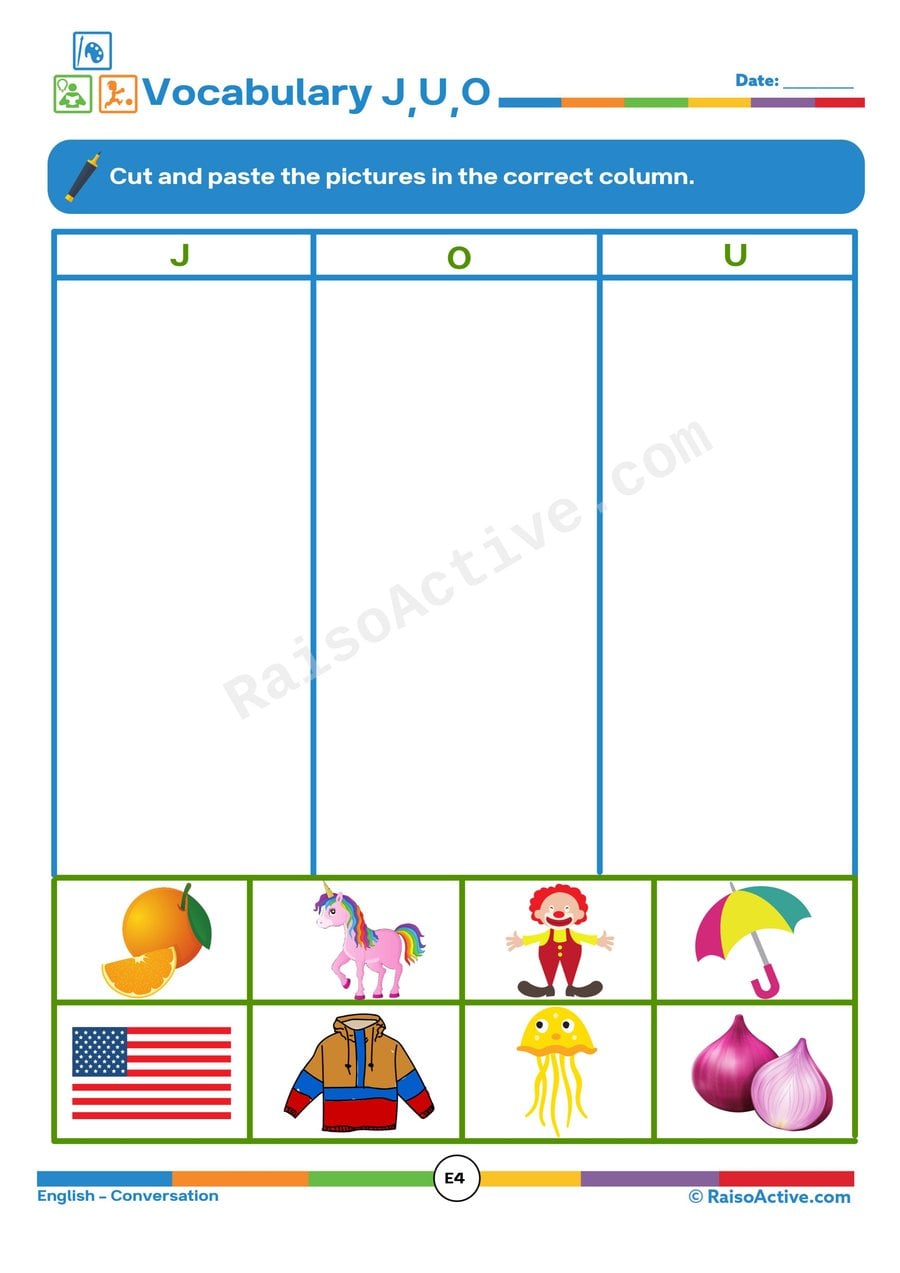
J, U, O Sorting Worksheet: Cut and Paste Pictures!
Ages 3-5 · Preschool–Pre-KAges 3-5 · Nursery–ReceptionAges 3-5 · Nursery–LKGAges 3-5
Sorting pictures by their beginning letter sound into J, U, or O columns asks children ages 3-5 to actively compare three different sounds rather than just recognizing one letter at a time, a more demanding phonics task than single-letter worksheets. This kind of three-way sorting builds sharper listening discrimination, since J, U, and O can sound similar in casual speech but are quite distinct once isolated. The cut-and-paste format also reinforces the sorting decision physically, since children must place each picture correctly rather than simply circling an answer.

Trace and Color the Fruits: Number Matching Worksheet
Ages 4-6 · Pre-K–KindergartenAges 4-6 · Reception–Year 1Ages 4-6 · LKG–UKGAges 4-6
This worksheet links three number skills together for 4-6 year olds: tracing dotted numerals for handwriting practice, counting a row of fruit for quantity, and then checking that the fruit count actually matches the traced number — a self-checking loop that reinforces number-to-quantity correspondence rather than treating tracing and counting as separate tasks. That verification step (does the fruit count really match?) pushes your child to count carefully rather than just glance and guess.

Non-Living Things Coloring Worksheet for Preschoolers
Ages 3-5 · Preschool–Pre-KAges 3-5 · Nursery–ReceptionAges 3-5 · Nursery–LKGAges 3-5
Coloring only the non-living things on the page asks children ages 3-5 to apply a real scientific rule — that living things grow, move, breathe, and eat, while non-living things do not — rather than just naming objects. This requires them to think through each picture individually and test it against the rule, building early classification and critical thinking skills. Learning to separate living from non-living things is one of the first formal science concepts children encounter and sets up later lessons about plants, animals, and the environment.
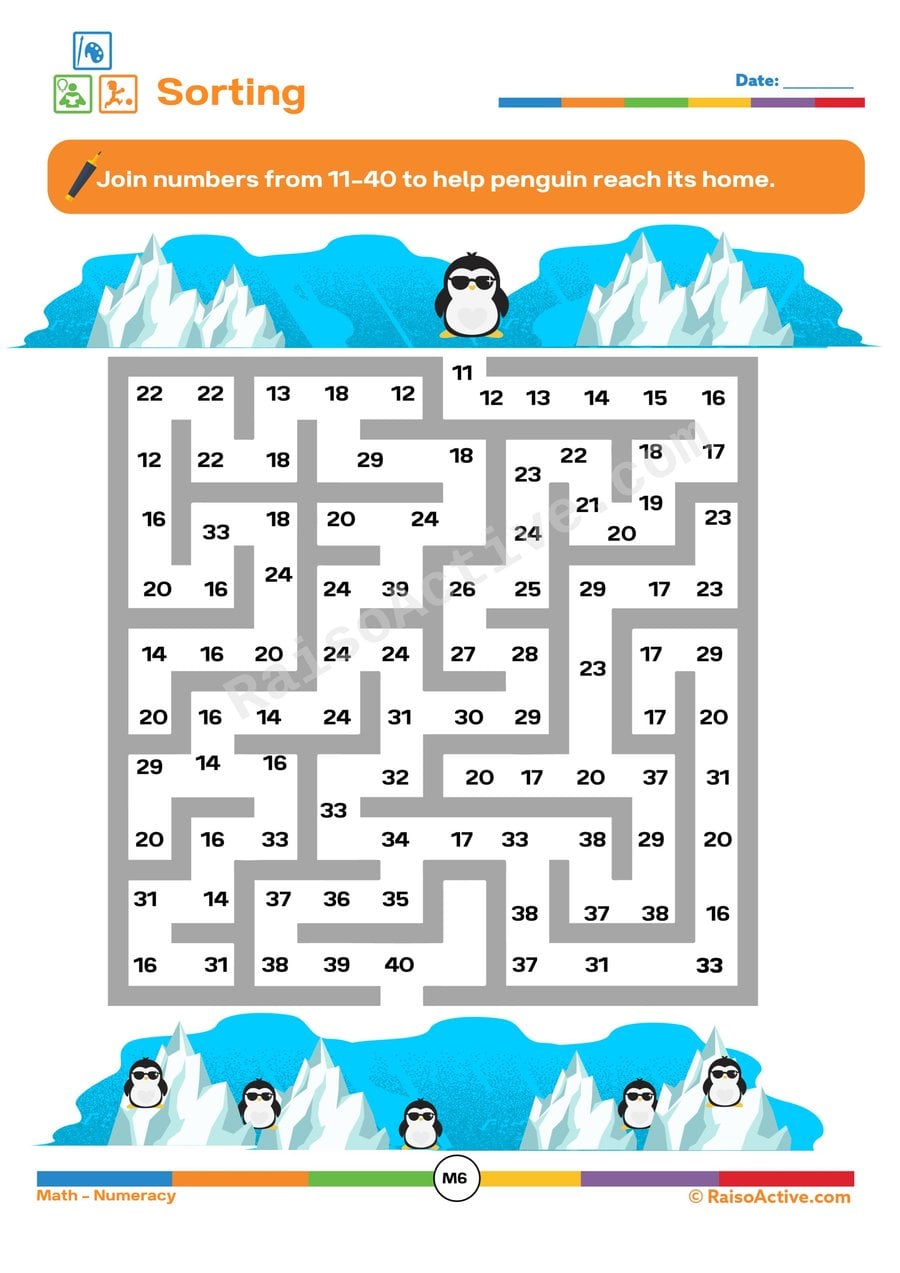
Penguin's Path: A Fun Sorting Worksheet for Kids!
Ages 4-6 · Pre-K–KindergartenAges 4-6 · Reception–Year 1Ages 4-6 · LKG–UKGAges 4-6
This maze worksheet has 4-6 year olds trace a path through numbers 11 to 40, building both number sequencing across a wider range and the fine motor control needed to draw a connected line dot to dot. Because the range spans several decades, your child gets real practice with the trickiest part of early counting — the transitions between decades (19 to 20, 29 to 30) — while the penguin's journey gives the task a clear, motivating goal.
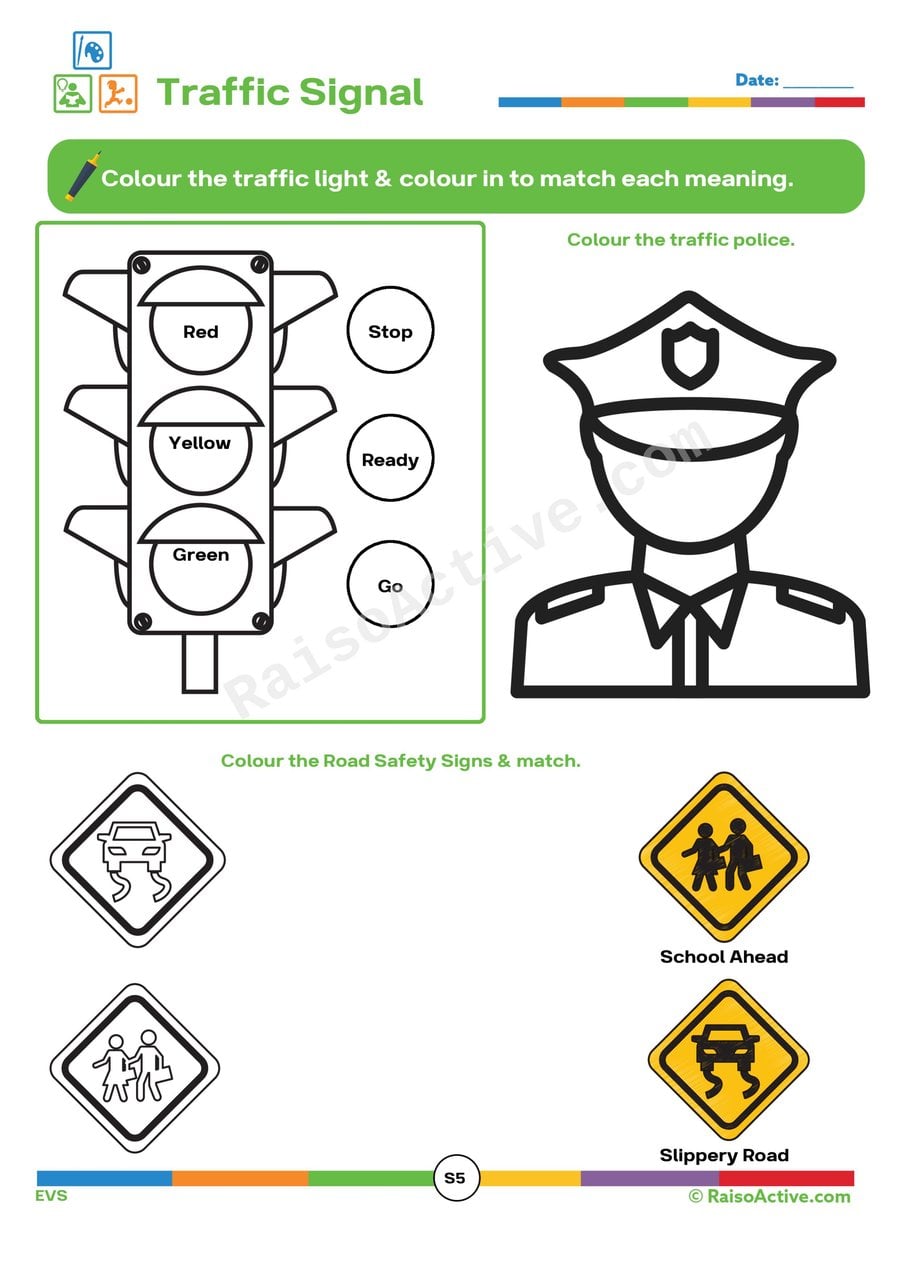
Traffic Signal Fun: Color and Match the Meanings!
Ages 3-5 · Preschool–Pre-KAges 3-5 · Nursery–ReceptionAges 3-5 · Nursery–LKGAges 3-5
Coloring traffic lights and matching words to their meanings teaches children ages 3-5 that colors carry specific, important messages in the real world, an early and practical form of symbol recognition and road safety awareness. Matching written words to the correct traffic light or road sign also reinforces early reading skills by connecting simple vocabulary to something visually familiar from everyday outings. Understanding what red, yellow, and green mean at a traffic light gives children knowledge they can apply immediately as pedestrians and future road users.
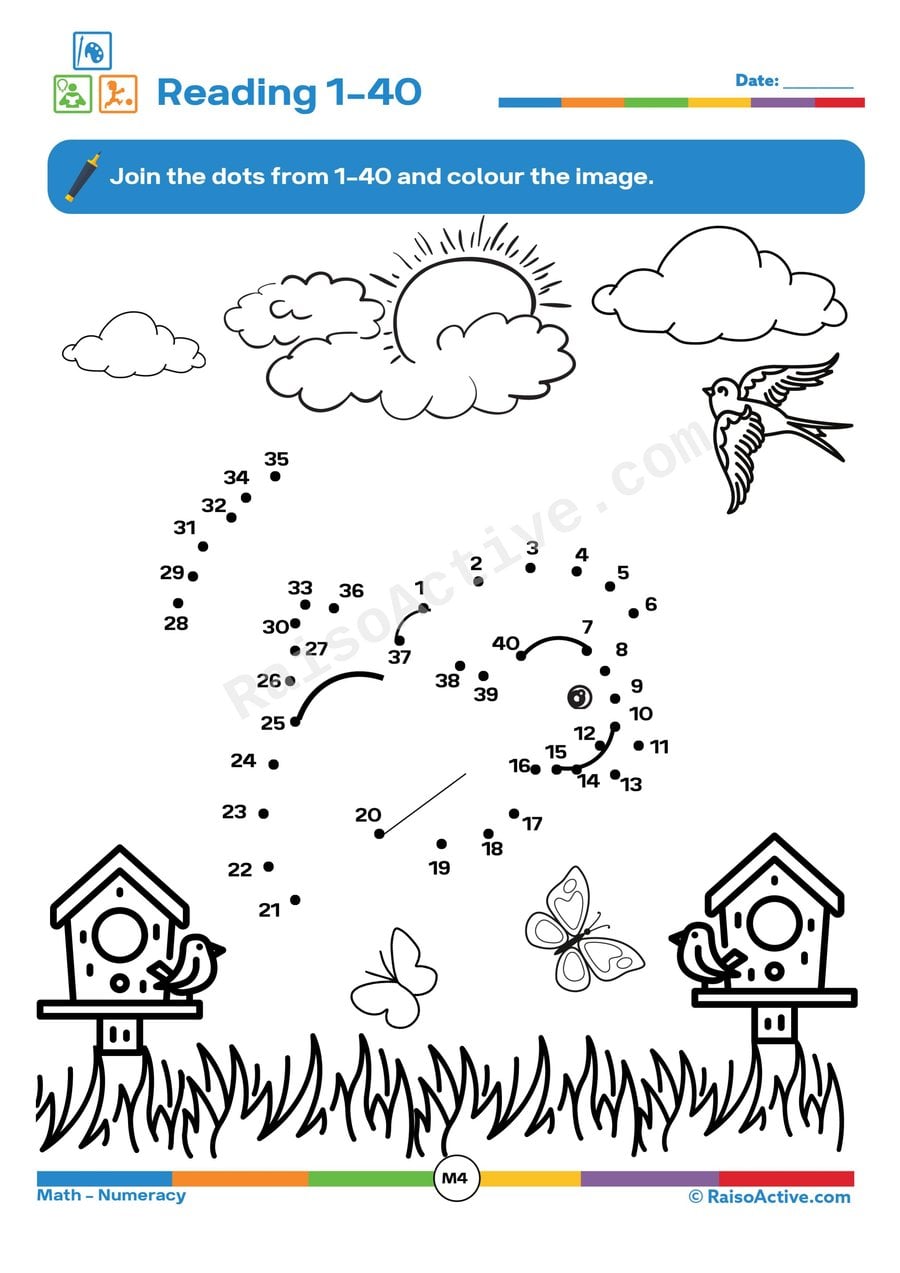
Connect the Dots: Sunny Day Picture Worksheet
Ages 3-5 · Preschool–Pre-KAges 3-5 · Nursery–ReceptionAges 3-5 · Nursery–LKGAges 3-5
Connecting the dots from 1 to 40 gives 3-5 year olds real practice with number sequencing well beyond the basic 1-10 range most preschool materials cover, while the physical act of drawing a line from dot to dot builds the same pencil control needed for handwriting. Because the picture only appears once every number has been found and connected in order, it also rewards sustained attention — your child has to keep track of where they are in the sequence across a fairly long worksheet, which is a real stretch at this age.

Community Helpers & Early Learning Activities Worksheet
Ages 3-5 · Preschool–Pre-KAges 3-5 · Nursery–ReceptionAges 3-5 · Nursery–LKGAges 3-5
This worksheet bundles several community-helper-themed activities, coloring, role-play, and object identification, to build vocabulary and social understanding around the different people who help in a community, like police officers or firefighters. For ages 3-5, learning about community helpers builds both social awareness and early classification skills as children learn to associate specific tools or uniforms with specific jobs.
Related worksheets

Trace and Learn the Number 7 Worksheet for Preschoolers
Ages 3-5 · Preschool–Pre-KAges 3-5 · Nursery–ReceptionAges 3-5 · Nursery–LKGAges 3-5
Children ages 3-5 practice the diagonal stroke pattern of the numeral 7 through guided tracing, then reinforce the quantity it represents by drawing exactly seven raindrops. This pairing of symbol-writing with a matching counting task helps children understand that '7' isn't just a shape to copy but a specific amount they can produce and check themselves.
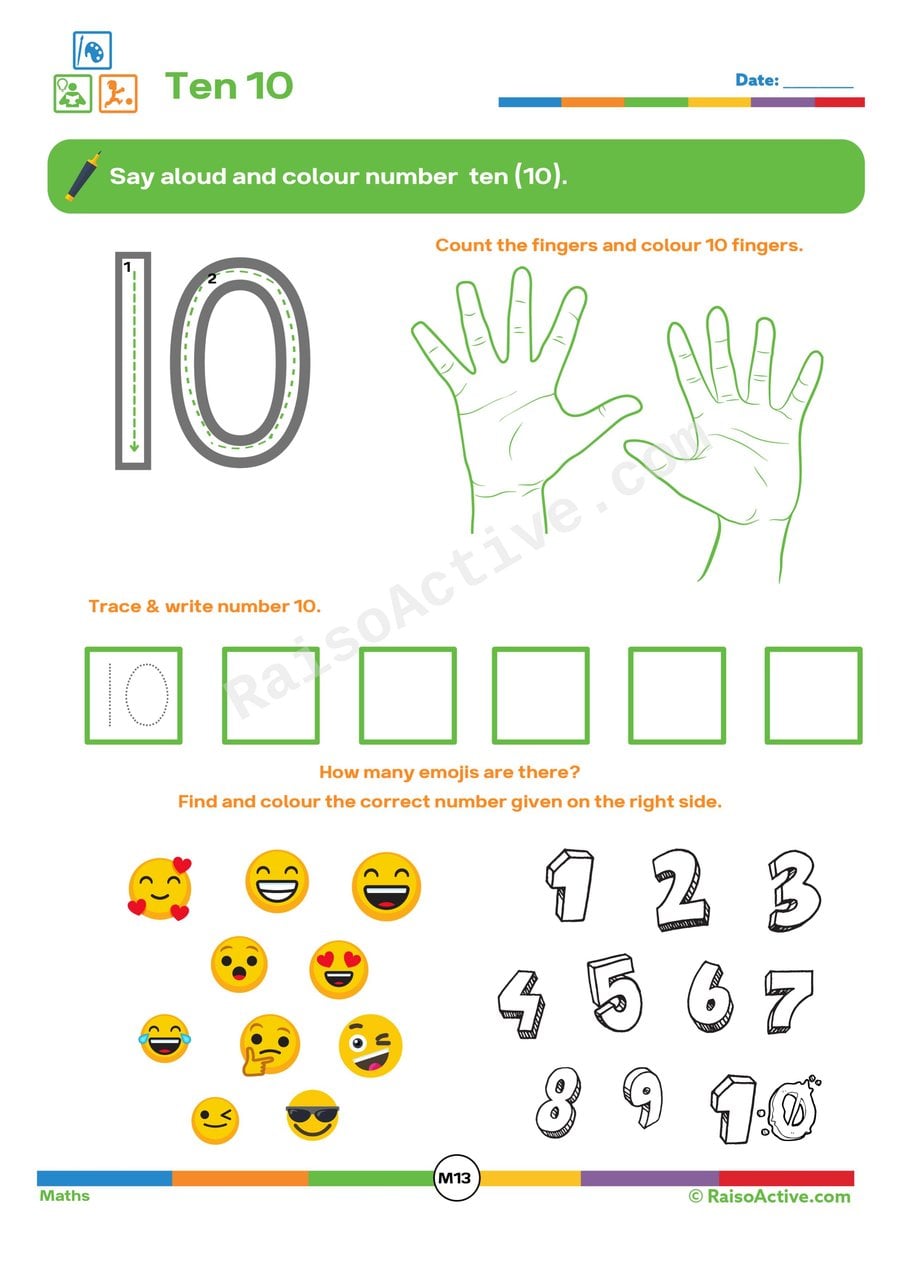
Number 10 Worksheet: Trace, Count, and Color!
Ages 3-5 · Preschool–Pre-KAges 3-5 · Nursery–ReceptionAges 3-5 · Nursery–LKGAges 3-5
Children ages 3-5 practice tracing and writing the two-digit number 10 while reinforcing counting to ten through a hands-based counting activity and a number-recognition search task. This worksheet layers several skills — tracing, counting, and visual recognition — to give children multiple ways to practice the same number.

Learn to Write the Number 7: A Fun Tracing and Counting Worksheet!
Ages 4-5 · Pre-KAges 4-5 · ReceptionAges 4-5 · LKGAges 4-5
This worksheet helps children ages 4-5 learn the correct stroke sequence for writing the number 7, while counting fingers and mangoes reinforces that the numeral stands for a specific quantity of seven items. Practicing both writing and counting for the same number in one sitting strengthens the link between number recognition and number formation.
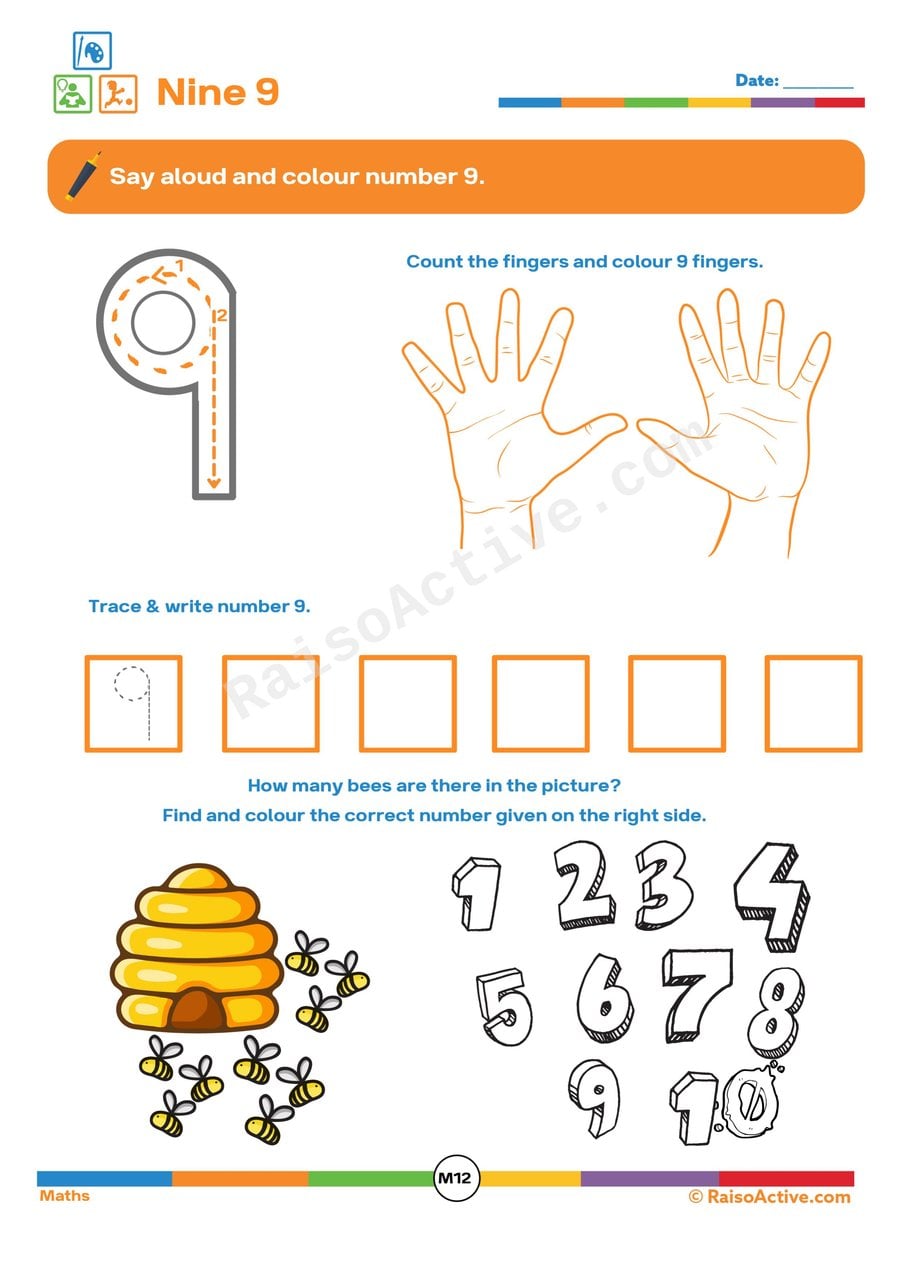
Number 9 Worksheet: Trace, Count, and Color!
Ages 3-5 · Preschool–Pre-KAges 3-5 · Nursery–ReceptionAges 3-5 · Nursery–LKGAges 3-5
This worksheet helps children ages 3-5 learn to recognize and write the number 9 through guided tracing, while counting fingers and bees builds fine motor coordination alongside number sense as they count all the way up to nine. Practicing the same number across three different activities, tracing, writing, and counting, helps the numeral and its quantity stick together in memory.
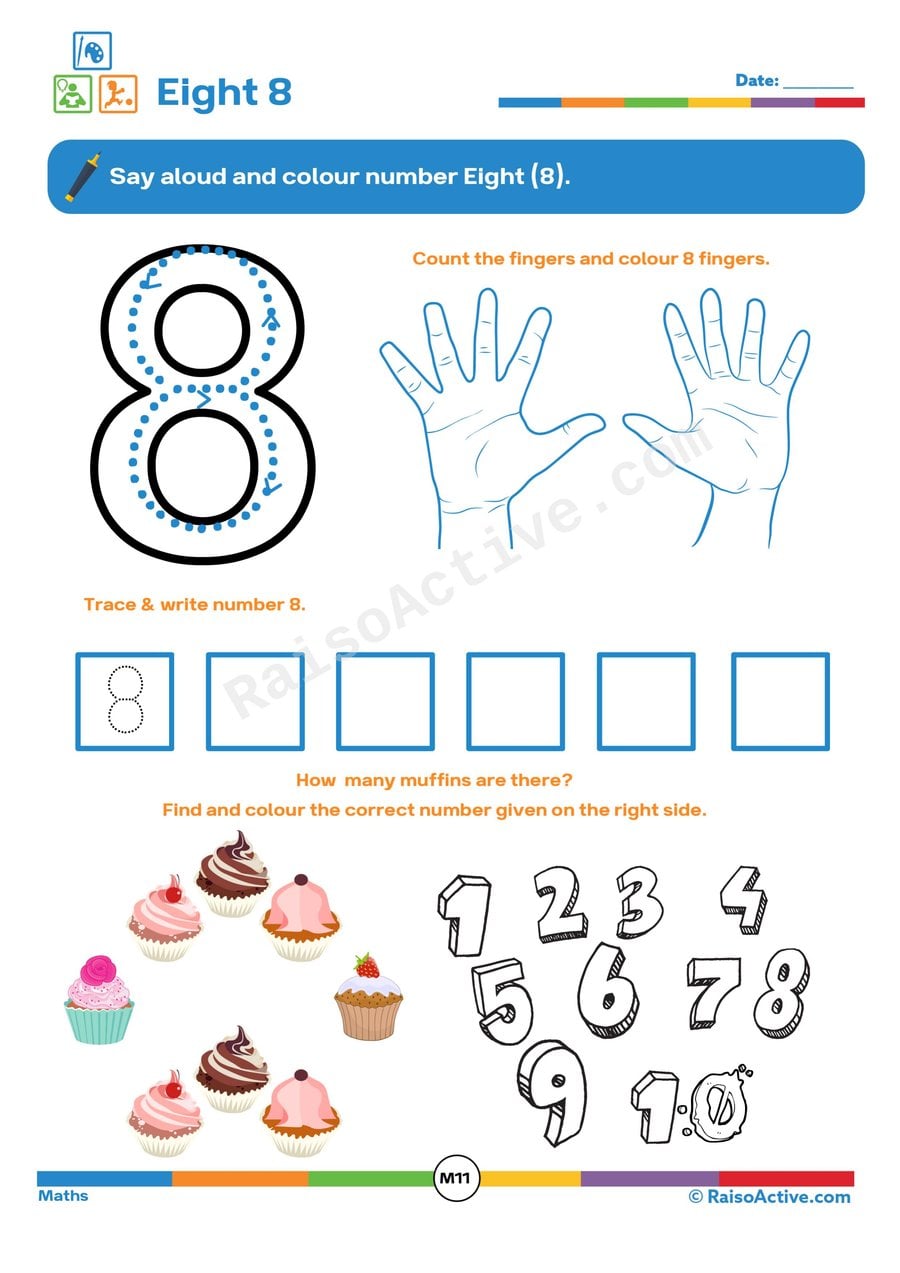
Number Eight (8) Worksheet: Trace, Count, and Color!
Ages 3-5 · Preschool–Pre-KAges 3-5 · Nursery–ReceptionAges 3-5 · Nursery–LKGAges 3-5
This worksheet helps children ages 3-5 learn to recognize, trace, and write the number 8 using its continuous curved stroke, while counting fingers and muffins reinforces one-to-one correspondence for the quantity eight. Circling the correct count among options also sharpens numeral recognition alongside handwriting practice.

Tracing and Counting Worksheet: Learning the Number 3!
Ages 3-5 · Preschool–Pre-KAges 3-5 · Nursery–ReceptionAges 3-5 · Nursery–LKGAges 3-5
This worksheet helps children ages 3-5 learn to recognize, trace, and write the number 3 using its correct stroke pattern, while a hands-and-ducks counting activity reinforces that the numeral 3 represents exactly three objects. Combining tracing with counting connects the written symbol to its real quantity, which is central to early number sense.
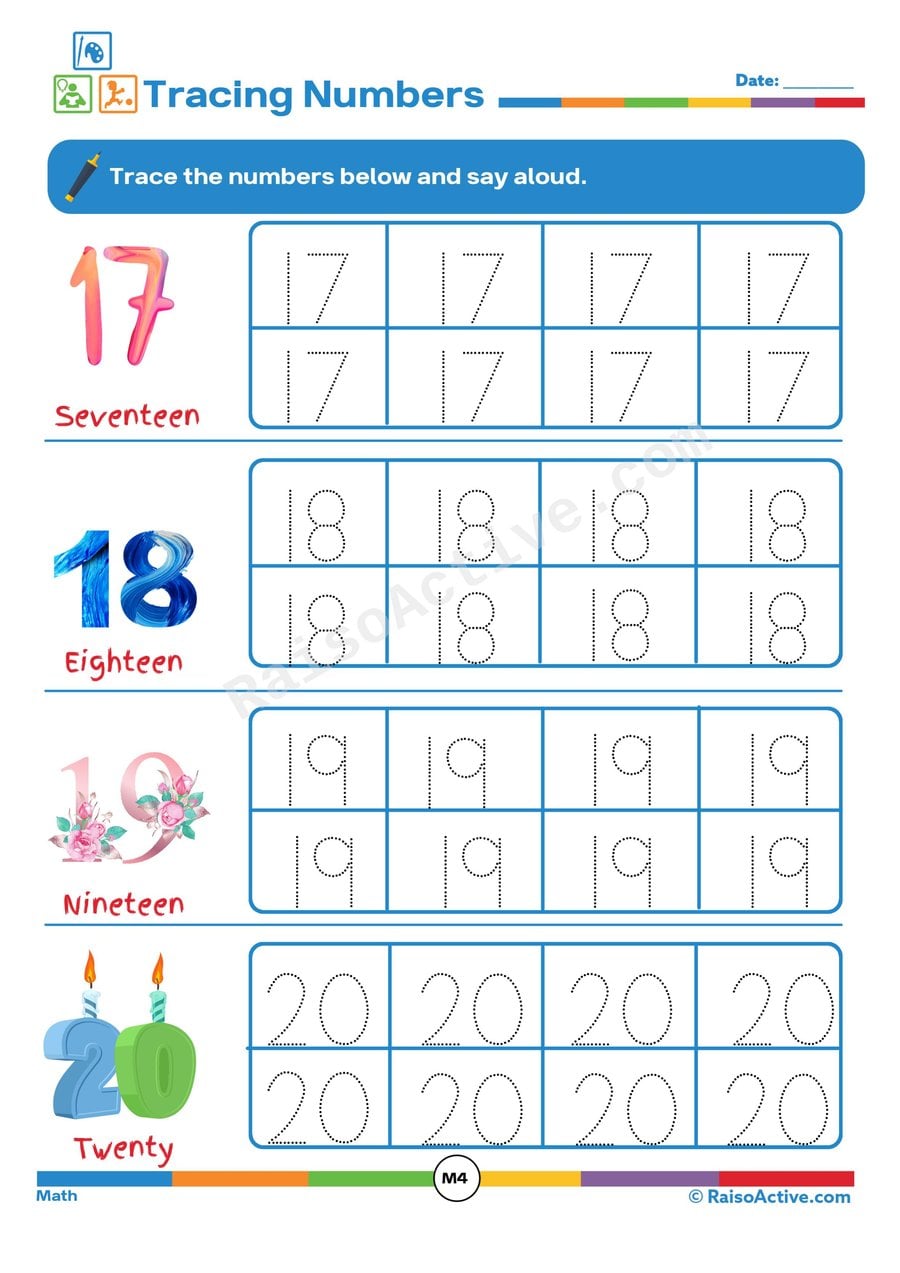
Trace and Learn Numbers 17-20 Worksheet
Ages 4-6 · Pre-K–KindergartenAges 4-6 · Reception–Year 1Ages 4-6 · LKG–UKGAges 4-6
This tracing worksheet helps children ages 4-6 build number-writing fluency and number-name recognition for 17 through 20, a range that's often trickier than smaller numbers because it involves two-digit sequencing and less familiar number words like 'seventeen' and 'nineteen'. Tracing the dotted numerals builds the fine motor control and muscle memory needed for independent number writing, while saying each number aloud reinforces the link between the written numeral and its spoken name. This range also sets up the transition into the twenties and beyond.

Tracing and Writing the Number 5 Worksheet for Preschoolers
Ages 3-5 · Preschool–Pre-KAges 3-5 · Nursery–ReceptionAges 3-5 · Nursery–LKGAges 3-5
This worksheet targets the specific pencil-control needed to form the numeral 5 correctly, while linking that written symbol to the quantity it represents through counting the apples on the page. Practicing number formation alongside counting at this age helps children connect the abstract symbol '5' to a concrete amount they can see and touch.
Guides for this topic

Number Formation Rhymes 0–9 and How to Fix Reversals
Original number formation rhymes for 0–9, the correct stroke order for each digit, why 3, 5 and 7 get reversed most often, and multisensory fixes that work.

Best Worksheets for 3-Year-Olds: What Works and What to Avoid
What works on worksheets for 3-year-olds: short sessions, crayons, tracing lines, matching, cutting, a free weekly plan, and signs one is too advanced.
Fostering Creativity in Structured Learning: The Perfect Balance for Young Minds
Learn how to blend creativity with structured learning for children ages 1-8. Practical strategies, activities, and printable worksheets for parents and teachers.
Reviews
Every worksheet for ages 3–5, no watermark
Members download the full library of 1,000+ worksheets and every activity pack without watermarks or daily limits. One year costs ₹999 in India or $20 elsewhere.
See membership plansOr download any worksheet free with a watermark (5 a day).