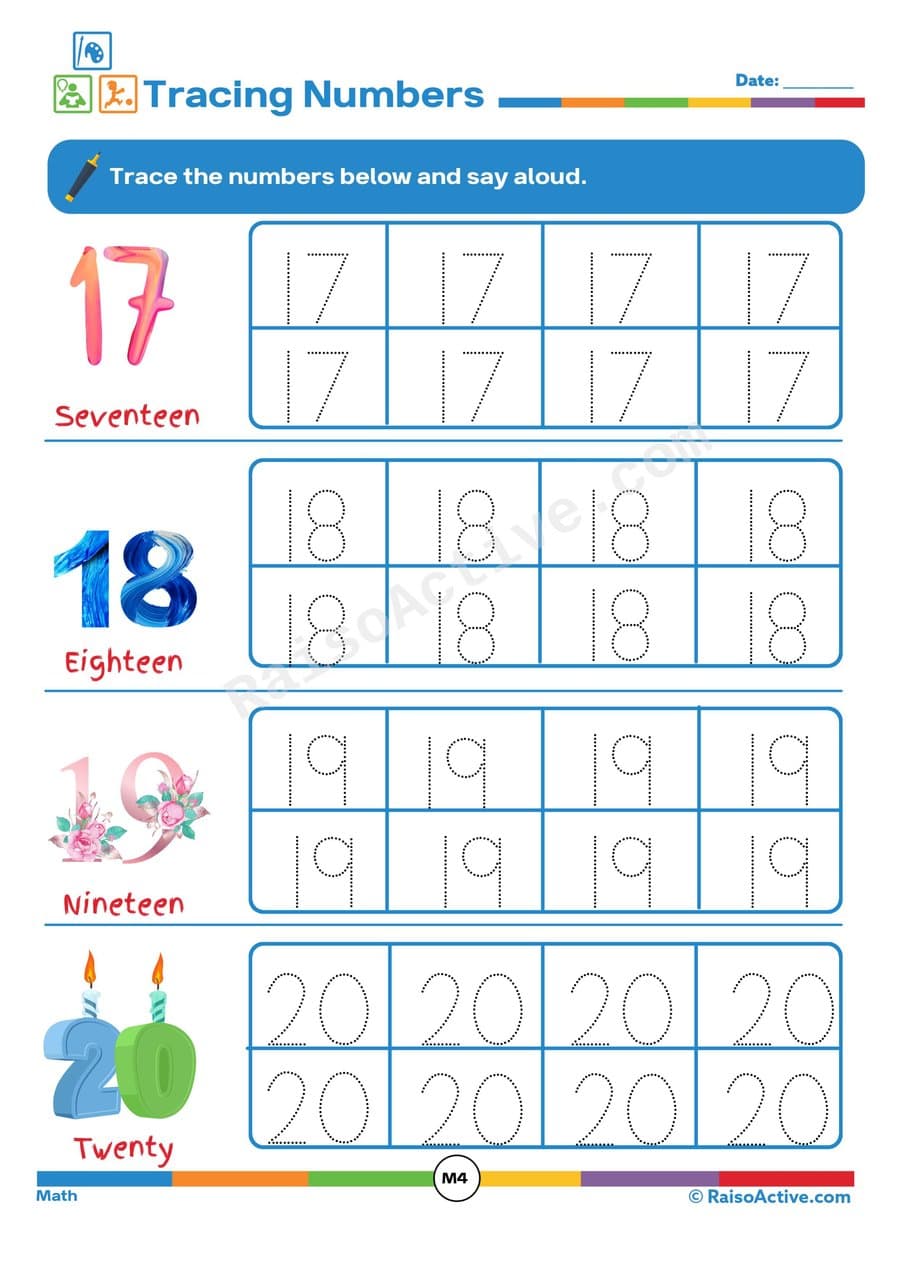
Trace and Learn Numbers 17-20 Worksheet
This tracing worksheet helps children ages 4-6 build number-writing fluency and number-name recognition for 17 through 20, a range that's often trickier than smaller numbers because it involves two-digit sequencing and less familiar number words like 'seventeen' and 'nineteen'. Tracing the dotted numerals builds the fine motor control and muscle memory needed for independent number writing, while saying each number aloud reinforces the link between the written numeral and its spoken name. This range also sets up the transition into the twenties and beyond.
Curriculum
How to use this worksheet
Have your child trace over the dotted numeral 17 slowly with a pencil, saying 'seventeen' aloud as they trace. Move to 18, 19, and 20 in the same way, tracing each number while saying its name clearly. Encourage your child to keep their pencil strokes smooth and within the dotted lines rather than rushing. Once all four numbers are traced, have your child point to each one and say its name from memory, without tracing.
Materials needed
- Pencil
- Crayons
Extension activities
- •Count out 17, 18, 19, and 20 small objects like buttons or blocks to physically match each number.
- •Play a number-recognition game, calling out a number between 17 and 20 and having your child find and point to it.
- •Practice writing 17 through 20 independently on a blank sheet after tracing, without the dotted guide.
- •Make a simple number line from 15 to 20 and have your child place small stickers on each number as they say it.
- •Count aloud together from 1 to 20 each day this week to build fluency through the full range.
Tips for parents and teachers
Numbers in the teens are notoriously confusing for young children because the spoken names don't follow an obvious pattern, so extra repetition here is normal and expected. Watch for reversed digits, especially with '1' and '7', and gently guide the pencil direction if needed rather than erasing and redoing. Counting real objects alongside tracing helps cement that these numerals represent actual quantities, not just shapes to copy.

Written by
Hemsweta Jain · Teacher Cheena
MBA and Early Childhood Educator, teaching since 2014 · Founder of RaisoActive, Mumbai
Every RaisoActive worksheet is designed and checked by the founder before publishing.
Published · Last reviewed
Related worksheets
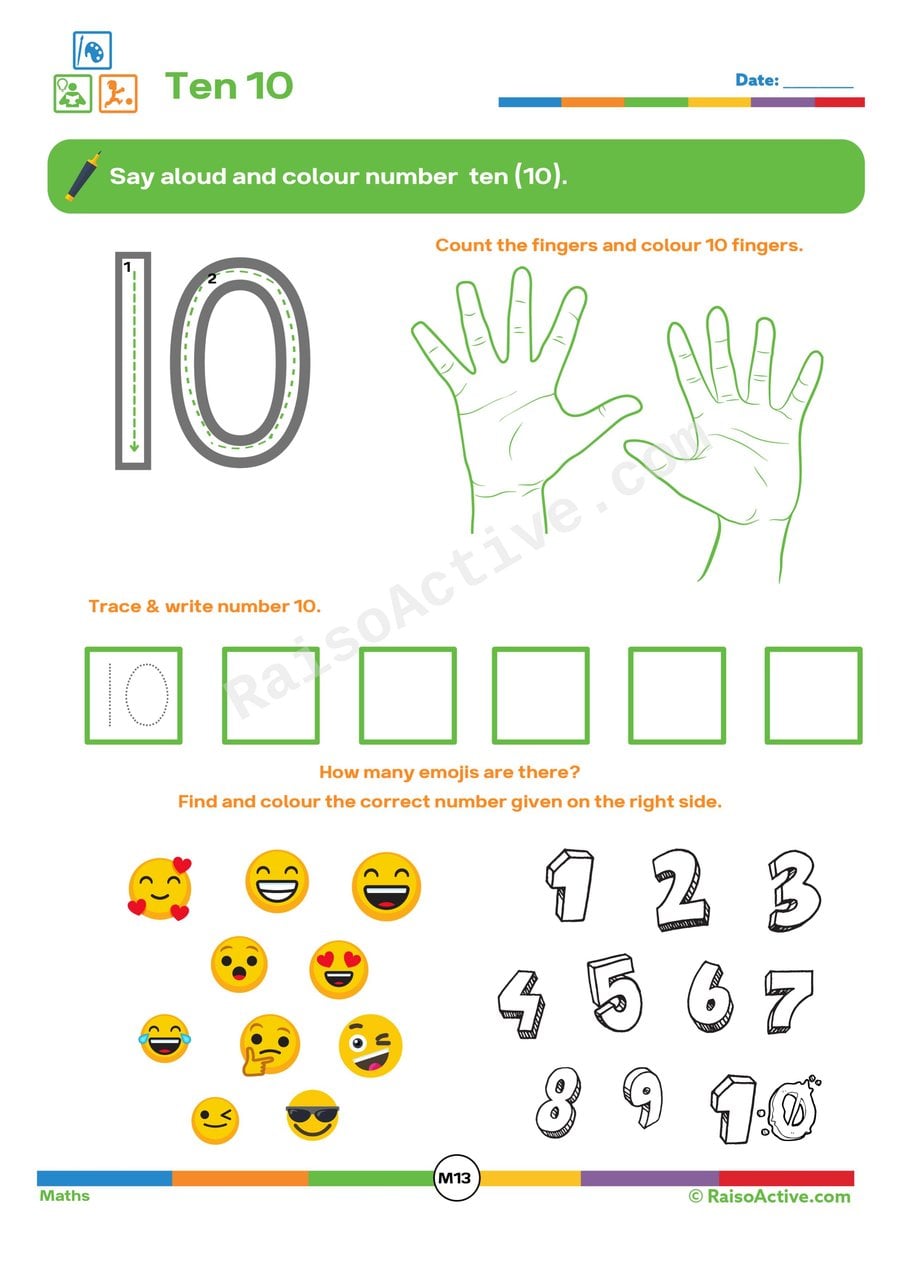
Number 10 Worksheet: Trace, Count, and Color!
Children ages 3-5 practice tracing and writing the two-digit number 10 while reinforcing counting to ten through a hands-based counting activity and a number-recognition search task. This worksheet layers several skills — tracing, counting, and visual recognition — to give children multiple ways to practice the same number.
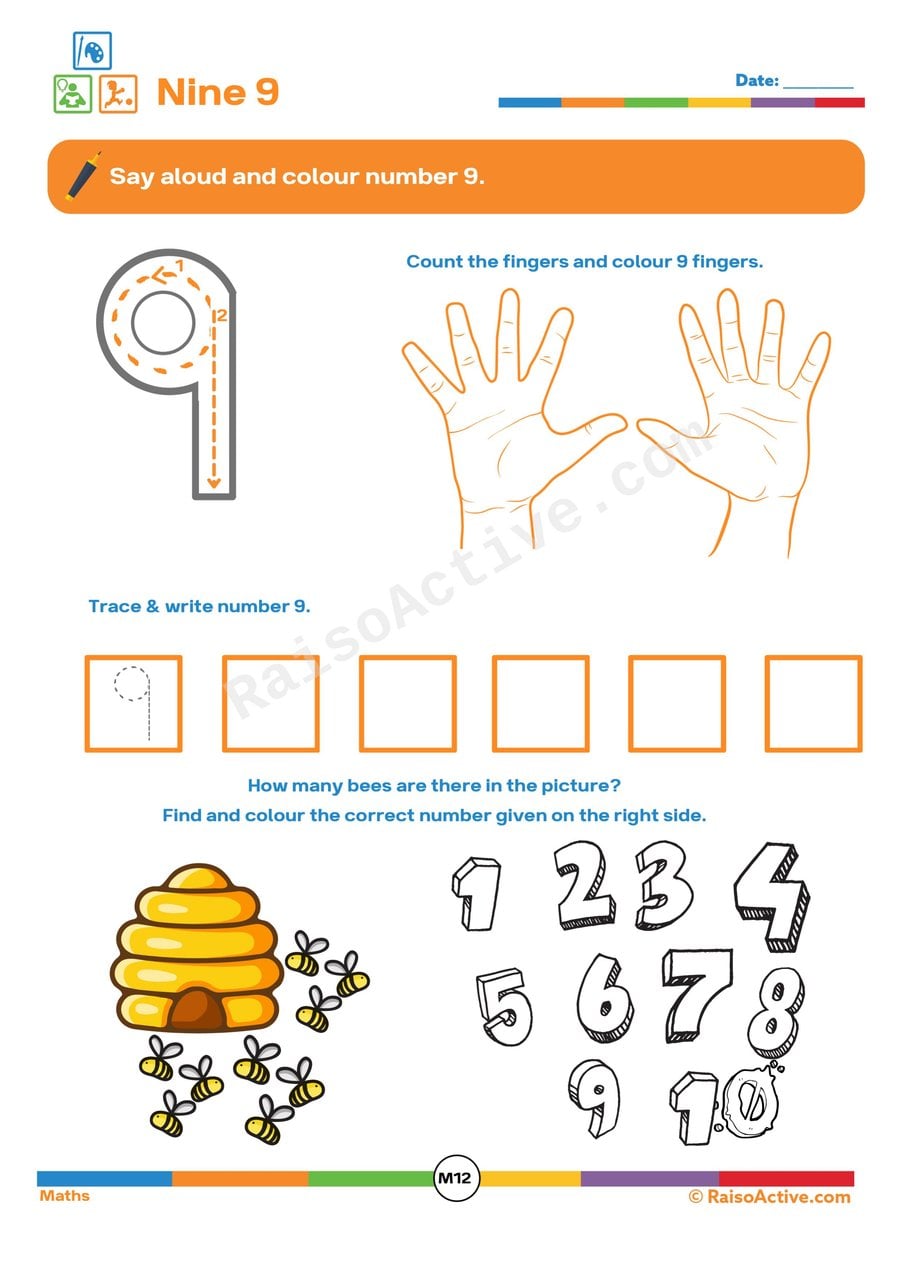
Number 9 Worksheet: Trace, Count, and Color!
This worksheet helps children ages 3-5 learn to recognize and write the number 9 through guided tracing, while counting fingers and bees builds fine motor coordination alongside number sense as they count all the way up to nine. Practicing the same number across three different activities, tracing, writing, and counting, helps the numeral and its quantity stick together in memory.
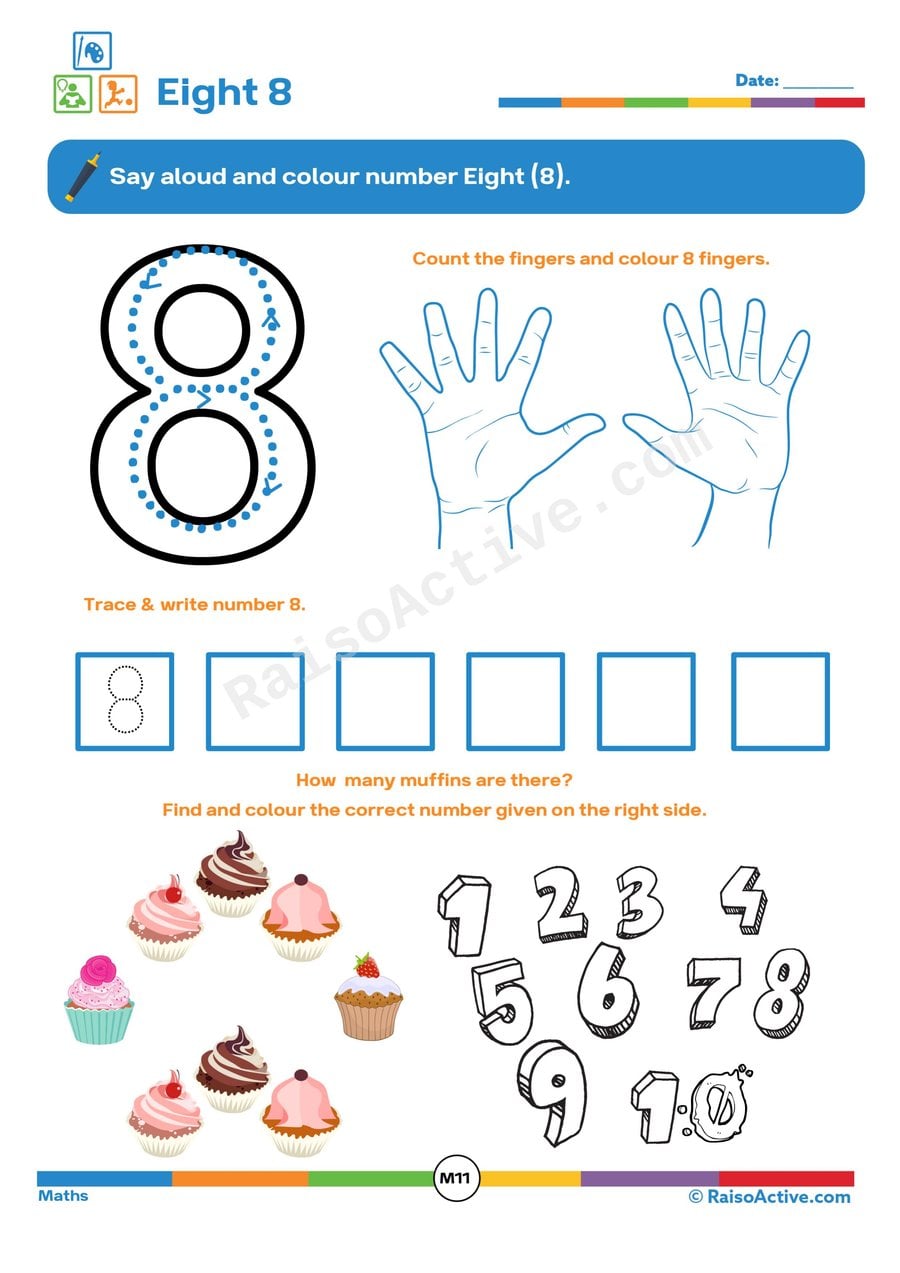
Number Eight (8) Worksheet: Trace, Count, and Color!
This worksheet helps children ages 3-5 learn to recognize, trace, and write the number 8 using its continuous curved stroke, while counting fingers and muffins reinforces one-to-one correspondence for the quantity eight. Circling the correct count among options also sharpens numeral recognition alongside handwriting practice.

Learn to Write the Number 7: A Fun Tracing and Counting Worksheet!
This worksheet helps children ages 4-5 learn the correct stroke sequence for writing the number 7, while counting fingers and mangoes reinforces that the numeral stands for a specific quantity of seven items. Practicing both writing and counting for the same number in one sitting strengthens the link between number recognition and number formation.
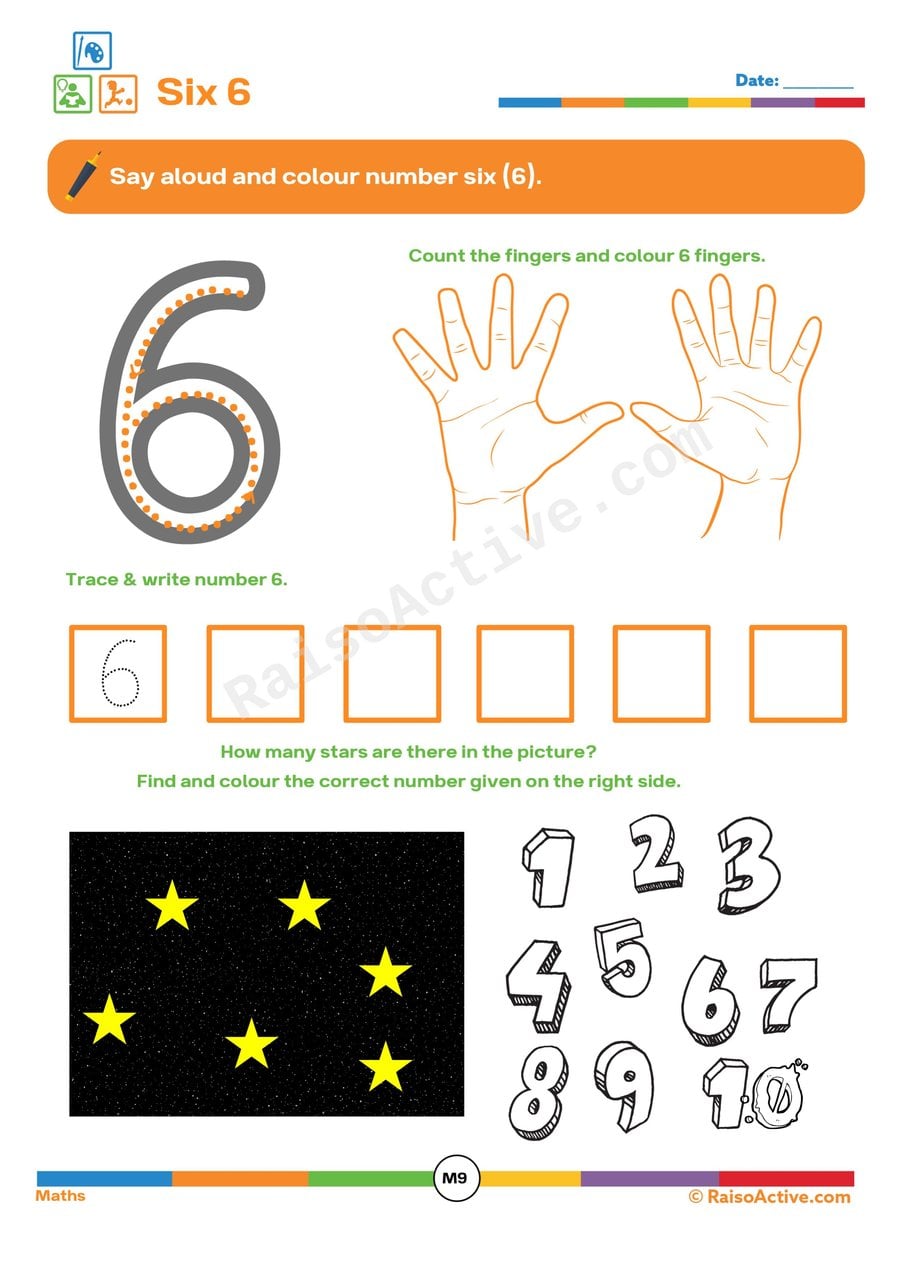
Number Six (6) Worksheet: Trace, Write, and Count!
Children ages 4-5 practice tracing and independently writing the number six while reinforcing the quantity it represents by counting a group of stars. Moving from guided tracing to independent writing, then to counting practice, builds both the motor skill and the number sense needed for early math confidence.

Tracing and Counting Fun: Number 5 Worksheet for Preschoolers
Children ages 4-5 practice tracing and writing the number 5 while reinforcing counting up to five through a picture-based matching task. Repeating the number in multiple formats — tracing, writing, and counting — helps cement both the shape of the numeral and the quantity it represents.
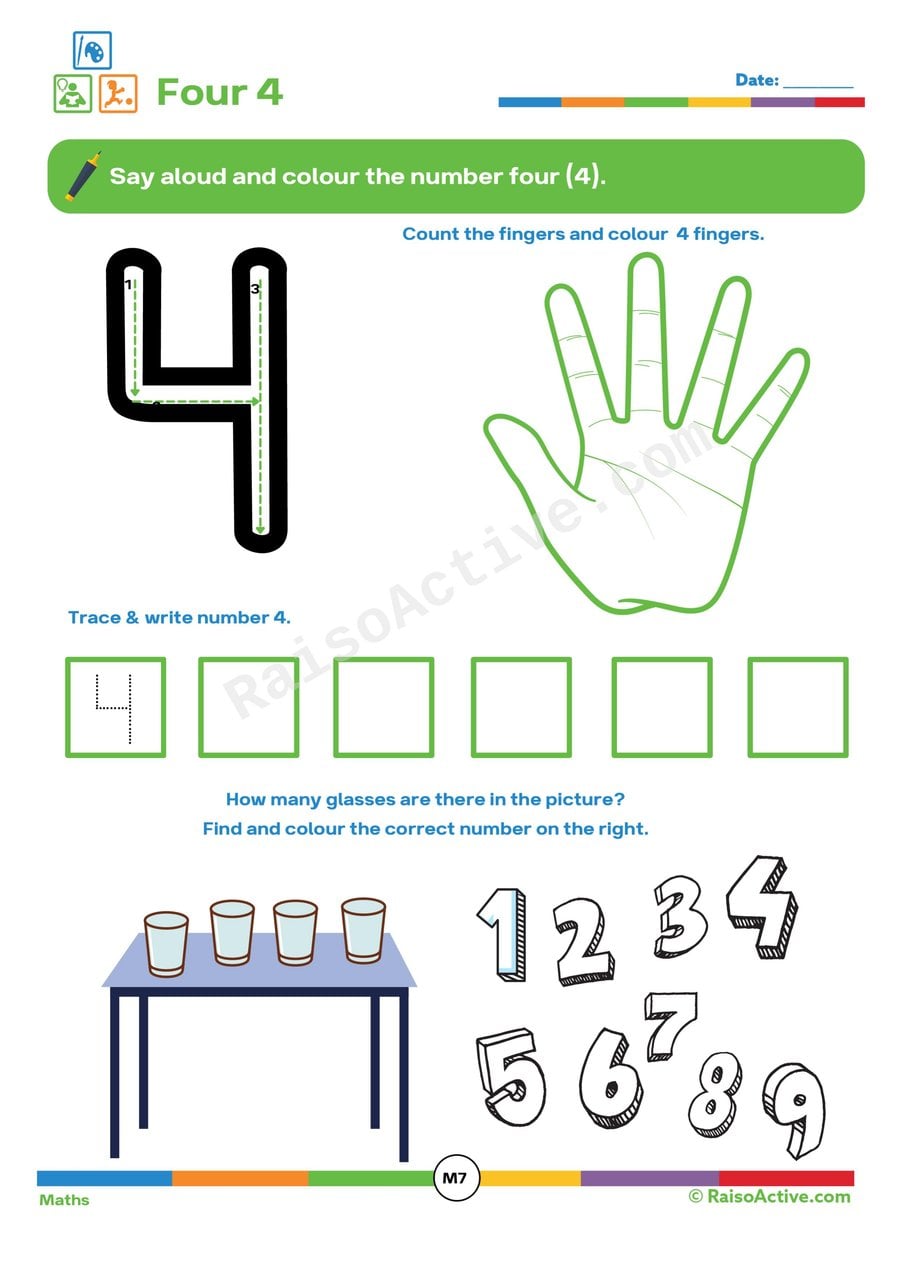
Number Four Worksheet: Trace, Count, and Color!
This worksheet helps children build the pencil control to write the number 4 correctly while linking that written numeral to the quantity it represents through counting fingers and objects on the page. For four- and five-year-olds, combining tracing with hands-on counting — like counting fingers on a hand or glasses in a row — reinforces that the number 4 always represents the same fixed amount, no matter what's being counted.

Tracing and Counting Worksheet: Learning the Number 3!
This worksheet helps children ages 3-5 learn to recognize, trace, and write the number 3 using its correct stroke pattern, while a hands-and-ducks counting activity reinforces that the numeral 3 represents exactly three objects. Combining tracing with counting connects the written symbol to its real quantity, which is central to early number sense.
Guides for this topic
Number Formation Rhymes 0–9 and How to Fix Reversals
Original number formation rhymes for 0–9, the correct stroke order for each digit, why 3, 5 and 7 get reversed most often, and multisensory fixes that work.
Christmas and Winter Activities That Combine Fun and Learning: Creating Magical Educational Experiences
Discover Christmas and winter activities that combine festive fun with real learning. Crafts, counting, literacy, and printable worksheets for ages 2 to 8 — perfect for home and school.
Age-Appropriate Halloween Learning Activities: Balancing Spooks and Skills for Young Learners
Discover fun, age-appropriate Halloween learning activities for young children. Spooky crafts, counting games, literacy ideas, and printable worksheets for ages 2 to 8.
Reviews
Every worksheet for ages 4–6, no watermark
Members download the full library of 1,000+ worksheets and every activity pack without watermarks or daily limits. One year costs ₹1,000 in India or $20 elsewhere.
See membership plansOr download any worksheet free with a watermark (5 a day).