Coin Spotting Fun: Circle the Coins!
This worksheet asks children ages 3-5 to scan a page of mixed images and circle every coin they can find, building early visual discrimination and introducing the concept of money as a distinct category of object. Learning to recognize coins by their round shape and shiny appearance lays early groundwork for later skills like counting money and understanding value.

Part of the pack
Month 9: Holistic Preschool Play Learning | Ages Up to 4
This is page 21 of the pack. Ages 3-4 · PreschoolAges 3-4 · NurseryAges 3-4
Made for your child
Counting to 10, made for your child
A maths pack with your child's name in it: pictures that explain, practice at three levels, puzzles and story sums about them. Print a new set whenever they finish.
Make a maths packFree preview · free for members
Curriculum
- Money > Coin Recognition
How to use this worksheet
Look at the full page of images together first, without circling anything, and talk about what makes a coin look different from other objects — its round shape, its shine, its size. Have your child go through the page circling every coin they spot. Once finished, count together how many coins were found and talk about any patterns, like differences in size.
Materials needed
- Pencil
Extension activities
- 1Collect a handful of real coins and sort them by size, color, or value.
- 2Set up a pretend shop using toy or real coins so your child can practice 'buying' small items.
- 3Take a coin rubbing using paper and a crayon to explore the texture and design on a coin's surface.
- 4Play an 'I spy' game around the house or in a piggy bank looking specifically for coins.

Written by
Hemsweta Jain · Teacher Cheena
MBA and Early Childhood Educator, teaching since 2014 · Founder of RaisoActive, Mumbai
Every RaisoActive worksheet is designed and checked by the founder before publishing.
Published · Last reviewed
More from Month 9: Holistic Preschool Play Learning | Ages Up to 4

Letter Recognition Worksheet: Fill in the Beginning Letter!
Ages 3-5 · Preschool–Pre-KAges 3-5 · Nursery–ReceptionAges 3-5 · Nursery–LKGAges 3-5
This worksheet gives children ages 3-5 practice identifying the beginning sound of pictured words, writing the missing letter to complete each one, and then specifically finding words that start with the letter 'W'. Focusing on one target letter in the second half of the worksheet adds a layer of selective attention, asking children to recognize a specific letter among several options rather than just filling in blanks.

Transport Vehicles Cut and Paste Worksheet for Preschoolers
Ages 3-5 · Preschool–Pre-KAges 3-5 · Nursery–ReceptionAges 3-5 · Nursery–LKGAges 3-5
This worksheet has children ages 3-5 sort transport vehicles by cutting them out and pasting each one onto the correct scene — road, water, or sky — building early classification skills alongside vocabulary about how different vehicles travel. Sorting by category, rather than just naming objects, is an important thinking skill that helps children organize new knowledge as they learn about the world.

Days of the Week Cut and Paste Worksheet for Preschoolers
Ages 3-5 · Preschool–Pre-KAges 3-5 · Nursery–ReceptionAges 3-5 · Nursery–LKGAges 3-5
This worksheet teaches children ages 3-5 the order of the days of the week by having them cut out day names and paste them correctly under 'Yesterday', 'Today', and 'Tomorrow'. Understanding this relative time sequence is an important early step in developing time concepts, and the physical cut-and-paste format makes an abstract idea like 'yesterday' more concrete and hands-on.
Social Helpers Tools Worksheet for Kids
Ages 3-5 · Preschool–Pre-KAges 3-5 · Nursery–ReceptionAges 3-5 · Nursery–LKGAges 3-5
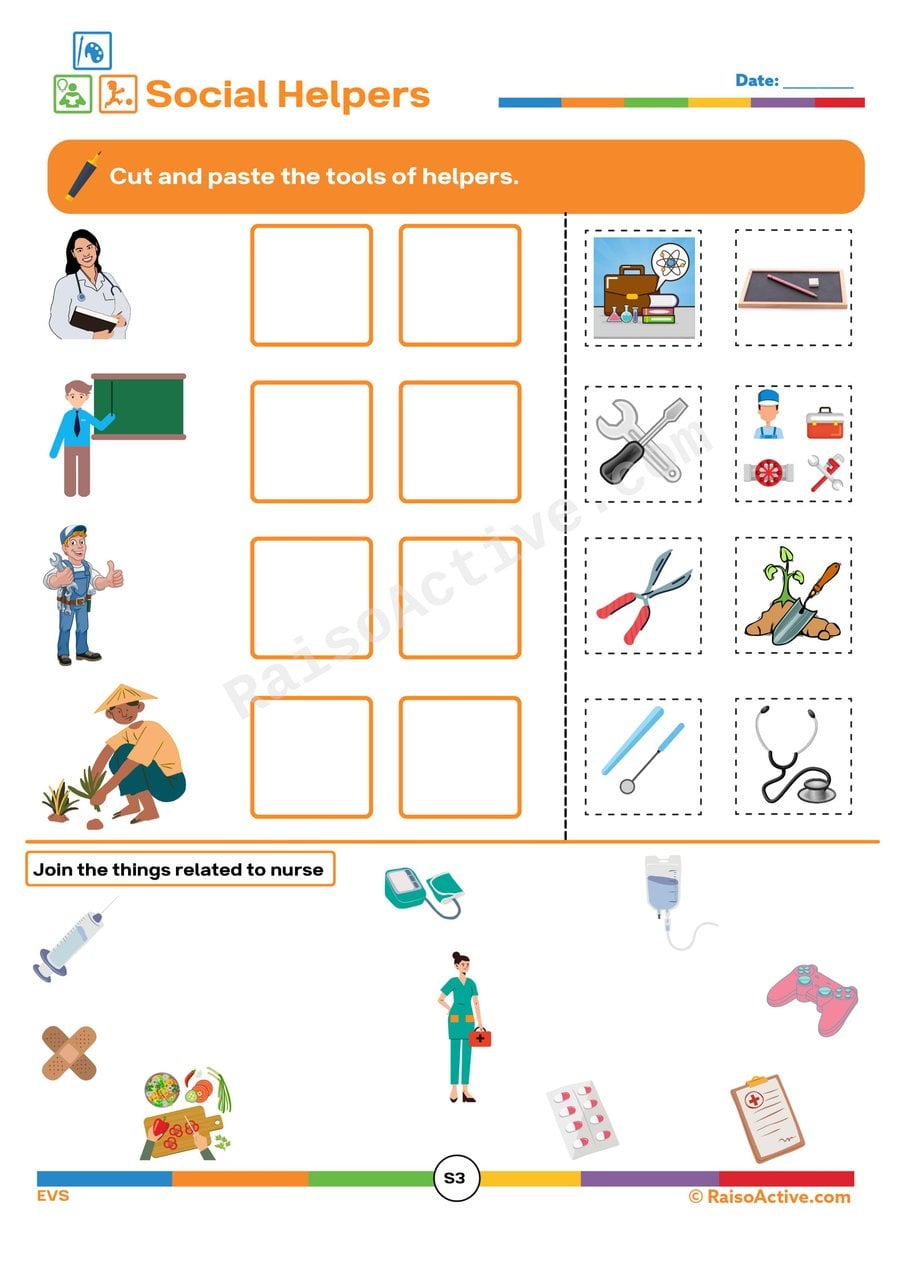
This worksheet teaches children ages 3-5 to connect community helpers with the tools and equipment they use in their jobs, building early social studies knowledge alongside visual matching skills. Recognizing that a stethoscope belongs to a doctor or a hose belongs to a firefighter helps children understand how tools relate to specific roles and responsibilities in their community. The cut-and-paste and joining activities also reinforce fine motor control and visual discrimination as children sort similar-looking small pictures.

Alphabet Cut and Paste Worksheet: Matching Letters and Objects
Ages 3-5 · Preschool–Pre-KAges 3-5 · Nursery–ReceptionAges 3-5 · Nursery–LKGAges 3-5
This cut-and-paste worksheet helps children ages 3-5 practice letter recognition by matching pictures to their correct beginning letter and gluing them into place, combining early phonics with fine motor skill development. Handling scissors and glue at this age builds the hand strength and precision needed for later handwriting, while the matching task reinforces that each letter represents a specific sound. Doing both together makes this a genuinely multi-skill activity rather than a single-purpose worksheet.
Inside and Outside Worksheet for Kids
Ages 3-5 · Preschool–Pre-KAges 3-5 · Nursery–ReceptionAges 3-5 · Nursery–LKGAges 3-5
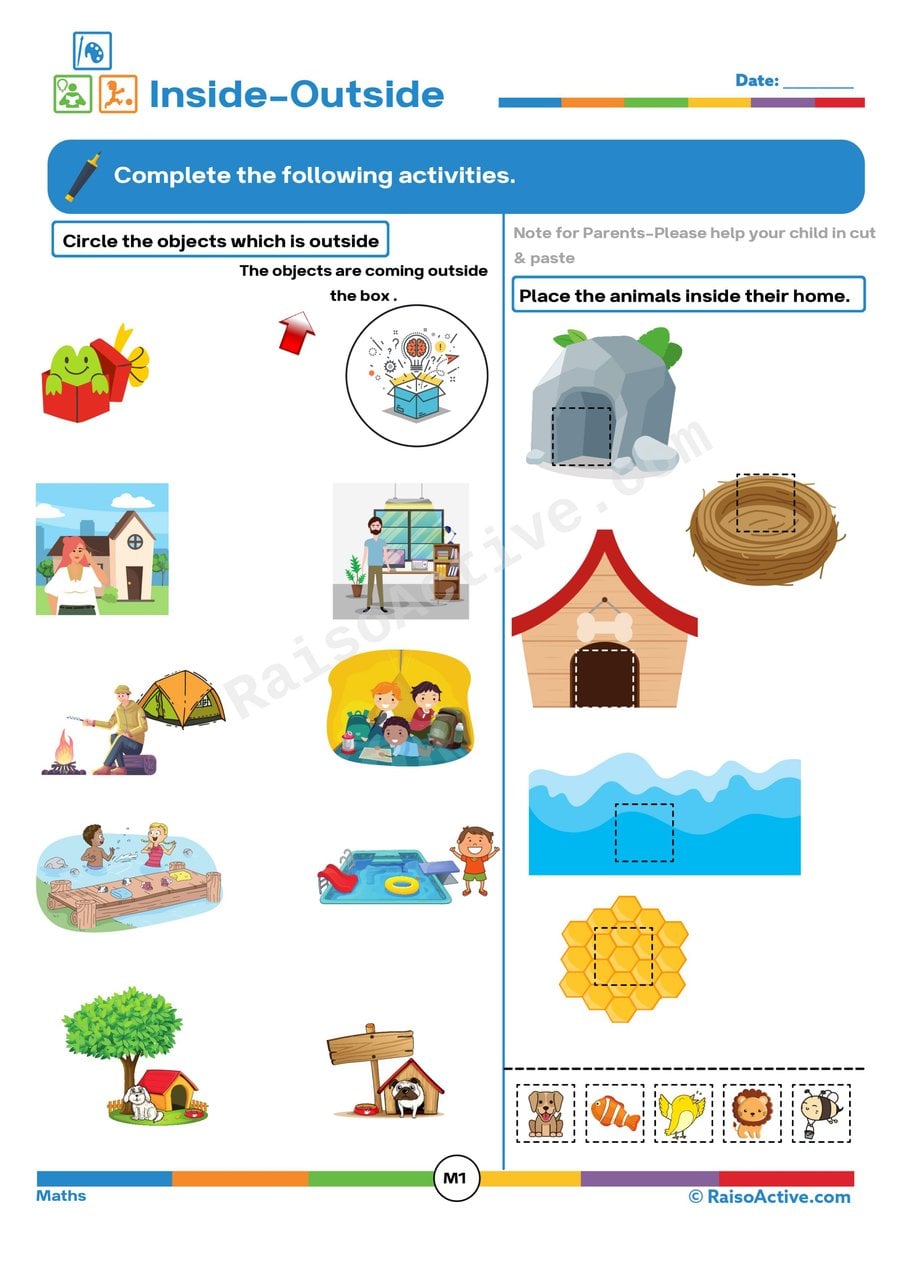
Understanding 'inside' and 'outside' as opposite positional concepts helps children ages 3-5 build early spatial reasoning and vocabulary they'll rely on constantly in both everyday language and later math instruction involving position and location. This worksheet asks children to identify objects in different settings and then physically place animals into their homes, giving them practice applying the concept rather than just naming it. Matching each animal to its correct home also reinforces basic categorization — recognizing that different creatures belong in different types of spaces.

Princess's Number Path: Fill in the Missing Numbers Worksheet
Ages 4-6 · Pre-K–KindergartenAges 4-6 · Reception–Year 1Ages 4-6 · LKG–UKGAges 4-6
Filling in missing numbers along a themed path gives children ages 4-6 practice with number sequencing — understanding that numbers follow a fixed, predictable order and being able to identify what comes before or after a given number. This skill goes beyond simple counting, since a child has to hold the number sequence in their head and apply it to gaps rather than just reciting numbers in order from the start. The princess-and-prince storyline gives the exercise a narrative hook that keeps young children engaged through what might otherwise feel like a repetitive counting task.
Number Tracing and Counting Worksheet for Kids
Ages 4-6 · Pre-K–KindergartenAges 4-6 · Reception–Year 1Ages 4-6 · LKG–UKGAges 4-6
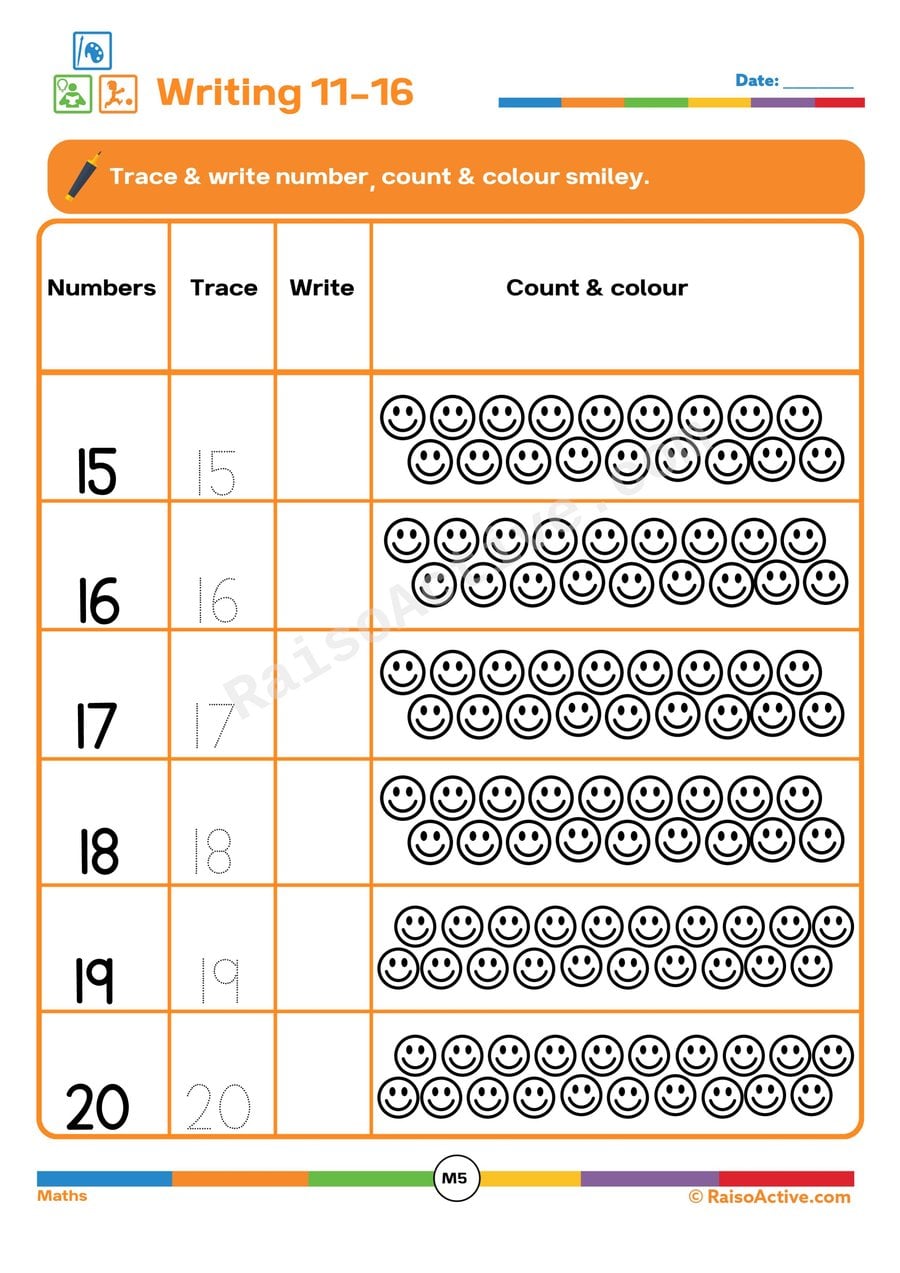
This worksheet layers three connected numeracy skills for children ages 4-6: tracing numerals to build correct number formation, writing numbers independently from memory, and counting objects to connect a written numeral to an actual quantity. Number formation practice at this age matters because children often develop habits — like starting a number from the wrong point — that are hard to unlearn later, so guided tracing helps establish correct strokes early. Pairing that with counting smiley faces ensures the numeral isn't just a shape being copied but a quantity being understood.
Related worksheets

Parts of a Leaf Worksheet for Preschoolers: Learn and Play!
Ages 3-5 · Preschool–Pre-KAges 3-5 · Nursery–ReceptionAges 3-5 · Nursery–LKGAges 3-5
This hands-on activity teaches children ages 3-5 the parts of a leaf — tip, blade, veins, midrib, petiole, and stem — by having them shape a leaf from playdough while comparing it to a real leaf. Building a physical model alongside a real specimen helps children connect abstract vocabulary to tangible features they can see and touch, which is especially effective for this age group.

Clothing Pattern Match Worksheet for Preschoolers
Ages 3-5 · Preschool–Pre-KAges 3-5 · Nursery–ReceptionAges 3-5 · Nursery–LKGAges 3-5
This worksheet has children ages 3-5 study repeating patterns on clothing items — stripes, polka dots, or checks — and match each item to its identical twin, building visual discrimination and early pattern-sequencing skills. Distinguishing between similar-looking patterns also sharpens attention to detail, a skill that later supports letter and word recognition.

Easter Pattern Match Worksheet: Bunny, Basket, and Egg Fun!
Ages 3-5 · Preschool–Pre-KAges 3-5 · Nursery–ReceptionAges 3-5 · Nursery–LKGAges 3-5
This worksheet has children ages 3-5 study a repeating pattern shown across a set of bunny, basket, and egg images, then identify which item on the right continues or matches that same pattern. Recognizing a pattern by its color or design sequence builds early algebraic thinking, since spotting what comes next is a skill children will rely on throughout math.

Harvests & New Years: One Harvest, Many Names Across India
Ages 4-8 · Pre-K–Grade 2Ages 4-8 · Reception–Year 3Ages 4-8 · LKG–Class 2Ages 4-8
Children learn that the same winter harvest is celebrated with different names across India, and that many states have their own New Year festival.
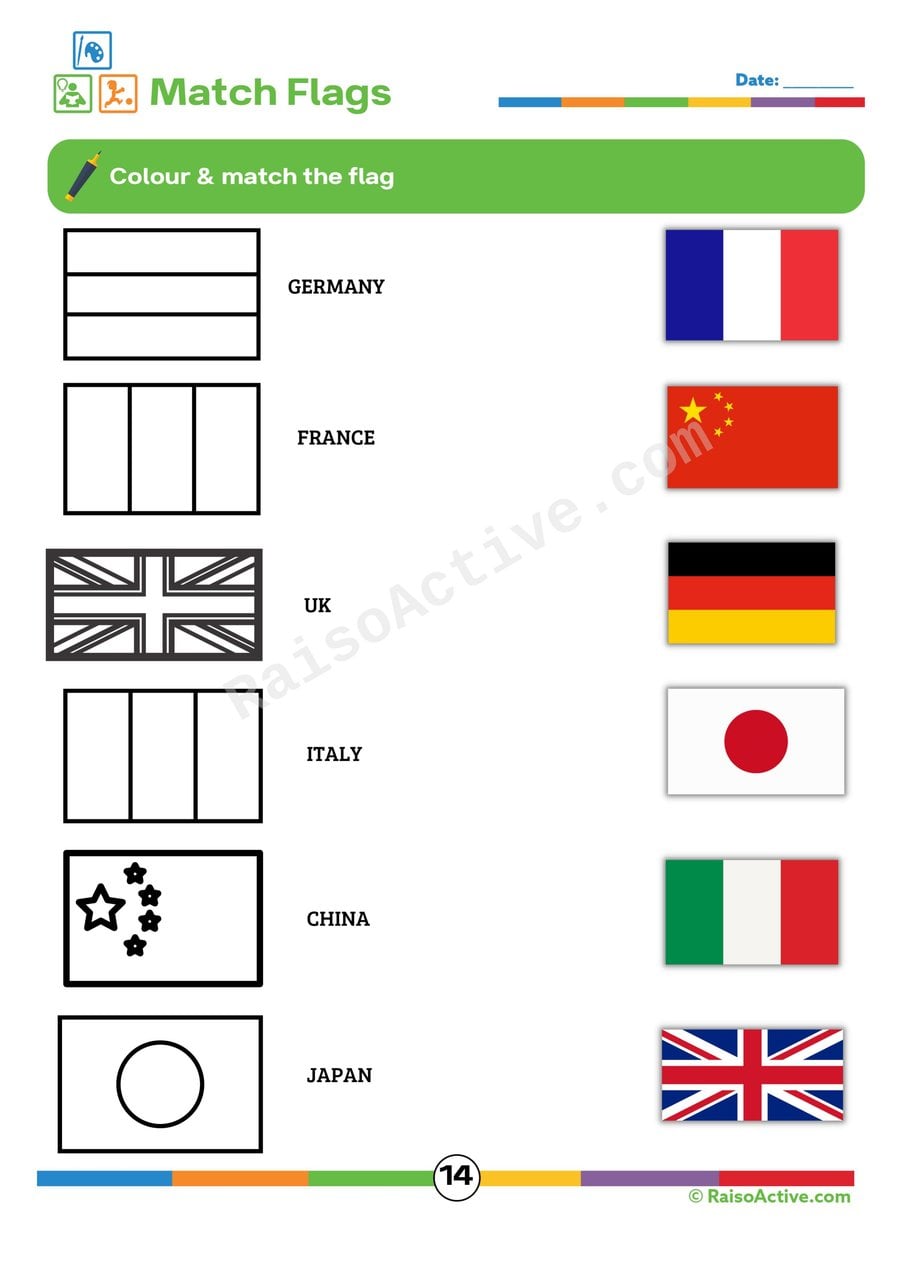
Match the Flags Worksheet: Color and Learn!
Ages 4-6 · Pre-K–KindergartenAges 4-6 · Reception–Year 1Ages 4-6 · LKG–UKGAges 4-6
This worksheet helps children ages 4-6 recognize different country flags by coloring them accurately and matching each one to its correct country name. Coloring flags with real colors, rather than free choice, adds a layer of factual precision to the usual creative coloring task, reinforcing that flags carry specific, meaningful designs.

Soap & Pepper Science Experiment Worksheet for Preschoolers
Ages 3-5 · Preschool–Pre-KAges 3-5 · Nursery–ReceptionAges 3-5 · Nursery–LKGAges 3-5
This simple experiment introduces children ages 3-5 to the basic science of surface tension and how soap breaks it, using pepper flakes sprinkled on water as a visual demonstration. Watching the pepper scatter away the instant soap touches the water gives children a concrete, memorable example of cause and effect, an early building block for scientific thinking.
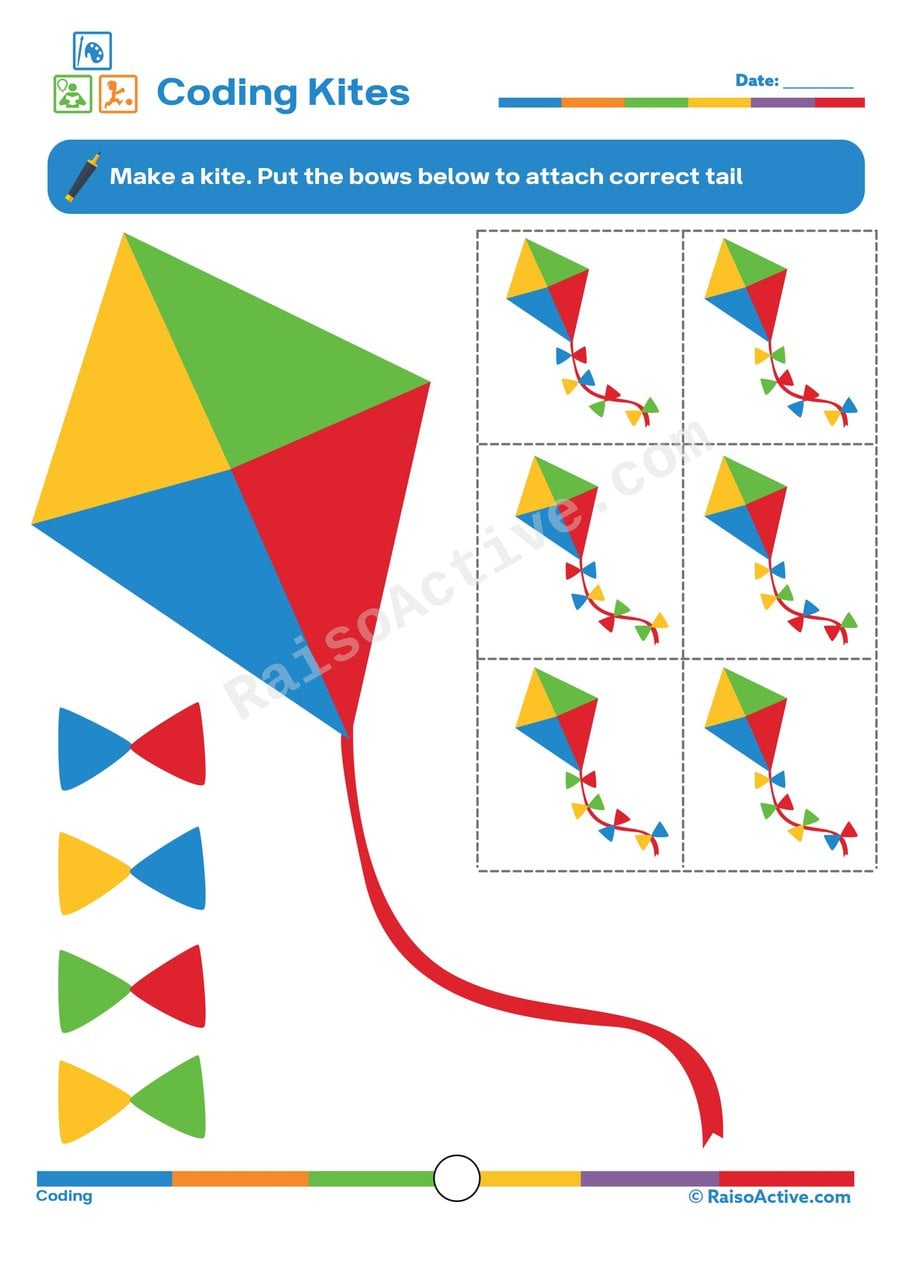
Coding Kites Worksheet: Match the Bows!
Ages 3-5 · Preschool–Pre-KAges 3-5 · Nursery–ReceptionAges 3-5 · Nursery–LKGAges 3-5
By matching each colorful bow to the kite sharing its color pattern, children ages 3-5 practice visual pattern recognition — an early form of the same logical sequencing used in beginner coding concepts. Cutting, matching, and gluing the correct bow also reinforces color-word vocabulary and precise hand-eye coordination.

Match the Flags! A Fun Coloring Worksheet for Kids
Ages 3-5 · Preschool–Pre-KAges 3-5 · Nursery–ReceptionAges 3-5 · Nursery–LKGAges 3-5
This worksheet combines coloring with flag recognition, helping children ages 3-5 practice fine motor control while learning to match a colored flag to its correct blank outline. Coloring the flags first, then matching them, adds an extra layer of visual processing as children must recall the colors they just used to complete the matching step.
Guides for this topic

Best Worksheets for 3-Year-Olds: What Works and What to Avoid
What works on worksheets for 3-year-olds: short sessions, crayons, tracing lines, matching, cutting, a free weekly plan, and signs one is too advanced.

Coding Activities for Preschoolers: Building Tomorrow's Thinkers Today
Discover 15+ unplugged and screen-based coding activities for preschoolers that build sequencing, logic, and problem-solving skills through play. NEP 2020 aligned.

Discovering Wonder: Nature-Based Learning Activities That Captivate Young Children
Explore nature-based learning activities for children ages 2–7 — leaf rubbings, bug hunts, nature journals, and seasonal Indian outdoor ideas that spark wonder.
Reviews
Every worksheet for ages 3–5, no watermark
Members download the full library of 1,000+ worksheets and every activity pack without watermarks or daily limits. One year costs ₹999 in India or $20 elsewhere.
See membership plansOr download any worksheet free with a watermark (5 a day).