Inside and Outside Worksheet for Kids
Understanding 'inside' and 'outside' as opposite positional concepts helps children ages 3-5 build early spatial reasoning and vocabulary they'll rely on constantly in both everyday language and later math instruction involving position and location. This worksheet asks children to identify objects in different settings and then physically place animals into their homes, giving them practice applying the concept rather than just naming it. Matching each animal to its correct home also reinforces basic categorization — recognizing that different creatures belong in different types of spaces.

Part of the pack
Month 9: Holistic Preschool Play Learning | Ages Up to 4
This is page 9 of the pack. Ages 3-4 · PreschoolAges 3-4 · NurseryAges 3-4
Made for your child
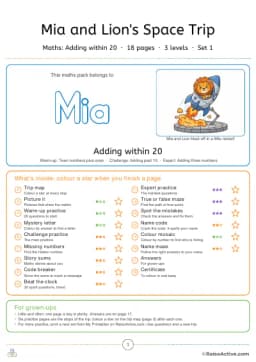
Counting to 10, made for your child
A maths pack with your child's name in it: pictures that explain, practice at three levels, puzzles and story sums about them. Print a new set whenever they finish.
Make a maths packFree preview · free for members
Curriculum
- Spatial Sense > Positional Words
How to use this worksheet
Look at the first section together and identify which objects are shown outside versus inside, having your child circle the ones that are outside. Talk through why each object belongs where it does as you go. Move to the second section, where animals need a home, and help your child cut out each animal picture carefully. Have them decide which home matches each animal and glue it into the correct spot, explaining their reasoning out loud as they work.
Materials needed
- Pencil
- Scissors
- Glue
Extension activities
- 1Take a walk around the house or yard and point out things that are inside versus outside.
- 2Draw a picture split in half, with inside items on one side and outside items on the other.
- 3Play a quick sorting game with toys, placing them 'inside' a box or 'outside' of it based on your instructions.
- 4Read a picture book together and pause to ask whether each scene is happening inside or outside.
- 5Act out being 'inside' and 'outside' a hula hoop or blanket fort as a physical vocabulary game.

Written by
Hemsweta Jain · Teacher Cheena
MBA and Early Childhood Educator, teaching since 2014 · Founder of RaisoActive, Mumbai
Every RaisoActive worksheet is designed and checked by the founder before publishing.
Published · Last reviewed
Related worksheets

Positional Words Worksheet: Over, Under, Up, and Down!
Ages 3-5 · Preschool–Pre-KAges 3-5 · Nursery–ReceptionAges 3-5 · Nursery–LKGAges 3-5
This worksheet helps children ages 3-5 build spatial reasoning by identifying and applying the positional words over, under, up, and down to describe where objects are in relation to one another. Understanding these words is foundational not just for following directions, but also for later concepts like map reading and following multi-step instructions.
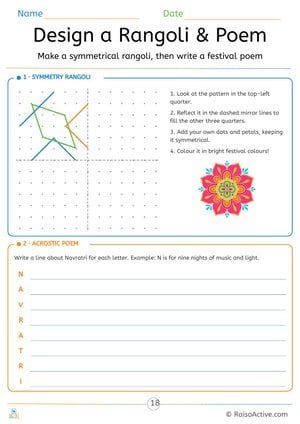
Navratri Symmetry Rangoli and Acrostic Poem
Ages 7-11 · Grade 2–Grade 3Ages 7-11 · Year 3–Year 4Ages 7-11 · Class 2–Class 3Ages 7-11
Children reflect a pattern in two mirror lines to complete a four-way symmetrical rangoli on a dot grid, add their own symmetrical details, and write an acrostic poem with one line for each letter of NAVRATRI.

Navratri Picture Cards: Cut-Out Memory Match Game
Ages 4-6 · Pre-K–KindergartenAges 4-6 · Reception–Year 1Ages 4-6 · LKG–UKGAges 4-6
Children learn six Navratri words, match each picture to its word and clue, and practise memory and cutting skills.
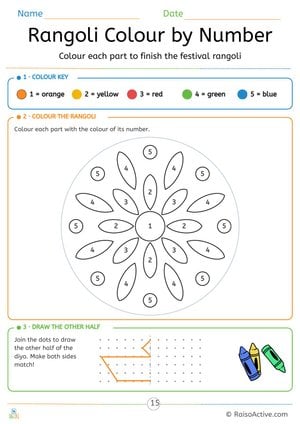
Navratri Rangoli Colour by Number and Symmetry Diya
Ages 4-6 · Pre-K–KindergartenAges 4-6 · Reception–Year 1Ages 4-6 · LKG–UKGAges 4-6
Children match numbers to colours using a key, colour a rangoli pattern carefully and draw the other half of a shape so both sides match.
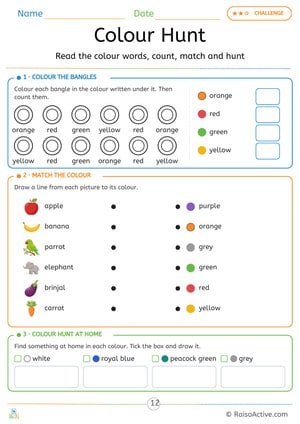
Navratri Colour Hunt: Colour Words, Matching and Bangles
Ages 4-6 · Pre-K–KindergartenAges 4-6 · Reception–Year 1Ages 4-6 · LKG–UKGAges 4-6
Children read colour words, colour bangles to match, count how many of each colour, match everyday things to their colours and find colours around the home.
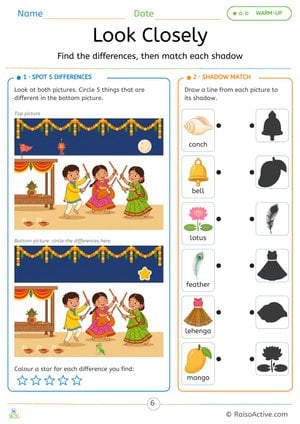
Navratri Look Closely: Spot the Difference and Shadow Match
Ages 4-6 · Pre-K–KindergartenAges 4-6 · Reception–Year 1Ages 4-6 · LKG–UKGAges 4-6
Children compare two pictures carefully to find what is different and match objects to their shadows by looking at shape.

Clothing Pattern Match Worksheet for Preschoolers
Ages 3-5 · Preschool–Pre-KAges 3-5 · Nursery–ReceptionAges 3-5 · Nursery–LKGAges 3-5
This worksheet has children ages 3-5 study repeating patterns on clothing items — stripes, polka dots, or checks — and match each item to its identical twin, building visual discrimination and early pattern-sequencing skills. Distinguishing between similar-looking patterns also sharpens attention to detail, a skill that later supports letter and word recognition.
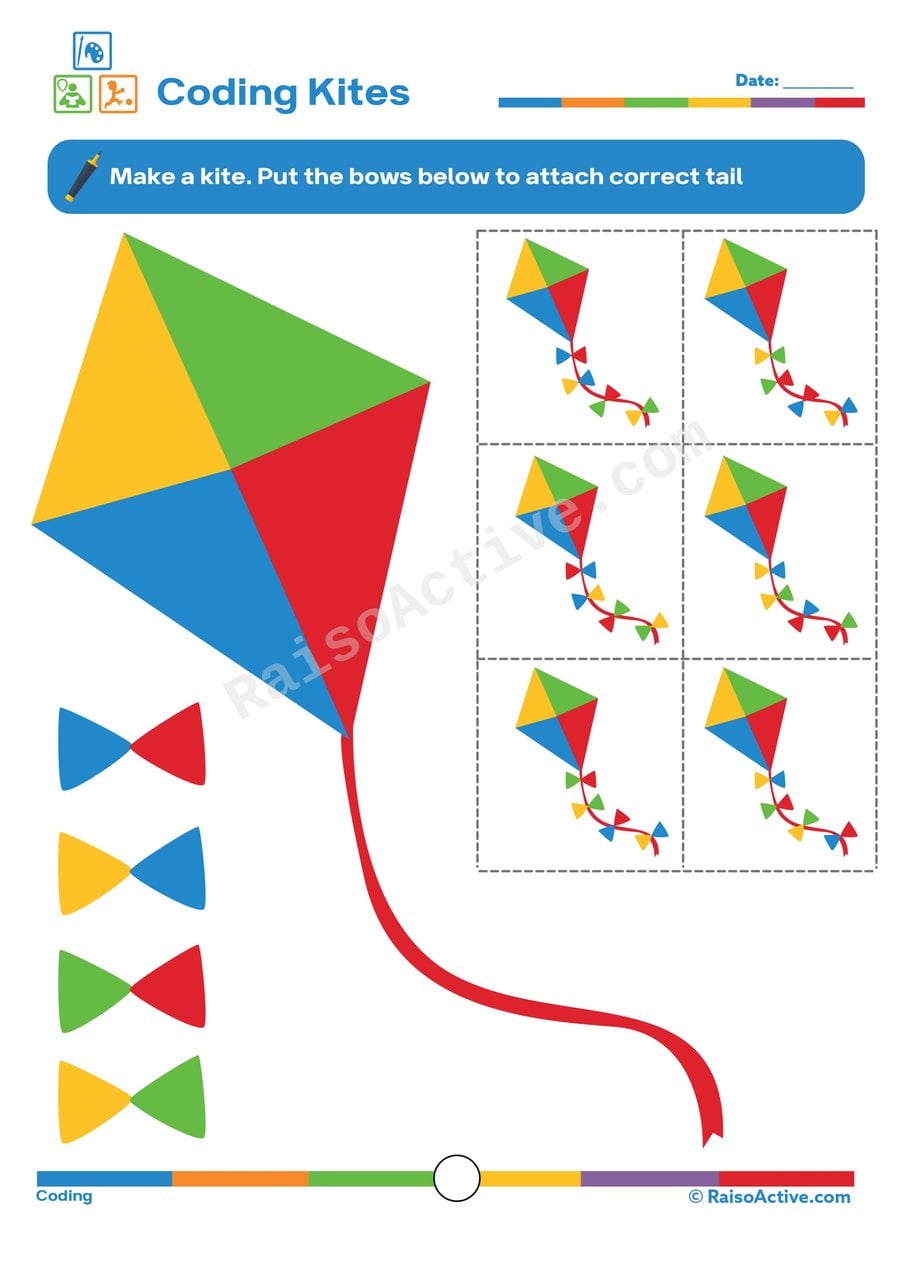
Coding Kites Worksheet: Match the Bows!
Ages 3-5 · Preschool–Pre-KAges 3-5 · Nursery–ReceptionAges 3-5 · Nursery–LKGAges 3-5
This activity sharpens visual observation in children ages 3-5 as they compare color sequences on each kite to a set of loose bows and find the exact match. Careful, systematic comparison — checking each color in order rather than glancing quickly — builds an attention-to-detail habit that transfers directly to early reading and number work.
Guides for this topic

Reviews
Every worksheet for ages 3–5, no watermark
Members download the full library of 1,000+ worksheets and every activity pack without watermarks or daily limits. One year costs ₹999 in India or $20 elsewhere.
See membership plansOr download any worksheet free with a watermark (5 a day).