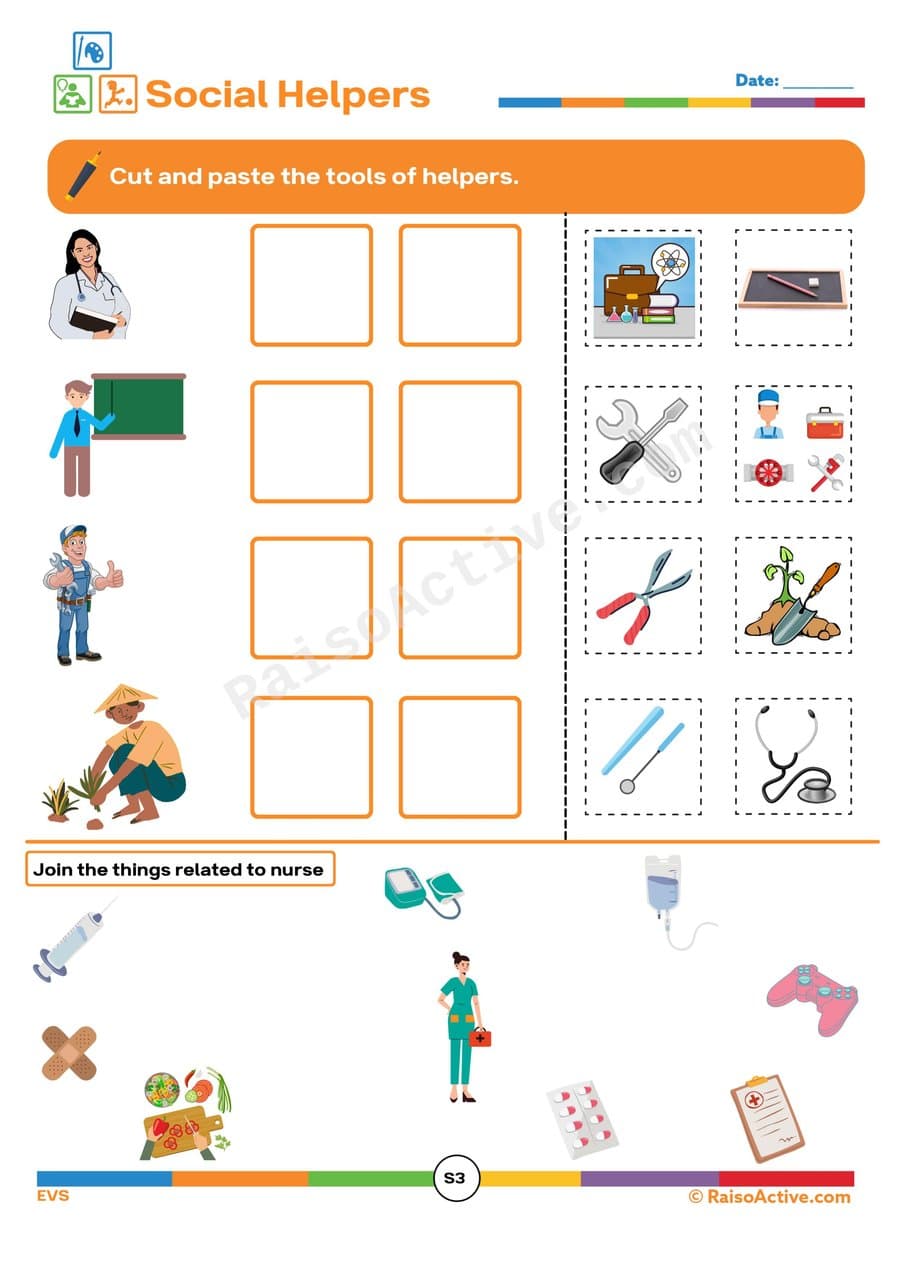
Social Helpers Tools Worksheet for Kids
This worksheet teaches children ages 3-5 to connect community helpers with the tools and equipment they use in their jobs, building early social studies knowledge alongside visual matching skills. Recognizing that a stethoscope belongs to a doctor or a hose belongs to a firefighter helps children understand how tools relate to specific roles and responsibilities in their community. The cut-and-paste and joining activities also reinforce fine motor control and visual discrimination as children sort similar-looking small pictures.
Curriculum
How to use this worksheet
Look at the community helpers pictured on the page together and talk about what job each one does. Have your child cut out the tool pictures at the bottom of the page, naming each tool as they go. Help them figure out which helper uses each tool and glue it into the matching box. Finally, have your child draw lines connecting the additional items related to the nurse, talking through why each one belongs with that helper.
Materials needed
- Scissors
- Glue
- Pencil or Marker
Extension activities
- •Talk about other community helpers not shown on the worksheet, like teachers, mail carriers, or bus drivers, and what tools they use.
- •Set up a simple pretend-play station at home with props representing one community helper's job.
- •Draw a picture of what your child wants to be when they grow up and the tools that job might need.
- •Take a walk or drive and point out any community helpers you see in action, like a mail carrier or construction worker.
- •Read a book about community helpers and discuss the tools mentioned in the story.
Tips for parents and teachers
If your child hasn't encountered a particular tool before, take a moment to explain what it's used for rather than moving past it quickly, since building this vocabulary is part of the point. Cutting small tool shapes can be fiddly, so offer help with tricky cuts to keep frustration low. Use this as a natural opening to talk about jobs in your own family or community that your child may recognize.

Written by
Hemsweta Jain · Teacher Cheena
MBA and Early Childhood Educator, teaching since 2014 · Founder of RaisoActive, Mumbai
Every RaisoActive worksheet is designed and checked by the founder before publishing.
Published · Last reviewed
Related worksheets
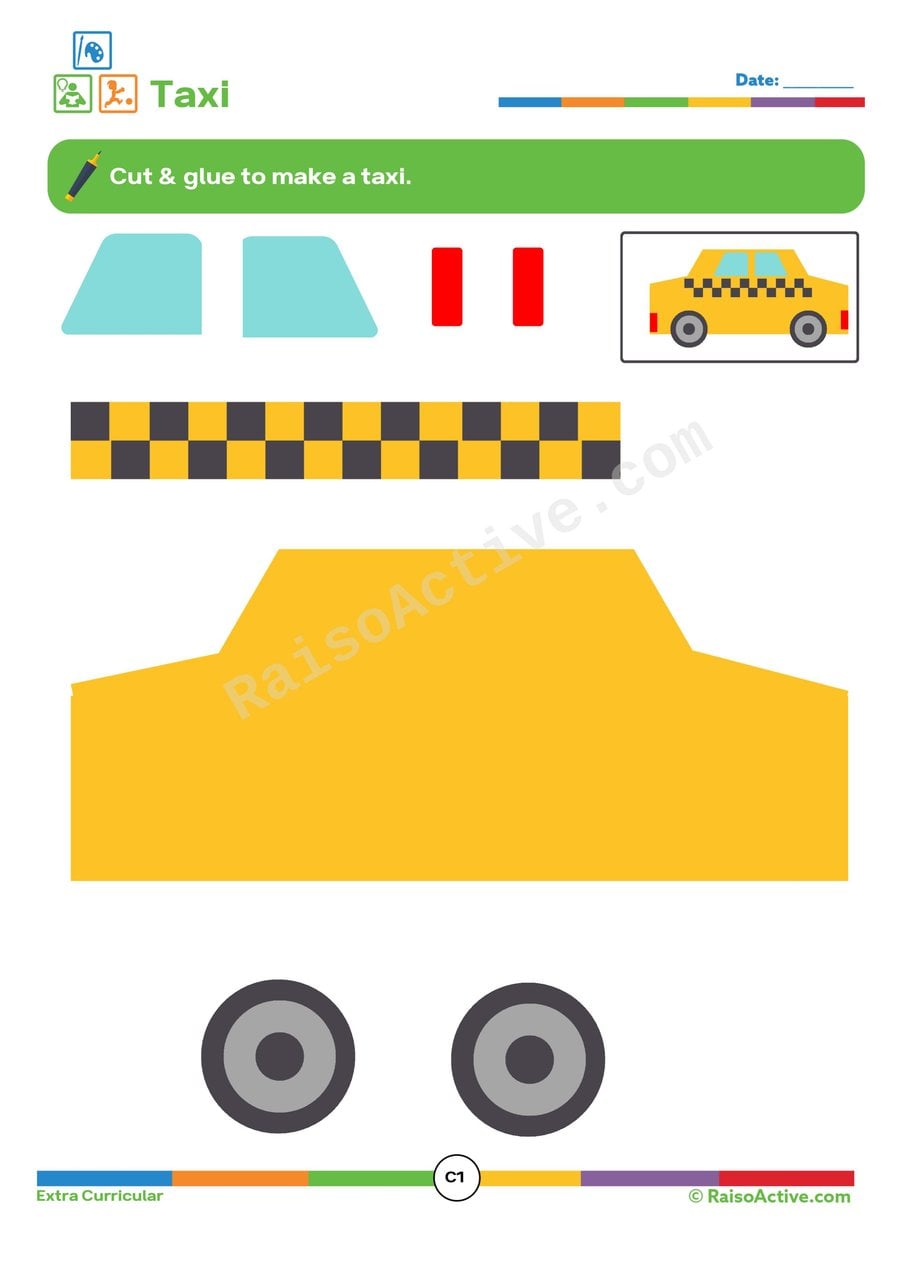
Taxi Cut and Paste Worksheet for Preschoolers
This craft-style worksheet gives children ages 3-5 focused practice with cutting along both straight and curved lines and assembling several separate pieces into one recognizable picture — a taxi. Building an image from multiple cut-out parts requires spatial planning, since children must figure out where each piece belongs relative to the others before gluing. The community-helper theme also introduces vocabulary around transportation and the people who drive it.

Community Helpers Cut and Paste Worksheet for Kids
This cut-and-paste worksheet helps children ages 3-5 connect community helpers, such as a firefighter or doctor, to the tools and equipment each one uses in their job. Handling scissors to cut out small pictures and precisely placing them in the correct box builds fine motor control and hand-eye coordination, while the matching task itself deepens understanding of community roles and how people help one another.

Role Play: Color, Cut, and Create Your Neighborhood!
This hands-on activity turns community-helper knowledge into a 3D building project: children color buildings and helper figures, cut them out along the dotted lines, and assemble a small neighborhood on cardboard. That construction step is what makes this different from a typical coloring page — folding tabs and sticking pieces upright requires spatial reasoning about how a flat cutout becomes a standing structure, on top of the fine motor demands of careful cutting. It also reinforces community-helper roles by having your child literally place each helper into the neighborhood they belong in.

Police Officer Worksheet: Learn About Community Helpers!
Beyond coloring practice, this worksheet builds early community-helper knowledge by asking children to identify which specific items — a badge, a hat, handcuffs, a whistle — actually belong to a police officer's job. Circling the correct items requires visual discrimination and recall of a real-world role, which is the beginning of understanding that different jobs come with different tools and responsibilities. Drawing the officer's face afterward adds a layer of personal expression to a lesson that's otherwise about categorization.
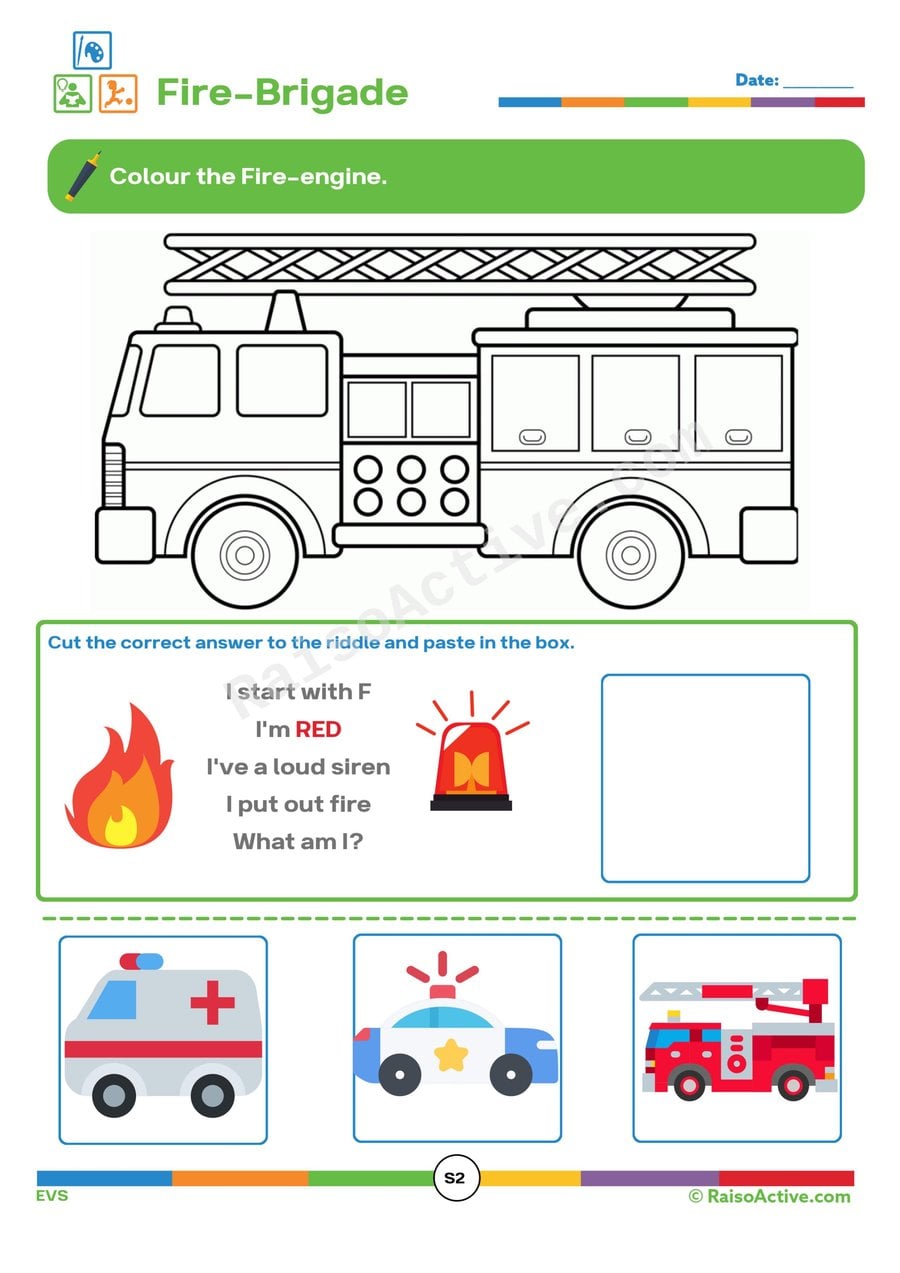
Fire Engine Fun: Color and Solve the Riddle!
This worksheet pairs creative coloring with a light dose of deductive reasoning — after coloring the fire engine, children have to solve a simple riddle and pick out the correct picture answer to paste in place. That riddle-solving step goes beyond coloring practice into comprehension and logical thinking, since your child has to listen to clues, consider a few possible answers, and choose the one that actually fits, all while learning about firefighters as community helpers.

Firefighter Fun: Circle the Equipment & Maze Worksheet
Circling firefighter equipment builds vocabulary and visual discrimination for children ages 3-5, since they must identify which pictured items — a hose, helmet, or ladder — actually belong to a firefighter's tools versus unrelated objects. Guiding the fire truck through a maze to reach the station afterward adds a hands-on problem-solving and fine motor challenge, requiring children to plan and trace a path with a pencil. Combining a community-helper theme with a maze keeps the page varied while introducing real vocabulary about an occupation many young children find exciting.

Community Helpers & Early Learning Activities Worksheet
This worksheet bundles several community-helper-themed activities, coloring, role-play, and object identification, to build vocabulary and social understanding around the different people who help in a community, like police officers or firefighters. For ages 3-5, learning about community helpers builds both social awareness and early classification skills as children learn to associate specific tools or uniforms with specific jobs.

Doctor Role Play Worksheet: Patient Emergency Form
Through pretend-play as a doctor filling out a patient form, children practice early functional writing and decision-making, selecting a 'patient,' identifying what hurts, and choosing a treatment. This kind of role play also builds empathy and emotional vocabulary around illness and care, helping ages 3-5 process what happens during real doctor visits in a low-stakes, imaginative context.
Guides for this topic
Best Worksheets for 3-Year-Olds: What Works and What to Avoid
What works on worksheets for 3-year-olds: short sessions, crayons, tracing lines, matching, cutting, a free weekly plan, and signs one is too advanced.
Age-Appropriate Problem-Solving Activities: Building Critical Thinkers from the Ground Up
Discover fun, age-appropriate problem-solving activities for children ages 1-8. Build critical thinking, logic, and reasoning skills through play-based learning.
Critical Thinking Activities That Actually Work for Young Children: Building Tomorrow's Thinkers Today
Discover proven critical thinking activities for young children. Age-wise logic games, questioning techniques, and hands-on ideas to build thinking skills at home.
Reviews
Every worksheet for ages 3–5, no watermark
Members download the full library of 1,000+ worksheets and every activity pack without watermarks or daily limits. One year costs ₹1,000 in India or $20 elsewhere.
See membership plansOr download any worksheet free with a watermark (5 a day).