Before and After Numbers Worksheet for Preschoolers
Knowing which number comes immediately before or after another is a core piece of number sense for children ages 4-6, building the mental number line they'll rely on for addition, subtraction, and later mental math. This worksheet ties that skill to counting sets of objects first, which grounds the abstract number sequence in something concrete and countable. Practicing both directions — before and after — also strengthens flexible thinking about number order rather than only counting forward by rote.

Part of the pack
Month 9: Holistic Preschool Play Learning | Ages Up to 4
This is page 19 of the pack. Ages 3-4 · PreschoolAges 3-4 · NurseryAges 3-4
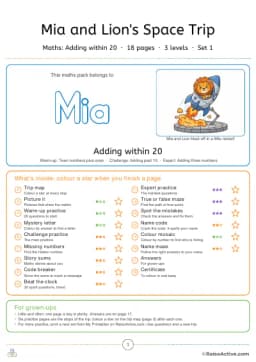
Made for your child
Counting to 10, made for your child
A maths pack with your child's name in it: pictures that explain, practice at three levels, puzzles and story sums about them. Print a new set whenever they finish.
Make a maths packFree preview · free for members
Curriculum
- Number Sense > Number Sequencing
How to use this worksheet
Have your child count the objects in the first set out loud, pointing to each one as they count. Ask them to figure out and write the number that comes just before that count in the box provided. Move to the next set of objects and repeat the process for the number that comes after. Once finished, review the page together and have your child count from the smallest number to the largest to check their answers.
Materials needed
- Pencil
- Crayons
Extension activities
- 1Create a number line on paper or with sidewalk chalk and have your child hop to the number before or after one you call out.
- 2Use small manipulatives like blocks or coins to build a counted set, then add or remove one to show before-and-after physically.
- 3Play a 'what comes next' game during daily routines, like counting stairs or steps.
- 4Write a row of numbers with gaps and challenge your child to fill in the missing ones.

Written by
Hemsweta Jain · Teacher Cheena
MBA and Early Childhood Educator, teaching since 2014 · Founder of RaisoActive, Mumbai
Every RaisoActive worksheet is designed and checked by the founder before publishing.
Published · Last reviewed
More from Month 9: Holistic Preschool Play Learning | Ages Up to 4

Parent's Guide: Sentence Framing and Early Literacy Activities
Ages 3-5 · Preschool–Pre-KAges 3-5 · Nursery–ReceptionAges 3-5 · Nursery–LKGAges 3-5
This parent's guide equips families of children ages 3-5 with a toolkit of hands-on activities — sentence framing, letter games, number and money recognition, and before/after sequencing with blocks — that build early literacy and numeracy together rather than in isolation. Framing simple sentences specifically helps children move from single words to connected speech, a critical bridge toward writing their own sentences later.

Count and Match! Number Recognition Worksheet for Preschoolers
Ages 3-5 · Preschool–Pre-KAges 3-5 · Nursery–ReceptionAges 3-5 · Nursery–LKGAges 3-5
This worksheet has preschoolers ages 3-5 practice one-to-one correspondence — touching or pointing to each object exactly once while counting — before writing the total and matching it to the correct numeral in a circle. Counting accurately requires more coordination than it looks like at this age, since children must track which objects they've already counted while saying numbers in the right order. Adding the final matching step reinforces that a written numeral represents a specific, countable quantity rather than just a symbol to memorize.

Color the Balloons with the Dolphin! A Fun Coloring Worksheet
Ages 3-5 · Preschool–Pre-KAges 3-5 · Nursery–ReceptionAges 3-5 · Nursery–LKGAges 3-5
This coloring worksheet helps children ages 3-5 practice color recognition and following visual instructions by matching colored dots on the balloons and dolphin to the correct crayon color. Reading a color-coded key and applying it accurately builds attention to detail and the ability to follow a multi-step visual instruction, a skill that transfers to many other early learning tasks. Coloring within the balloon and dolphin shapes also strengthens the hand control needed for later writing.

Match the Letters: Fun Vocabulary Worksheet for Preschoolers!
Ages 3-5 · Preschool–Pre-KAges 3-5 · Nursery–ReceptionAges 3-5 · Nursery–LKGAges 3-5
This worksheet helps children ages 3-5 connect familiar vocabulary pictures to their correct starting letters, reinforcing both letter recognition and the idea that written letters represent spoken sounds. Building vocabulary alongside letter knowledge gives children two ways into literacy at once — through meaning and through print — which supports children with different learning strengths.

Physical Activity Worksheet for Kids: Identify and Tick!
Ages 4-6 · Pre-K–KindergartenAges 4-6 · Reception–Year 1Ages 4-6 · LKG–UKGAges 4-6
This identify-and-tick worksheet asks children ages 4-6 to sort a row of pictures into 'physical activity' and 'everyday chore' categories, building the classification skills that underlie early scientific thinking. Ticking the correct boxes also reinforces visual discrimination, since children must notice differences in body position and action between, say, jumping and sweeping. At this age, connecting movement with fun helps children start to associate exercise with enjoyment rather than obligation.
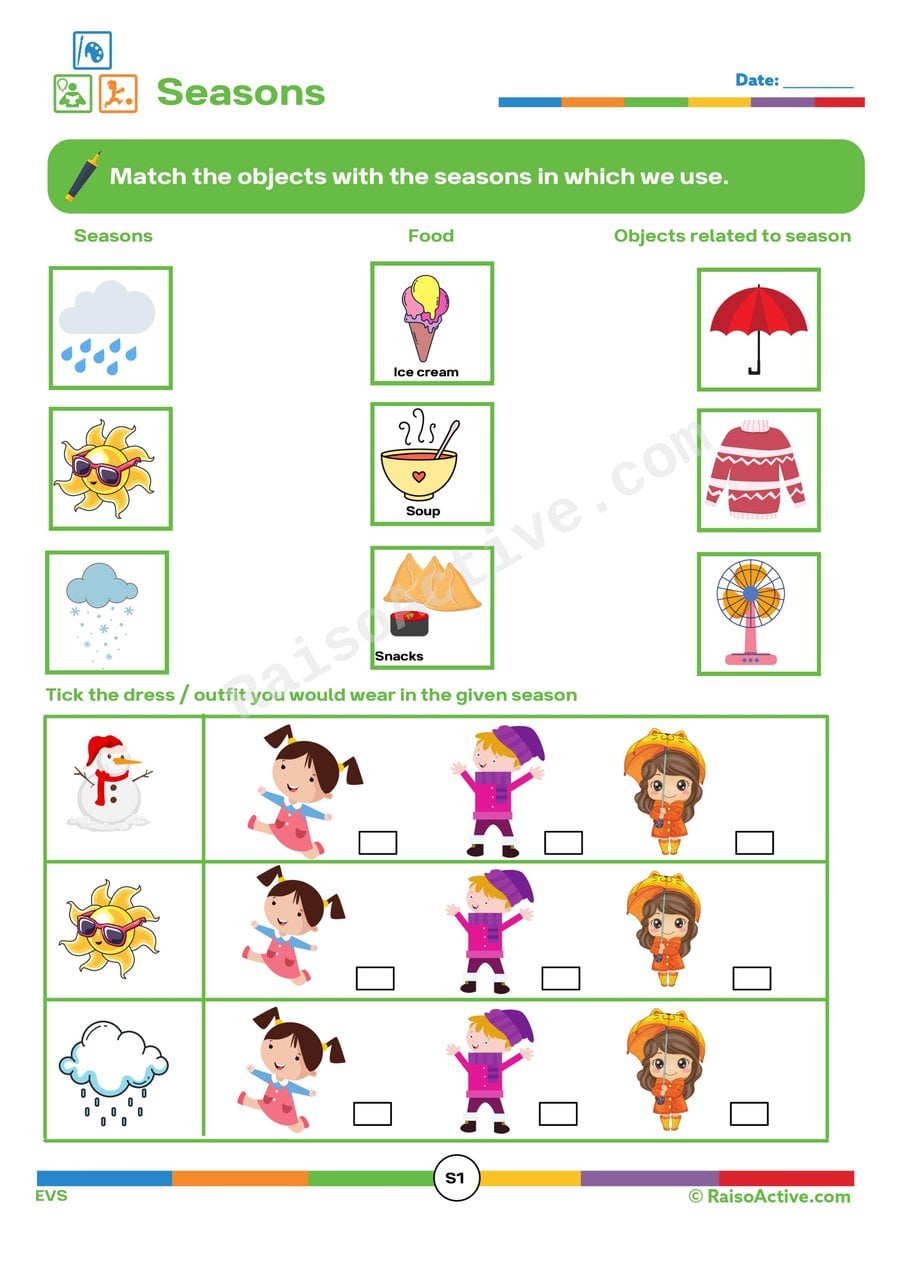
Seasons Matching Worksheet for Preschoolers
Ages 3-5 · Preschool–Pre-KAges 3-5 · Nursery–ReceptionAges 3-5 · Nursery–LKGAges 3-5
Understanding that different seasons bring different weather, clothing, and activities is an early science and life-skills concept for children ages 3-5, and this worksheet builds that understanding by having them match objects to the correct season and consider what they'd wear in each. Making these connections requires observation and categorization skills, since a child has to recall or reason through why a snowman belongs with winter or shorts belong with summer rather than simply memorizing a fixed answer. This kind of seasonal reasoning also lays groundwork for later science topics like weather patterns and the calendar year.
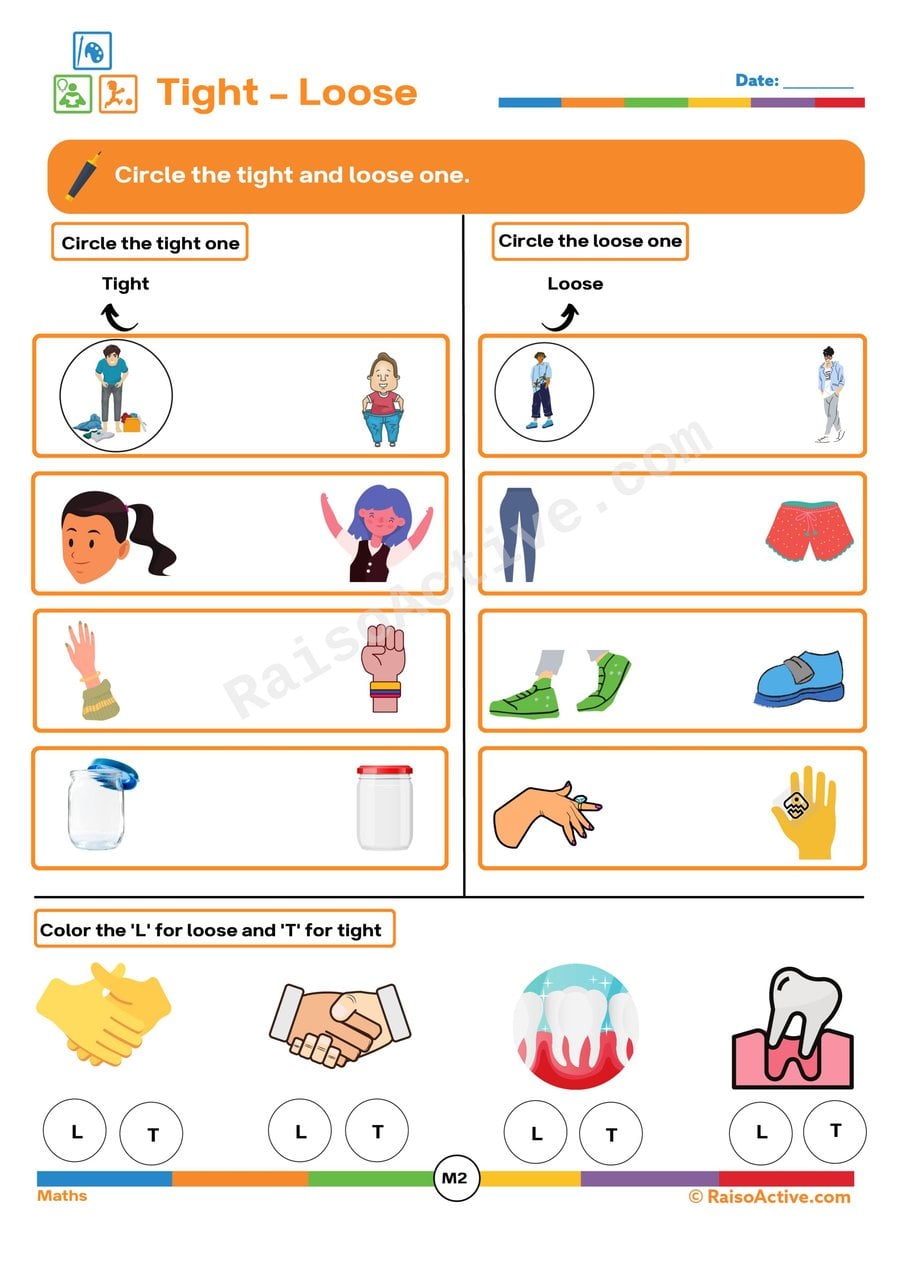
Tight and Loose Worksheet: Circle and Color!
Ages 3-5 · Preschool–Pre-KAges 3-5 · Nursery–ReceptionAges 3-5 · Nursery–LKGAges 3-5
Understanding opposite pairs like 'tight' and 'loose' helps children ages 3-5 build descriptive vocabulary and comparative thinking, skills that support both language development and early reasoning about physical properties. This worksheet asks children to look closely at pictured items — like shoelaces, screws, or clothing — and judge which state each one is in, which sharpens observation skills alongside vocabulary. Learning opposites like this also lays groundwork for later concepts such as measurement and comparison in math.

Colorful Seasons: Dot-to-Dot Tree Leaves Worksheet for Kids
Ages 3-5 · Preschool–Pre-KAges 3-5 · Nursery–ReceptionAges 3-5 · Nursery–LKGAges 3-5
This worksheet introduces children ages 3-5 to the four seasons through a hands-on painting activity, using cotton buds to dab colorful 'leaves' onto tree outlines and matching each tree's colors to the correct season. Connecting a season to its visual cues, like green leaves for spring or bare branches for winter, builds early science vocabulary and observation skills. The dabbing motion with cotton buds also strengthens the pincer grip children need for holding pencils and other tools later on.
Related worksheets

Missing Numbers Worksheet: Before, Between, and After
Ages 4-6 · Pre-K–KindergartenAges 4-6 · Reception–Year 1Ages 4-6 · LKG–UKGAges 4-6
This worksheet asks children ages 4-6 to fill in missing numbers that come before, between, or after given numbers in a sequence, building a deeper understanding of number order than simple counting alone. Recognizing what number is missing from a sequence requires children to mentally hold the number line and reason about relative position, a skill that supports later addition and subtraction.
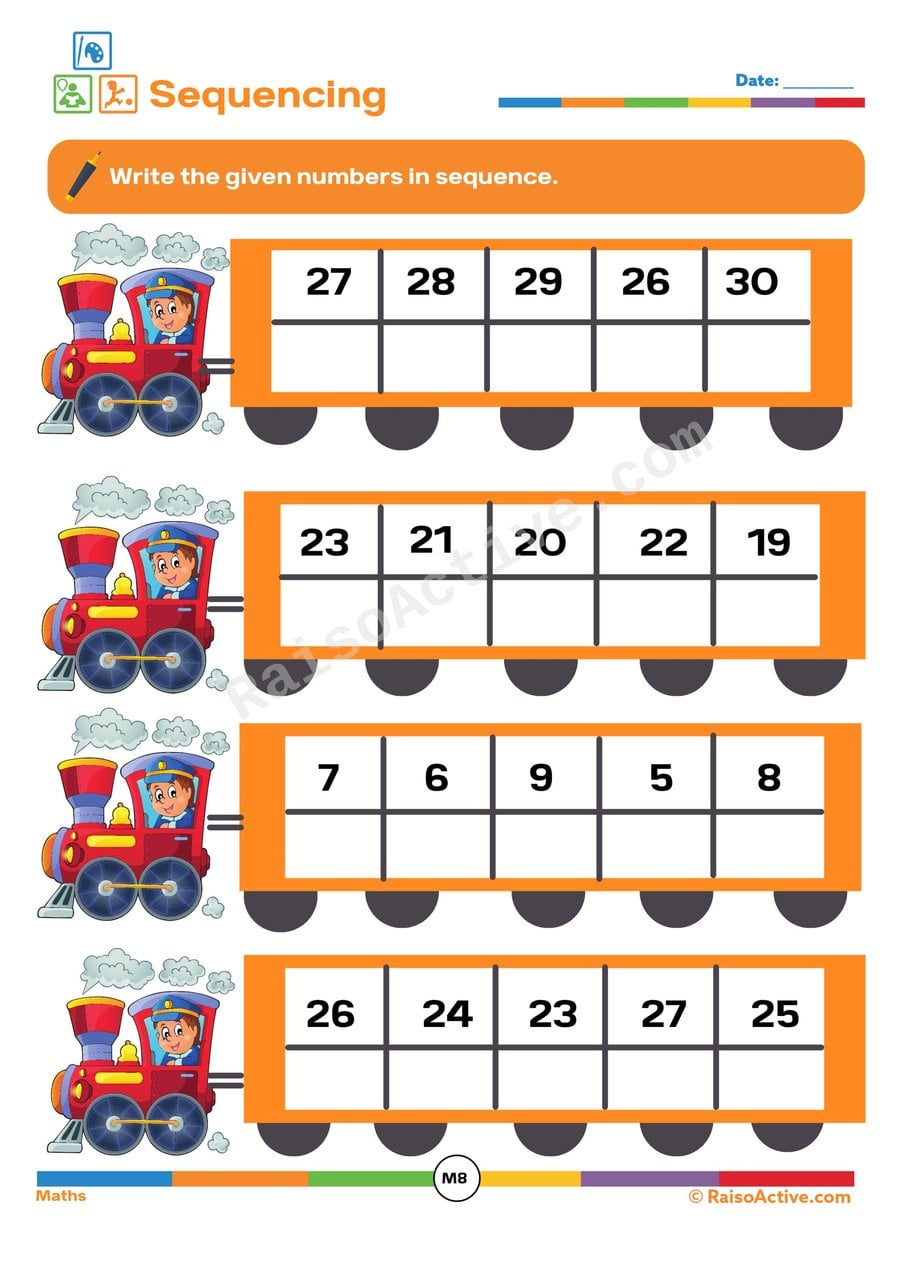
Number Sequencing Train Worksheet for Kids
Ages 4-6 · Pre-K–KindergartenAges 4-6 · Reception–Year 1Ages 4-6 · LKG–UKGAges 4-6
This train-themed sequencing worksheet challenges children ages 4-6 to fill in missing numbers scattered throughout a sequence, requiring them to recognize number order well enough to identify a gap anywhere in the run rather than only counting forward from the start. This deeper sequencing skill supports later math concepts like skip counting, addition, and number lines. Writing the missing numbers by hand, rather than just saying them aloud, also reinforces number formation alongside number order.

Recite Numbers Worksheet: Connect the Dots and Practice Number Sequencing!
Ages 3-5 · Preschool–Pre-KAges 3-5 · Nursery–ReceptionAges 3-5 · Nursery–LKGAges 3-5
Children ages 3-5 practice number sequencing and recitation as they connect numbered dots in order to reveal a hidden picture, reinforcing both number recognition and the ability to count forward smoothly without skipping. Saying each number aloud while connecting it also builds the verbal counting fluency children need before they can count objects accurately.
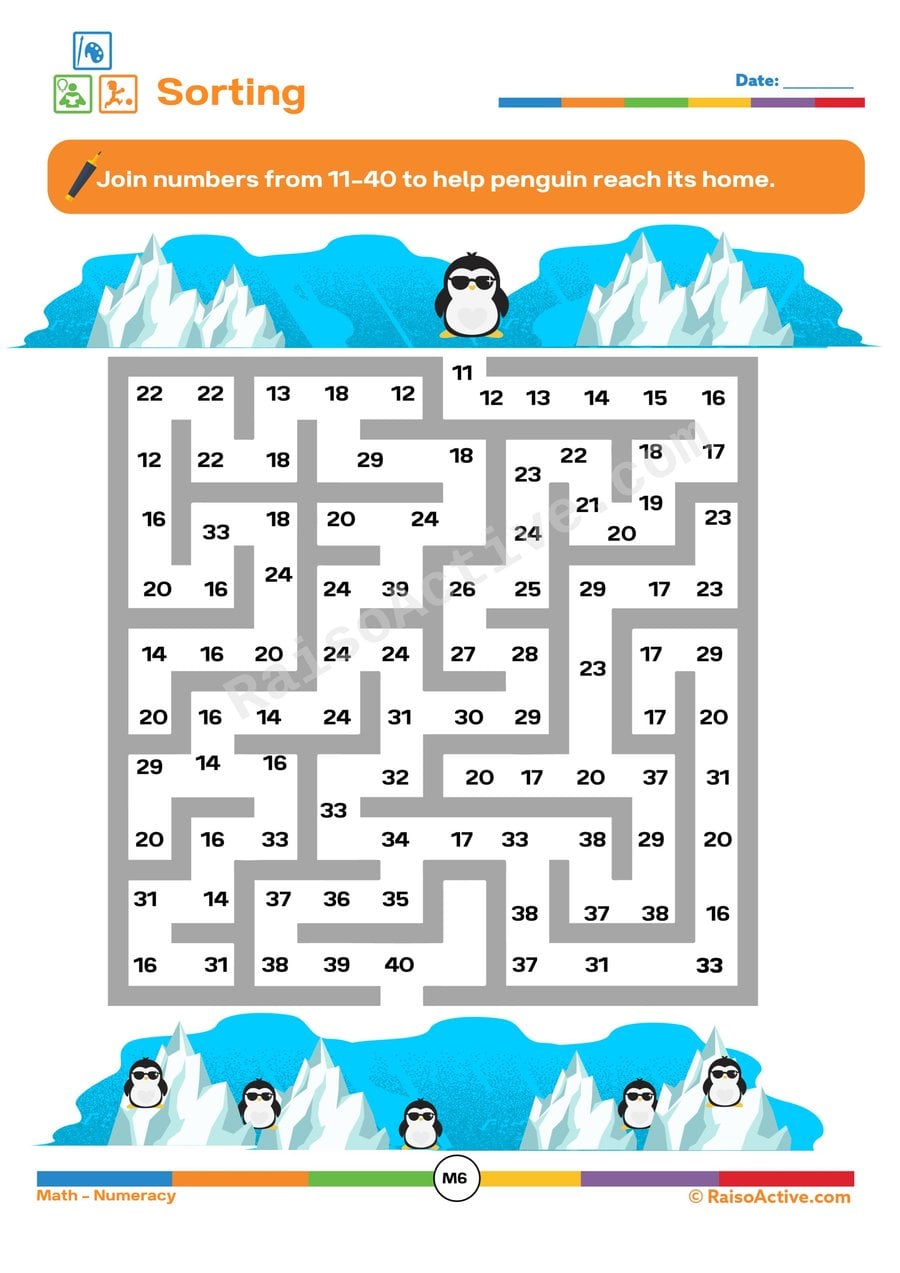
Penguin's Path: A Fun Sorting Worksheet for Kids!
Ages 4-6 · Pre-K–KindergartenAges 4-6 · Reception–Year 1Ages 4-6 · LKG–UKGAges 4-6
This maze worksheet has 4-6 year olds trace a path through numbers 11 to 40, building both number sequencing across a wider range and the fine motor control needed to draw a connected line dot to dot. Because the range spans several decades, your child gets real practice with the trickiest part of early counting — the transitions between decades (19 to 20, 29 to 30) — while the penguin's journey gives the task a clear, motivating goal.

Descending Order Balloons Worksheet for Preschoolers
Ages 4-6 · Pre-K–KindergartenAges 4-6 · Reception–Year 1Ages 4-6 · LKG–UKGAges 4-6
This worksheet asks children ages 4-6 to arrange the numbers on a row of balloons from largest to smallest, practicing descending order as a companion skill to the more commonly taught ascending order. Comparing several numbers at once and deciding their relative size builds a flexible sense of number magnitude that supports later skills like rounding and estimation.
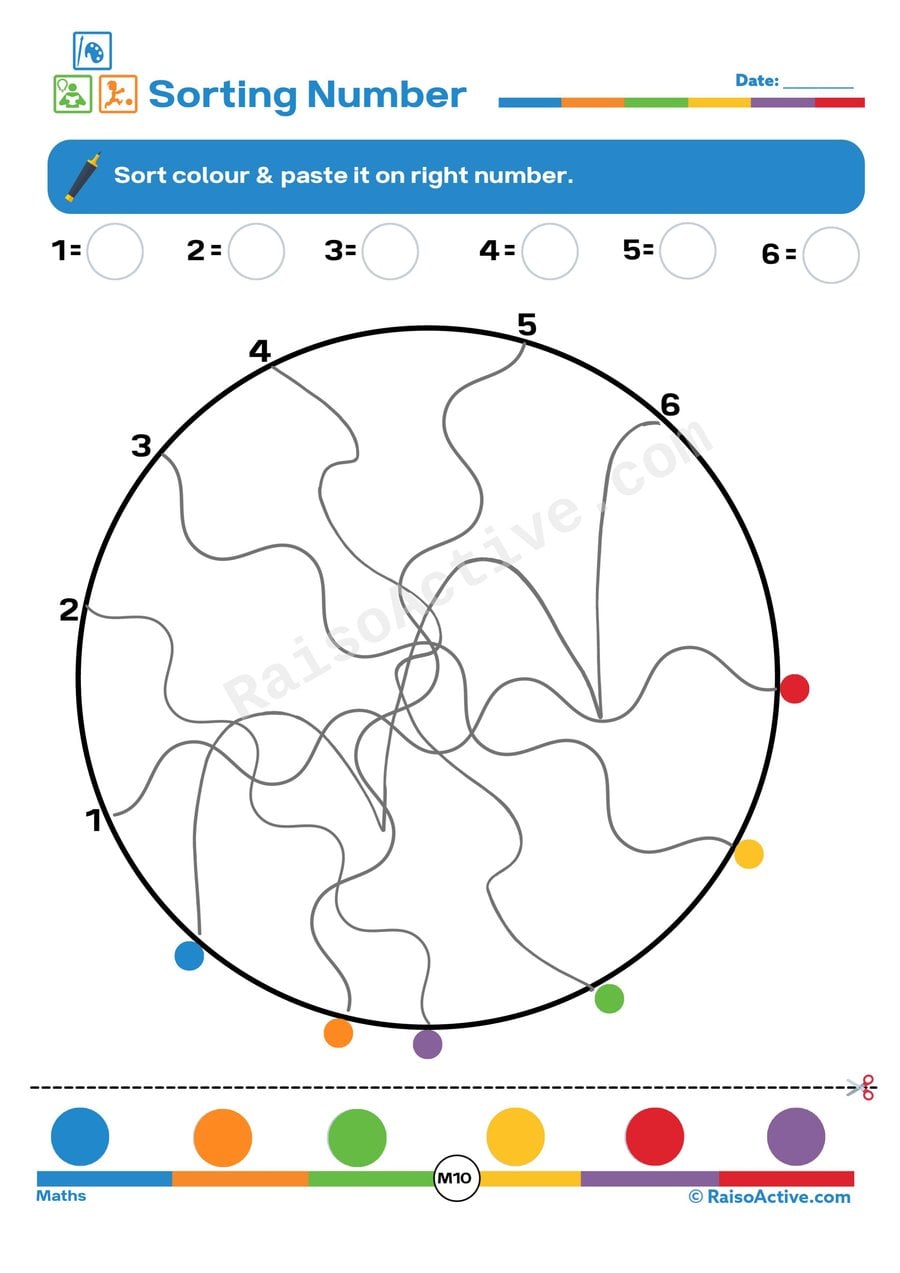
Sorting Numbers Worksheet: Color and Paste!
Ages 3-5 · Preschool–Pre-KAges 3-5 · Nursery–ReceptionAges 3-5 · Nursery–LKGAges 3-5
Children ages 3-5 practice matching quantities to written numerals by counting sets of colored dots and pasting them next to the correct number, reinforcing both counting accuracy and number recognition in a hands-on cut-and-paste format. Sorting by matching color groups to numbers also builds early visual categorization skills.

Egg Sorting Worksheet: Count and Order the Chicks!
Ages 3-5 · Preschool–Pre-KAges 3-5 · Nursery–ReceptionAges 3-5 · Nursery–LKGAges 3-5
Cutting out and arranging numbered eggs in order builds number sequencing skills for children ages 3-5, requiring them to compare several numbers at once and place them correctly rather than just recognizing a single number in isolation. This hands-on ordering task also reinforces counting fluency, since children benefit from counting aloud as they check their arrangement.

Beehive Number Fun: Missing Numbers 0-30 Worksheet
Ages 4-6 · Pre-K–KindergartenAges 4-6 · Reception–Year 1Ages 4-6 · LKG–UKGAges 4-6
Filling in missing numbers along a beehive path gives 4-6 year olds practice with the full 0-30 number sequence, a meaningful stretch beyond the more common 1-10 or 1-20 ranges seen in earlier counting worksheets. Because the missing numbers are scattered rather than all at the end, your child has to actually understand what number comes next at multiple points in the sequence, rather than simply continuing a count from a known starting point.
Guides for this topic

Number Formation Rhymes 0–9 and How to Fix Reversals
Original number formation rhymes for 0–9, the correct stroke order for each digit, why 3, 5 and 7 get reversed most often, and multisensory fixes that work.

Christmas and Winter Activities That Combine Fun and Learning: Creating Magical Educational Experiences
Discover Christmas and winter activities that combine festive fun with real learning. Crafts, counting, literacy, and printable worksheets for ages 2 to 8 — perfect for home and school.
Age-Appropriate Halloween Learning Activities: Balancing Spooks and Skills for Young Learners
Discover fun, age-appropriate Halloween learning activities for young children. Spooky crafts, counting games, literacy ideas, and printable worksheets for ages 2 to 8.
Reviews
Every worksheet for ages 4–6, no watermark
Members download the full library of 1,000+ worksheets and every activity pack without watermarks or daily limits. One year costs ₹999 in India or $20 elsewhere.
See membership plansOr download any worksheet free with a watermark (5 a day).