Tight and Loose Worksheet: Circle and Color!
Understanding opposite pairs like 'tight' and 'loose' helps children ages 3-5 build descriptive vocabulary and comparative thinking, skills that support both language development and early reasoning about physical properties. This worksheet asks children to look closely at pictured items — like shoelaces, screws, or clothing — and judge which state each one is in, which sharpens observation skills alongside vocabulary. Learning opposites like this also lays groundwork for later concepts such as measurement and comparison in math.

Part of the pack
Month 9: Holistic Preschool Play Learning | Ages Up to 4
This is page 10 of the pack. Ages 3-4 · PreschoolAges 3-4 · NurseryAges 3-4
Made for your child
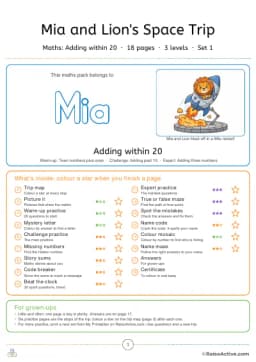
Counting to 10, made for your child
A maths pack with your child's name in it: pictures that explain, practice at three levels, puzzles and story sums about them. Print a new set whenever they finish.
Make a maths packFree preview · free for members
Curriculum
- Vocabulary > Opposites
How to use this worksheet
Look at each picture together and talk about what you notice, asking questions like 'does this look tight or loose?' Have your child circle the items that show something tight and the items that show something loose in their respective sections. Once circling is done, ask them to color the letter 'L' if the item is loose or the letter 'T' if the item is tight. Review the page together afterward, asking your child to explain a couple of their choices out loud.
Materials needed
- Pencil
- Crayons
Extension activities
- 1Find real examples of tight and loose around the house, like a tightly screwed jar lid versus a loose button.
- 2Act out the words tight and loose with your body — squeeze your fists tight, then let your arms hang loose.
- 3Compare two pieces of clothing, one snug and one baggy, and talk about which is tight and which is loose.
- 4Practice tying shoelaces tightly and loosely and discuss the difference in how they hold.

Written by
Hemsweta Jain · Teacher Cheena
MBA and Early Childhood Educator, teaching since 2014 · Founder of RaisoActive, Mumbai
Every RaisoActive worksheet is designed and checked by the founder before publishing.
Published · Last reviewed
More from Month 9: Holistic Preschool Play Learning | Ages Up to 4

Community Helpers Cut and Paste Worksheet for Preschoolers
Ages 3-5 · Preschool–Pre-KAges 3-5 · Nursery–ReceptionAges 3-5 · Nursery–LKGAges 3-5
This cut-and-paste worksheet focuses specifically on firefighters for children ages 3-5, teaching them to recognize firefighting equipment like a hose, helmet, or ladder and connect each item to a firefighter's job. Learning about a single community helper in depth, rather than several at once, lets young children build a richer, more detailed understanding of what that job actually involves. The cutting, gluing, and circling tasks also build the fine motor coordination needed for more complex craft and writing activities later.

Alphabet Cut and Paste Worksheet: Matching Letters and Objects
Ages 3-5 · Preschool–Pre-KAges 3-5 · Nursery–ReceptionAges 3-5 · Nursery–LKGAges 3-5
This cut-and-paste worksheet helps children ages 3-5 practice letter recognition by matching pictures to their correct beginning letter and gluing them into place, combining early phonics with fine motor skill development. Handling scissors and glue at this age builds the hand strength and precision needed for later handwriting, while the matching task reinforces that each letter represents a specific sound. Doing both together makes this a genuinely multi-skill activity rather than a single-purpose worksheet.
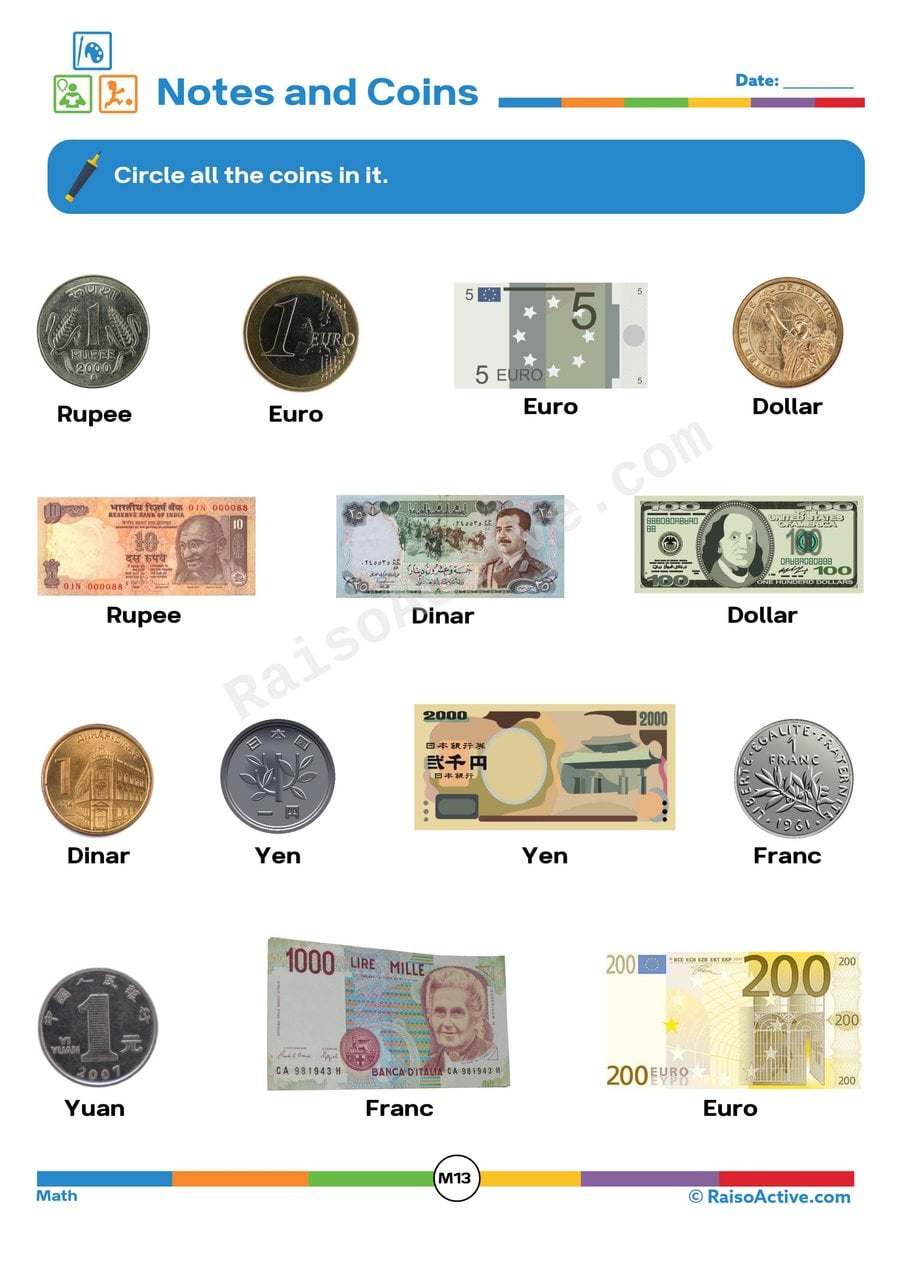
Coin Spotting Fun: Circle the Coins!
Ages 3-5 · Preschool–Pre-KAges 3-5 · Nursery–ReceptionAges 3-5 · Nursery–LKGAges 3-5
This worksheet asks children ages 3-5 to scan a page of mixed images and circle every coin they can find, building early visual discrimination and introducing the concept of money as a distinct category of object. Learning to recognize coins by their round shape and shiny appearance lays early groundwork for later skills like counting money and understanding value.

Color the Balloons with the Dolphin! A Fun Coloring Worksheet
Ages 3-5 · Preschool–Pre-KAges 3-5 · Nursery–ReceptionAges 3-5 · Nursery–LKGAges 3-5
This coloring worksheet helps children ages 3-5 practice color recognition and following visual instructions by matching colored dots on the balloons and dolphin to the correct crayon color. Reading a color-coded key and applying it accurately builds attention to detail and the ability to follow a multi-step visual instruction, a skill that transfers to many other early learning tasks. Coloring within the balloon and dolphin shapes also strengthens the hand control needed for later writing.

Physical Activity Worksheet for Kids: Identify and Tick!
Ages 4-6 · Pre-K–KindergartenAges 4-6 · Reception–Year 1Ages 4-6 · LKG–UKGAges 4-6
This identify-and-tick worksheet asks children ages 4-6 to sort a row of pictures into 'physical activity' and 'everyday chore' categories, building the classification skills that underlie early scientific thinking. Ticking the correct boxes also reinforces visual discrimination, since children must notice differences in body position and action between, say, jumping and sweeping. At this age, connecting movement with fun helps children start to associate exercise with enjoyment rather than obligation.

Letter Recognition Worksheet: Fill in the Beginning Letter!
Ages 3-5 · Preschool–Pre-KAges 3-5 · Nursery–ReceptionAges 3-5 · Nursery–LKGAges 3-5
This worksheet gives children ages 3-5 practice identifying the beginning sound of pictured words, writing the missing letter to complete each one, and then specifically finding words that start with the letter 'W'. Focusing on one target letter in the second half of the worksheet adds a layer of selective attention, asking children to recognize a specific letter among several options rather than just filling in blanks.

Earlier and Later: Flower Bloom Sequencing Worksheet for Preschoolers
Ages 3-5 · Preschool–Pre-KAges 3-5 · Nursery–ReceptionAges 3-5 · Nursery–LKGAges 3-5
Sequencing events in order is an early scientific and narrative reasoning skill, and this worksheet uses the life cycle of a flower to give children ages 3-5 concrete practice with the concepts of 'earlier' and 'later.' By matching earlier-stage images to their later-stage counterparts, children start to understand cause and change over time, a concept that underlies both storytelling and basic science observation. Drawing the next stage of the flower's bloom afterward adds a predictive element, asking children to apply the pattern they've just observed.

Transport Worksheet: Circle and Count the Transport Items!
Ages 3-5 · Preschool–Pre-KAges 3-5 · Nursery–ReceptionAges 3-5 · Nursery–LKGAges 3-5
This worksheet combines two skills for children ages 3-5: visually identifying which pictures represent transportation versus other objects, and then counting a separate group of transport items and recording the total as a number. Circling only the correct category first requires categorization and attention to detail, while the counting section that follows builds one-to-one correspondence with a real-world, kid-friendly theme that most children find naturally engaging. Vehicles are also a great vocabulary-building topic, since children often already know many transport names from daily life.
Related worksheets

Full and Empty Worksheet: Matching Activity for Preschoolers
Ages 3-5 · Preschool–Pre-KAges 3-5 · Nursery–ReceptionAges 3-5 · Nursery–LKGAges 3-5
This matching worksheet has children ages 3-5 draw lines connecting pictures to the labels 'Full' or 'Empty,' building comparative vocabulary around volume and quantity that goes beyond counting into descriptive reasoning about how much of something is present. Understanding full and empty as opposites is an early step toward later concepts like more, less, and measurement.

Thick and Thin Sorting Worksheet for Preschoolers
Ages 3-5 · Preschool–Pre-KAges 3-5 · Nursery–ReceptionAges 3-5 · Nursery–LKGAges 3-5
This sorting worksheet asks children ages 3-5 to classify pictured objects as either thick or thin, building an early comparative vocabulary skill that goes beyond simple size words like big and small into more specific, descriptive language. Learning to compare and sort by a specific physical property is an important step toward the broader skill of classification used throughout early math and science.
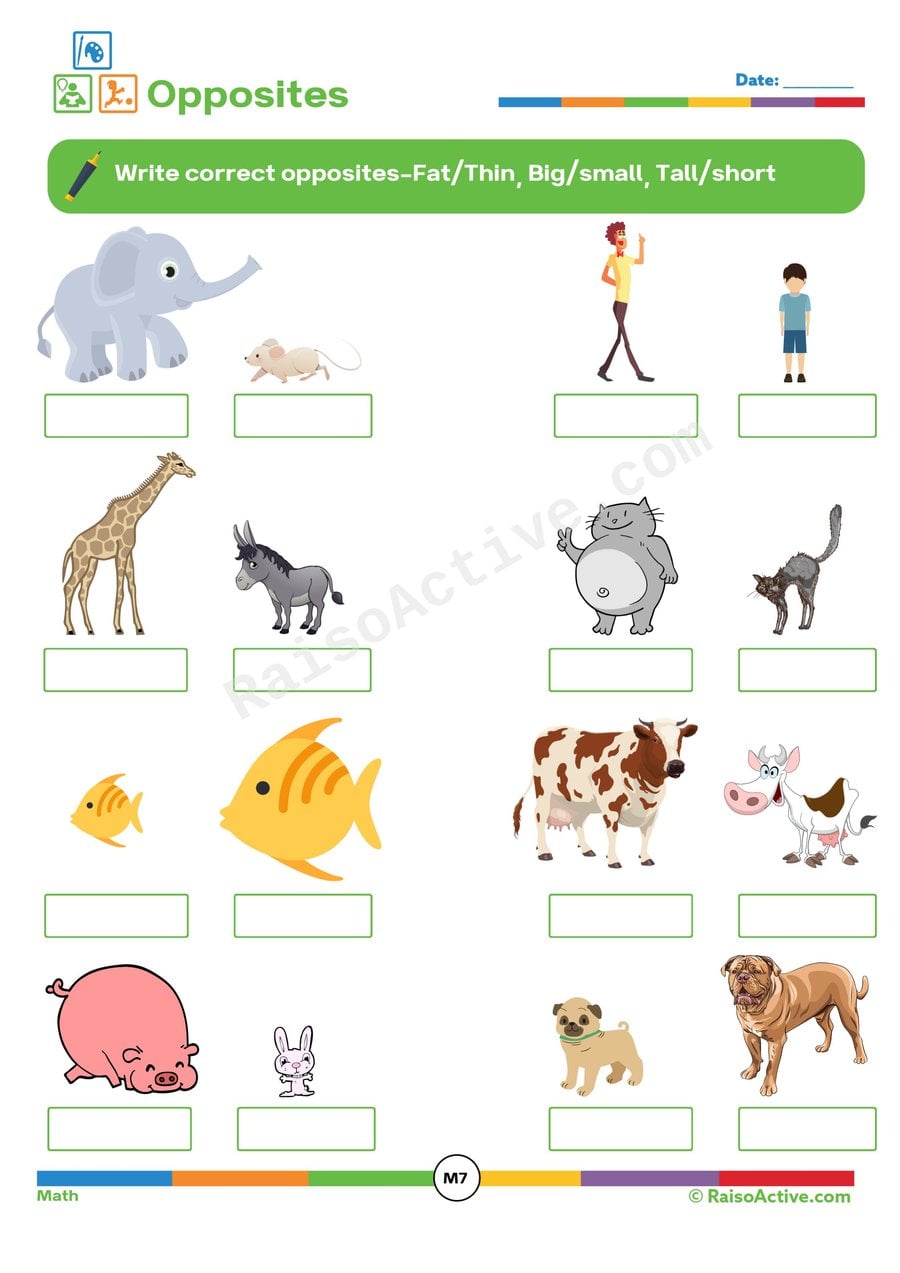
Opposites Worksheet: Fat/Thin, Big/Small, Tall/Short
Ages 3-5 · Preschool–Pre-KAges 3-5 · Nursery–ReceptionAges 3-5 · Nursery–LKGAges 3-5
Identifying opposite pairs like fat and thin, big and small, and tall and short teaches children ages 3-5 to think comparatively, recognizing that these descriptive words only make sense in relation to something else. This early vocabulary work also builds the reasoning skills needed to compare and contrast, a thinking pattern that shows up across science, math, and language throughout their schooling.
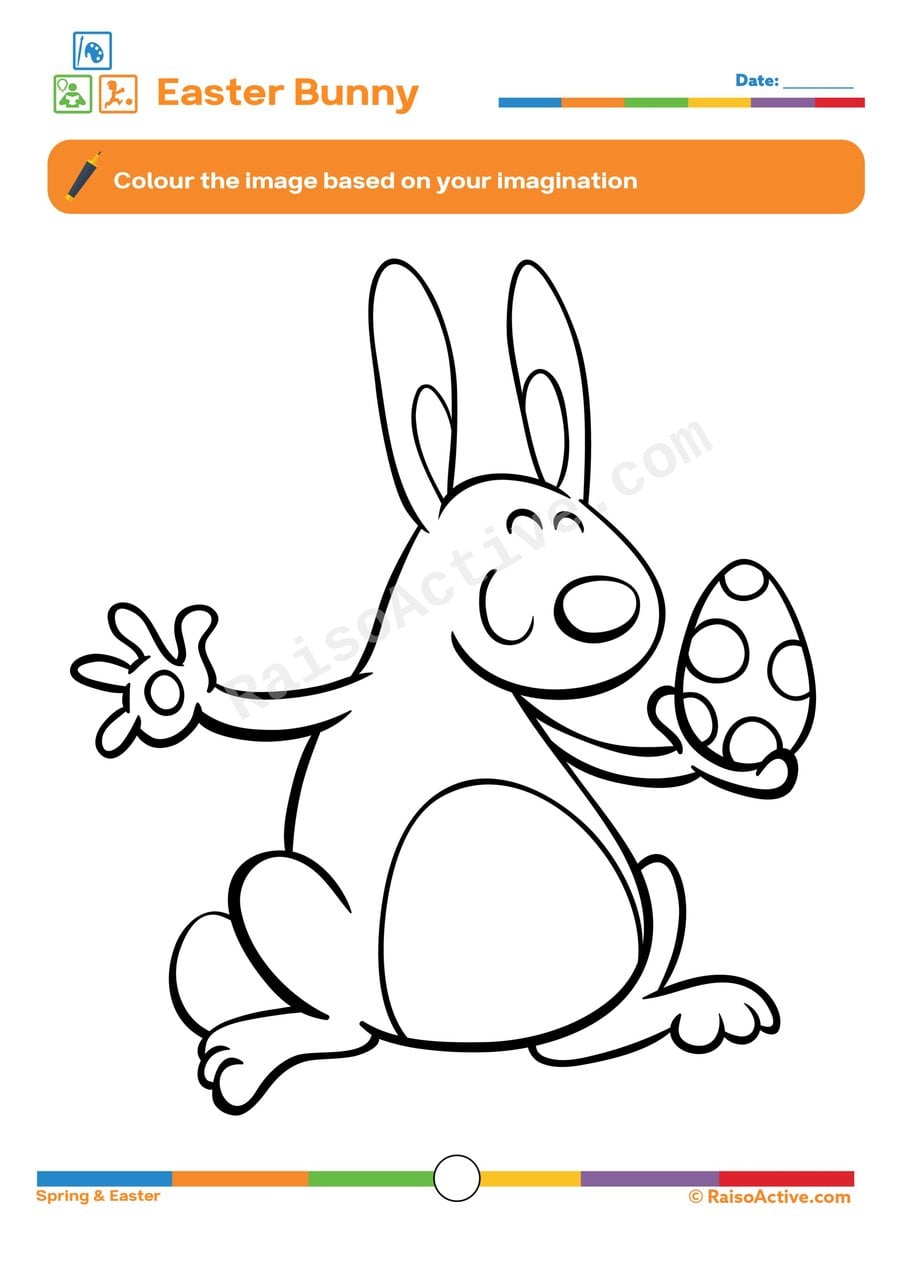
Easter Bunny Coloring Worksheet for Kids
Ages 3-5 · Preschool–Pre-KAges 3-5 · Nursery–ReceptionAges 3-5 · Nursery–LKGAges 3-5
Children ages 3-5 build fine motor control and creative expression while coloring an Easter bunny and egg using crayons or colored pencils. Open-ended coloring tasks like this one, without a strict color code, give children room to make independent choices while still practicing the pencil grip and control needed for later writing.
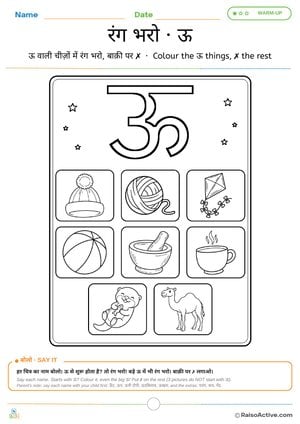
Colour the ऊ Things: Hindi Letter ऊ Colouring Page | रंग भरो · ऊ
Ages 3-7 · Preschool–Grade 1Ages 3-7 · Nursery–Year 2Ages 3-7 · Nursery–Class 1Ages 3-7
Children listen for the first sound of each picture name and decide whether it starts with ऊ. They colour the ऊ pictures, cross out the others and colour the big letter.

Balloon Pattern Matching Worksheet for Preschoolers
Ages 3-5 · Preschool–Pre-KAges 3-5 · Nursery–ReceptionAges 3-5 · Nursery–LKGAges 3-5
Children ages 3-5 build early pattern-recognition skills on this worksheet by studying a sequence of colored balloons and finding the matching set to complete it. Recognizing and continuing a repeating sequence is a foundational pre-math skill that later supports understanding of number patterns, skip counting, and simple algebraic thinking.
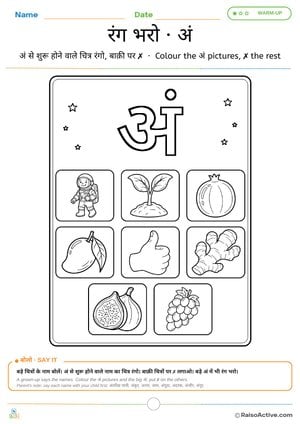
Colour the अं Words – Hindi Letter अं (am) Colouring Worksheet | अं वाली चीज़ों में रंग भरो
Ages 3-7 · Preschool–Grade 1Ages 3-7 · Nursery–Year 2Ages 3-7 · Nursery–Class 1Ages 3-7
Children say each picture name aloud, decide whether it starts with अं, colour the matching pictures (अंकुर, अंतरिक्ष यात्री, अंजीर, अंगूठा and अंगूर) and the big outline letter, and put a cross on the rest. Sorting by first sound trains the ear and colouring builds hand control.

Christmas Matching Worksheet for Preschoolers: Find the Identical Objects!
Ages 3-5 · Preschool–Pre-KAges 3-5 · Nursery–ReceptionAges 3-5 · Nursery–LKGAges 3-5
Comparing objects in a row to find the one that exactly matches the first picture builds visual discrimination in children ages 3-5, a skill that requires noticing small differences in shape, color, and detail. This kind of close looking is a direct precursor to letter recognition, since young readers must later tell apart similarly shaped letters like b and d using the same careful visual comparison. The Christmas theme keeps the repetitive matching task feeling festive rather than tedious.
Guides for this topic

Best Worksheets for 3-Year-Olds: What Works and What to Avoid
What works on worksheets for 3-year-olds: short sessions, crayons, tracing lines, matching, cutting, a free weekly plan, and signs one is too advanced.
Fostering Creativity in Structured Learning: The Perfect Balance for Young Minds
Learn how to blend creativity with structured learning for children ages 1-8. Practical strategies, activities, and printable worksheets for parents and teachers.
Christmas and Winter Activities That Combine Fun and Learning: Creating Magical Educational Experiences
Discover Christmas and winter activities that combine festive fun with real learning. Crafts, counting, literacy, and printable worksheets for ages 2 to 8 — perfect for home and school.
Reviews
Every worksheet for ages 3–5, no watermark
Members download the full library of 1,000+ worksheets and every activity pack without watermarks or daily limits. One year costs ₹999 in India or $20 elsewhere.
See membership plansOr download any worksheet free with a watermark (5 a day).