Tracing Numbers 13-16 Worksheet for Preschoolers
Tracing the numbers 13 through 16 gives children practice with the trickier teen-number range, where number names and digit order don't always match intuitively, fourteen starts with the digit that comes second, for example, making handwriting practice here also a subtle exercise in number sense. For ages three to five, saying each number aloud while tracing helps cement both its written form and its place in the counting sequence.
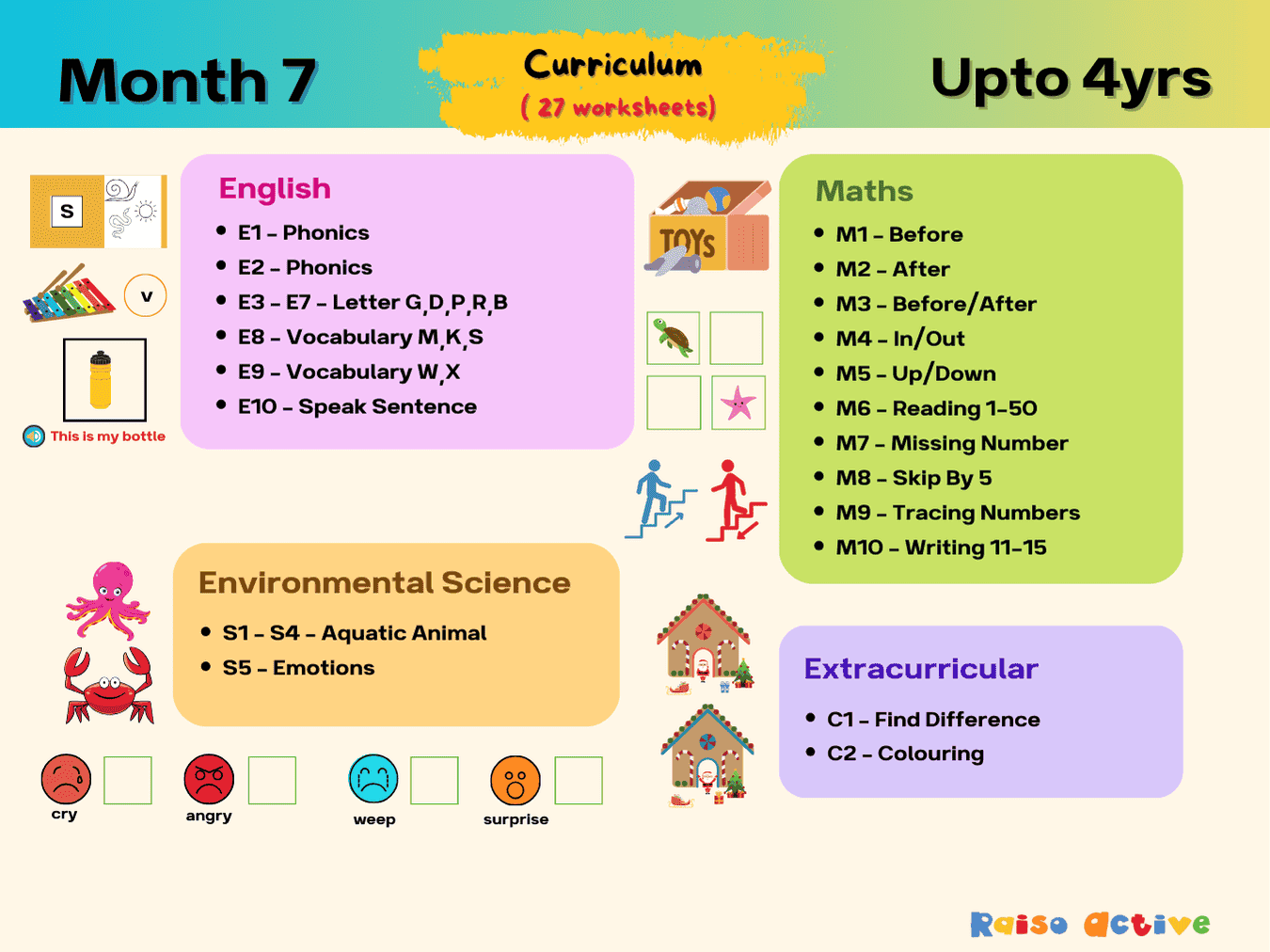
Part of the pack
Month 7: Comprehensive preschool learning | Ages Up to 4
This is page 22 of the pack. Ages 2-4 · PreschoolAges 2-4 · NurseryAges 2-4

Made for your child
Counting to 10, made for your child
A maths pack with your child's name in it: pictures that explain, practice at three levels, puzzles and story sums about them. Print a new set whenever they finish.
Make a maths packFree preview · free for members
Curriculum
- Number Recognition > Number Tracing 1-10
How to use this worksheet
Have your child trace the number 13 in the box provided, saying 'thirteen' aloud as they form each stroke. Move to 14, 15, and 16 in the same way, tracing each number while saying its name out loud before moving to the next. Encourage them to notice how each traced number looks slightly different, comparing the shapes of the '1' at the start of each one. Once all four numbers are traced, have your child count aloud from 13 to 16 one more time, pointing to each number as they say it.
Materials needed
- Pencil
- Crayons
Extension activities
- 1Have your child count a group of 13 to 16 small objects, like blocks or crayons, to connect the numbers to real quantities.
- 2Ask your child to draw each number independently on a separate sheet of paper without tracing.
- 3Use the numbers to create simple addition or subtraction problems, like '13 plus 1' or '16 minus 1.'
- 4Play a number-recognition game, calling out a number between 13 and 16 and having your child find and point to it.

Written by
Hemsweta Jain · Teacher Cheena
MBA and Early Childhood Educator, teaching since 2014 · Founder of RaisoActive, Mumbai
Every RaisoActive worksheet is designed and checked by the founder before publishing.
Published · Last reviewed
More from Month 7: Comprehensive preschool learning | Ages Up to 4

Before and After: Sequencing Worksheet for Early Learners
Ages 3-5 · Preschool–Pre-KAges 3-5 · Nursery–ReceptionAges 3-5 · Nursery–LKGAges 3-5
Sequencing 'before' and 'after' events trains children to think about time and cause-and-effect in order, a reasoning skill that underlies reading comprehension, like following a story's plot, and everyday routines alike. This cut-and-paste format adds a physical, hands-on layer, requiring children to manipulate and place pictures correctly rather than just pointing, which reinforces the sequencing concept through action.
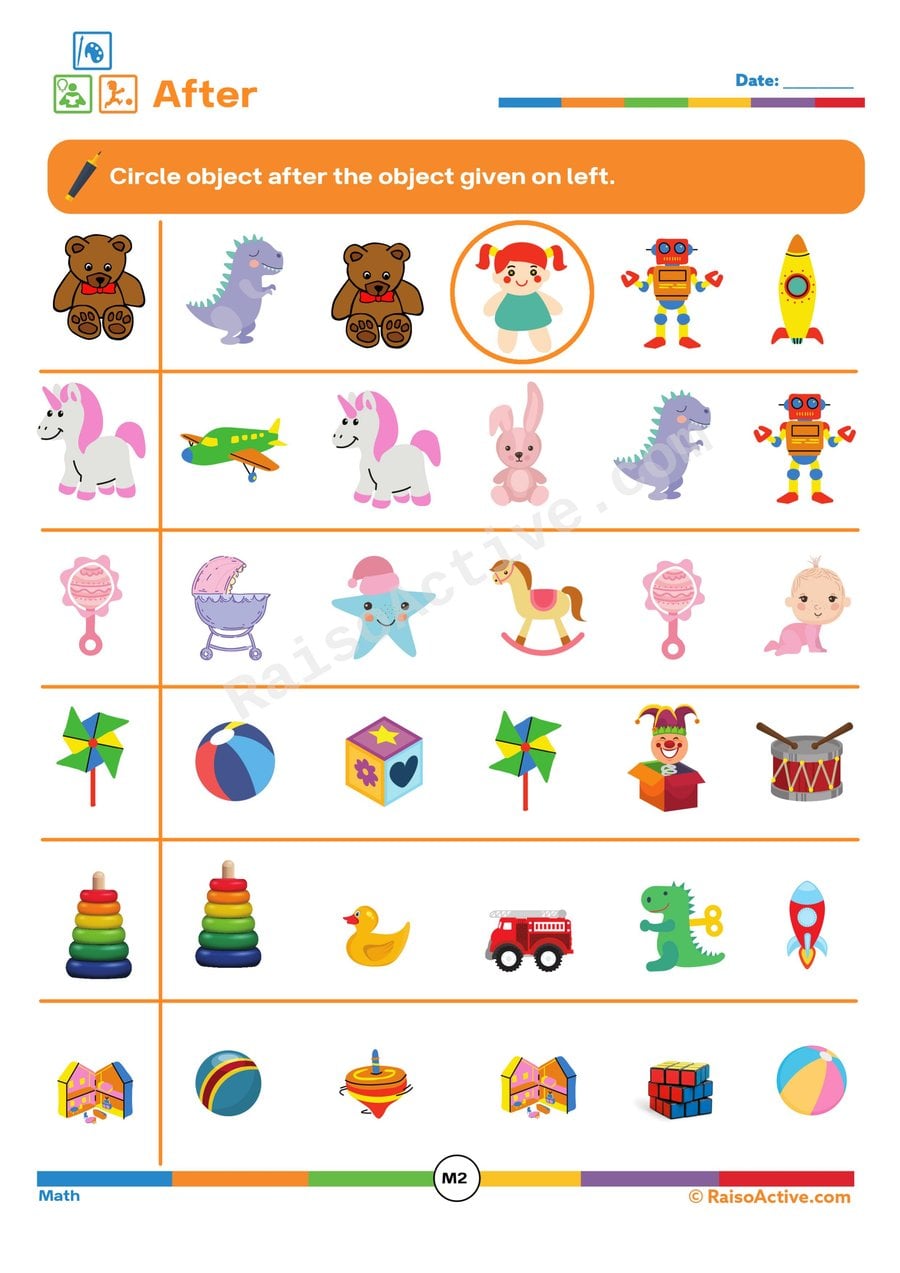
Object Sequencing Worksheet: What Comes After?
Ages 3-5 · Preschool–Pre-KAges 3-5 · Nursery–ReceptionAges 3-5 · Nursery–LKGAges 3-5
Preschoolers ages 3-5 build sequencing and pattern-recognition skills by identifying what object logically comes next after a given item. Predicting what comes next requires observing a pattern or relationship and applying that logic forward, an early form of the reasoning used in later math and science. Circling the correct answer among several options also sharpens careful visual comparison and decision-making.

Letter G Tracing Worksheet: Learn to Write and Color!
Ages 3-5 · Preschool–Pre-KAges 3-5 · Nursery–ReceptionAges 3-5 · Nursery–LKGAges 3-5
Preschoolers ages 3-5 build handwriting readiness by tracing both the uppercase and lowercase letter G along dotted guide lines, developing the fine motor control and pencil grip needed for future writing. The distinct curved shape of the letter G, especially its small hook, offers valuable practice with controlled curved strokes. Coloring pictures that start with G connects the letter's shape to its beginning sound, reinforcing early phonics.

Writing Numbers 11-16 Worksheet: Trace, Write & Count!
Ages 4-6 · Pre-K–KindergartenAges 4-6 · Reception–Year 1Ages 4-6 · LKG–UKGAges 4-6
This worksheet moves children ages 4-6 beyond single-digit numbers, giving them structured practice tracing, writing, and counting the numbers 11 through 16. Working with two-digit numbers for the first time helps children understand place value informally, seeing that these numbers are built from a 'ten' plus more. The paired counting section connects each written number to a matching quantity of objects, reinforcing number meaning rather than just symbol recognition.
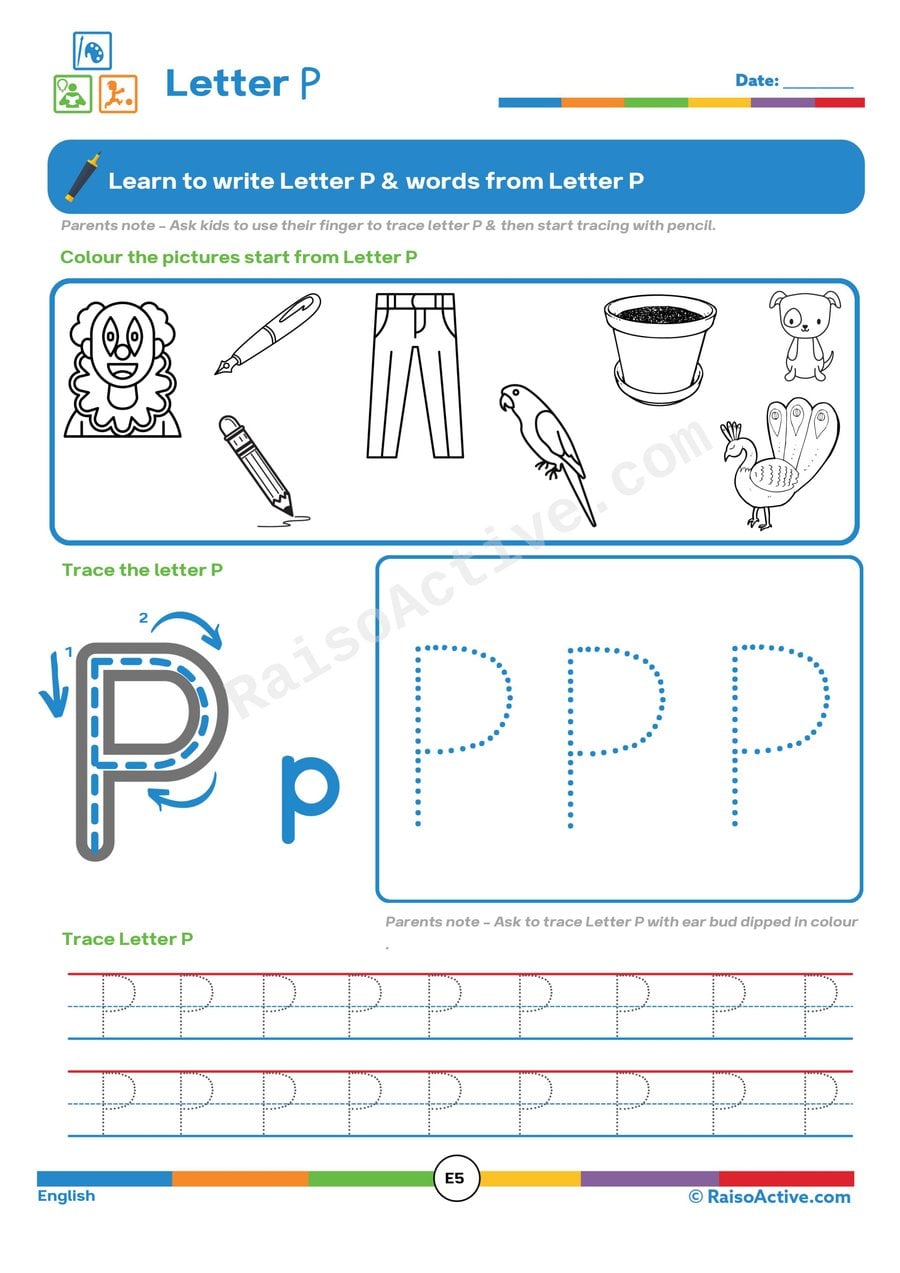
Letter P Tracing Worksheet for Preschoolers
Ages 3-5 · Preschool–Pre-KAges 3-5 · Nursery–ReceptionAges 3-5 · Nursery–LKGAges 3-5
Preschoolers ages 3-5 build the pencil control and muscle memory needed for handwriting by tracing both the uppercase and lowercase letter P along guided dotted lines. Repeated tracing strengthens the fine motor pathways used in future writing while also reinforcing left-to-right, top-to-bottom stroke direction. Naming pictures that start with P connects the letter shape to its sound, laying groundwork for phonics.

Trace and Color the Letter B Worksheet for Preschoolers
Ages 3-5 · Preschool–Pre-KAges 3-5 · Nursery–ReceptionAges 3-5 · Nursery–LKGAges 3-5
Children ages 3-5 build handwriting readiness by tracing the letter B, practicing the straight vertical line and two connected curves that make up its shape. This combination of a straight stroke and rounded curves gives varied fine motor practice compared to letters made of only one type of line. Coloring pictures that start with B links the visual letter shape to its beginning sound, strengthening early phonics awareness.
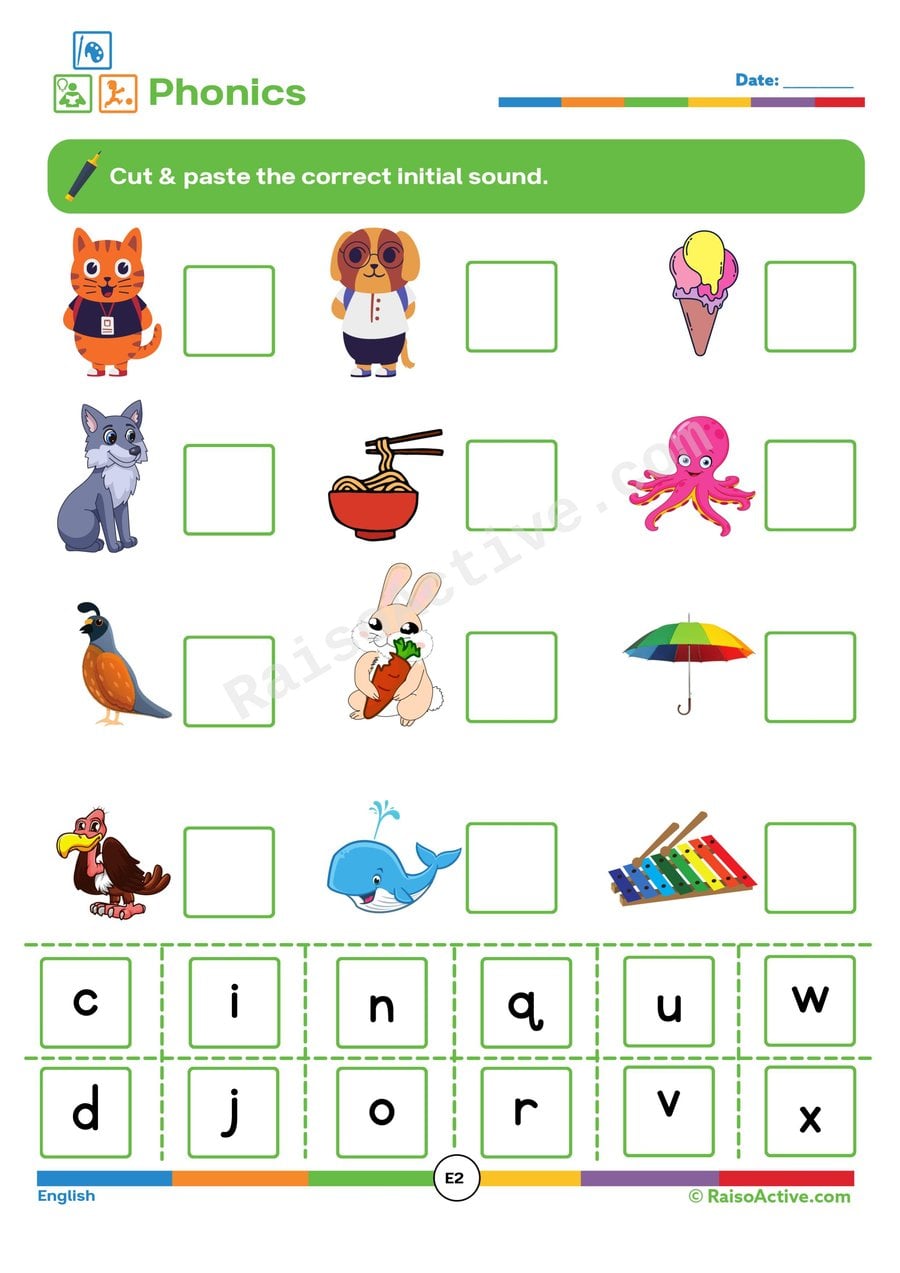
Initial Sound Match: Cut and Paste Worksheet
Ages 4-5 · Pre-KAges 4-5 · ReceptionAges 4-5 · LKGAges 4-5
Children ages 4-5 develop phonemic awareness by identifying the beginning sound of each pictured object and matching it to the correct letter, a critical pre-reading skill for connecting sounds to symbols. This cut-and-paste format adds fine motor practice with scissors and glue alongside the phonics work. Recognizing initial sounds is one of the strongest early predictors of later reading success.

Emotions Worksheet: Count, Color, and Identify Feelings!
Ages 3-5 · Preschool–Pre-KAges 3-5 · Nursery–ReceptionAges 3-5 · Nursery–LKGAges 3-5
Identifying emotions from facial expressions and then counting and coloring them builds emotional literacy, the ability to name feelings like happy, sad, or surprised, alongside basic counting practice, giving children a vocabulary for something they experience daily but may not yet know how to describe. For ages three to five, naming emotions explicitly is an important early step in self-regulation and empathy.
Related worksheets
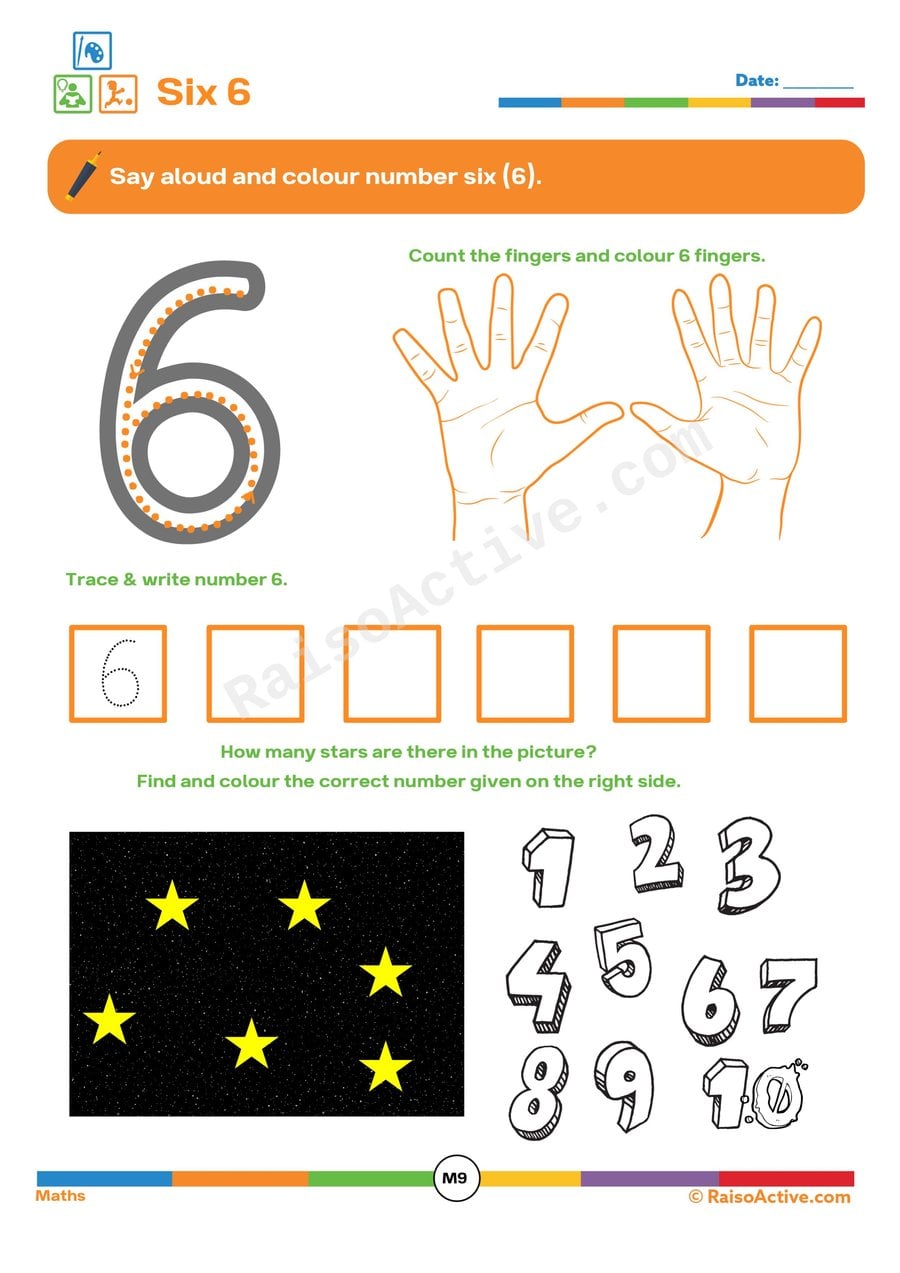
Number Six (6) Worksheet: Trace, Write, and Count!
Ages 4-5 · Pre-KAges 4-5 · ReceptionAges 4-5 · LKGAges 4-5
Children ages 4-5 practice tracing and independently writing the number six while reinforcing the quantity it represents by counting a group of stars. Moving from guided tracing to independent writing, then to counting practice, builds both the motor skill and the number sense needed for early math confidence.

Tracing and Writing the Number 5 Worksheet for Preschoolers
Ages 3-5 · Preschool–Pre-KAges 3-5 · Nursery–ReceptionAges 3-5 · Nursery–LKGAges 3-5
This worksheet targets the specific pencil-control needed to form the numeral 5 correctly, while linking that written symbol to the quantity it represents through counting the apples on the page. Practicing number formation alongside counting at this age helps children connect the abstract symbol '5' to a concrete amount they can see and touch.

Tracing and Counting Worksheet: Learning the Number 3!
Ages 3-5 · Preschool–Pre-KAges 3-5 · Nursery–ReceptionAges 3-5 · Nursery–LKGAges 3-5
This worksheet helps children ages 3-5 learn to recognize, trace, and write the number 3 using its correct stroke pattern, while a hands-and-ducks counting activity reinforces that the numeral 3 represents exactly three objects. Combining tracing with counting connects the written symbol to its real quantity, which is central to early number sense.
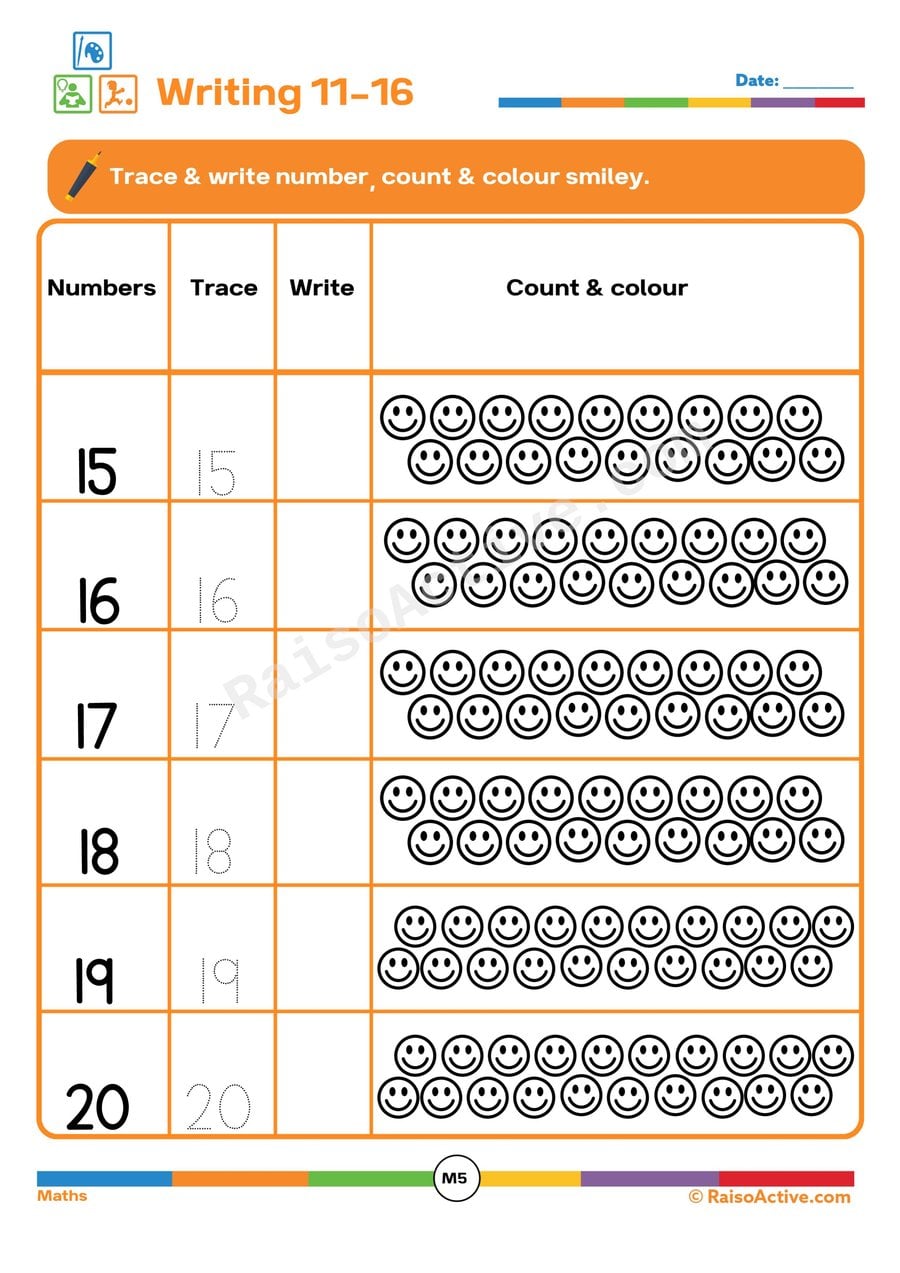
Number Tracing and Counting Worksheet for Kids
Ages 4-6 · Pre-K–KindergartenAges 4-6 · Reception–Year 1Ages 4-6 · LKG–UKGAges 4-6
This worksheet layers three connected numeracy skills for children ages 4-6: tracing numerals to build correct number formation, writing numbers independently from memory, and counting objects to connect a written numeral to an actual quantity. Number formation practice at this age matters because children often develop habits — like starting a number from the wrong point — that are hard to unlearn later, so guided tracing helps establish correct strokes early. Pairing that with counting smiley faces ensures the numeral isn't just a shape being copied but a quantity being understood.

Number 8 Worksheet: Trace, Count, and Color Butterflies!
Ages 3-5 · Preschool–Pre-KAges 3-5 · Nursery–ReceptionAges 3-5 · Nursery–LKGAges 3-5
Tracing the number 8 while counting and coloring eight butterflies helps children ages 3-5 connect the written numeral to the actual quantity it represents, reinforcing number sense alongside handwriting. The final step, drawing any eight objects of the child's choosing, moves beyond guided practice into independent application, checking whether the concept of 'eight' has truly transferred rather than just been copied. This progression from tracing to counting to free drawing builds a complete, layered understanding of one specific number.
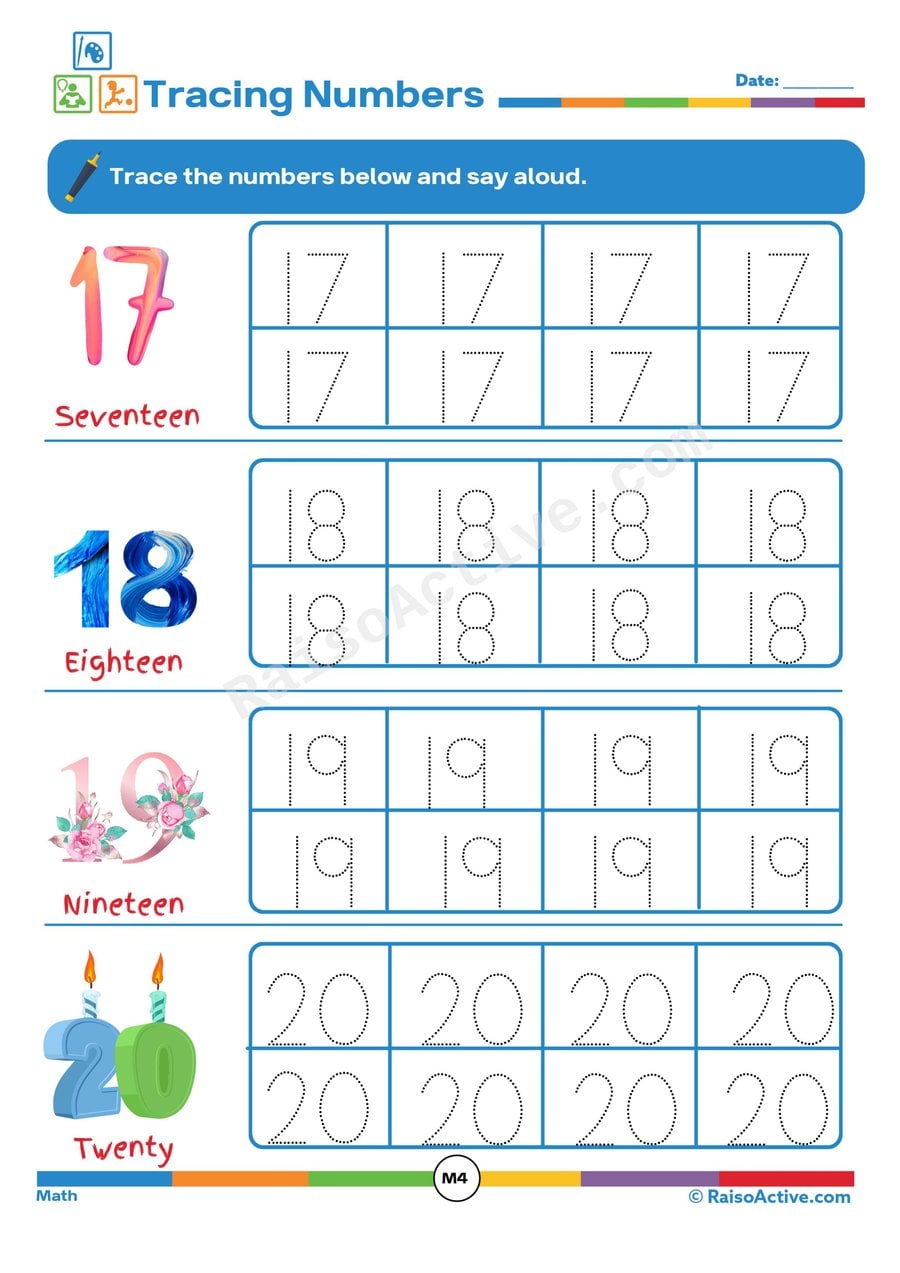
Trace and Learn Numbers 17-20 Worksheet
Ages 4-6 · Pre-K–KindergartenAges 4-6 · Reception–Year 1Ages 4-6 · LKG–UKGAges 4-6
This tracing worksheet helps children ages 4-6 build number-writing fluency and number-name recognition for 17 through 20, a range that's often trickier than smaller numbers because it involves two-digit sequencing and less familiar number words like 'seventeen' and 'nineteen'. Tracing the dotted numerals builds the fine motor control and muscle memory needed for independent number writing, while saying each number aloud reinforces the link between the written numeral and its spoken name. This range also sets up the transition into the twenties and beyond.

Tracing and Counting Fun: Number 5 Worksheet for Preschoolers
Ages 4-5 · Pre-KAges 4-5 · ReceptionAges 4-5 · LKGAges 4-5
Children ages 4-5 practice tracing and writing the number 5 while reinforcing counting up to five through a picture-based matching task. Repeating the number in multiple formats — tracing, writing, and counting — helps cement both the shape of the numeral and the quantity it represents.

Tracing Number 2 Worksheet: Practice Writing & Counting!
Ages 3-5 · Preschool–Pre-KAges 3-5 · Nursery–ReceptionAges 3-5 · Nursery–LKGAges 3-5
This worksheet combines number formation practice for the numeral 2 with early counting skills, asking children ages 3-5 to trace the curved-then-flat stroke of a 2 and then apply that number by counting and circling matching groups of balloons. Connecting the written symbol to an actual quantity is a critical step in building number sense, not just handwriting.
Guides for this topic

Number Formation Rhymes 0–9 and How to Fix Reversals
Original number formation rhymes for 0–9, the correct stroke order for each digit, why 3, 5 and 7 get reversed most often, and multisensory fixes that work.

Documenting Learning Without Drowning in Data: A Practical Guide for Parents and Teachers
Learn practical ways to document your child's learning without overwhelm. Simple portfolios, observation tips, and printable trackers for ages 1-8.

How to Help Your Child with Letter Reversals: A Complete Guide for Parents and Teachers
Letter reversals are normal until age 7-8. Learn the best multisensory strategies, anchor letter tricks, and activities to help children write b, d, p, and q correctly.
Reviews
Every worksheet for ages 3–5, no watermark
Members download the full library of 1,000+ worksheets and every activity pack without watermarks or daily limits. One year costs ₹999 in India or $20 elsewhere.
See membership plansOr download any worksheet free with a watermark (5 a day).