Writing Numbers 11-16 Worksheet: Trace, Write & Count!
This worksheet moves children ages 4-6 beyond single-digit numbers, giving them structured practice tracing, writing, and counting the numbers 11 through 16. Working with two-digit numbers for the first time helps children understand place value informally, seeing that these numbers are built from a 'ten' plus more. The paired counting section connects each written number to a matching quantity of objects, reinforcing number meaning rather than just symbol recognition.
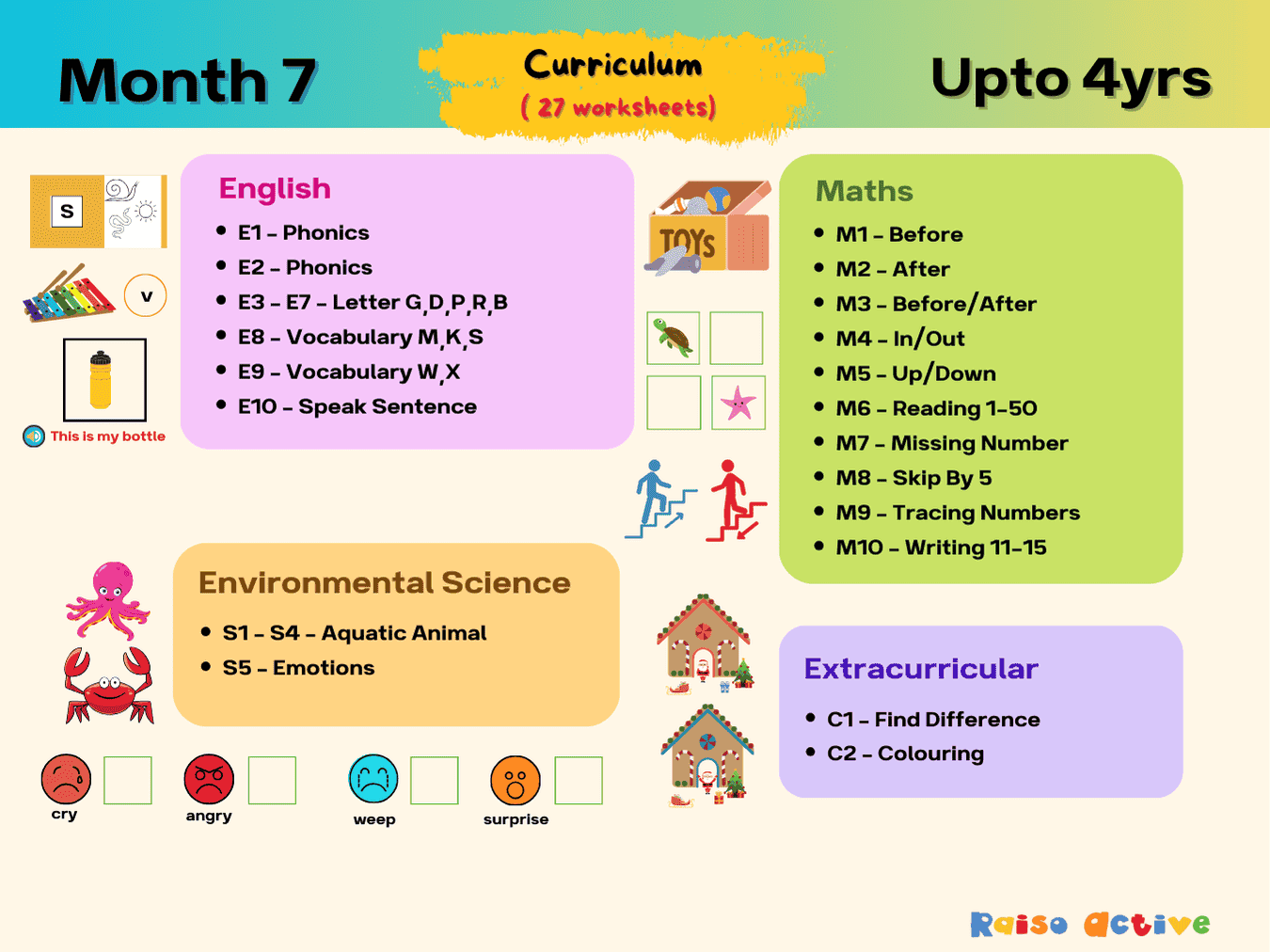
Part of the pack
Month 7: Comprehensive preschool learning | Ages Up to 4
This is page 23 of the pack. Ages 2-4 · PreschoolAges 2-4 · NurseryAges 2-4
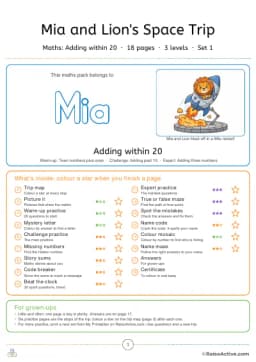
Made for your child
Counting to 10, made for your child
A maths pack with your child's name in it: pictures that explain, practice at three levels, puzzles and story sums about them. Print a new set whenever they finish.
Make a maths packFree preview · free for members
Curriculum
- Number Recognition > Number Writing
How to use this worksheet
Start with number 11, having your child trace the dotted numeral with a finger before tracing it with a pencil, then writing it independently on the practice line. Repeat this trace-then-write pattern for each number up through 16, saying the number name aloud every time it's written. In the 'Count & Colour' section, have your child count the smiley faces for each number carefully, pointing to each one, then color that exact quantity as indicated. Finish by rereading the full sequence from 11 to 16 together.
Materials needed
- Pencil
- Crayons
Extension activities
- 1Use counters or small snacks to build a physical group of 13 or 14 items and match it to the written number.
- 2Play a number hunt looking for the numbers 11 through 16 on clocks, calendars, or house numbers.
- 3Have your child draw the matching quantity of dots or stars next to each written number.
- 4Practice counting forward and backward between 10 and 16 using fingers or a number line.
- 5Create simple flashcards with numbers 11-16 and quiz recognition speed as a quick game.

Written by
Hemsweta Jain · Teacher Cheena
MBA and Early Childhood Educator, teaching since 2014 · Founder of RaisoActive, Mumbai
Every RaisoActive worksheet is designed and checked by the founder before publishing.
Published · Last reviewed
More from Month 7: Comprehensive preschool learning | Ages Up to 4

Fun Phonics Activities: Letter S Worksheet for Preschoolers
Ages 3-5 · Preschool–Pre-KAges 3-5 · Nursery–ReceptionAges 3-5 · Nursery–LKGAges 3-5
This multi-part activity page immerses preschoolers in the sound and shape of the letter 'S' through drawing, speaking, and playful games rather than a single worksheet task, which research on early phonics shows helps the sound-letter connection stick faster than tracing alone. Ages three to five benefit especially from this variety, since moving between drawing, talking, and active games matches their short attention spans while reinforcing the same target sound from multiple directions.
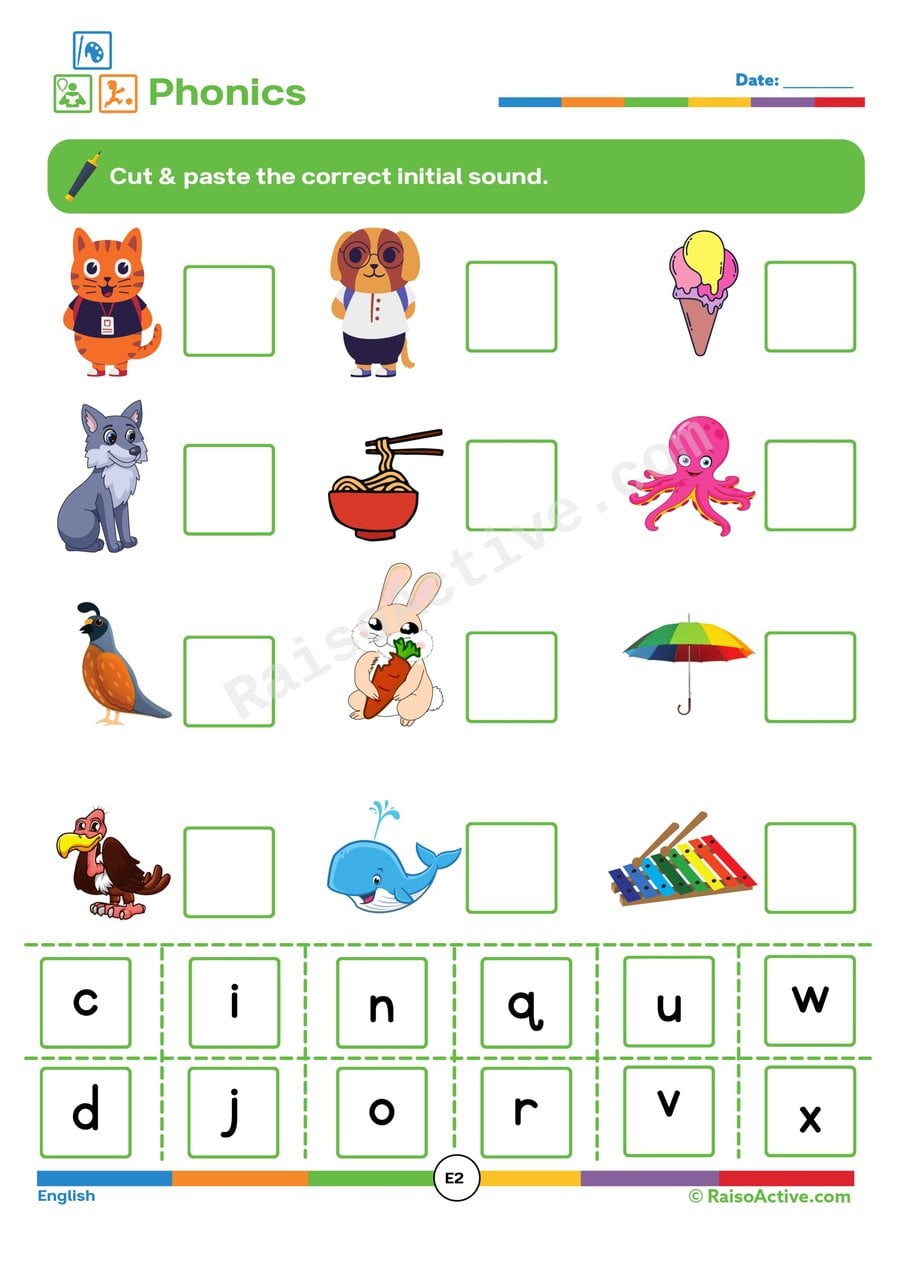
Initial Sound Match: Cut and Paste Worksheet
Ages 4-5 · Pre-KAges 4-5 · ReceptionAges 4-5 · LKGAges 4-5
Children ages 4-5 develop phonemic awareness by identifying the beginning sound of each pictured object and matching it to the correct letter, a critical pre-reading skill for connecting sounds to symbols. This cut-and-paste format adds fine motor practice with scissors and glue alongside the phonics work. Recognizing initial sounds is one of the strongest early predictors of later reading success.
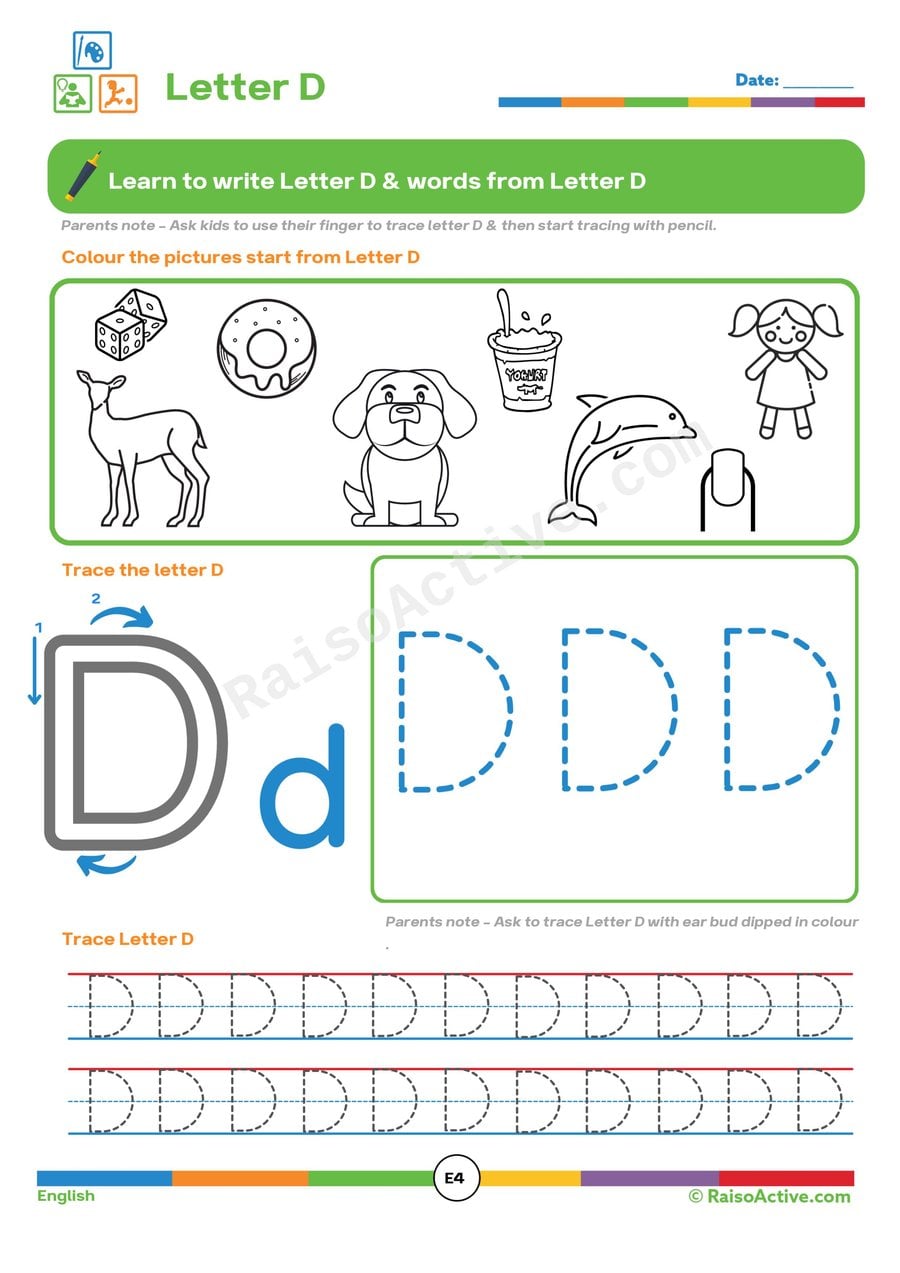
Letter D Tracing Worksheet: Learn to Write & Color!
Ages 3-5 · Preschool–Pre-KAges 3-5 · Nursery–ReceptionAges 3-5 · Nursery–LKGAges 3-5
Tracing both uppercase and lowercase D repeatedly builds the fine motor muscle memory needed for correct letter formation, while the accompanying picture coloring reinforces the 'D' sound by asking children to identify objects that start with it. For ages three to five, combining tracing with picture-based sound practice teaches the letter as both a shape and a sound at the same time, rather than as an isolated symbol.

Up and Down Worksheet: Counting and Writing Practice for Preschoolers
Ages 3-5 · Preschool–Pre-KAges 3-5 · Nursery–ReceptionAges 3-5 · Nursery–LKGAges 3-5
Children ages 3-5 combine spatial reasoning with counting practice by counting steps or elements going up and down, then writing the totals. Understanding 'up' and 'down' as directional concepts supports later skills like reading graphs, climbing stairs safely, and following spatial instructions. Writing the counted numbers afterward reinforces number formation alongside the counting itself.
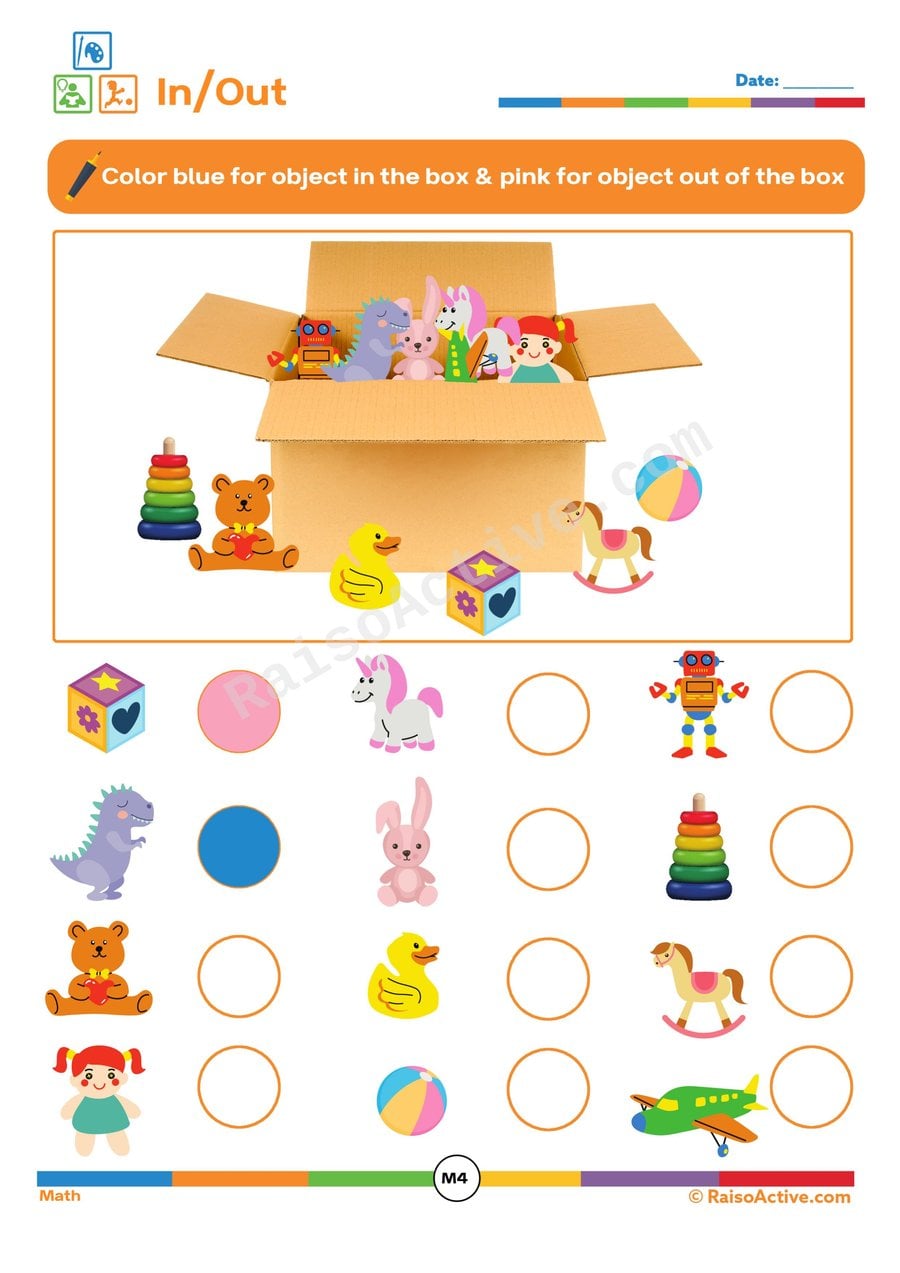
In/Out Sorting Worksheet: Color the Objects!
Ages 3-5 · Preschool–Pre-KAges 3-5 · Nursery–ReceptionAges 3-5 · Nursery–LKGAges 3-5
Sorting objects as 'in' or 'out' of a box builds on the positional vocabulary preschoolers need before they can follow multi-step directions or understand simple math concepts like sets and groups. Using color as the sorting tool here, blue for inside and pink for outside, also strengthens the ability to hold two rules in mind simultaneously and apply the correct one to each object in turn.
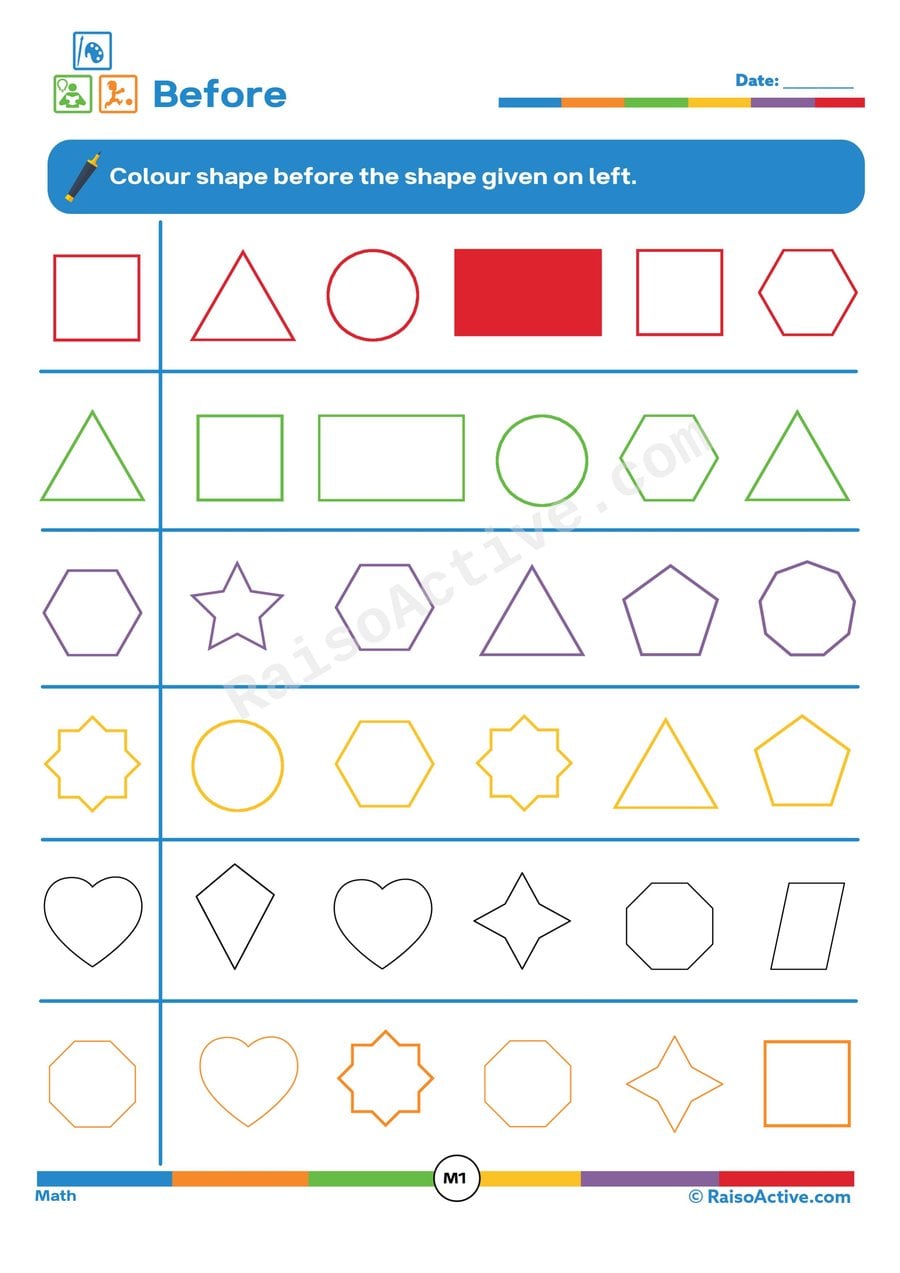
Shape Coloring Worksheet: Before the Shape!
Ages 3-5 · Preschool–Pre-KAges 3-5 · Nursery–ReceptionAges 3-5 · Nursery–LKGAges 3-5
This worksheet combines shape recognition with sequencing by asking children to identify which shape comes before a given shape in a row, requiring them to understand order as well as shape names. For ages three to five, thinking about what comes 'before' something visually is a gentle introduction to ordinal reasoning that will later apply to numbers and letters as well as shapes.

Missing Number Puzzle: Cut and Paste to Reveal the Hidden Picture!
Ages 4-6 · Pre-K–KindergartenAges 4-6 · Reception–Year 1Ages 4-6 · LKG–UKGAges 4-6
Children ages 4-6 practice number recognition and sequencing by identifying which numbers are missing from a grid and placing the correct cut-out pieces to reveal a hidden picture underneath. The reveal element adds motivation and delayed gratification, encouraging children to complete every number rather than rushing through a few. This activity also builds scissor precision and spatial planning as pieces must fit exact spots.
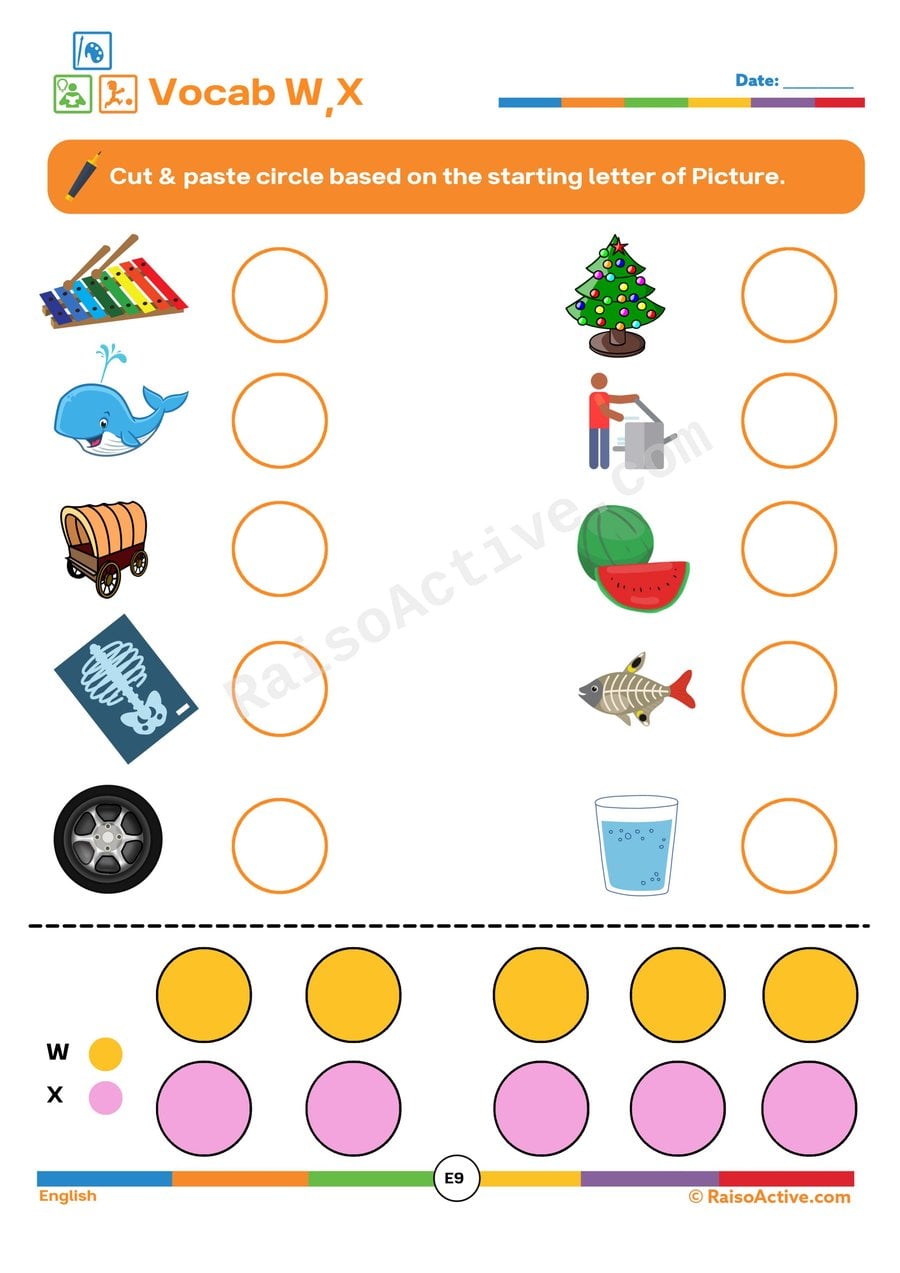
W and X Words Worksheet: Cut and Paste Fun!
Ages 4-5 · Pre-KAges 4-5 · ReceptionAges 4-5 · LKGAges 4-5
Identifying words that start with W and the much rarer letter X gives children practice distinguishing beginning sounds across a wider range of vocabulary, since X-words are less common and require extra attention to hear correctly. For ages four to five, the cut-and-paste format adds a deliberate pause before each answer, helping avoid the rushed guessing that can happen with a quicker matching task.
Related worksheets

Number Writing Worksheet: Trace, Write, Count, and Paste Numbers!
Ages 3-5 · Preschool–Pre-KAges 3-5 · Nursery–ReceptionAges 3-5 · Nursery–LKGAges 3-5
This multi-step worksheet strengthens number formation, counting, and one-to-one correspondence all in one activity, as children ages 3-5 trace and write numerals, then count a group of objects and paste the matching quantity in a box. Combining writing with hands-on counting and cutting helps children connect the written symbol to the actual amount it represents, a key milestone in early numeracy.

Trace and Write the Number 0 Worksheet for Preschoolers
Ages 3-5 · Preschool–Pre-KAges 3-5 · Nursery–ReceptionAges 3-5 · Nursery–LKGAges 3-5
This worksheet gives children ages 3-5 focused practice forming the number 0, building the fine motor control and pencil grip needed for handwriting while reinforcing that 0 represents 'none' or an empty group. Tracing the curved stroke repeatedly also helps children internalize the shape through muscle memory, which supports faster, more confident number writing later.

Number Writing Worksheet 0-10: Trace, Count, and Write!
Ages 4-5 · Pre-KAges 4-5 · ReceptionAges 4-5 · LKGAges 4-5
This worksheet combines three numeracy skills in one sitting: recognizing printed numerals 0 through 10, forming them correctly through tracing, and matching a quantity of objects to its written number. For 4-5 year-olds, connecting the abstract symbol '7' to seven actual objects is the key leap between rote counting and true number sense.
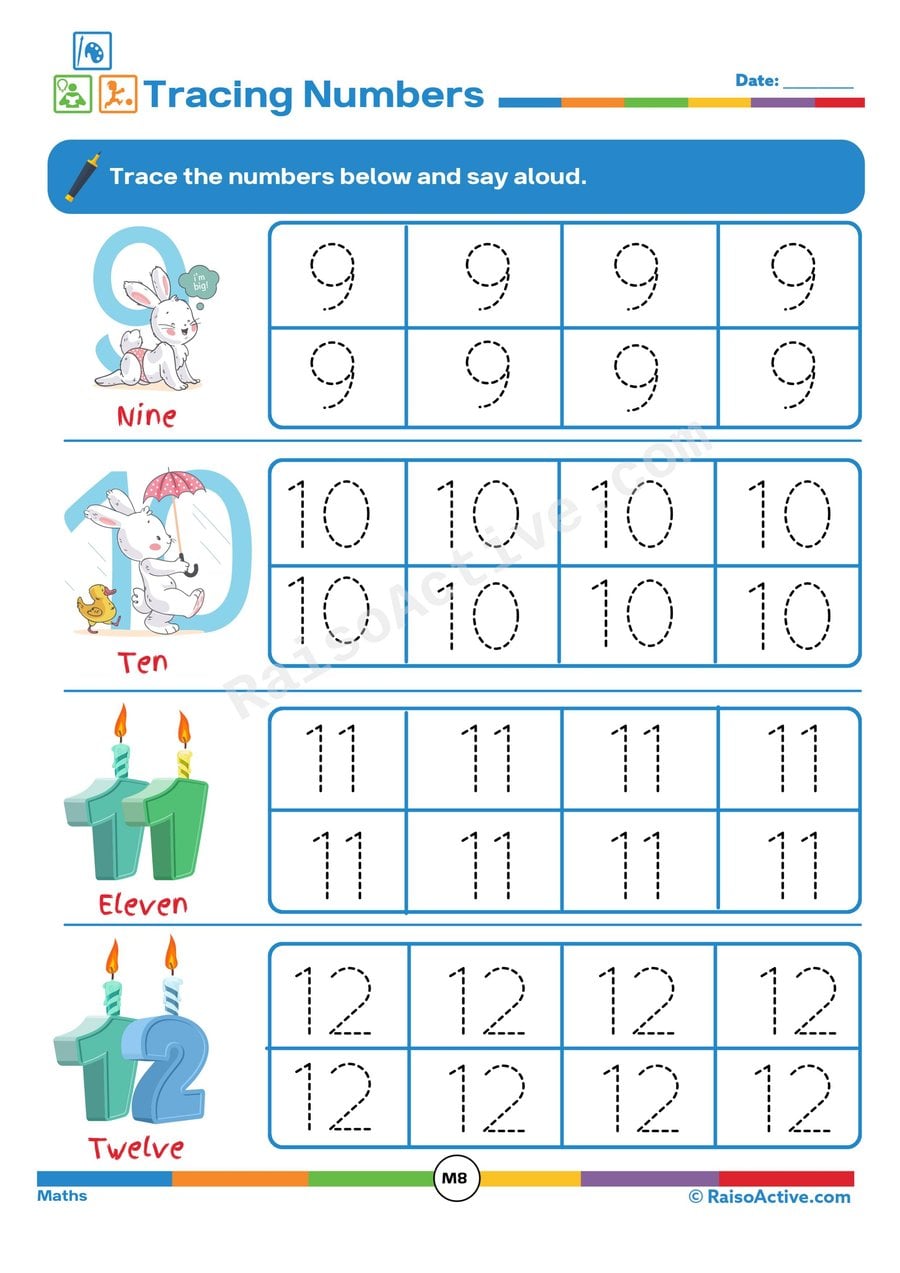
Trace the Numbers: Practice Writing Numbers 9-12!
Ages 3-5 · Preschool–Pre-KAges 3-5 · Nursery–ReceptionAges 3-5 · Nursery–LKGAges 3-5
Tracing numerals 9 through 12 strengthens the small hand muscles and pencil control preschoolers need for later handwriting, while repeated exposure to each numeral's shape builds the visual memory that underlies number recognition. Ages 3-5 are also learning that a written numeral represents a specific quantity, so pairing the traced digit with its name reinforces early number sense alongside the motor skill.

Writing Numbers Worksheet: Counting and Tracing for Preschoolers
Ages 3-5 · Preschool–Pre-KAges 3-5 · Nursery–ReceptionAges 3-5 · Nursery–LKGAges 3-5
Counting a group of objects, writing the total, and then tracing that same number gives children ages 3-5 a complete loop of practice — recognizing a quantity, representing it with a written numeral, and reinforcing the numeral's shape through tracing. This combination targets both number sense and handwriting in a single page, which is more efficient and engaging than practicing each skill separately. Repeating this pattern across several different numbers also builds flexibility, since children must apply the process freshly to each new quantity rather than following a single fixed routine.
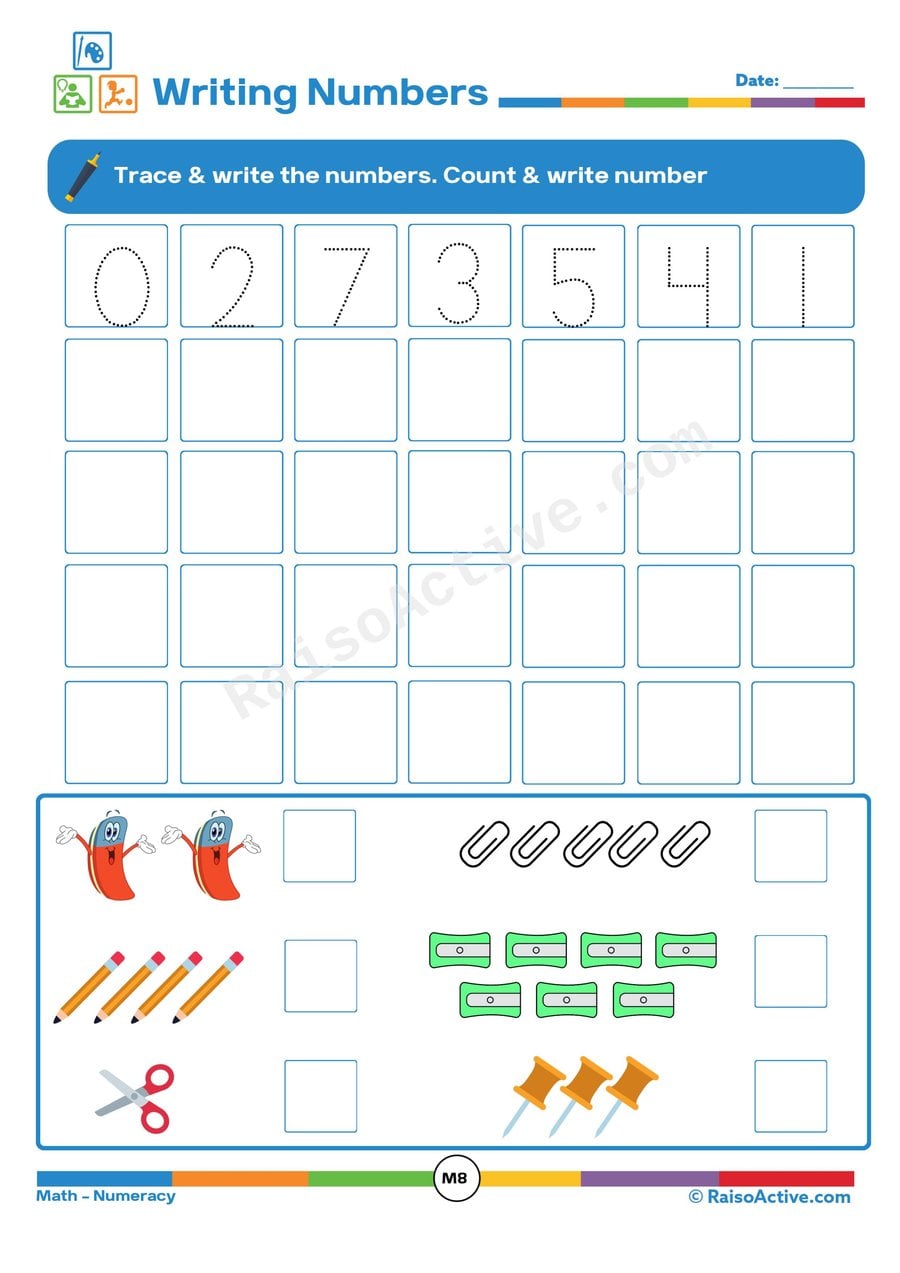
Trace and Write Numbers 0-5 Worksheet
Ages 3-5 · Preschool–Pre-KAges 3-5 · Nursery–ReceptionAges 3-5 · Nursery–LKGAges 3-5
Tracing and writing the numbers 0 through 5 builds the specific hand strokes needed to form each numeral correctly, a skill that develops separately from simply being able to count or recognize numbers by sight for children ages 3-5. Following the tracing with a counting-and-writing section, where children count objects and record the total themselves, connects the motor skill of writing numbers directly to their meaning as quantities. Practicing this small, foundational range first builds the confidence needed before tackling larger numbers later.

Writing Number 6 Worksheet: Trace, Color, and Count!
Ages 4-5 · Pre-KAges 4-5 · ReceptionAges 4-5 · LKGAges 4-5
This worksheet builds number 6 recognition for 4-5 year olds through tracing, coloring, and counting practice, connecting the written numeral to an actual quantity of objects your child counts aloud. Bringing formation, counting, and independent writing together in one page reinforces that '6' isn't just a shape to copy but represents a specific, countable amount, which is the real foundation of number sense.
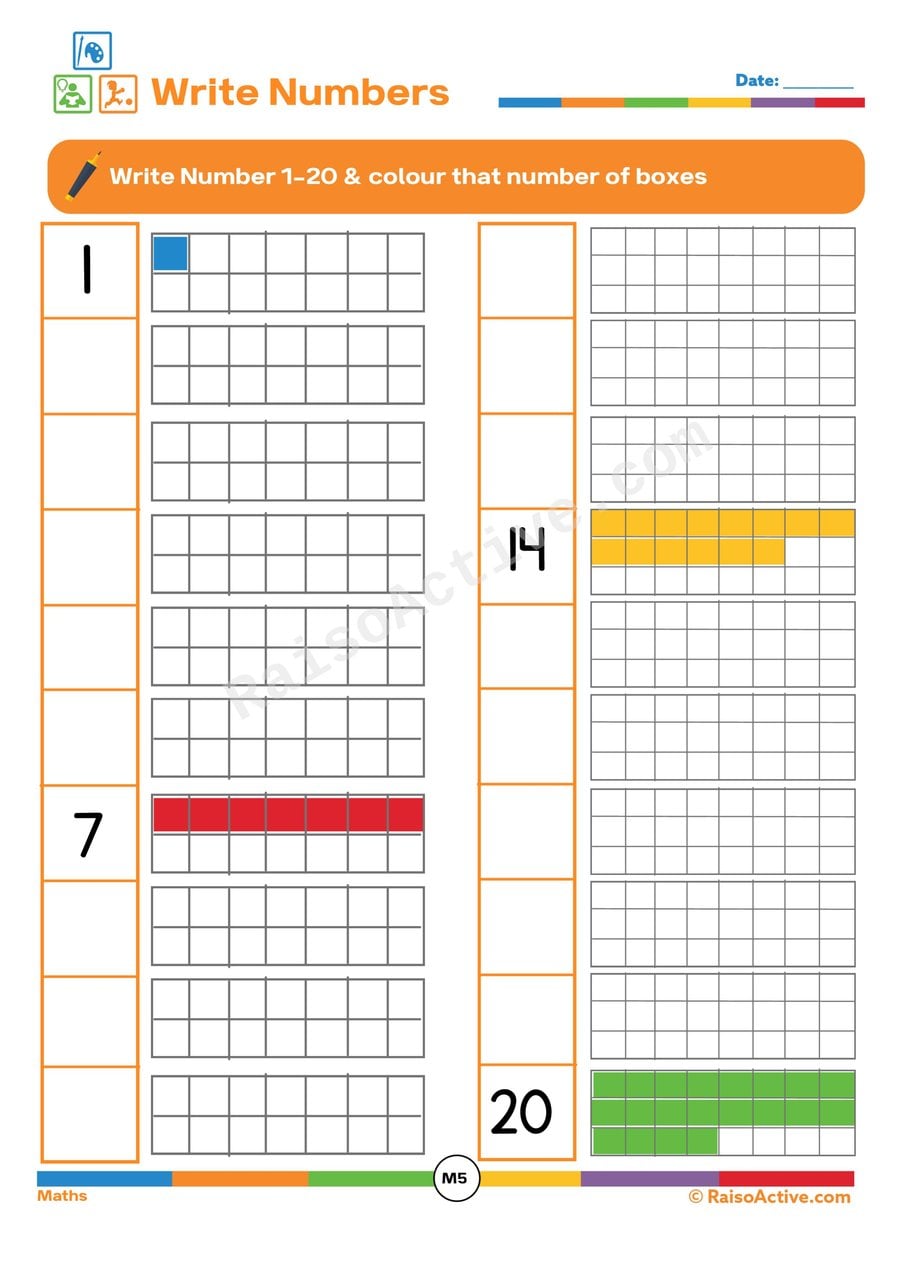
Write and Color Numbers 1-20 Worksheet
Ages 4-6 · Pre-K–KindergartenAges 4-6 · Reception–Year 1Ages 4-6 · LKG–UKGAges 4-6
Children ages 4-6 practice writing numbers from 1 to 20 in sequence while reinforcing quantity recognition by coloring the matching number of boxes for each number, connecting the written numeral to the amount it represents. Extending number writing practice up through 20 supports children moving beyond single digits into the teens and twenties, a range many children find confusing.
Guides for this topic

Number Formation Rhymes 0–9 and How to Fix Reversals
Original number formation rhymes for 0–9, the correct stroke order for each digit, why 3, 5 and 7 get reversed most often, and multisensory fixes that work.

Christmas and Winter Activities That Combine Fun and Learning: Creating Magical Educational Experiences
Discover Christmas and winter activities that combine festive fun with real learning. Crafts, counting, literacy, and printable worksheets for ages 2 to 8 — perfect for home and school.
Age-Appropriate Halloween Learning Activities: Balancing Spooks and Skills for Young Learners
Discover fun, age-appropriate Halloween learning activities for young children. Spooky crafts, counting games, literacy ideas, and printable worksheets for ages 2 to 8.
Reviews
Every worksheet for ages 4–6, no watermark
Members download the full library of 1,000+ worksheets and every activity pack without watermarks or daily limits. One year costs ₹999 in India or $20 elsewhere.
See membership plansOr download any worksheet free with a watermark (5 a day).