
Missing Number Puzzle: Cut and Paste to Reveal the Hidden Picture!
Children ages 4-6 practice number recognition and sequencing by identifying which numbers are missing from a grid and placing the correct cut-out pieces to reveal a hidden picture underneath. The reveal element adds motivation and delayed gratification, encouraging children to complete every number rather than rushing through a few. This activity also builds scissor precision and spatial planning as pieces must fit exact spots.
Curriculum
How to use this worksheet
Look at the number grid together first and identify a few visible numbers to establish the counting pattern being used. Have your child cut out the individual number pieces at the bottom of the page, keeping them in order if possible to avoid mixing them up. One at a time, ask them to figure out which number is missing from a blank space, say it aloud, and glue the matching piece into that spot. Continue until every gap is filled and the hidden picture is fully revealed, then celebrate by naming what the picture shows.
Materials needed
- Scissors
- Glue or Tape
- Pencil
Extension activities
- •Create a simple number line on paper with missing numbers for your child to fill in from memory.
- •Turn it into a treasure hunt by hiding number cards around a room in sequence for your child to find.
- •Use building blocks stacked in a row and remove one to ask 'which number is missing?'
- •Count forward and backward together starting from any number that appeared in the grid.
- •Have your child design their own missing-number puzzle for a family member to solve.
Tips for parents and teachers
If your child struggles to identify a missing number, have them count aloud from the last known number before the gap rather than guessing. Small cut-out pieces can be fiddly, so offer to pre-cut a few if frustration builds, keeping focus on the number sequencing rather than the scissor work. The reveal of the hidden picture is a great moment to pause and ask what they predicted it would be.

Written by
Hemsweta Jain · Teacher Cheena
MBA and Early Childhood Educator, teaching since 2014 · Founder of RaisoActive, Mumbai
Every RaisoActive worksheet is designed and checked by the founder before publishing.
Published · Last reviewed
Related worksheets

Missing Numbers: Ice Cream Fun Worksheet for Kids
This worksheet helps children ages 3-5 practice number sequencing by identifying and writing in the missing numerals within a series of ice cream cones and cars, numbers 1 through 10. Filling in a gap within an otherwise familiar sequence requires children to hold the whole counting order in mind and recognize what number logically belongs in the empty spot, which is more demanding than counting forward from the start each time. The playful ice cream and car theme keeps the repeated number practice visually engaging.

Hopscotch Numbers 1-50 Worksheet: Fill in the Missing Numbers!
This hopscotch-themed worksheet gives children ages 4-6 practice filling in missing numbers within the 1-50 range, extending their number sequencing beyond the more commonly rehearsed 1-20 range and building familiarity with two-digit number patterns like the '20s' or '30s.' Framing the numbers as a hopscotch grid connects the paper activity to a familiar physical game, helping children mentally picture themselves counting forward as they move up the grid. This kind of extended-range practice is an important bridge toward comfortable counting to 100.

Before and After Numbers Worksheet for Preschoolers
This number sequencing worksheet asks children ages 4-6 to identify the numbers that come immediately before and after a given number, strengthening their mental number line and reinforcing the concept that numbers exist in a fixed, ordered sequence. This before-and-after reasoning is more demanding than simple counting because it requires children to move both forward and backward from a starting point. Building this flexible number sense supports later addition and subtraction, which both rely on moving confidently along a mental number line.

Number Sequencing Worksheet: Practice Counting and Ordering Numbers!
This worksheet gives children ages 4-5 focused practice writing numerals in order by filling in the missing numbers within several different counting sequences. Unlike simple counting aloud, writing each numeral by hand forces children to connect the spoken number word to its correct written symbol, reinforcing both number recognition and early handwriting control.
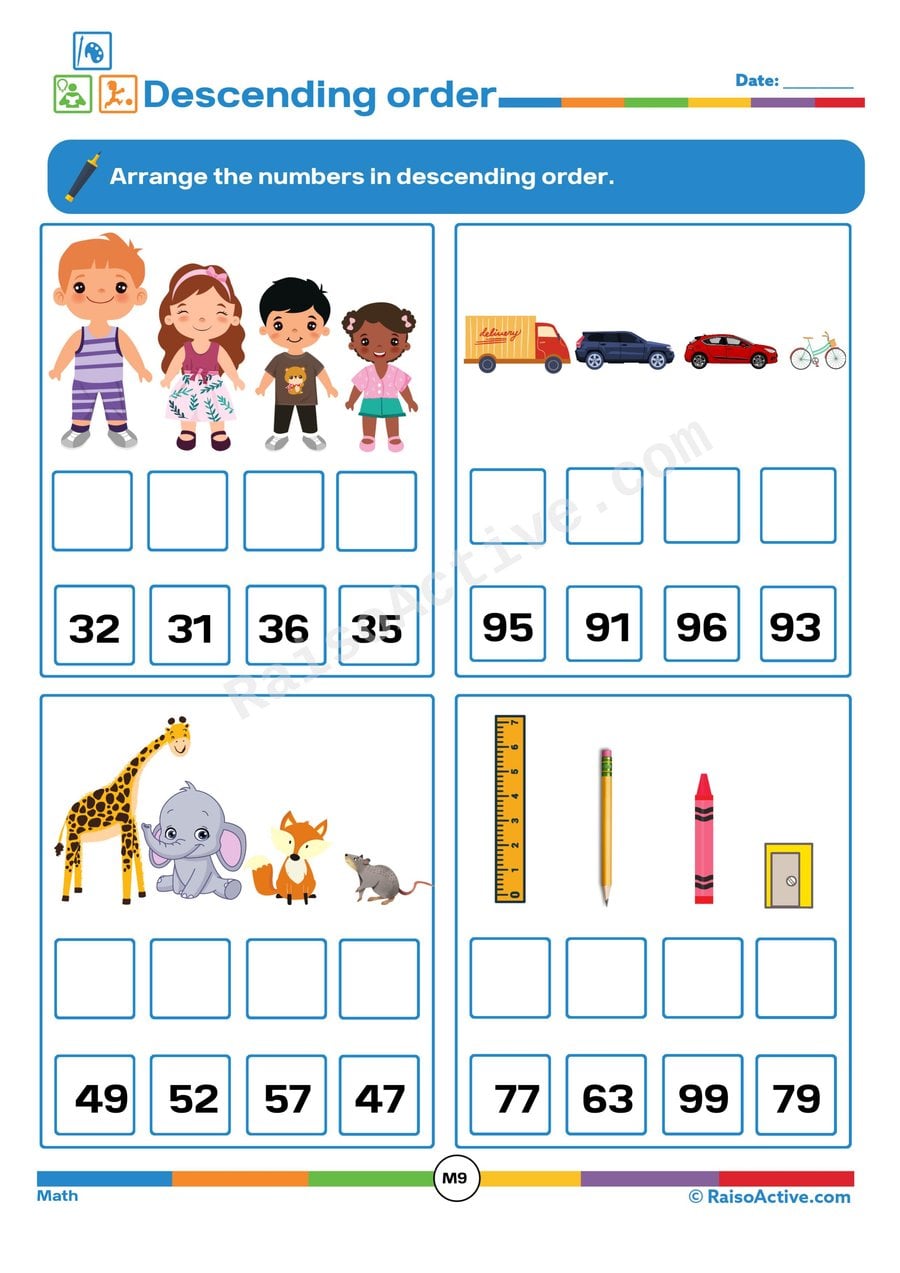
Descending Order Worksheet: Numbers 31-99
This worksheet extends number-sequencing skills for children ages 4-6 into the two-digit range of 31 to 99, asking them to arrange given numbers from largest to smallest. Working with larger numbers requires understanding that the tens digit generally determines size first, an important step toward place-value thinking. Practicing descending order, which is less intuitive than counting up, also strengthens flexible number sense.

Ascending Order Cut and Paste Worksheet for Preschoolers
This worksheet teaches children ages 4-6 to arrange numbered animal pictures from smallest to largest, reinforcing the concept of ascending order as a foundational number-sequencing skill. Physically cutting and repositioning each numbered piece, rather than simply writing numbers in order, makes the abstract idea of 'smallest to largest' into something children can manipulate and see. This hands-on approach also builds patience and careful visual comparison.

Dinosaur's Missing Numbers Worksheet: Cut and Paste Fun!
Children ages 4-6 practice number recognition and sequencing in a playful dinosaur theme, identifying which numbers are missing from a sequence and pasting them into the correct spots on a row of eggs. The dinosaur and egg imagery adds motivation and narrative context to what's otherwise a straightforward but important numeracy task — recognizing numerals and understanding their fixed order.

Before and After Numbers Worksheet: Counting Bananas!
Figuring out which number comes immediately before and after a given number strengthens children ages 4-5's understanding of number order and the counting sequence, a concept that's more abstract than simply counting objects one by one. Coloring a matching number of bananas for each answer adds a concrete, visual check, letting children confirm their number sense by physically representing the quantity. This worksheet bridges rote number-sequence memorization with real quantity understanding.
Guides for this topic
Number Formation Rhymes 0–9 and How to Fix Reversals
Original number formation rhymes for 0–9, the correct stroke order for each digit, why 3, 5 and 7 get reversed most often, and multisensory fixes that work.
Christmas and Winter Activities That Combine Fun and Learning: Creating Magical Educational Experiences
Discover Christmas and winter activities that combine festive fun with real learning. Crafts, counting, literacy, and printable worksheets for ages 2 to 8 — perfect for home and school.
Age-Appropriate Halloween Learning Activities: Balancing Spooks and Skills for Young Learners
Discover fun, age-appropriate Halloween learning activities for young children. Spooky crafts, counting games, literacy ideas, and printable worksheets for ages 2 to 8.
Reviews
Every worksheet for ages 4–6, no watermark
Members download the full library of 1,000+ worksheets and every activity pack without watermarks or daily limits. One year costs ₹1,000 in India or $20 elsewhere.
See membership plansOr download any worksheet free with a watermark (5 a day).