Letter G Tracing Worksheet: Learn to Write and Color!
Preschoolers ages 3-5 build handwriting readiness by tracing both the uppercase and lowercase letter G along dotted guide lines, developing the fine motor control and pencil grip needed for future writing. The distinct curved shape of the letter G, especially its small hook, offers valuable practice with controlled curved strokes. Coloring pictures that start with G connects the letter's shape to its beginning sound, reinforcing early phonics.
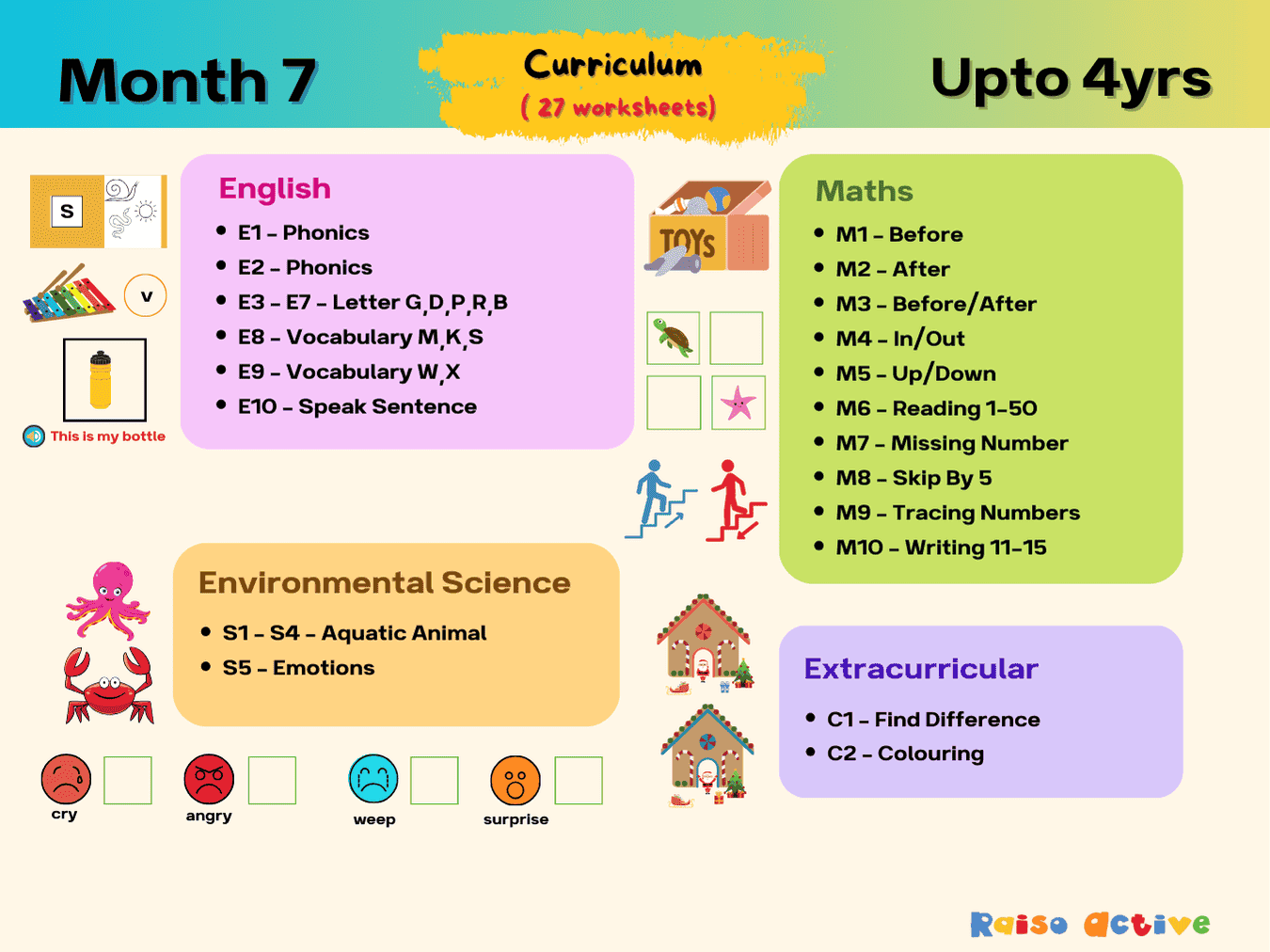
Part of the pack
Month 7: Comprehensive preschool learning | Ages Up to 4
This is page 6 of the pack. Ages 2-4 · PreschoolAges 2-4 · NurseryAges 2-4
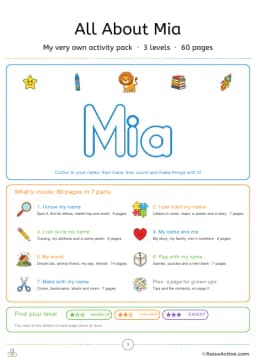
Made for your child
A whole activity pack made with their name
60 pages to spot, build, trace and write their own name, plus pages about their favourites, feelings and family. See a free preview with their name.
Make an All About Me packFree preview · free for members
Or start free: a name tracing sheet with their nameCurriculum
- Writing > Letter Tracing A-Z
How to use this worksheet
Start with the uppercase G, having your child trace the dotted shape first with a finger to feel the curve and hook before switching to a pencil. Move to the lowercase g, pointing out how its rounded body and descending tail differ from the capital letter. After tracing both forms, look at the pictures on the page together, naming each one and listening for the /g/ sound at the start. Finish by coloring the pictures that begin with the letter G, then have your child trace the letter G once more independently on the practice lines.
Materials needed
- Pencil
- Crayons
Extension activities
- 1Search the house or classroom for objects starting with G, like grapes, a glass, or a game.
- 2Practice writing the letter G with a finger in a tray of sand or shaving cream.
- 3Make a collage of pictures cut from magazines that all start with the letter G.
- 4Play a matching game pairing uppercase G with lowercase g cards.
- 5Draw a simple picture of something starting with G and label it together.

Written by
Hemsweta Jain · Teacher Cheena
MBA and Early Childhood Educator, teaching since 2014 · Founder of RaisoActive, Mumbai
Every RaisoActive worksheet is designed and checked by the founder before publishing.
Published · Last reviewed
More from Month 7: Comprehensive preschool learning | Ages Up to 4
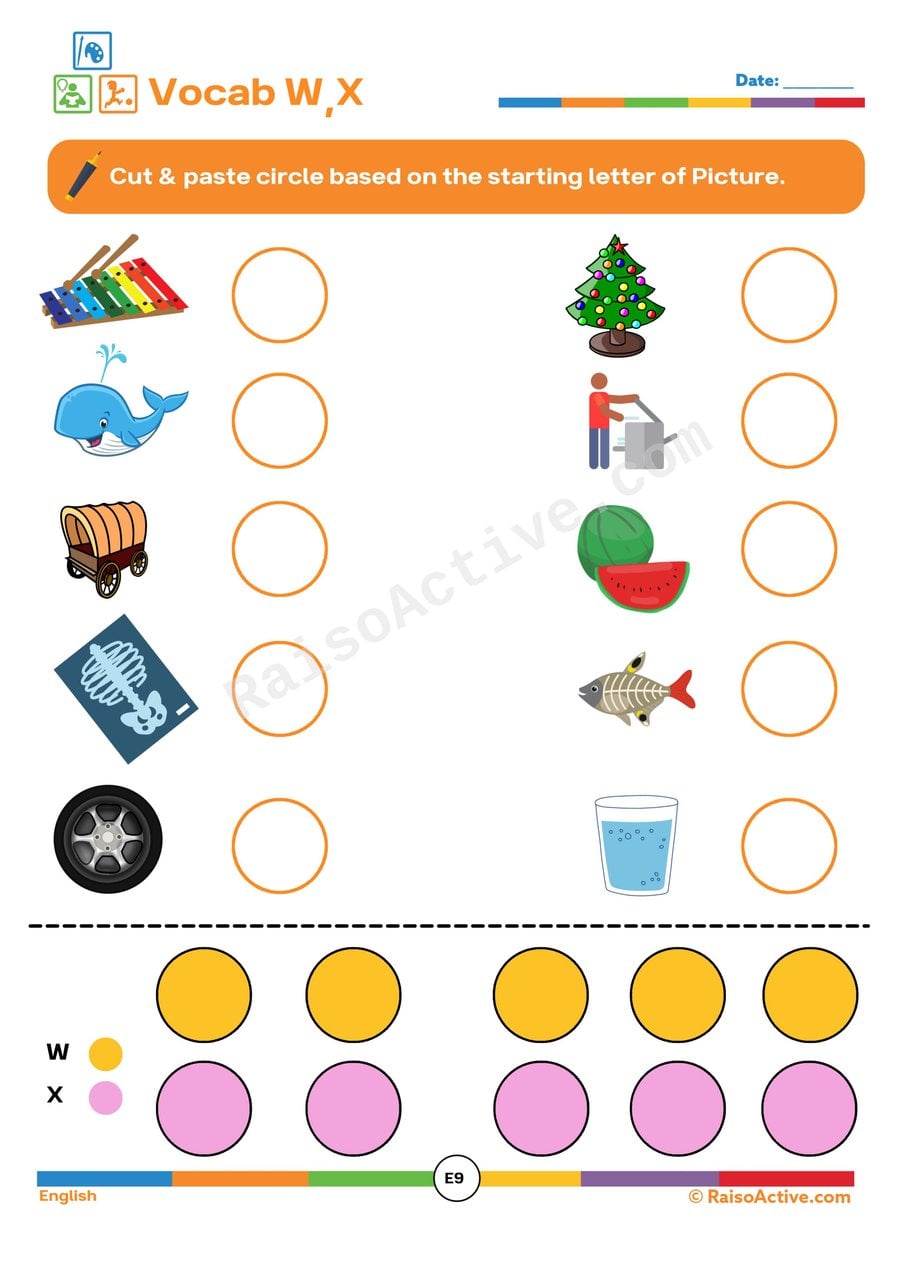
W and X Words Worksheet: Cut and Paste Fun!
Ages 4-5 · Pre-KAges 4-5 · ReceptionAges 4-5 · LKGAges 4-5
Identifying words that start with W and the much rarer letter X gives children practice distinguishing beginning sounds across a wider range of vocabulary, since X-words are less common and require extra attention to hear correctly. For ages four to five, the cut-and-paste format adds a deliberate pause before each answer, helping avoid the rushed guessing that can happen with a quicker matching task.
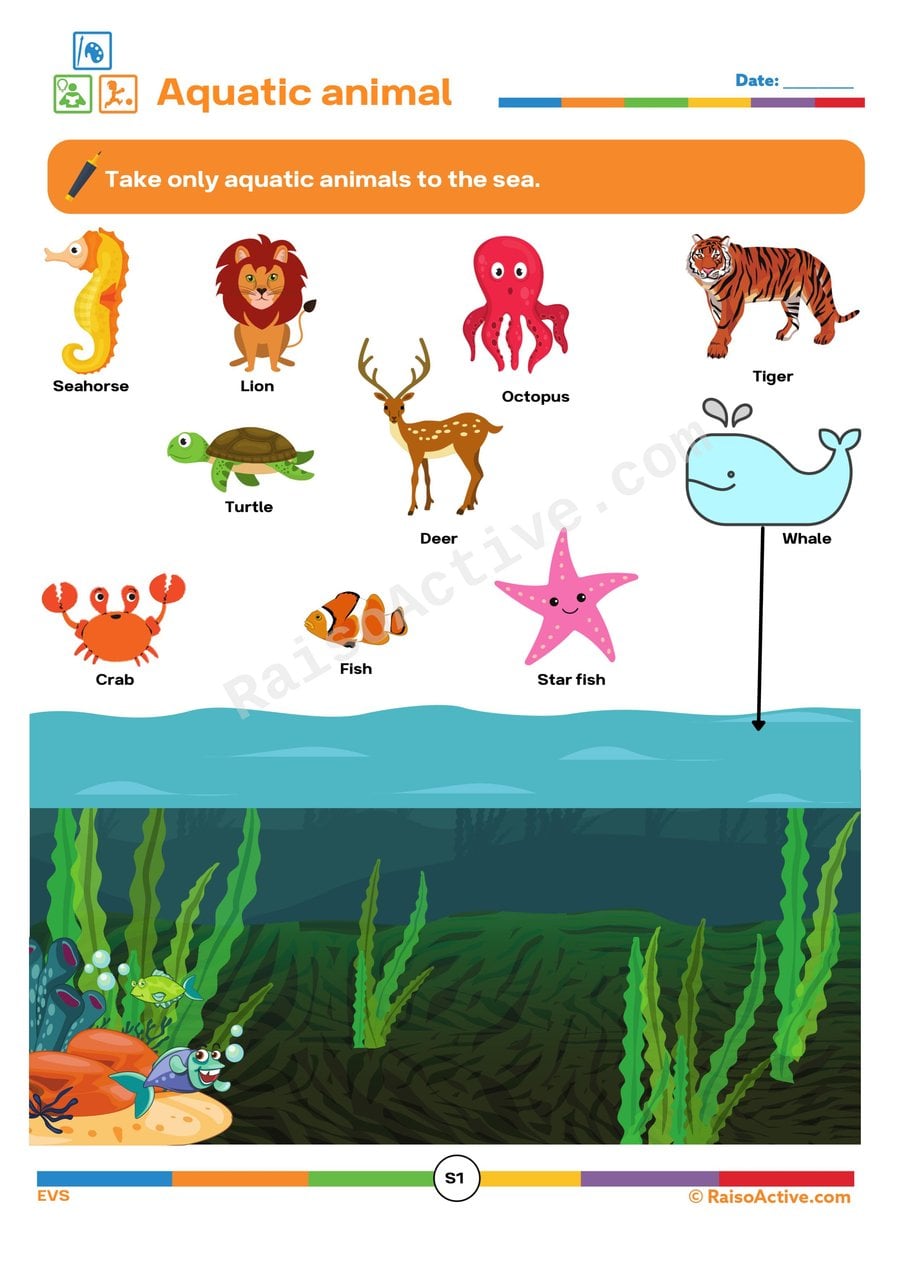
Aquatic Animals Worksheet: Sorting Sea Creatures!
Ages 3-5 · Preschool–Pre-KAges 3-5 · Nursery–ReceptionAges 3-5 · Nursery–LKGAges 3-5
Preschoolers ages 3-5 build early science classification skills by identifying which animals live in the sea and circling them from a mixed group of pictures. Sorting animals by habitat introduces the concept that living things are suited to specific environments, a foundational idea in life science. Following the clear instruction to circle only sea creatures also strengthens listening comprehension and visual discrimination.

Cut and Paste Initial Sounds Worksheet for Preschoolers
Ages 4-5 · Pre-KAges 4-5 · ReceptionAges 4-5 · LKGAges 4-5
This worksheet asks children to identify the very first sound of a picture's name and then physically select and paste the matching letter, combining phoneme isolation with a hands-on confirmation step that a simple matching line doesn't provide. For ages four to five, the cutting and choosing process slows the task down just enough to make sure the sound-letter connection is deliberate rather than a quick guess.

Octopus Parts Matching Worksheet for Preschoolers
Ages 3-5 · Preschool–Pre-KAges 3-5 · Nursery–ReceptionAges 3-5 · Nursery–LKGAges 3-5
Preschoolers ages 3-5 learn the specific body parts of an octopus — like its tentacles, head, and eyes — by drawing lines to match written labels to the correct part of the image. This vocabulary-building matching task develops early scientific observation skills, teaching children to look closely at an animal's features rather than seeing it as one blob shape. It also reinforces left-to-right label reading paired with visual scanning.
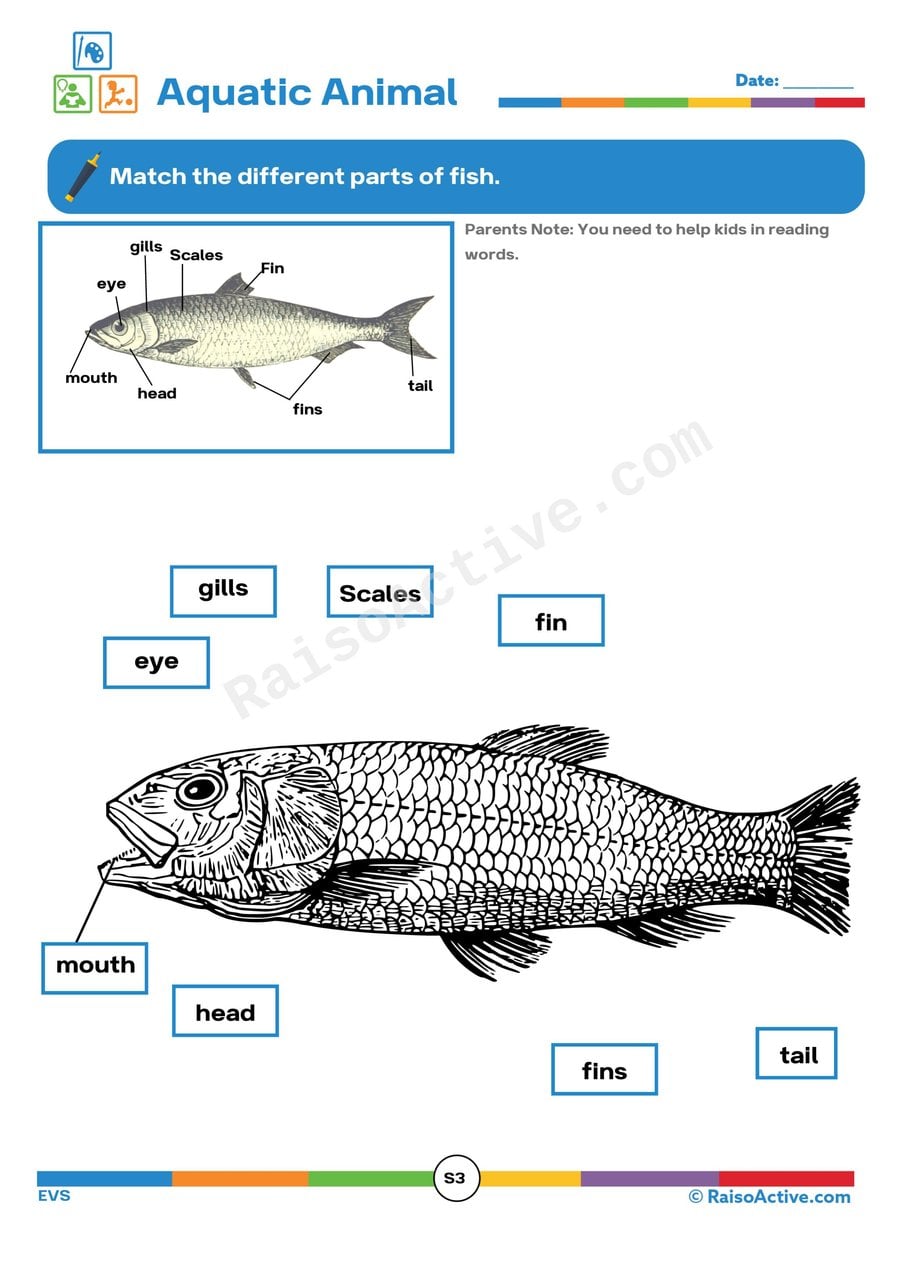
Fish Parts Matching Worksheet for Preschoolers
Ages 3-5 · Preschool–Pre-KAges 3-5 · Nursery–ReceptionAges 3-5 · Nursery–LKGAges 3-5
Preschoolers ages 3-5 learn the specific parts of a fish — like fins, gills, tail, and scales — by drawing lines connecting each written word to the correct location on a fish illustration. This vocabulary-focused matching task builds observational science skills, teaching children to see an animal's individual features rather than one general shape. It also reinforces early word recognition as children connect written labels to visual meaning.
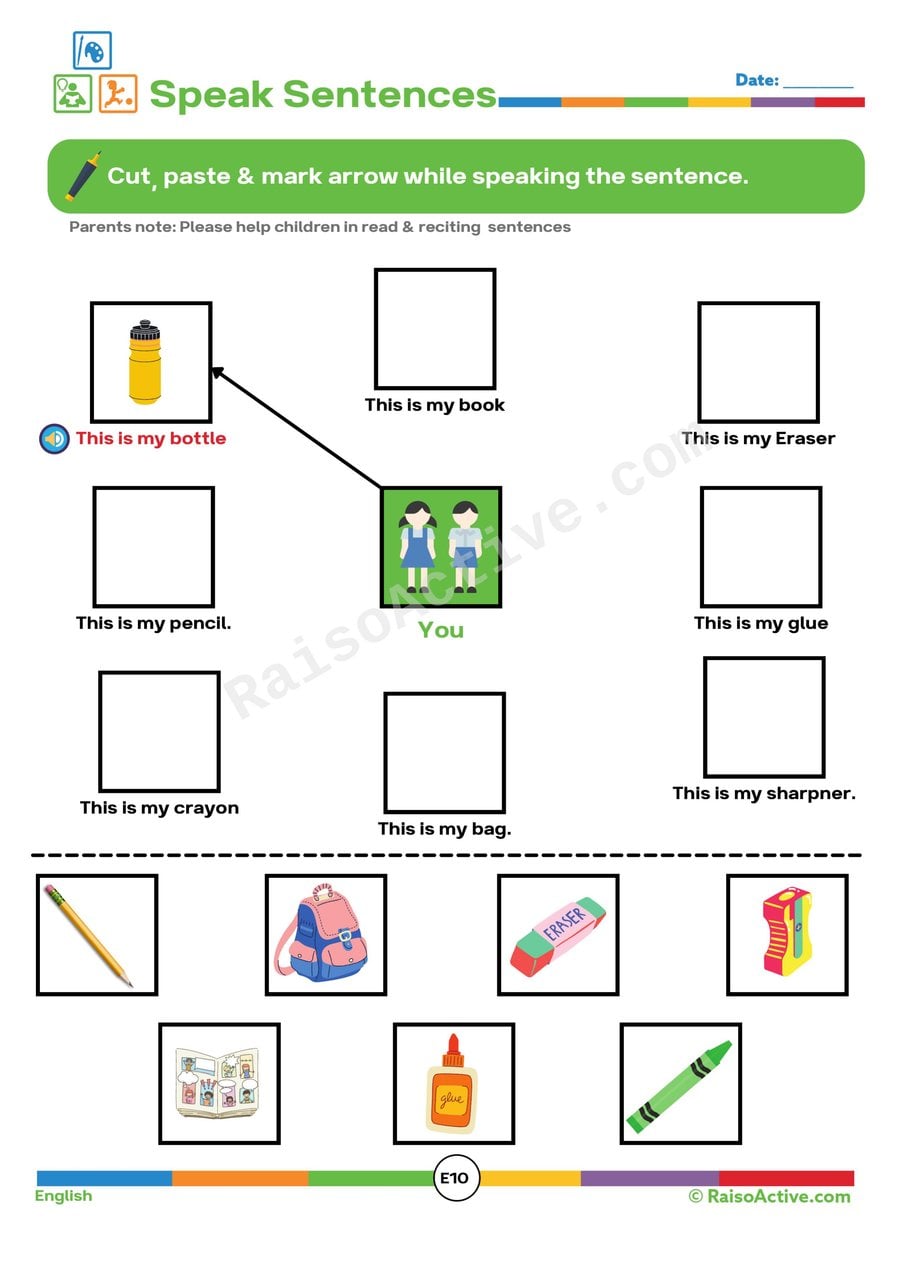
Speak Sentences Worksheet: Cut, Paste, and Match!
Ages 3-5 · Preschool–Pre-KAges 3-5 · Nursery–ReceptionAges 3-5 · Nursery–LKGAges 3-5
Children ages 3-5 practice matching spoken sentence meaning to pictures by cutting out images and pasting them next to the correct simple sentence, building early reading comprehension. This task requires connecting written or read-aloud words to real-world meaning, a critical step before children can read independently for understanding. The cutting and pasting also continues building the fine motor precision needed for handwriting and other classroom tasks.
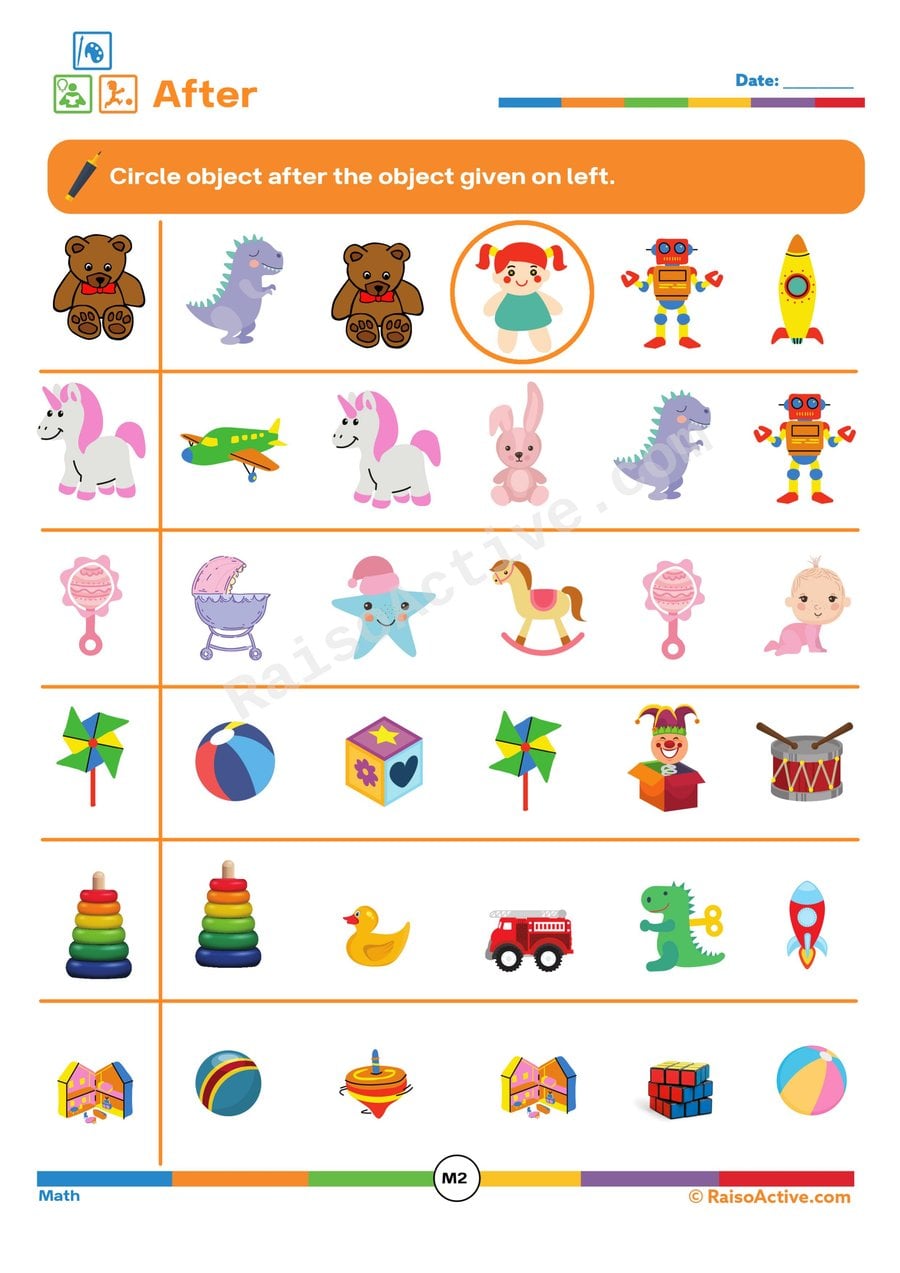
Object Sequencing Worksheet: What Comes After?
Ages 3-5 · Preschool–Pre-KAges 3-5 · Nursery–ReceptionAges 3-5 · Nursery–LKGAges 3-5
Preschoolers ages 3-5 build sequencing and pattern-recognition skills by identifying what object logically comes next after a given item. Predicting what comes next requires observing a pattern or relationship and applying that logic forward, an early form of the reasoning used in later math and science. Circling the correct answer among several options also sharpens careful visual comparison and decision-making.
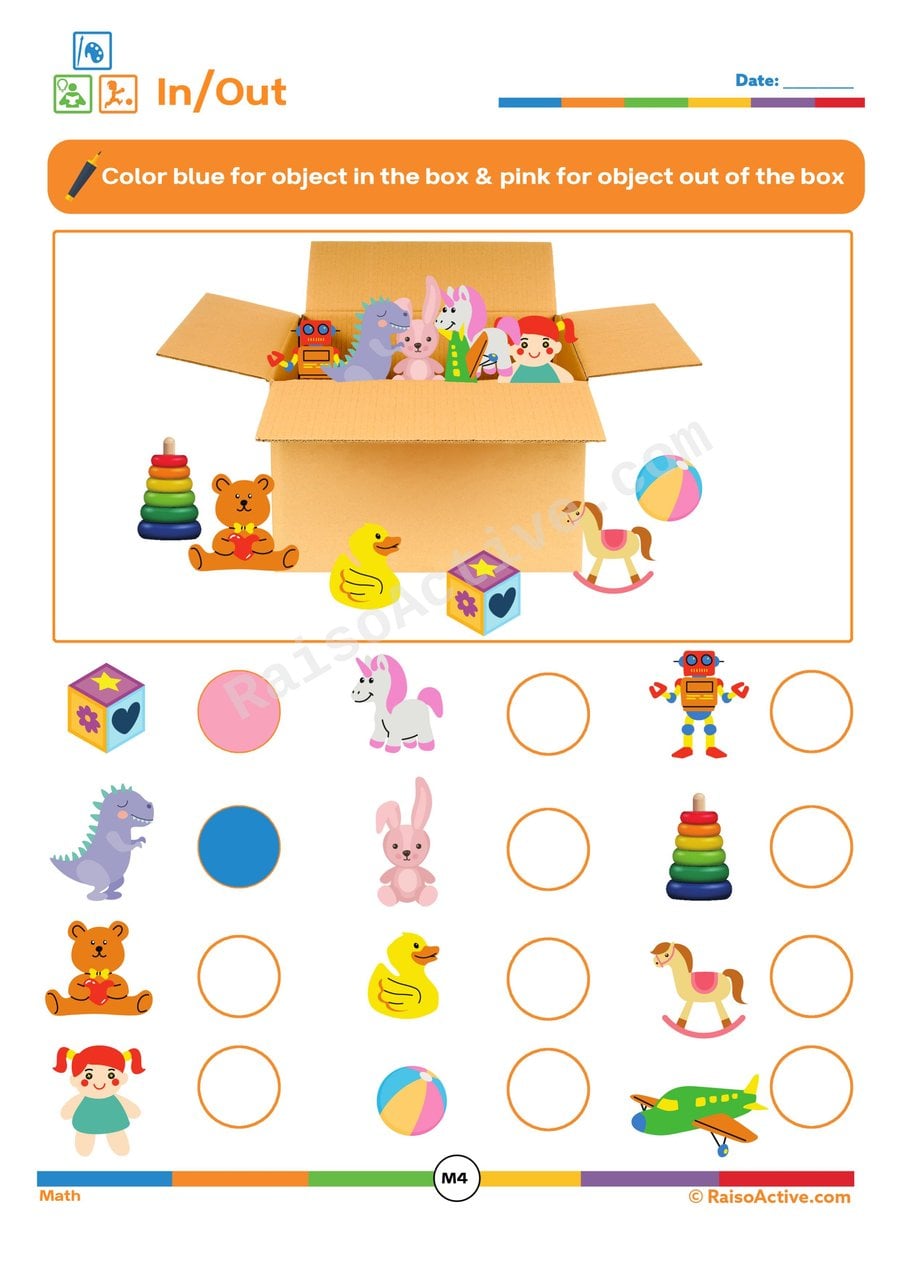
In/Out Sorting Worksheet: Color the Objects!
Ages 3-5 · Preschool–Pre-KAges 3-5 · Nursery–ReceptionAges 3-5 · Nursery–LKGAges 3-5
Sorting objects as 'in' or 'out' of a box builds on the positional vocabulary preschoolers need before they can follow multi-step directions or understand simple math concepts like sets and groups. Using color as the sorting tool here, blue for inside and pink for outside, also strengthens the ability to hold two rules in mind simultaneously and apply the correct one to each object in turn.
Related worksheets

Trace the Letter T Worksheet: Practice Writing & Coloring Fun!
Ages 3-5 · Preschool–Pre-KAges 3-5 · Nursery–ReceptionAges 3-5 · Nursery–LKGAges 3-5
This worksheet builds recognition and formation of the letter T through guided tracing and by identifying pictures of words that start with T, like 'tiger' or 'turtle.' For three- to five-year-olds, the letter T's simple cross-shaped stroke — one straight line down, one straight line across — makes it a good letter for practicing controlled, confident pencil strokes.

Learn the Letter 'n' Worksheet: Tracing, Matching, and Coloring Fun!
Ages 3-5 · Preschool–Pre-KAges 3-5 · Nursery–ReceptionAges 3-5 · Nursery–LKGAges 3-5
This worksheet builds letter 'n' recognition for 3-5 year olds through tracing, a highlighting search, matching to pictures, and coloring — four connected tasks that ask your child to hold onto the same letter across different formats and follow multi-step instructions in sequence. The letter 'n' is frequently confused with 'm' since both involve humps, so the repeated exposure here helps children start telling the two apart by sound and shape.

Letter 'i' Tracing and Matching Worksheet for Preschoolers
Ages 3-5 · Preschool–Pre-KAges 3-5 · Nursery–ReceptionAges 3-5 · Nursery–LKGAges 3-5
This worksheet builds recognition of the letter 'i' for 3-5 year olds through tracing, picture matching, and a highlighting activity, giving repeated exposure to both the letter's shape and its sound in a single sitting. Matching objects that start with 'i' alongside the tracing practice connects the visual letter shape to real vocabulary, reinforcing that letters aren't abstract marks but stand for actual sounds your child hears in words they already know.
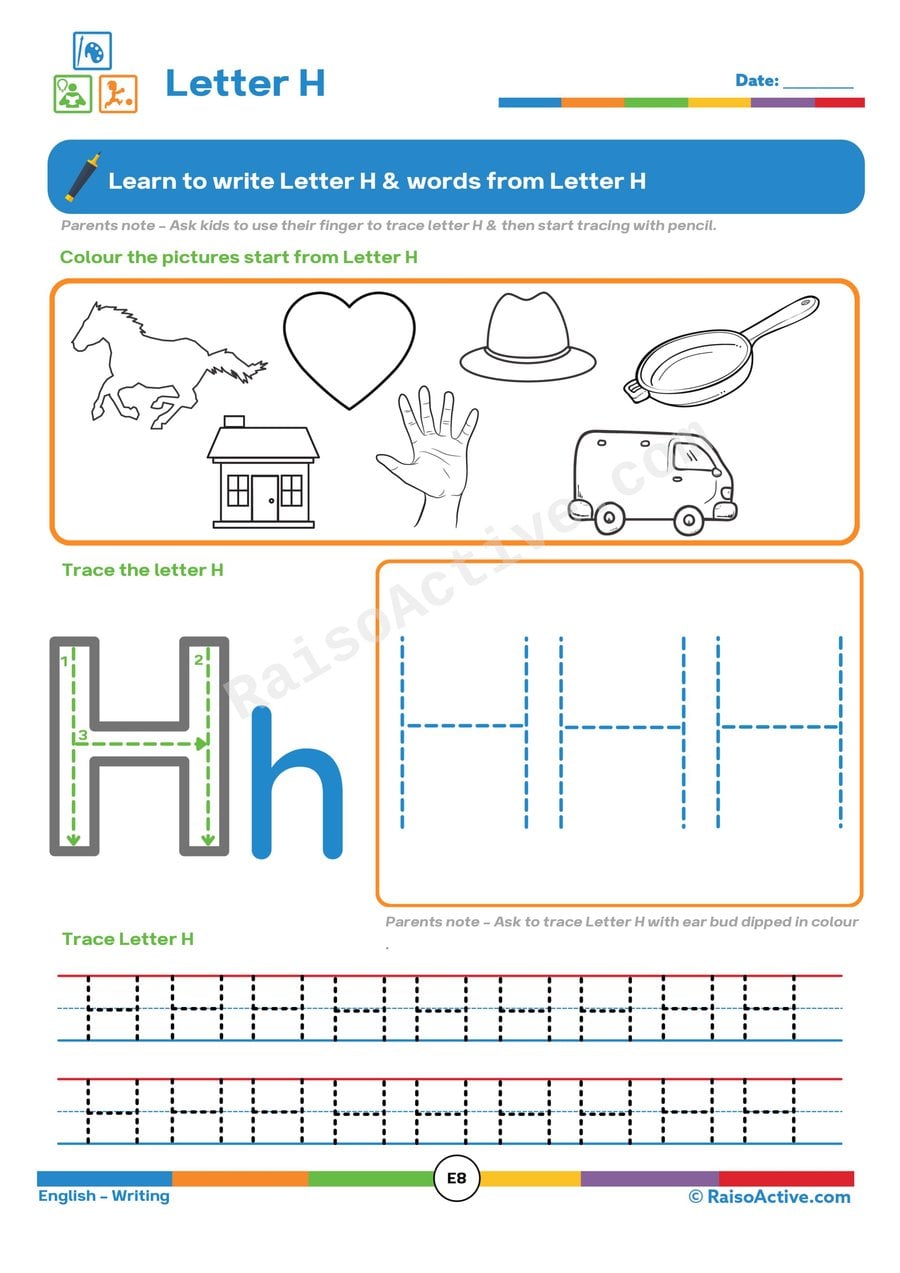
Trace the Letter H Worksheet for Preschoolers
Ages 3-5 · Preschool–Pre-KAges 3-5 · Nursery–ReceptionAges 3-5 · Nursery–LKGAges 3-5
Tracing the capital letter H gives children ages 3-5 focused practice in pencil control, directional tracking (top to bottom, left to right), and the specific line-and-line motion that forms H's two verticals and one horizontal bar. Pairing the tracing with pictures that start with H also strengthens letter-sound association, an essential early step toward decoding words later on.

Letter W Worksheet: Tracing, Coloring, and Word Recognition!
Ages 3-5 · Preschool–Pre-KAges 3-5 · Nursery–ReceptionAges 3-5 · Nursery–LKGAges 3-5
This worksheet builds recognition and formation of the letter W through tracing, writing, and identifying words that begin with it, like 'watermelon' or 'whale.' For three- to five-year-olds, practicing a letter with a more complex zigzag shape than earlier letters like O or L also develops the finer pencil control needed for more advanced handwriting.
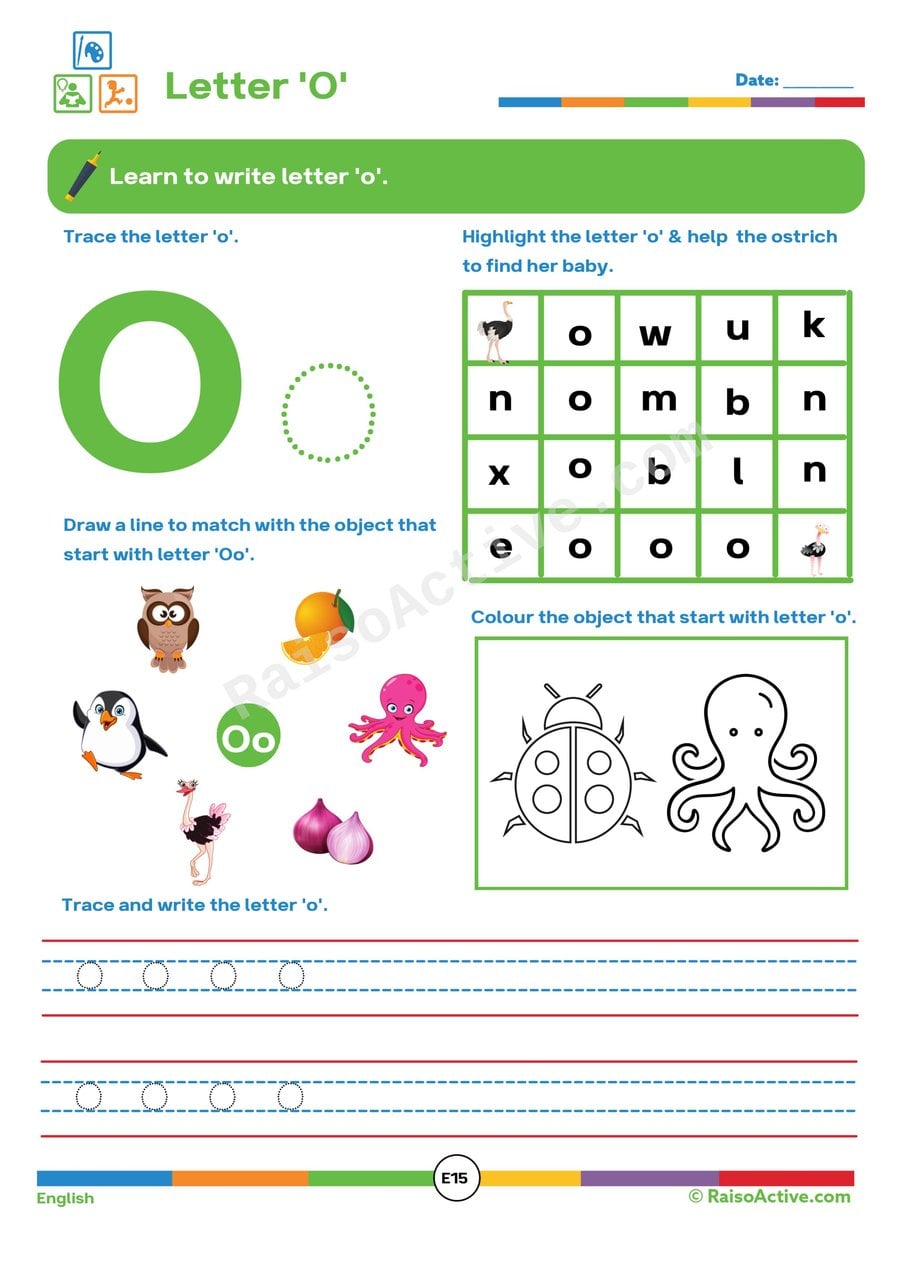
Letter 'O' Worksheet: Trace, Match, and Color!
Ages 3-5 · Preschool–Pre-KAges 3-5 · Nursery–ReceptionAges 3-5 · Nursery–LKGAges 3-5
Tracing, matching, and coloring the letter 'O' gives children ages 3-5 practice with one of the simplest letter shapes to form, making it a great confidence-building letter alongside its sound recognition value for words like 'octopus' and 'ostrich.' Matching pictures that start with 'O' to the letter reinforces the sound-symbol connection through familiar, often fun animal vocabulary. Highlighting the letter within a busy grid adds a visual search challenge that builds focus and letter discrimination beyond simple tracing.

Learn the Letter U! Tracing, Matching, and Coloring Worksheet
Ages 3-5 · Preschool–Pre-KAges 3-5 · Nursery–ReceptionAges 3-5 · Nursery–LKGAges 3-5
Children ages 3-5 practice forming the letter U in both its capital and lowercase shapes, while also learning to spot U words among other pictures, building both handwriting control and letter-sound recognition together. The matching component adds a layer of visual scanning practice, since children must compare each picture's beginning sound against the target letter.

Learn the Letter 'V': Tracing, Matching, and Coloring Worksheet
Ages 3-5 · Preschool–Pre-KAges 3-5 · Nursery–ReceptionAges 3-5 · Nursery–LKGAges 3-5
Tracing, matching, and coloring the letter 'V' gives children ages 3-5 focused repetition on a letter formed entirely from two diagonal strokes, a different motor pattern than the curves and verticals used in many other letters. Matching pictures like a violin or a van to the letter builds the sound-symbol connection for the /v/ sound, which can be tricky to distinguish from /f/ or /b/ for young learners. Highlighting the lowercase 'v' within a letter grid to help a character find an object adds a game-like search element that keeps attention on the task.
Guides for this topic

Best Worksheets for 3-Year-Olds: What Works and What to Avoid
What works on worksheets for 3-year-olds: short sessions, crayons, tracing lines, matching, cutting, a free weekly plan, and signs one is too advanced.
Documenting Learning Without Drowning in Data: A Practical Guide for Parents and Teachers
Learn practical ways to document your child's learning without overwhelm. Simple portfolios, observation tips, and printable trackers for ages 1-8.
Fostering Creativity in Structured Learning: The Perfect Balance for Young Minds
Learn how to blend creativity with structured learning for children ages 1-8. Practical strategies, activities, and printable worksheets for parents and teachers.
Reviews
Every worksheet for ages 3–5, no watermark
Members download the full library of 1,000+ worksheets and every activity pack without watermarks or daily limits. One year costs ₹999 in India or $20 elsewhere.
See membership plansOr download any worksheet free with a watermark (5 a day).