Inside or Outside Sorting Worksheet for Preschoolers
This worksheet teaches children ages 3-5 to apply the spatial concepts of 'inside' and 'outside' by sorting pictures of objects into the location where they typically belong. Deciding where an object usually belongs requires children to draw on their own real-world experience and apply it to a new sorting task, strengthening both spatial vocabulary and everyday reasoning. This kind of applied sorting is more demanding than simply naming inside or outside items when shown a single picture.
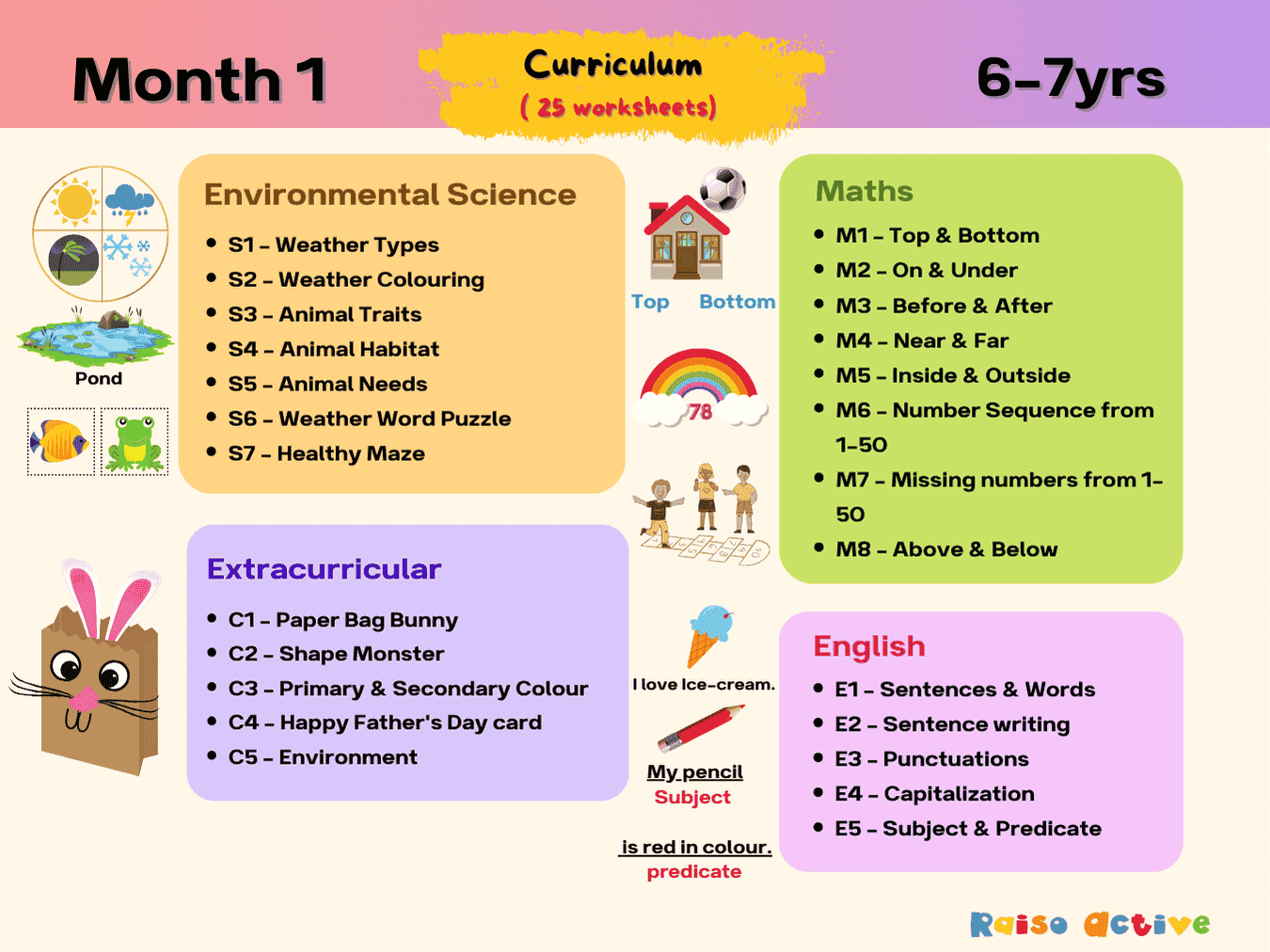
Part of the pack
Month 1: Learning & Development | Ages 6-7
This is page 13 of the pack. Ages 6-7 · Grade 1Ages 6-7 · Year 2Ages 6-7 · Class 1Ages 6-7
Made for your child
Counting to 10, made for your child
A maths pack with your child's name in it: pictures that explain, practice at three levels, puzzles and story sums about them. Print a new set whenever they finish.
Make a maths packFree preview · free for members
Curriculum
- Spatial Sense > Spatial Concepts
How to use this worksheet
Look at the two category boxes — 'Inside' and 'Outside' — together and talk about a few examples of things typically found in each place. Have your child cut out the pictures from the bottom of the page using child-safe scissors. For each picture, ask 'would you usually find this inside a house or outside?' before gluing it into the matching box. Once every picture is sorted, review both categories together and ask your child to name one more example for each.
Materials needed
- Scissors
- Glue
- Pencil
Extension activities
- 1Go on a scavenger hunt around your house and yard, identifying objects that are inside or outside.
- 2Draw pictures of things that are inside and outside.
- 3Play a quick game naming an object and having your child shout 'inside!' or 'outside!'
- 4Sort real toys from around the house into inside and outside piles.
- 5Take a walk and point out things that belong outside versus things that belong inside.

Written by
Hemsweta Jain · Teacher Cheena
MBA and Early Childhood Educator, teaching since 2014 · Founder of RaisoActive, Mumbai
Every RaisoActive worksheet is designed and checked by the founder before publishing.
Published · Last reviewed
More from Month 1: Learning & Development | Ages 6-7
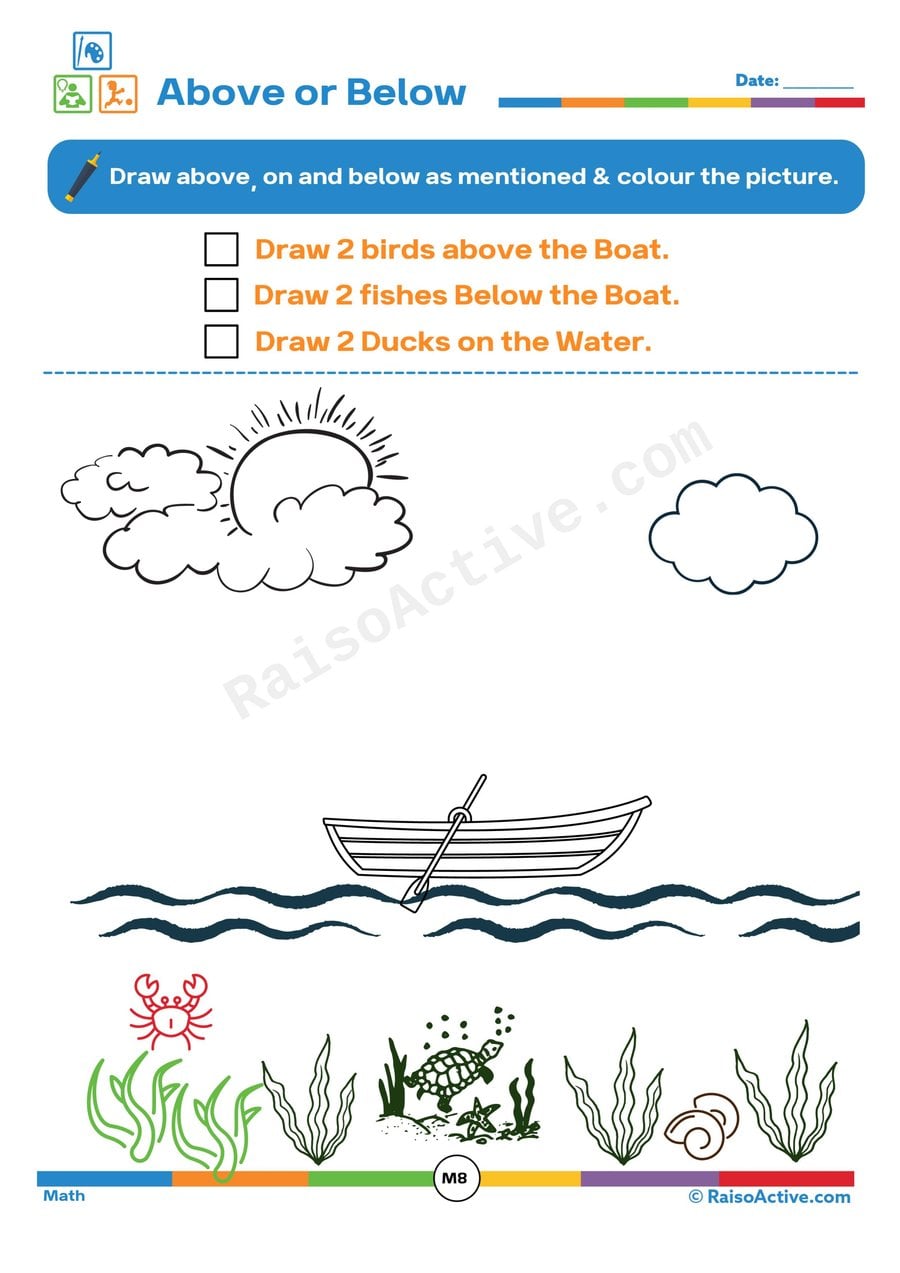
Above or Below Worksheet: Draw and Color!
Ages 3-5 · Preschool–Pre-KAges 3-5 · Nursery–ReceptionAges 3-5 · Nursery–LKGAges 3-5
This worksheet asks children ages 3-5 to apply the positional concepts of 'above,' 'below,' and 'on' by actively drawing new objects into a scene rather than simply pointing or circling. Drawing an item in a specific spatial position, like a bird above a boat, requires children to translate a verbal instruction into an accurate visual placement, which is a more demanding test of spatial understanding than passive matching. Coloring the finished scene afterward adds a satisfying creative finish to the activity.

Capitalization Worksheet: Practice Writing Sentences Correctly!
Ages 4-6 · Pre-K–KindergartenAges 4-6 · Reception–Year 1Ages 4-6 · LKG–UKGAges 4-6
This worksheet teaches children ages 4-6 the rule that sentences begin with a capital letter, along with an introduction to capitalizing proper nouns like names and places. Rewriting sentences correctly, rather than just circling errors, gives children active practice applying the capitalization rule themselves, which builds the habit more effectively than passive correction exercises.

Paper Bag Bunny Craft Worksheet for Preschoolers
Ages 3-5 · Preschool–Pre-KAges 3-5 · Nursery–ReceptionAges 3-5 · Nursery–LKGAges 3-5
This paper bag craft has children ages 3-5 follow a multi-step sequence of instructions — attaching a pom pom nose, spoon ears, googly eyes, and whisker details — while practicing the fine motor control needed to place and glue small materials precisely. Because the craft uses several different textures and materials in one project, children also get sensory-rich practice beyond typical paper-and-crayon activities. Successfully completing each step in order builds confidence in following sequential, multi-part directions.

Before and After Numbers Worksheet for Preschoolers
Ages 4-6 · Pre-K–KindergartenAges 4-6 · Reception–Year 1Ages 4-6 · LKG–UKGAges 4-6
This number sequencing worksheet asks children ages 4-6 to identify the numbers that come immediately before and after a given number, strengthening their mental number line and reinforcing the concept that numbers exist in a fixed, ordered sequence. This before-and-after reasoning is more demanding than simple counting because it requires children to move both forward and backward from a starting point. Building this flexible number sense supports later addition and subtraction, which both rely on moving confidently along a mental number line.

Weather Color by Number Worksheet for Preschoolers
Ages 3-5 · Preschool–Pre-KAges 3-5 · Nursery–ReceptionAges 3-5 · Nursery–LKGAges 3-5
This color-by-number activity has children ages 3-5 practice matching numerals to a color key while completing a weather-themed picture, combining number recognition with color recognition and the fine motor control needed for careful, contained coloring. Because each numbered section must be colored correctly for the picture to look right, children get immediate visual feedback on whether their number identification was accurate. The weather theme also gives a natural opportunity to talk about the picture's subject once it's revealed.

Sheep's Barnyard Adventure: A Fun Counting and Movement Worksheet
Ages 4-6 · Pre-K–KindergartenAges 4-6 · Reception–Year 1Ages 4-6 · LKG–UKGAges 4-6
This board-game-style worksheet helps children ages 4-6 practice counting and number recognition by rolling a die and moving a sheep piece along a numbered path, following simple instructions at each stop. Turning counting practice into a game with chance and movement keeps children engaged far longer than a static worksheet, while still reinforcing accurate counting and number sequence recognition along the path.
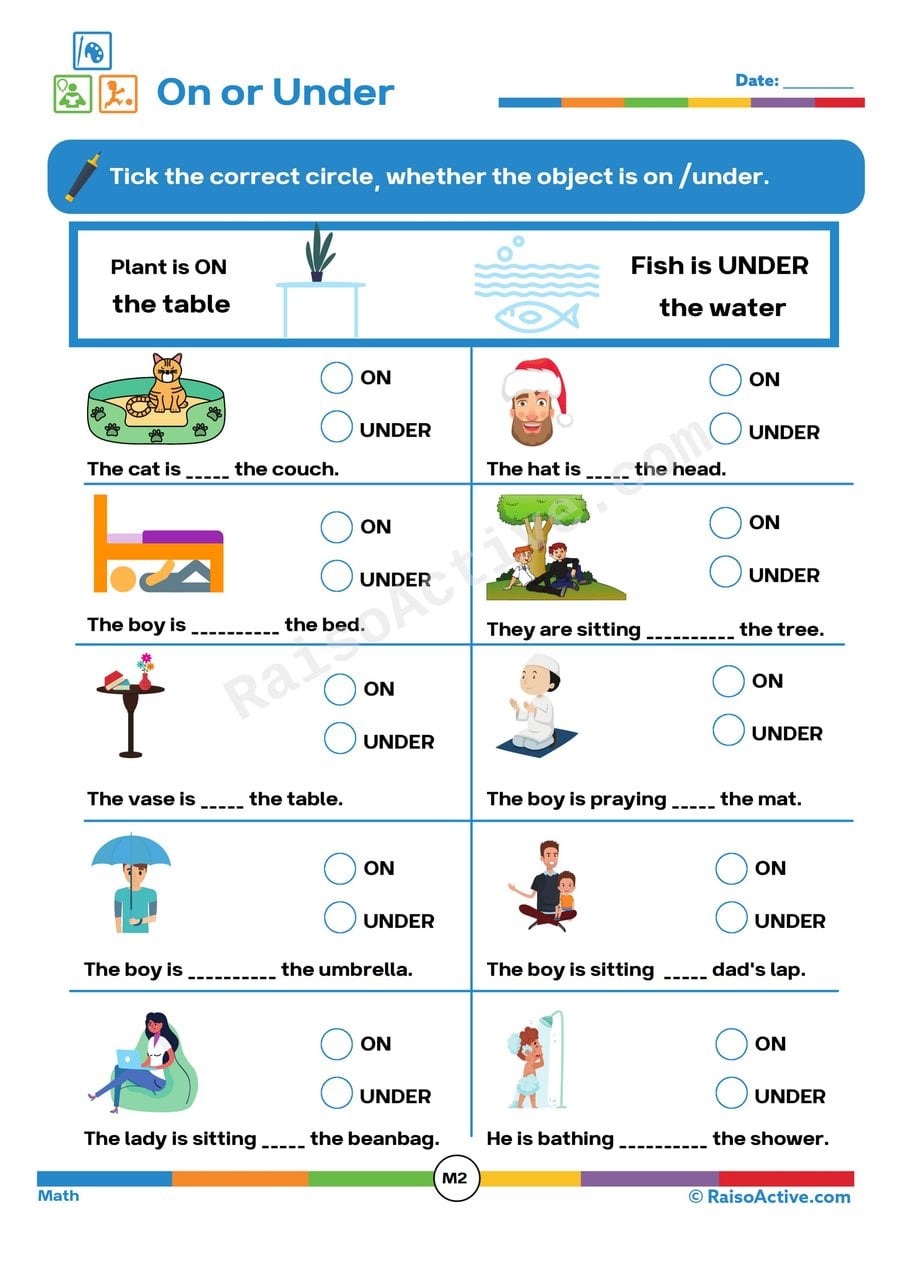
On or Under Worksheet: Where is the Object?
Ages 3-5 · Preschool–Pre-KAges 3-5 · Nursery–ReceptionAges 3-5 · Nursery–LKGAges 3-5
Reading a short sentence describing an object's location and then ticking the picture that matches teaches children ages 3-5 to connect spoken or written prepositions, 'on' and 'under,' to a visual representation, strengthening both listening comprehension and spatial vocabulary. This worksheet requires children to hold a sentence in mind and compare it against a picture, which is a slightly more advanced skill than simply naming a position they can already see. Understanding prepositions like these supports later reading comprehension, since so many simple stories depend on describing where things are.

Parent's Guide: Fun Activities for Early Readers and Number Learners!
Ages 3-5 · Preschool–Pre-KAges 3-5 · Nursery–ReceptionAges 3-5 · Nursery–LKGAges 3-5
This parent guide brings together a set of activity ideas that build two foundational skills at once for children ages 3-5: early reading, through short sentences and sight words, and early number sense, through counting, adding, and subtracting within a comfortable range. Rather than a single worksheet task, it gives caregivers a roadmap of small, achievable practice moments that fit naturally into daily routines. Following a guide like this helps parents pace learning appropriately instead of jumping into material that's too advanced too soon.
Related worksheets

Front or Behind Sorting Worksheet for Preschoolers
Ages 3-5 · Preschool–Pre-KAges 3-5 · Nursery–ReceptionAges 3-5 · Nursery–LKGAges 3-5
Positional words like 'front' and 'behind' describe relationships between objects rather than the objects themselves, which makes them a genuinely trickier concept for a 3-5 year old than sorting by color or size. Deciding where each picture belongs and sorting it into the right box builds early spatial reasoning that later supports following multi-step directions and understanding maps or diagrams.
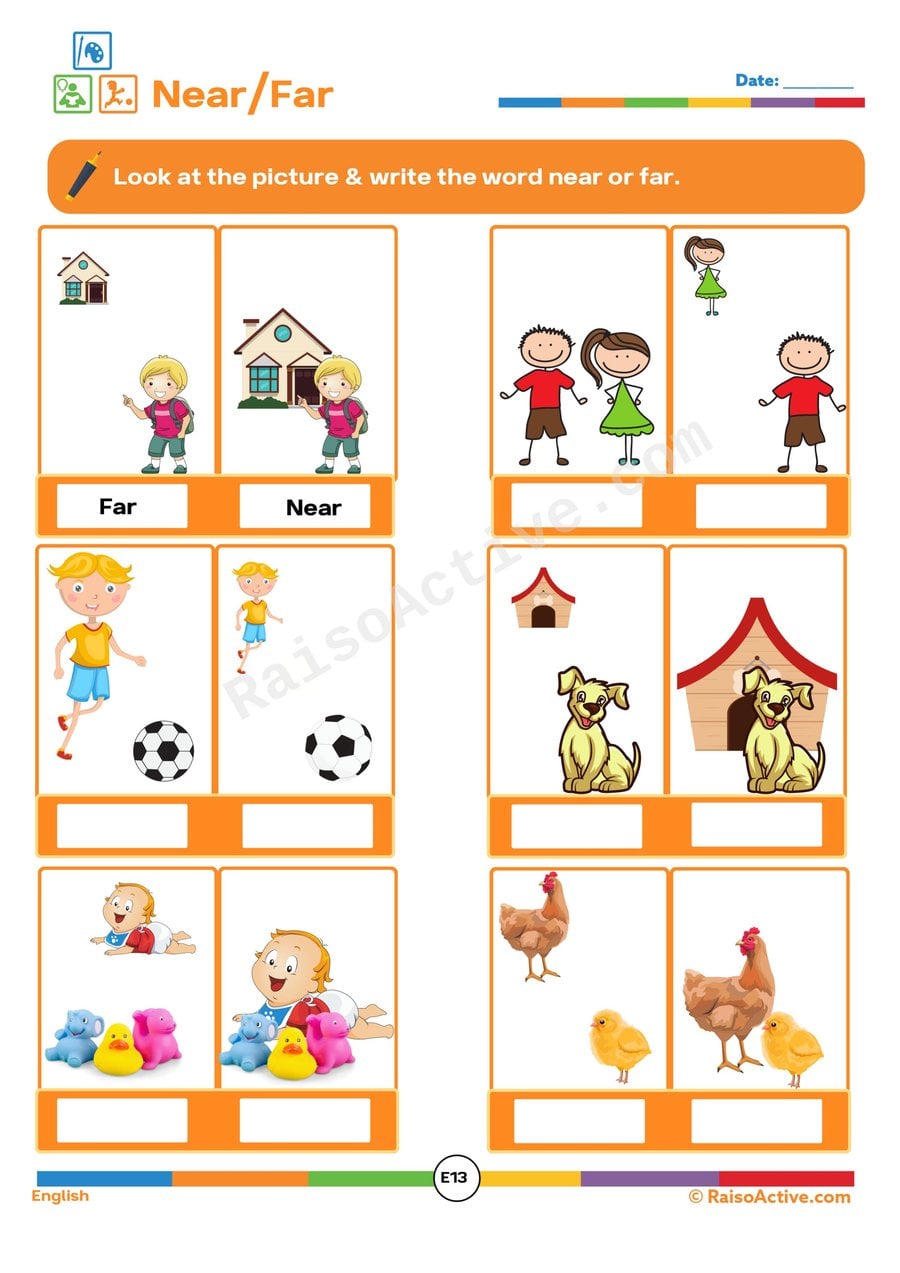
Near and Far Worksheet for Preschoolers
Ages 3-5 · Preschool–Pre-KAges 3-5 · Nursery–ReceptionAges 3-5 · Nursery–LKGAges 3-5
Understanding 'near' and 'far' introduces children ages 3-5 to relative distance, a spatial concept that supports later skills like reading maps, estimating measurement, and following directional instructions. This worksheet asks children to look at pictures and judge whether an object or person is positioned close by or at a distance, sharpening visual observation alongside vocabulary development. Because near and far are relative terms rather than fixed categories, this practice also introduces the idea that some concepts depend on comparison rather than having one single correct answer.

Front and Behind Worksheet: Identifying Positional Words
Ages 3-5 · Preschool–Pre-KAges 3-5 · Nursery–ReceptionAges 3-5 · Nursery–LKGAges 3-5
Understanding 'front' and 'behind' gives children ages 3-5 the spatial vocabulary they need to follow instructions and describe the world around them accurately, an important stepping stone toward later concepts like ordinal position and basic geometry. This worksheet asks them to apply the words to specific pictures rather than just hear them in passing, which cements the connection between the word and the physical relationship it describes. Positional language like this also supports following multi-step directions at home and in the classroom.

Top and Bottom Fun: Observe and Tick the Correct Position!
Ages 3-5 · Preschool–Pre-KAges 3-5 · Nursery–ReceptionAges 3-5 · Nursery–LKGAges 3-5
Children ages 3-5 build spatial reasoning and positional vocabulary as they observe pictures and decide whether an object is positioned at the top or the bottom. Understanding positional words like 'top' and 'bottom' supports children's ability to follow multi-step directions and later helps with concepts like graphing and map reading.

Over and Under Worksheet: Identifying Object Positions
Ages 3-5 · Preschool–Pre-KAges 3-5 · Nursery–ReceptionAges 3-5 · Nursery–LKGAges 3-5
This worksheet helps children ages 3-5 learn and identify the spatial concepts of 'over' and 'under' by examining pictures and deciding which positional word correctly describes what they see. Practicing this distinction builds the vocabulary foundation children need to follow multi-step directions involving location.

Above and Below Worksheet: Identifying Object Positions
Ages 3-5 · Preschool–Pre-KAges 3-5 · Nursery–ReceptionAges 3-5 · Nursery–LKGAges 3-5
Positional words like 'above' and 'below' give three-to-five-year-olds a vocabulary for describing where things are in space, a skill that underpins everything from map reading to following multi-step instructions later on. This activity page asks children to look closely at a scene and decide whether each object sits above or below a reference point, sharpening visual scanning and the ability to hold a spatial rule in mind while checking multiple items against it.

Draw & Color: Under, Over, and Above the Water Worksheet
Ages 3-5 · Preschool–Pre-KAges 3-5 · Nursery–ReceptionAges 3-5 · Nursery–LKGAges 3-5
This open-ended drawing worksheet asks children ages 3-5 to place creatures and objects under, above, and at water level, building early understanding of positional and spatial vocabulary within a real-world context. Drawing something for each of three distinct zones also encourages children to organize their ideas into categories before putting pencil to paper.

Open and Close Worksheet: Circle the Open and Closed Objects!
Ages 3-5 · Preschool–Pre-KAges 3-5 · Nursery–ReceptionAges 3-5 · Nursery–LKGAges 3-5
Children ages 3-5 build early categorization skills by identifying whether pictured objects, like a door, a box, or a jar, are open or closed. This concept requires observing a physical state and applying a descriptive word correctly, an important early step in building descriptive vocabulary. Recognizing open versus closed also has practical safety value, connecting worksheet learning to real-world awareness.
Guides for this topic

Age-Appropriate Problem-Solving Activities: Building Critical Thinkers from the Ground Up
Discover fun, age-appropriate problem-solving activities for children ages 1-8. Build critical thinking, logic, and reasoning skills through play-based learning.
Critical Thinking Activities That Actually Work for Young Children: Building Tomorrow's Thinkers Today
Discover proven critical thinking activities for young children. Age-wise logic games, questioning techniques, and hands-on ideas to build thinking skills at home.

Preparing Your Child for a Rapidly Changing World: Essential Skills for Future Success
Discover the essential 21st century skills your child needs for future success. Practical tips on creativity, critical thinking, digital literacy & emotional intelligence for ages 1-8.
Reviews
Every worksheet for ages 3–5, no watermark
Members download the full library of 1,000+ worksheets and every activity pack without watermarks or daily limits. One year costs ₹999 in India or $20 elsewhere.
See membership plansOr download any worksheet free with a watermark (5 a day).